Cooperative control and geometric amplification in dissipative quantum systems
Pith reviewed 2026-06-30 06:15 UTC · model grok-4.3
The pith
Dissipation becomes a control resource for qubits when short coherent pulses reorient the Bloch vector onto fast relaxation directions.
A machine-rendered reading of the paper's core claim, the machinery that carries it, and where it could break.
Core claim
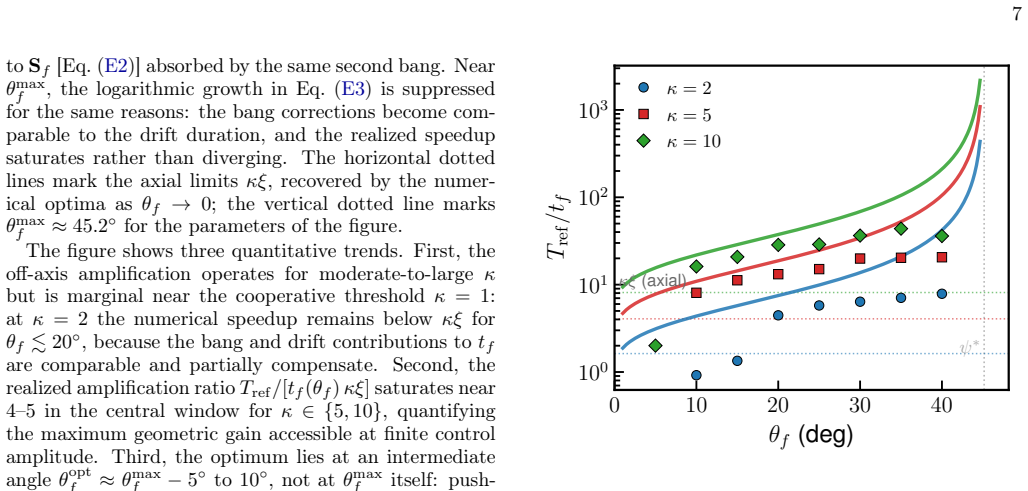
In a qubit subject to non-unital anisotropic Bloch relaxation, a short coherent pulse reorients the Bloch vector onto a fast dissipative eigendirection; the subsequent free relaxation carries the state near the target with at most one final corrective pulse. For axial targets this produces a closed-form hitting-time speedup of order kappa equals T1/T2 over passive relaxation. For out-of-equilibrium non-axial targets an off-axis interception mechanism supplies additional geometric amplification, allowing the speedup normalized to the axial passive-reset time to exceed the axial kappa xi benchmark by an extra factor of four to five.
What carries the argument
Bang-drift-bang strategy in which coherent pulses select fast dissipative eigendirections of the anisotropic Bloch relaxation.
If this is right
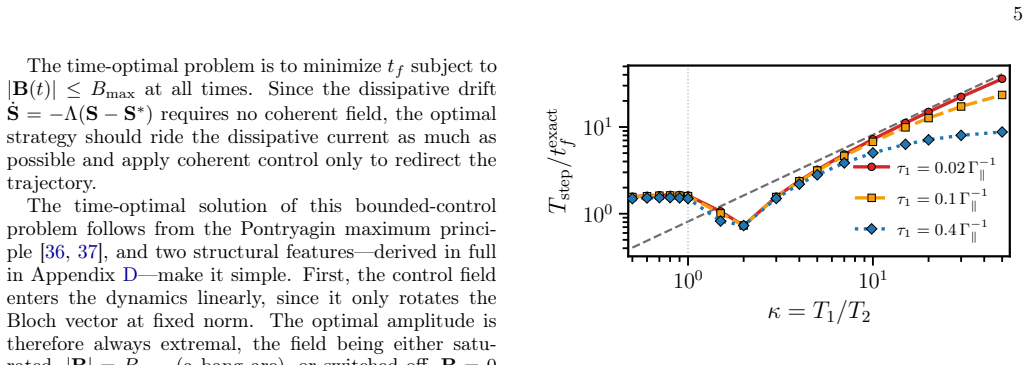
- For axial targets the hitting time is reduced by a factor of order kappa equals T1/T2 relative to passive relaxation.
- For non-axial targets the normalized speedup exceeds the axial benchmark by an extra factor of four to five via geometric amplification.
- The resulting protocols apply directly to standard Bloch-vector platforms such as magnetic-resonance spins, nitrogen-vacancy centers, and superconducting circuits.
- The mechanism enables faster quantum-control and fast-reset protocols by making dissipation itself a selectable resource.
Where Pith is reading between the lines
- The same reorientation principle could be tested in multi-qubit registers by pulsing to align several Bloch vectors simultaneously to shared fast channels.
- Bath engineering that deliberately increases anisotropy might further enlarge the geometric amplification factor beyond the reported four-to-five range.
- The approach suggests a concrete experimental signature: the dependence of speedup on the angle between the initial state and the fast eigendirection should match the predicted interception geometry.
- Integration with existing pulse-shaping hardware in superconducting circuits would provide a direct test of the ideal-pulse assumption under realistic drift conditions.
Load-bearing premise
The qubit undergoes non-unital anisotropic Bloch relaxation and ideal short coherent pulses can reorient the Bloch vector onto a fast eigendirection without other dynamical limitations.
What would settle it
Measure the hitting time to a non-axial target under controlled anisotropic relaxation and check whether the observed speedup normalized to axial passive reset exceeds the axial kappa xi benchmark by a factor of four to five.
Figures
read the original abstract
In the control of dissipative quantum systems, the slow relaxation modes usually set the ultimate manipulation timescale. Here we show that this apparent bottleneck can be bypassed: dissipation itself becomes a control resource when fast relaxation channels are deliberately exploited. We demonstrate this mechanism for a qubit subject to non-unital and anisotropic Bloch relaxation. A short coherent pulse first reorients the Bloch vector onto a fast dissipative eigendirection; the subsequent free relaxation then carries the state close to the target, with at most one final corrective pulse. The resulting bang-drift-bang strategy is cooperative: coherent control selects the dissipative channel, while the bath performs most of the transfer. For axial targets, we obtain a closed-form speedup over passive relaxation by a factor of order $\kappa=T_1/T_2\gg1$. For out-of-equilibrium non-axial targets, an additional off-axis interception mechanism provides a further geometric amplification, allowing the hitting-time speedup, still normalized to the axial passive-reset time, to exceed the axial $\kappa\xi$ benchmark by an extra factor of four to five. The mechanism therefore directly connects to standard Bloch-vector qubit platforms, including magnetic-resonance spins, nitrogen-vacancy centers, and superconducting circuits, with potential relevance for quantum-control and fast-reset protocols.
Editorial analysis
A structured set of objections, weighed in public.
Referee Report
Summary. The paper claims that for a qubit under non-unital anisotropic Bloch relaxation, a bang-drift-bang protocol—short coherent pulses to reorient the Bloch vector onto fast dissipative eigendirections followed by free evolution—bypasses slow relaxation modes. This yields closed-form speedups of order κ=T1/T2 ≫1 for axial targets and an additional geometric amplification factor of 4–5 for out-of-equilibrium non-axial targets (normalized to axial passive-reset time), with the bath performing most of the transfer.
Significance. If the central derivations hold, the work provides an explicit cooperative mechanism in which coherent control selects dissipative channels, delivering parameter-free closed-form speedups and a direct link to standard qubit platforms (magnetic-resonance spins, NV centers, superconducting circuits). The geometric-amplification claim for non-axial targets is a concrete, falsifiable prediction that could inform fast-reset protocols.
major comments (1)
- [abstract (non-axial targets paragraph)] The additional factor of four to five for non-axial targets (abstract) is derived under the assumption of ideal instantaneous coherent pulses that exactly map the state onto a fast dissipative eigendirection. No Trotter-error bound, finite-duration Lindblad integration, or robustness analysis is referenced; if pulse duration is comparable to any relaxation timescale, the off-axis interception geometry no longer maps exactly onto the claimed fast channel, directly affecting the load-bearing extra amplification.
Simulated Author's Rebuttal
We thank the referee for the constructive feedback. We address the single major comment below, agreeing that the idealized assumption requires explicit clarification.
read point-by-point responses
-
Referee: [abstract (non-axial targets paragraph)] The additional factor of four to five for non-axial targets (abstract) is derived under the assumption of ideal instantaneous coherent pulses that exactly map the state onto a fast dissipative eigendirection. No Trotter-error bound, finite-duration Lindblad integration, or robustness analysis is referenced; if pulse duration is comparable to any relaxation timescale, the off-axis interception geometry no longer maps exactly onto the claimed fast channel, directly affecting the load-bearing extra amplification.
Authors: We agree that the factor of 4–5 is obtained under the ideal instantaneous-pulse limit. The manuscript derives closed-form hitting times precisely in this limit (see Sec. III and IV), where the coherent reorientation is treated as instantaneous relative to all dissipative timescales. The abstract and main text describe the pulses as “short” but do not explicitly bound their duration. We will revise the abstract, introduction, and conclusion to state the assumption clearly and to note the validity regime (pulse duration ≪ T2). A quantitative Trotter or finite-duration analysis lies outside the present scope; the reported speedups are therefore theoretical predictions for the ideal cooperative protocol. revision: yes
Circularity Check
No significant circularity; derivations from rates and geometry are self-contained
full rationale
The paper derives closed-form speedup factors (order κ and extra geometric amplification) analytically from the non-unital anisotropic Bloch relaxation generator, the bang-drift-bang protocol, and the stated ideal-pulse reorientation. No step reduces a claimed prediction to a fitted parameter, self-definition, or load-bearing self-citation chain. The reader's assessment of score 2.0 aligns with minor or absent self-citation load; the central hitting-time results remain independent of the target quantities by construction. The instantaneous-pulse assumption is an explicit modeling choice whose validity is separate from circularity.
Axiom & Free-Parameter Ledger
axioms (1)
- domain assumption Qubit state evolution follows the Bloch equations with non-unital and anisotropic relaxation rates
Reference graph
Works this paper leans on
-
[1]
Introducing the costate vector p(t), the Pontryagin Hamiltonian associated with Eq
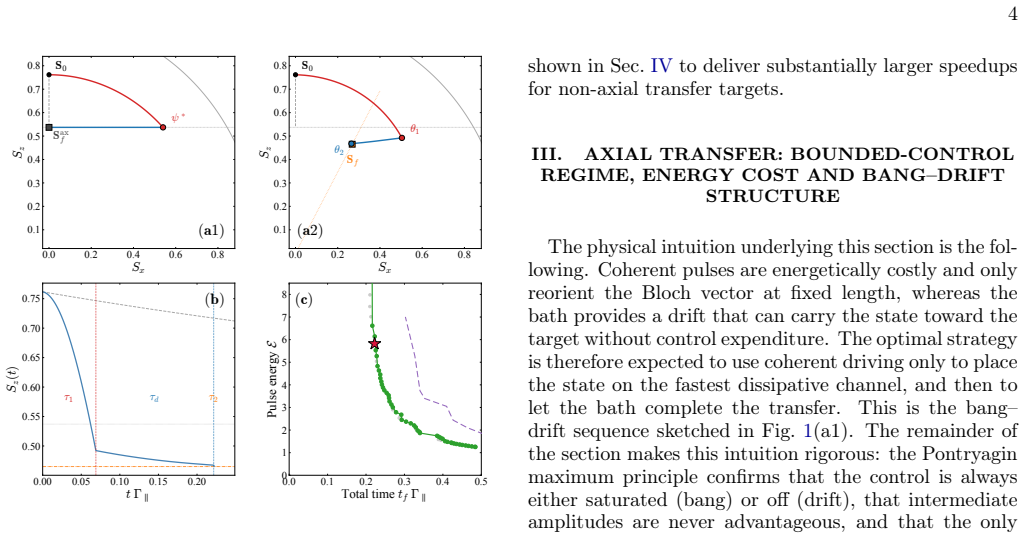
Three-dimensional Pontryagin setup and meridional reduction We record here the full three-dimensional minimum- time problem from which the reduced synthesis used in the main text is obtained. Introducing the costate vector p(t), the Pontryagin Hamiltonian associated with Eq. (3) is HP =p· γB×S−Λ(S−S ∗) −1.(D1) BecauseH P depends on the field only throughp...
-
[2]
Theradial dynamicsisentirelydrift- generated; coherent control acts only on the orientation nas a bounded rotation on the unit sphere
Exact radial–angular decomposition WritingS=rnwithr=|S|andn∈S 2, the equations of motion decompose exactly as ˙r=n·w(rn),(D4) ˙n= 1 r Πnw(rn) +γB×n,(D5) withΠ n =I−n⊗n. Theradial dynamicsisentirelydrift- generated; coherent control acts only on the orientation nas a bounded rotation on the unit sphere. ForΛ = diag(Γ ⊥,Γ ⊥,Γ ∥), axial symmetry makes the me...
-
[3]
On the cooperative sector C={(r, θ) ;r >0,0≤θ≤ψ ∗}, whereψ ∗ = arccos(s∗/si), one has a(r, θ) =−sinθ h (Γ⊥ −Γ ∥) cosθ+ Γ ∥ s∗ r i <0(D12) withθ∈(0, ψ ∗]
Reduced Pontryagin synthesis on the cooperative meridian Forthediagonalthermalbath, thecooperativetransfer is governed by the exact reduced dynamics ˙r=b(r, θ) :=−Γ ⊥rsin 2 θ−Γ ∥rcos 2 θ+ Γ ∥s∗ cosθ, (D9) ˙θ=a(r, θ) +u,(D10) with a(r, θ) := (Γ∥ −Γ ⊥) sinθcosθ−Γ ∥ s∗ r sinθ,(D11) and|u| ≤u max :=γB max. On the cooperative sector C={(r, θ) ;r >0,0≤θ≤ψ ∗}, w...
-
[4]
M. A. Nielsen and I. L. Chuang,Quantum Computation and Quantum Information(Cambridge University Press, Cambridge, 2000)
2000
-
[5]
Giovannetti, S
V. Giovannetti, S. Lloyd, and L. Maccone, Quantum- enhanced measurements: beating the standard quantum limit, Science306, 1330–1336 (2004)
2004
-
[6]
Vinjanampathy and J
S. Vinjanampathy and J. Anders, Quantum thermody- namics, Contemp. Phys.57, 545–579 (2016)
2016
-
[7]
Phys.48, 771 (2000)
D.P.DiVincenzo,The Physical Implementation of Quan- tum Computation, Fortschr. Phys.48, 771 (2000)
2000
-
[8]
Magnard, P
P. Magnard, P. Kurpiers, B. Royer, T. Walter, J.-C. Besse, S. Gasparinetti, M. Pechal, J. Heinsoo, S. Storz, A. Blais, and A. Wallraff,Fast and Unconditional All- Microwave Reset of a Superconducting Qubit, Phys. Rev. Lett.121, 060502 (2018)
2018
-
[9]
Y. Zhou, Z. Zhang, Z. Yin, S. Huai, X. Gu, X. Xu, J. Allcock, F. Liu, G. Xu, Q. Yu, J.-S. Tsai, Y. Liu, and S. Zhang,Rapid and unconditional parametric reset pro- tocol for tunable superconducting qubits, Nat. Commun. 12, 5924 (2021)
2021
-
[10]
G. Kim, A. Butler, V. S. Ferreira, X. Zhang, A. Hadley, E. Kim, and O. Painter,Fast Unconditional Reset and Leakage Reduction of a Tunable Superconducting Qubit via an Engineered Dissipative Bath, Phys. Rev. Applied 24, 014012 (2025)
2025
-
[11]
Krantz, M
P. Krantz, M. Kjaergaard, F. Yan, T. P. Orlando, S. Gus- tavsson, and W. D. Oliver, A quantum engineer’s guide to superconducting qubits, Appl. Phys. Rev.6, 021318 (2019)
2019
-
[12]
Kjaergaard, M
M. Kjaergaard, M. E. Schwartz, J. Braumüller, P. Krantz, J. I.-J. Wang, S. Gustavsson, and W. D. Oliver, Superconducting qubits: Current state of play, Annu. Rev. Condens. Matter Phys.11, 369 (2020)
2020
-
[13]
M. W. Doherty, N. B. Manson, P. Delaney, F. Jelezko, J. Wrachtrup, and L. C. L. Hollenberg, The nitrogen- vacancy colour centre in diamond, Phys. Rep.528, 1 (2013)
2013
-
[14]
Abragam,Principles of Nuclear Magnetism(Claren- don Press, Oxford, 1961)
A. Abragam,Principles of Nuclear Magnetism(Claren- don Press, Oxford, 1961)
1961
-
[15]
Torrontegui, S
E. Torrontegui, S. Ibáñez, S. Martínez-Garaot, M. Mod- ugno, A. del Campo, D. Guéry-Odelin, A. Ruschhaupt, X. Chen, and J. G. Muga, Shortcuts to adiabaticity, Adv. At. Mol. Opt. Phys.62, 117 (2013)
2013
-
[16]
Guéry-Odelin, A
D. Guéry-Odelin, A. Ruschhaupt, A. Kiely, E. Tor- rontegui, S. Martínez-Garaot, and J. G. Muga, Short- cuts to adiabaticity: Concepts, methods, and applica- tions, Rev. Mod. Phys.91, 045001 (2019)
2019
-
[17]
Alipour, A
S. Alipour, A. Chenu, A. T. Rezakhani, and A. del Campo, Shortcuts to Adiabaticity in Driven Open Quan- tum Systems: Balanced Gain and Loss and Non- Markovian Evolution, Quantum4, 336 (2020)
2020
-
[18]
Guéry-Odelin, C
D. Guéry-Odelin, C. Jarzynski, C. A. Plata, A. Pra- dos, and E. Trizac, Shortcuts to equilibrium: concepts, methods and perspectives, Rep. Prog. Phys.86, 035902 (2023)
2023
-
[19]
Hatomura, Shortcuts to adiabaticity: theoretical framework, relations between different methods, and ver- satile approximations, J
T. Hatomura, Shortcuts to adiabaticity: theoretical framework, relations between different methods, and ver- satile approximations, J. Phys. B: At. Mol. Opt. Phys. 57, 102001 (2024)
2024
-
[20]
Impens and D
F. Impens and D. Guéry-Odelin, Fast quantum control in dissipative systems using dissipationless solutions, Sci. Rep.9, 4048 (2019)
2019
-
[21]
Ciliberto, Engineered swift equilibration of a Brownian particle, Nat
I.A.Martínez, A.Petrosyan, D.Guéry-Odelin, E.Trizac, and S. Ciliberto, Engineered swift equilibration of a Brownian particle, Nat. Phys.12, 843–846 (2016)
2016
-
[22]
Le Cunuder, I
A. Le Cunuder, I. A. Martínez, A. Petrosyan, D. Guéry- Odelin, E. Trizac, and S. Ciliberto, Fast equilibrium switch of a micro mechanical oscillator, Appl. Phys. Lett. 109, 113502 (2016)
2016
-
[23]
Raynal, T
D. Raynal, T. de Guillebon, D. Guéry-Odelin, E. Trizac, J.-S. Lauret, and L. Rondin, Shortcuts to equilibrium with a levitated particle in the underdamped regime, Phys. Rev. Lett.131, 087101 (2023)
2023
-
[24]
J. F. Poyatos, J. I. Cirac, and P. Zoller,Quantum Reser- voir Engineering with Laser Cooled Trapped Ions, Phys. Rev. Lett.77, 4728 (1996)
1996
-
[25]
Phys.5, 633 (2009)
F.Verstraete, M.M.Wolf, andJ.I.Cirac,Quantum com- putation and quantum-state engineering driven by dissi- pation, Nat. Phys.5, 633 (2009)
2009
-
[26]
P. M. Harrington, E. J. Mueller, and K. W. Murch,Engi- neered dissipation for quantum information science, Nat. Rev. Phys.4, 660 (2022)
2022
-
[27]
Sugny, C
D. Sugny, C. Kontz, and H. R. Jauslin, Time-optimal control of a two-level dissipative quantum system, Phys. Rev. A76, 023419 (2007)
2007
-
[28]
Bonnard and D
B. Bonnard and D. Sugny, Time-minimal control of dis- sipative two-level quantum systems: The integrable case, SIAM J. Control Optim.48, 1289 (2009)
2009
-
[29]
Lapert, Y
M. Lapert, Y. Zhang, M. Braun, S. J. Glaser, and D. Sugny, Singular extremals for the time-optimal con- trol of dissipative spin-1 2 particles, Phys. Rev. Lett.104, 083001 (2010)
2010
-
[30]
Mukherjee, A
V. Mukherjee, A. Carlini, A. Mari, T. Caneva, S. Mon- tangero, T.Calarco, R.Fazio, andV.Giovannetti, Speed- ing up and slowing down the relaxation of a qubit by optimal control, Phys. Rev. A88, 062326 (2013)
2013
-
[31]
Lokutsievskiy, and M
L. Lokutsievskiy, and M. Sigalotti, Time-optimal state transfer for an open qubit, J. Phys. A: Math. Theor.57, 275302 (2024)
2024
-
[32]
F. Ares, P. Calabrese, and S. Murciano, The quantum Mpemba effects, Nat. Rev. Phys.7, 451–460 (2025)
2025
-
[33]
Carollo, A
F. Carollo, A. Lasanta, and I. Lesanovsky, Exponentially accelerated approach to stationarity in Markovian open quantum systems through the Mpemba effect, Phys. Rev. Lett.127, 060401 (2021)
2021
-
[34]
Lindblad, On the generators of quantum dynamical semigroups, Commun
G. Lindblad, On the generators of quantum dynamical semigroups, Commun. Math. Phys.48, 119 (1976)
1976
-
[35]
Gorini, A
V. Gorini, A. Kossakowski, and E. C. G. Sudarshan, Completely positive dynamical semigroups ofN-level systems, J. Math. Phys.17, 821 (1976). 13
1976
-
[36]
Breuer and F
H.-P. Breuer and F. Petruccione,The Theory of Open Quantum Systems(Oxford University Press, Oxford, 2002)
2002
-
[37]
Zermelo, Über das Navigationsproblem bei ruhender oder veränderlicher Windverteilung, Z
E. Zermelo, Über das Navigationsproblem bei ruhender oder veränderlicher Windverteilung, Z. Angew. Math. Mech.11, 114 (1931)
1931
-
[38]
Russell and S
B. Russell and S. Stepney, Zermelo navigation in the quantum brachistochrone, J. Phys. A48, 115303 (2015)
2015
-
[39]
L. S. Pontryagin, V. G. Boltyanskii, R. V. Gamkrelidze, and E. F. Mishchenko,The Mathematical Theory of Op- timal Processes(Wiley, New York, 1962)
1962
-
[40]
Ansel, E
Q. Ansel, E. Dionis, F. Arrouas, B. Peaudecerf, S. Guérin, D. Guéry-Odelin, and D. Sugny, J. Phys. B: At. Mol. Opt. Phys.57, 133001 (2024)
2024
-
[41]
Khaneja, T
N. Khaneja, T. Reiss, C. Kehlet, T. Schulte-Herbrüggen, and S. J. Glaser, Optimal control of coupled spin dynam- ics: design of NMR pulse sequences by gradient ascent algorithms, J. Magn. Reson.172, 296–305 (2005)
2005
-
[42]
Commun.12, 1779 (2021)
A.P.M.Placeet al., Newmaterialplatformforsupercon- ducting transmon qubits with coherence times exceeding 0.3 milliseconds, Nat. Commun.12, 1779 (2021)
2021
-
[43]
Wanget al., Towards practical quantum computers: transmon qubit with a lifetime approaching 0.5 millisec- onds, npj Quantum Inf.8, 3 (2022)
C. Wanget al., Towards practical quantum computers: transmon qubit with a lifetime approaching 0.5 millisec- onds, npj Quantum Inf.8, 3 (2022)
2022
-
[44]
Barendset al., Superconducting quantum circuits at the surface code threshold for fault tolerance, Nature 508, 500 (2014)
R. Barendset al., Superconducting quantum circuits at the surface code threshold for fault tolerance, Nature 508, 500 (2014)
2014
-
[45]
Jarmola, V
A. Jarmola, V. M. Acosta, K. Jensen, S. Chemerisov, and D. Budker, Temperature- and magnetic-field-dependent longitudinal spin relaxation in nitrogen-vacancy ensem- bles in diamond, Phys. Rev. Lett.108, 197601 (2012)
2012
-
[46]
Mater.8, 383 (2009)
G.Balasubramanianet al., Ultralongspincoherencetime in isotopically engineered diamond, Nat. Mater.8, 383 (2009)
2009
-
[47]
H. H. Vallabhapurapu, J. P. Slack-Smith, V. K. Sewani, C. Adambukulam, A. Morello, J. J. Pla, and A. Laucht, Fast coherent control of a nitrogen-vacancy-center spin ensemble using a KTaO3 dielectric resonator at cryogenic temperatures, Phys. Rev. Applied16, 044051 (2021)
2021
-
[48]
M. H. Levitt,Spin Dynamics: Basics of Nuclear Mag- netic Resonance, 2nd ed. (Wiley, Chichester, 2008)
2008
-
[49]
P. S. C. Wu and G. Otting, Rapid pulse length deter- mination in high-resolution NMR, J. Magn. Reson.176, 115 (2005)
2005
-
[50]
Alicki and K
R. Alicki and K. Lendi,Quantum Dynamical Semi- groups and Applications, Lecture Notes in Physics717 (Springer, Berlin, 2007)
2007
-
[51]
Kraus, H
B. Kraus, H. P. Büchler, S. Diehl, A. Kantian, A. Micheli, and P. Zoller, Preparation of entangled states by quan- tum Markov processes, Phys. Rev. A78, 042307 (2008)
2008
-
[52]
Witthaut, F
D. Witthaut, F. Trimborn, and S. Wimberger, Dissipa- tion induced coherence of a two-mode Bose-Einstein con- densate, Phys. Rev. Lett.101, 200402 (2008)
2008
discussion (0)
Sign in with ORCID, Apple, or X to comment. Anyone can read and Pith papers without signing in.