REVIEW 2 major objections 2 minor 1 cited by
Polarization Analysis of Ringdown Signals
T0 review · 2 major / 2 minor · reviewed 2026-05-19 · grok-4.3
Pith's one-line read Ringdown signals from binary black hole mergers carry measurable circular polarization that directly infers the source inclination angle.
desk verdict This shows ringdown polarization can give inclination for non-precessing mergers with two detectors under the symmetry assumption, with clear biases shown for precessing cases. read the letter →
The pith
A machine-rendered reading of the paper's core claim, the machinery that carries it, and where it could break.
The reading
What carries the argument
Equatorial reflection symmetry that constrains two of the four degrees of freedom per quasi-normal mode and fixes the polarization-amplitude and phase relations through the inclination angle.
What would settle it
A statistically significant mismatch between the inclination angle inferred from ringdown polarization and the inclination obtained from a full inspiral-merger-ringdown analysis of a confirmed non-precessing event would falsify the constrained model's applicability.
Extended reading notes
Core claim
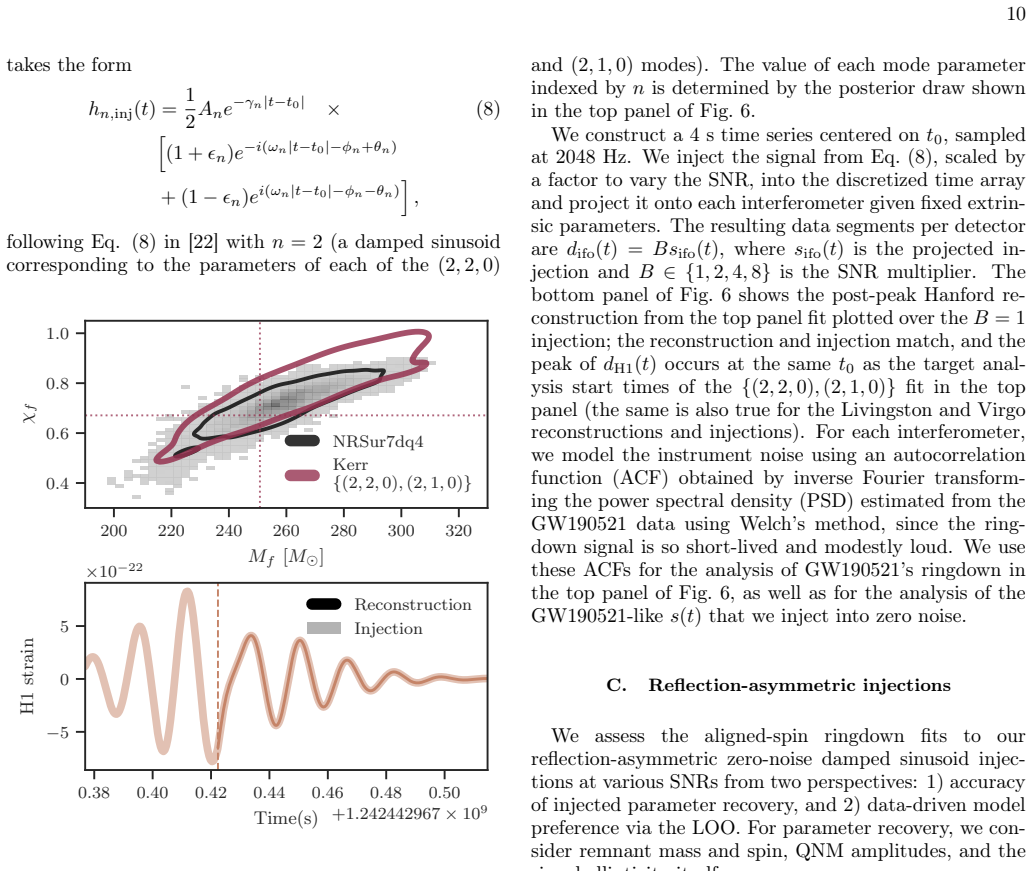
When quasi-normal modes are excited with equatorial reflection symmetry, the relationship between polarization amplitudes and phases in each mode is fixed by the inclination angle to the equatorial plane. Fitting this constrained model to ringdown data from events like GW150914 extracts the degree of circular polarization and handedness using only the two LIGO detectors; the measured polarization then yields an independent inclination inference. The same model fails for precessing systems such as GW190521, producing systematic biases in recovered mode parameters.
Load-bearing premise
Merging black holes whose spins are aligned or anti-aligned with the orbital angular momentum excite quasi-normal modes that possess equatorial reflection symmetry.
Editorial extensions
If this is right
- For aligned-spin mergers the ringdown alone suffices to measure circular polarization without reference to the earlier inspiral or merger phases.
- Polarization-derived inclinations provide an independent cross-check on geometry parameters extracted from the complete waveform.
- Detector networks with only two sites can still extract geometric information from sufficiently loud ringdown signals under the symmetry assumption.
- Precessing mergers require the unrestricted four-degree-of-freedom polarization model to avoid biased quasi-normal-mode frequency and amplitude estimates.
Reading between the lines
- Future higher-sensitivity detectors could apply the same polarization test to a statistical sample of events to verify the prevalence of aligned-spin mergers.
- The method offers a post-merger-only route to study spin-orbit alignment, complementary to full-waveform analyses.
- Deviations from the predicted polarization-inclination relation in high-signal-to-noise ringdowns could flag either precession or departures from Kerr quasi-normal modes.
Signed reviews
Editorial analysis
A structured set of objections, weighed in public.
Referee Report
Summary. The paper introduces a constrained polarization model for black hole ringdown signals that exploits equatorial reflection symmetry expected in non-precessing mergers. This symmetry reduces each quasi-normal mode from four to two degrees of freedom, fixing the relationship between polarization amplitudes/phases and the source inclination angle. The authors fit both this constrained model and an unconstrained arbitrary-polarization model to GW150914-like signals and to GW190521-like precessing injections, showing that circular polarization degree and handedness can be recovered with two LIGO detectors alone and translated into an inclination estimate under the symmetry assumption. For precessing systems the constrained model produces biases in recovered frequencies and amplitudes relative to the unconstrained fit.
Significance. If the symmetry assumption holds for the targeted systems, the work offers a ringdown-only route to inclination inference that could complement full IMR analyses and become more valuable with improving detector sensitivity. The explicit comparison of constrained versus arbitrary-polarization models on both real-event data and controlled injections quantifies the systematic risk of using an incorrect polarization ansatz, which is a useful cautionary result for the field.
major comments (2)
- [Section describing the constrained model and GW150914 fits] The central claim that polarization measurements from two detectors can be translated into an inclination estimate rests on the equatorial reflection symmetry assumption for non-precessing mergers. The manuscript should include a quantitative test (e.g., injections with small spin misalignments that mildly violate the symmetry) showing the size of the resulting bias in the recovered inclination when the constrained model is still applied.
- [Results section on precessing-system injections] For the GW190521-like injections, the reported biases in mode frequencies and amplitudes under the constrained model need to be compared directly to the statistical uncertainties of the fit; without this comparison it is difficult to judge whether the biases are large enough to affect science results at current or design detector sensitivities.
minor comments (2)
- [Abstract and results] Clarify the precise metric used for 'weaker predictive accuracy' when comparing the two models on injections.
- [Methods] Ensure all symbols for polarization amplitudes, phases, and inclination are defined consistently before first use and appear in a notation table if possible.
Simulated Author's Rebuttal
We thank the referee for their positive assessment of our manuscript and for the constructive suggestions. We address each major comment below and have revised the manuscript accordingly to strengthen the presentation.
read point-by-point responses
-
Referee: [Section describing the constrained model and GW150914 fits] The central claim that polarization measurements from two detectors can be translated into an inclination estimate rests on the equatorial reflection symmetry assumption for non-precessing mergers. The manuscript should include a quantitative test (e.g., injections with small spin misalignments that mildly violate the symmetry) showing the size of the resulting bias in the recovered inclination when the constrained model is still applied.
Authors: We agree that a quantitative assessment of the inclination bias under mild violations of equatorial reflection symmetry would be a useful addition. Our existing analysis contrasts the exact symmetry case (aligned spins) with strong violations (highly precessing systems), but we will add a new set of injections with small spin misalignments (10–20 degrees) and report the resulting bias in the recovered inclination. These results will be included in a revised version of the manuscript. revision: yes
-
Referee: [Results section on precessing-system injections] For the GW190521-like injections, the reported biases in mode frequencies and amplitudes under the constrained model need to be compared directly to the statistical uncertainties of the fit; without this comparison it is difficult to judge whether the biases are large enough to affect science results at current or design detector sensitivities.
Authors: We thank the referee for highlighting this point. In the revised manuscript we will augment the GW190521-like injection results with a direct comparison of the observed biases in mode frequencies and amplitudes against the statistical uncertainties extracted from the posterior distributions. This will allow readers to evaluate the practical significance of the systematics relative to statistical errors at both current and design sensitivities. revision: yes
Circularity Check
No significant circularity detected
full rationale
The paper applies an external modeling assumption of equatorial reflection symmetry (valid for non-precessing aligned-spin mergers) to constrain two of the four degrees of freedom per quasi-normal mode. This constraint is used to fit ringdown signals directly to detector strain data, enabling extraction of circular polarization degree and handedness even with two LIGO detectors, followed by translation to inclination under the same assumption. No step reduces by construction to its inputs: the symmetry is stated as a prior physical expectation rather than derived from the fit, the polarization parameters are obtained from data fitting rather than being redefined in terms of inclination, and no self-citations or ansatzes are invoked as load-bearing. Analysis of precessing cases (e.g., GW190521) explicitly shows model mismatch and biases, confirming the framework is not tautological. The derivation remains self-contained against the strain data under the stated assumptions.
Assumptions & free parameters
free parameters (2)
- mode amplitudes and phases
- inclination angle
assumptions (1)
- domain assumption Merging binary black holes with spins (anti)aligned to orbital angular momentum excite quasi-normal modes with equatorial reflection symmetry.
Cite this review
Pith. "Pith review of Polarization Analysis of Ringdown Signals." pith.science (2026). https://pith.science/paper/ICESHCAA
@misc{pith2026260515271,
  author       = {Pith},
  title        = {Pith review of: Polarization Analysis of Ringdown Signals},
  year         = {2026},
  howpublished = {\url{https://pith.science/paper/ICESHCAA}},
  note         = {Machine review of arXiv:2605.15271}
}
read the original abstract
Merging binary black holes exhibit a ringdown phase in which they primarily emit gravitational waves in the shape of damped sinusoids corresponding to quasi-normal modes of the Kerr remnant. In general, each mode carries four degrees of freedom encoding amplitude and phase information. When the modes are excited with equatorial reflection symmetry, as is the case for black hole mergers with spins (anti)aligned to the orbital angular momentum, the symmetry constrains two degrees of freedom. As a result, the relationship between polarization amplitudes and phases in each mode is fixed by the viewing (inclination) angle to the equatorial plane. We use such a constrained model to fit the ringdown signals of both non-precessing and precessing systems such as GW150914 and GW190521, respectively. We show that we can measure the degree of circular polarization and handedness of ringdown signals like those of GW150914, even if only the two LIGO detectors are available; such a polarization measurement can be translated into an inferred source inclination assuming the reflection symmetry above, again using the ringdown signal alone. On the other hand, the constrained polarization model is insufficient to capture the polarization structure of signals from precessing systems, leading to biases in the inferred mode frequencies and amplitudes. We explore the magnitude of this effect by fitting GW190521-like injections with the restricted model, finding weaker predictive accuracy relative to the arbitrary-polarization model and potentially significant systematic biases. As our detectors continue to improve, using the correct polarization model is increasingly important to avoid biased ringdown measurements.
Figures


Figures from the paper (12 more)




Lean theorems connected to this paper
-
IndisputableMonolith/Foundation/AlexanderDuality.leanalexander_duality_circle_linking unclear?
unclearRelation between the paper passage and the cited Recognition theorem.
When the modes are excited with equatorial reflection symmetry, as is the case for black hole mergers with spins (anti)aligned to the orbital angular momentum, the symmetry constrains two degrees of freedom. As a result, the relationship between polarization amplitudes and phases in each mode is fixed by the viewing (inclination) angle
What do these tags mean?
- matches
- The paper's claim is directly supported by a theorem in the formal canon.
- supports
- The theorem supports part of the paper's argument, but the paper may add assumptions or extra steps.
- extends
- The paper goes beyond the formal theorem; the theorem is a base layer rather than the whole result.
- uses
- The paper appears to rely on the theorem as machinery.
- contradicts
- The paper's claim conflicts with a theorem or certificate in the canon.
- unclear
- Pith found a possible connection, but the passage is too broad, indirect, or ambiguous to say the theorem truly supports the claim.
Forward citations
Cited by 1 Pith paper
-
GWTC-5.0: Tests of General Relativity
Tests of general relativity on 168 LIGO–Virgo–KAGRA gravitational-wave events (including 72 new from O4b) find GR consistent with all data, improving post-Newtonian and ringdown deviation bounds by 1.2–2.6×.
Reference graph
Works this paper leans on
-
[1]
Post-Newtonian Theory for Gravitational Waves
L. Blanchet, Living Reviews in Relativity17, 2 (2014), arXiv:1310.1528 [gr-qc]
work page Pith review arXiv 2014
-
[2]
B. P. Abbottet al., Annalen der Physik529, 1600209 (2017), arXiv:1608.01940 [gr-qc]
work page Pith review arXiv 2017
-
[3]
R. P. Kerr, Phys. Rev. Lett.11, 237 (1963)
work page 1963
-
[4]
C. V. Vishveshwara, Phys. Rev. D1, 2870 (1970)
work page 1970
-
[5]
S. A. Teukolsky, Astrophys. J.185, 635 (1973)
work page 1973
-
[6]
W. H. Press and S. A. Teukolsky, Astrophys. J.185, 649 (1973)
work page 1973
-
[7]
S. A. Teukolsky and W. H. Press, Astrophys. J.193, 443 (1974)
work page 1974
-
[8]
Black hole spectroscopy: from theory to experiment
E. Berti, V. Cardoso, G. Carullo, J. Abedi, N. Af- shordi, S. Albanesi, V. Baibhav, S. Bhagwat, J. L. Blázquez-Salcedo, B. Bonga, B. Bucciotti, G. Caneva Santoro, P. A. Cano, C. Capano, M. Ho-Yeuk Cheung, C. Chirenti, G. B. Cook, A. Ka-Wai Chung, M. De Ami- cis, K. Destounis, O. J. C. Dias, W. Del Pozzo, F. Duque, W. M. Farr, E. Finch, N. Franchini, K. Fr...
work page Pith review arXiv 2025
Show all 78 references
-
[9]
W. H. Press, Astrophysical Journal Letters170, L105 (1971)
1971
-
[10]
Chandrasekhar and S
S. Chandrasekhar and S. Detweiler, Proceedings of the Royal Society of London Series A344, 441 (1975)
1975
-
[11]
E. W. Leaver, Proceedings of the Royal Society of London Series A402, 285 (1985)
1985
-
[12]
Berti, V
E. Berti, V. Cardoso, and A. O. Starinets, Classical and QuantumGravity26,163001(2009),arXiv:0905.2975[gr- qc]
2009 arXiv
-
[13]
London, D
L. London, D. Shoemaker, and J. Healy, Phys. Rev. D 90, 124032 (2014), arXiv:1404.3197 [gr-qc]
2014 arXiv
-
[14]
M. Isi, M. Giesler, W. M. Farr, M. A. Scheel, and S. A. Teukolsky, Phys. Rev. Lett.123, 111102 (2019), arXiv:1905.00869 [gr-qc]
2019 arXiv
-
[15]
Giesler, M
M. Giesler, M. Isi, M. A. Scheel, and S. A. Teukolsky, Physical Review X9, 041060 (2019), arXiv:1903.08284 [gr-qc]
2019
-
[16]
Boyle, N
M.Giesler, S.Ma, K.Mitman, N.Oshita, S.A.Teukolsky, M. Boyle, N. Deppe, L. E. Kidder, J. Moxon, K. C. Nelli, H. P. Pfeiffer, M. A. Scheel, W. Throwe, and N. L. Vu, Phys. Rev. D111, 084041 (2025), arXiv:2411.11269 [gr- qc]
2025
-
[17]
Carter, Phys
B. Carter, Phys. Rev. Lett.26, 331 (1971)
1971
-
[18]
Penrose, Riv
R. Penrose, Riv. Nuovo Cim.1, 252 (1969)
1969
-
[19]
S. L. Detweiler, Astrophys. J.239, 292 (1980)
1980
-
[20]
Dreyer, B
O. Dreyer, B. J. Kelly, B. Krishnan, L. S. Finn, D. Gar- rison, and R. Lopez-Aleman, Class. Quantum Grav.21, 787 (2004), arXiv:gr-qc/0309007
2004 arXiv
-
[21]
Gürlebeck, Phys
N. Gürlebeck, Phys. Rev. Lett.114, 151102 (2015), arXiv:1503.03240 [gr-qc]
2015 arXiv
-
[22]
Isi and W
M. Isi and W. M. Farr, arXiv e-prints , arXiv:2107.05609 (2021), arXiv:2107.05609 [gr-qc]
2021
-
[23]
Isi, Classical and Quantum Gravity40, 203001 (2023), arXiv:2208.03372 [gr-qc]
M. Isi, Classical and Quantum Gravity40, 203001 (2023), arXiv:2208.03372 [gr-qc]
2023
-
[24]
Kamaretsos, M
I. Kamaretsos, M. Hannam, and B. S. Sathyaprakash, Phys. Rev. Lett.109, 141102 (2012), arXiv:1207.0399 [gr- qc]
2012 arXiv
-
[25]
H. Zhu, H. Siegel, K. Mitman, M. Isi, W. M. Farr, M. Boyle, N. Deppe, L. E. Kidder, S. Ma, J. Moxon, K. C. Nelli, H. P. Pfeiffer, M. A. Scheel, S. A. Teukolsky, W. Throwe, V. Varma, and N. L. Vu, Phys. Rev. D111, 064052 (2025), arXiv:2312.08588 [gr-qc]
2025
-
[26]
Aasiet al., Classical and Quantum Gravity32, 074001 (2015), arXiv:1411.4547 [gr-qc]
J. Aasiet al., Classical and Quantum Gravity32, 074001 (2015), arXiv:1411.4547 [gr-qc]
2015 arXiv
-
[27]
Acerneseet al., Classical and Quantum Gravity32, 024001 (2015), arXiv:1408.3978 [gr-qc]
F. Acerneseet al., Classical and Quantum Gravity32, 024001 (2015), arXiv:1408.3978 [gr-qc]
2015 arXiv
-
[28]
Akutsuet al., Progress of Theoretical and Experi- mental Physics2021, 05A101 (2021), arXiv:2005.05574 [physics.ins-det]
T. Akutsuet al., Progress of Theoretical and Experi- mental Physics2021, 05A101 (2021), arXiv:2005.05574 [physics.ins-det]
2021
-
[29]
The LIGO Scientific Collaboration, the Virgo Collabora- tion, and the KAGRA Collaboration, arXiv e-prints , arXiv:2508.18082 (2025), arXiv:2508.18082 [gr-qc]
2025 arXiv
-
[30]
Boyle, M
L. Boyle, M. Kesden, and S. Nissanke, Phys. Rev. Lett. 100, 151101 (2008), arXiv:0709.0299 [gr-qc]
2008 arXiv
-
[31]
Boyle, L
M. Boyle, L. E. Kidder, S. Ossokine, and H. P. Pfeiffer, arXiv e-prints , arXiv:1409.4431 (2014), arXiv:1409.4431 [gr-qc]
2014 arXiv
-
[32]
Carullo, W
G. Carullo, W. Del Pozzo, and J. Veitch, Phys. Rev. D 99, 123029 (2019), arXiv:1902.07527 [gr-qc]
2019 arXiv
-
[33]
pyRing: a time-domain ringdown analysis python package,
G. Carullo, W. Del Pozzo, and J. Veitch, “pyRing: a time-domain ringdown analysis python package,” git.ligo.org/lscsoft/pyring (2023)
2023
-
[34]
Gennari, G
V. Gennari, G. Carullo, and W. Del Pozzo, European Physical Journal C84, 233 (2024), arXiv:2312.12515 [gr- qc]
2024
-
[35]
C. D. Capano, M. Cabero, J. Westerweck, J. Abedi, S. Kastha, A. H. Nitz, Y.-F. Wang, A. B. Nielsen, and B. Krishnan, Phys. Rev. Lett.131, 221402 (2023)
2023
-
[36]
C. D. Capano, J. Abedi, S. Kastha, A. H. Nitz, J. West- erweck, Y.-F. Wang, M. Cabero, A. B. Nielsen, and B. Krishnan, Classical and Quantum Gravity41, 245009 (2024), arXiv:2209.00640 [gr-qc]
2024
-
[37]
Ghosh, A
R. Ghosh, A. K. Mishra, and S. Sarkar, Phys. Rev. D 112, 064092 (2025), arXiv:2412.08942 [gr-qc]
2025
-
[38]
Mateu-Lucena, S
M. Mateu-Lucena, S. Husa, M. Colleoni, H. Estellés, C. García-Quirós, D. Keitel, M. d. L. Planas, and A. Ramos-Buades, Monthly Notices of the Royal Astro- nomical Society517, 2403 (2022), arXiv:2105.05960 [gr- qc]
2022
-
[39]
Khalil, A
M. Khalil, A. Buonanno, H. Estellés, D. P. Mihaylov, S. Ossokine, L. Pompili, and A. Ramos-Buades, Phys. Rev. D108, 124036 (2023), arXiv:2303.18143 [gr-qc]
2023
-
[40]
maxisi/ringdown: v1.0.0,
M. Isi, HarrisonS-Phys, W. M. Farr, N. Khusid, A. Hus- sain, and R. Udall, “maxisi/ringdown: v1.0.0,” (2024)
2024
-
[41]
The LIGO Scientific Collaboration, The Virgo Collab- oration, The Kagra Collaboration, and Others, arXiv e-prints , arXiv:2509.07348 (2025), arXiv:2509.07348 [gr- qc]
2025
-
[42]
A. G. Abacet al., Phys. Rev. Lett.135, 111403 (2025), arXiv:2509.08054 [gr-qc]
2025 arXiv
-
[43]
A. G. Abacet al., Astrophysical Journal Letters993, L25 (2025), arXiv:2507.08219 [astro-ph.HE]
2025 arXiv
-
[44]
Siegel, N
H. Siegel, N. M. Khusid, M. Isi, and W. M. Farr, arXiv e-prints , arXiv:2511.02691 (2025), arXiv:2511.02691 [gr- qc]
2025
-
[45]
Berti, V
E. Berti, V. Cardoso, and M. Casals, Phys. Rev. D73, 024013 (2006), arXiv:gr-qc/0511111 [gr-qc]
2006 arXiv
-
[46]
G. B. Cook and M. Zalutskiy, Phys. Rev. D90, 124021 (2014), arXiv:1410.7698 [gr-qc]
2014 arXiv
-
[47]
B. J. Kelly and J. G. Baker, Phys. Rev. D87, 084004 (2013), arXiv:1212.5553 [gr-qc]
2013 arXiv
-
[48]
Berti and A
E. Berti and A. Klein, Phys. Rev. D90, 064012 (2014)
2014
-
[49]
J. N. Goldberg, A. J. Macfarlane, E. T. Newman, 18 F. Rohrlich, and E. C. G. Sudarshan, Journal of Mathe- matical Physics8, 2155 (1967)
1967
-
[50]
B. P. Abbottet al., Phys. Rev. Lett.116, 061102 (2016), arXiv:1602.03837 [gr-qc]
2016 arXiv
-
[51]
B. P. Abbottet al., Phys. Rev. Lett.116, 241102 (2016), arXiv:1602.03840 [gr-qc]
2016 arXiv
-
[52]
Finch and C
E. Finch and C. J. Moore, Phys. Rev. D106, 043005 (2022), arXiv:2205.07809 [gr-qc]
2022
-
[53]
Cotesta, G
R. Cotesta, G. Carullo, E. Berti, and V. Cardoso, Phys. Rev. Lett.129, 111102 (2022)
2022
-
[54]
Isi and W
M. Isi and W. M. Farr, Phys. Rev. Lett.131, 169001 (2023)
2023
-
[55]
Carullo, R
G. Carullo, R. Cotesta, E. Berti, and V. Cardoso, Phys. Rev. Lett.131, 169002 (2023)
2023
-
[56]
S. Ma, L. Sun, and Y. Chen, Phys. Rev. D107, 084010 (2023)
2023
-
[57]
Correia, Y.-F
A. Correia, Y.-F. Wang, J. Westerweck, and C. D. Ca- pano, Phys. Rev. D110, L041501 (2024)
2024
-
[58]
Varma, S
V. Varma, S. E. Field, M. A. Scheel, J. Blackman, D. Gerosa, L. C. Stein, L. E. Kidder, and H. P. Pfeiffer, Physical Review Research1, 033015 (2019), arXiv:1905.09300 [gr-qc]
2019 arXiv
-
[59]
T.Islam, A.Vajpeyi, F.H.Shaik, C.-J.Haster, V.Varma, S. E. Field, J. Lange, R. O’Shaughnessy, and R. Smith, Phys. Rev. D112, 044001 (2025), arXiv:2309.14473 [gr- qc]
2025
-
[60]
Nrsurcat-1,
T. Islam, A. Vajpeyi, F. Shaik, C.-J. Haster, V. Varma, S. Field, J. Lange, R. O’Shaughnessy, and R. Smith, “Nrsurcat-1,” (2023)
2023
-
[61]
Siegel, M
H. Siegel, M. Isi, and W. M. Farr, Phys. Rev. D111, 044070 (2025), arXiv:2410.02704 [gr-qc]
2025
-
[62]
Vehtari, A
A. Vehtari, A. Gelman, and J. Gabry, arXiv e-prints , arXiv:1507.04544 (2015), arXiv:1507.04544 [stat.CO]
2015 arXiv
-
[63]
Thrane and C
E. Thrane and C. Talbot, Publications of the Astronomi- cal Society of Australia36, e010 (2019), arXiv:1809.02293 [astro-ph.IM]
2019
-
[64]
Siegel, M
H. Siegel, M. Isi, and W. M. Farr, Phys. Rev. D108, 064008 (2023), arXiv:2307.11975 [gr-qc]
2023
-
[65]
O. A. Martin, O. Abril-Pla, J. Deklerk, S. D. Axen, C. Carroll, A. Hartikainen, and A. Vehtari, Journal of Open Source Software11, 9889 (2026)
2026
-
[66]
Abbottet al., Phys
R. Abbottet al., Phys. Rev. Lett.125, 101102 (2020), arXiv:2009.01075 [gr-qc]
2020
-
[67]
Abbottet al., Astrophysical Journal Letters900, L13 (2020), arXiv:2009.01190 [astro-ph.HE]
R. Abbottet al., Astrophysical Journal Letters900, L13 (2020), arXiv:2009.01190 [astro-ph.HE]
2020
-
[68]
Olsen, J
S. Olsen, J. Roulet, H. S. Chia, L. Dai, T. Venumadhav, B. Zackay, and M. Zaldarriaga, Phys. Rev. D104, 083036 (2021)
2021
-
[69]
Biscoveanu, M
S. Biscoveanu, M. Isi, V. Varma, and S. Vitale, Phys. Rev. D104, 103018 (2021)
2021
-
[70]
S. J. Miller, M. Isi, K. Chatziioannou, V. Varma, and I. Mandel, Phys. Rev. D109, 024024 (2024), arXiv:2310.01544 [astro-ph.HE]
2024
-
[71]
Berti, V
E. Berti, V. Cardoso, J. A. Gonzalez, U. Sperhake, M. Hannam, S. Husa, and B. Brügmann, Phys. Rev. D76, 064034 (2007), arXiv:gr-qc/0703053 [gr-qc]
2007 arXiv
-
[72]
Abbottet al., Physical Review X13, 041039 (2023), arXiv:2111.03606 [gr-qc]
R. Abbottet al., Physical Review X13, 041039 (2023), arXiv:2111.03606 [gr-qc]
2023 arXiv
-
[73]
Vehtari, D
A. Vehtari, D. P. Simpson, Y. Yao, and A. Gelman, arXiv e-prints , arXiv:1810.05374 (2018), arXiv:1810.05374 [stat.ME]
2018 arXiv
-
[74]
M. Isi, M. Pitkin, and A. J. Weinstein, Phys. Rev. D96, 042001 (2017), arXiv:1703.07530 [gr-qc]
2017 arXiv
-
[75]
Riles, Progress in Particle and Nuclear Physics68, 1 (2013), arXiv:1209.0667 [hep-ex]
K. Riles, Progress in Particle and Nuclear Physics68, 1 (2013), arXiv:1209.0667 [hep-ex]. Appendix A: Implementation
2013 arXiv
-
[76]
We can write the plus and cross polarization states for each ringdown mode in the linear basis as h(+/×) j (t) =A (+/×) j cos 2πfjt−ϕ (+/×) j e−t/τj ,(A1) wherej≡(ℓ,|m|, n)
Design matrix Our ringdown models sample the real and imaginary parts of complex mode amplitudes in quadratures, or Cartesian components. We can write the plus and cross polarization states for each ringdown mode in the linear basis as h(+/×) j (t) =A (+/×) j cos 2πfjt−ϕ (+/×)...
-
[77]
aligned-ness
Polarization angle The global polarization angleψpositions the (+/×) polarization basis on the sky in the plane perpendicular to the line of slight to the GW source (the wave frame) and determinesF (+/×). In other words, for generic elliptically polarized GWs whose ringdown mo...
-
[78]
The∥⃗ v∥of the samples used to construct both injec- tions sets are consistent with one another and within1σ of the∥⃗ v∥distribution
Note there are no posterior samples at∥⃗ v∥= 0due to volume effects (the aligned-spin subspace is measure zero in the full space of quadratures), so any sample draw would encode some polarization content that is inaccessi- ble by the aligned-spin ringdown model. The∥⃗ v∥of the...
Reviewed May 19, 2026 · model on record in the stance chip above.
Discussion (0). Continue with ORCID to comment.