Quantum steering in networks: Measurement-device-independent detection, continuous variables, and practical Gaussian schemes
Pith reviewed 2026-06-25 21:01 UTC · model grok-4.3
The pith
Steering certification in quantum networks lifts to the measurement-device-independent regime using a trusted set of input states.
A machine-rendered reading of the paper's core claim, the machinery that carries it, and where it could break.
Core claim
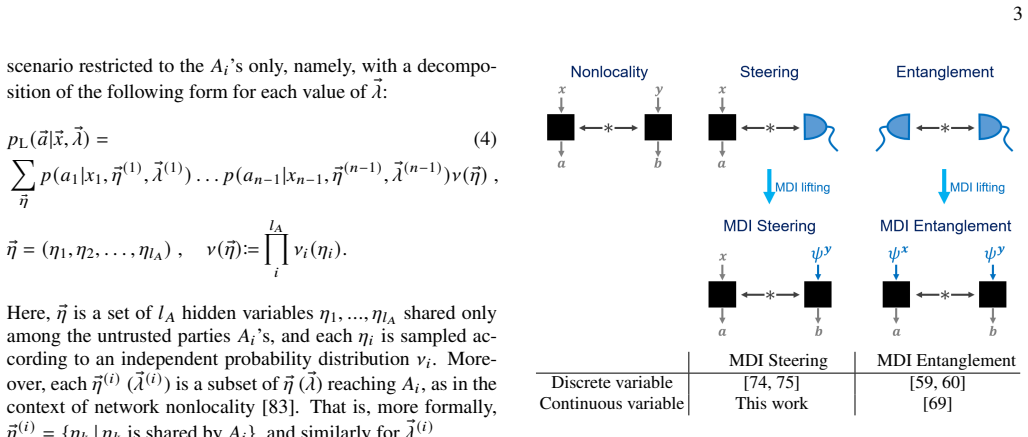
It is always possible to lift steering certification to the measurement-device-independent regime, in which even the last trusted party can treat their local hardware as a black-box, except for a set of fiduciary quantum states used as the inputs to the experiment. This holds both for finite-dimensional systems as well as for bosonic continuous-variable systems, for which a full characterization is provided in the bipartite case. Measurement-device-independent network steering protocols based entirely on Gaussian operations are introduced, which cannot be used for fully device-independent protocols but become viable once a single trusted input is inserted.
What carries the argument
Lifting of steering certification to the measurement-device-independent regime via fiduciary quantum states prepared by the single trusted party
If this is right
- Steering-based applications such as randomness generation become feasible with minimal trust beyond full nonlocality.
- Gaussian operations become a viable option for certification as soon as one trusted input is available in the network.
- The bipartite continuous-variable case admits a full characterization under this minimal-trust model.
- The protocols have feasible experimental requirements compared with fully device-independent approaches.
Where Pith is reading between the lines
- Networks containing only one party capable of preparing trusted states could now support steering certification in more realistic hardware settings.
- The minimal-trust model may serve as an intermediate step between standard steering and full device-independent protocols for other quantum tasks.
- Similar lifting arguments might extend the Gaussian schemes to larger multipartite continuous-variable networks.
Load-bearing premise
A trusted set of fiduciary quantum states can be prepared and injected as inputs by the single trusted party independently of the untrusted devices.
What would settle it
An experiment in which the single trusted party cannot prepare or verify the required fiduciary states without depending on the untrusted devices, so that the measurement-device-independent lifting no longer works.
Figures
read the original abstract
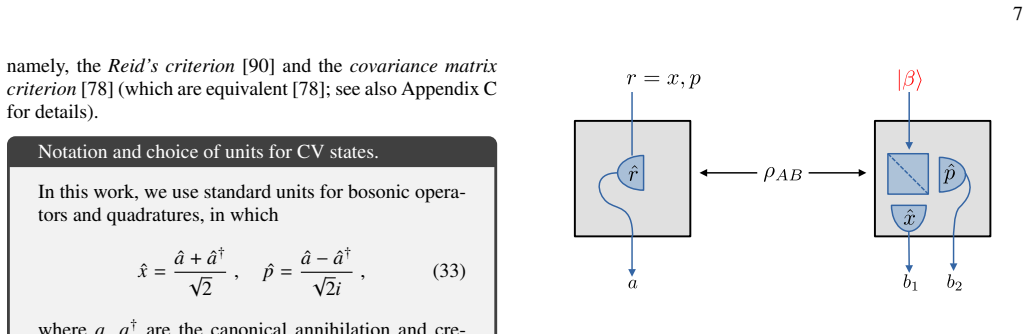
We consider quantum steering certification in multipartite networks, with a focus on minimal trust scenarios: all-except-one parties are untrusted and treated device-independently. We show that it is always possible to lift steering certification to the measurement-device-independent regime, in which even the (last) trusted party can treat their local hardware as a black-box, except for a set of fiduciary quantum states used as the inputs to the experiment. This holds both for finite-dimensional systems as well as for bosonic continuous-variable systems, for which we provide a full characterization in the bipartite case. Additionally, we introduce measurement-device-independent network steering protocols based entirely on Gaussian operations -- which cannot be used for fully device-independent protocols, and thus become instead a viable option for minimal trust certification as soon as a single trusted input is inserted in the network. Our results present a basis for steering-based applications (such as randomness generation) with minimal trust beyond full nonlocality and with feasible experimental requirements.
Editorial analysis
A structured set of objections, weighed in public.
Referee Report
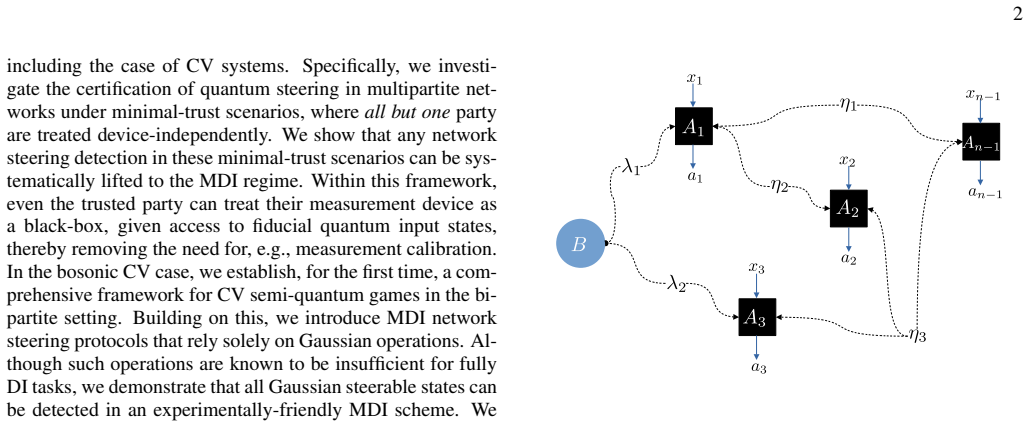
Summary. The manuscript claims that steering certification in multipartite networks can always be lifted to the measurement-device-independent (MDI) regime, treating all but one party device-independently while using a trusted set of fiduciary quantum states as inputs for the remaining party. This lifting holds for finite-dimensional systems and bosonic continuous-variable systems (with a full bipartite CV characterization provided). The authors additionally introduce practical MDI network steering protocols based entirely on Gaussian operations and discuss applications such as randomness generation under minimal trust assumptions.
Significance. If the lifting result and bipartite CV characterization hold rigorously, the work provides a valuable bridge between standard steering and full device independence, enabling steering-based tasks with reduced trust and feasible experimental requirements via Gaussian schemes. The explicit conditioning on fiduciary states is a strength, as it makes the minimal-trust model transparent and falsifiable. The result is particularly relevant for continuous-variable systems where Gaussian operations are practical.
minor comments (2)
- [Abstract] The abstract states a 'full characterization' for the bipartite CV case; the main text should explicitly delineate the scope (e.g., which class of states or measurements are covered) to avoid ambiguity about completeness.
- Notation for the fiduciary states and the MDI lifting construction should be introduced with a clear diagram or table in the main text to aid readability for experimental readers.
Simulated Author's Rebuttal
We thank the referee for their positive summary, significance assessment, and recommendation of minor revision for our manuscript on quantum steering in networks. No specific major comments are provided in the report, so we have nothing further to address point by point.
Circularity Check
No significant circularity
full rationale
The paper advances a theoretical existence result: steering certification can always be lifted to the MDI regime provided a trusted set of fiduciary input states is available to the single trusted party. This is stated explicitly as a conditional characterization applying to both finite-dimensional and bipartite CV systems, with additional Gaussian protocols introduced under the same minimal-trust premise. No load-bearing step reduces by construction to a fitted parameter, self-definition, or self-citation chain; the central claim does not rename empirical patterns or import uniqueness theorems from prior author work as external facts. The derivation therefore remains self-contained against external benchmarks and receives the default non-circularity finding.
Axiom & Free-Parameter Ledger
axioms (1)
- standard math Standard postulates of quantum mechanics (Hilbert space, Born rule, completely positive maps)
Reference graph
Works this paper leans on
-
[1]
Each of them must beR,N, or a finite Cartesian product between them
Four index setsA={𝑎},B={𝑏},X={𝑥},Y={𝑦}. Each of them must beR,N, or a finite Cartesian product between them
-
[2]
A probability distribution𝑃 X (𝑥)onXand a state en- semble{𝜓 𝑦 𝐵′ , 𝑃Y (𝑦)} 𝑦 onY(namely, each𝜓 𝑦 𝐵′ is a state, and𝑃 Y (𝑦)is a probability distribution onY)
-
[3]
⪰game” and its strong version “≻game
A bounded pay-off functionP:A × B × X × Y →R. 6 A given steering gameGaims to test the steerability of a given state𝜌 𝐴𝐵 shared by Alice and Bob, which works as follows. In each round, the referee picks indices𝑥∈ Xand𝑦∈ Y according to the probability distributions𝑃 X (𝑥)and𝑃 Y (𝑦). The referee sends the index𝑥to Alice and the quantum state 𝜓 𝑦 𝐵′ to Bob. ...
-
[4]
almost device- independent
In these units, the quadratures’ variance on coherent states, including the vacuum, is equal to 1 2. Coherent states are defined as |𝛼⟩ =𝑒 𝑖 √ 2𝛼 𝑝 ˆ𝑥−𝑖 √ 2𝛼 𝑥 ˆ𝑝|0⟩ =𝑒 𝛼ˆ𝑎† −𝛼 ∗ ˆ𝑎|0⟩ ,(34) where𝛼=𝛼 𝑥 +𝑖𝛼 𝑝. A coherent state satisfies⟨ˆ𝑥𝛼⟩=√ 2𝛼𝑥 and⟨ˆ𝑝𝛼⟩= √ 2𝛼 𝑝. Reid’s criterion considers a two-input scenario for the un- trusted party, Alice, trying to ...
-
[5]
Quantum complementarity: a novel resource for quantum science and technologies
From this, with such a protocol, it follows that the entire witness becomes Wprotocol = 1 2 + ⟨ˆ𝑥2 err⟩ + ⟨ˆ𝑝2 err⟩ 2 .(44) It then further follows that, if𝜌 𝐴𝐵 is steerable and such that ⟨ˆ𝑥2 err⟩ + ⟨ˆ𝑝2 err⟩<1, we have Wprotocol <1,(45) which violates the inequality in Eq. (40) whenΔ 𝛽 is suffi- ciently large. For a pure two-mode squeezed state, which c...
2024
-
[6]
Gisin, G
N. Gisin, G. Ribordy, W. Tittel, and H. Zbinden, Quantum cryptography, Rev. Mod. Phys.74, 145 (2002)
2002
-
[7]
Chiribella, G
G. Chiribella, G. M. D ´Ariano, and P. Perinotti, Theoreti- cal framework for quantum networks, Physics Review A80, 022339 (2009)
2009
-
[8]
Wehner, D
S. Wehner, D. Elkouss, and R. Hanson, Quantum internet: A vision for the road ahead, Science362, eaam9288 (2018)
2018
-
[9]
Azuma, S
K. Azuma, S. E. Economou, D. Elkouss, P. Hilaire, L. Jiang, H.-K. Lo, and I. Tzitrin, Quantum repeaters: From quantum networks to the quantum internet, Reviews of Modern Physics 95, 045006 (2023)
2023
-
[10]
D. Main, P. Drmota, D. P. Nadlinger, E. M. Ainley, A. Agrawal, B. C. Nichol, R. Srinivas, G. Araneda, and D. M. Lucas, Distributed quantum computing across an optical net- work link, Nature638, 383–388 (2025)
2025
-
[11]
Raussendorf and H
R. Raussendorf and H. J. Briegel, A One-Way Quantum Com- puter, Physical Review Letters86, 5188 (2001)
2001
-
[12]
Yang, H.-Y
Z.-P. Yang, H.-Y . Ku, A. Baishya, Y .-R. Zhang, A. F. Kockum, Y .-N. Chen, F.-L. Li, J.-S. Tsai, and F. Nori, Deterministic one- way logic gates on a cloud quantum computer, Phys. Rev. A 105, 042610 (2022)
2022
-
[13]
C. Roh, G. Gwak, Y .-D. Yoon, and Y .-S. Ra, Generation of three-dimensional cluster entangled state, Nature Photonics 19, 526–532 (2025)
2025
-
[14]
Gashu Feyisa, J.-S
C. Gashu Feyisa, J.-S. You, H.-Y . Ku, and H. H. Jen, Accel- erating multipartite entanglement generation in non-hermitian superconducting qubits, Quantum Science and Technology10, 025021 (2025)
2025
-
[15]
S. P. Neumann, A. Buchner, L. Bulla, M. Bohmann, and R. Ursin, Continuous entanglement distribution over a transna- tional 248 km fiber link, Nature Communications13, 6134 (2022)
2022
-
[16]
Jiang et al., One- and two-dimensional cluster states for topological phase simulation and measurement-based quan- tum computation, Nature Physics22, 430–438 (2026)
T. Jiang et al., One- and two-dimensional cluster states for topological phase simulation and measurement-based quan- tum computation, Nature Physics22, 430–438 (2026)
2026
-
[17]
Zhang, Y .-Y
R. Zhang, Y .-Y . Fei, Z. Liu, X. Zhang, X.-F. Yin, Y . Mao, L. Li, N.-L. Liu, O. G ¨uhne, X. Ma, Y .-A. Chen, and J.-W. Pan, Entanglement superactivation in multiphoton distillation networks, Phys. Rev. Lett.136, 120801 (2026)
2026
-
[18]
Chudzicki and F
C. Chudzicki and F. W. Strauch, Parallel state transfer and effi- cient quantum routing on quantum networks, Phys. Rev. Lett. 105, 260501 (2010)
2010
-
[19]
F. Hahn, A. Pappa, and J. Eisert, Quantum network routing and local complementation, npj Quantum Information5, 76 (2019)
2019
-
[20]
Kristj ´ansson, Y
H. Kristj ´ansson, Y . Zhong, A. Munson, and G. Chiribella, Quantum networks with coherent routing of information through multiple nodes, npj Quantum Information10, 131 (2024)
2024
-
[21]
Rosset, C
D. Rosset, C. Branciard, T. J. Barnea, G. P ¨utz, N. Brunner, and N. Gisin, Nonlinear bell inequalities tailored for quantum networks, Phys. Rev. Lett.116, 010403 (2016)
2016
-
[22]
J. Yin, Y . Cao, Y .-H. Li, S.-K. Liao, L. Zhang, J.-G. Ren, W.-Q. Cai, W.-Y . Liu, B. Li, H. Dai, G.-B. Li, Q.-M. Lu, Y .-H. Gong, Y . Xu, S.-L. Li, F.-Z. Li, Y .-Y . Yin, Z.-Q. Jiang, M. Li, J.-J. Jia, G. Ren, D. He, Y .-L. Zhou, X.-X. Zhang, N. Wang, X. Chang, Z.-C. Zhu, N.- L. Liu, Y .-A. Chen, C.-Y . Lu, R. Shu, C.-Z. Peng, J.- Y . Wang, and J.-W. Pa...
-
[23]
Liao, W.-Q
S.-K. Liao, W.-Q. Cai, W.-Y . Liu, L. Zhang, Y . Li, J.-G. Ren, J. Yin, Q. Shen, Y . Cao, Z.-P. Li, F.-Z. Li, X.-W. Chen, L.-H. Sun, J.-J. Jia, J.-C. Wu, X.-J. Jiang, J.-F. Wang, Y .-M. Huang, Q. Wang, Y .-L. Zhou, L. Deng, T. Xi, L. Ma, T. Hu, Q. Zhang, Y .-A. Chen, N.-L. Liu, X.-B. Wang, Z.-C. Zhu, C.-Y . Lu, R. Shu, C.-Z. Peng, J.-Y . Wang, and J.-W. P...
2017
-
[24]
Navascu ´es, E
M. Navascu ´es, E. Wolfe, D. Rosset, and A. Pozas-Kerstjens, Genuine network multipartite entanglement, Phys. Rev. Lett. 125, 240505 (2020)
2020
-
[25]
Villegas-Aguilar, E
L. Villegas-Aguilar, E. Polino, F. Ghafari, M. T. Quintino, K. T. Laverick, I. R. Berkman, S. Rogge, L. K. Shalm, N. Tis- chler, E. G. Cavalcanti, S. Slussarenko, and G. J. Pryde, Non- locality activation in a photonic quantum network, Nature Communications15, 3112 (2024)
2024
-
[26]
T ´oth and O
G. T ´oth and O. G ¨uhne, Detecting genuine multipartite entan- glement with two local measurements, Phys. Rev. Lett.94, 060501 (2005)
2005
-
[27]
Y . Zhou, Q. Zhao, X. Yuan, and X. Ma, Detecting multipartite entanglement structure with minimal resources, npj Quantum Information5, 83 (2019)
2019
-
[28]
Seong, A
J. Seong, A. Bera, B. C. Hiesmayr, D. Chru´sci´nski, and J. Bae, Mirrored entanglement witnesses for multipartite and high- dimensional quantum systems, Quantum Science and Tech- nology11, 015037 (2026)
2026
-
[29]
Brunner, D
N. Brunner, D. Cavalcanti, S. Pironio, V . Scarani, and S. Wehner, Bell nonlocality, Rev. Mod. Phys.86, 419 (2014)
2014
-
[31]
J. I. Cirac, P. Zoller, H. J. Kimble, and H. Mabuchi, Quan- tum state transfer and entanglement distribution among distant nodes in a quantum network, Phys. Rev. Lett.78, 3221 (1997)
1997
-
[32]
Ac ´ın, N
A. Ac ´ın, N. Brunner, N. Gisin, S. Massar, S. Pironio, and V . Scarani, Device-independent security of quantum cryptog- raphy against collective attacks, Phys. Rev. Lett.98, 230501 (2007)
2007
-
[33]
G ¨uhne and G
O. G ¨uhne and G. T ´oth, Entanglement detection, Physics Re- ports474, 1 (2009)
2009
-
[34]
Vazirani and T
U. Vazirani and T. Vidick, Fully device-independent quantum key distribution, Phys. Rev. Lett.113, 140501 (2014)
2014
-
[35]
Chen, H.-Y
S.-L. Chen, H.-Y . Ku, W. Zhou, J. Tura, and Y .-N. Chen, Ro- bust self-testing of steerable quantum assemblages and its ap- plications on device-independent quantum certification, Quan- tum5, 552 (2021)
2021
-
[36]
L. B. Vieira, H.-Y . Ku, and C. Budroni, Entanglement- breaking channels are a quantum memory resource, Phys. Rev. Res.7, 043281 (2025)
2025
-
[37]
Armstrong, M
S. Armstrong, M. Wang, R. Y . Teh, Q. Gong, Q. He, J. Janousek, H.-A. Bachor, M. D. Reid, and P. K. Lam, Mul- tipartite einstein–podolsky–rosen steering and genuine tripar- tite entanglement with optical networks, Nature Physics11, 167–172 (2015)
2015
-
[38]
Cavalcanti, P
D. Cavalcanti, P. Skrzypczyk, G. H. Aguilar, R. V . Nery, P. S. Ribeiro, and S. P. Walborn, Detection of entanglement in asymmetric quantum networks and multipartite quantum steering, Nature Communications6, 7941 (2015)
2015
-
[39]
B. D. M. Jones, I. ˇSupi´c, R. Uola, N. Brunner, and P. Skrzypczyk, Network quantum steering, Phys. Rev. Lett. 127, 170405 (2021). 11
2021
-
[40]
Zhang, S
H. Zhang, S. Yang, and K. He, Star network quantum steering, Quantum Information Processing22, 286 (2023)
2023
-
[41]
L. E. A. Porto, L. Tendick, D. Cavalcanti, R. Uola, and M. T ´ulio Quintino, Can every set of incompatible measure- ments lead to genuine multipartite steering?, arXiv e-prints , arXiv:2603.25345 (2026), arXiv:2603.25345 [quant-ph]
arXiv 2026
-
[42]
Sarkar, Witnessing network steerability of every bipartite entangled state without inputs, Phys
S. Sarkar, Witnessing network steerability of every bipartite entangled state without inputs, Phys. Rev. A113, 032212 (2026)
2026
-
[43]
Sarkar, Network quantum steering enables randomness cer- tification without seed randomness, Quantum8, 1419 (2024)
S. Sarkar, Network quantum steering enables randomness cer- tification without seed randomness, Quantum8, 1419 (2024)
2024
-
[45]
Cavalcanti and P
D. Cavalcanti and P. Skrzypczyk, Quantum steering: a review with focus on semidefinite programming, Reports on Progress in Physics80, 024001 (2016)
2016
-
[46]
R. Uola, A. C. S. Costa, H. C. Nguyen, and O. G ¨uhne, Quan- tum steering, Rev. Mod. Phys.92, 015001 (2020)
2020
-
[47]
Xiang, S
Y . Xiang, S. Cheng, Q. Gong, Z. Ficek, and Q. He, Quan- tum steering: Practical challenges and future directions, PRX Quantum3, 030102 (2022)
2022
-
[48]
Passaro, D
E. Passaro, D. Cavalcanti, P. Skrzypczyk, and A. Ac ´ın, Op- timal randomness certification in the quantum steering and prepare-and-measure scenarios, New Journal of Physics17, 113010 (2015)
2015
-
[49]
D. J. Joch, S. Slussarenko, Y . Wang, A. Pepper, S. Xie, B.- B. Xu, I. R. Berkman, S. Rogge, and G. J. Pryde, Certified random-number generation from quantum steering, Phys. Rev. A106, L050401 (2022)
2022
-
[50]
Y . Li, Y . Xiang, X.-D. Yu, H. C. Nguyen, O. G ¨uhne, and Q. He, Randomness certification from multipartite quantum steering for arbitrary dimensional systems, Phys. Rev. Lett. 132, 080201 (2024)
2024
-
[51]
Y . Li, Y . Xiang, J. Tura, and Q. He, Necessary and sufficient condition for randomness certification from incompatibility, Phys. Rev. Lett.135, 060201 (2025)
2025
-
[52]
M. T. Quintino, T. V ´ertesi, and N. Brunner, Joint measura- bility, einstein-podolsky-rosen steering, and bell nonlocality, Phys. Rev. Lett.113, 160402 (2014)
2014
-
[53]
R. Uola, C. Budroni, O. G ¨uhne, and J.-P. Pellonp ¨a¨a, One-to- one mapping between steering and joint measurability prob- lems, Phys. Rev. Lett.115, 230402 (2015)
2015
-
[54]
Ku, C.-Y
H.-Y . Ku, C.-Y . Hsieh, S.-L. Chen, Y .-N. Chen, and C. Bu- droni, Complete classification of steerability under local fil- ters and its relation with measurement incompatibility, Nature Communications13, 4973 (2022)
2022
-
[55]
H.-Y . Ku, J. Kadlec, A. ˇCernoch, M. T. Quintino, W. Zhou, K. Lemr, N. Lambert, A. Miranowicz, S.-L. Chen, F. Nori, and Y .-N. Chen, Quantifying quantumness of channels with- out entanglement, PRX Quantum3, 020338 (2022)
2022
-
[56]
C.-Y . Hsieh, H.-Y . Ku, and C. Budroni, Characterisation and fundamental limitations of irreversible stochastic steer- ing distillation, arXiv e-prints , arXiv:2309.06191 (2023), arXiv:2309.06191 [quant-ph]
arXiv 2023
- [57]
-
[58]
Ji and E
K. Ji and E. Chitambar, Incompatibility as a resource for pro- grammable quantum instruments, PRX Quantum5, 010340 (2024)
2024
-
[59]
Hsieh and S.-L
C.-Y . Hsieh and S.-L. Chen, Thermodynamic approach to quantifying incompatible instruments, Phys. Rev. Lett.133, 170401 (2024)
2024
-
[60]
C.-Y . Hsieh and M. Gessner, General quantum resources provide advantages in work extraction tasks (2025), arXiv:2403.18753 [quant-ph]
arXiv 2025
-
[61]
Beyer, K
K. Beyer, K. Luoma, and W. T. Strunz, Steering heat en- gines: A truly quantum maxwell demon, Phys. Rev. Lett.123, 250606 (2019)
2019
-
[62]
W. Ji, Z. Chai, M. Wang, Y . Guo, X. Rong, F. Shi, C. Ren, Y . Wang, and J. Du, Spin quantum heat engine quantified by quantum steering, Phys. Rev. Lett.128, 090602 (2022)
2022
-
[63]
Biswas, C
T. Biswas, C. Datta, and L. P. Garc´ıa-Pintos, Quantum thermo- dynamic advantage in work extraction from steerable quantum correlations, Phys. Rev. Lett.135, 110402 (2025)
2025
-
[64]
Buscemi, All entangled quantum states are nonlocal, Phys
F. Buscemi, All entangled quantum states are nonlocal, Phys. Rev. Lett.108, 200401 (2012)
2012
-
[65]
Branciard, D
C. Branciard, D. Rosset, Y .-C. Liang, and N. Gisin, Measurement-device-independent entanglement witnesses for all entangled quantum states, Phys. Rev. Lett.110, 060405 (2013)
2013
-
[66]
P. Xu, X. Yuan, L.-K. Chen, H. Lu, X.-C. Yao, X. Ma, Y .- A. Chen, and J.-W. Pan, Implementation of a measurement- device-independent entanglement witness, Phys. Rev. Lett. 112, 140506 (2014)
2014
-
[67]
Verbanis, A
E. Verbanis, A. Martin, D. Rosset, C. C. W. Lim, R. T. Thew, and H. Zbinden, Resource-efficient measurement- device-independent entanglement witness, Phys. Rev. Lett. 116, 190501 (2016)
2016
-
[68]
Z.-D. Li, Q. Zhao, R. Zhang, L.-Z. Liu, X.-F. Yin, X. Zhang, Y .-Y . Fei, K. Chen, N.-L. Liu, F. Xu, Y .-A. Chen, L. Li, and J.- W. Pan, Measurement-device-independent entanglement wit- ness of tripartite entangled states and its applications, Phys. Rev. Lett.124, 160503 (2020)
2020
-
[69]
Cavalcanti, P
D. Cavalcanti, P. Skrzypczyk, and I. ˇSupi´c, All entangled states can demonstrate nonclassical teleportation, Phys. Rev. Lett.119, 110501 (2017)
2017
-
[70]
Rosset, F
D. Rosset, F. Buscemi, and Y .-C. Liang, Resource theory of quantum memories and their faithful verification with minimal assumptions, Phys. Rev. X8, 021033 (2018)
2018
-
[71]
ˇSupi´c, P
I. ˇSupi´c, P. Skrzypczyk, and D. Cavalcanti, Methods to esti- mate entanglement in teleportation experiments, Phys. Rev. A 99, 032334 (2019)
2019
-
[72]
Lipka-Bartosik and P
P. Lipka-Bartosik and P. Skrzypczyk, Operational advantages provided by nonclassical teleportation, Phys. Rev. Res.2, 023029 (2020)
2020
-
[73]
Lipka-Bartosik, A
P. Lipka-Bartosik, A. F. Ducuara, T. Purves, and P. Skrzypczyk, Operational significance of the quantum resource theory of buscemi nonlocality, PRX Quantum2, 020301 (2021)
2021
-
[74]
Abiuso, S
P. Abiuso, S. B ¨auml, D. Cavalcanti, and A. Ac ´ın, Measurement-device-independent entanglement detection for continuous-variable systems, Phys. Rev. Lett.126, 190502 (2021)
2021
-
[75]
Abiuso, Verification of continuous-variable quantum mem- ories, Quantum Science and Technology9, 01LT02 (2023)
P. Abiuso, Verification of continuous-variable quantum mem- ories, Quantum Science and Technology9, 01LT02 (2023)
2023
-
[76]
B. L. Larsen, A. A. E. Hajomer, P. Abiuso, S. Izumi, T. Gehring, J. S. Neergaard-Nielsen, A. Ac ´ın, and U. L. An- dersen, Continuous variable measurement-device-independent quantum certification, Phys. Rev. X16, 011070 (2026)
2026
-
[77]
S. L. Braunstein and P. van Loock, Quantum information with continuous variables, Rev. Mod. Phys.77, 513 (2005)
2005
-
[78]
Weedbrook, S
C. Weedbrook, S. Pirandola, R. Garc´ıa-Patr´on, N. J. Cerf, T. C. Ralph, J. H. Shapiro, and S. Lloyd, Gaussian quantum infor- mation, Rev. Mod. Phys.84, 621 (2012)
2012
-
[79]
E. G. Cavalcanti, M. J. W. Hall, and H. M. Wiseman, Entan- glement verification and steering when alice and bob cannot 12 be trusted, Phys. Rev. A87, 032306 (2013)
2013
-
[80]
Zhao, H.-Y
Y .-Y . Zhao, H.-Y . Ku, S.-L. Chen, H.-B. Chen, F. Nori, G.- Y . Xiang, C.-F. Li, G.-C. Guo, and Y .-N. Chen, Experimental demonstration of measurement-device-independent measure of quantum steering, npj Quantum Information6, 77 (2020)
2020
-
[81]
Y . Guo, S. Cheng, X. Hu, B.-H. Liu, E.-M. Huang, Y .- F. Huang, C.-F. Li, G.-C. Guo, and E. G. Cavalcanti, Ex- perimental measurement-device-independent quantum steer- ing and randomness generation beyond qubits, Phys. Rev. Lett. 123, 170402 (2019)
2019
-
[82]
Y .-Y . Zhao, C. Zhang, S. Cheng, X. Li, Y . Guo, B.-H. Liu, H.- Y . Ku, S.-L. Chen, Q. Wen, Y .-F. Huang, G.-Y . Xiang, C.-F. Li, and G.-C. Guo, Device-independent verification of einstein– podolsky–rosen steering, Optica10, 66 (2023)
2023
discussion (0)
Sign in with ORCID, Apple, or X to comment. Anyone can read and Pith papers without signing in.