Second-order dc conductivity in the velocity-gauge Keldysh formalism: gauge-invariant decomposition into nonlinear Drude, Berry-curvature-dipole, and quantum-metric responses
Pith reviewed 2026-06-26 10:11 UTC · model grok-4.3
The pith
The second-order dc nonlinear conductivity decomposes gauge-invariantly into four contributions with distinct relaxation-time scalings.
A machine-rendered reading of the paper's core claim, the machinery that carries it, and where it could break.
Core claim
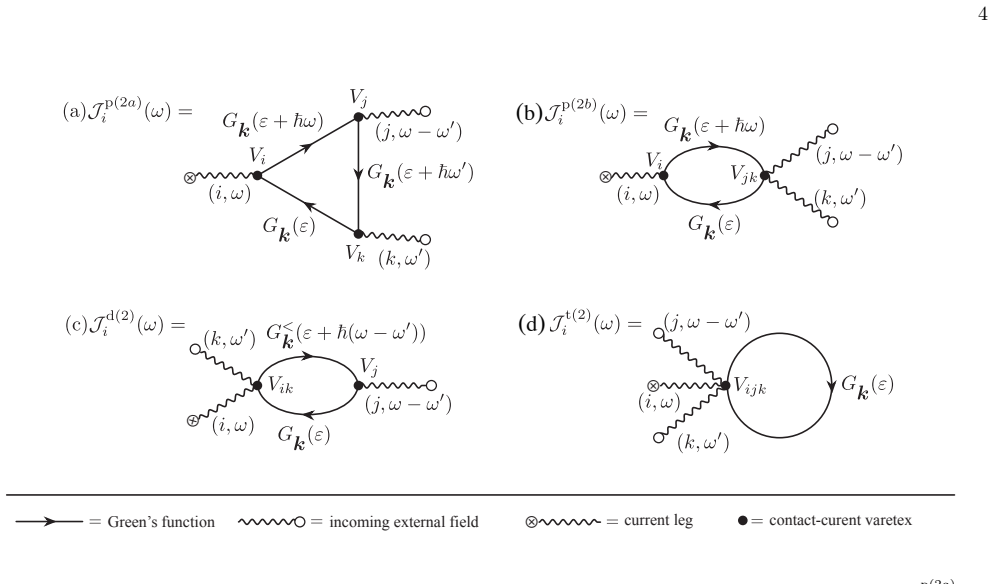
In the constant-relaxation-time approximation, the dc response separates into four contributions with distinct lifetime τ scalings and physical origins: the nonlinear Drude term σ^ND_ijk ∝ τ², the Berry-curvature-dipole term σ^BCD_ijk ∝ τ, the intraband quantum-metric-dipole term σ^intra-QMD_ijk ∝ τ⁰, and the interband quantum-metric-dipole term σ^inter-QMD_ijk ∝ τ⁰. All connection-dependent commutator terms generated in the band-basis expansion cancel exactly between the covariant-quantum-connection sector σ^C_ijk and the three-Berry-connection sector σ^T_ijk.
What carries the argument
Velocity-gauge Keldysh Green's function formalism with Peierls contact velocity vertices, producing exact cancellation of connection-dependent commutators between the covariant-quantum-connection and three-Berry-connection sectors.
If this is right
- The nonlinear Drude term dominates the response when the scattering lifetime is long.
- The Berry-curvature-dipole term scales linearly with lifetime while the two quantum-metric terms remain finite even at short lifetimes.
- Quantum-metric dipole responses can appear in systems where Berry curvature is identically zero.
- The intraband term is a Fermi-surface dipole of the ordinary quantum metric; the interband term is a Fermi-sea response involving a band-normalized quantum metric.
Where Pith is reading between the lines
- Varying the scattering rate experimentally could separate the four contributions by their different τ powers.
- The lifetime-independent quantum-metric terms may survive in disordered samples where the Drude and Berry terms are suppressed.
- The exact cancellation mechanism might extend to higher-order nonlinear responses within the same formalism.
Load-bearing premise
The constant-relaxation-time approximation holds throughout the clean limit for multiband tight-binding systems.
What would settle it
An explicit calculation of the second-order conductivity in a multiband model with momentum-dependent scattering that shows the four τ-scaling sectors mixing or the connection commutators failing to cancel.
Figures


read the original abstract
We derive a gauge-invariant clean-limit decomposition of the second-order dc nonlinear conductivity in multiband tight-binding systems within the velocity-gauge Keldysh Green's function formalism. In the constant-relaxation-time approximation, the dc response separates into four contributions with distinct lifetime $\tau$ scalings and physical origins: the nonlinear Drude term $\sigma^{\mathrm{ND}}_{ijk}\propto\tau^{2}$, the Berry-curvature-dipole term $\sigma^{\mathrm{BCD}}_{ijk}\propto\tau$, the intraband quantum-metric-dipole term $\sigma^{\mathrm{intra\text{-}QMD}}_{ijk}\propto\tau^{0}$, and the interband quantum-metric-dipole term $\sigma^{\mathrm{inter\text{-}QMD}}_{ijk}\propto\tau^{0}$. The intraband term is a Fermi-surface dipole of the ordinary band quantum metric, while the interband term is written, in the present representation, as a Fermi-sea-type response involving a band-normalized quantum metric. Working entirely within the velocity-gauge Keldysh--Kubo framework, we show that all connection-dependent commutator terms generated in the band-basis expansion cancel exactly between the covariant-quantum-connection sector $\sigma^{\mathcal{C}}_{ijk}$ and the three-Berry-connection sector $\sigma^{\mathcal{T}}_{ijk}$, making the role of the Peierls contact velocity vertices $V_{ij}$ and $V_{ijk}$ explicit; a complementary projector-based derivation appears in Ulrich et al., Phys. Rev. B 113, L201107 (2026), and our Fermi-surface dc-limit expression agrees with that reference after accounting for index and convention differences. As a diagnostic illustration, we introduce a real two-band model in which the Berry curvature and hence the BCD response vanish identically while the intraband quantum-metric dipole remains finite, establishing a practical route to quantum-metric dc responses not reducible to the Berry-curvature-dipole mechanism.
Editorial analysis
A structured set of objections, weighed in public.
Referee Report
Summary. The manuscript derives a gauge-invariant clean-limit decomposition of the second-order dc nonlinear conductivity for multiband tight-binding systems in the velocity-gauge Keldysh Green's function formalism under the constant-relaxation-time approximation. The dc response is separated into four contributions with distinct lifetime scalings: nonlinear Drude (∝τ²), Berry-curvature-dipole (∝τ), intraband quantum-metric-dipole (Fermi-surface dipole of the ordinary band quantum metric, ∝τ⁰), and interband quantum-metric-dipole (Fermi-sea-type response with band-normalized quantum metric, ∝τ⁰). All connection-dependent commutator terms cancel exactly between the covariant-quantum-connection sector and the three-Berry-connection sector; the Fermi-surface dc limit agrees with the complementary projector derivation of Ulrich et al. after index/convention adjustments. A diagnostic two-band model is introduced in which Berry curvature (and thus BCD) vanishes identically while the intraband QMD remains finite.
Significance. If the derivation holds, the work supplies a physically transparent separation of nonlinear dc conductivity channels according to their scattering-time dependence and isolates the independent contribution of the quantum metric. The explicit demonstration of exact commutator cancellation within the velocity-gauge Keldysh framework, together with the cross-check against an independent projector method, strengthens the result. The two-band model provides a concrete, falsifiable route to QMD-dominated responses that cannot be reduced to Berry-curvature mechanisms. These elements advance the analysis of nonlinear transport in multiband and topological systems.
minor comments (1)
- [Abstract] Abstract: the parenthetical remark on agreement with Ulrich et al. states that index and convention differences have been accounted for, but does not list them; a single sentence enumerating the main differences would improve immediate readability for readers comparing the two expressions.
Simulated Author's Rebuttal
We thank the referee for the careful reading of our manuscript and for the positive assessment. We are pleased that the referee finds the gauge-invariant decomposition, the exact cancellation of commutator terms, the cross-check with the projector method, and the diagnostic two-band model to be valuable contributions.
Circularity Check
No significant circularity; derivation self-contained in Keldysh framework
full rationale
The paper derives the gauge-invariant decomposition and exact cancellation of connection-dependent commutators directly from the velocity-gauge Keldysh Green's function formalism under constant-relaxation-time approximation. The four contributions with distinct τ scalings follow from the band-basis expansion and Peierls vertices within that framework. The cited Ulrich et al. reference supplies an independent complementary projector derivation and external agreement check on the Fermi-surface limit rather than a load-bearing self-citation chain. No parameters are fitted and then relabeled as predictions, no ansatz is imported via prior self-work, and no uniqueness theorem is invoked from overlapping authors. The central results are therefore not equivalent to the inputs by construction.
Axiom & Free-Parameter Ledger
free parameters (1)
- relaxation time τ
axioms (2)
- domain assumption Velocity-gauge Keldysh Green's function formalism applies to multiband tight-binding systems in the clean limit
- domain assumption Constant-relaxation-time approximation holds for classifying dc responses
Reference graph
Works this paper leans on
-
[1]
Provost, J. P. and Vall. Riemannian structure on manifolds of quantum states , journal =. 1980 , doi =
1980
-
[2]
and Sinova, J
Nagaosa, N. and Sinova, J. and Onoda, S. and MacDonald, A. H. and Ong, N. P. , title =. Reviews of Modern Physics , volume =. 2010 , doi =
2010
-
[3]
Peotta, S. and T. Superfluidity in topologically nontrivial flat bands , journal =. 2015 , doi =
2015
-
[4]
Superconductivity, superfluidity and quantum geometry in twisted multilayer systems , journal =
T. Superconductivity, superfluidity and quantum geometry in twisted multilayer systems , journal =. 2022 , doi =
2022
-
[5]
and Guo, G.-Y
Ahn, J. and Guo, G.-Y. and Nagaosa, N. and Vishwanath, A. , title =. Nature Physics , volume =. 2022 , doi =
2022
-
[6]
and Fu, L
Sodemann, I. and Fu, L. , title =. Physical Review Letters , volume =. 2015 , doi =
2015
-
[7]
Semiclassical theory of the photogalvanic effect in non-centrosymmetric systems
Deyo, E. and Golub, L. E. and Ivchenko, E. L. and Spivak, B. , title =. arXiv preprint , year =. 0904.1917 , archivePrefix =
work page internal anchor Pith review Pith/arXiv arXiv 1917
-
[8]
and Orenstein, J
Moore, Joel E. and Orenstein, J. , title =. Phys.\ Rev.\ Lett. , volume =. 2010 , doi =
2010
-
[9]
Ma, Qiong and Xu, Su-Yang and Shen, Huitao and MacNeill, David and Fatemi, Valla and Chang, Tay-Rong and Moll, Alexander M. H. and Jia, Shuang and Orth, Peter P. and Ling, Hong and others , title =. Nature , volume =. 2019 , doi =
2019
-
[10]
Nat.\ Mater
Kang, Kaifei and Li, Tingxin and Sohn, Egon and Shan, Jie and Mak, Kin Fai , title =. Nat.\ Mater. , volume =. 2019 , doi =
2019
-
[11]
Nat.\ Commun
Tokura, Yoshinori and Nagaosa, Naoto , title =. Nat.\ Commun. , volume =. 2018 , doi =
2018
-
[12]
and Yang, S
Gao, Y. and Yang, S. A. and Niu, Q. , title =. Physical Review Letters , volume =. 2014 , doi =
2014
-
[13]
Phys.\ Rev.\ Lett
Wang, Chong and Gao, Yang and Xiao, Di , title =. Phys.\ Rev.\ Lett. , volume =. 2021 , doi =
2021
-
[14]
, title =
Liu, Huiying and Zhao, Jianzhou and Huang, Yue-Xin and Wu, Weikang and Sheng, Xian-Lei and Xiao, Cong and Yang, Shengyuan A. , title =. Phys.\ Rev.\ Lett. , volume =. 2021 , doi =
2021
-
[15]
Phys.\ Rev.\ B , volume =
Das, Kamal and Lahiri, Shibalik and Atencia, Rhonald Burgos and Culcer, Dimitrie and Agarwal, Amit , title =. Phys.\ Rev.\ B , volume =. 2023 , doi =
2023
-
[16]
Phys.\ Rev.\ Lett
Kaplan, Daniel and Holder, Tobias and Yan, Binghai , title =. Phys.\ Rev.\ Lett. , volume =. 2024 , doi =
2024
-
[17]
Qiang, Xiao-Bin and Liu, Tianyu and Gao, Zi-Xuan and Lu, Hai-Zhou and Xie, X. C. , title =. Adv.\ Sci. , volume =. 2026 , doi =
2026
-
[18]
, title =
Ulrich, Yannis and Mitscherling, Johannes and Classen, Laura and Schnyder, Andreas P. , title =. Phys.\ Rev.\ B , volume =. 2026 , doi =
2026
-
[19]
Nature , volume =
Wang, Naizhou and Kaplan, Daniel and Zhang, Zhaowei and Holder, Tobias and Cao, Ning and Wang, Aifeng and Zhou, Xiaoyuan and Zhou, Feifei and Jiang, Zhengzhi and Zhang, Chusheng and Ru, Siyuan and Cai, Hongbing and Watanabe, Kenji and Taniguchi, Takashi and Yan, Binghai and Gao, Weibo , title =. Nature , volume =. 2023 , doi =
2023
-
[20]
Gao, Anyuan and Liu, Yu-Fei and Qiu, Jian-Xiang and Ghosh, Barun and Trevisan, T. V. and Onishi, Yugo and Hu, Chaowei and Qian, Tian and Tien, Hung-Ju and Chen, Sheng-Wei and others , title =. Science , volume =. 2023 , doi =
2023
-
[21]
Ward, J. C. , title =. Phys.\ Rev. , volume =. 1950 , doi =
1950
-
[22]
, title =
Takahashi, Y. , title =. Nuovo Cimento , volume =. 1957 , doi =
1957
-
[23]
and Sipe, J
Aversa, C. and Sipe, J. E. , title =. Phys.\ Rev.\ B , volume =. 1995 , doi =
1995
-
[24]
Sipe, J. E. and Shkrebtii, A. I. , title =. Phys.\ Rev.\ B , volume =. 2000 , doi =
2000
-
[25]
Ventura, G. B. and Passos, D. J. and Lopes dos Santos, J. M. B. and Viana Parente Lopes, J. M. and Peres, N. M. R. , title =. Phys.\ Rev.\ B , volume =. 2017 , doi =
2017
-
[26]
and Morimoto, Takahiro and Orenstein, Joseph and Moore, Joel E
Parker, Daniel E. and Morimoto, Takahiro and Orenstein, Joseph and Moore, Joel E. , title =. Phys.\ Rev.\ B , volume =. 2019 , doi =
2019
-
[27]
Keldysh, L. V. , title =. Sov.\ Phys.\ JETP , volume =
-
[28]
and Smith, H
Rammer, J. and Smith, H. , title =. Rev.\ Mod.\ Phys. , volume =. 1986 , doi =
1986
-
[29]
Ann.\ Phys
Danielewicz, Pawel , title =. Ann.\ Phys. , volume =. 1984 , doi =
1984
-
[30]
, title =
Langreth, David C. , title =. Linear and Nonlinear Electron Transport in Solids , editor =
-
[31]
and Nordlander, Peter , title =
Langreth, David C. and Nordlander, Peter , title =. 1991 , note =
1991
-
[32]
J.\ Phys.\ Soc.\ Jpn
Kubo, Ryogo , title =. J.\ Phys.\ Soc.\ Jpn. , volume =. 1957 , doi =
1957
-
[33]
Greenwood, D. A. , title =. Proc.\ Phys.\ Soc. , volume =. 1958 , doi =
1958
-
[34]
, title =
Boyd, Robert W. , title =
-
[35]
Ziman, J. M. , title =
-
[36]
, title =
Mahan, Gerald D. , title =. 2000 , doi =
2000
-
[37]
Quantum Field Theory of Non-equilibrium States , publisher =
Rammer, J. Quantum Field Theory of Non-equilibrium States , publisher =. 2007 , doi =
2007
-
[38]
, title =
Haug, Hartmut and Koch, Stephan W. , title =. 2009 , doi =
2009
-
[39]
2008 , doi =
Haug, Hartmut and Jauho, Antti-Pekka , title =. 2008 , doi =
2008
-
[40]
2013 , doi =
Stefanucci, Gianluca and van Leeuwen, Robert , title =. 2013 , doi =
2013
-
[41]
and Yao, Y
Culcer, D. and Yao, Y. and Niu, Q. , title =. Physical Review B , volume =. 2005 , doi =
2005
-
[42]
Phys.\ Rev.\ B , volume =
Michishita, Yoshihiro and Nagaosa, Naoto , title =. Phys.\ Rev.\ B , volume =. 2022 , doi =
2022
-
[43]
Phys.\ Rev.\ Research , volume =
Watanabe, Hikaru and Yanase, Youichi , title =. Phys.\ Rev.\ Research , volume =. 2020 , doi =
2020
-
[44]
Phys.\ Rev.\ X , volume =
Watanabe, Hikaru and Yanase, Youichi , title =. Phys.\ Rev.\ X , volume =. 2021 , doi =
2021
-
[45]
J.\ Phys.\ Soc.\ Jpn
Oiwa, Rikuto and Kusunose, Hiroaki , title =. J.\ Phys.\ Soc.\ Jpn. , volume =. 2022 , doi =
2022
-
[46]
Phys.\ Rev.\ B , volume =
Yamaguchi, Terufumi and Nakazawa, Kazuki and Yamakage, Ai , title =. Phys.\ Rev.\ B , volume =. 2024 , doi =
2024
-
[47]
Sci.\ Adv
Morimoto, Takahiro and Nagaosa, Naoto , title =. Sci.\ Adv. , volume =. 2016 , doi =
2016
-
[48]
, title =
Mitscherling, Johannes and Avdoshkin, Alexander and Moore, Joel E. , title =. Phys. Rev. B , volume =. 2025 , doi =
2025
-
[49]
, title =
Avdoshkin, Alexander and Mitscherling, Johannes and Moore, Joel E. , title =. Phys. Rev. Lett. , volume =. 2025 , doi =
2025
-
[50]
Jiang, Yiyang and Holder, Tobias and Yan, Binghai , title =. Rep. Prog. Phys. , volume =. 2025 , doi =
2025
-
[51]
Phys.\ Rev.\ B , volume =
Michishita, Yoshihiro and Peters, Robert , title =. Phys.\ Rev.\ B , volume =. 2021 , doi =
2021
-
[52]
Basis-independent spectral methods for non-linear optical response in arbitrary tight-binding models , journal =
Jo. Basis-independent spectral methods for non-linear optical response in arbitrary tight-binding models , journal =. 2020 , doi =
2020
-
[53]
and Klinovaja, Jelena and Loss, Daniel , title =
Nakazawa, Kazuki and Legg, Henry F. and Klinovaja, Jelena and Loss, Daniel , title =. Phys.\ Rev.\ B , volume =. 2025 , doi =
2025
- [54]
- [55]
- [56]
- [57]
-
[58]
Berry, M. V. , title =. Proc. R. Soc. Lond. A , volume =. 1984 , doi =
1984
-
[59]
Xiao, Di and Chang, Ming-Che and Niu, Qian , title =. Rev. Mod. Phys. , volume =. 2010 , doi =
2010
-
[60]
Resta, Raffaele , title =. Eur. Phys. J. B , volume =. 2011 , doi =
2011
-
[61]
, title =
Foreman, Bradley A. , title =. Phys. Rev. B , volume =. 2002 , doi =
2002
-
[62]
Phys.\ Rev.\ B , volume =
Low, Tony and Jiang, Yongjin and Guinea, Francisco , title =. Phys.\ Rev.\ B , volume =. 2015 , doi =
2015
-
[63]
Phys.\ Rev.\ B , volume =
Nandy, Snehasish and Sodemann, Inti , title =. Phys.\ Rev.\ B , volume =. 2019 , doi =
2019
-
[64]
Du, Z. Z. and Wang, C. M. and Li, Shuai and Lu, Hai-Zhou and Xie, X. C. , title =. Nature Communications , volume =. 2019 , doi =
2019
-
[65]
Xiao, Cong and Du, Z. Z. and Niu, Qian , title =. Phys.\ Rev.\ B , volume =. 2019 , doi =
2019
-
[66]
Du, Z. Z. and Wang, C. M. and Sun, Hai-Peng and Lu, Hai-Zhou and Xie, X. C. , title =. Nature Communications , volume =. 2021 , doi =
2021
-
[67]
Du, Z. Z. and Lu, Hai-Zhou and Xie, X. C. , title =. Nature Reviews Physics , volume =. 2021 , doi =
2021
discussion (0)
Sign in with ORCID, Apple, or X to comment. Anyone can read and Pith papers without signing in.