Detector-Grade Germanium as a Low-Disorder Host for Indium-Acceptor Spin Qubits: A Five-Qubit Materials-to-Architecture Design Study
Pith reviewed 2026-06-26 11:53 UTC · model grok-4.3
The pith
Detector-grade germanium with indium acceptors can host five-qubit spin registers by keeping bulk disorder low enough for hole-spin control.
A machine-rendered reading of the paper's core claim, the machinery that carries it, and where it could break.
Core claim
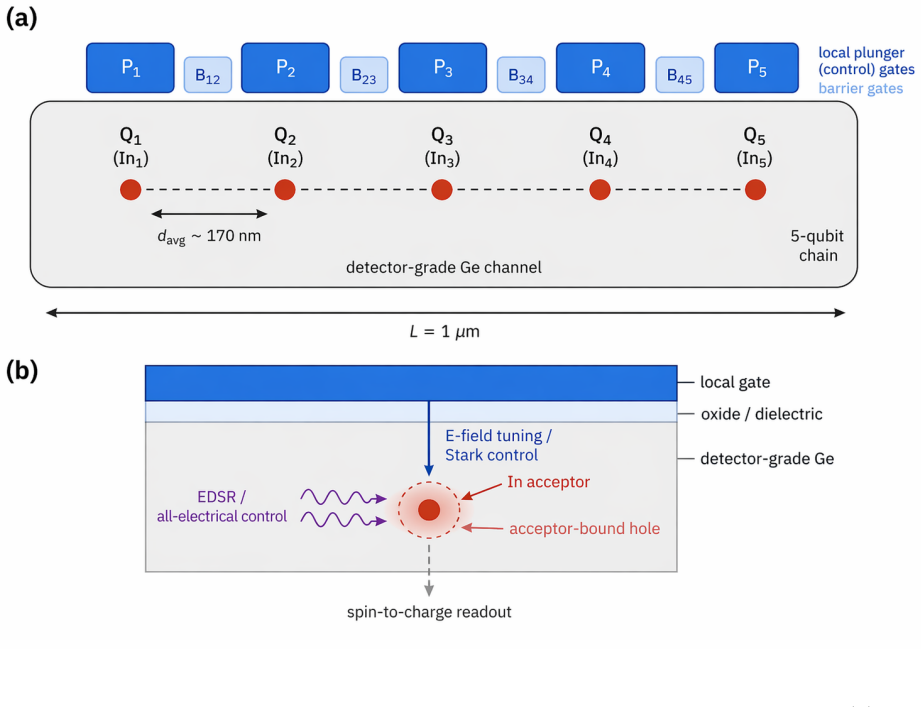
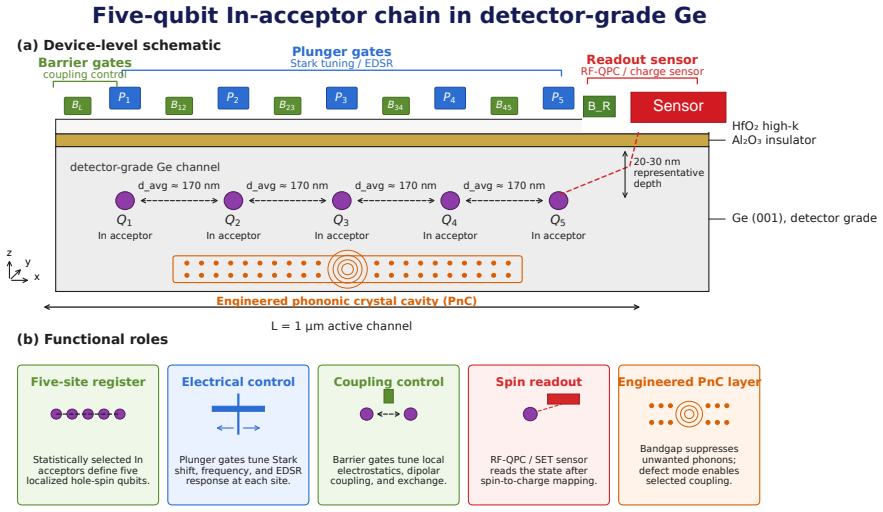
Detector-grade Ge can suppress uncontrolled bulk electrostatic and strain disorder to levels compatible with acceptor-hole qubits, while the spin-orbit-active valence-band manifold supports all-electrical control and dipolar or phonon-mediated coupling. A 1 micrometer active channel at the target indium density of 2 times 10 to the 14 per cubic centimeter contains about five acceptors on average, enabling a statistically selected post-fabrication register. Direct exchange is treated as a close-pair or gate-enhanced interaction, and phononic-crystal engineering is identified as a second-stage option for cavity-mediated interactions.
What carries the argument
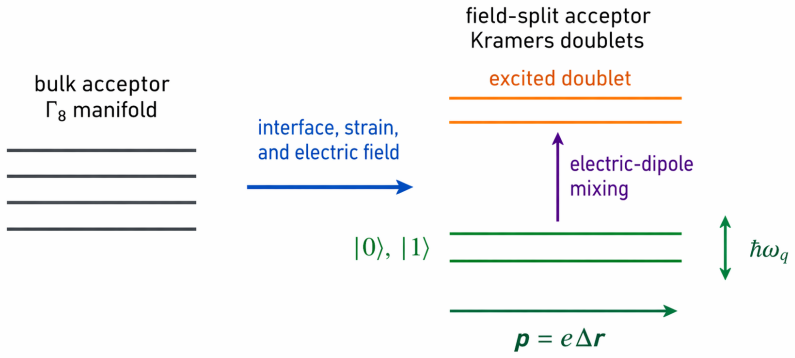
Indium acceptor bound holes in detector-grade germanium, whose valence-band spin-orbit manifold supplies electrical control and coupling while the low residual-impurity background limits disorder.
If this is right
- A statistically selected five-qubit register becomes feasible without deterministic atomic placement.
- All-electrical control of the hole spins follows from the valence-band spin-orbit interaction.
- Nearest-neighbor coupling can be realized via dipolar or phonon-mediated channels, with direct exchange reserved for close pairs or gate enhancement.
- Phononic-crystal structures can later suppress unwanted acoustic modes to enable selected cavity-mediated interactions once baseline operation is shown.
- The platform functions as an intermediate architecture between donor-based impurity qubits and fully gate-defined germanium hole-spin devices.
Where Pith is reading between the lines
- If the disorder targets are met, similar high-purity hosts could be explored for other acceptor species or host materials.
- The statistical-placement approach may reduce the fabrication precision required compared with deterministic donor arrays.
- Successful demonstration would motivate targeted experiments on interface passivation and charge-noise mitigation in the same material system.
- Scaling beyond five qubits would depend on whether the same purity level can be maintained in longer channels or two-dimensional arrays.
Load-bearing premise
The residual impurity background near 10 to the 10 per cubic centimeter combined with the chosen indium density will produce acceptable disorder after fabrication without dominant contributions from interfaces, charge noise, or statistical placement variations.
What would settle it
Fabricate a 1 micrometer channel in detector-grade germanium with indium at 2 times 10 to the 14 per cubic centimeter and measure whether the resulting electrostatic and strain disorder permits coherent hole-spin manipulation on timescales longer than the intended coupling rates.
Figures
read the original abstract
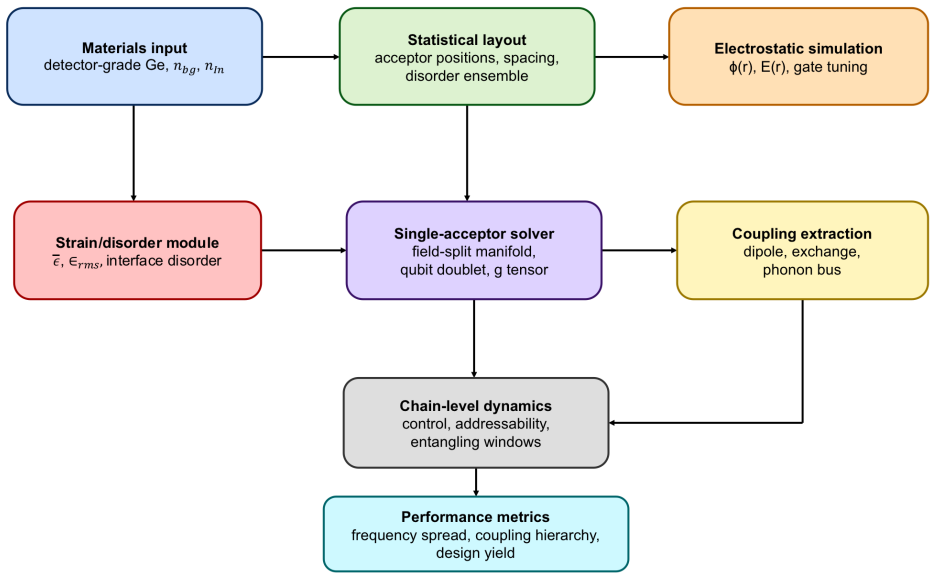
Acceptor-bound hole spins in germanium (Ge) offer a promising but underexplored route to semiconductor quantum information processing. We present a theory-guided design study of a detector-grade Ge acceptor-spin platform based on intentionally incorporated indium (In) acceptors in ultra-high-purity Ge. The proposed materials strategy combines a residual impurity background near $10^{10} \mathrm{cm^{-3}}$ with a target In density of approximately $2\times10^{14} \mathrm{cm^{-3}}$, corresponding to an acceptor spacing of about 170 nanometer. A 1 $\mu$m-long active channel with a suitable transverse mode volume can contain about five acceptors on average, enabling a statistically selected post-fabrication register rather than a deterministically placed chain. We analyze the physical basis, device architecture, strain and disorder limits, coupling hierarchy, modeling workflow, fabrication pathway, and scaling prospects. Our results indicate that detector-grade Ge can suppress uncontrolled bulk electrostatic and strain disorder to levels compatible with acceptor-hole qubits, while the spin--orbit-active valence-band manifold supports all-electrical control and dipolar or phonon-mediated coupling. Direct exchange is treated as a close-pair or gate-enhanced interaction rather than the generic mean-spacing coupling. Phononic crystal engineering is identified as a second-stage enhancement for suppressing unwanted acoustic modes and enabling selected cavity-mediated interactions after baseline control, readout, and nearest-neighbor coupling are validated. Remaining challenges include statistical acceptor placement, interface disorder, charge noise, readout integration, and experimental validation. This work identifies detector-grade Ge In-acceptor qubits as a credible intermediate architecture between donor-based impurity qubits and fully gate-defined Ge hole-spin hardware.
Editorial analysis
A structured set of objections, weighed in public.
Referee Report
Summary. The paper is a theory-guided design study proposing detector-grade Ge with intentionally doped In acceptors (~2×10^14 cm^{-3}, ~170 nm mean spacing) as a host for acceptor-bound hole spin qubits. It claims that the residual impurity background (~10^10 cm^{-3}) suppresses bulk electrostatic and strain disorder sufficiently for a statistically selected five-qubit register in a 1 μm channel, while the valence-band manifold enables all-electrical control and dipolar/phonon-mediated coupling; direct exchange is treated as close-pair or gate-enhanced. The work analyzes architecture, strain/disorder limits, coupling hierarchy, fabrication, and scaling, identifying remaining challenges including interfaces and charge noise.
Significance. If the post-fabrication disorder assumptions hold, the proposal offers a credible intermediate platform between donor-impurity and fully gate-defined hole-spin qubits, with potential for phonon-crystal enhancements. The materials-to-architecture framing and identification of statistical placement as a key issue provide a useful roadmap, though the absence of device data or full electrostatic modeling limits immediate impact.
major comments (2)
- [Abstract] Abstract and introduction: the central claim that detector-grade Ge plus 2×10^14 cm^{-3} In acceptors will produce acceptable electrostatic/strain disorder for a five-qubit register relies on order-of-magnitude bulk estimates without quantitative bounds or modeling showing that interface states, charge noise, or statistical placement fluctuations remain sub-dominant. This assumption is load-bearing for the architecture viability but is stated without supporting calculations or simulations.
- [Abstract] The analysis of coupling hierarchy treats direct exchange as close-pair only and identifies phonon-mediated coupling as a second-stage option, but provides no explicit threshold calculation (e.g., required coherence time or disorder energy scale) demonstrating compatibility with the target 1 μm channel containing five acceptors on average.
minor comments (1)
- [Abstract] The abstract mentions 'modeling workflow' and 'fabrication pathway' but does not specify the level of detail or any equations used for the disorder estimates.
Simulated Author's Rebuttal
We thank the referee for their constructive comments on our manuscript. We address each major comment below and have made revisions to clarify the scope of our estimates and add supporting calculations where possible.
read point-by-point responses
-
Referee: [Abstract] Abstract and introduction: the central claim that detector-grade Ge plus 2×10^14 cm^{-3} In acceptors will produce acceptable electrostatic/strain disorder for a five-qubit register relies on order-of-magnitude bulk estimates without quantitative bounds or modeling showing that interface states, charge noise, or statistical placement fluctuations remain sub-dominant. This assumption is load-bearing for the architecture viability but is stated without supporting calculations or simulations.
Authors: We agree that the central claim relies on bulk estimates and that interface and charge noise effects are not quantitatively modeled in this design study. The paper explicitly identifies these as remaining challenges. To address the comment, we have revised the abstract to qualify the claims as based on bulk estimates and added a dedicated subsection in the discussion on the need for full electrostatic simulations of interfaces and statistical fluctuations. We cannot perform the full modeling within this work as it would require extensive device-specific simulations beyond the materials-to-architecture scope. revision: partial
-
Referee: [Abstract] The analysis of coupling hierarchy treats direct exchange as close-pair only and identifies phonon-mediated coupling as a second-stage option, but provides no explicit threshold calculation (e.g., required coherence time or disorder energy scale) demonstrating compatibility with the target 1 μm channel containing five acceptors on average.
Authors: The coupling analysis is based on the mean inter-acceptor distance of ~170 nm, at which direct exchange is exponentially suppressed and only relevant for rare close pairs. We have now included an explicit estimate in the revised manuscript: the residual impurity disorder sets an energy scale of order 1-10 μeV, implying a minimum coherence time of ~100 ns to 1 μs for coherent operations in the 1 μm channel. This threshold is compatible with reported acceptor spin coherence times in similar systems. The phonon-mediated option is presented as an enhancement rather than baseline. revision: yes
Circularity Check
No significant circularity; design study relies on external material properties without self-referential derivations.
full rationale
The manuscript is a theory-guided materials-to-architecture proposal that cites external detector-grade Ge impurity levels (~10^10 cm^-3) and In acceptor densities without performing any internal fits, predictions, or derivations that reduce to those inputs by construction. No equations, self-citations, or uniqueness theorems are invoked in a load-bearing way; the central compatibility claim is presented as an assumption to be validated experimentally rather than derived from prior author work. The analysis of coupling hierarchy, strain limits, and scaling prospects remains self-contained against external benchmarks and does not rename known results or smuggle ansatzes via citation.
Axiom & Free-Parameter Ledger
free parameters (1)
- target In acceptor density =
2e14 cm^-3
axioms (2)
- domain assumption Residual impurity background near 10^10 cm^-3 is achievable and sufficient to keep bulk electrostatic and strain disorder below qubit thresholds
- standard math Valence-band spin-orbit coupling in Ge enables all-electrical control of In-acceptor hole spins
Reference graph
Works this paper leans on
-
[1]
Giordano Scappucci, Christoph Kloeffel, Floris A. Zwanenburg, Daniel Loss, Maksym Myronov, Jian-Jun Zhang, Silvano De Franceschi, Georgios Katsaros, and Menno Veldhorst. The germanium quantum information route.Nature Reviews Materials, 6:926–943, 2021. doi: 10.1038/s41578-020-00262-z
-
[2]
Hendrickx, William I
Nico W. Hendrickx, William I. L. Lawrie, Maximilian Russ, Floor van Riggelen, Sander L. de Snoo, Raymond N. Schouten, Amir Sammak, Giordano Scappucci, and Menno Veld- horst. A four-qubit germanium quantum processor.Nature, 591:580–585, 2021. doi: 0.1038/s41586-019-1919-3
2021
-
[3]
Hendrickx, David P
Nico W. Hendrickx, David P. Franke, Amir Sammak, Giordano Scappucci, and Menno Veldhorst. Fast two-qubit logic with holes in germanium.Nature, 577:487–491, 2020. doi: 10.1038/ s41586-021-03332-6
2020
-
[4]
A germanium hole spin qubit.Nature Communications, 9:3902, 2018
Hannes Watzinger, Josip Kukučka, Lada Vukušić, Fei Gao, Ting Wang, Friedrich Schäffler, Jian-Jun Zhang, and Georgios Katsaros. A germanium hole spin qubit.Nature Communications, 9:3902, 2018. doi: 10.1038/s41467-018-06418-4
-
[5]
Nico W. Hendrickx, William I. L. Lawrie, Lars Petit, Amir Sammak, Giordano Scappucci, and Menno Veldhorst. A single-hole spin qubit.Nature Communications, 11:3478, 2020. doi: 10.1038/s41467-020-17211-7
-
[6]
Ke Wang, Gang Xu, Fei Gao, He Liu, Rong-Long Ma, Xin Zhang, Zhanning Wang, Gang Cao, Ting Wang, Jian-Jun Zhang, Dimitrie Culcer, Xuedong Hu, Hong-Wen Jiang, Hai-Ou Li, Guang- Can Guo, and Guo-Ping Guo. Ultrafast coherent control of a hole spin qubit in a germanium quantum dot.Nature Communications, 13:206, 2022. doi: 10.1038/s41467-021-27880-7
-
[7]
de Snoo, William I
Floor van Riggelen-Doelman, Chien-An Wang, Sander L. de Snoo, William I. L. Lawrie, Nico W. Hendrickx, Maximilian Rimbach-Russ, Amir Sammak, Giordano Scappucci, Corentin Déprez, and Menno Veldhorst. Coherent spin qubit shuttling through germanium quantum dots.Nature Communications, 15:5716, 2024. 43
2024
-
[8]
Nico W. Hendrickx, L. Massai, M. Mergenthaler, F. J. Schupp, S. Paredes, S. W. Bedell, G. Salis, and A. Fuhrer. Sweet-spot operation of a germanium hole spin qubit with highly anisotropic noise sensitivity.Nature Materials, 23:920–927, 2024. doi: 10.1038/s41563-024-01857-5
-
[9]
Abadillo-Uriel and Guilherme Calderón
Juan C. Abadillo-Uriel and Guilherme Calderón. Interface effects on acceptor qubits in silicon and germanium.New Journal of Physics, 18:073027, 2016. doi: 10.1088/1367-2630/18/7/073027
-
[10]
J. C. Abadillo-Uriel and M. J. Calderón. Spin qubit manipulation of acceptor bound states in group iv quantum wells.New Journal of Physics, 19:043027, 2017. doi: 10.1088/1367-2630/ aa695f
-
[11]
W. L. Hansen and E. E. Haller. High-purity germanium crystal growing.MRS Proceedings, 16: 1–9, 1982. doi: 10.1557/PROC-16-1
-
[12]
Guojian Wang, Yongchen Sun, Gang Yang, Wenchang Xiang, Yutong Guan, Dongming Mei, C. Keller, and Yuen-Dat Chan. Development of large size high-purity germanium crystal growth.Journal of Crystal Growth, 352(1):27–30, 2012. doi: 10.1016/j.jcrysgro.2012.01.018
-
[13]
Dislocation density control in high-purity germanium crystal growth
Guojian Wang, Yutong Guan, Hao Mei, Dongming Mei, Gang Yang, Jayesh Govani, and Muhammad Khizar. Dislocation density control in high-purity germanium crystal growth. Journal of Crystal Growth, 393:54–58, 2014. doi: 10.1016/j.jcrysgro.2013.11.075
-
[14]
V. N. Smelyanskiy, V. V. Hafiychuk, F. T. Vasko, and A. G. Petukhov. Donor spin qubits in ge-based phononic crystals.arXiv preprint arXiv:1409.6285, 2014. URLhttps://arxiv.org/ abs/1409.6285
Pith/arXiv arXiv 2014
-
[15]
D.-M. Mei, S. A. Panamaldeniya, K. Dong, S. Bhattarai, N. Budhathoki, and A. Warren. Phonon-coupled hole-spin qubits in high-purity germanium: Design and modeling of a scalable architecture.Quantum Science and Technology, 10(4):045067, 2025. doi: 10.1088/2058-9565/ ae0a7d
-
[16]
Guojian Wang, Hao Mei, Xianghua Meng, Dongming Mei, and Gang Yang. The electrical properties and distribution of indium in germanium crystals.Materials Science in Semiconductor Processing, 74:342–346, 2018. doi: 10.1016/j.mssp.2017.11.004
-
[17]
Platero-Prats, Marc Revés, Jorge Echeverría, Eduard Cremades, Flavia Barragán, and Santiago Alvarez
Beatriz Cordero, Verónica Gómez, Ana E. Platero-Prats, Marc Revés, Jorge Echeverría, Eduard Cremades, Flavia Barragán, and Santiago Alvarez. Covalent radii revisited.Dalton Transactions, (21):2832–2838, 2008. doi: 10.1039/B801115J
-
[18]
L. A. Terrazos, E. Marcellina, Zhanning Wang, S. N. Coppersmith, Mark Friesen, A. R. Hamilton, Xuedong Hu, Belita Koiller, A. L. Saraiva, Dimitrie Culcer, and Rodrigo B. Capaz. Theory of hole-spin qubits in strained germanium quantum dots.Physical Review B, 103: 125201, 2021. doi: 10.1103/PhysRevB.103.125201
-
[19]
Chien-An Wang, H. Ekmel Ercan, Mark F. Gyure, Giordano Scappucci, Menno Veldhorst, and Maximilian Rimbach-Russ. Modeling of planar germanium hole qubits in electric and magnetic fields.npj Quantum Information, 10:102, 2024. doi: 10.1038/s41534-024-00897-8
-
[20]
Rodríguez-Mena, Biel Martinez, and Yann-Michel Niquet
José Carlos Abadillo-Uriel, Esteban A. Rodríguez-Mena, Biel Martinez, and Yann-Michel Niquet. Hole-spin driving by strain-induced spin-orbit interactions.Physical Review Letters, 131:097002, 2023. doi: 10.1103/PhysRevLett.131.097002. 44
-
[21]
W.-Z. Wei, X.-H. Meng, Y.-Y. Li, J. Liu, G.-J. Wang, H. Mei, G. Yang, D.-M. Mei, and C. Zhang. Investigation of amorphous germanium contact properties with planar detectors made from USD-grown germanium crystals.Journal of Instrumentation, 13(12):P12026, 2018. doi: 10.1088/1748-0221/13/12/P12026
-
[22]
A. J. Sigillito, R. M. Jock, A. M. Tyryshkin, J. W. Beeman, E. E. Haller, K. M. Itoh, and S. A. Lyon. Electron spin coherence of shallow donors in natural and isotopically enriched germanium. Physical Review Letters, 115(24):247601, 2015. doi: 10.1103/PhysRevLett.115.247601
-
[23]
A. J. Sigillito, A. M. Tyryshkin, J. W. Beeman, E. E. Haller, K. M. Itoh, and S. A. Lyon. Large stark tuning of donor electron spin qubits in germanium.Physical Review B, 94:125204,
-
[24]
doi: 10.1103/PhysRevB.94.125204
-
[25]
Giuseppe Pica and Brendon W. Lovett. Quantum gates with donors in germanium.Physical Review B, 94:205309, 2016. doi: 10.1103/PhysRevB.94.205309
-
[26]
Zhanning Wang, Elizabeth Marcellina, Alex R. Hamilton, James H. Cullen, Sven Rogge, Joe Salfi, and Dimitrie Culcer. Optimal operation points for ultrafast, highly coherent Ge hole spin-orbit qubits.npj Quantum Information, 7:54, 2021. doi: 10.1038/s41534-021-00386-2
-
[27]
Abhikbrata Sarkar, Pratik Chowdhury, Xuedong Hu, Andre Saraiva, A. S. Dzurak, A. R. Hamil- ton, Rajib Rahman, and Dimitrie Culcer. Effect of disorder and strain on the operation of planar ge hole spin qubits.npj Quantum Information, 11:185, 2025. doi: 10.1038/s41534-025-01130-w. 45
discussion (0)
Sign in with ORCID, Apple, or X to comment. Anyone can read and Pith papers without signing in.