REVIEW 2 major objections 5 minor 45 references
High-Quality Cloud-Free Optical Image Synthesis Using Multi-Temporal SAR and Contaminated Optical Data
T0 review · 2 major / 5 minor · reviewed 2026-08-16 · deepseek-v4-flash
Pith's one-line read CRSynthNet synthesizes a cloud-free optical image for a later date from two SAR images and one cloudy earlier optical image, beating eight methods on the new Zhengzhou flood dataset.
desk verdict Useful new dataset and a workmanlike SAR-optical fusion architecture, but the ablation narrative contradicts its own table and the 'near cloud-free' reference deserves a robustness check before the metrics are taken at face value. read the letter →
The pith
A machine-rendered reading of the paper's core claim, the machinery that carries it, and where it could break.
The reading
What carries the argument
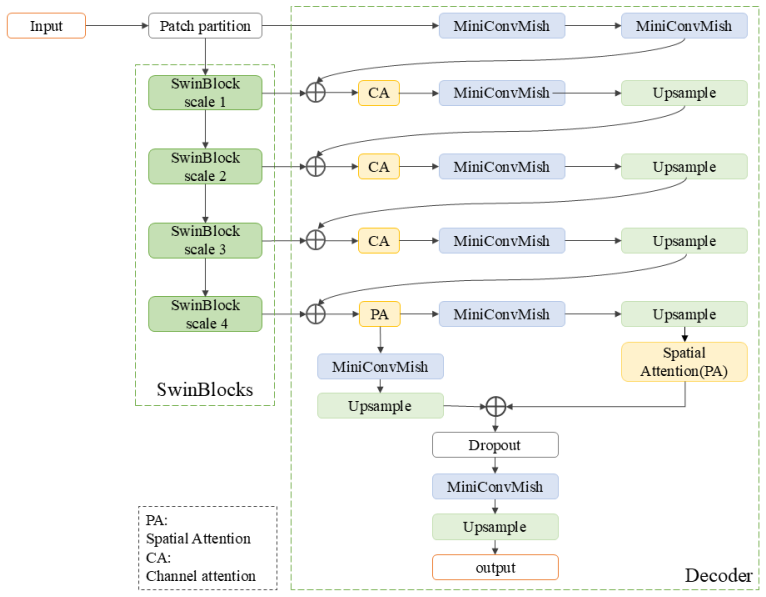
The load-bearing mechanism is the FusionAttention block, a joint attention module for two temporal feature maps. It derives queries, keys, and values from both inputs, concatenates Q and K along channels, L2-normalizes them, and computes Attention1 = Q · (K · V1) and Attention2 = Q · (K · V2); each attention output is scaled by a learnable γ and added back to its input as a residual. This lets the network decide, per location and channel, how much to trust the radar structure and how much to trust the earlier cloudy optical image when reconstructing the target scene. Around this block the architecture wraps a DownUpBlock for coarse-to-fine feature extraction, four scaled-up Swin Transformer blocks for multi-scale features, and a decoder with channel and spatial attention, while a three-scale discriminator with spectral normalization supplies adversarial feedback.
What would settle it
Take the TCSEN12 test pairs whose reference Sentinel-2 tiles are completely cloud-free by manual inspection, or mask out residual cloud pixels before computing PSNR, SSIM, MAE, and RMSE, and re-run the comparison against MTS2ONet; if CRSynthNet no longer leads on all metrics, the reported advantage is an artifact of scoring against a contaminated target.
Extended reading notes
Core claim
The paper's central claim is that missing optical images can be synthesized at the target date even when the only optical image available is cloud-contaminated, provided SAR images from both the earlier and the target date are available. The generator consumes S1 T1, S1 T2, and S2 T1 and predicts S2 T2; the reference used for training and testing is the latest S2 image with less than 5% cloud cover. CRSynthNet fuses the two modalities with a DownUp Block, a FusionAttention block, Swin Transformer blocks, and an attention-equipped decoder, and is trained adversarially with a similarity loss plus a least-squares GAN loss and a WGAN gradient penalty on the discriminator. On the TCSEN12 test set the paper reports PSNR 26.978, SSIM 0.648, MAE 0.041, RMSE 0.050, and FID 72.789, which it presents as the best among nine methods, with MTS2ONet the closest competitor. The supporting ablation study attributes the gains to the designed modules and discriminator, with spatial attention having the largest individual effect.
Load-bearing premise
The evaluation treats a satellite image that may still contain up to 5 percent cloud cover as the perfect truth, so any leftover cloud or slight misalignment in those reference images would directly inflate every reported quality score.
Editorial extensions
If this is right
- Users can obtain a usable optical image for a flooded area on a target date even when that date's optical acquisition is fully obscured, because the method only needs two SAR acquisitions and an earlier cloudy optical scene.
- On the TCSEN12 test set, CRSynthNet reports the best scores on all five metrics: PSNR 26.978, SSIM 0.648, MAE 0.041, RMSE 0.050, and FID 72.789, ahead of the previous best MTS2ONet with PSNR 26.225, SSIM 0.622, and FID 81.150.
- Ablations show the designed components carry the result: replacing the discriminator with the one from [13] lowers SSIM from 0.648 to 0.632, and removing spatial attention lowers PSNR to 25.808 and raises FID to 84.289.
- Because the reference target is allowed up to 5 percent cloud cover, the dataset reflects realistic operational conditions rather than requiring perfectly cloud-free training targets.
Reading between the lines
- If the reference images retain residual cloud or geometric misalignment, the absolute PSNR and SSIM numbers in the table are optimistic; the relative ordering of methods is still informative, but the magnitudes should be treated as upper bounds rather than true reconstruction fidelity.
- Because the network predicts a later date from earlier data, the same pipeline could support near-real-time flood monitoring: as soon as a new SAR pass arrives, a cloud-free optical estimate can be produced without waiting for a later clear optical overpass.
- A direct stress test would be to apply CRSynthNet to a non-flood region with stable land cover, or to train with reference labels built from multi-date compositing; this would separate the benefit of multi-temporal fusion from the benefit of learning flood-induced change.
Signed reviews
Editorial analysis
A structured set of objections, weighed in public.
Referee Report
Summary. The paper proposes CRSynthNet, a GAN-based network for synthesizing a cloud-free optical image at a target date from two temporal Sentinel-1 SAR images and one cloud-contaminated Sentinel-2 image from an earlier date. The architecture combines convolutional blocks, a DownUp Block, FusionAttention, SwinBlocks, a decoder with channel and spatial attention, and a three-scale discriminator. The authors also introduce TCSEN12, a dataset of Sentinel-1/Sentinel-2 image triplets from the Zhengzhou July 2021 flood region. Quantitative evaluation reports that CRSynthNet achieves PSNR 26.978, SSIM 0.648, MAE 0.041, RMSE 0.050, and FID 72.789, outperforming eight comparison methods on the TCSEN12 test set. Ablation studies are presented for the DownUp Block, FusionAttention, the discriminator, and the attention modules.
Significance. If the claimed results are valid, the paper contributes a new dataset and a method that addresses a practical scenario: generating cloud-free optical images when the only available optical input is itself cloud-contaminated. The design of the DownUp Block and FusionAttention, and the use of multi-temporal SAR with contaminated optical data, are plausible directions for further research. The paper also explicitly discusses limitations regarding feature-sparse scenes. The main value lies in the dataset and the empirical comparison, but the evaluation's validity depends on the quality of the reference images and the consistency of the ablation analysis.
major comments (2)
- [§3.4, Table 2] The ablation narrative contradicts the reported numbers. The text states that removing the DownUpBlock caused "a noticeable performance drop," yet Table 2 reports PSNR 27.053, which is higher than the full model's 26.978; it also reports a lower MAE (0.034 vs. 0.041). Similarly, the removal of Channel Attention improves FID to 71.875, better than the full model's 72.789, while the text calls it "a significant reduction in performance." Because the paper's central contribution claims rest on the necessity of these components, this internal inconsistency must be resolved: either reinterpret the ablations with appropriate metrics or provide a corrected analysis.
- [§2.1, §3.2] The evaluation reference is defined as a Sentinel-2 image with less than 5% cloud coverage, aligned to the other dates through a 6-day composite. During the Zhengzhou flood period, land cover changed substantially between the two acquisition windows, so the composite cannot guarantee pixel-level correspondence. All metrics in Table 1 (PSNR, SSIM, MAE, RMSE, FID) are computed against this potentially contaminated reference, with no cloud masking, no exclusion of cloudy patches, and no sensitivity analysis to the 5% cloud threshold. Residual cloud or misregistration in the reference could bias every reported metric and even affect the ranking over baselines. The paper should include cloud-masked evaluation or otherwise demonstrate that the reference images are sufficiently clean to support the headline comparison.
minor comments (5)
- [Abstract] There are multiple grammatical and wording errors, e.g., "spectral consist" should be "spectral consistency," and "This study offer" should be "This study offers." Proofreading is needed throughout.
- [§1 (References)] The reference list contains an incomplete citation: "[30, 31? ]" appears on page 4. Also, "deep learnig" on page 3 is a typo.
- [§2.2.3 (Loss function)] The values of the weighting factors alpha, beta, gamma, lambda, and lambda_gp are not reported. Since the paper states that the balance achieved by lambda is critical, please provide the actual values or a sensitivity study.
- [§2.1 (TCSEN12 Dataset)] The dataset description would benefit from explicit details: the number of image pairs, the spatial resolution of the tiles, the number of training/validation/test samples, and the cloud coverage distribution. This information is important for reproducibility and for interpreting the comparison.
- [§3.2 (Quantitative Evaluation)] The quantitative comparison reports a single run without standard deviations or statistical significance tests. The margin over MTS2ONet (PSNR 26.978 vs. 26.225, MAE 0.041 vs. 0.049) is modest, so providing variation across runs would strengthen the claim of superiority.
Circularity Check
No circularity: the central claim is a held-out supervised evaluation against an imperfect but independently defined reference, and no prediction reduces to its inputs by construction.
full rationale
The paper's central claim, that CRSynthNet outperforms eight baselines on the TCSEN12 test set, rests on a standard supervised train/test protocol: the network is trained with a composite loss (Equation 3) combining a similarity term against the reference and adversarial terms, and the reported PSNR/SSIM/MAE/RMSE/FID values in Table 1 are computed on test images against the same reference definition. This is not circular because the reference images are externally defined by Sentinel-2 acquisitions with less than 5% cloud coverage, not by the model's own outputs, and no test metric is fitted back into the loss weights or architecture. The ablation study compares model variants on the same held-out protocol, and the full model's score (PSNR 26.978) is not constructed to equal any component score. The only self-citations (e.g., reference [31] in related work) are descriptive and are not load-bearing for the central claim. The use of a '<5% cloud coverage' reference and 6-day composite alignment is a data-quality limitation that can bias metric comparisons, but it is a correctness/benchmark-validity concern, not a circularity of the claimed derivation chain.
Assumptions & free parameters
free parameters (5)
- alpha (VGG loss weight) =
not reported
- beta (cosine similarity loss weight) =
not reported
- gamma (MS-SSIM loss weight) =
not reported
- lambda (adversarial loss weight) =
not reported
- lambda_gp (gradient penalty weight) =
not reported
assumptions (4)
- domain assumption Reference S2 T2 images with less than 5% cloud coverage are treated as true cloud-free targets.
- domain assumption Sentinel-1 SAR backscatter at T1 and T2 contains sufficient information to predict Sentinel-2 optical reflectance at T2.
- domain assumption The 6-day composite generation yields temporally consistent and geospatially aligned T1/T2 pairs despite the 20 July 2021 flood event.
- domain assumption The VGG network pretrained on ImageNet provides a valid perceptual similarity measure for satellite optical images.
Cite this review
Pith. "Pith review of High-Quality Cloud-Free Optical Image Synthesis Using Multi-Temporal SAR and Contaminated Optical Data." pith.science (2026). https://pith.science/paper/IDW3GW7R
@misc{pith2026250416870,
  author       = {Pith},
  title        = {Pith review of: High-Quality Cloud-Free Optical Image Synthesis Using Multi-Temporal SAR and Contaminated Optical Data},
  year         = {2026},
  howpublished = {\url{https://pith.science/paper/IDW3GW7R}},
  note         = {Machine review of arXiv:2504.16870}
}
read the original abstract
Addressing gaps caused by cloud cover and the long revisit cycle of satellites is vital for providing essential data to support remote sensing applications. This paper tackles the challenges of missing optical data synthesis, particularly in complex scenarios with cloud cover. We propose CRSynthNet, a novel image synthesis network that incorporates innovative designed modules such as the DownUp Block and Fusion Attention to enhance accuracy. Experimental results validate the effectiveness of CRSynthNet, demonstrating substantial improvements in restoring structural details, preserving spectral consist, and achieving superior visual effects that far exceed those produced by comparison methods. It achieves quantitative improvements across multiple metrics: a peak signal-to-noise ratio (PSNR) of 26.978, a structural similarity index measure (SSIM) of 0.648, and a root mean square error (RMSE) of 0.050. Furthermore, this study creates the TCSEN12 dataset, a valuable resource specifically designed to address cloud cover challenges in missing optical data synthesis study. The dataset uniquely includes cloud-covered images and leverages earlier image to predict later image, offering a realistic representation of real-world scenarios. This study offer practical method and valuable resources for optical satellite image synthesis task.
Figures


Figures from the paper (7 more)


Reference graph
Works this paper leans on
-
[1]
T. H. Nguyen, S. Ricci, C. Fatras, A. Piacentini, A. Delmotte, E. Lavergne, P. Kettig, Improvement of flood extent representation with 23 remote sensing data and data assimilation, IEEE Transactions on Geo- science and Remote Sensing 60 (2022) 1–22
work page 2022
-
[2]
L. Yang, Q. Guan, J. Lin, J. Tian, Z. Tan, H. Li, Evolution of ndvi secular trends and responses to climate change: A perspective from nonlinearity and nonstationarity characteristics, Remote sensing of en- vironment 254 (2021) 112247
work page 2021
-
[3]
L. Wang, R. Li, C. Zhang, S. Fang, C. Duan, X. Meng, P. M. Atkinson, Unetformer: A unet-like transformer for efficient semantic segmentation of remote sensing urban scene imagery, ISPRS Journal of Photogram- metry and Remote Sensing 190 (2022) 196–214
work page 2022
-
[4]
Y. Song, D. Gnyawali, L. Qian, From early curiosity to space wide web: The emergence of the small satellite innovation ecosystem, Research Pol- icy 53 (2) (2024) 104932. doi:https://doi.org/10.1016/j.respol. 2023.104932
arXiv 2024
-
[5]
M. Gonzalez-Calabuig, M. ´Angel Fern´ andez-Torres, G. Camps-Valls, Generative networks for spatio-temporal gap filling of sentinel-2 re- flectances, ISPRS Journal of Photogrammetry and Remote Sensing 220 (2025) 637–648. doi:https://doi.org/10.1016/j.isprsjprs.2025. 01.016
-
[6]
W. Zhu, Z. Cao, P. Luo, Z. Tang, Y. Zhang, M. Hu, B. He, Urban flood-related remote sensing: research trends, gaps and opportunities, Remote Sensing 14 (21) (2022) 5505
work page 2022
-
[7]
L. E. Christovam, M. H. Shimabukuro, M. d. L. B. Galo, E. Honkavaara, Pix2pix conditional generative adversarial network with mlp loss func- tion for cloud removal in a cropland time series, Remote Sensing 14 (1) (2021) 144
work page 2021
-
[8]
Y. Li, Q. Liu, S. Chen, X. Zhang, An improved gap-filling method for reconstructing dense time-series images from landsat 7 slc-off data, Re- mote Sensing 16 (12) (2024) 2064
work page 2024
Show all 45 references
-
[9]
Z. Zeng, Y. Gan, A. J. Kettner, Q. Yang, C. Zeng, G. R. Braken- ridge, Y. Hong, Towards high resolution flood monitoring: An integrated 24 methodology using passive microwave brightness temperatures and sen- tinel synthetic aperture radar imagery, Journal of Hydrology 582 (202...
2020
-
[10]
L. Sun, R. Latifovic, D. Pouliot, Haze removal based on a fully auto- mated and improved haze optimized transformation for landsat imagery over land, Remote Sensing 9 (10) (2017) 972
2017
-
[11]
M. Xu, F. Deng, S. Jia, X. Jia, A. J. Plaza, Attention mechanism-based generative adversarial networks for cloud removal in landsat images, Remote sensing of environment 271 (2022) 112902
2022
-
[12]
X. Yang, J. Zhao, Z. Wei, N. Wang, X. Gao, Sar-to-optical image trans- lation based on improved cgan, Pattern Recognition 121 (2022) 108208
2022
-
[13]
C. Dong, G. Yang, Y. Wang, W. Sun, X. Meng, B. Chen, Integrating multi-temporal sar and optical information for missing optical imagery generation, IEEE Transactions on Geoscience and Remote Sensing
-
[14]
Addink, A
E. Addink, A. Stein, A comparison of conventional and geostatistical methods to replace clouded pixels in noaa-avhrr images, International Journal of Remote Sensing 20 (5) (1999) 961–977
1999
-
[15]
Van der Meer, Remote-sensing image analysis and geostatistics, In- ternational Journal of Remote Sensing 33 (18) (2012) 5644–5676
F. Van der Meer, Remote-sensing image analysis and geostatistics, In- ternational Journal of Remote Sensing 33 (18) (2012) 5644–5676
2012
-
[16]
Lin, P.-H
C.-H. Lin, P.-H. Tsai, K.-H. Lai, J.-Y. Chen, Cloud removal from multi- temporal satellite images using information cloning, IEEE transactions on geoscience and remote sensing 51 (1) (2012) 232–241
2012
-
[17]
Zhang, Q
Q. Zhang, Q. Yuan, C. Zeng, X. Li, Y. Wei, Missing data reconstruction in remote sensing image with a unified spatial–temporal–spectral deep convolutional neural network, IEEE Transactions on Geoscience and Remote Sensing 56 (8) (2018) 4274–4288
2018
-
[18]
C. Duan, J. Pan, R. Li, Thick cloud removal of remote sensing images using temporal smoothness and sparsity regularized tensor optimization, Remote Sensing 12 (20) (2020) 3446. 25
2020
-
[19]
Y. Chen, M. Chen, W. He, J. Zeng, M. Huang, Y.-B. Zheng, Thick cloud removal in multitemporal remote sensing images via low-rank reg- ularized self-supervised network, IEEE Transactions on Geoscience and Remote Sensing 62 (2024) 1–13
2024
-
[20]
Zhang, Q
Q. Zhang, Q. Yuan, Z. Li, F. Sun, L. Zhang, Combined deep prior with low-rank tensor svd for thick cloud removal in multitemporal images, ISPRS Journal of Photogrammetry and Remote Sensing 177 (2021) 161– 173
2021
-
[21]
L. Wang, Q. Wang, X. Tong, P. M. Atkinson, Mst-net: A general deep learning model for thick cloud removal from optical images, IEEE Transactions on Geoscience and Remote Sensing 63 (2025) 1–18. doi: 10.1109/TGRS.2025.3543617
2025
-
[22]
F. Zhou, D. Zhong, R. Peiman, Reconstruction of cloud-free sentinel-2 image time-series using an extended spatiotemporal image fusion ap- proach, Remote Sensing 12 (16) (2020) 2595
2020
-
[23]
Merkle, P
N. Merkle, P. Fischer, S. Auer, R. M¨ uller, On the possibility of conditional adversarial networks for multi-sensor image matching, in: 2017 IEEE International Geoscience and Remote Sensing Symposium (IGARSS), IEEE, 2017, pp. 2633–2636
2017
-
[24]
Fuentes Reyes, S
M. Fuentes Reyes, S. Auer, N. Merkle, C. Henry, M. Schmitt, Sar- to-optical image translation based on conditional generative adversar- ial networks—optimization, opportunities and limits, Remote Sensing 11 (17) (2019) 2067
2019
-
[25]
L. Wang, X. Xu, Y. Yu, R. Yang, R. Gui, Z. Xu, F. Pu, Sar-to-optical image translation using supervised cycle-consistent adversarial networks, Ieee Access 7 (2019) 129136–129149
2019
-
[26]
K. Doi, K. Sakurada, M. Onishi, A. Iwasaki, Gan-based sar-to-optical image translation with region information, in: IGARSS 2020-2020 IEEE International Geoscience and Remote Sensing Symposium, IEEE, 2020, pp. 2069–2072
2020
-
[27]
J. Guo, C. He, M. Zhang, Y. Li, X. Gao, B. Song, Edge-preserving convolutional generative adversarial networks for sar-to-optical image translation, Remote Sensing 13 (18) (2021) 3575. 26
2021
-
[28]
Meraner, P
A. Meraner, P. Ebel, X. X. Zhu, M. Schmitt, Cloud removal in sentinel- 2 imagery using a deep residual neural network and sar-optical data fusion, ISPRS J. Photogramm. Remote. Sens. 166 (2020) 333–346
2020
-
[29]
F. Xu, Y. Shi, P. Ebel, L. Yu, G.-S. Xia, W. Yang, X. X. Zhu, Glf-cr: Sar-enhanced cloud removal with global–local fusion, ISPRS J. Pho- togramm. Remote. Sens. 192 (2022) 268–278
2022
-
[30]
R. Mao, H. Li, G. Ren, Z. Yin, Cloud removal based on sar-optical remote sensing data fusion via a two-flow network, IEEE J. Sel. Top. In Appl. Earth Obs. Remote. Sens. 15 (2022) 7677–7686
2022
-
[31]
C. Duan, M. Belgiu, A. Stein, Feature enhancement network for cloud removal in optical images by fusing with sar images, Int. J. Remote. Sens. 45 (1) (2024) 51–67
2024
-
[32]
F. Xu, Y. Shi, P. Ebel, W. Yang, X. X. Zhu, Multimodal and multires- olution data fusion for high-resolution cloud removal: A novel baseline and benchmark, IEEE Transactions on Geoscience and Remote Sensing 62 (2023) 1–15
2023
-
[33]
Z. Liu, H. Hu, Y. Lin, Z. Yao, Z. Xie, Y. Wei, J. Ning, Y. Cao, Z. Zhang, L. Dong, F. Wei, B. Guo, Swin transformer v2: Scaling up capacity and resolution, in: 2022 IEEE/CVF Conference on Computer Vision and Pattern Recognition (CVPR), 2022, pp. 11999–12009. doi:10.1109/ CVPR5...
2022
-
[34]
X. Mao, Q. Li, H. Xie, R. Y. Lau, Z. Wang, S. Paul Smolley, Least squares generative adversarial networks, in: Proceedings of the IEEE international conference on computer vision, 2017, pp. 2794–2802
2017
-
[35]
Simonyan, A
K. Simonyan, A. Zisserman, Very deep convolutional networks for large- scale image recognition, Computational and Biological Learning Society, 2015, pp. 1–14
2015
-
[36]
Z. Wang, E. Simoncelli, A. Bovik, Multiscale structural similarity for image quality assessment, in: The Thrity-Seventh Asilomar Conference on Signals, Systems & Computers, 2003, Vol. 2, 2003, pp. 1398–1402 Vol.2. doi:10.1109/ACSSC.2003.1292216. 27
2003 arXiv
-
[37]
Z. Wang, A. Bovik, H. Sheikh, E. Simoncelli, Image quality assessment: from error visibility to structural similarity, IEEE Transactions on Image Processing 13 (4) (2004) 600–612. doi:10.1109/TIP.2003.819861
2004
-
[38]
Arjovsky, S
M. Arjovsky, S. Chintala, L. Bottou, Wasserstein generative adversarial networks, in: D. Precup, Y. W. Teh (Eds.), Proceedings of the 34th International Conference on Machine Learning, Vol. 70 of Proceedings of Machine Learning Research, PMLR, 2017, pp. 214–223
2017
-
[39]
J.-Y. Zhu, R. Zhang, D. Pathak, T. Darrell, A. A. Efros, O. Wang, E. Shechtman, Toward multimodal image-to-image translation, Ad- vances in neural information processing systems 30
-
[40]
Huang, M.-Y
X. Huang, M.-Y. Liu, S. Belongie, J. Kautz, Multimodal unsupervised image-to-image translation, in: Proceedings of the European conference on computer vision (ECCV), 2018, pp. 172–189
2018
-
[41]
J.-Y. Zhu, T. Park, P. Isola, A. A. Efros, Unpaired image-to-image trans- lation using cycle-consistent adversarial networks, in: Proceedings of the IEEE international conference on computer vision, 2017, pp. 2223–2232
2017
-
[42]
Dalmaz, M
O. Dalmaz, M. Yurt, T. C ¸ ukur, Resvit: residual vision transformers for multimodal medical image synthesis, IEEE Transactions on Medical Imaging 41 (10) (2022) 2598–2614
2022
-
[43]
R. Chen, W. Huang, B. Huang, F. Sun, B. Fang, Reusing discrimina- tors for encoding: Towards unsupervised image-to-image translation, in: Proceedings of the IEEE/CVF conference on computer vision and pattern recognition, 2020, pp. 8168–8177
2020
-
[44]
T. Park, A. A. Efros, R. Zhang, J.-Y. Zhu, Contrastive learning for un- paired image-to-image translation, in: Computer Vision–ECCV 2020: 16th European Conference, Glasgow, UK, August 23–28, 2020, Pro- ceedings, Part IX 16, Springer, 2020, pp. 319–345
2020
-
[45]
Heusel, H
M. Heusel, H. Ramsauer, T. Unterthiner, B. Nessler, S. Hochreiter, Gans trained by a two time-scale update rule converge to a local nash equi- librium, Advances in neural information processing systems 30. 28
Reviewed August 16, 2026 · model on record in the stance chip above.
Discussion (0). Continue with ORCID to comment.