UNCASExt -- A Systematic Computational Framework for Uncertainty Propagation and Scope Consistency in Absolute Environmental Sustainability Assessments (AESA)
Pith reviewed 2026-06-26 12:44 UTC · model grok-4.3
The pith
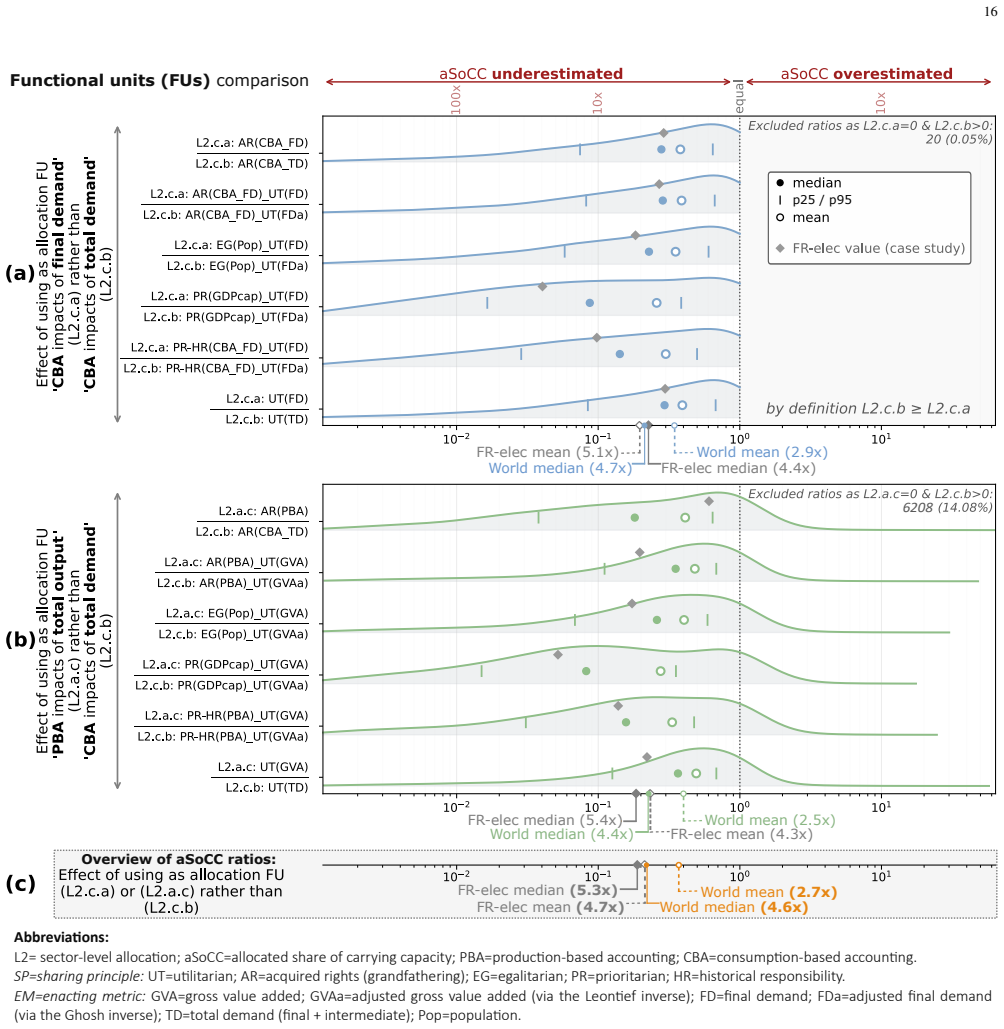
Mismatches between functional units of environmental burdens and allocated carrying capacities lead to underallocation by a median factor of 4.6 across sector-region pairs.
A machine-rendered reading of the paper's core claim, the machinery that carries it, and where it could break.
Core claim
The central claim is that formalizing allocation procedures to match scopes across impact pathway modeling, production-based versus consumption-based accounting, and business-to-consumer versus business-to-business activities, together with uncertainty propagation and support for static or dynamic carrying capacities, reveals that functional-unit mismatches cause underallocation with a median factor of 4.6 across available sector-region pairs. The framework enables consistent absolute sustainability ratios at country and sector levels while handling both historical data and future transition scenarios.
What carries the argument
UNCASExt, the extension that formalizes scope-matching allocation procedures across three dimensions and propagates uncertainty to produce consistent absolute sustainability ratios.
If this is right
- Scope alignment across the three dimensions prevents systematic underallocation of carrying capacities relative to burdens.
- The framework supports both steady-state and dynamic carrying capacities for assessments spanning past and future periods.
- Uncertainty propagation improves the reliability of comparisons between burdens and capacities at sector and country scales.
- The approach scales to multi-regional input-output data for harmonized absolute environmental sustainability assessments.
Where Pith is reading between the lines
- The quantified underallocation suggests that many existing assessments without scope alignment may systematically overstate available environmental space.
- Extending the three scope dimensions to additional activity categories beyond electricity could surface further inconsistencies in other sectors.
- Integrating the framework with uncertainty sources outside the three formalized dimensions would test whether remaining gaps affect policy conclusions.
Load-bearing premise
The three formalized dimensions of scope together with the chosen data sources are sufficient to capture and correct all relevant inconsistencies in the absolute sustainability ratio.
What would settle it
A recalculation of absolute sustainability ratios for the same activities using standard allocation methods versus the scope-aligned procedures that shows no material change in underallocation factors would falsify the central claim.
Figures
read the original abstract
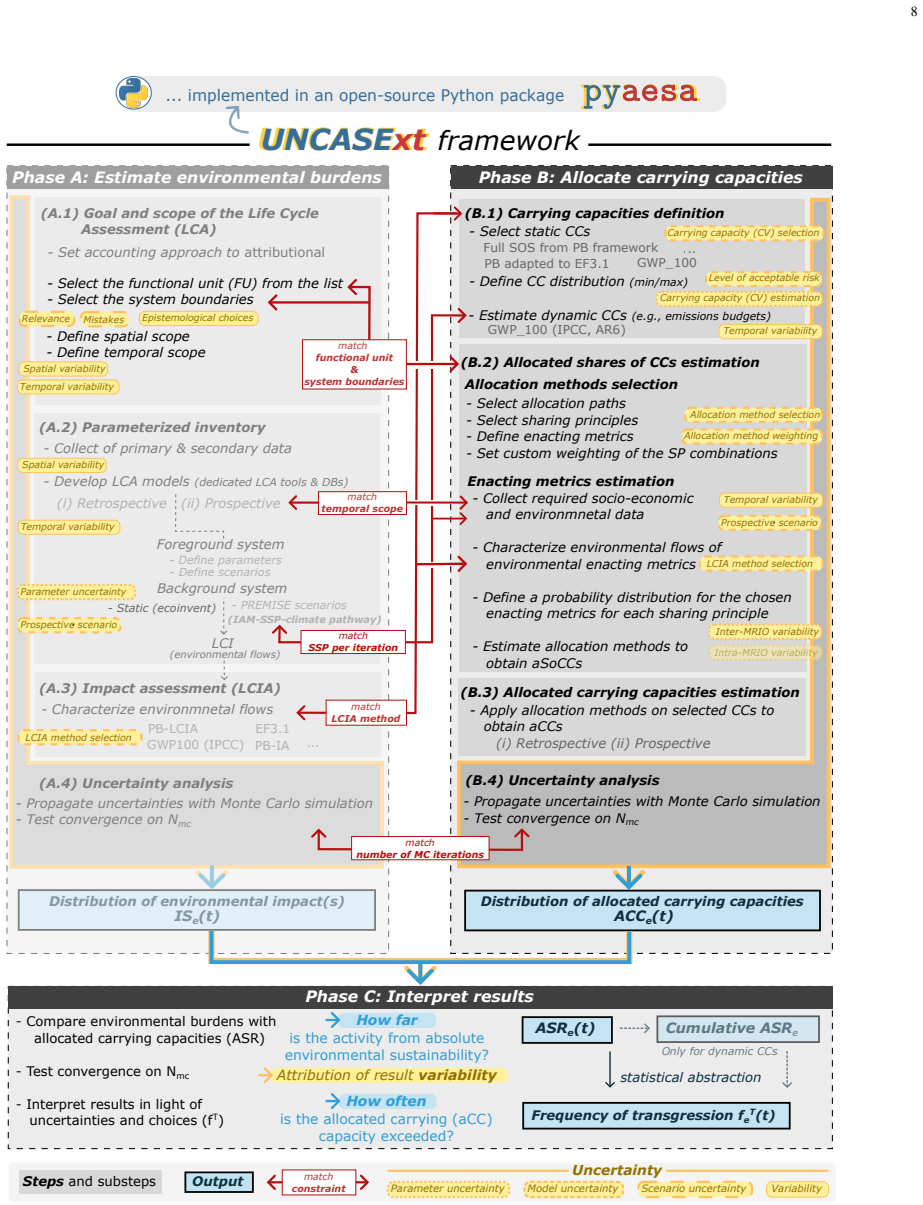
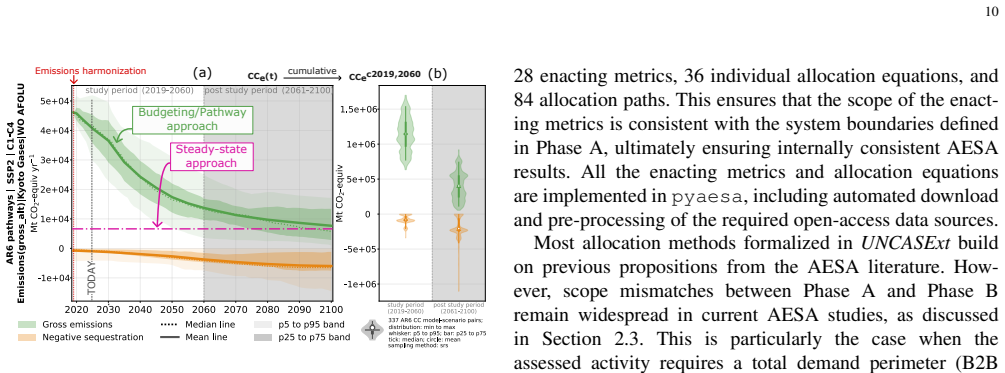
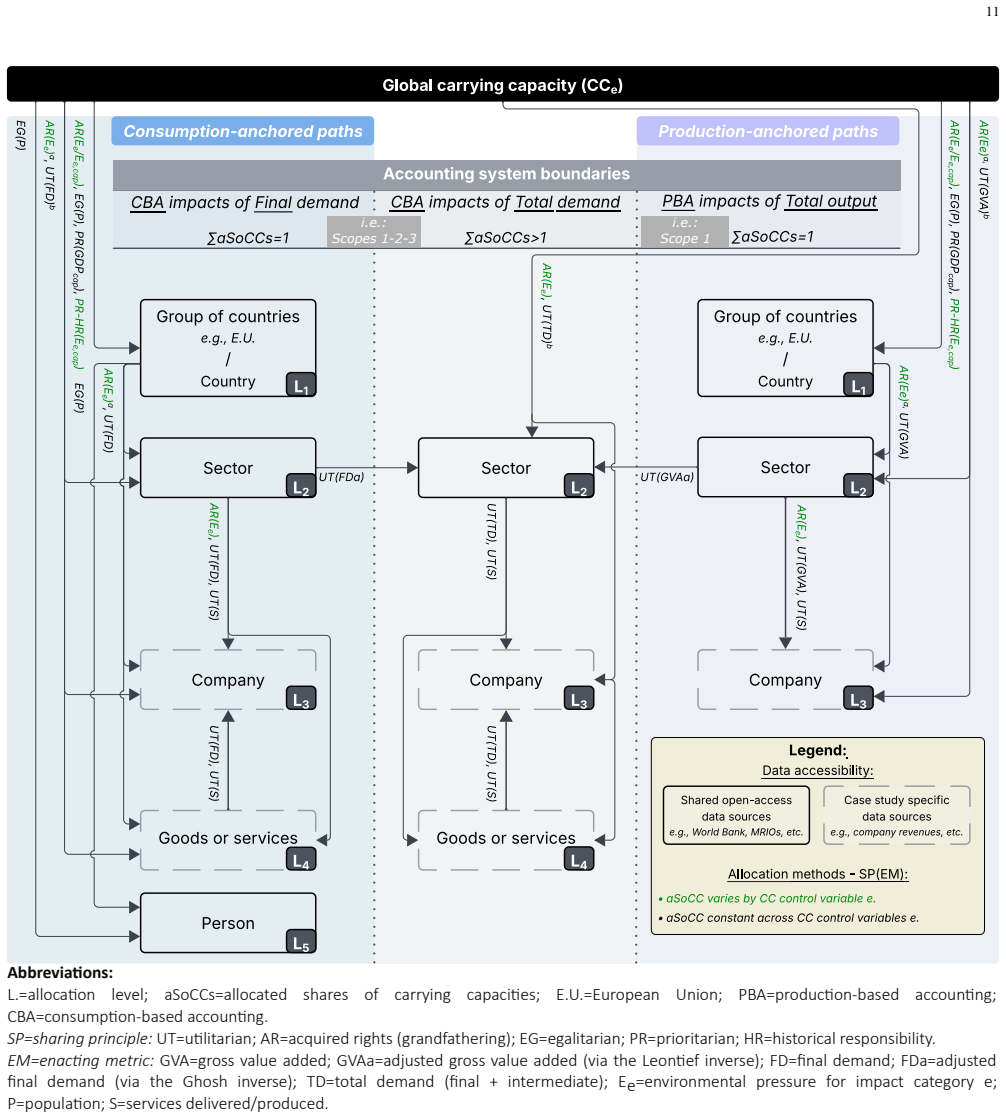
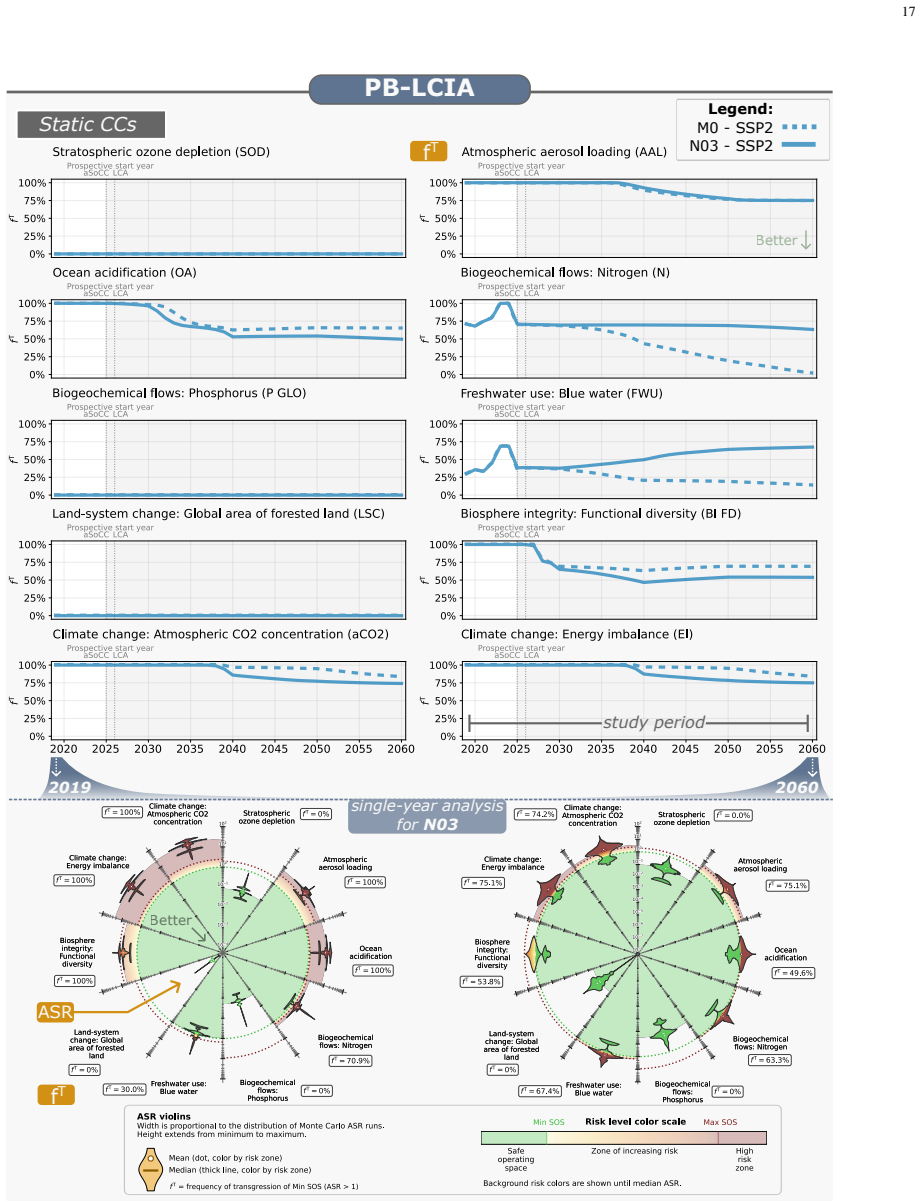
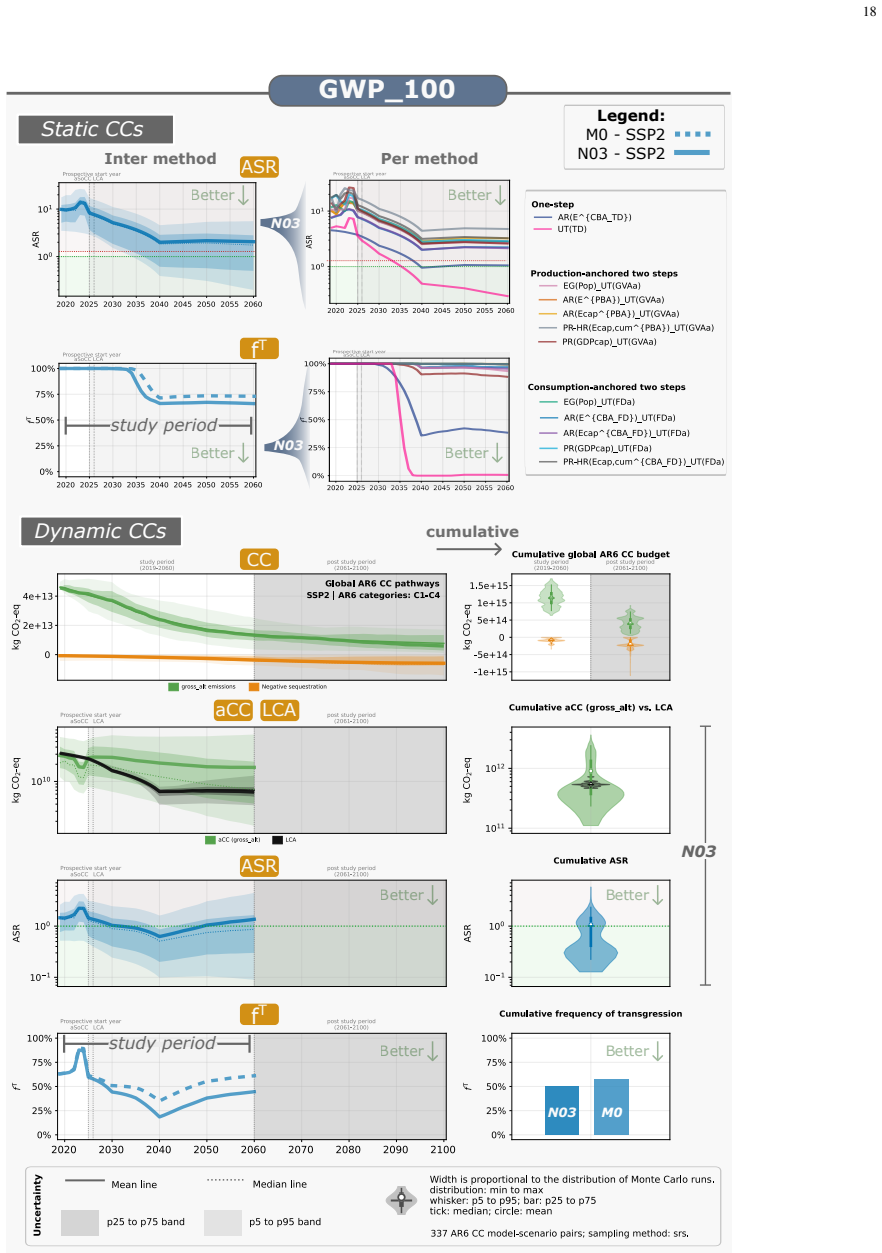
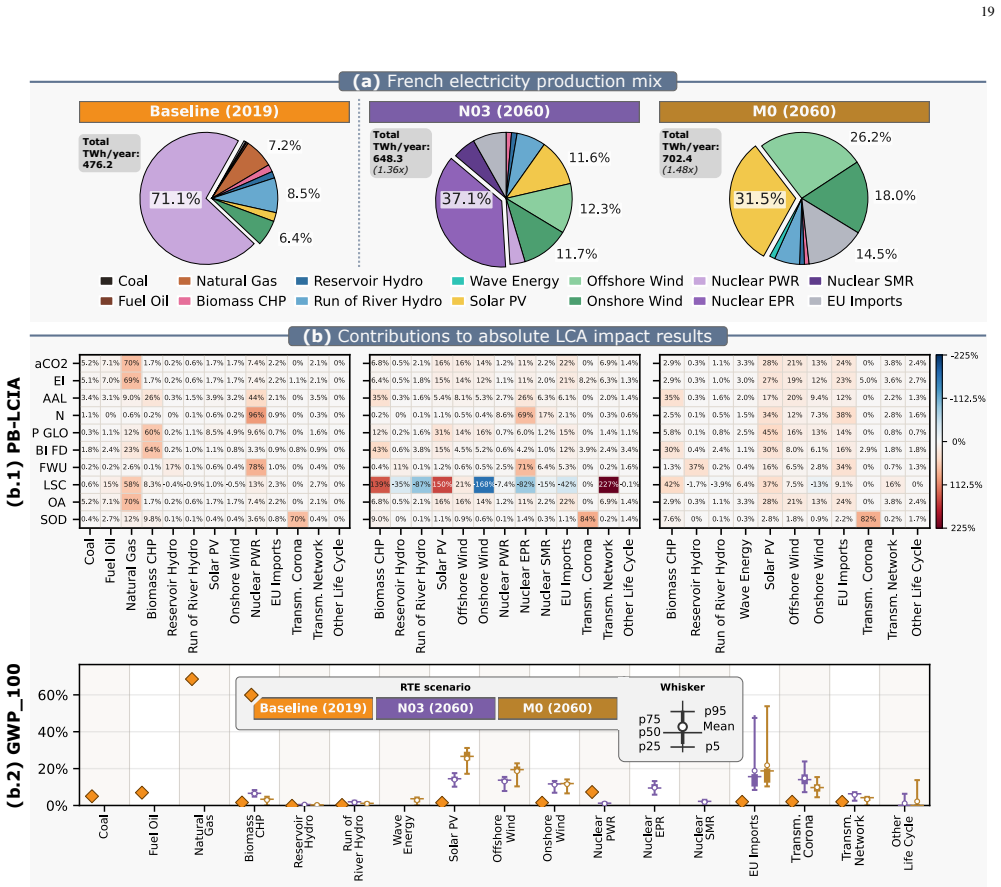
Absolute environmental sustainability assessment (AESA) has gained increasing attention in environmental research and policymaking. However, its reliability is challenged by several sources of uncertainty that remain insufficiently accounted for, as well as by scope inconsistencies within the absolute sustainability ratio (ASR), which compares estimated environmental burdens with allocated carrying capacities for a given human activity. This work introduces UNCASExt, an extension of the UNCASE framework for systematically propagating uncertainty and ensuring scope consistency in AESA, together with a supporting open-source Python package, pyaesa. At country and sector levels, the computational framework formalizes allocation procedures that match the scope of allocated carrying capacities with that of estimated environmental burdens across three dimensions: impact pathway modeling; production-based versus consumption-based accounting; business-to-consumer versus business-to-business activities. It also incorporates temporal dynamics, supporting both retrospective and prospective assessments with either static steady-state or dynamic carrying capacities, including greenhouse gas budgets from the Intergovernmental Panel on Climate Change Sixth Assessment Report under Shared Socioeconomic Pathway transition scenarios. The framework is applied to a case study of electricity consumption in France over the period 2019 to 2060. The results show that mismatches between the functional units of estimated environmental burdens and allocated carrying capacities can lead to substantial underallocation, with a median factor of 4.6x across all available sector-region pairs in EXIOBASE 3.10.2. Overall, UNCASExt and pyaesa provide a scalable solution to support AESA harmonization and a versatile way forward to bridge the gap between methodological guidelines and practical application.
Editorial analysis
A structured set of objections, weighed in public.
Referee Report
Summary. The manuscript introduces UNCASExt, an extension of the prior UNCASE framework, together with the open-source pyaesa Python package, to systematically propagate uncertainty and enforce scope consistency in absolute environmental sustainability assessments (AESA). It formalizes allocation procedures that align allocated carrying capacities with estimated environmental burdens across three dimensions (impact pathway modeling, production-based vs. consumption-based accounting, and B2C vs. B2B activities), supports retrospective/prospective assessments with static or dynamic carrying capacities drawn from IPCC SSP scenarios, and applies the framework to EXIOBASE 3.10.2 data, reporting a median 4.6x underallocation factor arising from functional-unit mismatches across all available sector-region pairs, plus a case study of French electricity consumption 2019–2060.
Significance. If the empirical result holds, the work supplies a reproducible, scalable computational approach to a recognized practical problem in AESA. The explicit open-source release of pyaesa and the use of standard public datasets (EXIOBASE 3.10.2, IPCC AR6 budgets) constitute clear strengths in verifiability and applicability. The reported median 4.6x underallocation quantifies a potentially policy-relevant scope mismatch that prior AESA studies have not systematically measured at this scale.
major comments (2)
- [Section 3] Section 3 (Scope Consistency Formalization): the manuscript presents the three formalized dimensions as jointly sufficient to capture and correct relevant scope inconsistencies, yet supplies neither an explicit completeness argument nor a cross-check against documented scope issues in the AESA literature; because the 4.6x median is obtained by applying precisely these rules, the absence of such verification is load-bearing for interpreting the factor as a general correction rather than an artifact of the chosen formalization.
- [Section 4.2] Section 4.2 (EXIOBASE Application and Results): the median 4.6x underallocation is stated without reported uncertainty ranges, sensitivity checks on the allocation rules, or verification that residual scope mismatches remain after application; given that the framework’s primary contribution includes uncertainty propagation, the lack of these diagnostics weakens the central quantitative claim.
minor comments (2)
- [Abstract] Abstract: the 4.6x median is given without the total number of sector-region pairs or any measure of dispersion, which would improve interpretability of the result.
- [Section 3] Notation: the distinction between static and dynamic carrying capacities is introduced but the precise mathematical definitions (e.g., how temporal budgets are allocated to functional units) are not cross-referenced to the equations used in the EXIOBASE calculation.
Simulated Author's Rebuttal
We thank the referee for the constructive and detailed comments, which help clarify the presentation of our framework and results. We address each major comment below and indicate the revisions we will make to the manuscript.
read point-by-point responses
-
Referee: [Section 3] Section 3 (Scope Consistency Formalization): the manuscript presents the three formalized dimensions as jointly sufficient to capture and correct relevant scope inconsistencies, yet supplies neither an explicit completeness argument nor a cross-check against documented scope issues in the AESA literature; because the 4.6x median is obtained by applying precisely these rules, the absence of such verification is load-bearing for interpreting the factor as a general correction rather than an artifact of the chosen formalization.
Authors: We agree that an explicit completeness argument and cross-check would strengthen the section. The three dimensions were derived from the most frequently cited scope inconsistencies in the AESA literature (impact pathway modeling, production- vs. consumption-based accounting, and B2B vs. B2C allocation). The 4.6x median is presented strictly as the outcome of applying these rules to EXIOBASE 3.10.2, not as a universal correction factor. In the revised manuscript we will add a dedicated subsection that (i) maps the three dimensions to documented scope issues from representative AESA studies and (ii) explicitly states the limitations of the chosen formalization, including potential additional dimensions not covered. This will clarify the interpretive scope of the reported factor. revision: yes
-
Referee: [Section 4.2] Section 4.2 (EXIOBASE Application and Results): the median 4.6x underallocation is stated without reported uncertainty ranges, sensitivity checks on the allocation rules, or verification that residual scope mismatches remain after application; given that the framework’s primary contribution includes uncertainty propagation, the lack of these diagnostics weakens the central quantitative claim.
Authors: We acknowledge the inconsistency between the framework’s emphasis on uncertainty propagation and the presentation of the 4.6x median as a single deterministic value. The median is computed directly from the functional-unit mismatch before and after applying the allocation rules; it is not itself an AESA ratio to which the full uncertainty propagation is applied. To address the comment, the revised results section will include (i) sensitivity checks on key allocation parameters (e.g., B2B/B2C classification thresholds), (ii) any data-derived uncertainty ranges that can be propagated to the mismatch factor, and (iii) a verification table or metric showing residual scope mismatches after rule application. These additions will align the quantitative claim with the framework’s methodological contributions. revision: yes
Circularity Check
Minor self-citation to prior UNCASE framework; central result remains empirical
full rationale
The paper presents UNCASExt as an extension of a prior UNCASE reference and applies formalized allocation procedures across three scope dimensions to external EXIOBASE 3.10.2 data, yielding the median 4.6x underallocation factor as a direct computational output. No derivation reduces by construction to fitted parameters, self-definitions, or self-citation chains; the quantitative claim is reproducible via the open pyaesa package on independent datasets. This qualifies as a normal minor self-reference without load-bearing circularity.
Axiom & Free-Parameter Ledger
Reference graph
Works this paper leans on
-
[1]
science , volume=
Planetary boundaries: Guiding human development on a changing planet , author=. science , volume=. 2015 , publisher=
2015
-
[2]
Science advances , volume=
Earth beyond six of nine planetary boundaries , author=. Science advances , volume=. 2023 , publisher=
2023
-
[3]
Global environmental change , volume=
National environmental limits and footprints based on the Planetary Boundaries framework: The case of Switzerland , author=. Global environmental change , volume=. 2018 , publisher=
2018
-
[4]
The International Journal of Life Cycle Assessment , volume=
Introducing carrying capacity-based normalisation in LCA: framework and development of references at midpoint level , author=. The International Journal of Life Cycle Assessment , volume=. 2015 , publisher=
2015
-
[5]
Environmental Research Letters , volume=
Framework to define environmental sustainability boundaries and a review of current approaches , author=. Environmental Research Letters , volume=. 2020 , publisher=
2020
-
[6]
Lind, Andreas and Andersen, Louise Carus , title =
-
[7]
Building and Environment , volume=
Using absolute environmental sustainability assessment and mid-to-endpoint modeling to identify the most relevant impact categories to include in a building LCA , author=. Building and Environment , volume=. 2025 , publisher=
2025
-
[8]
Journal of environmental management , volume=
Environmental sustainability of European production and consumption assessed against planetary boundaries , author=. Journal of environmental management , volume=. 2020 , publisher=
2020
-
[9]
Sustainable Production and Consumption , volume=
Level of decoupling between economic growth and environmental pressure on Earth-system processes , author=. Sustainable Production and Consumption , volume=. 2023 , publisher=
2023
-
[10]
One Earth , volume=
Sustainability footprints of a renewable carbon transition for the petrochemical sector within planetary boundaries , author=. One Earth , volume=. 2021 , publisher=
2021
-
[11]
Journal of Industrial Ecology , volume=
Life cycle assessment-based Absolute Environmental Sustainability Assessment is also relative , author=. Journal of Industrial Ecology , volume=. 2022 , publisher=
2022
-
[12]
Science of the Total Environment , volume=
How to bring absolute sustainability into decision-making: an industry case study using a planetary boundary-based methodology , author=. Science of the Total Environment , volume=. 2018 , publisher=
2018
-
[13]
Economic Systems Research , volume =
Subnational. Economic Systems Research , volume =. doi:10.1080/09535314.2025.2599092 , urldate =
-
[14]
, howpublished =
n.d. , howpublished =
-
[15]
Guidance for Applying Absolute Environmental Sustainability Assessment on Activities at Different Scales (
Bj. Guidance for Applying Absolute Environmental Sustainability Assessment on Activities at Different Scales (
-
[16]
Renewable and Sustainable Energy Reviews , volume=
National SDG-7 performance assessment to support achieving sustainable energy for all within planetary limits , author=. Renewable and Sustainable Energy Reviews , volume=. 2023 , publisher=
2023
-
[17]
Sustainable Production and Consumption , volume=
Communicating the environmental impacts of individual actions in the context of Planetary Boundaries , author=. Sustainable Production and Consumption , volume=. 2025 , publisher=
2025
-
[18]
Sustainable Production and Consumption , year=
Absolute environmental sustainability assessments of long-lived systems: A review of challenges with the representation of time and future research directions , author=. Sustainable Production and Consumption , year=
-
[19]
Sustainable Production and Consumption , volume=
Quantifying uncertainties in absolute environmental sustainability assessment: A general framework applied to French electricity production , author=. Sustainable Production and Consumption , volume=. 2025 , publisher=
2025
-
[20]
Bai, Xuemei and Hasan, Syezlin and Andersen, Lauren Seaby and Bj. Translating. Nature Sustainability , volume =. doi:10.1038/s41893-023-01255-w , urldate =
-
[21]
Yang, Qiang and Paulillo, Andrea , year = 2025, month = jan, journal =. Advancing. doi:10.1016/j.procir.2024.12.087 , urldate =
-
[22]
Byers, Edward and Krey, Volker and Kriegler, Elmar and Riahi, Keywan and Schaeffer, Roberto and Kikstra, Jarmo and Lamboll, Robin and Nicholls, Zebedee and Sandstad, Marit and Smith, Chris and others , year =
-
[23]
Balanza, Th. Exploring Configurations of a. Environmental Research Letters , volume =. doi:10.1088/1748-9326/ade26b , urldate =
-
[24]
Environmental Impact Assessment Review , volume =
Investigating Methodological Aspects of Absolute Environmental Sustainability Assessment Based on Planetary Boundaries , author =. Environmental Impact Assessment Review , volume =. doi:10.1016/j.eiar.2025.108154 , urldate =
-
[25]
Quantifying Environmental Impacts on Planetary Boundaries:
Yang, Qiang and Paulillo, Andrea , year = 2026, month = jun, journal =. Quantifying Environmental Impacts on Planetary Boundaries:. doi:10.1016/j.eiar.2026.108355 , urldate =
-
[26]
Sacchi, R. and Terlouw, T. and Siala, K. and Dirnaichner, A. and Bauer, C. and Cox, B. and Mutel, C. and Daioglou, V. and Luderer, G. , year = 2022, month = may, journal =. doi:10.1016/j.rser.2022.112311 , urldate =
-
[27]
Stadler, Konstantin and Wood, Richard and Bulavskaya, Tatyana and S. 2026 , publisher =. doi:10.5281/zenodo.20051562 , url =
-
[28]
https://doi.org/ 10.1111/jiec.12715
Stadler, Konstantin and Wood, Richard and Bulavskaya, Tatyana and S. Journal of Industrial Ecology , volume =. doi:10.1111/jiec.12715 , urldate =
-
[29]
OECD , year = 2023, journal =. Inter-
2023
-
[30]
2025 , urldate =
World Development Indicators , author =. 2025 , urldate =
2025
-
[31]
Economic Systems Research , volume =
A Scenario-Based Method for Projecting Multi-Regional Input--Output Tables , author =. Economic Systems Research , volume =. doi:10.1080/09535314.2021.1952404 , urldate =
-
[32]
Carbon Footprint Reduction Potential of Consumption Changes in Five
Cap, Stephanie and Li, Sinja and. Carbon Footprint Reduction Potential of Consumption Changes in Five. Sustainable Production and Consumption , volume =. doi:10.1016/j.spc.2025.08.018 , urldate =
-
[33]
Implementing Exogenous Scenarios in a Global
Wiebe, Kirsten Svenja and Bjelle, Eivind Lekve and T. Implementing Exogenous Scenarios in a Global. Journal of Economic Structures , volume =. doi:10.1186/s40008-018-0118-y , urldate =
-
[34]
Life cycle assessment: theory and practice , pages=
Uncertainty management and sensitivity analysis , author=. Life cycle assessment: theory and practice , pages=. 2017 , publisher=
2017
-
[35]
Stadler, Konstantin , year = 2021, month = may, journal =. Pymrio --. doi:10.5334/jors.251 , urldate =
-
[36]
Robinson, John B , journal=. 1990 , publisher=. doi:10.1016/0016-3287(90)90018-D , note=
-
[37]
Journal of Environmental Management , volume=
Carrying capacity-based benchmarks for Belgian residential buildings , author=. Journal of Environmental Management , volume=. 2024 , publisher=
2024
-
[38]
Lca\_algebraic: A Library Bringing Symbolic Calculus to
Jolivet, Rapha. Lca\_algebraic: A Library Bringing Symbolic Calculus to. The International Journal of Life Cycle Assessment , volume =. doi:10.1007/s11367-021-01993-z , urldate =
-
[39]
Bj. Beyond Net Zero Climate Targets: A Research Agenda for Absolute Environmental Sustainability Assessment to Support Decisions at Different Scales , shorttitle =. Environmental Research Letters , issn =. doi:10.1088/1748-9326/ae3dfa , urldate =
-
[40]
and Min, Jihoon , year = 2018, month = jul, journal =
Rao, Narasimha D. and Min, Jihoon , year = 2018, month = jul, journal =. Decent. doi:10.1007/s11205-017-1650-0 , urldate =
-
[41]
Environmental Research Letters , volume =
Review of Life-Cycle Based Methods for Absolute Environmental Sustainability Assessment and Their Applications , author =. Environmental Research Letters , volume =. doi:10.1088/1748-9326/ab89d7 , urldate =
-
[42]
Sustainable Production and Consumption , volume =
Developing Sufficiency-Based Sharing Principles for Absolute Environmental Sustainability Assessment Using Decent Living Standards and Planetary Boundaries , author =. Sustainable Production and Consumption , volume =. doi:10.1016/j.spc.2025.01.008 , urldate =
-
[43]
Ryberg, Morten W. and Bjerre, Troels K. and Nielsen, Per Henrik and Hauschild, Michael , year = 2021, journal =. Absolute Environmental Sustainability Assessment of a. doi:10.1111/jiec.13075 , urldate =
-
[44]
Sharing the Safe Operating Space:
Hjalsted, Anjila Wegge and Laurent, Alexis and Andersen, Martin Marchman and Olsen, Karen Holm and Ryberg, Morten and Hauschild, Michael , year = 2021, journal =. Sharing the Safe Operating Space:. doi:10.1111/jiec.13050 , urldate =
-
[45]
Huijbregts, Mark A. J. , year = 1998, month = sep, journal =. Application of Uncertainty and Variability in. doi:10.1007/BF02979835 , urldate =
-
[46]
doi:10.1007/978-3-319-56475-3 , urldate =
Life. doi:10.1007/978-3-319-56475-3 , urldate =
-
[47]
Bj. A. Journal of Industrial Ecology , volume =. doi:10.1111/jiec.12820 , abstract =
-
[48]
and Andersen, Martin Marchman and Owsianiak, Miko
Ryberg, Morten W. and Andersen, Martin Marchman and Owsianiak, Miko. Downscaling the Planetary Boundaries in Absolute Environmental Sustainability Assessments --. Journal of Cleaner Production , volume =. doi:10.1016/j.jclepro.2020.123287 , urldate =
-
[49]
Renewable and Sustainable Energy Reviews , volume =
More Rationality and Inclusivity Are Imperative in Reference Transition Scenarios Based on. Renewable and Sustainable Energy Reviews , volume =. doi:10.1016/j.rser.2025.115924 , urldate =
-
[50]
Ryberg, Morten W. and Owsianiak, Miko. Development of a Life-Cycle Impact Assessment Methodology Linked to the. Ecological Indicators , volume =. doi:10.1016/j.ecolind.2017.12.065 , urldate =
-
[51]
Climate Change 2022: Mitigation of Climate Change , shorttitle =
2022
-
[52]
Paulillo, Andrea and. Approaches to Incorporate. Resources, Environment and Sustainability , volume =. doi:10.1016/j.resenv.2024.100169 , urldate =
-
[53]
Rodrigues, Jo. Uncertainty of. Environmental Science & Technology , volume =. doi:10.1021/acs.est.8b00632 , urldate =
-
[54]
The International Journal of Life Cycle Assessment , volume =
Survey of Approaches to Improve Reliability in Lca , author =. The International Journal of Life Cycle Assessment , volume =. doi:10.1007/BF02978849 , urldate =
-
[55]
, title =
Wooldridge, Jeffrey M. , title =. 2009 , publisher =
2009
-
[56]
Journal of the Royal Statistical Society: Series B (Methodological) , year =
Aitchison, John , title =. Journal of the Royal Statistical Society: Series B (Methodological) , year =
-
[57]
, title =
Greene, William H. , title =. 2003 , publisher =
2003
-
[58]
Seber, George A. F. and Lee, Alan J. , title =. 2003 , publisher =
2003
-
[59]
Modelling and Analysis of Compositional Data , year =
Pawlowsky-Glahn, Vera and Egozcue, Juan Jos. Modelling and Analysis of Compositional Data , year =
-
[60]
Variance Based Sensitivity Analysis of Model Output
Saltelli, Andrea and Annoni, Paola and Azzini, Ivano and Campolongo, Francesca and Ratto, Marco and Tarantola, Stefano , year = 2010, month = feb, journal =. Variance Based Sensitivity Analysis of Model Output. doi:10.1016/j.cpc.2009.09.018 , urldate =
-
[61]
S. Endogenizing. Environmental Science & Technology , volume =. doi:10.1021/acs.est.8b02791 , urldate =
-
[62]
An Open-Access Web Application to Visualise Countries' and Regions' Carbon Footprints Using
Andrieu, Baptiste and Le Boulzec, Hugo and Delannoy, Louis and Verzier, Fran. An Open-Access Web Application to Visualise Countries' and Regions' Carbon Footprints Using. Communications Earth & Environment , volume =. doi:10.1038/s43247-024-01378-8 , urldate =
-
[63]
Sobol, I. M. , title =. Mathematical Modelling and Computational Experiments , year =
-
[64]
Planetary Health Check 2025: A Scientific Assessment of the State of the Planet (Report)
Sakschewski, Boris and Caesar, Levke and Andersen, Lauren and Bechthold, Max and Bergfeld, Lotta and Beusen, Arthur and Billing, Maik and Bodirsky, Benjamin Leon and Botsyun, Svetlana and Dennis, Donovan P. and Donges, Jonathan and Dou, Xinyu and Eriksson, Axel and Fetzer, Ingo and Gerten, Dieter and H. Planetary. Planetary Boundaries Science (PBScience) ...
-
[65]
Terminology for Future-Oriented Life Cycle Assessment: Review and Recommendations , shorttitle =
Arvidsson, Rickard and Svanstr. Terminology for Future-Oriented Life Cycle Assessment: Review and Recommendations , shorttitle =. The International Journal of Life Cycle Assessment , volume =. doi:10.1007/s11367-023-02265-8 , urldate =
-
[66]
Nature Communications , volume =
Construction of an Enterprise-Level Global Supply Chain Database , author =. Nature Communications , volume =. doi:10.1038/s41467-025-66083-2 , urldate =
-
[67]
Langkau, Sabine and Steubing, Bernhard and Mutel, Christopher and Ajie, Maulana Permana and Erdmann, Lorenz and. A Stepwise Approach for. The International Journal of Life Cycle Assessment , volume =. doi:10.1007/s11367-023-02175-9 , urldate =
-
[68]
Differentiation of Greenhouse Gases in Corporate Science-Based Targets Improves Alignment with
Bj. Differentiation of Greenhouse Gases in Corporate Science-Based Targets Improves Alignment with. Environmental Research Letters , volume =. doi:10.1088/1748-9326/ace0cf , urldate =
-
[69]
A New Consistent Framework for Assignment of Safe Operating Space to
Oosterhoff, Hendrik Christiaan and Golsteijn, Laura and Laurent, Alexis and Ryberg, Morten Walbech , year = 2023, month = may, journal =. A New Consistent Framework for Assignment of Safe Operating Space to. doi:10.1016/j.jclepro.2023.136574 , urldate =
-
[70]
Shared Producer and Consumer Responsibility ---
Lenzen, Manfred and Murray, Joy and Sack, Fabian and Wiedmann, Thomas , year = 2007, month = feb, journal =. Shared Producer and Consumer Responsibility ---. doi:10.1016/j.ecolecon.2006.05.018 , urldate =
-
[71]
Nature Climate Change , volume =
The Why and How of Assigning Responsibility for Supply Chain Emissions , author =. Nature Climate Change , volume =. doi:10.1038/s41558-022-01543-x , urldate =
-
[72]
Gopalakrishnan, Sanjith and Granot, Daniel and Granot, Frieda and So. Incentives and. Management Science , volume =. doi:10.1287/mnsc.2020.3724 , urldate =
-
[73]
Ecological Economics , series =
Conceptualising Environmental Responsibility , author =. Ecological Economics , series =. doi:10.1016/j.ecolecon.2010.04.005 , urldate =
-
[74]
2022 , month = nov, howpublished =
Byers, Edward and Krey, Volker and Kriegler, Elmar and Riahi, Keywan and Schaeffer, Roberto and Kikstra, Jarmo and Lamboll, Robin and Nicholls, Zebedee and Sandstad, Marit and Smith, Chris and van der Wijst, Kaj and Al Khourdajie, Alaa and Lecocq, Franck and Portugal-Pereira, Joana and Saheb, Yamina and Stromann, Anders and Winkler, Harald and Auer, Corne...
-
[75]
Nature sustainability , volume=
Human impacts on planetary boundaries amplified by Earth system interactions , author=. Nature sustainability , volume=. 2020 , publisher=
2020
-
[76]
Natural Resources , volume=
Visualizing relationships between drivers of environmental change and pressures on land-based ecosystems , author=. Natural Resources , volume=. 2014 , publisher=
2014
-
[77]
Ecological Economics , volume =
A Framework to Allocate Responsibilities of the Global Environmental Concerns:. Ecological Economics , volume =. doi:10.1016/j.ecolecon.2021.107258 , abstract =
-
[78]
Calculating the Sustainability of Products Based on Their Efficiency and Function , author =. One Earth , volume =. doi:10.1016/j.oneear.2022.10.011 , urldate =
-
[79]
Weidner, Till and. Energy Systems Modeling and Optimization for Absolute Environmental Sustainability: Current Landscape and Opportunities , shorttitle =. Computers & Chemical Engineering , volume =. doi:10.1016/j.compchemeng.2022.107883 , urldate =
-
[80]
Optimising Fuel Supply Chains within Planetary Boundaries:
Ehrenstein, Michael and. Optimising Fuel Supply Chains within Planetary Boundaries:. Applied Energy , volume =. doi:10.1016/j.apenergy.2020.115486 , urldate =
discussion (0)
Sign in with ORCID, Apple, or X to comment. Anyone can read and Pith papers without signing in.