The forgotten bright star: Theta Eridani as a millenary stellar transient observed by Hipparchus, Ptolemy and al-Sufi
Pith reviewed 2026-07-01 01:49 UTC · model grok-4.3
The pith
Theta Eridani's recorded ancient brightness reflects a real millenary common-envelope transient in its binary, not observer errors.
A machine-rendered reading of the paper's core claim, the machinery that carries it, and where it could break.
Core claim
Theta Eridani Aa+Ab forms a tight eccentric binary (a=0.083 au, e=0.105) of intermediate-mass stars (roughly 2.3 and 2.2 solar masses) that fill about 80 percent of their Roche lobes, with the primary having just completed core hydrogen burning; these conditions indicate that a previous eccentricity near 0.6 produced a millenary common-envelope stage powered by orbital energy extraction, accounting for the historical Delta V of about 2.7.
What carries the argument
The solved orbital parameters and stellar radii of the inner binary, which together indicate a prior eccentric Roche-lobe overflow that initiated a long common-envelope transient.
If this is right
- The historical magnitude records accurately captured a real change rather than repeated errors.
- Orbital energy released during the common-envelope phase supplied the extra luminosity for roughly a millennium.
- The system reached its current near-contact state after the transient ended.
- The primary's post-core-hydrogen-burning status aligns with the timing needed for the proposed evolutionary path.
Where Pith is reading between the lines
- Other close binaries with similar masses and near-Roche contact could host undetected historical transients if their eccentricities were once higher.
- Binary population models may need to incorporate longer common-envelope durations triggered by eccentric overflow to match observed merger rates.
- The outer tertiary companion could have influenced the inner binary's eccentricity evolution in ways not yet modeled.
Load-bearing premise
That the present-day separation, eccentricity, and radii suffice to show an earlier eccentricity of about 0.6 would have produced a common-envelope phase lasting long enough and bright enough to match the observed Delta V without further luminosity or duration calculations.
What would settle it
New measurements showing the current eccentricity or radii are incompatible with a prior state that could sustain a common-envelope phase of the required duration and brightness.
Figures
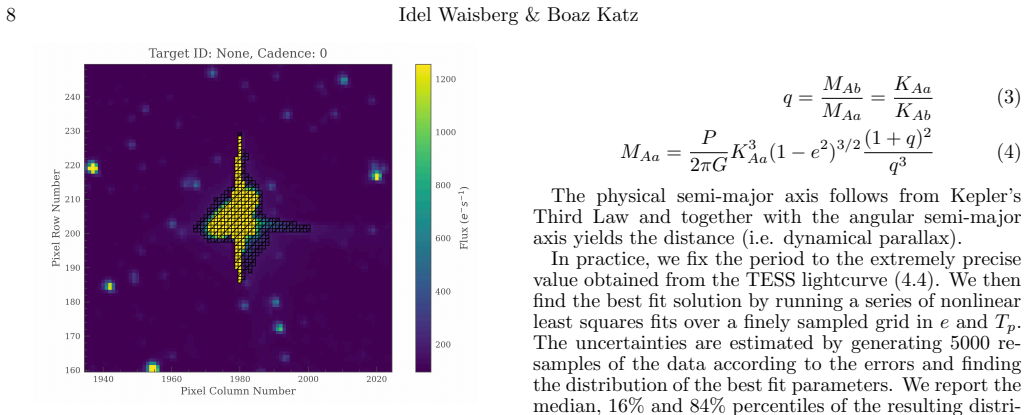
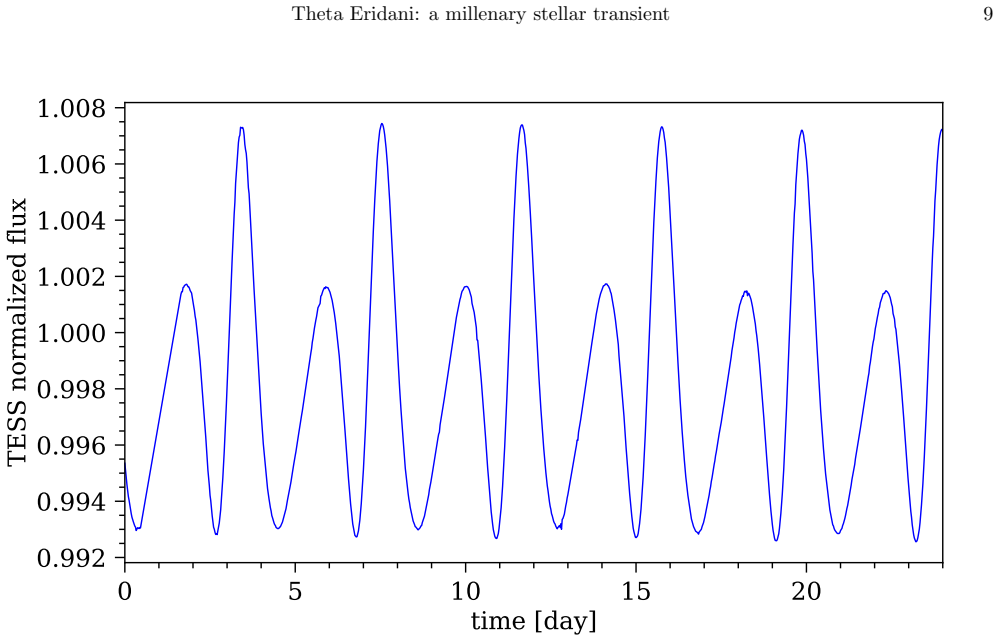
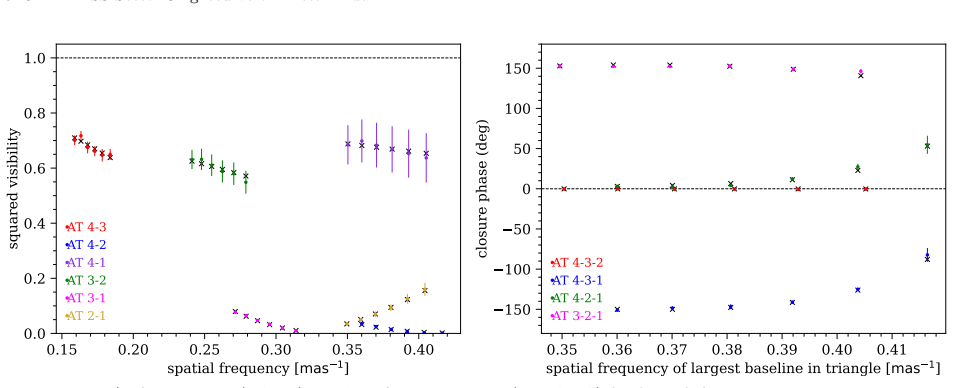
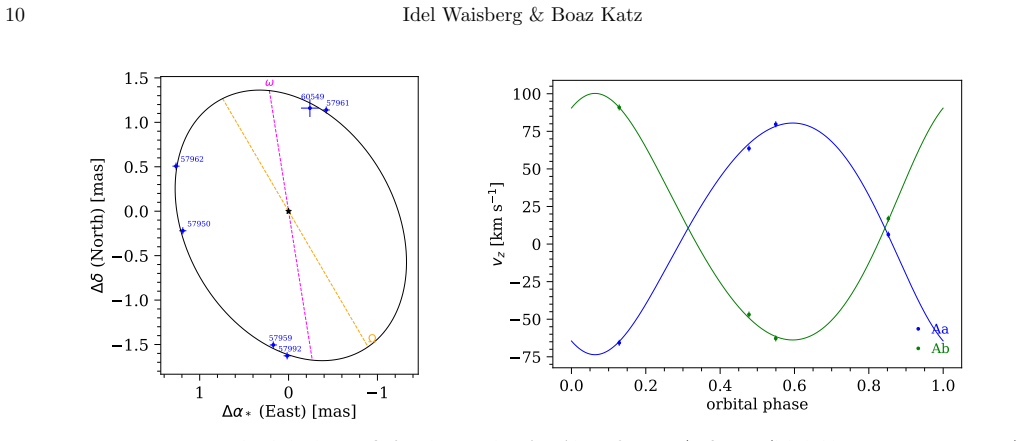
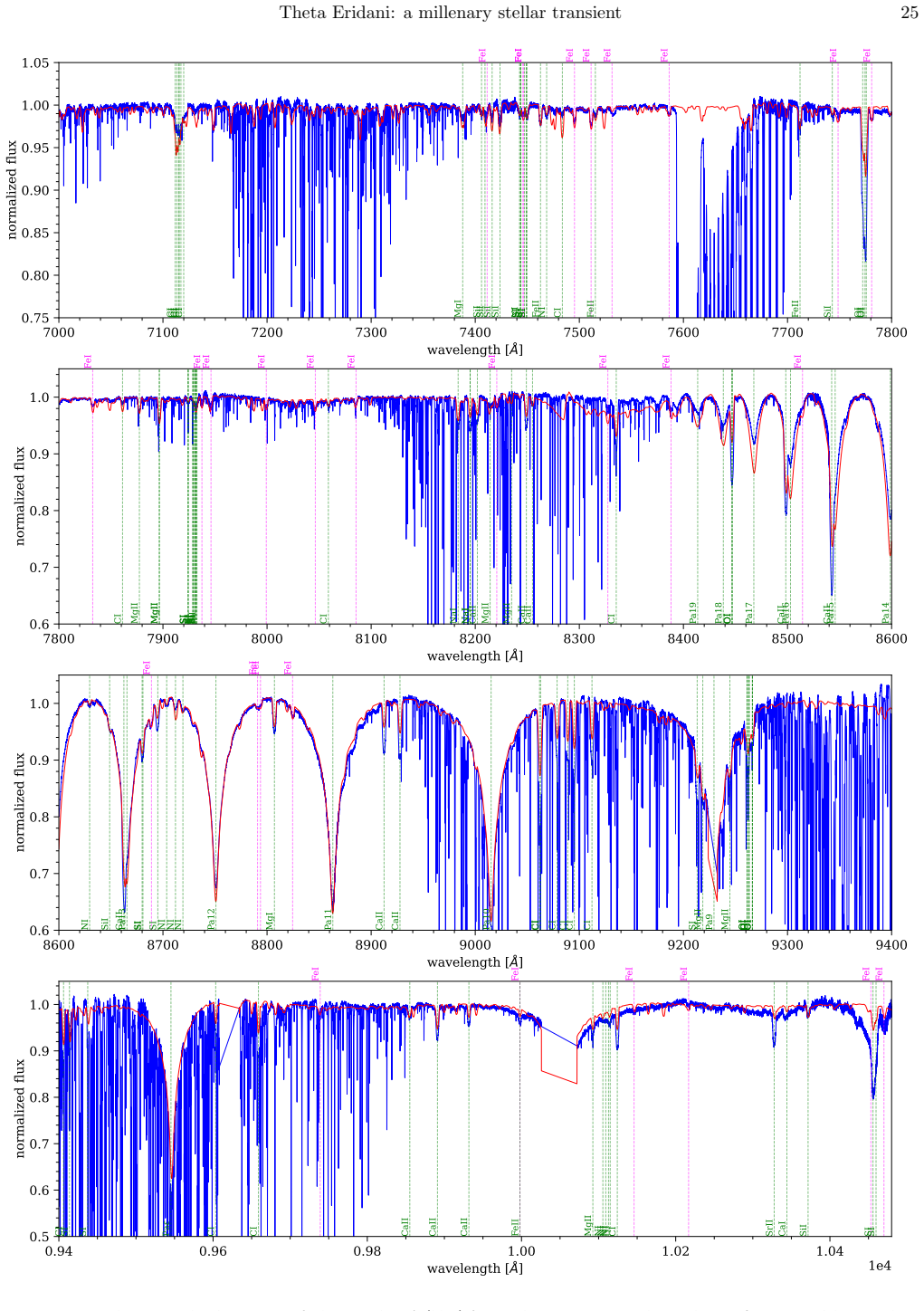
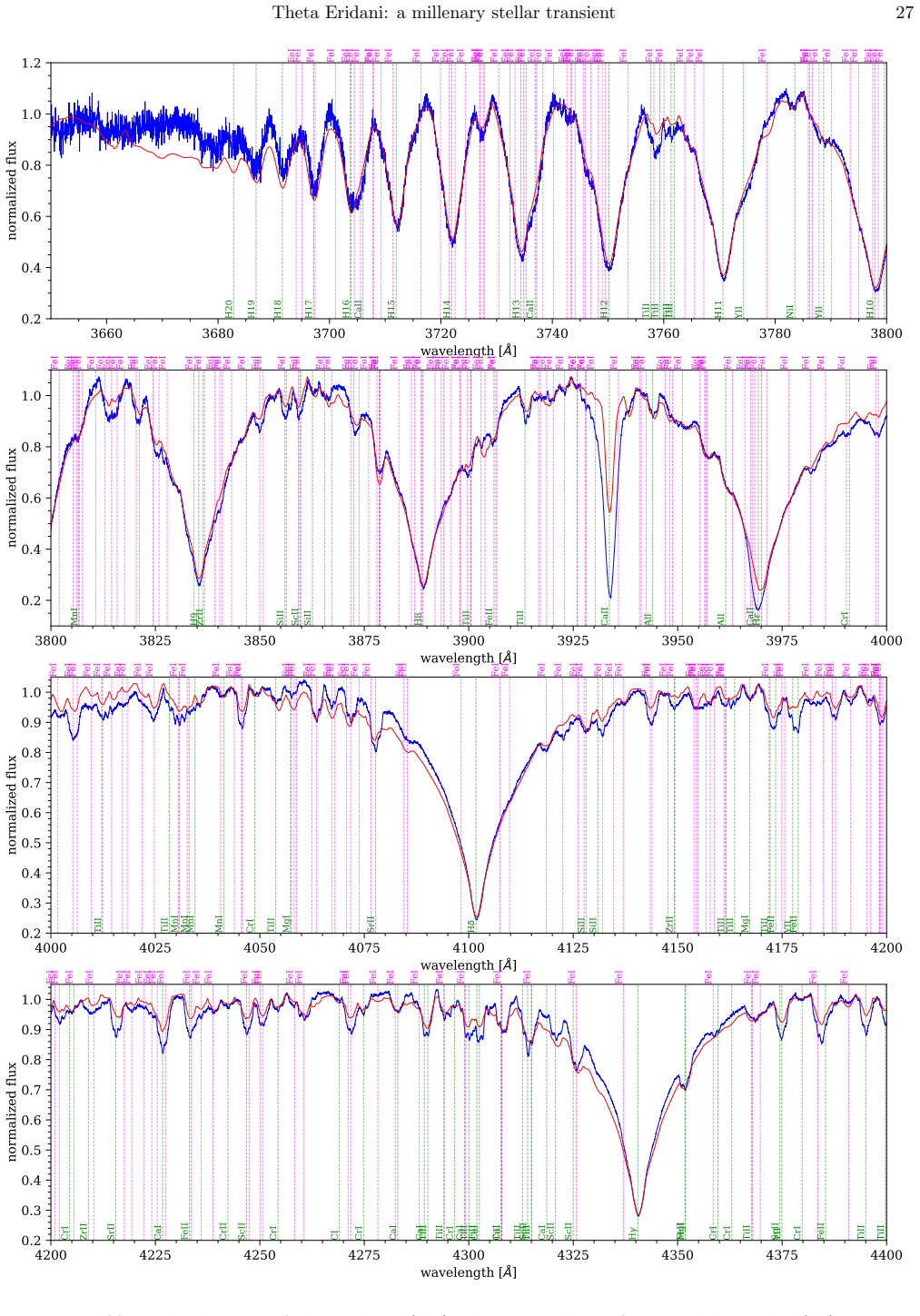
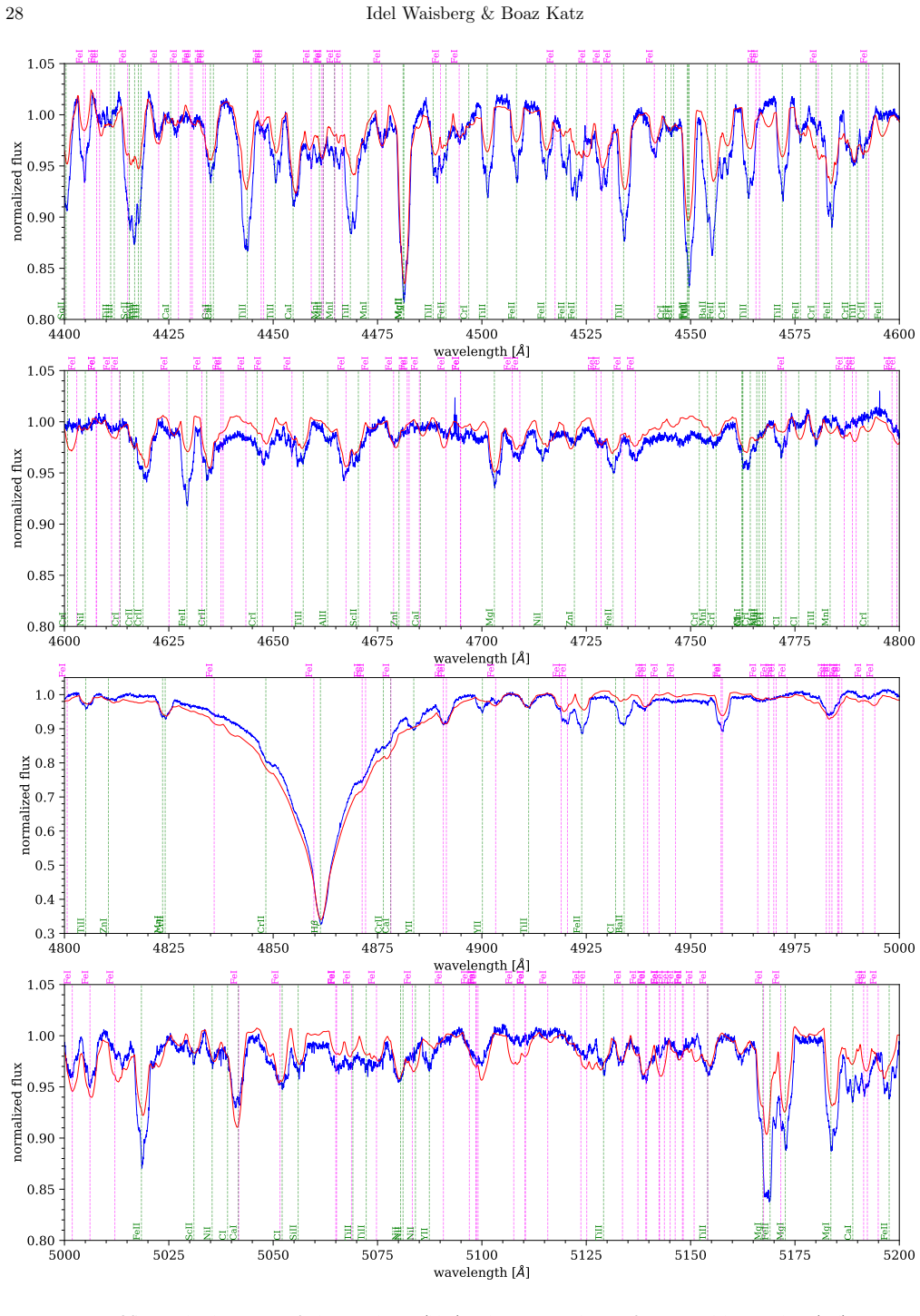
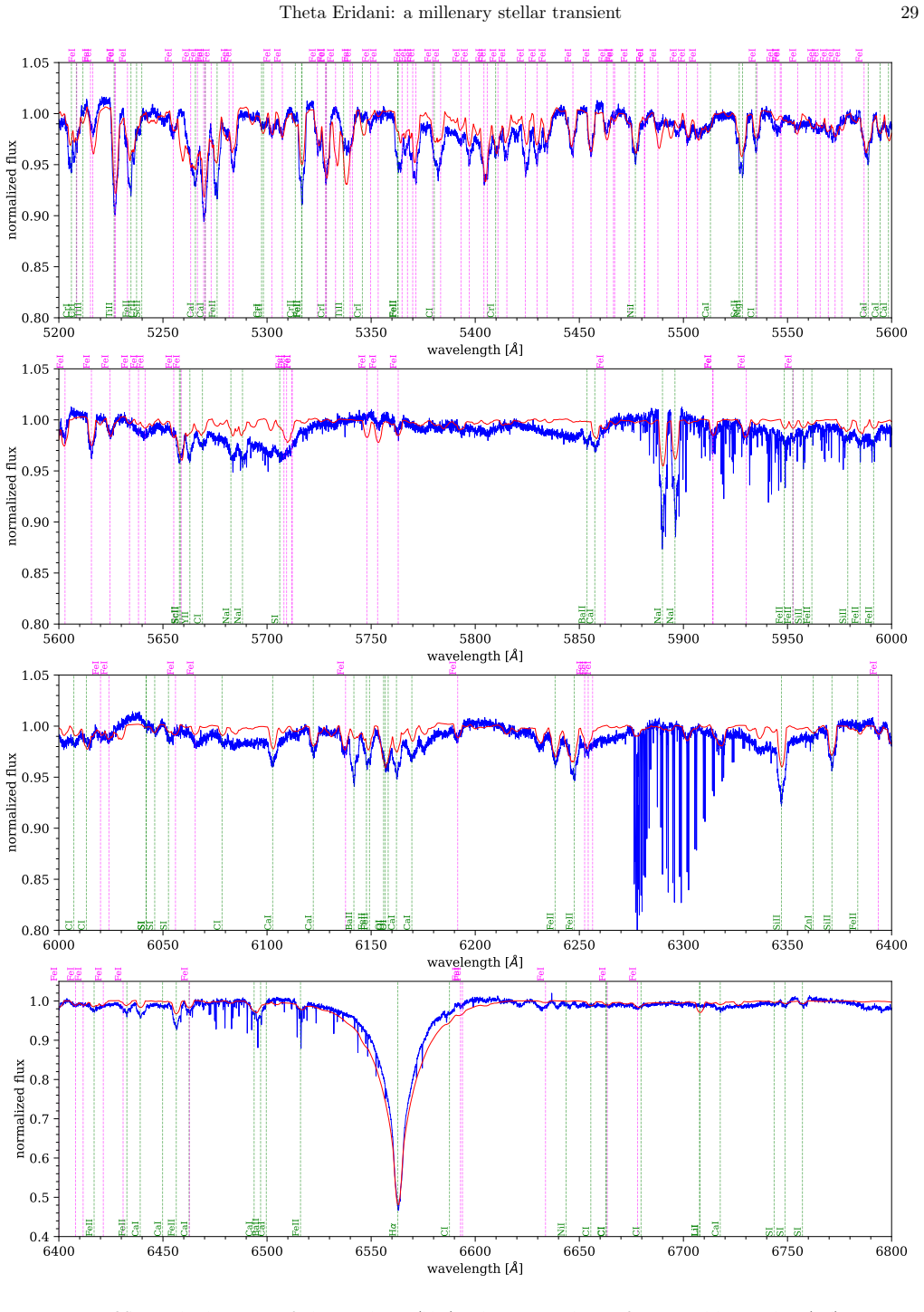
read the original abstract
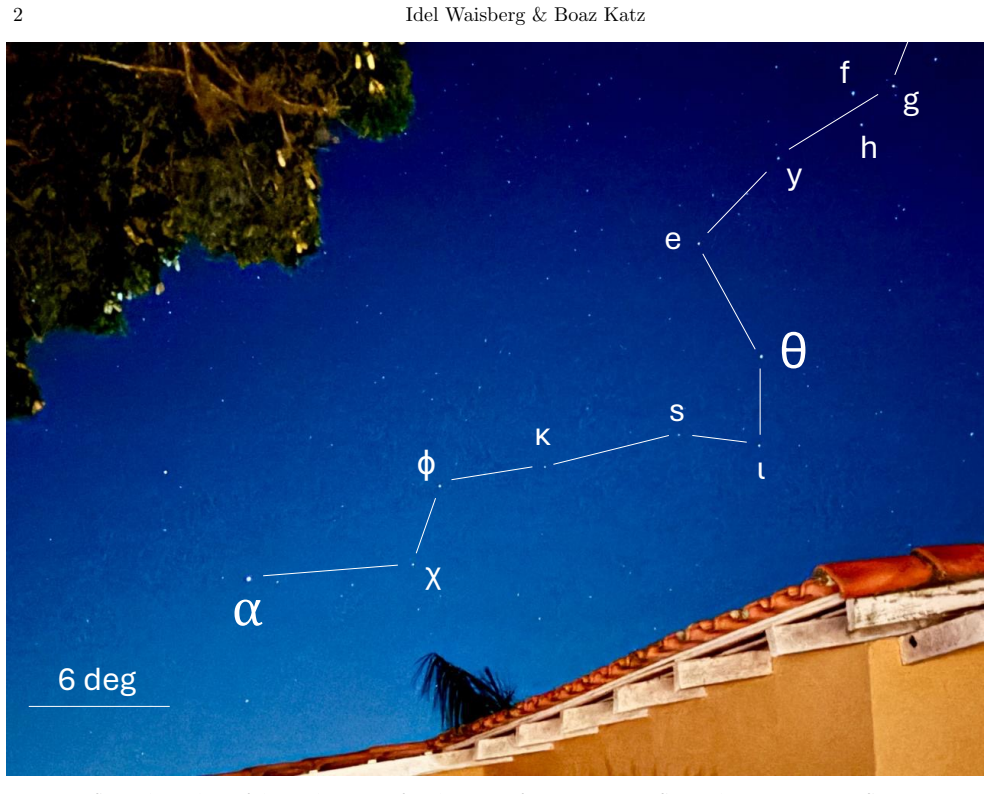
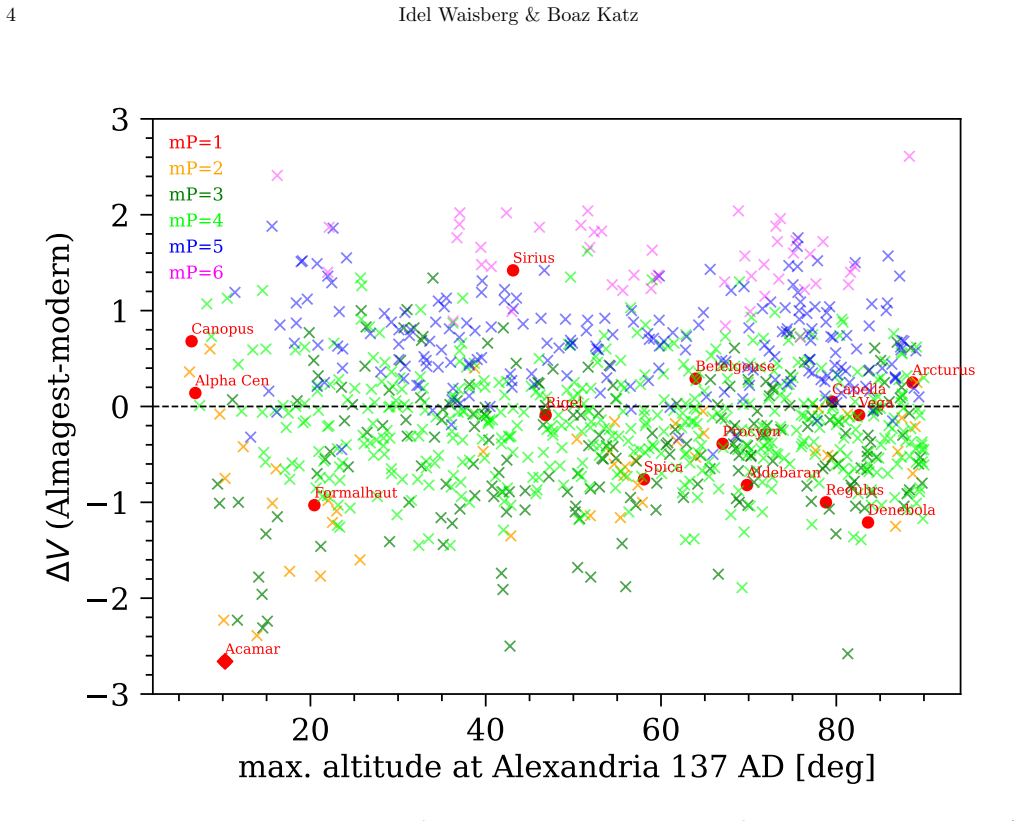
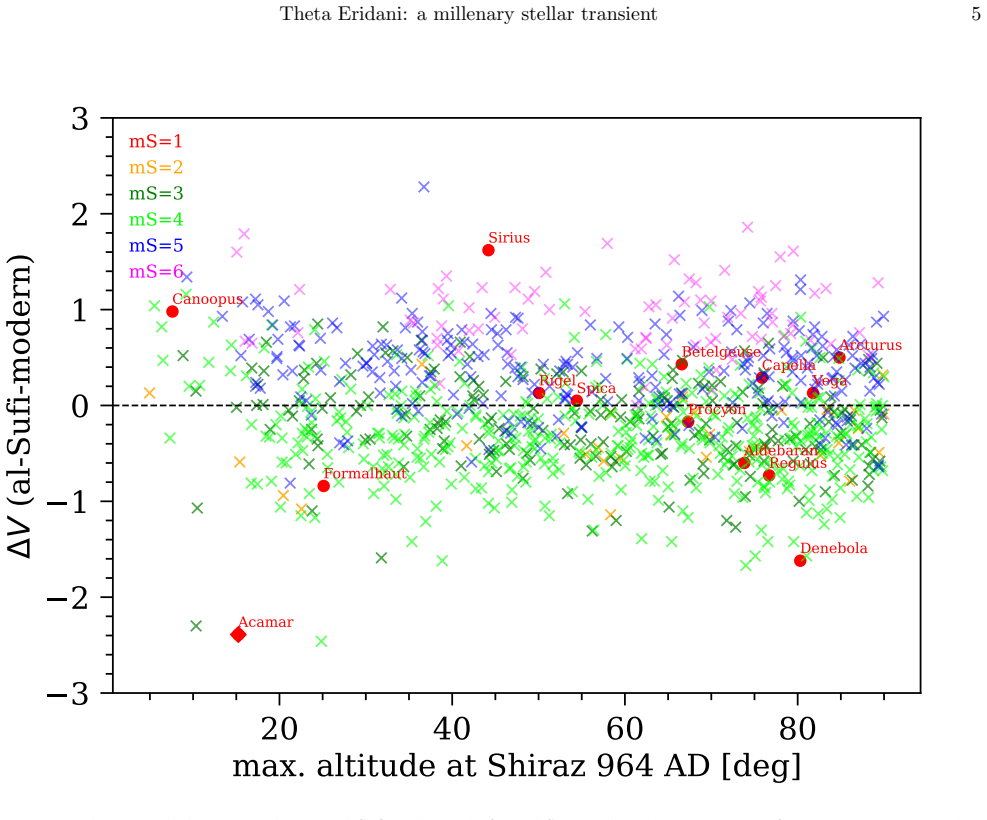
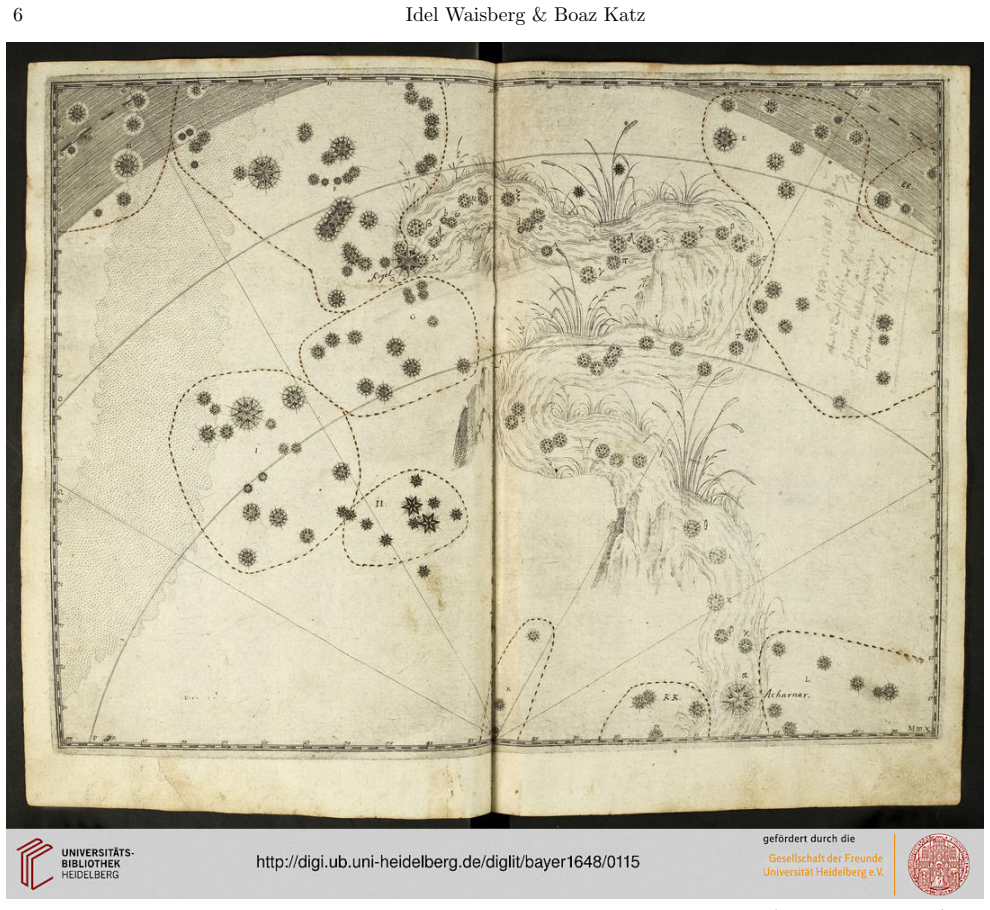
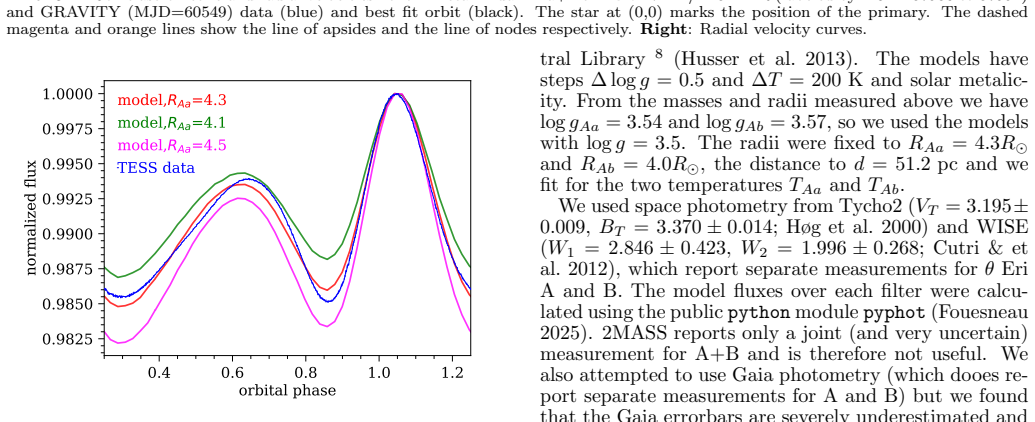
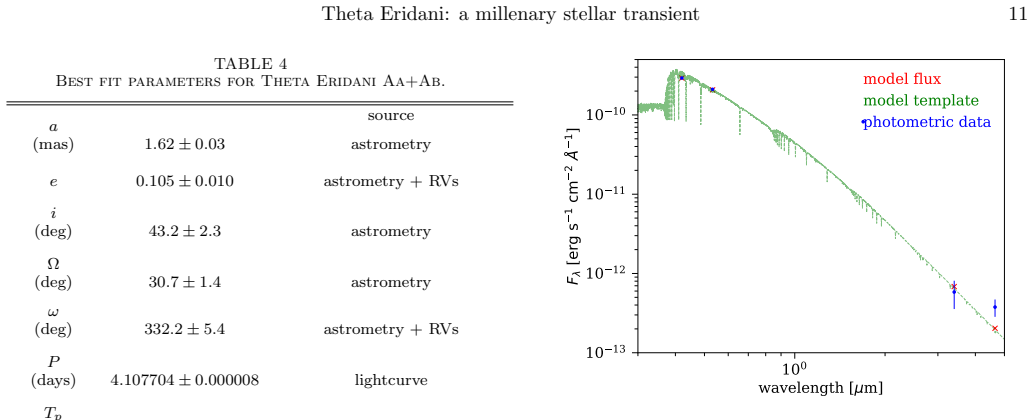
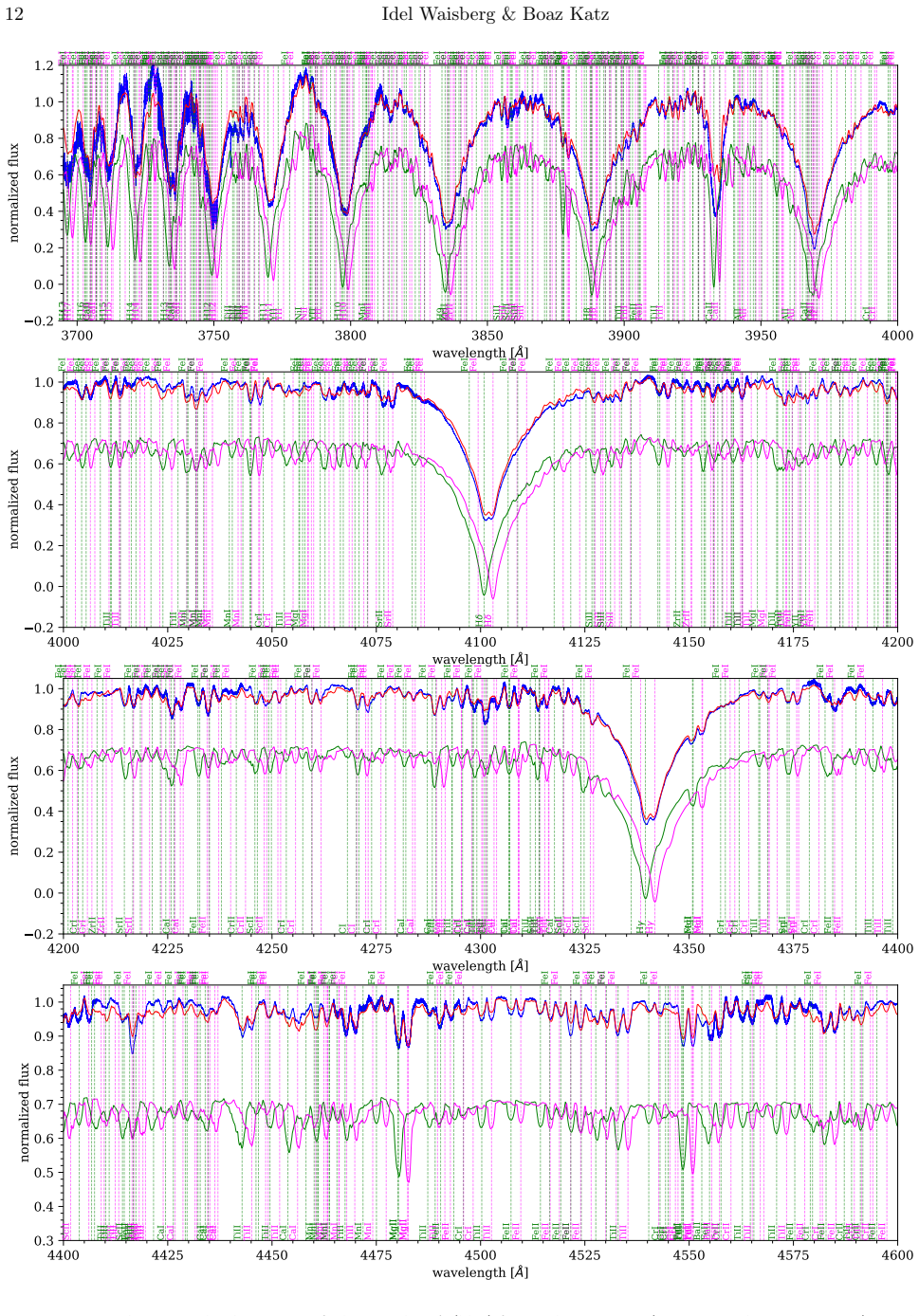
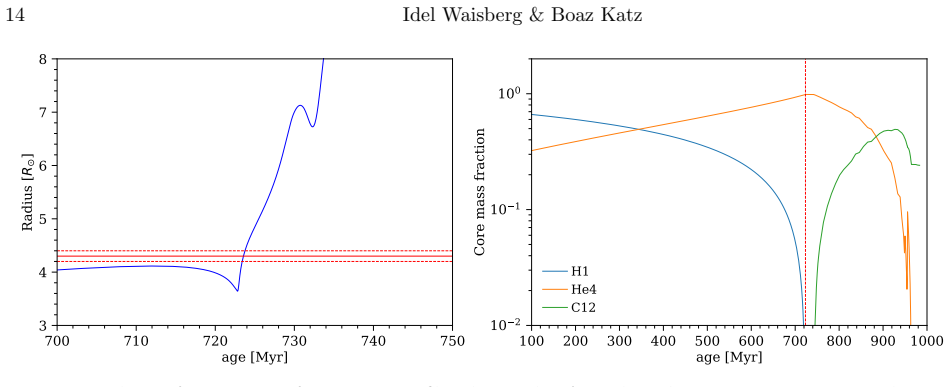
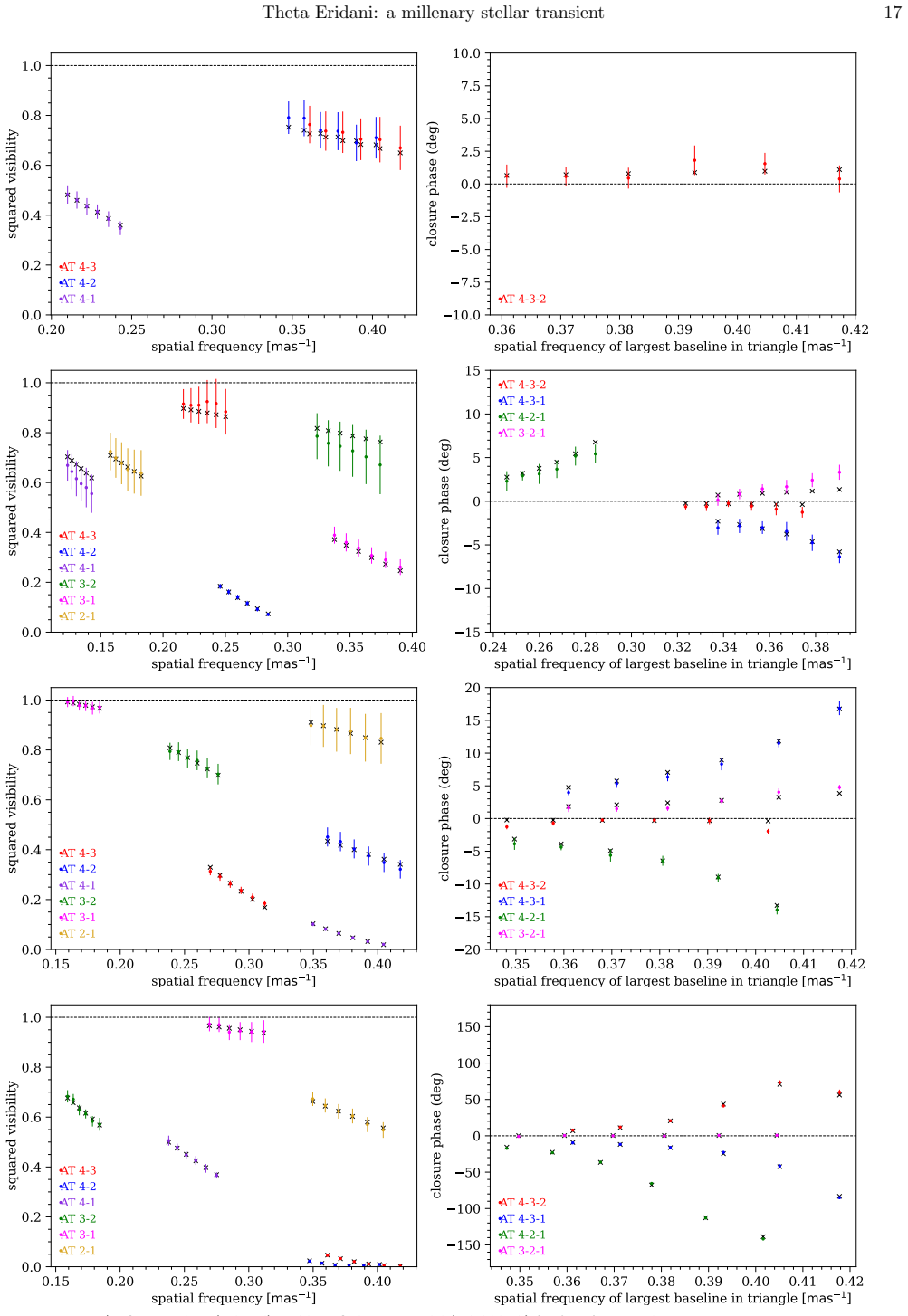
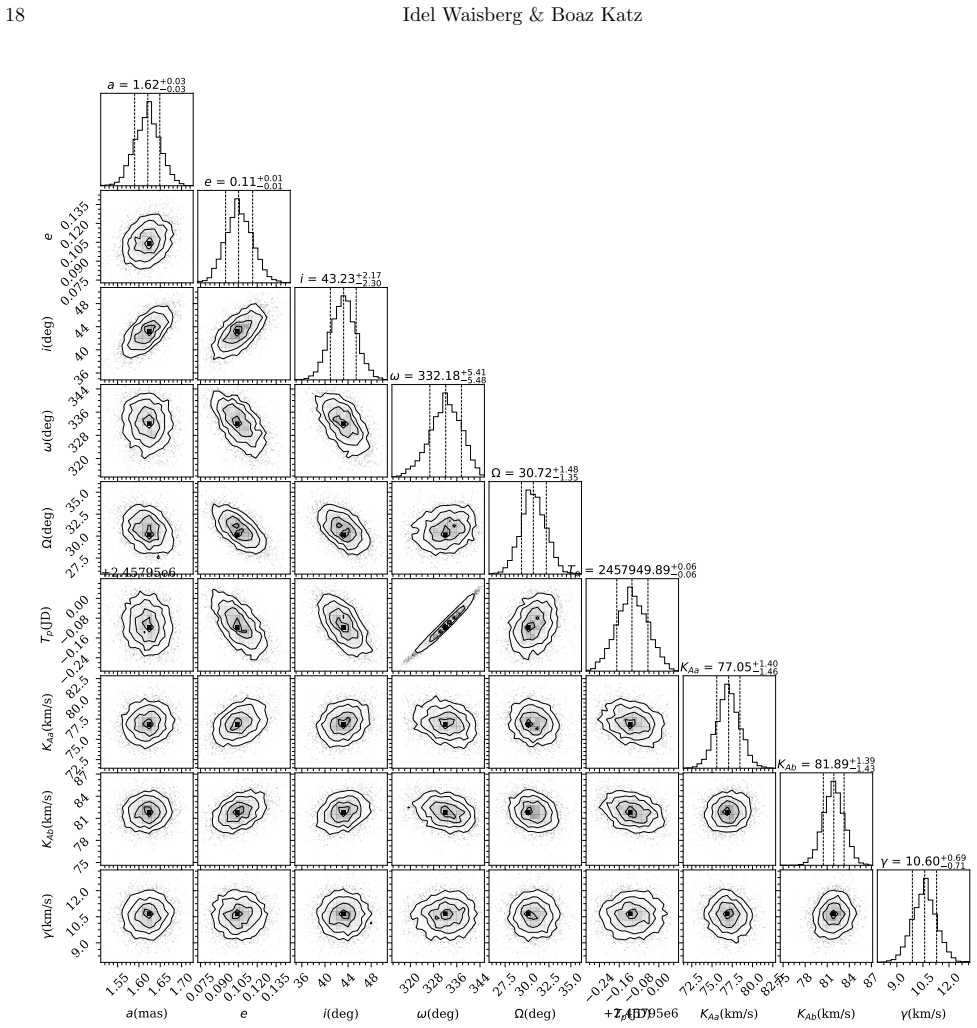
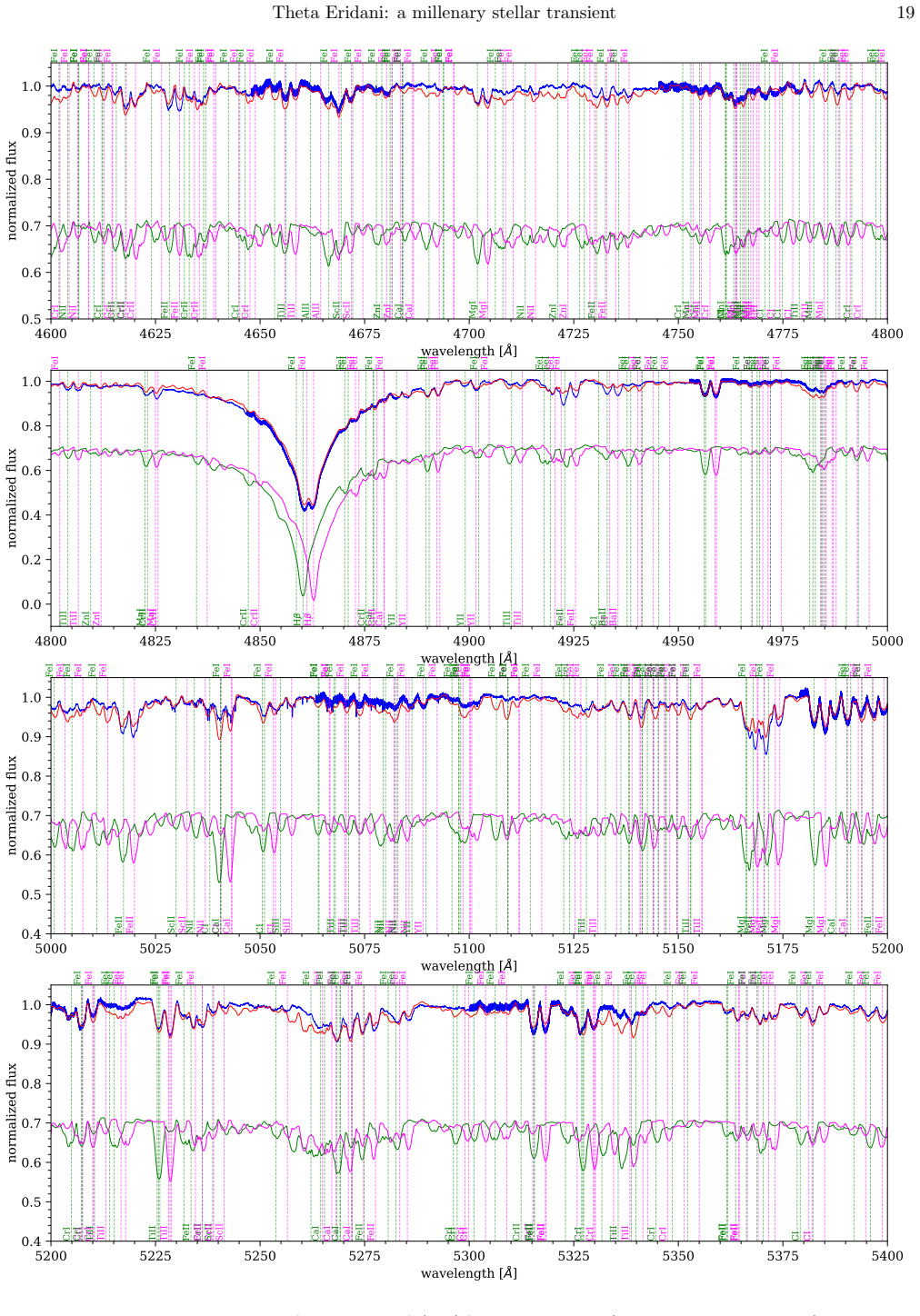
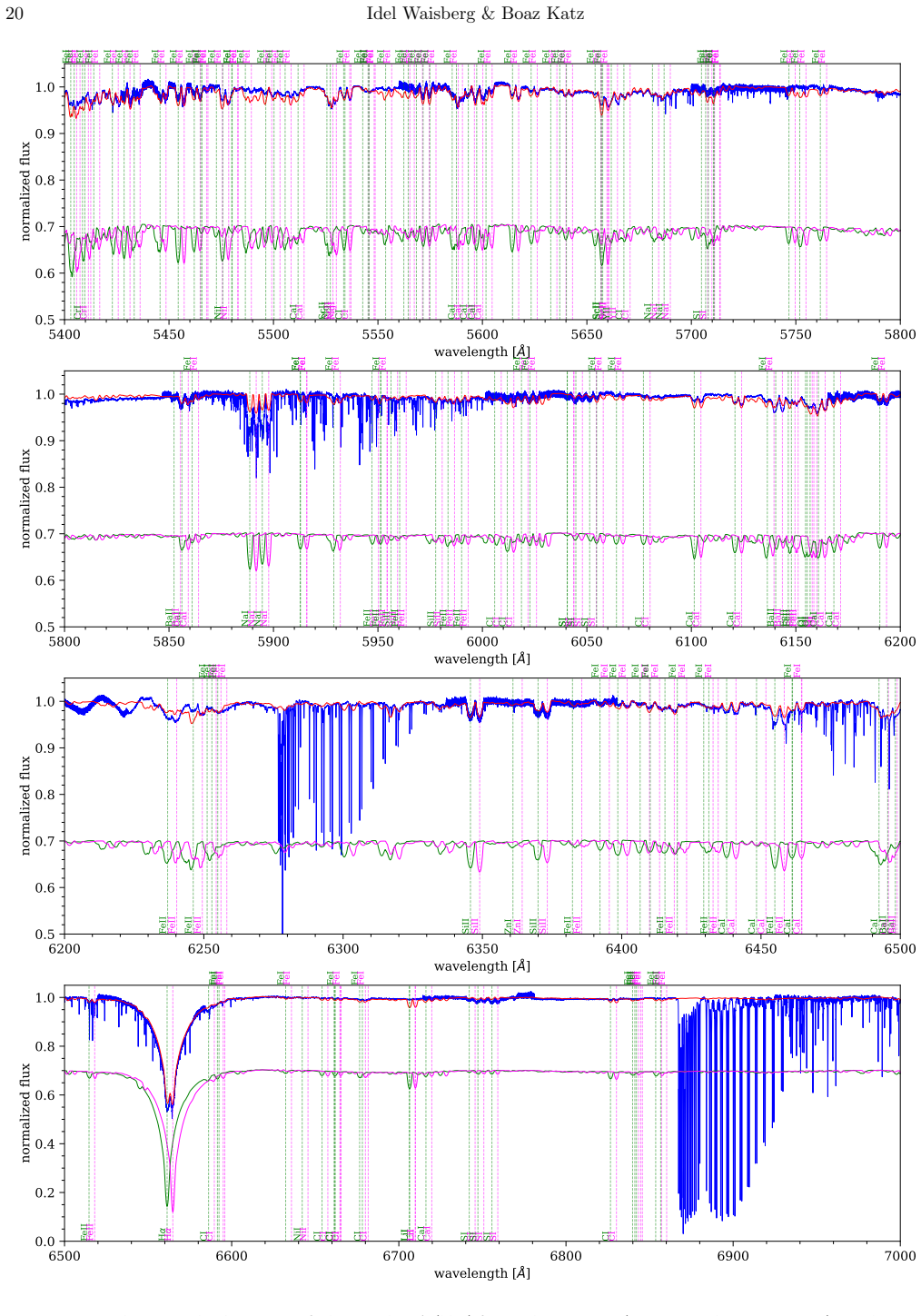
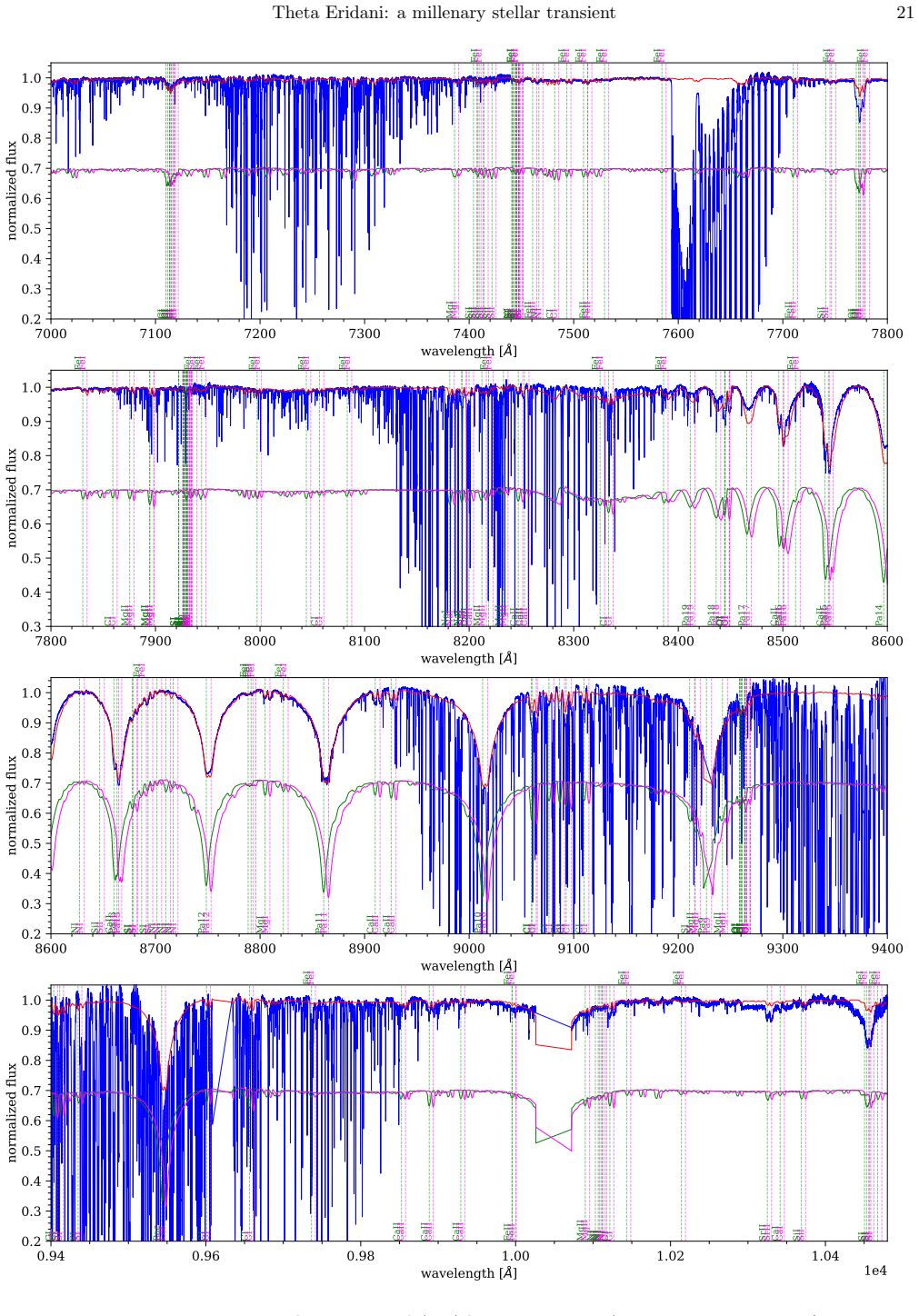
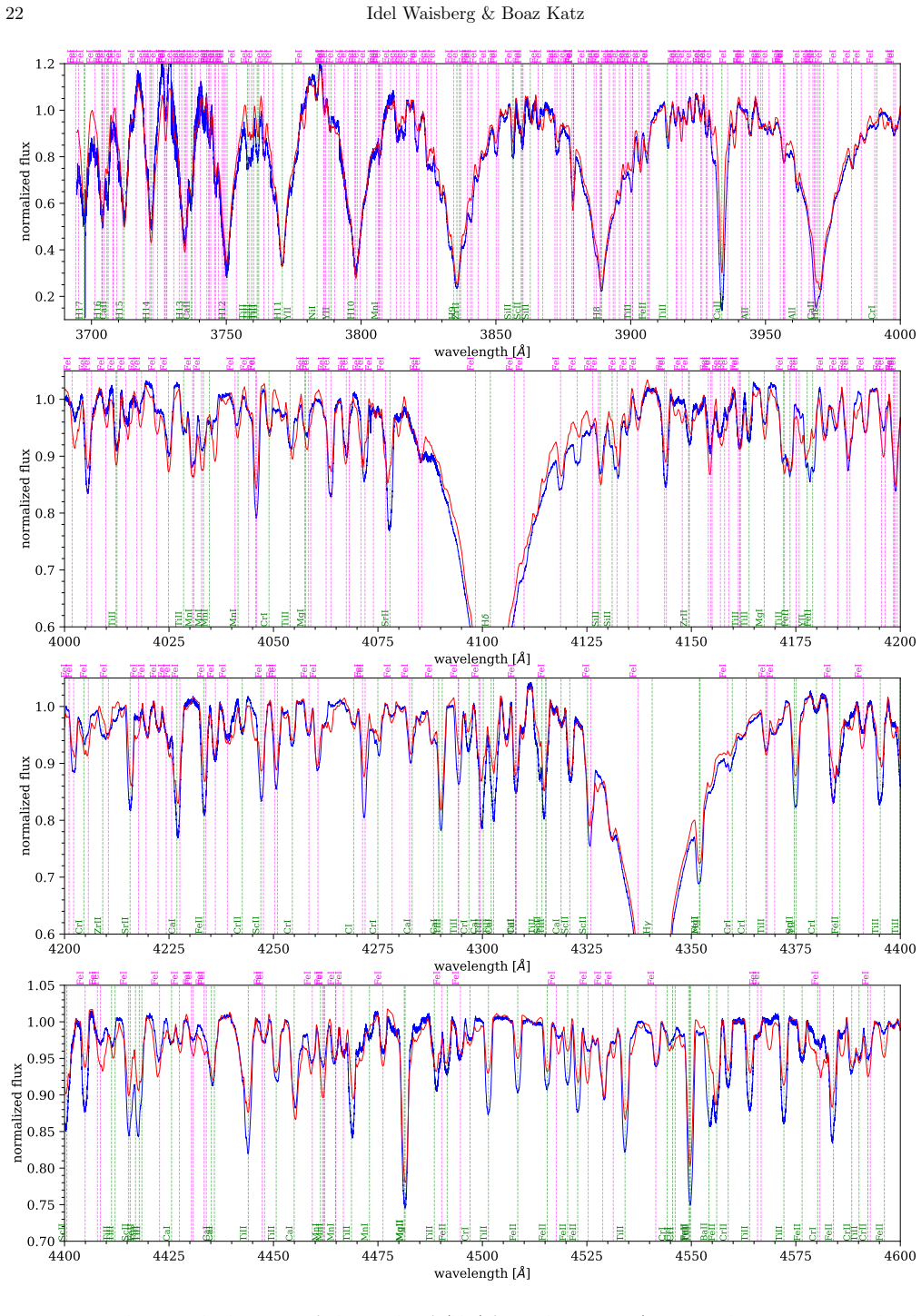
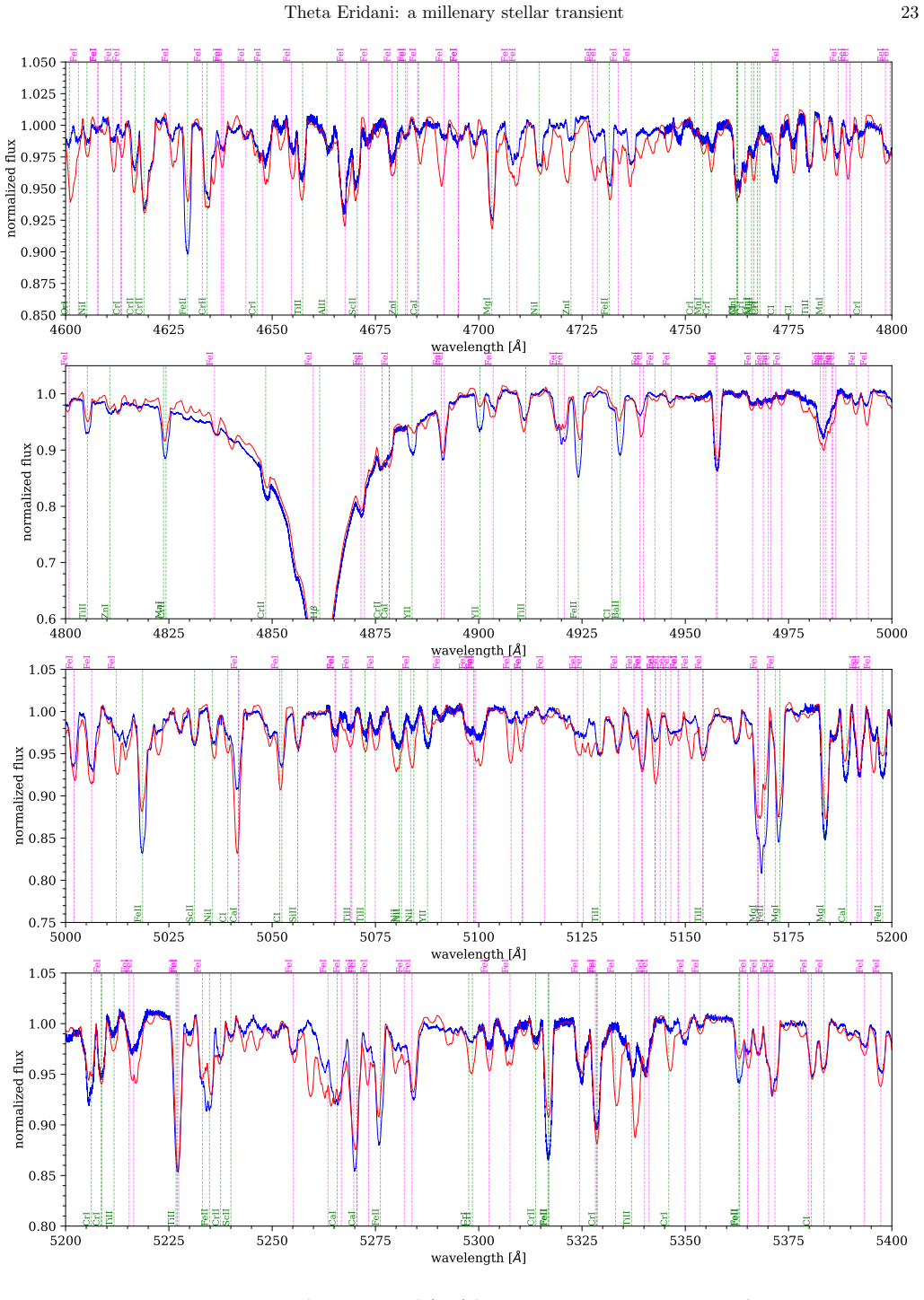
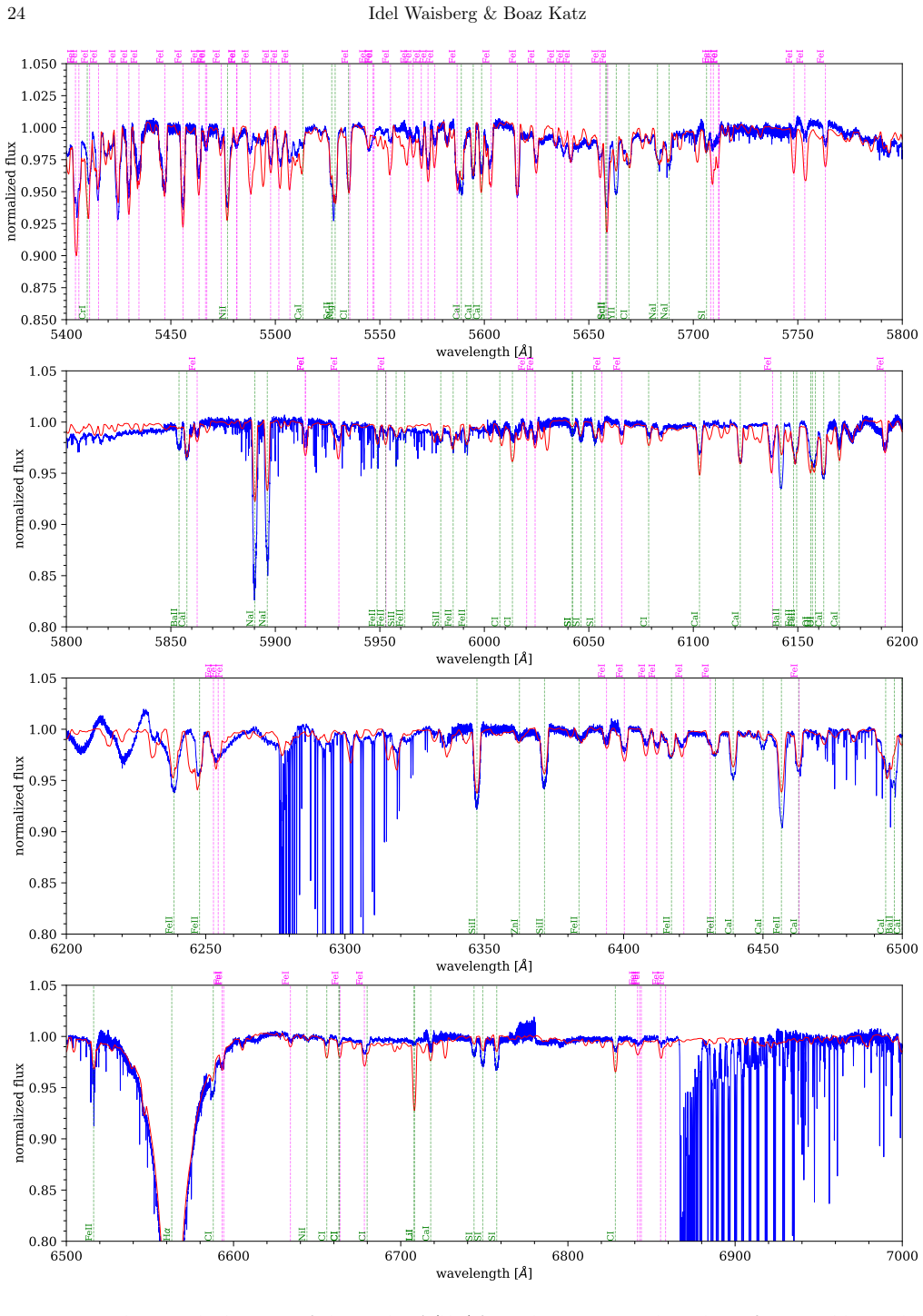
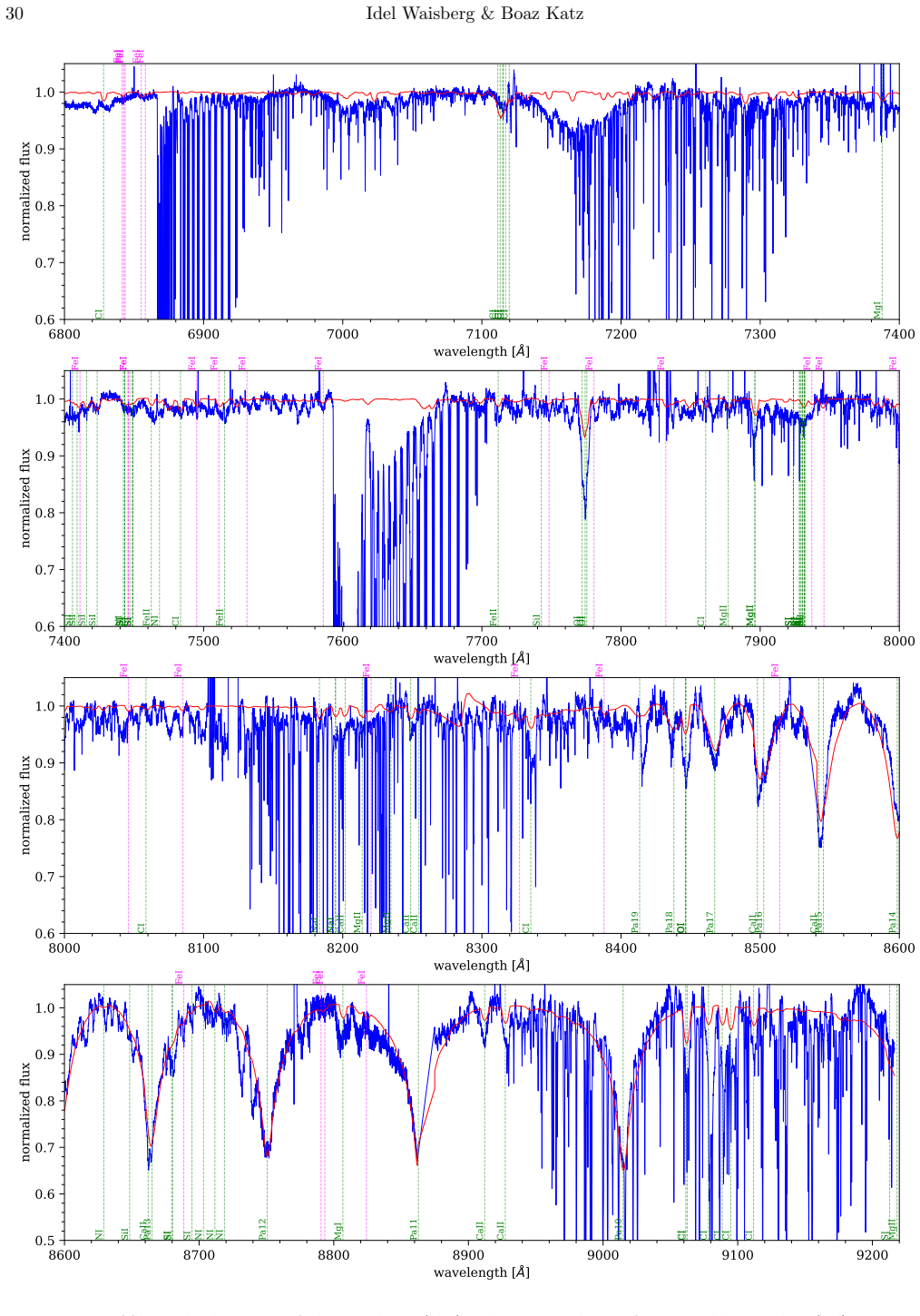
Theta Eridani is a V=2.9 star that was nonetheless reported as one of the thirteen brightest stars in the night sky by both Ptolemy in his Almagest (137 AD) and by al-Sufi in his The Book of Fixed Stars (964 AD), in addition to being previously referred by Hipparchus (129 BC) as a particularly bright star. The discrepancy between its historical and modern visual magnitude $\Delta V \sim 2.7$ is the highest among the $\sim 1000$ stars in the Almagest. Theta Eridani is actually a triple star system, and here we combine interferometric data from VLTI/PIONIER and VLTI/GRAVITY, spectroscopic data from ESPaDOns and FEROS, and photometric data from TESS in order to solve for the orbital parameters, masses and radii of the close inner binary Theta Eridani Aa+Ab. We find that it is a tight eccentric binary ($a=0.083 \text{ au}$, $e=0.105$) of intermediate-mass stars ($M_{Aa}\simeq 2.3 M_{\odot}$, $M_{Ab}\simeq 2.2 M_{\odot}$) that are extended to $\sim 80\%$ of their Roche lobe radii ($R_{Aa}\simeq 4.3 R_{\odot}, R_{Ab} \simeq 4.0 R_{\odot}$), resulting in prominent ellipsoidal oscillations in the lightcurve. We also find that the primary is in a very special phase of its evolution in which it has just finished core hydrogen burning. The remarkable combination of orbital and stellar parameters hints that the historical brightening of Theta Eridani was due to a millenary transient phase powered by orbital energy extraction during a long-lived ``common envelope'' stage triggered by eccentric Roche lobe overflow in a previously more eccentric binary ($e\simeq0.6$). This strengthens the case that the apparent brightening was real and not due to an error by three different ancient observers, as has been commonly claimed in the past.
Editorial analysis
A structured set of objections, weighed in public.
Referee Report
Summary. The paper claims that Theta Eridani's reported historical brightness (ΔV~2.7 brighter than today) by Hipparchus, Ptolemy, and al-Sufi was a real millenary transient, not observer error. New VLTI interferometry, spectroscopy, and TESS photometry yield an inner binary with a=0.083 au, e=0.105, M_Aa≈2.3 M⊙, M_Ab≈2.2 M⊙, radii ~80% of Roche lobes, and the primary just post-core-H burning; these parameters are argued to imply a prior e≈0.6 state that triggered a long-lived common-envelope phase powered by orbital energy extraction.
Significance. If the interpretation holds, the work would supply a rare empirical anchor on the duration and luminosity of common-envelope episodes in intermediate-mass binaries and would rehabilitate three independent ancient magnitude records. The multi-dataset orbital solution itself is a clear technical contribution regardless of the historical interpretation.
major comments (1)
- [Abstract and concluding discussion] Abstract and concluding discussion: the central claim that the measured parameters 'hint' at a prior e≈0.6 common-envelope transient capable of producing ΔV~2.7 rests on an unquantified extrapolation; no binary-evolution integration, common-envelope luminosity estimate, energy-budget calculation, or timescale derivation is presented to show that the required brightness increase and ~1000 yr duration would actually occur.
minor comments (2)
- [Abstract] The abstract states the primary 'has just finished core hydrogen burning' without citing the specific evolutionary track or isochrone used to reach that conclusion.
- Notation for the triple system (Aa+Ab vs. the outer component) should be defined once at first use for clarity.
Simulated Author's Rebuttal
We thank the referee for their thorough review and constructive comments. We respond to the single major comment below.
read point-by-point responses
-
Referee: [Abstract and concluding discussion] Abstract and concluding discussion: the central claim that the measured parameters 'hint' at a prior e≈0.6 common-envelope transient capable of producing ΔV~2.7 rests on an unquantified extrapolation; no binary-evolution integration, common-envelope luminosity estimate, energy-budget calculation, or timescale derivation is presented to show that the required brightness increase and ~1000 yr duration would actually occur.
Authors: We agree that the current manuscript presents the common-envelope interpretation as a hint based on the combination of measured parameters (tight orbit, near-contact radii, post-core-H-burning primary) without explicit quantitative support. This is a valid observation. In revision we will add order-of-magnitude estimates using the standard αλ common-envelope energy formalism applied to the observed semi-major axis and component masses, a rough luminosity scale from orbital-energy dissipation, and a timescale argument consistent with the ~1000 yr span of the historical records. The abstract and concluding discussion will be updated to incorporate these estimates, to make the speculative character of the scenario explicit, and to note that full binary-evolution integrations lie beyond the scope of the present work. revision: yes
Circularity Check
No circularity: orbital solution from external data; historical interpretation is non-derivational suggestion
full rationale
The paper derives current binary parameters (a=0.083 au, e=0.105, masses ~2.3/2.2 M⊙, radii ~4.3/4.0 R⊙) directly from VLTI interferometry, ESPaDOns/FEROS spectroscopy, and TESS photometry. These inputs are independent of the historical magnitude reports. The text states only that the parameters 'hint' at a prior e≃0.6 common-envelope phase explaining ΔV~2.7; no equation, integration, or luminosity calculation is shown that reduces the historical discrepancy to the fitted orbit by construction. No self-citations, fitted inputs renamed as predictions, or ansatzes appear in the load-bearing steps. The chain is self-contained against external observations.
Axiom & Free-Parameter Ledger
free parameters (1)
- prior eccentricity
axioms (2)
- domain assumption Ancient magnitude reports are reliable indicators of true stellar brightness rather than systematic error.
- domain assumption Current orbital parameters permit reliable backward extrapolation to a prior state with e~0.6 without significant angular-momentum loss or mass transfer altering the orbit in unaccounted ways.
Reference graph
Works this paper leans on
-
[1]
The Relation between Rotational Velocities and Spectral Peculiarities among A-Type Stars. , keywords =. doi:10.1086/192182 , adsurl =
-
[2]
Knowledge: An Illustrated Magazine of Science , year = 1893, month = jul, volume =
The Story of Eridani. Knowledge: An Illustrated Magazine of Science , year = 1893, month = jul, volume =
-
[3]
, year = 1916, month = aug, volume =
The Magnitude of Eridani. , year = 1916, month = aug, volume =. doi:10.1038/097479d0 , adsurl =
-
[4]
Speed-Error Cross-Correlation Dating of Ancient Star Catalogues, with Application to the Almagest
Speed-Error Cross-Correlation Dating of Ancient Star Catalogues, with Application to the Almagest. arXiv e-prints , keywords =. doi:10.48550/arXiv.2604.02521 , archivePrefix =. 2604.02521 , primaryClass =
work page internal anchor Pith review Pith/arXiv arXiv doi:10.48550/arxiv.2604.02521
-
[5]
doi:10.3931/e-rara-309 , adsurl =
Uranometria omnium asterismorum continens schemata, nova methodo delineata aereis laminis expressa. doi:10.3931/e-rara-309 , adsurl =
-
[6]
Astrocut: Tools for creating cutouts of TESS images
-
[7]
Mesa Isochrones and Stellar Tracks (MIST). I. Solar-scaled Models. , keywords =. doi:10.3847/0004-637X/823/2/102 , archivePrefix =. 1604.08592 , primaryClass =
work page internal anchor Pith review Pith/arXiv arXiv doi:10.3847/0004-637x/823/2/102
-
[8]
Apsidal motion constants, moment of inertia, and gravitational potential energy
Theoretical tidal evolution constants for stellar models from the pre-main sequence to the white dwarf stage. Apsidal motion constants, moment of inertia, and gravitational potential energy. , keywords =. doi:10.1051/0004-6361/202346250 , archivePrefix =. 2305.01627 , primaryClass =
-
[9]
VizieR Online Data Catalog: WISE All-Sky Data Release (Cutri+ 2012)
2012
-
[10]
A study of bright southern slowly pulsating B stars. I. Determination of the orbital parameters and of the main frequency of the spectroscopic binaries. , keywords =
-
[11]
Performances and First Results
ESPaDOnS: The New Generation Stellar Spectro-Polarimeter. Performances and First Results. Solar Polarization 4 , year = 2006, editor =
2006
-
[12]
MESA Isochrones and Stellar Tracks (MIST) 0: Methods for the construction of stellar isochrones
MESA Isochrones and Stellar Tracks (MIST) 0: Methods for the Construction of Stellar Isochrones. , keywords =. doi:10.3847/0067-0049/222/1/8 , archivePrefix =. 1601.05144 , primaryClass =
work page internal anchor Pith review Pith/arXiv arXiv doi:10.3847/0067-0049/222/1/8
-
[13]
Journal for the History of Astronomy , keywords =
The depth of association between the ancient star catalogues. Journal for the History of Astronomy , keywords =. doi:10.1177/002182860303400207 , adsurl =
-
[14]
Aproximations to the radii of Roche lobes. , keywords =. doi:10.1086/160960 , adsurl =
-
[15]
Spectra of binaries classified as lambda Boo stars
Spectra of binaries classified as lambda Bootis stars. , keywords =. doi:10.1051/0004-6361:20011020 , archivePrefix =. astro-ph/0107243 , primaryClass =
work page internal anchor Pith review Pith/arXiv arXiv doi:10.1051/0004-6361:20011020
-
[16]
doi:10.5281/zenodo.14712174 , url =
Fouesneau, Morgan , title =. doi:10.5281/zenodo.14712174 , url =
-
[17]
Summary of the content and survey properties
Gaia Data Release 3. Summary of the content and survey properties. , keywords =. doi:10.1051/0004-6361/202243940 , archivePrefix =. 2208.00211 , primaryClass =
-
[18]
The Observatory , year = 1900, month = dec, volume =
Changes in the stellar heavens (concluded). The Observatory , year = 1900, month = dec, volume =
1900
-
[19]
(Doctoral dissertation, James Cook University)
Abd al-Rahman al-Sufi and his book of the fixed stars: a journey of re-discovery. (Doctoral dissertation, James Cook University)
-
[20]
Catalogus Stellarum Australium sive Supplementum Catalogi Tychonici exhibens Longitudines et Latitudines Stellarum fixarum
-
[21]
, keywords =
The Tycho-2 catalogue of the 2.5 million brightest stars. , keywords =
-
[22]
A new extensive library of PHOENIX stellar atmospheres and synthetic spectra
A new extensive library of PHOENIX stellar atmospheres and synthetic spectra. , keywords =. doi:10.1051/0004-6361/201219058 , archivePrefix =. 1303.5632 , primaryClass =
work page internal anchor Pith review Pith/arXiv arXiv doi:10.1051/0004-6361/201219058
-
[23]
, keywords =
Tidal evolution in close binary systems. , keywords =
-
[24]
Revised optical air mass tables and approximation formula. , keywords =. doi:10.1364/AO.28.004735 , adsurl =
-
[25]
The Messenger , keywords =
Commissioning FEROS, the new high-resolution spectrograph at La-Silla. The Messenger , keywords =
-
[26]
Ulugh Beg's catalogue of stars: revised from all Persian manuscripts existing in Great Britain, with a vocabulary of Persian and Arabic words
-
[27]
Mass Transfer in Binary Stars Using Smoothed Particle Hydrodynamics. II. Eccentric Binaries. , keywords =. doi:10.1088/0004-637X/726/2/67 , archivePrefix =. 1011.2204 , primaryClass =
work page internal anchor Pith review Pith/arXiv arXiv doi:10.1088/0004-637x/726/2/67
-
[28]
PIONIER: a 4-telescope visitor instrument at VLTI
PIONIER: a 4-telescope visitor instrument at VLTI. , keywords =. doi:10.1051/0004-6361/201117586 , archivePrefix =. 1109.1918 , primaryClass =
work page internal anchor Pith review Pith/arXiv arXiv doi:10.1051/0004-6361/201117586 1918
-
[29]
From Flamsteed to Piazzi and Lalande: new standards in 18th century astrometry. , keywords =. doi:10.1051/0004-6361/201423899 , adsurl =
-
[30]
Observational Evidence for Tidal Interaction in Close Binary Systems
Observational Evidence for Tidal Interaction in Close Binary Systems. EAS Publications Series , year = 2008, editor =. doi:10.1051/eas:0829001 , archivePrefix =. 0801.0134 , primaryClass =
work page internal anchor Pith review Pith/arXiv arXiv doi:10.1051/eas:0829001 2008
-
[31]
Modules for Experiments in Stellar Astrophysics (MESA)
Modules for Experiments in Stellar Astrophysics (MESA). , keywords =. doi:10.1088/0067-0049/192/1/3 , archivePrefix =. 1009.1622 , primaryClass =
work page internal anchor Pith review Pith/arXiv arXiv doi:10.1088/0067-0049/192/1/3
-
[32]
Modules for Experiments in Stellar Astrophysics (MESA): Planets, Oscillations, Rotation, and Massive Stars. , keywords =. doi:10.1088/0067-0049/208/1/4 , archivePrefix =. 1301.0319 , primaryClass =
work page internal anchor Pith review Pith/arXiv arXiv doi:10.1088/0067-0049/208/1/4
-
[33]
Modules for Experiments in Stellar Astrophysics (MESA): Binaries, Pulsations, and Explosions
Modules for Experiments in Stellar Astrophysics (MESA): Binaries, Pulsations, and Explosions. , keywords =. doi:10.1088/0067-0049/220/1/15 , archivePrefix =. 1506.03146 , primaryClass =
work page internal anchor Pith review Pith/arXiv arXiv doi:10.1088/0067-0049/220/1/15
-
[34]
PolarBase: a data base of high resolution spectropolarimetric stellar observations
PolarBase: A Database of High-Resolution Spectropolarimetric Stellar Observations. , keywords =. doi:10.1086/676976 , archivePrefix =. 1401.1082 , primaryClass =
work page internal anchor Pith review Pith/arXiv arXiv doi:10.1086/676976
-
[35]
Astronomische Nachrichten , keywords =
Accuracy of magnitudes in pre‑telescopic star catalogs. Astronomische Nachrichten , keywords =. doi:10.1002/asna.202013803 , archivePrefix =. 2008.04967 , primaryClass =
-
[36]
A Computational Guide to Physics of Eclipsing Binaries. I. Demonstrations and Perspectives. , keywords =. doi:10.1086/430591 , archivePrefix =. astro-ph/0503361 , primaryClass =
work page internal anchor Pith review Pith/arXiv arXiv doi:10.1086/430591
-
[37]
Physics Of Eclipsing Binaries. II. Toward the Increased Model Fidelity. , keywords =. doi:10.3847/1538-4365/227/2/29 , archivePrefix =. 1609.08135 , primaryClass =
work page internal anchor Pith review Pith/arXiv arXiv doi:10.3847/1538-4365/227/2/29
-
[38]
Mass transfer in eccentric binary stars. , keywords =. doi:10.1111/j.1365-2966.2005.08813.x , adsurl =
-
[39]
Journal of Astronomical Telescopes, Instruments, and Systems , year = 2015, month = jan, volume =
Transiting Exoplanet Survey Satellite (TESS). Journal of Astronomical Telescopes, Instruments, and Systems , year = 2015, month = jan, volume =. doi:10.1117/1.JATIS.1.1.014003 , adsurl =
work page internal anchor Pith review doi:10.1117/1.jatis.1.1.014003 2015
-
[40]
The Thousand Star Magnitudes in the Catalogues of Ptolemy, Al Sufi, and Tycho Are All Corrected for Atmospheric Extinction. Journal for the History of Astronomy , keywords =. doi:10.1177/002182861304400103 , archivePrefix =. 1303.1833 , primaryClass =
work page internal anchor Pith review Pith/arXiv arXiv doi:10.1177/002182861304400103
-
[41]
Description des \'E toiles Fixes: Compose \'e s au Milieu du Dixi \`e me Si \`e cle de Notre \'E re par l'Astronome Persan Abd-al-Rahman al- S \= u f \=
-
[42]
Dynamical tides in eccentric binaries containing massive main-sequence stars: analytical expressions. , keywords =. doi:10.1093/mnras/stab3698 , archivePrefix =. 2110.12030 , primaryClass =
-
[43]
Early star catalogues of the southern sky: De Houtman, Kepler (Second and Third Classes), and Halley
Early star catalogues of the southern sky. De Houtman, Kepler (second and third classes), and Halley. , keywords =. doi:10.1051/0004-6361/201116795 , archivePrefix =. 1104.0946 , primaryClass =
work page internal anchor Pith review Pith/arXiv arXiv doi:10.1051/0004-6361/201116795
-
[44]
The star catalogues of Ptolemaios and Ulugh Beg. Machine-readable versions and comparison with the modern Hipparcos Catalogue. , keywords =. doi:10.1051/0004-6361/201219596 , archivePrefix =. 1206.0628 , primaryClass =
work page internal anchor Pith review Pith/arXiv arXiv doi:10.1051/0004-6361/201219596
-
[45]
Binarity and beyond in A stars - I. Survey description and first results of VLTI/GRAVITY observations of VAST targets with high Gaia-Hipparcos accelerations. , keywords =. doi:10.1093/mnras/stad872 , archivePrefix =. 2206.05251 , primaryClass =
-
[46]
Hidden Companions to Intermediate-mass Stars. XXXIII. Unveiling a 2.35M _ , 0.06 au Companion to Acamar = Theta Eridani A. Research Notes of the American Astronomical Society , keywords =. doi:10.3847/2515-5172/ae2f5d , adsurl =
-
[47]
Society for Astronomical Sciences Annual Symposium , year = 2006, month = may, volume =
The International Variable Star Index (VSX). Society for Astronomical Sciences Annual Symposium , year = 2006, month = may, volume =
2006
-
[48]
, year = 1916, month = jun, volume =
Ptolemy's Catalogue of Stars. , year = 1916, month = jun, volume =. doi:10.1038/097341a0 , adsurl =
-
[49]
, year = 1905, month = may, volume =
A list of twelve stars whose radial velocities vary. , year = 1905, month = may, volume =. doi:10.1086/141223 , adsurl =
-
[50]
Hunter, J. D. , Title =. Computing In Science & Engineering , Volume =
-
[51]
Computing in Science & Engineering , volume=
The NumPy array: a structure for efficient numerical computation , author=. Computing in Science & Engineering , volume=. 2011 , publisher=
2011
discussion (0)
Sign in with ORCID, Apple, or X to comment. Anyone can read and Pith papers without signing in.