REVIEW 1 major objections 4 minor 107 references
Neutrino flavor-wave transport: Numerical tests and theoretical challenges
T0 review · 1 major / 4 minor · reviewed 2026-08-10 · deepseek-v4-flash
Pith's one-line read Spectral degeneracies break the quasistatic approximation that neutrino flavor-wave transport depends on.
desk verdict First slow-driving tests of flavor-wave transport show quasistaticity breaks down at exceptional points, but an inconsistency between Eq. (29) and Algorithm 1 needs checking before the central claim holds. read the letter →
The pith
A machine-rendered reading of the paper's core claim, the machinery that carries it, and where it could break.
The reading
What carries the argument
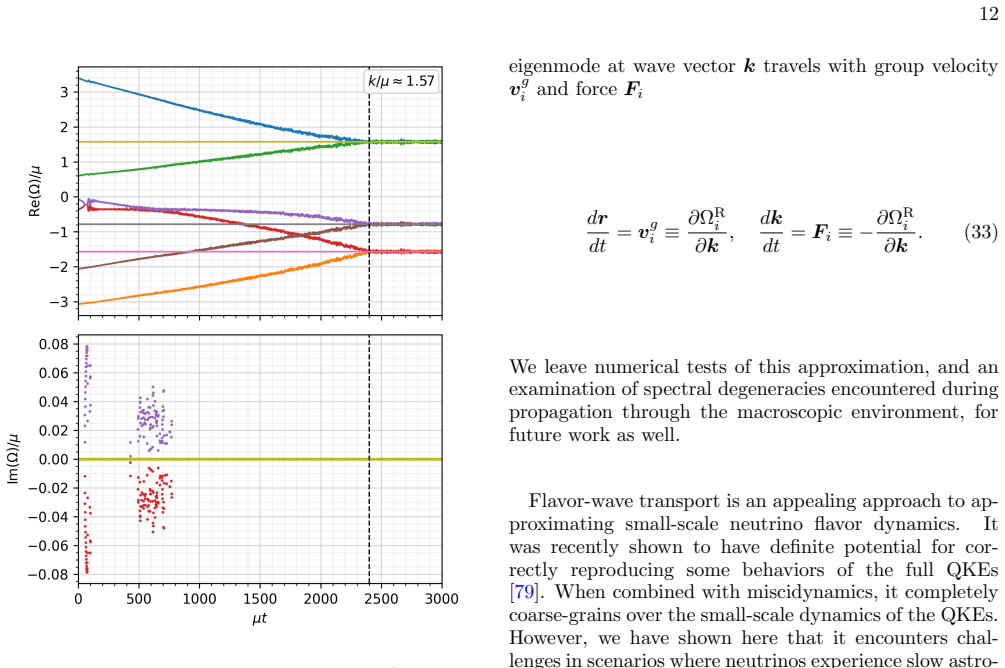
The load-bearing object is the Fourier-space flavor-wave Hamiltonian $H_n$, a non-Hermitian matrix acting on the wave function $\Psi_n$ that collects the spatial Fourier modes of the polarization vectors at each momentum. Its eigenvectors and eigenvalues give the flavor-wave energy levels $\Omega_R$ and growth or decay rates $\Omega_I$, and the transformed equation $i\partial_t \Phi_n = \Omega_n \Phi_n + S_n^{-1}N_n - i S_n^{-1}(\partial_t S_n)\Phi_n$ splits evolution into phase and instability dynamics, nonlinear wave-wave coupling, and driving-induced level transitions. The quasilinear approximation sets $N_n=0$; the quasistatic approximation drops the last term. The mechanism that undermines quasistaticity is the exceptional point, where two eigenvalues and their eigenvectors coalesce, so the eigenbasis decomposition itself breaks down and near-degenerate modes undergo amplified transitions under slow driving. Parallel transport is defined by setting the diagonal of $S_n^{-1}(\partial_t S_n)$ to zero and is assumed throughout.
What would settle it
Run the same slow-injection two- and three-beam simulations with an increasing number of momentum bins, for example 10, 50, and 200, and measure whether the hybrid quasistatic solution's error decreases toward the exact quantum kinetic result as the grid approaches the continuum; if the error vanishes with enough bins, the claim that spectral degeneracies generically break quasistaticity would be an artifact of discretization rather than a property of flavor-wave transport.
Extended reading notes
Core claim
On the paper's own terms, the central finding is stated in Sec. VI: 'Spectral degeneracies cause a breakdown of the validity of the QS approximation because they amplify mode transitions due to finite rates of driving.' In the two-beam and three-beam simulations, the quasilinear solution reproduces mean polarizations $\langle P_q^z\rangle$ reasonably early on but deviates as flavor-wave turbulence redistributes the Fourier spectra $|P_k|$; the agreement improves when the calculation is re-seeded with exact data, which the authors flag as exaggerating the match. A hybrid method that applies the quasistatic approximation only where the minimum eigenvalue gap exceeds a threshold $C$ grows less accurate as $C$ is lowered, because exceptional points and small energy gaps generate significant nonadiabatic transitions. The paper also reports that transverse components of the mean polarizations, which spontaneously break rotational symmetry in flavor space, can render stable backgrounds unstable, though no such effect was seen in the main evolutions. Consequently, flavor-wave transport will either need a tractable approximation for nonquasistatic level transitions or an alternative formulation that avoids exceptional points.
Load-bearing premise
The numerical evidence comes from periodic-box models with only two or three discrete momentum bins, and the paper acknowledges that the continuum limit of infinitely many momentum bins might behave fundamentally differently and resolve the degeneracy-amplified nonquasistatic transitions.
Editorial extensions
If this is right
- Quasistatic flavor-wave transport is unreliable for wave vectors whose spectra pass through degeneracies, which occurs generically in media driven near marginal stability.
- Flavor-wave transport will require either a tractable approximation for nonquasistatic transitions or a reformulation that avoids exceptional points altogether.
- The quasilinear approximation may need to be replaced by flavor-wave kinetics, which retains resonant wave-wave interactions treated as collisionlike processes.
- Hybrid schemes that selectively apply the quasistatic approximation based on a minimum eigenvalue gap become less accurate as the threshold is lowered, so the approximation cannot simply be applied more aggressively.
- The continuum limit with infinitely many momentum bins is an open question; if it behaves differently, the failure of quasistaticity may be tied to momentum discretization.
Reading between the lines
- Beyond the paper: the same exceptional-point obstruction should affect any non-Hermitian quasiparticle transport scheme that assumes adiabatic following of a slowly varying background, so tests in simpler non-Hermitian toy models could isolate when a Landau-Zener-like transition formula exists.
- Beyond the paper: one could test whether the finite-rate transition probability through a flavor-wave exceptional point obeys a scaling law in the driving rate; if such a law exists, it could be folded into transport as an effective transition rate.
- Beyond the paper: because the paper finds new instabilities when mean transverse polarizations break rotational symmetry, flavor-wave transport codes that assume $\langle P_q\rangle\parallel z$ may need to track transverse mean components even when they are small.
Editorial analysis
A structured set of objections, weighed in public.
Referee Report
Summary. The paper presents the first numerical tests of flavor-wave (flavomon) transport under slow astrophysical driving, using periodic-box QKE simulations with two or three discrete momentum beams as the exact ground truth. It tests the quasilinear (QL) approximation, which neglects nonlinear wave-wave coupling, and the quasistatic (QS) approximation, which neglects transitions driven by finite rates of change of the flavor-wave eigensystem. The central numerical finding is that the QS approximation degrades as the quasistaticity threshold C in Eq. (28) is lowered, with degradation attributed to spectral degeneracies and exceptional points that amplify nonadiabatic mode transitions. The paper also develops flavor-wave parallel transport, discusses the heuristic basis of the QS approximation, and examines instabilities that appear when the mean polarizations have transverse components.
Significance. If the central claim holds, the paper is an important and timely negative result: the QS approximation, which is essential to current formulations of flavor-wave transport, becomes unreliable precisely in the marginally stable, slowly driven regimes expected in supernovae and neutron star mergers. The work also makes a useful conceptual distinction between quasistaticity and adiabaticity and identifies exceptional points as a transport-relevant feature of non-Hermitian flavor-wave eigensystems. Strengths include benchmarking against the exact QKE (an external ground truth), a falsifiable numerical trend (worse agreement as C is lowered), and the use of an open-source code base. However, the central mechanism is not cleanly isolated as presented because of an inconsistency between the hybrid method's defining equation and its pseudocode, and because the eigenbasis conversion used in the QS branch may be numerically ill-conditioned near the very degeneracies under study. These issues are fixable but require verification.
major comments (1)
- [Sec. IV, Figs. 2-4] The hybrid method converts between Psi_n and Phi_n through S_n and S_n^-1 for every mode, including QS modes whose eigenvalue gaps are just above the threshold C. Near an exceptional point S_n is singular, and for small but nonzero gaps the condition number of S_n grows; the reconstructed Psi_n can then contain large numerical errors even if the evolution of Phi_n is physically correct. Lowering C from 0.05 to 0.03 (Fig. 2) or from 0.13 to 0.06 (Fig. 3) admits modes with smaller gaps into the QS branch, so the observed degradation could in part be a numerical artifact of eigenbasis conversion rather than the omitted i S^-1 (partial_t S_n) Phi_n term. Because the paper's central conclusion is that degeneracies amplify physical nonadiabatic transitions, the authors should report the condition number of S_n (or an equivalent measure) for the QS-evolved modes and demonstrate that the degradation persists with time-step refinement and with a scheme that avoids the eigenbasis conversion for the borderline modes.
minor comments (4)
- [Sec. II D, after Eq. (24)] The sentence requiring |Omega_{n,i} - Omega_{n,j}| >> 1/T says the eigenvalues are 'significantly nondegenerate,' which is correct, but two sentences later the text says the requirement is that the eigenvalues are 'significantly degenerate'; the latter should read 'significantly nondegenerate' or 'well separated.'
- [Figs. 2-3] The comparisons between the hybrid method and the exact QKE are described qualitatively ('appreciably worse,' 'quite good'). Adding a quantitative error metric, such as the time-integrated L2 difference in the mean polarizations or in the Fourier spectra, would make the threshold dependence of the degradation more precise and easier to compare across the two test cases.
- [Sec. VI, first paragraph] The caveat that the continuum limit with an infinite number of momentum bins 'might behave fundamentally differently' is important and should be carried into the abstract and the concluding statements, because the abstract currently states the degeneracy problem without this qualification, and the numerical evidence is limited to two- and three-beam discrete models.
- [Sec. IV, Eq. (28)] The threshold C is compared with instantaneous eigenvalue separations, but the nonadiabatic transition amplitude also depends on the matrix elements of S_n^-1 partial_t S_n and on the rate of change of the Hamiltonian. The heuristic criterion is understandable and the paper references Ref. [104], but a brief remark that C is a proxy rather than a rigorous adiabaticity condition would help readers interpret the threshold scans.
Circularity Check
No significant circularity: the approximations are benchmarked against exact QKE solutions, and the self-cited framework is the object under test rather than the evidence for its own validity.
full rationale
The paper's central numerical tests compare the QL and QS approximations with direct solutions of the Fourier-space QKEs using the externally maintained NuGas code, so the benchmark is an independent ground truth rather than an output of the flavor-wave transport framework. The approximate evolution equations (Eqs. 16, 26, 29) are obtained by explicit truncations of the exact eigenbasis equation (Eq. 15), not by fitting; no parameter is tuned to make the approximate curves match. The frequent self-citations (Refs. 72-75, 96) supply the theoretical vocabulary and prior formalism being tested, and are not used to rule out alternatives or to generate the benchmark data. The conclusion that spectral degeneracies break quasistaticity is consistent with the derivation of the QS approximation itself (the 1/T suppression in Eq. 25 fails when splittings are small), and the numerical experiments quantify that failure in specific slowly driven models; this is a validation of the approximation's stated applicability condition, not a fitted prediction. The two-beam restart from simulation data is explicitly acknowledged as exaggerating agreement, and the discrete-momentum limitation is stated in Sec. VI. One correctness caveat, which does not affect the circularity verdict: the text says the QS hybrid retains the nonlinear term S^{-1}N_n (Eq. 29), but Algorithm 1's QS branch updates Φ_n with only -iΩ_nΦ_nΔt; if the implementation follows the algorithm, the Sec. IV degradation with smaller C could reflect QL errors rather than purely nonquasistatic transitions.
Assumptions & free parameters
free parameters (4)
- Injection amplitude ζ =
1 (two-beam), -3/2 (three-beam)
- Quasistatic criterion threshold C =
0.05 and 0.03 (two-beam); 0.13 and 0.06 (three-beam)
- Initial subgrid fluctuation seed =
10^-6
- Injection duration and final time =
Injection over µt in [0,2400], final time µt=3000
assumptions (6)
- domain assumption Collisionless QKE in the fast limit (Eq. 1) is the exact dynamics to be approximated.
- domain assumption Flavor waves are quasiparticles whose properties are set by the local mean background.
- domain assumption Flavor-wave eigensystems vary slowly on the astrophysical scale (slow driving).
- ad hoc to paper The quasistatic criterion min_{i≠j}|Ω_{n,i}-Ω_{n,j}| > C (Eq. 28) identifies wave vectors where the QS approximation is valid.
- ad hoc to paper n=0 mean polarizations can be approximated as exactly along ±z in the hybrid calculations.
- domain assumption Periodic-box, discrete-momentum-beam models represent the physics of astrophysical neutrino media.
Cite this review
Pith. "Pith review of Neutrino flavor-wave transport: Numerical tests and theoretical challenges." pith.science (2026). https://pith.science/paper/IFUWH6YV
@misc{pith2026260802984,
  author       = {Pith},
  title        = {Pith review of: Neutrino flavor-wave transport: Numerical tests and theoretical challenges},
  year         = {2026},
  howpublished = {\url{https://pith.science/paper/IFUWH6YV}},
  note         = {Machine review of arXiv:2608.02984}
}
read the original abstract
Neutrino quantum kinetics is computationally intractable in the neutrino-dense arenas of core-collapse supernovae and neutron star mergers. Flavor-wave (or flavomon) transport is an emerging approach to this problem in which small-scale flavor inhomogeneities are treated as quasiparticles with properties determined by the local mean background. We present the first numerical calculations of flavor-wave transport under slow driving. Our results show some quantitative successes but also underscore the theoretical challenges that need to be overcome. Two issues are particularly concerning. (1) Nonlinear wave-wave coupling may be important. (2) Degeneracies and small energy gaps are responsible for significant nonadiabatic transitions. Future work will need to address these points if flavor-wave transport is to be viable in settings of astrophysical interest. Other topics examined include flavor-wave parallel transport and flavor-space symmetry breaking.
Figures


Figures from the paper (2 more)

Reference graph
Works this paper leans on
-
[1]
M. C. Volpe, Neutrinos from dense environments: Fla- vor mechanisms, theoretical approaches, observations, and new directions, Rev. Mod. Phys.96, 025004 (2024)
2024
-
[2]
Johns, S
L. Johns, S. Richers, and M.-R. Wu, Neutrino oscilla- tions in core-collapse supernovae and neutron star merg- ers, Annu. Rev. Nucl. Part. Sci. (2025)
2025
-
[3]
Tamborra, Neutrinos from explosive transients at the dawn of multi-messenger astronomy, Nat
I. Tamborra, Neutrinos from explosive transients at the dawn of multi-messenger astronomy, Nat. Rev. Phys.7, 285 (2025)
2025
-
[4]
R. F. Sawyer, Neutrino cloud instabilities just above the neutrino sphere of a supernova, Phys. Rev. Lett.116, 081101 (2016)
2016
-
[5]
Wu, Y.-Z
M.-R. Wu, Y.-Z. Qian, G. Mart ´ ınez-Pinedo, T. Fischer, and L. Huther, Effects of neutrino oscillations on nucle- osynthesis and neutrino signals for an 18M J supernova model, Phys. Rev. D91, 065016 (2015)
2015
-
[6]
Wu and I
M.-R. Wu and I. Tamborra, Fast neutrino conversions: Ubiquitous in compact binary merger remnants, Phys. Rev. D95, 103007 (2017)
2017
-
[7]
M.-R. Wu, I. Tamborra, O. Just, and H.-T. Janka, Imprints of neutrino-pair flavor conversions on nucle- osynthesis in ejecta from neutron-star merger remnants, Phys. Rev. D96, 123015 (2017)
2017
-
[8]
Abbar, H
S. Abbar, H. Duan, K. Sumiyoshi, T. Takiwaki, and M. C. Volpe, On the occurrence of fast neutrino fla- vor conversions in multidimensional supernova models, Phys. Rev. D100, 043004 (2019)
2019
Show all 107 references
-
[9]
Delfan Azari, S
M. Delfan Azari, S. Yamada, T. Morinaga, W. Iwakami, H. Okawa, H. Nagakura, and K. Sumiyoshi, Linear anal- ysis of fast-pairwise collective neutrino oscillations in core-collapse supernovae based on the results of boltz- mann simulations, Phys. Rev. D99, 103011 (2019)
2019
-
[10]
Morinaga, H
T. Morinaga, H. Nagakura, C. Kato, and S. Yamada, Fast neutrino-flavor conversion in the preshock region of core-collapse supernovae, Phys. Rev. Res.2, 012046 (2020)
2020
-
[11]
Xiong, A
Z. Xiong, A. Sieverding, M. Sen, and Y.-Z. Qian, Poten- tial impact of fast flavor oscillations on neutrino-driven winds and their nucleosynthesis, Astrophys. J.900, 144 (2020)
2020
-
[12]
Ko, M.-K
H. Ko, M.-K. Cheoun, E. Ha, M. Kusakabe, T. Hayakawa, H. Sasaki, T. Kajino, M.-a. Hashimoto, M. Ono, M. D. Usang, S. Chiba, K. Nakamura, A. Tol- stov, K. Nomoto, T. Kawano, and G. J. Mathews, Neu- trino process in core-collapse supernovae with neutrino self-interaction and msw...
2020
-
[13]
George, M.-R
M. George, M.-R. Wu, I. Tamborra, R. Ardevol- Pulpillo, and H.-T. Janka, Fast neutrino flavor conver- sion, ejecta properties, and nucleosynthesis in newly- formed hypermassive remnants of neutron-star mergers, Phys. Rev. D102, 103015 (2020)
2020
-
[14]
Abbar, F
S. Abbar, F. Capozzi, R. Glas, H.-T. Janka, and I. Tam- borra, On the characteristics of fast neutrino flavor in- stabilities in three-dimensional core-collapse supernova models, Phys. Rev. D103, 063033 (2021)
2021
-
[15]
Johns and H
L. Johns and H. Nagakura, Fast flavor instabilities and the search for neutrino angular crossings, Phys. Rev. D 103, 123012 (2021)
2021
-
[16]
Nagakura, A
H. Nagakura, A. Burrows, L. Johns, and G. M. Fuller, Where, when, and why: Occurrence of fast-pairwise collective neutrino oscillation in three-dimensional core- collapse supernova models, Phys. Rev. D104, 083025 (2021)
2021
-
[17]
Li and D
X. Li and D. M. Siegel, Neutrino fast flavor conversions in neutron-star postmerger accretion disks, Phys. Rev. Lett.126, 251101 (2021)
2021
-
[18]
O. Just, S. Abbar, M.-R. Wu, I. Tamborra, H.-T. Janka, and F. Capozzi, Fast neutrino conversion in hydrody- namic simulations of neutrino-cooled accretion disks, Phys. Rev. D105, 083024 (2022)
2022
-
[19]
Fern´ andez, S
R. Fern´ andez, S. Richers, N. Mulyk, and S. Fahlman, Fast flavor instability in hypermassive neutron star disk outflows, Phys. Rev. D106, 103003 (2022)
2022
-
[20]
Fujimoto and H
S.-i. Fujimoto and H. Nagakura, Explosive nucleosyn- thesis with fast neutrino-flavour conversion in core- collapse supernovae, Mon. Not. R. Astron. Soc.519, 2623 (2023)
2023
-
[21]
Xiong, L
Z. Xiong, L. Johns, M.-R. Wu, and H. Duan, Collisional flavor instability in dense neutrino gases, Phys. Rev. D 108, 083002 (2023)
2023
-
[22]
Ehring, S
J. Ehring, S. Abbar, H.-T. Janka, G. Raffelt, and I. Tamborra, Fast neutrino flavor conversions can help and hinder neutrino-driven explosions, Phys. Rev. Lett. 131, 061401 (2023)
2023
-
[23]
Ehring, S
J. Ehring, S. Abbar, H.-T. Janka, G. Raffelt, and I. Tamborra, Fast neutrino flavor conversion in core- collapse supernovae: A parametric study in 1D mod- els, Phys. Rev. D107, 103034 (2023), arXiv:2301.11938 [astro-ph.HE]
2023 arXiv
-
[24]
Ehring, S
J. Ehring, S. Abbar, H.-T. Janka, G. Raffelt, K. Naka- mura, and K. Kotake, Gravitational-wave signatures of nonstandard neutrino properties in collapsing stellar cores, Phys. Rev. Lett.136, 021201 (2026)
2026
-
[25]
Akaho, J
R. Akaho, J. Liu, H. Nagakura, M. Zaizen, and S. Ya- mada, Collisional and fast neutrino flavor instabilities in two-dimensional core-collapse supernova simulation with boltzmann neutrino transport, Phys. Rev. D109, 023012 (2024)
2024
-
[26]
J. Liu, H. Nagakura, R. Akaho, A. Ito, M. Zaizen, S. Fu- rusawa, and S. Yamada, Muon-induced collisional flavor instability in core-collapse supernova, Phys. Rev. D110, 043039 (2024)
2024
-
[27]
Mukhopadhyay, J
P. Mukhopadhyay, J. Miller, and G. C. McLaughlin, The time evolution of fast flavor crossings in postmerger disks around a black hole remnant, Astrophys. J.974, 110 (2024)
2024
-
[28]
Y. Qiu, D. Radice, S. Richers, and M. Bhattacharyya, Neutrino flavor transformation in neutron star mergers, Phys. Rev. Lett.135, 091401 (2025)
2025
-
[29]
Wang and A
T. Wang and A. Burrows, The effect of the fast-flavor in- stability on core-collapse supernova models, Astrophys. J.986, 153 (2025)
2025
-
[30]
K. A. Lund, P. Mukhopadhyay, J. M. Miller, and G. C. McLaughlin, Angle-dependent in situ fast flavor trans- formations in post-neutron-star-merger disks, Astro- phys. J. Lett.985, L9 (2025)
2025
-
[31]
K. Mori, T. Takiwaki, K. Kotake, and S. Horiuchi, Three-dimensional core-collapse supernova models with phenomenological treatment of neutrino flavor conver- sions, Publ. Astron. Soc. Jpn.77, L9 (2025)
2025
-
[32]
V. A. Kosteleck` y and S. Samuel, Neutrino oscillations 14 in the early universe with an inverted neutrino-mass hi- erarchy, Phys. Lett. B318, 127 (1993)
1993
-
[33]
H. Duan, G. M. Fuller, and Y.-Z. Qian, Collective neu- trino flavor transformation in supernovae, Phys. Rev. D 74, 123004 (2006)
2006
-
[34]
Dasgupta and A
B. Dasgupta and A. Mirizzi, Temporal instability en- ables neutrino flavor conversions deep inside super- novae, Phys. Rev. D92, 125030 (2015)
2015
-
[35]
Shalgar and I
S. Shalgar and I. Tamborra, Neutrino quantum kinet- ics in a core-collapse supernova, J. Cosmol. Astropart. Phys.09, 021, arXiv:2406.09504 [astro-ph.HE]
-
[36]
D. F. G. Fiorillo and G. G. Raffelt, Theory of neutrino slow flavor evolution. part i. homogeneous medium, J. High Energy Phys.2025(4), 146
2025
-
[37]
D. F. G. Fiorillo and G. G. Raffelt, Theory of neutrino slow flavor evolution. part ii. space-time evolution of linear instabilities, J. High Energy Phys.2025(6), 146
2025
-
[38]
D. F. G. Fiorillo, H.-T. Janka, and G. G. Raffelt, Neutrino-mass-driven instabilities as the earliest flavor conversion in supernovae, Phys. Rev. Lett.135, 231003 (2025)
2025
-
[39]
Johns, Collisional Flavor Instabilities of Super- nova Neutrinos, Phys
L. Johns, Collisional Flavor Instabilities of Super- nova Neutrinos, Phys. Rev. Lett.130, 191001 (2023), arXiv:2104.11369 [hep-ph]
2023 arXiv
-
[40]
Johns and Z
L. Johns and Z. Xiong, Collisional instabilities of neu- trinos and their interplay with fast flavor conversion in compact objects, Phys. Rev. D106, 103029 (2022)
2022
-
[41]
Xiong, M.-R
Z. Xiong, M.-R. Wu, G. Mart ´ ınez-Pinedo, T. Fischer, M. George, C.-Y. Lin, and L. Johns, Evolution of col- lisional neutrino flavor instabilities in spherically sym- metric supernova models, Phys. Rev. D107, 083016 (2023), arXiv:2210.08254 [astro-ph.HE]
2023 arXiv
-
[42]
Xiong, L
Z. Xiong, L. Johns, M.-R. Wu, and H. Duan, Collisional flavor instability in dense neutrino gases, Phys. Rev. D 108, 083002 (2023), arXiv:2212.03750 [hep-ph]
2023 arXiv
-
[43]
J. Liu, M. Zaizen, and S. Yamada, Systematic study of the resonancelike structure in the collisional flavor in- stability of neutrinos, Phys. Rev. D107, 123011 (2023), arXiv:2302.06263 [hep-ph]
2023 arXiv
-
[44]
J. Liu, H. Nagakura, R. Akaho, A. Ito, M. Zaizen, and S. Yamada, Universality of the neutrino collisional fla- vor instability in core-collapse supernovae, Phys. Rev. D108, 123024 (2023), arXiv:2310.05050 [astro-ph.HE]
2023 arXiv
-
[45]
Akaho, J
R. Akaho, J. Liu, H. Nagakura, M. Zaizen, and S. Ya- mada, Collisional and fast neutrino flavor instabilities in two-dimensional core-collapse supernova simulation with Boltzmann neutrino transport, Phys. Rev. D109, 023012 (2024), arXiv:2311.11272 [astro-ph.HE]
2024 arXiv
-
[46]
Shalgar and I
S. Shalgar and I. Tamborra, Do neutrinos become flavor unstable due to collisions with matter in the supernova decoupling region?, Phys. Rev. D109, 103011 (2024), arXiv:2307.10366 [astro-ph.HE]
2024 arXiv
-
[47]
C. Kato, H. Nagakura, and L. Johns, Collisional flavor swap with neutrino self-interactions, Phys. Rev. D109, 103009 (2024), arXiv:2309.02619 [astro-ph.HE]
2024 arXiv
-
[48]
Froustey, S
J. Froustey, S. Richers, E. Grohs, S. D. Flynn, F. Fou- cart, J. P. Kneller, and G. C. McLaughlin, Neutrino fast flavor oscillations with moments: Linear stability analy- sis and application to neutron star mergers, Phys. Rev. D109, 043046 (2024)
2024
-
[49]
T. Wang, H. Nagakura, L. Johns, and A. Burrows, Ef- fect of the collisional flavor instability on core-collapse supernova models, Phys. Rev. D112, 063039 (2025)
2025
-
[50]
H. Duan, G. M. Fuller, and Y.-Z. Qian, Collective neu- trino oscillations, Annu. Rev. Nucl. Part. Sci.60, 569 (2010)
2010
-
[51]
Chakraborty, R
S. Chakraborty, R. Hansen, I. Izaguirre, and G. Raffelt, Collective neutrino flavor conversion: Recent develop- ments, Nucl. Phys. B908, 366 (2016)
2016
-
[52]
Tamborra and S
I. Tamborra and S. Shalgar, New developments in fla- vor evolution of a dense neutrino gas, Annu. Rev. Nucl. Part. Sci.71(2021)
2021
-
[53]
Johns, H
L. Johns, H. Nagakura, G. M. Fuller, and A. Burrows, Fast oscillations, collisionless relaxation, and spurious evolution of supernova neutrino flavor, Phys. Rev. D 102, 103017 (2020)
2020
-
[54]
Shalgar and I
S. Shalgar and I. Tamborra, Neutrino decoupling is al- tered by flavor conversion, Phys. Rev. D108, 043006 (2023)
2023
-
[55]
Shalgar, On the length scale of collective neutrino oscillations, arXiv preprint arXiv:2408.06422 (2024)
S. Shalgar, On the length scale of collective neutrino oscillations, arXiv preprint arXiv:2408.06422 (2024)
2024 arXiv
-
[56]
Nagakura, M
H. Nagakura, M. Zaizen, J. Liu, and L. Johns, Reso- lution requirements for numerical modeling of neutrino quantum kinetics, Phys. Rev. D111, 043028 (2025)
2025
-
[57]
Myers, T
M. Myers, T. Cooper, M. Warren, J. Kneller, G. McLaughlin, S. Richers, E. Grohs, and C. Fr¨ ohlich, Neutrino flavor mixing with moments, Phys. Rev. D 105, 123036 (2022)
2022
-
[58]
Grohs, S
E. Grohs, S. Richers, S. M. Couch, F. Foucart, J. P. Kneller, and G. McLaughlin, Neutrino fast flavor insta- bility in three dimensions for a neutron star merger, Phys. Lett. B846, 138210 (2023)
2023
-
[59]
Grohs, S
E. Grohs, S. Richers, S. M. Couch, F. Foucart, J. Froustey, J. P. Kneller, and G. C. McLaugh- lin, Two-moment Neutrino Flavor Transformation with Applications to the Fast Flavor Instability in Neu- tron Star Mergers, Astrophys. J.963, 11 (2024), arXiv:2309.00972 [astro-ph.HE]
2024 arXiv
-
[60]
Froustey, S
J. Froustey, S. Richers, E. Grohs, S. D. Flynn, F. Fou- cart, J. P. Kneller, and G. C. McLaughlin, Neutrino fast flavor oscillations with moments: Linear stability analy- sis and application to neutron star mergers, Phys. Rev. D109, 043046 (2024), arXiv:2311.11968 [astro-ph.HE]
2024 arXiv
-
[61]
J. P. Kneller, J. Froustey, E. B. Grohs, F. Foucart, G. C. McLaughlin, and S. Richers, Quantum closures for neutrino moment transport, Phys. Rev. D111, 063046 (2025)
2025
-
[62]
Froustey, J
J. Froustey, J. P. Kneller, and G. C. McLaughlin, Quan- tum maximum entropy closure for small flavor coher- ence, Phys. Rev. D111, 063022 (2025)
2025
-
[63]
Grohs, S
E. Grohs, S. Richers, J. Froustey, F. Foucart, J. P. Kneller, and G. C. McLaughlin, Advection algorithms for quantum neutrino moment transport, Phys. Rev. D 111, 083018 (2025)
2025
-
[64]
Xiong, M.-R
Z. Xiong, M.-R. Wu, M. George, and C.-Y. Lin, Robust integration of fast flavor conversions in classical neutrino transport, Phys. Rev. Lett.134, 051003 (2025)
2025
-
[65]
Nagakura, L
H. Nagakura, L. Johns, and M. Zaizen, Bhatnagar- gross-krook subgrid model for neutrino quantum kinet- ics, Phys. Rev. D109, 083013 (2024)
2024
-
[66]
Zaizen and H
M. Zaizen and H. Nagakura, Simple method for deter- mining asymptotic states of fast neutrino-flavor conver- sion, Phys. Rev. D107, 103022 (2023)
2023
-
[67]
Zaizen, Spectral diversity in collisional neutrino- flavor conversion: Flavor equipartition or swap, Phys
M. Zaizen, Spectral diversity in collisional neutrino- flavor conversion: Flavor equipartition or swap, Phys. Rev. D111, 103029 (2025)
2025
-
[68]
Padilla-Gay, H.-H
I. Padilla-Gay, H.-H. Chen, S. Abbar, M.-R. Wu, and Z. Xiong, Flavor equilibration of supernova neutrinos: 15 Exploring the dynamics of slow modes, Phys. Rev. D 112, 043039 (2025)
2025
-
[69]
Froustey, Predicting the outcome of collisional neu- trino flavor conversion, Phys
J. Froustey, Predicting the outcome of collisional neu- trino flavor conversion, Phys. Rev. D112, 023029 (2025)
2025
-
[70]
J. Liu, H. Nagakura, M. Zaizen, L. Johns, and S. Ya- mada, Asymptotic states of fast neutrino-flavor conver- sions in the three-flavor framework, Phys. Rev. D111, 123004 (2025)
2025
-
[71]
Urquilla and L
E. Urquilla and L. Johns, Testing common approxima- tions of neutrino fast flavor conversion, Phys. Rev. D 113, 103013 (2026)
2026
-
[72]
Johns, Subgrid modeling of neutrino oscillations in astrophysics, Phys
L. Johns, Subgrid modeling of neutrino oscillations in astrophysics, Phys. Rev. D112, 043024 (2025)
2025
-
[73]
Johns, Thermodynamics of oscillating neutrinos, Phys
L. Johns, Thermodynamics of oscillating neutrinos, Phys. Rev. D112, 063032 (2025)
2025
-
[74]
A. Kost, L. Johns, and H. Duan, Once-in-a-lifetime en- counter models for neutrino media. ii. quasisteady states and miscidynamic flavor evolution, Phys. Rev. D112, 103004 (2025)
2025
-
[75]
Johns and A
L. Johns and A. Kost, Local-equilibrium theory of neutrino oscillations, arXiv preprint arXiv:2506.03271 (2025)
2025 arXiv
-
[76]
D. F. G. Fiorillo and G. G. Raffelt, Fast Flavor Conver- sions at the Edge of Instability in a Two-Beam Model, Phys. Rev. Lett.133, 221004 (2024)
2024
-
[77]
D. F. G. Fiorillo and G. G. Raffelt, Collective flavor conversions are interactions of neutrinos with quantized flavor waves, Phys. Rev. Lett.134, 211003 (2025)
2025
-
[78]
D. F. Fiorillo and G. G. Raffelt, Flavomon ray tracing in matter gradients, arXiv preprint arXiv:2604.18689 (2026)
2026 arXiv
-
[79]
D. F. Fiorillo and G. G. Raffelt, Quasi-linear theory of fast flavor instabilities in homogeneous environments, arXiv preprint arXiv:2603.28854 (2026)
2026
-
[80]
Wolfenstein, Neutrino oscillations in matter, Phys
L. Wolfenstein, Neutrino oscillations in matter, Phys. Rev. D17, 2369 (1978)
1978
-
[81]
S. P. Mikheyev and A. Y. Smirnov, Resonance enhance- ment of oscillations in matter and solar neutrino spec- troscopy, Sov. J. Nucl. Phys.42, 913 (1985)
1985
-
[82]
H. Duan, G. M. Fuller, J. Carlson, and Y.-Z. Qian, Sim- ulation of coherent nonlinear neutrino flavor transfor- mation in the supernova environment: Correlated neu- trino trajectories, Phys. Rev. D74, 105014 (2006)
2006
-
[83]
H. Duan, G. M. Fuller, J. Carlson, and Y.-Z. Qian, Co- herent development of neutrino flavor in the supernova environment, Phys. Rev. Lett.97, 241101 (2006)
2006
-
[84]
G. G. Raffelt and A. Y. Smirnov, Self-induced spectral splits in supernova neutrino fluxes, Phys. Rev. D76, 081301 (2007)
2007
-
[85]
G. G. Raffelt and A. Y. Smirnov, Adiabaticity and spec- tral splits in collective neutrino transformations, Phys. Rev. D76, 125008 (2007)
2007
-
[86]
A. Kost, L. Johns, and H. Duan, Once-in-a-lifetime en- counter models for neutrino media: From coherent oscil- lations to flavor equilibration, Phys. Rev. D109, 103037 (2024)
2024
-
[87]
Johns and S
L. Johns and S. Rodriguez, Collisional flavor pendula and neutrino quantum thermodynamics, arXiv preprint arXiv:2312.10340 (2023)
2023 arXiv
-
[88]
Hannestad, G
S. Hannestad, G. G. Raffelt, G. Sigl, and Y. Y. Wong, Self-induced conversion in dense neutrino gases: Pendu- lum in flavor space, Phys. Rev. D74, 105010 (2006)
2006
-
[89]
H. Duan, G. M. Fuller, J. Carlson, and Y.-Z. Qian, Analysis of collective neutrino flavor transformation in supernovae, Phys. Rev. D75, 125005 (2007)
2007
-
[90]
Johns and G
L. Johns and G. M. Fuller, Strange mechanics of the neutrino flavor pendulum, Phys. Rev. D97, 023020 (2018)
2018
-
[91]
Johns, H
L. Johns, H. Nagakura, G. M. Fuller, and A. Burrows, Neutrino oscillations in supernovae: Angular moments and fast instabilities, Phys. Rev. D101, 043009 (2020)
2020
-
[92]
Padilla-Gay, I
I. Padilla-Gay, I. Tamborra, and G. G. Raffelt, Neutrino flavor pendulum reloaded: The case of fast pairwise con- version, Phys. Rev. Lett.128, 121102 (2022)
2022
-
[93]
D. F. G. Fiorillo and G. G. Raffelt, Slow and fast col- lective neutrino oscillations: Invariants and reciprocity, Phys. Rev. D107, 043024 (2023)
2023
-
[94]
Banerjee, A
A. Banerjee, A. Dighe, and G. Raffelt, Linearized flavor- stability analysis of dense neutrino streams, Phys. Rev. D84, 053013 (2011)
2011
-
[95]
Izaguirre, G
I. Izaguirre, G. Raffelt, and I. Tamborra, Fast pairwise conversion of supernova neutrinos: A dispersion relation approach, Phys. Rev. Lett.118, 021101 (2017)
2017
-
[96]
J. Liu, L. Johns, H. Nagakura, M. Zaizen, and S. Ya- mada, Dynamical equilibria of fast neutrino flavor con- version, arXiv preprint arXiv:2509.26418 (2025)
2025
-
[97]
Morinaga, Fast neutrino flavor instability and neu- trino flavor lepton number crossings, Phys
T. Morinaga, Fast neutrino flavor instability and neu- trino flavor lepton number crossings, Phys. Rev. D105, L101301 (2022)
2022
-
[98]
Mirizzi, G
A. Mirizzi, G. Mangano, and N. Saviano, Self-induced flavor instabilities of a dense neutrino stream in a two- dimensional model, Phys. Rev. D92, 021702 (2015)
2015
-
[99]
Dattoli, R
G. Dattoli, R. Mignani, and A. Torre, Geometrical phase in the cyclic evolution of non-hermitian systems, J. Phys. A23, 5795 (1990)
1990
-
[100]
Mehri-Dehnavi and A
H. Mehri-Dehnavi and A. Mostafazadeh, Geometric phase for non-hermitian hamiltonians and its holonomy interpretation, J. Math. Phys.49, 082105 (2008)
2008
-
[101]
He, X.-Q
X.-G. He, X.-Q. Li, B. H. J. McKellar, and Y. Zhang, Berry phase in neutrino oscillations, Phys. Rev. D72, 053012 (2005)
2005
-
[102]
Johns and G
L. Johns and G. M. Fuller, Geometric phases in neutrino oscillations with nonlinear refraction, Phys. Rev. D95, 043003 (2017)
2017
-
[103]
Johns, Geometric and majorana phases in neutrino oscillations, Phys
L. Johns, Geometric and majorana phases in neutrino oscillations, Phys. Rev. D105, 033002 (2022)
2022
-
[104]
Ib´ a˜ nez and J
S. Ib´ a˜ nez and J. G. Muga, Adiabaticity condition for non-hermitian hamiltonians, Phys. Rev. A89, 033403 (2014)
2014
-
[105]
J. Liu, H. Nagakura, M. Zaizen, L. Johns, R. Akaho, and S. Yamada, Quasisteady evolution of fast neutrino- flavor conversions, Phys. Rev. D111, 023051 (2025)
2025
-
[106]
Richers, H
S. Richers, H. Duan, M.-R. Wu, S. Bhattacharyya, M. Zaizen, M. George, C.-Y. Lin, and Z. Xiong, Code comparison for fast flavor instability simulations, Phys. Rev. D106, 043011 (2022), arXiv:2205.06282 [astro- ph.HE]
2022 arXiv
-
[107]
G. G. Raffelt and G. Sigl, Self-induced decoherence in dense neutrino gases, Phys. Rev. D75, 083002 (2007)
2007
Reviewed August 10, 2026 · model on record in the stance chip above.
Discussion (0). Continue with ORCID to comment.