REVIEW 4 major objections 4 minor 12 references
On $\mathbb{Z}$-invariant self-adjoint extensions of the Laplacian on quantum circuits
T0 review · 4 major / 4 minor · reviewed 2026-08-14 · deepseek-v4-flash
Pith's one-line read The paper proves that a Z-invariant quasi-δ self-adjoint extension of the Laplacian on an infinite loop chain exists exactly when δ and the loop phase difference are constant along the chain.
desk verdict A solid, checkable characterization of Z-invariant quasi-δ boundary conditions on loop chains, but the 'characterisation' is narrower than the abstract claims and the phase bookkeeping needs fixing. read the letter →
The pith
A machine-rendered reading of the paper's core claim, the machinery that carries it, and where it could break.
The reading
What carries the argument
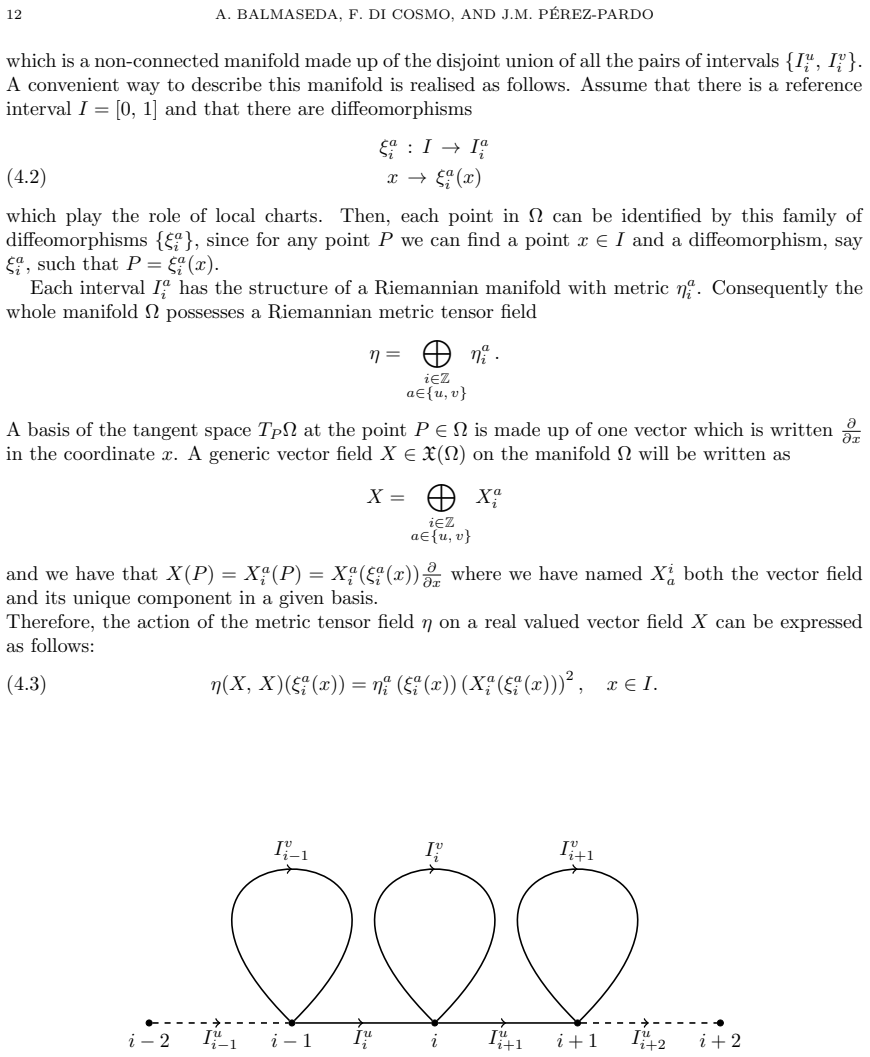
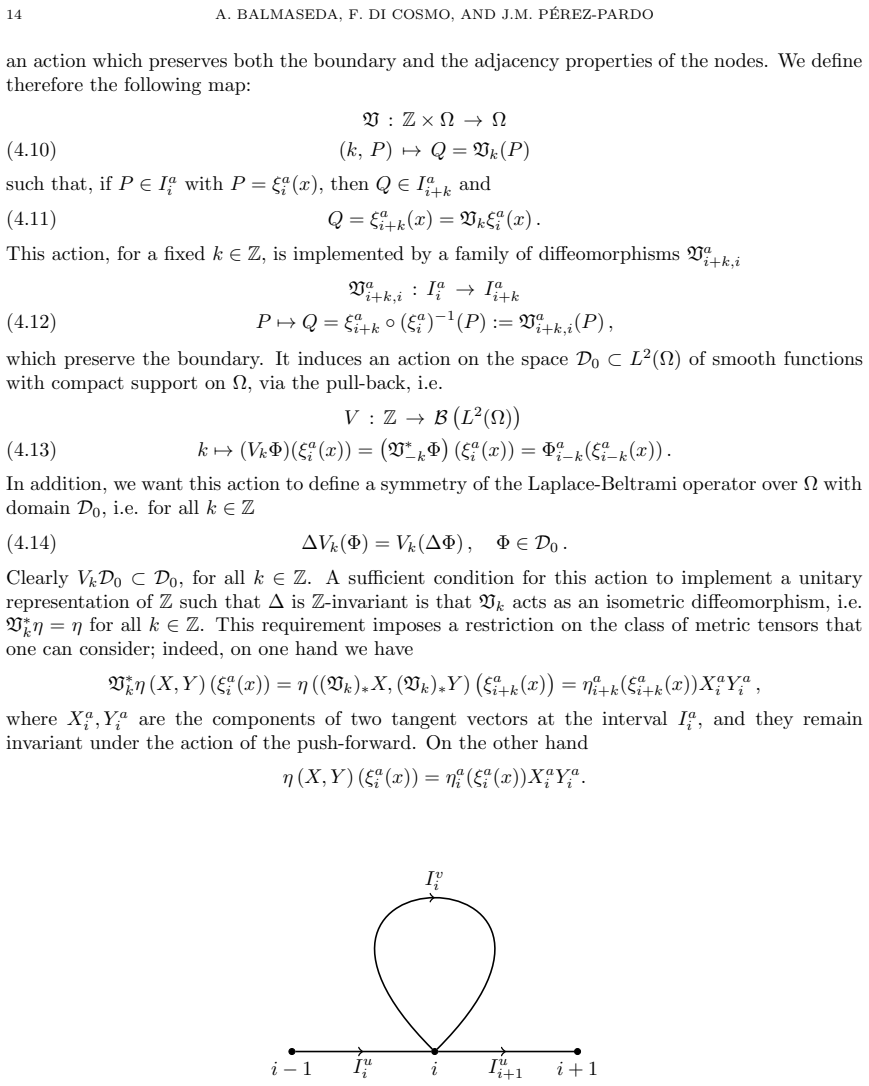
The quasi-$\delta$ family is the central object. At a vertex of degree $d$, the boundary condition is set by a unitary $U_\nu=e^{i\delta}P^\perp_\nu-P_\nu$, where $P^\perp_\nu$ is the rank-one orthogonal projector onto the line spanned by $(1,e^{i\alpha_1},\dots,e^{i\alpha_{d-1}})^T$; this is exactly the condition that $|\Phi|$ be continuous at the vertex while the arguments of the components differ by the phases $\alpha_j$. The proof mechanism is the commutativity criterion of Theorem 2.5: a self-adjoint extension is $G$-invariant precisely when its boundary unitary commutes with the trace representation of $G$ on the boundary data. For the chain, the generator of the $\mathbb{Z}$ action is a block diagonal matrix with phase factors $e^{-i\theta^a_i}$, and Proposition 3.7 reduces the commutation condition to the proportionality $v_1\zeta_{i-1}\propto\zeta_i$, which is exactly the constancy of $\delta$ and of $\alpha_i^1-\alpha_i^2$.
What would settle it
Set up a two-periodic chain with $\alpha^0_1-\alpha^0_2=0$ and $\alpha^1_1-\alpha^1_2=\pi/2$, and solve the $4\times4$ block commutation condition $v_1Uv_1^*=U$ for the most general diagonal phases $\theta^a_i$; a nonzero solution would disprove the necessity of condition (ii), while the absence of solutions confirms it.
Extended reading notes
Core claim
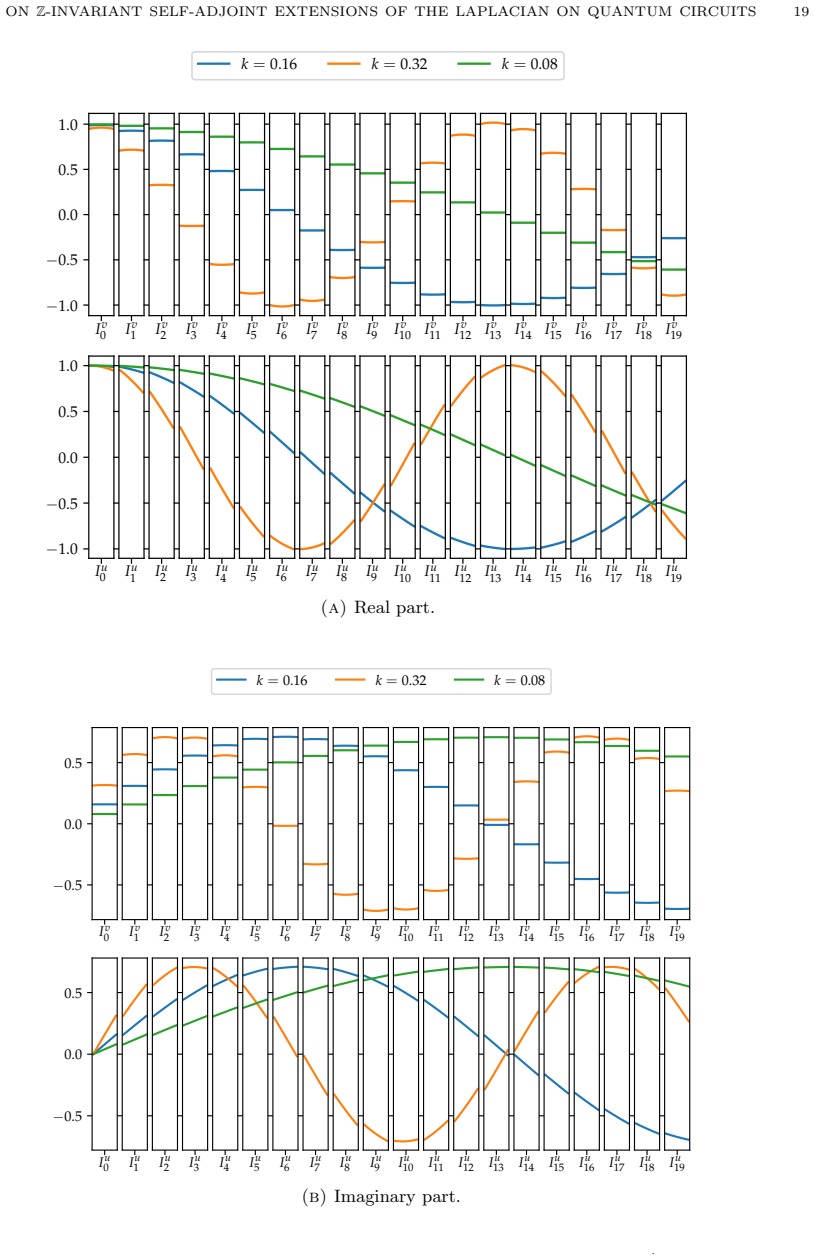
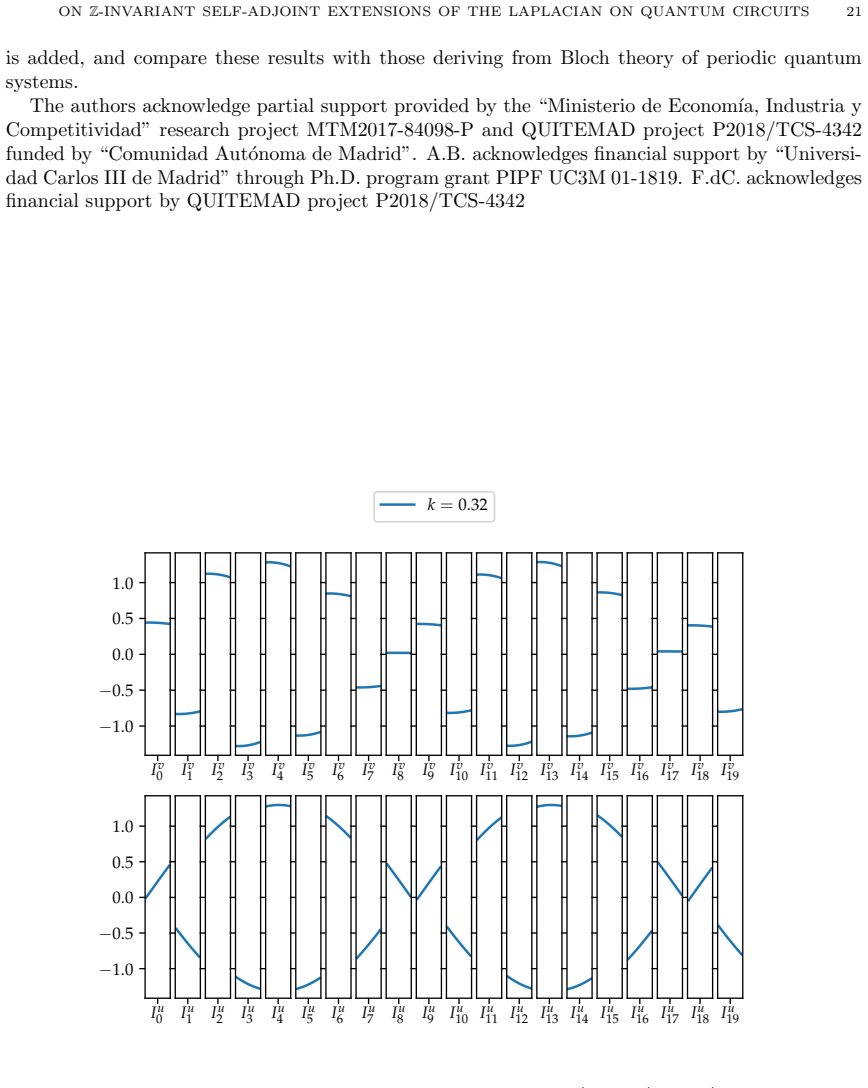
The central claim is Theorem 4.1. For the infinite loop-chain circuit, the group $\mathbb{Z}$ is a symmetry compatible with every quasi-$\delta$ self-adjoint extension exactly when (i) $\delta_i=\delta$ for all $i$, and (ii) $\alpha_i^1-\alpha_i^2$ does not depend on $i$. Under these conditions the trace representation of the shift can be phased so that it commutes with the block diagonal boundary unitary, and hence, by the general invariance criterion, the extension is $\mathbb{Z}$-invariant. The paper derives the resulting generalized eigenfunctions from the linear system (4.24)--(4.27), with explicit $\delta=0$ solutions (4.30)--(4.31), and notes that these are candidate eigenfunctions pending a finiteness check of their inner products with the domain.
Load-bearing premise
The load-bearing premise is that every topology-preserving vertex coupling of the circuit is quasi-$\delta$, which the paper justifies by taking continuity of $|\Phi|$ at each node as the defining feature; if a physically admissible local coupling allowed $|\Phi|$ to jump or had more than one nontrivial eigenvalue, Theorem 4.1 would characterize only a subfamily of the translation-invariant extensions.
Editorial extensions
If this is right
- The $\mathbb{Z}$-invariant quasi-$\delta$ extensions form a two-parameter family: a real $\delta$ and a real loop-phase difference $\alpha=\alpha_i^2-\alpha_i^1$, with the remaining phases chosen to match the unitary representation of the shift.
- For every such extension, generalized eigenfunctions can be computed cell by cell from the linear system (4.24)--(4.27); when $\delta=0$ the coefficients satisfy the closed formulas (4.30)--(4.31).
- Adding a bounded-below periodic potential $v_i^a(x)=v^a(x)$ to each interval does not alter the self-adjoint extension analysis, so the characterization also covers those Schrödinger-type Hamiltonians.
- The same method applies to a finite chain of $m$ cells with periodic boundary conditions, where the cyclic group $\mathbb{Z}_m$ plays the role of $\mathbb{Z}$ and the spectrum is discrete.
- Not every periodic repetition of vertex parameters is translation-invariant: a vertex-dependent loop phase difference cannot be absorbed by any choice of the phases in the representation, so it is genuinely forbidden.
Reading between the lines
- Dropping the quasi-$\delta$ restriction, the same commutator method should yield a full classification of local translation-invariant vertex couplings; the paper does not attempt that, so enumerating unitary $4\times4$ blocks with more than one non-$-1$ eigenvalue is a natural open step.
- The candidate-eigenfunction caveat means some $k$ values solving (4.24)--(4.27) may not belong to the spectrum; computing the required inner-product finiteness for the plotted figures would give a concrete spectral test.
- The phase $\theta$ in the representation plays the role of a quasi-momentum, so the system (4.24)--(4.27) should reproduce Bloch-theory band structure once a periodic potential is added; comparing the two approaches is a direct testable extension.
Signed reviews
Editorial analysis
A structured set of objections, weighed in public.
Referee Report
Summary. The paper revisits the criterion of Ibort et al. for G-invariant self-adjoint extensions of the Laplace-Beltrami operator in terms of unitary operators on the boundary Hilbert space, then applies it to a one-dimensional quantum circuit obtained by repeating an elementary cell consisting of a chain segment and a loop. After restricting to the quasi-delta family of vertex conditions, characterized by continuity of |Phi| at each node, the paper proves (Theorem 4.1) that Z-invariance under a phase-valued representation forces the vertex parameter delta to be constant and the loop phase difference alpha_i^1 - alpha_i^2 to be vertex-independent. It then writes down linear systems for the generalized eigenfunctions and derives closed-form amplitude relations in selected cases. The final paragraph of Section 4 candidly notes that the computed functions are only candidates for generalized eigenfunctions.
Significance. If Theorem 4.1 is correct, the paper provides a useful method for constructing translation-invariant boundary conditions on periodic quantum circuits and for setting up the corresponding spectral problem. The proof is constructive and is explicitly derived from the commutation condition [v,U]=0 together with the quasi-delta form of U, with no circularity in the theorem statement itself; the paper also acknowledges the candidate-eigenfunction caveat. However, the reach of the headline claim is limited by the unproven restriction to the quasi-delta family, and the displayed formulas contain indexing and sign inconsistencies that must be repaired before the central derivation can be considered verified.
major comments (4)
- [Abstract and Section 3] The abstract states that the paper characterises Z-invariant self-adjoint extensions of the Laplacian on the circuit, but the actual characterization in Theorem 4.1 applies only to the quasi-delta family introduced in Section 3. The restriction is made through the modeling assumption that |Phi| be continuous at every node, which forces each vertex block to have rank-one P^perp and hence the form U_nu = e^{i delta} P^perp_nu - P_nu (Eq. (3.4)). This is a modeling premise, not a classification: local vertex unitaries that are block-local in the threaded arrangement but do not satisfy |Phi| continuity, e.g. a constant unitary U_0 with more than one eigenvalue different from -1, commute with the plain translation and are therefore Z-invariant under the trace representation. The theorem's own wording 'compatible with every quasi-delta self-adjoint extension' is accurate, but the abstract and the closing paragraph of Section 5 overstate the scope. The authors should either prove that every local, topology-preserving unitary is necessarily quasi-delta, or explicitly qualify all claims as restricted to the quasi-delta family.
- [Theorem 4.1 proof and Eqs. (4.17)-(4.23)] The proof of Theorem 4.1 is not internally consistent with the definition of the trace representation. Eq. (4.17) defines the generator by (V^theta_1 Phi)(xi^a_i(x)) = e^{-i theta^a_i} Phi^a_{i-1}(x), which for k=1 gives a trace action (v_1 phi)^a_i = e^{-i theta^a_i} phi^a_{i-1}; Eq. (4.23), however, gives (v_k phi)^a_i = e^{-i sum_{n=1}^k theta^a_{i+n}} phi^a_{i-k}, i.e. for k=1 the phase index is i+1 rather than i. The proof then uses the block v^{i-1}_1 = diag(e^{-i theta^u_{i-1}}, e^{-i theta^v_i}, e^{-i theta^v_i}, e^{-i theta^u_i}), which is a third assignment, with the first and fourth components shifted relative to the first two assignments. As a result, the computation of v_1^* U v_1 and the derivation of conditions (i)-(ii) cannot be checked as written. The theorem may be correct after a consistent reindexing, but the displayed formulas need to be reconciled before the proof is accepted.
- [Eqs. (4.24)-(4.31)] There is a sign inconsistency in the phase alpha. Condition (ii) of Theorem 4.1 states that alpha_i^1 - alpha_i^2 is independent of i, whereas immediately after Eq. (4.27) the text states 'where alpha_i^2 - alpha_i^1 = alpha is constant'. The subsequent derivation of the variables A^i_out, A^i_in, B^i_out, B^i_in and the closed formulas (4.28)-(4.31) systematically use alpha = alpha_i^2 - alpha_i^1. If the intended convention is the one in condition (ii), the sign of alpha in (4.30) and (4.31) is flipped, which changes the dispersion relations; if the convention after (4.27) is intended, condition (ii) should be rewritten. The authors should fix the sign convention and re-verify the algebra in (4.28)-(4.31).
- [Abstract and final paragraph of Section 4] The abstract claims that the analysis allows 'the determination of the spectrum and generalised eigenfunctions in particular examples'. The final paragraph of Section 4, however, states that the calculated functions are only candidates for generalized eigenfunctions and that an additional inner-product condition must be checked to decide whether a given k is actually in the spectrum. No such check is performed, so the paper does not in fact determine the spectrum in any example. The authors should either provide the missing spectral criterion and apply it to at least one case, or weaken the claims in the abstract and Section 5.
minor comments (4)
- [Proof of Theorem 4.1] In the proof of Theorem 4.1, 'we only need to proof that' should read 'prove'.
- [References] The reference list contains two distinct entries both keyed [Ibort et al.(2015)] with different titles and journals; they should be disambiguated and cited by distinct labels to avoid ambiguity.
- [Throughout] The symbols ell^2 and mathfrak l^2 are used interchangeably for the Hilbert space of boundary data; one notation should be used consistently.
- [Section 4] The term 'generalised eigenfunction' is used without a definition or a reference; the paper should state precisely what is meant (e.g., distributions satisfying the boundary conditions and having finite inner products with domain elements), especially since the final paragraph relies on that notion.
Circularity Check
No significant circularity; Theorem 4.1 follows from the stated quasi-δ modeling ansatz and the external Ibort et al. characterization, with no fitted parameter renamed as a prediction.
full rationale
The derivation chain is self-contained relative to its stated assumptions. Theorem 2.5 is quoted as an external published characterization of G-invariant self-adjoint extensions; although one author of the present paper overlaps with [Ibort et al. 2015], the cited theorem has an independent proof and its hypotheses do not include the target result, so using it is legitimate rather than circular. The quasi-δ family is introduced in Section 3 as an explicit modeling choice from locality and continuity of |Φ| at vertices, not as a hidden input of the Z-invariance theorem. Theorem 4.1 then takes a quasi-δ extension satisfying the explicit hypotheses (constant δ and constant loop phase difference) and constructs the representation phases θ by showing v1^{i-1}ζ_{i-1}∝ζ_i; the constant parameters are hypotheses, not outputs smuggled through the proof. The generalized-eigenfunction system (4.24)-(4.27) is obtained by imposing those boundary conditions, and the paper expressly cautions that the functions are only candidates until an additional integrability condition is verified. There is no data fitting, no parameter fitted to a subset and then called a prediction, and no equation that reduces to its own input by construction. The plausible criticism that non-quasi-δ local vertex conditions are not classified is a scope limitation of the modeling premise, not a circularity in the derivation.
Assumptions & free parameters
free parameters (4)
- δ (quasi-δ vertex coupling phase)
- α_i^1, α_i^2, α_i^3 (relative phases at vertex i)
- θ^a_i (phases of the Z-representation)
- l_u, l_v (interval lengths)
assumptions (5)
- standard math Self-adjoint extensions of the Laplace-Beltrami operator are in one-to-one correspondence with admissible unitaries U on the boundary data space with spectral gap at -1 (Thm 2.5, quoted from Ibort et al. 2015).
- standard math A self-adjoint extension defined by U is G-invariant iff the trace representation commutes with U, under the hypotheses that the representation is traceable and preserves the Neumann extension (Thm 2.5(i), Thm 2.6).
- domain assumption Topology-preserving circuit boundary conditions coincide with the quasi-δ family: |Φ| continuous at each vertex, so P^⊥ is rank one onto span{(1,e^{iα1},...)} (Eqs. (3.2)-(3.4)).
- domain assumption The Z-action commutes with the Laplacian only when the phases θ^a_i are constant on each interval.
- domain assumption The Z-action is isometric, forcing all intervals of each type to have equal lengths l_u, l_v.
Cite this review
Pith. "Pith review of On $\mathbb{Z}$-invariant self-adjoint extensions of the Laplacian on quantum circuits." pith.science (2026). https://pith.science/paper/IG56N67B
@misc{pith2026190804214,
  author       = {Pith},
  title        = {Pith review of: On $\mathbbZ$-invariant self-adjoint extensions of the Laplacian on quantum circuits},
  year         = {2026},
  howpublished = {\url{https://pith.science/paper/IG56N67B}},
  note         = {Machine review of arXiv:1908.04214}
}
abstract
An analysis of the invariance properties of self-adjoint extensions of symmetric operators under the action of a group of symmetries is presented. For a given group $G$, criteria for the existence of $G$-invariant self-adjoint extensions of the Laplace-Beltrami operator over a Riemannian manifold are illustrated and critically revisited. These criteria are employed for characterising self-adjoint extensions of the Laplace-Beltrami operator on an infinite set of intervals, $\Omega$, constituting a quantum circuit, which are invariant under a given action of the group $\mathbb{Z}$. A study of the different unitary representations of the group $\mathbb{Z}$ on the space of square integrable functions on $\Omega$ is performed and the corresponding $\mathbb{Z}$-invariant self-adjoint extensions of the Laplace-Beltrami operator are introduced. The study and characterisation of the invariance properties allows for the determination of the spectrum and generalised eigenfunctions in particular examples.
Figures

Figures from the paper (3 more)

Reference graph
Works this paper leans on
-
[1]
Self-Adjoint Extensions of the Laplace–Beltrami Operator and Unitaries at the Boundary
[Ibort et al.(2015)] Ibort, A.; Lled´ o, F.; P´ erez-Pardo, J. Self-Adjoint Extensions of the Laplace–Beltrami Operator and Unitaries at the Boundary. Journal of Functional Analysis 2015, 268, 634–670. doi:10.1016/j.jfa.2014.10.013. [Kittel(2004)] Kittel, C. Introduction to Solid State Physics , 8th ed.; John Wiley & Sons Inc: Hoboken, NJ,
-
[8]
Methods of Modern Mathematical Physics I: Functional Analysis , rev and enl ed.; Elsevier,
[Reed and Simon(2012)] Reed, M.; Simon, B. Methods of Modern Mathematical Physics I: Functional Analysis , rev and enl ed.; Elsevier,
work page 2012
-
[9]
[Gelfand and Shilov(1967)] Gelfand, I.; Shilov, G. generalised Functions, Vol. 3: Theory of Differential Equations ; Academic Press: New York,
work page 1967
-
[1931]
The Theory of Groups and Quantum Mechanics ; Courier Corporation,
[Weyl(1950)] Weyl, H. The Theory of Groups and Quantum Mechanics ; Courier Corporation,
work page 1950
-
[1950]
Allgemeine Eigenwerttheorie Hermitescher Funktionaloperatoren
[v Neumann(1930)] v Neumann, J. Allgemeine Eigenwerttheorie Hermitescher Funktionaloperatoren. Mathematische Annalen 1930, 102, 49–131. doi:10.1007/BF01782338. [Kato(1995)] Kato, T. Perturbation Theory for Linear Operators ; Classics in Mathematics, Springer: Berlin,
-
[1967]
ON Z-INVARIANT SELF-ADJOINT EXTENSIONS OF THE LAPLACIAN ON QUANTUM CIRCUITS 23 [Marsden et al.(1988)] Marsden, J.E.; Abraham, R.; Ratiu, T. Manifolds, Tensor Analysis, and Applications , 3 ed.; Applied Mathematical Sciences, Springer-Verlag: New York,
work page 1988
-
[1982]
Universal Computation by Quantum Walk
[Childs(2009)] Childs, A. Universal Computation by Quantum Walk. Physical Review Letters 2009, 102, 180501. doi:10.1103/PhysRevLett.102.180501. Depto. de Matem ´aticas, Univ. Carlos III de Madrid, Avda. de la Universidad 30, 28911 Legan ´es, Madrid, Spain E-mail address: abalmase@math.uc3m.es Depto. de Matem ´aticas, Univ. Carlos III de Madrid, Avda. de l...
-
[1988]
[Naylor and Sell(1982)] Naylor, A.; Sell, G. Linear Operator Theory in Engineering and Science ; Applied Mathe- matical Sciences, Springer-Verlag: New York,
work page 1982
Show all 12 references
-
[1995]
Sobolev Spaces; Pure and Applied Mathematics, Elsevier Science,
[Adams and Fournier(2003)] Adams, R.A.; Fournier, J.J.F. Sobolev Spaces; Pure and Applied Mathematics, Elsevier Science,
2003
-
[2003]
Solvable Models in Quantum Mechanics; Springer Science & Business Media,
[Albeverio et al.(2012)] Albeverio, S.; Gesztesy, F.; Hoegh-Krohn, R.; Holden, H. Solvable Models in Quantum Mechanics; Springer Science & Business Media,
2012
-
[2004]
¨Uber die Quantenmechanik der Elektronen in Kristallgittern
[Bloch(1929)] Bloch, F. ¨Uber die Quantenmechanik der Elektronen in Kristallgittern. Zeitschrift f¨ ur Physik1929, 52, 555–600. doi:10.1007/BF01339455. [Balachandran et al.(1995)] Balachandran, A.P.; Bimonte, G.; Marmo, G.; Simoni, A. Topology Change and Quan- tum Physics. Nuc...
1929 arXiv
-
[2012]
From Classical to Quantum Mechanics: An Intro- duction to the Formalism, Foundations and Applications ; Cambridge University Press: Cambridge,
[Esposito et al.(2004)] Esposito, G.; Marmo, G.; Sudarshan, G. From Classical to Quantum Mechanics: An Intro- duction to the Formalism, Foundations and Applications ; Cambridge University Press: Cambridge,
2004
Reviewed August 14, 2026 · model on record in the stance chip above.
Discussion (0). Continue with ORCID to comment.