REVIEW 4 major objections 5 minor 31 references
Improving Low-Resolution Face Recognition under Limited Data: How Synthetic Data Generation Can Close the Domain Gap
T0 review · 4 major / 5 minor · reviewed 2026-08-10 · deepseek-v4-flash
Pith's one-line read Low-resolution face recognition tuned on synthetic benchmarks picks the wrong degradation setting for real images, and a learned super-resolution front-end loses to a direct feed of the aligned image.
desk verdict A useful, honest empirical comparison with a solid direct-feed baseline result, but the headline synthetic-real inversion is not fully nailed down and needs resolution-distribution evidence. read the letter →
The pith
A machine-rendered reading of the paper's core claim, the machinery that carries it, and where it could break.
The reading
What carries the argument
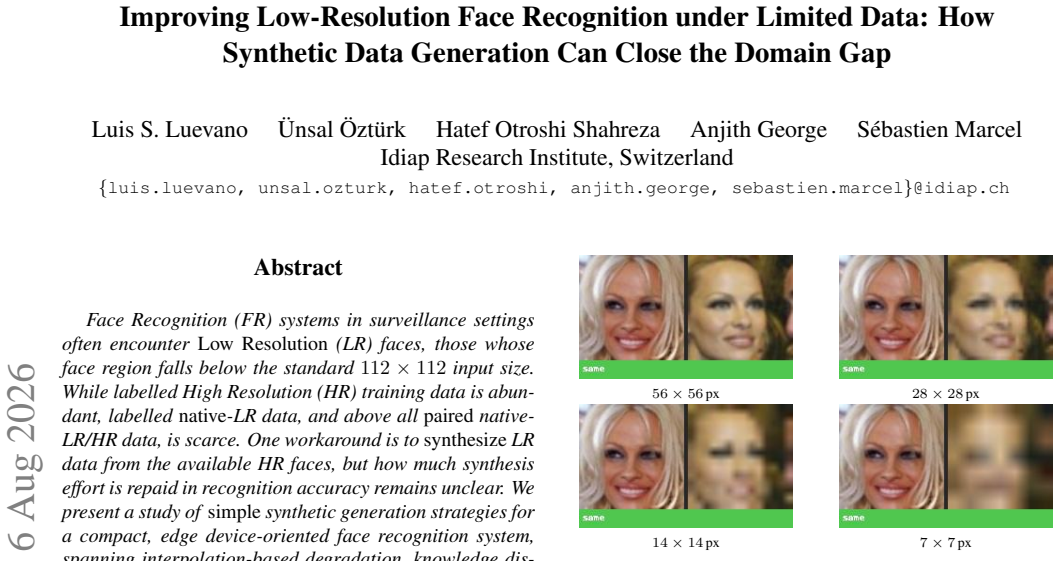
The machinery that carries the argument is a paired evaluation design: the same models are trained on synthetic low-resolution variants of high-resolution data and then scored on both synthetic cross-resolution verification sets and the real native low-resolution identification set TinyFace under two alignment pipelines. The central objects are the degradation settings written $s{\downarrow}d/{\uparrow}u$ (downsample to $s$ pixels with interpolation $d$, upsample back to 112 px with $u$) and the five adaptation strategies: interpolation augmentation, knowledge distillation, a Prepended Domain Transformer (a small input-side translator that maps a probe into a frozen backbone's input domain), a Real-ESRGAN-style native 32 px stem, and a learned super-resolution front-end. The learned front-end uses two $\times2$ sub-pixel (PixelShuffle) stages plus convolutions to go from 32 px to 112 px, with a Stage 1 identity-aware loss $\mathcal{L}_{\mathrm{SR}} = \ell_1 + \lambda_{\mathrm{id}}(1-\cos(\phi(\mathrm{SR}(x_{\mathrm{LR}})), \phi(x_{\mathrm{HR}})))$ and a Stage 2 joint contrastive objective with the translator; it is this explicit generative machinery that the paper shows does not beat feeding the aligned low-resolution image directly into the frozen backbone.
What would settle it
Train the same EdgeFace-S models for each degradation setting with several random seeds and measure the seed-to-seed spread of TinyFace mAP; if the 56 px setting does not beat 28 px and the high-resolution baseline by more than that spread, the ranking inversion is not established. Separately, evaluate the learned super-resolution front-end on a compact backbone that is retrained rather than frozen; if it then beats the compact direct feed, the claim that the front-end never beats direct feed would need qualification.
Extended reading notes
Core claim
The paper's central claim is that low-resolution face recognition adaptation cannot be tuned or validated on synthetic degradation alone. Across synthetic verification benchmarks, the configuration $28{\downarrow}c/{\uparrow}a$ (cubic downsampling to 28 px, area upsampling back to 112 px) is consistently the best for every adaptation method, but on the real native low-resolution identification set TinyFace the same configuration is the worst of the family and lands below the high-resolution-trained baseline, while the milder $56{\downarrow}c/{\uparrow}a$ setting wins. In parallel, the paper claims that a learned, identity-aware super-resolution front-end prepended to a frozen strong backbone never surpasses directly feeding that backbone the aligned low-resolution image, so the direct feed is a baseline any restoration or translation pipeline must be measured against. It further claims that synthesis effort is not monotonically rewarded: on a retrainable compact backbone, the cheapest interpolation augmentation is the only synthesis that improves over its own direct-feed baseline, while Real-ESRGAN-style degradation and the learned front-end do not. Finally, the average-accuracy gains from low-resolution-aware synthesis do not reduce demographic disparity on RFW, with the FMR Gini moving in both directions across test resolutions.
Load-bearing premise
The load-bearing premise is that the reported single-run accuracy differences, especially the 56 px advantage over 28 px on TinyFace and the direct-feed advantage over the super-resolution front-end, are larger than run-to-run training noise, despite no error bars being reported and only 4 of 12 down/up combinations converging stably.
Editorial extensions
If this is right
- Reported gains from any restoration or translation front-end for low-resolution face recognition should be compared against a direct-feed strong backbone under the same alignment, since that baseline beats the learned super-resolution pipeline here.
- Tuning the training degradation on synthetic benchmarks alone can select the worst configuration for real deployment: the optimal training resolution depends on the target domain, 28 px on synthetic data versus 56 px on native low-resolution faces.
- For compact edge models, cheap interpolation augmentation at a mild resolution ($56{\downarrow}c/{\uparrow}a$) is the only synthesis that improves over its own baseline, outperforming both Real-ESRGAN-style degradation and the learned super-resolution front-end on TinyFace.
- Training at 56 px and 28 px also acts as a regularizer on standard high-resolution benchmarks and IJB-C, matching or exceeding the high-resolution baseline, while a native 32 px stem trades away high-resolution capability.
Reading between the lines
- A testable extension the paper leaves implicit is to estimate the degradation (blur, noise, compression) of a target camera and train at the synthetic setting that matches it, then check on native low-resolution faces whether the ranking inversion closes.
- Because the direct-feed baseline already includes the aligner's interpolation, the marginal value of a separate super-resolution module likely depends on the aligner; comparing aligners could change the verdict for the learned front-end.
- The paper does not evaluate fine-tuning on real native low-resolution data, so a natural next experiment is to add a small amount of native low-resolution faces to the synthetic training mix and see whether the learned front-end finally beats direct feed; the paper names this as future work.
Editorial analysis
A structured set of objections, weighed in public.
Referee Report
Summary. The paper studies synthetic low-resolution (LR) data generation strategies for face recognition on a compact backbone (EdgeFace-S), comparing interpolation-based augmentation, knowledge distillation, a Prepended Domain Transformer (PDT), Real-ESRGAN-style degradation, and an identity-aware learned super-resolution front-end. It evaluates these methods on synthetic cross-resolution benchmarks (LFW, CFP-FP, AgeDB-30) and on the real native-LR dataset TinyFace, under two alignment pipelines. The central claims are: (i) the degradation setting that is optimal on synthetic benchmarks (28↓c/↑a) is not optimal on real LR, where the milder 56↓c/↑a setting wins; (ii) synthesis effort does not pay off monotonically, with simple interpolation augmentation being the only approach that improves a compact backbone over its own baseline; (iii) a learned identity-aware SR front-end never beats directly feeding the aligned LR image to a strong frozen backbone; and (iv) LR-aware synthesis does not reduce demographic bias on RFW. The paper also releases the pipeline and includes a fairness analysis.
Significance. The paper addresses a practically important and understudied question: whether synthetic LR training and evaluation transfer to genuinely captured LR faces. Its direct-feed strong-backbone baseline is a fair and often missing reference point, and its negative result for the learned SR front-end is a useful caution for the field. The evaluation on TinyFace with two aligners is a strength, as is the release of the pipeline. If the central claims hold, the paper would provide clear practical guidance: validate LR FR methods on real LR data and compare against direct feed. The main limitations are the lack of repeated runs or error bars, the post-hoc selection of only 4 of 12 interpolation combinations, and insufficient evidence that the synthetic-to-real ranking inversion is not an artifact of resolution-distribution mismatch or small accuracy differences.
major comments (4)
- [§5.3, §9(i), Tables 4–6] The claim that 28↓c/↑a is 'the worst configuration on TinyFace' is not supported by the full set of reported results. Under the aligned-pad protocol (Table 5), the 14↓a/↑c setting has lower mAP than 28↓c/↑a for both the LR backbone (45.67 vs. 48.51) and KD (45.67 vs. 47.94), and PDT also degrades further at 14↓a/↑c. In Table 4, only the 56↓c/↑a and 28↓c/↑a columns are compared on TinyFace, with the 14↓a/↑c entry omitted. The conclusion should be scoped to the DFA-aligned LR-backbone comparison between 56 and 28, or all settings should be evaluated under the same aligner before making the unqualified statement.
- [§5.1–§5.3, Tables 1–4] The synthetic macro-mean appears to average over multiple test resolutions (56/28/14/7 px), whereas TinyFace has a fixed but unreported native resolution distribution. If TinyFace probes are predominantly near 56 px, then the 56↓c/↑a model may win on TinyFace simply because its training resolution matches the test distribution, rather than because of a fundamental synthetic–real degradation mismatch. The paper should report the face-height statistics of the TinyFace probes after alignment and, at minimum, provide synthetic per-resolution results (e.g., evaluation at 56, 28, 14, and 7 px separately) to show that 28↓c/↑a is genuinely preferred at low synthetic resolutions and 56↓c/↑a at higher ones. Without this, the headline 'synthetic–real gap' is confounded.
- [§7, Tables 1–6] The study reports single-run accuracies without error bars or repeated-seed experiments, yet several key ranking differences are small. For example, Table 1 shows HR→LR LR-backbone 80.74 for 28↓c/↑a vs. 80.25 for 56↓c/↑a; Table 5 shows mAP 49.31 vs. 48.96 for the same two settings; and in Table 6, the R-1 values for 56↓c/↑a augmentation and the Real-ESRGAN 32px stem are both 61.40. The claim that 28↓c/↑a is best on synthetic benchmarks but worst on TinyFace depends on these small differences being reproducible. At least three seeds with mean and standard deviation (or a paired significance test) are needed for the main comparisons. The paper should also clarify the criterion by which only 4 of 12 interpolation combinations 'converged stably' and whether this selection was made before or after looking at TinyFace results.
- [§6.1, §8, §9(iii), Tables 6 and 11] Conclusion (iii) states that a learned, identity-aware SR front-end 'never beats simply feeding a strong frozen backbone the aligned LR image.' This is supported only for the frozen EdgeFace-base (WebFace12M) setting; the full SR+PDT pipeline was not evaluated on the compact EdgeFace-S backbone, as the paper's own Limitations section (Section 8) acknowledges. The conclusion should be explicitly scoped to the strong frozen backbone, and the generalization to compact backbones should be presented as a hypothesis rather than a finding. This also affects the interpretation of Table 11, where the 'high effort' row is computed on a different backbone than the 'low effort' rows.
minor comments (5)
- [Abstract and Section 3] The abstract describes all methods as 'simple synthetic generation strategies,' but the Real-ESRGAN-style degradation pipeline and the learned SR front-end are moderately complex; consider rephrasing to 'synthetic generation strategies of varying complexity.'
- [Table 4] The 14↓a/↑c column is marked with an em dash on the TinyFace row but the caption does not explain why this setting was not evaluated on real LR; please state the reason.
- [Equation (1) and Section 3.1] The hyperparameters λ_id in Eq. (1), λ_e in the KD loss, and λ_w in the KD loss are not reported; providing their values (or a reference to the code release) would improve reproducibility.
- [Section 7] The sentence 'At 7px all methods degrade sharply on CFP-FP and AgeDB-30, an unresolved domain gap' is a significant limitation and would be better placed in the Limitations section, where it can be discussed along with the proposed follow-up work.
- [Table 12] The fairness table reports FMR ratios and Gini indices for 28px and above, but the main text should more clearly state that at 14 and 7 px the global FNMR is above 0.9 so the per-group comparison is not informative; currently this appears only in a closing sentence of Section 7.1.
Circularity Check
No circularity found: the synthetic–real gap is an independent empirical comparison, and self-citations are not load-bearing.
full rationale
The paper's central claims are empirical: models trained under several synthetic degradation settings are evaluated on external synthetic benchmarks (LFW, CFP-FP, AgeDB-30) and on the real native-LR TinyFace, with no parameter fitted to TinyFace being reported as a prediction. Claim (i) compares the ranking of the same trained models on two independent test sets; claim (iii) compares a learned SR front-end with a direct feed of the aligned LR image on the same frozen backbone, and the result is an observed defeat of the authors' own generative pipeline. Self-citations (EdgeFace [6] as backbone, PDT [8] as a compared baseline) provide components rather than the justification for the conclusion; indeed the paper reports that PDT and the SR pipeline underperform, which is contrary to what a self-citation-driven argument would predict. The stated limitations (SR evaluated only on a large frozen backbone; only 4 of 12 interpolation settings converged stably) are honest scope restrictions and affect generality or statistical robustness, not circularity. The tension between conclusion (i) and Table 5's aligned-pad results is an internal consistency issue, not a circular reduction. The skeptic's alternative explanation involving TinyFace's unreported resolution distribution is a confound or correctness concern, not a circularity by construction.
Assumptions & free parameters
free parameters (3)
- lambda_id (Eq. 1) =
not reported
- lambda_e (KD embedding loss) =
not reported
- lambda_w (KD weight loss) =
not reported
assumptions (4)
- domain assumption The tested synthetic degradations (interpolation chains and Real-ESRGAN-style pipeline) are assumed to be representative of real LR degradation ranges, so the observed ranking on TinyFace generalizes beyond the specific TinyFace and DFA alignment setup.
- domain assumption The differences between configurations are assumed to exceed run-to-run variance, since each model is trained once with no seeds or error bars.
- domain assumption TinyFace with the specified aligners is taken as a representative real native-LR benchmark for the study's conclusions about optimal training resolution.
- domain assumption The identity-aware SR loss (Eq. 1) with a frozen backbone is a valid objective for preserving identity in upsampled images.
Cite this review
Pith. "Pith review of Improving Low-Resolution Face Recognition under Limited Data: How Synthetic Data Generation Can Close the Domain Gap." pith.science (2026). https://pith.science/paper/IGLZZTPZ
@misc{pith2026260806580,
  author       = {Pith},
  title        = {Pith review of: Improving Low-Resolution Face Recognition under Limited Data: How Synthetic Data Generation Can Close the Domain Gap},
  year         = {2026},
  howpublished = {\url{https://pith.science/paper/IGLZZTPZ}},
  note         = {Machine review of arXiv:2608.06580}
}
abstract
Face Recognition (FR) systems in surveillance settings often encounter Low Resolution (LR) faces, those whose face region falls below the standard 112 $\times$ 112 input size. While labelled High Resolution (HR) training data is abundant, labelled native-LR data, and above all paired native LR/HR data, is scarce. One workaround is to synthesize LR data from the available HR faces, but how much synthesis effort is repaid in recognition accuracy remains unclear. We present a study of simple synthetic generation strategies for a compact, edge device-oriented face recognition system, spanning interpolation-based degradation, knowledge distillation, a Prepended Domain Transformer (PDT), Real ESRGAN-style degradation, and a learned Super Resolution (SR) front-end with an identity-aware loss. We evaluate these strategies on synthetic cross-resolution face benchmarks (LFW, CFP-FP, AgeDB-30) and on TinyFace, a real-world native LR dataset, and expose a synthetic-real gap: the degradation setting that is optimal on synthetic benchmarks is not the one that is optimal on real LR. We find that more synthesis effort does not help monotonically: the learned SR front-end does not surpass a direct feed of the aligned LR image into a strong backbone, while simple interpolation augmentation of a compact backbone is the only synthesis that improves over its own baseline. We conclude that generative methods for LR face recognition must be validated on real LR and against a direct-feed baseline, and release our pipeline at https://idiap.ch/paper/synth-lrfr
Figures


Figures from the paper (3 more)


Reference graph
Works this paper leans on
-
[1]
X. An, X. Zhu, Y . Gao, Y . Xiao, Y . Zhao, Z. Feng, L. Wu, B. Qin, M. Zhang, D. Zhang, and Y . Fu. Partial FC: Training 10 million identities on a single machine. InProceedings of the IEEE/CVF International Conference on Computer Vision Workshops (ICCVW), pages 1445–1449, 2021
work page 2021
-
[2]
Boosting Cross-Quality Face Verification using Blind Face Restoration
M. Bengherabi, D. Laib, F. S. Lasnami, and R. Boussaha. Boosting cross-quality face verification using blind face restoration. InInternational Conference of the Biometrics Special Interest Group (BIOSIG), 2023. arXiv:2308.07967
work page Pith review arXiv 2023
- [3]
-
[4]
J. Deng, J. Guo, N. Xue, and S. Zafeiriou. ArcFace: Additive angular margin loss for deep face recognition. InProceed- ings of the IEEE/CVF Conference on Computer Vision and Pattern Recognition (CVPR), pages 4690–4699, 2019
work page 2019
-
[5]
S. Ge, S. Zhao, C. Li, Y . Zhang, and J. Li. Efficient low- resolution face recognition via bridge distillation.IEEE Transactions on Image Processing, 29:6898–6908, 2020
work page 2020
- [6]
-
[7]
A. George and S. Marcel. Heterogeneous face recognition using domain invariant units. InIEEE International Confer- ence on Acoustics, Speech and Signal Processing (ICASSP),
- [8]
Show all 31 references
-
[9]
Hadsell, S
R. Hadsell, S. Chopra, and Y . LeCun. Dimensionality reduc- tion by learning an invariant mapping. InProceedings of the IEEE Conference on Computer Vision and Pattern Recogni- tion (CVPR), pages 1735–1742, 2006
2006
-
[10]
Hinton, O
G. Hinton, O. Vinyals, and J. Dean. Distilling the knowledge in a neural network.arXiv preprint arXiv:1503.02531, 2015
2015 arXiv
-
[11]
G. B. Huang, M. Ramesh, T. Berg, and E. Learned-Miller. Labeled faces in the wild: A database for studying face recognition in unconstrained environments. Technical Re- port 07-49, University of Massachusetts, Amherst, 2007
2007
-
[12]
M. Kim. CVLface: A modular library for face recognition research (differentiable face aligner).https://github. com/mk-minchul/CVLface, 2024
2024
-
[13]
J. N. Kolf, F. Boutros, J. Elliesen, M. Theuerkauf, N. Damer, et al. EFaR 2023: Efficient face recognition competition. In IEEE International Joint Conference on Biometrics (IJCB),
2023
-
[14]
Liu, Z.-P
S. Liu, Z.-P. Duan, J. OuYang, J. Fu, H. Park, Z. Liu, C.-L. Guo, and C. Li. FaceMe: Robust blind face restoration with personal identification. InProceedings of the AAAI Confer- ence on Artificial Intelligence, 2025. arXiv:2501.05177
2025 arXiv
-
[15]
Loshchilov and F
I. Loshchilov and F. Hutter. Decoupled weight decay regu- larization. InInternational Conference on Learning Repre- sentations (ICLR), 2019
2019
-
[16]
L. S. Luevano, L. Chang, H. M ´endez-V´azquez, Y . Mart´ınez- D´ıaz, and M. Gonz ´alez-Mendoza. A study on the perfor- mance of unconstrained very low resolution face recognition: Analyzing current trends and new research directions.IEEE Access, 9:75470–75493, 2021
2021
-
[17]
L. S. Luevano, Y . Mart ´ınez-D´ıaz, H. M ´endez-V´azquez, M. Gonz ´alez-Mendoza, and D. Frey. Swiftfaceformer: An efficient and lightweight hybrid architecture for accurate face recognition applications. In A. Antonacopoulos, S. Chaud- huri, R. Chellappa, C.-L. Liu, S. Bhatta...
2025
-
[18]
M. Maaz, A. Shaker, H. Cholakkal, S. Khan, S. W. Zamir, R. M. Anwer, and F. S. Khan. EdgeNeXt: Efficiently amal- gamated CNN-transformer architecture for mobile vision ap- plications. InComputer Vision – ECCV 2022 Workshops, 2022
2022
-
[19]
Mart´ınez-D´ıaz, L
Y . Mart´ınez-D´ıaz, L. S. Luevano, and H. M ´endez-V´azquez. Effectiveness of blind face restoration to boost face recogni- tion performance at low-resolution images. InInternational Workshop on Artificial Intelligence and Pattern Recognition (IWAIPR), pages 455–467, 2023
2023
-
[20]
Mart ´ınez-D´ıaz, L
Y . Mart ´ınez-D´ıaz, L. S. Luevano, H. M ´endez-V´azquez, M. Nicol ´as-D´ıaz, L. Chang, and M. Gonz ´alez-Mendoza. Shufflefacenet: A lightweight face architecture for efficient and highly-accurate face recognition. In2019 IEEE/CVF In- ternational Conference on Computer Vision...
2019
-
[21]
Mart´ınez-D´ıaz, M
Y . Mart´ınez-D´ıaz, M. Nicol ´as-D´ıaz, H. M ´endez-V´azquez, L. S. Luevano, L. Chang, M. Gonzalez-Mendoza, and L. E. Sucar. Benchmarking lightweight face architectures on spe- cific face recognition scenarios.Artificial Intelligence Re- view, 54(8):6201–6244, Dec. 2021
2021
-
[22]
F. V . Massoli, G. Amato, and F. Falchi. Cross-resolution learning for face recognition.Image and Vision Computing, 99:103927, 2020
2020
-
[23]
B. Maze, J. Adams, J. A. Duncan, N. Kalka, T. Miller, C. Otto, A. K. Jain, W. T. Niggel, J. Anderson, J. Cheney, and P. Grother. IARPA Janus Benchmark-C: Face dataset and protocol. InInternational Conference on Biometrics (ICB), pages 158–165, 2018
2018
-
[24]
Moschoglou, A
S. Moschoglou, A. Papaioannou, C. Sagonas, J. Deng, I. Kot- sia, and S. Zafeiriou. AgeDB: The first manually collected, in-the-wild age database. InProceedings of the IEEE Con- ference on Computer Vision and Pattern Recognition Work- shops (CVPRW), pages 51–59, 2017
2017
-
[25]
Sengupta, J.-C
S. Sengupta, J.-C. Chen, C. Castillo, V . M. Patel, R. Chel- lappa, and D. W. Jacobs. Frontal to profile face verification in the wild. InIEEE Winter Conference on Applications of Computer Vision (WACV), 2016
2016
-
[26]
W. Shi, J. Caballero, F. Husz ´ar, J. Totz, A. P. Aitken, R. Bishop, D. Rueckert, and Z. Wang. Real-time single im- age and video super-resolution using an efficient sub-pixel convolutional neural network. InProceedings of the IEEE Conference on Computer Vision and Pattern Rec...
2016
-
[27]
H. Wang, Y . Wang, Z. Zhou, X. Ji, D. Gong, J. Zhou, Z. Li, and W. Liu. CosFace: Large margin cosine loss for deep face recognition. InProceedings of the IEEE Conference on Computer Vision and Pattern Recognition (CVPR), pages 5265–5274, 2018
2018
-
[28]
M. Wang, W. Deng, J. Hu, X. Tao, and Y . Huang. Racial faces in the wild: Reducing racial bias by information max- imization adaptation network. In2019 IEEE/CVF Interna- tional Conference on Computer Vision, ICCV 2019, Seoul, Korea (South), October 27 - November 2, 2019, pages 692–
2019
-
[29]
X. Wang, L. Xie, C. Dong, and Y . Shan. Real-ESRGAN: Training real-world blind super-resolution with pure syn- thetic data. InProceedings of the IEEE/CVF International Conference on Computer Vision Workshops (ICCVW), pages 1905–1914, 2021
1905
-
[30]
X. Wang, K. Yu, S. Wu, J. Gu, Y . Liu, C. Dong, Y . Qiao, and C. C. Loy. ESRGAN: Enhanced super-resolution gen- erative adversarial networks. InComputer Vision – ECCV 2018 Workshops, 2018
2018
-
[31]
Z. Zhu, G. Huang, J. Deng, Y . Ye, J. Huang, X. Chen, J. Zhu, T. Yang, J. Lu, D. Du, and J. Zhou. WebFace260M: A bench- mark unveiling the power of million-scale deep face recogni- tion. InProceedings of the IEEE/CVF Conference on Com- puter Vision and Pattern Recognition (CVP...
2021
Reviewed August 10, 2026 · model on record in the stance chip above.
Discussion (0). Continue with ORCID to comment.