REVIEW 2 major objections 7 minor 32 references
Transcendental maps and Fuchsian groups unified in infinite-degree correspondences
Reviewed by Pith at T0; open to challenge. T0 means a machine referee read the full paper against a public rubric. the ladder, T0–T4 →
T0 review · glm-5.2
2026-07-08 16:46 UTC pith:IGWOW7YG
load-bearing objection First general construction of transcendental correspondences mating entire maps with Fuchsian groups; David integrability in the attracting case is the one soft spot to check. the 2 major comments →
Transcendental correspondences: when Fuchsian groups take over basins of entire maps
The pith
A machine-rendered reading of the paper's core claim, the machinery that carries it, and where it could break.
Core claim
The paper proves that for every degree d ≥ 2, every entire map f in a suitable class (hyperbolic with quasidisk Fatou components, or strongly geometrically finite with parabolic basins) with a marked basin U of degree d, and every compatible Fuchsian group G of the same boundary degree d, there exists a meromorphic function h: ℂ → ℂ̂ with a unique simple pole at 0 such that the deleted covering correspondence of h composed with η(z) = 1/z yields a bi-degree (∞:∞) holomorphic correspondence that simultaneously realizes f outside the grand orbit of U and G inside a component of the expulsion set. The construction works in both attracting (David surgery) and parabolic (quasiconformal surgery)刚性
What carries the argument
The load-bearing objects are: (1) factor Bowen–Series maps, which encode the boundary action of a Fuchsian group as a continuous expansive circle covering map of degree d, providing the group-side input; (2) a combination theorem using quasiconformal surgery (parabolic case) or David surgery (attracting case) that replaces the dynamics of f on a Fatou basin with the factor Bowen–Series map, producing a partially defined holomorphic map g; (3) a conformal welding construction along the boundary where g is an orientation-reversing involution, which produces the meromorphic function h with a single simple pole; (4) the correspondence formula (z,w) ∈ C ⟺ [h(w) − h(η(z))]/[w − η(z)] = 0, which is
Load-bearing premise
In the attracting case, the David surgery requires that a certain Beltrami coefficient satisfies an exponential decay condition for large dilatation across all iterated preimage components of the basin. The proof verifies this using uniform quasidisk geometry and uniform degree bounds on preimage components; if these uniform geometric controls fail for some map in the class, the David integrability could break and the correspondence would not be well-defined.
What would settle it
Find a hyperbolic entire map f satisfying the stated class conditions (bounded quasidisk Fatou components, finitely many critical points per component) for which the pulled-back Beltrami coefficient in the David surgery fails the exponential decay condition (4.6) — i.e., the set of large dilatation does not shrink fast enough under iteration. This would invalidate the attracting-case combination theorem and hence the correspondence construction for that map.
If this is right
- The construction extends the Sullivan dictionary between rational dynamics and Kleinian groups to the transcendental setting, providing the first systematic family of transcendental correspondences beyond the single prior example of Bullett–Freiberger.
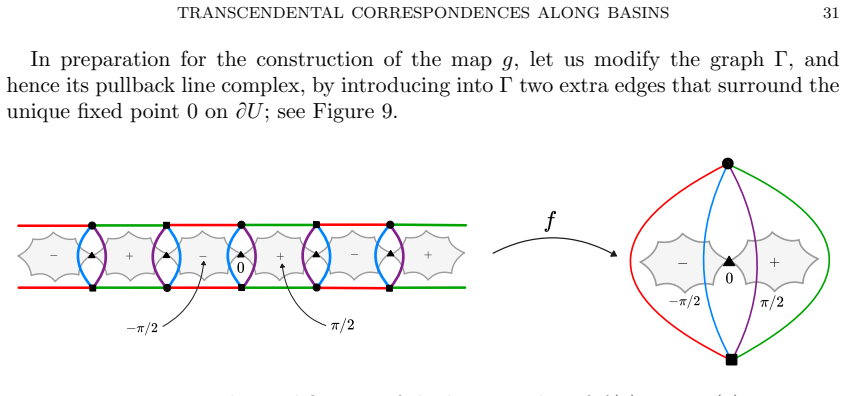
- When f has finitely many singular values, the line complex of h is explicitly computable from the line complex of f and the orbifold data of G, giving a combinatorial handle on the resulting correspondence.
- The construction admits extension to replacing dynamics on multiple Fatou components simultaneously, which would embed products of Teichmüller spaces of genus-zero orbifolds into spaces of transcendental correspondences.
- The paper raises the question of pre-compactness and boundary behavior of families of such correspondences as the group varies in its Teichmüller space, paralleling degeneration results for algebraic correspondences.
Where Pith is reading between the lines
- If the David integrability condition fails for some map f in the attracting class — for instance, if the uniform quasidisk geometry or uniform degree bounds on preimage components break down — the entire correspondence construction in the attracting case would collapse, leaving only the parabolic case as robust.
- The correspondence's bi-degree (∞:∞) is intrinsic to the transcendental setting: the essential singularity of f at infinity forces h to be transcendental meromorphic, so no finite-degree algebraic correspondence can capture this mating. This suggests a structural barrier to any finite-degree approximation of these matings.
- The explicit line complex construction for Speiser-class maps suggests that the combinatorial type of h is determined by a gluing of the Speiser graph of f with the orbifold signature of G, which could in principle be used to classify all such correspondences for a given singular-value count.
Editorial analysis
A structured set of objections, weighed in public.
Referee Report
Summary. This paper initiates a systematic study of holomorphic correspondences of bi-degree (∞:∞) that arise as conformal matings of transcendental entire maps with Fuchsian groups. Given an entire map f in a class K_⋄(d) (attracting or parabolic) with a marked invariant basin U, and a compatible Fuchsian group G in G_⋄(d), the authors construct a holomorphic correspondence C ⊂ ℂ* × ℂ* that simultaneously (i) has a forward branch conformally conjugate to f outside the grand orbit of U, (ii) has branches generating a group conjugate to G acting on a component of the expulsion set, and (iii) is expressible as a deleted covering correspondence of a meromorphic function h with a unique simple pole at 0, composed with the Möbius involution η(z) = 1/z. The construction proceeds via quasiconformal surgery (parabolic case) or David surgery (attracting case) to build a conformal combination map g, followed by a welding construction to produce h, and finally a verification that the resulting correspondence C has the required dynamical properties. The paper also describes the line complex of h when f is in the Speiser class.
Significance. The paper extends the theory of algebraic correspondences (matings of rational maps with Fuchsian groups) to the transcendental setting, a direction previously explored only in the special case of [BF08]. The construction is parameter-free: given f and G, the correspondence C is determined by the surgery and welding, with no fitted constants. The meromorphic function h is constructed from the geometry of g via welding, not postulated. The parabolic case (§4.1) uses standard quasiconformal surgery cleanly. The attracting case (§4.2) involves a non-trivial David integrability estimate (Lemma 4.2) that carefully controls pullback geometry using uniform quasidisk properties (Proposition 2.8) and uniform degree bounds (Lemma 2.7). The line complex description in §5.1 for Speiser-class maps provides a concrete combinatorial handle on the output. The main theorem is a genuine extension of the Sullivan dictionary to the transcendental entire setting.
major comments (2)
- [§4.2, Lemma 4.2, proof (p. 24)] The key estimate in Lemma 4.2 for s=1 invokes [Zha16, Lemma 6.4] to obtain σ_Euc(B_i) ≤ C_1 · diam²_Euc(U_i) · e^{−α_1/ε} (equation (4.9)). The paper [Zha16] concerns PZ-type Siegel disks in the sine family, and the manuscript does not state the hypotheses of [Zha16, Lemma 6.4] or explain why it applies to general f ∈ K_attr(d). The estimate itself — exponential decay of the David bad set under pullback by a proper holomorphic map of bounded degree with controlled geometry — is plausible and should follow from the area formula combined with Koebe distortion and the η-bounded geometry of U_i (established via [CDKS22, Lemma A.7]). However, if the specific formulation in [Zha16] uses properties particular to sine maps (e.g., specific critical point structure or covering properties), the citation may not directly transfer. This is the single load-bearing point for the David integrability in
- [§4.2, Lemma 4.2, second claim (p. 25)] In the proof of the second claim of Lemma 4.2, the Koebe distortion argument yields the estimate σ((f^k|U'_i)^{-1}(E)) ≤ L · σ(U'_i) · σ(E)/σ(U_i) for Borel sets E ⊂ U_i. The application with E = B_i requires that B_i ⊂ U_i, which holds by construction. However, the uniformity of the constant L over all i ∈ I_N and all k ≥ 1 depends on the Koebe space mod(V'_i ∖ U'_i) being uniformly bounded below. The argument shows mod(V'_i ∖ U'_i) = mod(V_i ∖ U_i) ≥ (1/D) mod(V ∖ U), where D is the uniform degree bound for landing maps f^N: U_i → U. This step is correct, but the role of D should be made explicit: the uniform lower bound on the Koebe space is inversely proportional to D, and D is bounded by Lemma 2.7. A brief sentence clarifying that the Koebe constant L depends on D (and hence is uniform) would strengthen the argument.
minor comments (7)
- [§1.2, Main Theorem] The sets R₀, E, R are introduced in the Main Theorem statement before their definitions are given (the footnote helps, but the notation R vs R₀ could be clarified earlier). Consider adding a forward reference to §6.1 where these sets are formally defined.
- [§3.3] The notation H_d for the Hecke group with q = d+1 is introduced but the relationship between the parameter q and the degree d could be stated more prominently, as it is easy to miss that d = q−1.
- [§4.2, equation (4.5)] The Beltrami coefficient μ is defined using the notation (ψ∘φ∘f^k)^*(μ₀) for k ∈ ℕ_{≥1}. It would help to explicitly note that f^k here refers to the k-th iterate of f restricted to the appropriate preimage component, to avoid any ambiguity with the global iterate.
- [§5, Theorem 5.1] In the proof, the welding construction produces a Riemann surface Σ that is argued to be a punctured sphere. The argument that boundary components corresponding to parabolic fixed points reduce to points (via infinite modulus of the annulus Ã) is clean, but a citation for the standard result used (e.g., [Oik63, Theorem 1] is cited, but the criterion that infinite modulus implies removable boundary could be stated more explicitly) would aid the reader.
- [§6.3, Proposition 6.8] The proof of Proposition 6.8 is described as 'analogous to that of [MM25, Proposition 5.7]'. While the authors do work out details, the verification that the side-pairing transformations of T̃₀ correspond to the generators of G under Φ₀^{-1} is somewhat compressed. A brief expansion of this step would improve readability.
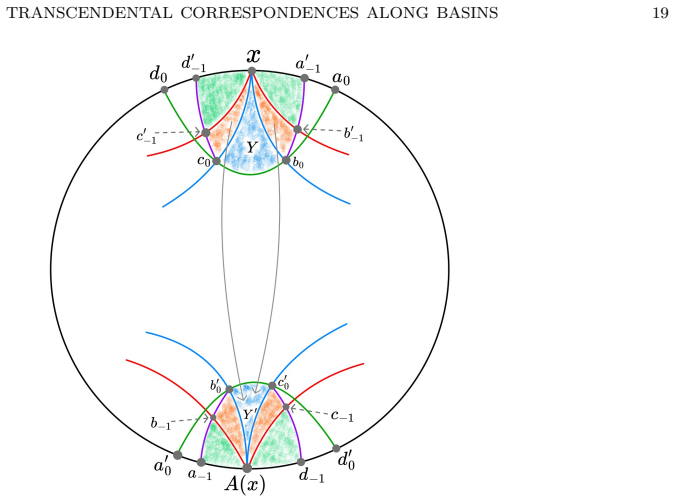
- [Figures 1–2] The figures are helpful. In Figure 2, the caption mentions G_attr(2) consists of two groups, but the text in §3.3 defines G_attr more generally. Ensure consistency between the figure caption and the general definition.
- [References] The reference [EFGP26] has a 2026 date; verify this is the correct publication year. Similarly for [BLLM26], [LM26], [LoM26], [LMM26].
Simulated Author's Rebuttal
We thank the referee for a careful reading and for identifying two specific points in the proof of Lemma 4.2 that require clarification. Both points are well-taken and will be addressed in the revision. The first concerns the applicability of a citation to a different setting; we will replace the citation with a self-contained argument. The second concerns making explicit the dependence of a Koebe constant on the uniform degree bound. Neither point requires changes to the statements of any results, only to the exposition of the proof.
read point-by-point responses
-
Referee: The key estimate in Lemma 4.2 for s=1 invokes [Zha16, Lemma 6.4] to obtain the exponential decay estimate (equation (4.9)). The referee notes that [Zha16] concerns PZ-type Siegel disks in the sine family, and questions whether the hypotheses of [Zha16, Lemma 6.4] transfer to general f in K_attr(d). The referee observes that the estimate should follow from the area formula, Koebe distortion, and eta-bounded geometry, but that the specific formulation in [Zha16] may use properties particular to sine maps.
Authors: The referee is correct that the citation to [Zha16, Lemma 6.4] is not directly transferable as stated, since that result is formulated in the specific context of PZ-type Siegel disks for sine maps and may use properties particular to that family. We will revise the manuscript to replace the citation with a self-contained argument. Specifically, the estimate (4.9) — exponential decay of the David bad set under pullback by a proper holomorphic map of bounded degree with controlled geometry — follows from the area formula combined with Koebe distortion and the eta-bounded geometry of the preimage components U_i (established via [CDKS22, Lemma A.7]). The key ingredients are: (1) the eta-bounded geometry of U_i, which gives the diameter-area comparison (4.8); (2) the uniform degree bound from Lemma 2.7, which controls the branching of f: U_i -> U; and (3) the Koebe distortion theorem applied to the proper map f: V_i -> V, where V_i is the preimage component containing U_i. These ingredients are all established in the manuscript and are valid for general f in K_attr(d), not just sine maps. We will write out this argument explicitly in the revised proof, removing the reference to [Zha16]. revision: yes
-
Referee: In the proof of the second claim of Lemma 4.2, the uniformity of the Koebe constant L over all i in I_N and all k >= 1 depends on the Koebe space mod(V'_i minus U'_i) being uniformly bounded below. The argument shows mod(V'_i minus U'_i) = mod(V_i minus U_i) >= (1/D) mod(V minus U), where D is the uniform degree bound for landing maps. The referee asks that the role of D be made explicit: the uniform lower bound on the Koebe space is inversely proportional to D, and D is bounded by Lemma 2.7.
Authors: We agree that the role of D should be made explicit. The uniform lower bound on the Koebe space mod(V'_i minus U'_i) is indeed inversely proportional to D, and D is bounded by Lemma 2.7. We will add a clarifying sentence in the revised proof stating that the Koebe constant L depends on D (via the modulus inequality mod(V'_i minus U'_i) >= (1/D) mod(V minus U)), and since D is uniformly bounded by Lemma 2.7, the constant L is uniform over all i in I_N and all k >= 1. revision: yes
Circularity Check
No significant circularity; construction is parameter-free with independently verifiable external citations
full rationale
The paper constructs a holomorphic correspondence C from two inputs (an entire map f and a Fuchsian group G) via quasiconformal/David surgery and welding. The derivation chain is: (1) define a Beltrami coefficient μ from the geometry of f and the boundary conjugacy ψ (Eq. 4.5), (2) prove μ satisfies the David integrability condition (Claim I, Lemma 4.2), (3) integrate μ to obtain a David homeomorphism Ψ and define g = Ψ ∘ f̂ ∘ Ψ⁻¹ (Claim II), (4) construct a meromorphic h via welding on the boundary involution of g (Theorem 5.1), (5) define C from h and η (Eq. 6.2), and (6) verify the dynamical properties of C (Theorem 6.2). No step reduces to its inputs by definition. The correspondence C is not postulated and then shown to equal a fit; it is constructed from the surgery output g, and its properties are verified against the original f and G. Self-citations ([MM25, LLM24, BLLM26, LMMN25]) provide the factor Bowen–Series machinery and David extension results; these are independently established results with their own proofs, not ansätze smuggled in. The citation [Zha16, Lemma 6.4] used in Lemma 4.2 is an external result by a different author; whether it applies to general K_attr maps is a correctness concern, not a circularity issue. The line complex construction in §5.1 is illustrative, not load-bearing for the main theorem. The construction is parameter-free: given f and G, C is determined by the surgery and welding with no fitted constants. The only minor concern is that several load-bearing citations ([MM25], [LMMN25]) share co-authors with the present paper, but these results have independent proofs and are not merely restatements of the present paper's claims, so they do not create circularity.
Axiom & Free-Parameter Ledger
free parameters (2)
- d (degree) =
integer ≥ 2
- ⋄ (type) =
attr or par
axioms (6)
- standard math David Integrability Theorem: if μ satisfies the exponential decay condition (4.6), then the Beltrami equation has a David homeomorphism solution.
- standard math Quasiconformal surgery / Measurable Riemann Mapping Theorem
- domain assumption Factor Bowen–Series maps are virtually mateable and orbit equivalent to the associated Fuchsian group
- domain assumption Compatibility theorems: boundary conjugacy between Blaschke products and factor Bowen–Series maps extend to David (attracting) or quasiconformal (parabolic) homeomorphisms of the disk
- domain assumption Strongly geometrically finite entire maps have bounded Jordan domain Fatou components (Theorem 2.2) and hyperbolic entire maps in the specified class have uniform quasidisk Fatou components (Theorem 2.5, Proposition 2.8)
- domain assumption Welding via orientation-reversing involutions produces a genus-zero Riemann surface (punctured sphere) when the local dynamics near singular boundary points yields infinite-modulus annuli
invented entities (3)
-
Classes K_⋄(d) of mateable entire maps
independent evidence
-
Classes G_⋄(d) of compatible Fuchsian groups
independent evidence
-
The meromorphic function h with unique simple pole
independent evidence
read the original abstract
In this paper, we initiate a systematic study of $(\infty : \infty)$ holomorphic correspondences that naturally arise as conformal combinations (matings) of transcendental entire maps with Fuchsian groups. This construction parallels the recent theory of finite-degree algebraic correspondences associated with rational maps. Our correspondence combines the dynamics of a transcendental entire function outside a distinguished attracting/parabolic basin with the action of a compatible Fuchsian group within it. We show that the resulting correspondence is the composition of a M\"obius involution and the deleted covering correspondence of a meromorphic function having exactly one simple pole. When the transcendental entire function has finitely many singular values, so does this meromorphic function, and its line complex can be described explicitly.
Figures






Reference graph
Works this paper leans on
-
[1]
L. V. Ahlfors and L. Sario. Riemann surfaces . Princeton Mathematical Series, vol. No. 26, Princeton University Press, Princeton, NJ, 1960
work page 1960
-
[2]
M. Alhamed, L. Rempe, and D. Sixsmith. Geometrically finite transcendental entire functions. J. Lond. Math. Soc. , 106(2):485--527, 2022
work page 2022
- [3]
-
[4]
W. Bergweiler, N. Fagella, and L. Rempe-Gillen. Hyperbolic entire functions with bounded Fatou components. Comment. Math. Helv. , 90(4):799--829, 2015
work page 2015
-
[5]
W. Bergweiler and S. Morosawa. Semihyperbolic entire functions. Nonlinearity , 15(5):1673--1684, 2002. doi:10.1088/0951-7715/15/5/316 https://doi.org/10.1088/0951-7715/15/5/316
-
[6]
S. Bullett and M. Freiberger. A family of matings between transcendental entire functions and a Fuchsian group. in Transcendental Dynamics and Complex Analysis, LMS Lecture Notes No. 348 (edited by P.J.Rippon and G.M.Stallard), Cambridge University Press, 90--110, 2008
work page 2008
-
[7]
S. Bullett, L. Lomonaco, M. Lyubich, and S. Mukherjee. Mating parabolic rational maps with Hecke groups. Proc. London Math. Soc. (3), vol. 132, no. 3, e70132, 2026
work page 2026
-
[8]
S. Bullett and C. Penrose. Mating quadratic maps with the modular group. Invent. Math. 115(3):483–511, 1994
work page 1994
-
[9]
B. Branner and N. Fagella. Quasiconformal Surgery in Holomorphic Dynamics. Cambridge University Press, Cambridge, 2014
work page 2014
-
[10]
R. Bowen and C. Series. Markov maps associated with Fuchsian groups. Inst. Hautes \'Etudes Sci. Publ. Math. 50:153--170, 1979
work page 1979
-
[11]
T. Clark, K. Drach, O. Kozlovski, and S. van Strien. The Dynamics of Complex Box Mappings. Arnold Math. J. , 8:319--410, 2022. doi:10.1007/s40598-022-00200-7 https://doi.org/10.1007/s40598-022-00200-7
-
[12]
V. Evdoridou, N. Fagella, L. Geyer, and L. Pardo-Sim\'on. Grand orbit relations in wandering domains. Rev. Mat. Iberoam. (2026), published online first, doi:10.4171/RMI/1631 https://doi.org/10.4171/RMI/1631
-
[13]
A. Epstein and L. Rempe-Gillen On invariance of order and the area property for finite-type entire functions Ann. Acad. Sci. Fenn. Math. 40:573--599, 2015
work page 2015
-
[14]
P. Fatou. Notice sur les travaux scientifiques de M . P . F atou. Astronome titulaire de l'observatoire de Paris, 5--29, 1929, https://www.math.purdue.edu/ eremenko/dvi/fatou-b.pdf
work page 1929
-
[15]
A. Goldberg and I. Ostrovskii. Value Distribution of Meromorphic Functions. Translations of Mathematical Monographs , Volume 236 (2008) 488 pp
work page 2008
-
[16]
A. Hatcher. Algebraic Topology . Cambridge University Press, Cambridge, 2002
work page 2002
-
[17]
O. Kozlovski, W. Shen, and S. van Strien. Rigidity for real polynomials. Ann. Math. 165: 749--841, 2007
work page 2007
-
[18]
L. Lomonaco and S. Mukherjee. Algebraic correspondences and Schwarz reflections: Where rational dynamics meets Kleinian groups. https://arxiv.org/abs/2511.08408, to appear in the Proceedings of the ICM 2026
-
[19]
Y. Luo, M. Lyubich, and S. Mukherjee. A general dynamical theory of Schwarz reflections, B-involutions, and algebraic correspondences https://arxiv.org/abs/2408.00204, 2024
work page internal anchor Pith review Pith/arXiv arXiv 2024
-
[20]
Y. Luo, M. Mj, and S. Mukherjee. Teichm \"u ller spaces, polynomial loci, and degeneration in spaces of algebraic correspondences. https://arxiv.org/abs/2504.13107, to appear in J. Reine Angew. Math. , 2026
work page internal anchor Pith review Pith/arXiv arXiv 2026
-
[21]
M. Lyubich and S. Mukherjee. Mirrors of conformal dynamics: Interplay between anti-rational maps, reflection groups, Schwarz reflections, and correspondences. In Algebraic, Complex, and Arithmetic Dynamics , pp 341--476, edited by Laura DeMarco and Mattias Jonsson, Simons Symposia, Springer, 2026
work page 2026
-
[22]
M. Lyubich, S. Merenkov, S. Mukherjee, and D. Ntalampekos. David extension of circle homeomorphisms, welding, mating, and removability. Mem. Amer. Math. Soc. 313 (2025), no. 1588
work page 2025
- [23]
-
[24]
H. Mihaljevi \'c -Brandt. A landing theorem for dynamic rays of geometrically finite entire functions. J. Lond. Math. Soc. , 81(3):696--714, 2010. doi:10.1112/jlms/jdq014 https://doi.org/10.1112/jlms/jdq014
-
[25]
M. Mj and S. Mukherjee. The Sullivan dictionary and Bowen--Series maps. EMS Surv. Math. Sci. 10 (2023), 179--221. doi:10.4171/EMSS/70 https://doi.org/10.4171/EMSS/70
- [26]
- [27]
-
[28]
Correspondences on hyperelliptic surfaces, combination theorems, and Hurwitz spaces
S. Mukherjee and S. Viswanathan. Correspondences on hyperelliptic surfaces, combination theorems, and Hurwitz spaces. https://arxiv.org/abs/2508.18711, 2025
work page internal anchor Pith review Pith/arXiv arXiv 2025
-
[29]
K. Oikawa. A remark to the construction of Riemann surfaces by welding. J. Sci. Hiroshima Univ. Ser. A-I Math. , 27:213–216, 1963
work page 1963
-
[30]
L. Rempe-Gillen and D. J. Sixsmith. Hyperbolic entire functions and the Eremenko--Lyubich class: Class B or not Class B ? Math. Z., 286(3-4):1783–800, 2017
work page 2017
-
[31]
G. Zhang. On PZ type Siegel disks in the sine family. Ergod. Th. Dyn. Syst. 36:973--1006, 2016
work page 2016
- [32]
discussion (0)
Sign in with ORCID, Apple, or X to comment. Anyone can read and Pith papers without signing in.