REVIEW 5 major objections 4 minor 280 references
This paper argues that the cool gas around galaxies shows a clear azimuthal metallicity split, but only among clouds whose velocities match the rotation of their host galaxy: co-rotating low-ionisation clouds near the projected disk plane a
Reviewed by Pith at T0; open to challenge. T0 means a machine referee read the full paper against a public rubric. the ladder, T0–T4 →
T0 review · deepseek-v4-flash
2026-08-02 02:19 UTC pith:IGYJ47VH
load-bearing objection A plausible but not yet proven azimuthal metallicity gradient in co-rotating cool CGM gas — needs a quantitative completeness model before the claim holds. the 5 major comments →
The chemodynamical signature of coherent metal-poor inflow and enriched recycled accretion in the cool circumgalactic medium
The pith
A machine-rendered reading of the paper's core claim, the machinery that carries it, and where it could break.
Core claim
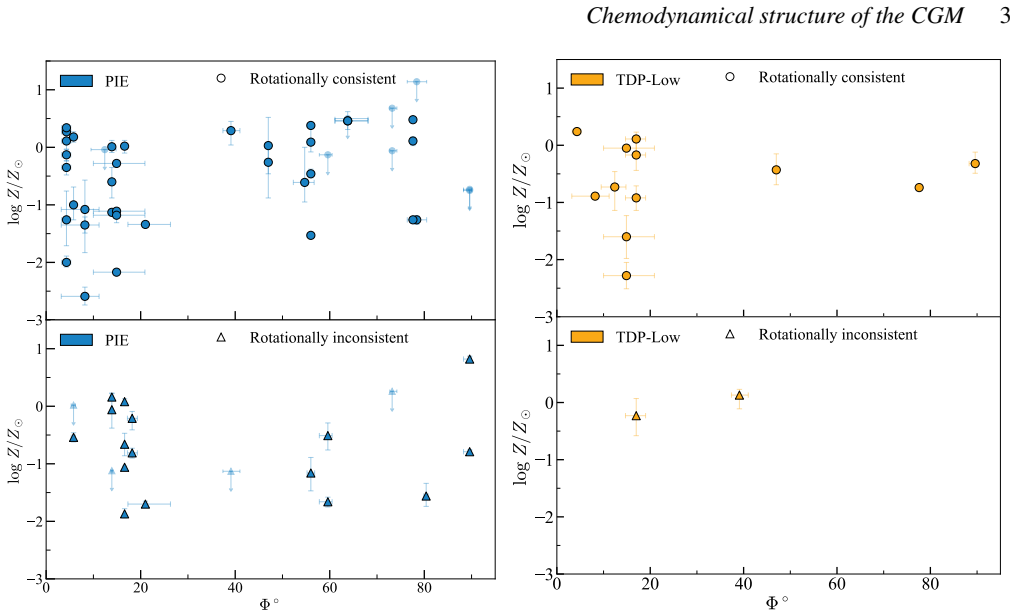
Among clouds in photo-ionisation equilibrium whose line-of-sight velocities are consistent with the direction of host-galaxy rotation, mean metallicity is log(Z/Zsun) = -0.77 ± 0.16 at Φ<30° versus -0.25 ± 0.13 at Φ>30°, a difference of -0.52 ± 0.20 dex at 2.6σ. The same co-rotating major-axis clouds have higher neutral-hydrogen column density (+1.63 ± 0.45 dex), higher hydrogen density (+0.71 ± 0.22 dex), and lower non-thermal Doppler broadening (-5.92 ± 2.32 km/s), with no significant temperature difference. No such azimuthal metallicity trend appears in rotation-inconsistent clouds or in the higher-ionisation warm phase. The authors interpret the multi-parameter separation as evidence tha
What carries the argument
The load-bearing tool is kinematic selection applied to a cloud-by-cloud ionisation catalogue: each absorption cloud is first assigned an ionisation phase (cool photo-ionised 'PIE' clouds versus warmer time-dependent 'TDP-low' clouds) and a set of physical properties (metallicity, density, temperature, Doppler parameters) from Bayesian photoionisation modelling; then each cloud is classified as rotation-consistent or not by comparing its line-of-sight velocity with the host galaxy's rotation curve. The azimuthal angle Φ relative to the projected major axis, split at 30°, is applied only to the rotation-consistent PIE population. The paper's central mechanism is that angular-momentum selectio
Load-bearing premise
The load-bearing assumption is that the lower neutral-hydrogen column densities at Φ>30° do not bias the inferred metallicities upward: if metal-poor clouds at large azimuthal angles are preferentially missed by the detection floor (or if the joint photoionisation modelling degenerately raises metallicity at low N(HI)), the −0.52 dex offset could be partly or wholly an artifact, and the inflow/recycled-accretion interpretation would lose its foundation.
What would settle it
Re-analyse the same 21 galaxies restricting both azimuthal bins to clouds above a common N(HI) detection threshold and recompute the mean metallicity offset; if Δ⟨log Z⟩ drops to ~0, the claim is falsified. Alternatively, inject synthetic metal-poor clouds at Φ>30° with the observed lower N(HI) into the modelling pipeline and show whether they would be detected; if they would be missed, the completeness floor alone can produce the offset.
If this is right
- If true, earlier null results for azimuthal metallicity gradients (both sightline-averaged and cloud-by-cloud) were diluted by kinematically decoupled gas; future surveys must combine metallicity with rotation kinematics.
- The cool CGM near the disk plane is dominated by dense, metal-poor, dynamically cold gas, consistent with filamentary accretion retaining angular momentum.
- Co-rotating enriched gas at larger azimuths is more likely recycled accretion than ballistic outflow, because it keeps rotational coherence.
- The warm/high-ionisation phase is kinematically decoupled and chemically independent, so single-phase abundance measurements cannot represent the CGM baryon cycle.
- Metallicity and angular momentum must be treated as joint observables when comparing observations to simulations of galaxy haloes.
Where Pith is reading between the lines
- A straightforward extension is to re-analyse existing MgII and OVI absorber surveys with the same kinematic split; if the pattern repeats, the inflow/recycled-accretion dichotomy is generic rather than peculiar to this sample.
- The 2.6σ significance and small sample (43 co-rotating PIE clouds from 21 galaxies) imply the true amplitude could be larger or smaller; a larger sample with dense rotation curves would sharpen the Φ-cut and test whether 30° is the physical boundary.
- Because the high-Φ subsample has systematically lower N(HI), a quantitative completeness model could show whether metal-poor clouds at large azimuth are simply undetected; if so, the inferred metallicity offset would shrink.
- The absence of a temperature difference while non-thermal broadening rises suggests turbulence/mixing, not heating; this could be tested in simulations by predicting bnt and metallicity jointly for recycled fountain gas.
Editorial analysis
A structured set of objections, weighed in public.
Referee Report
Summary. This Letter cross-matches the MGHS cloud-by-cloud ionization catalog (Sameer et al. 2024) with galaxy rotation curves (Nateghi et al. 2024a,b) for 21 galaxies. Restricting to low-ionization PIE clouds whose line-of-sight velocities are consistent with galaxy rotation, the authors split the sample at azimuthal angle Phi=30 deg and report that major-axis clouds (Phi<30 deg) have lower metallicity by -0.52+/-0.20 dex, higher N(HI) by +1.63+/-0.45 dex, higher density by +0.71+/-0.22 dex, and lower non-thermal broadening by -5.92+/-2.32 km/s, with no significant temperature difference. They interpret this as evidence for coherent metal-poor inflow along the disk plane and enriched, turbulent recycled accretion at larger azimuthal angles. The higher-ionization TDP-low phase shows no significant azimuthal metallicity dependence, and the paper argues that angular-momentum selection is essential for revealing chemodynamical structure.
Significance. If the headline result is robust, the paper would be an important step beyond sightline-averaged and phase-mixed analyses: it identifies an angular-momentum-selected azimuthal metallicity difference in the cool CGM, with a multi-parameter signature that connects to simulations of cold accretion and recycled fountains. The authors are careful to use a cloud-by-cloud catalog, Kaplan-Meier estimates for censored data, and bootstrap uncertainties, and they explicitly acknowledge the limited power of the censored two-sample test. The azimuthal and kinematic cuts are not constructed from metallicity, so the central cross-tabulation is not circular. However, the current evidence is not yet at the strength claimed: the headline significance is 2.6sigma, the censored two-sample test is non-significant, the Phi=30 deg cut is data-driven without sensitivity analysis, the bootstrap treats clouds as independent despite clustering in galaxies, and the detection-floor/censoring issue is dismissed qualitatively. These concerns are fixable with additional analysis, but they are load-bearing for the central claim.
major comments (5)
- [Sec. 3.1, Table 1] The headline difference Delta<log Z>=-0.52+/-0.20 (2.6sigma) is not supported by the censored two-sample test, which gives p=0.18+/-0.27; the text itself admits the test is underpowered. Yet the Abstract and Conclusions say the paper 'demonstrates' the gradient. Please report the number of detected metallicities versus upper limits in each azimuthal bin, specify which two-sample survival test is used (log-rank? Peto? etc.), and state whether the result persists if upper limits are simply excluded. A 2.6sigma bootstrap difference with a non-significant censored test cannot carry the weight of the current conclusions without additional sensitivity checks.
- [Sec. 3.1, Fig. 1] The split at Phi_cut=30 deg appears to be chosen after inspecting the data, and no sensitivity analysis is shown. The paper should report Delta<log Z> as a function of Phi_cut (e.g., 15, 20, 25, 30, 35, 40, 45 deg) for the rotation-consistent PIE population, and also show how the result depends on the velocity tolerance used to define 'rotation-consistent'. If the signal only appears at 30 deg, the interpretation as a physical bimodality is much weaker.
- [Sec. 3.1, Table 1] The detection-floor concern is not adequately addressed. The Phi>30 deg subsample has log N(HI) lower by 1.63+/-0.45 dex, so the metallicity detection floor is plausibly higher there; Kaplan-Meier estimation assumes non-informative censoring, which is violated if censoring depends on N(HI) (and thus potentially on Z). The rebuttal that low-metallicity clouds are seen at high Phi when the kinematic selection is removed (Fig. 1) is not decisive because those clouds are a different kinematic population with a different N(HI) distribution. Please provide a quantitative completeness model: e.g., simulate the Sameer et al. detection limits, compare N(HI) distributions of the two azimuthal bins, and test whether the Z offset survives after restricting to regions where the detection floors overlap. Without this, the -0.52 dex offset could be a censoring artefact.
- [Secs. 2-3, bootstrap procedure] The 43 rotation-consistent PIE clouds are drawn from only 21 galaxies, with multiple clouds per galaxy. The bootstrap resampling treats clouds as independent samples, which underestimates uncertainties if clouds from the same galaxy are correlated (e.g., through common environment, inclination, SED, or outflow geometry). Please repeat the main bootstrap using galaxy as the resampling unit (cluster bootstrap) and report the resulting uncertainties and significance. This applies to all rows of Table 1, not only metallicity.
- [Secs. 2, 4.2] The quantities Z, nH, N(HI), and bnt are jointly inferred from the same absorption lines via the Sameer et al. (2024) Cloudy modeling. The paper presents these as 'independent physical parameters' (Sec. 4.2), but systematic modeling degeneracies or shared priors could introduce correlated offsets. For example, at fixed ionic ratios a lower N(HI) can be partially compensated by a higher Z in the ionization solution. Please show posterior covariances for representative clouds, or test the sensitivity of the azimuthal differences to alternative ionizing SEDs/priors, to demonstrate that the Z and N(HI) offsets are not driven by a common modeling degeneracy.
minor comments (4)
- [Abstract/Conclusions] The language 'demonstrate' is stronger than the statistics support. Suggest 'suggest' or 'provide evidence for' given the p=0.18+/-0.27 censored test and the small sample.
- [Sec. 3.2] The TDP-low sample consists of 12 rotation-consistent and 2 rotation-inconsistent clouds. The claim of a 'similar metallicity distribution' to PIE clouds is not backed by a quantitative test. State the sample sizes and give a test or explicitly refrain from interpretation.
- [Fig. 1] Individual points are plotted without uncertainties. Add representative error bars for Z or state in the caption why they are omitted. This is important because many metallicities are upper limits and the figure currently suggests a clean bimodality.
- [Sec. 3.1] The sentence 'We also find that the differences between rotation-consistent and rotation-inconsistent PIE clouds for all of these properties are consistent with zero' is not accompanied by numbers. A small table or a sentence with the key values would improve transparency.
Circularity Check
No significant circularity: the result is a new cross-tabulation of independently derived prior measurements, and the kinematic/azimuthal selections are not defined in terms of metallicity.
full rationale
The paper's central claim is an empirical cross-tabulation, not a derivation from first principles. It combines two pre-existing, independently constructed data products: the cloud-by-cloud ionisation modelling of Sameer et al. (2024) and the rotation-consistent kinematic classifications of Nateghi et al. (2024a,b). The rotation-consistent flag is based on line-of-sight velocities relative to the host-galaxy rotation curve, not on metallicity; the azimuthal angle is a geometric projection, also independent of metallicity. The metallicity, N(HI), density, temperature, and broadening parameters were inferred by cloudy modelling without azimuthal angle or rotation class as inputs, so no fitted parameter is being renamed as a prediction. Sameer et al. (2024) actually reported no azimuthal metallicity dependence, so the present signal could not have been imported from that citation. The self-citations are to published data products and code-based modelling, which count as independent support under the stated criteria; they are load-bearing as data sources but not as unverified assertions. The paper's own caveat in §3.1 that 'the lower H I column densities at Φ>30° may raise the metallicity detection floor and reduce sensitivity to the most metal-poor clouds' is an acknowledged completeness/robustness limitation, not a circularity: it does not make the metallicity difference true by construction. No equation or definition in the paper reduces the reported difference to its own inputs. The Kaplan–Meier and bootstrap statistics are standard tools applied to the pre-existing fitted values; they do not encode the outcome. Thus there is no step in the derivation chain that is equivalent to its inputs by construction.
Axiom & Free-Parameter Ledger
free parameters (3)
- azimuthal split Phi_cut =
30 deg
- rotation-consistency velocity tolerance =
not stated in this paper
- ionisation-model priors and ionising SED =
from Sameer et al. (2024)
axioms (6)
- domain assumption Photoionisation-equilibrium (PIE) and time-dependent photoionisation (TDP) models with Cloudy recover unbiased physical conditions (Z, nH, T) for individual absorption clouds.
- domain assumption The Nateghi et al. (2024a,b) rotation-consistent classification correctly identifies gas co-rotating with the disk.
- domain assumption Projected azimuthal angle Φ at inclination i>30° is a valid proxy for 3D disk-plane vs polar geometry.
- domain assumption Individual clouds are statistically independent for bootstrap error estimation.
- standard math Kaplan–Meier survival analysis with left-censored upper limits gives unbiased means when upper limits are more common in one azimuthal bin.
- standard math Flat ΛCDM with H0=70, Ωm=0.3, ΩΛ=0.7.
read the original abstract
The azimuthal and kinematic structure of the CGM is often interpreted as planar accretion and bipolar outflows, yet direct metallicity evidence for this picture remains ambiguous. We combine cloud-by-cloud ionisation modelling with galaxy rotation kinematics for 21 galaxies from the Multiphase Galaxy Halos Survey to investigate how metallicity depends on azimuthal angle and angular momentum. We find that low-ionisation clouds kinematically consistent with disk rotation have ~0.5 dex lower metallicity near the projected major axis ($\Phi<30^\circ$) than at larger azimuthal angles. Major-axis clouds also exhibit higher N(HI), higher density, and reduced non-thermal line broadening compared to clouds at larger azimuthal angles. In contrast, the higher-ionisation phase shows no significant metallicity dependence on azimuthal angle and has lower column densities, lower densities, higher temperatures, and broader line widths than the co-rotating major-axis low-ionisation clouds. These combined metallicity--kinematic--ionisation signatures are consistent with dynamically cold, metal-poor inflow along the disk plane and enriched, more turbulent gas at larger azimuthal angles that likely traces angular-momentum-supported recycled accretion, embedded within a dynamically complex warmer phase. These results show that metallicity and angular momentum are jointly imprinted by the baryon cycle and are both required to uncover the physical origins of CGM gas.
Figures

Reference graph
Works this paper leans on
-
[1]
Astropy: A community Python package for astronomy. , keywords =. doi:10.1051/0004-6361/201322068 , archivePrefix =. 1307.6212 , primaryClass =
-
[2]
The DrizzlePac Handbook, HST Data Handbook , year = "2012", adsurl =
The DrizzlePac Handbook. The DrizzlePac Handbook, HST Data Handbook , year = "2012", adsurl =
2012
-
[3]
J. D. Hunter , journal=. Matplotlib: A 2D Graphics Environment , year=. doi:10.1109/MCSE.2007.55 , ISSN=
-
[4]
2006 , publisher =
A guide to NumPy. 2006 , publisher =
2006
-
[5]
http://www.scipy.org/
Eric Jones and Travis Oliphant and Pearu Peterson and others , title =. 2001 , url = "http://www.scipy.org/", note =
2001
-
[6]
Optical Modeling and Performance Predictions V , year = "2011", series =
20 years of Hubble Space Telescope optical modeling using Tiny Tim. Optical Modeling and Performance Predictions V , year = "2011", series =. doi:10.1117/12.892762 , adsurl =
-
[7]
The Connection between Galaxies and Intergalactic Absorption Lines at Redshift 2< -0.5ex < -0.5ex 3. , keywords =. 2005. doi:10.1086/431753 , archivePrefix =. astro-ph/0505122 , primaryClass =
Pith/arXiv arXiv 2005
-
[8]
Cool circumgalactic gas of passive galaxies from cosmological inflow. , keywords =. doi:10.1051/0004-6361/201835002 , archivePrefix =. 1903.06182 , primaryClass =
Pith/arXiv arXiv 1903
-
[9]
The Size Evolution of Star-forming Galaxies since z ̃ 7 Using ZFOURGE. , keywords =. 2017. doi:10.3847/2041-8213/834/2/L11 , archivePrefix =. 1612.05262 , primaryClass =
Pith/arXiv arXiv 2017
-
[10]
Galaxy Clusters in the Line of Sight to Background Quasars. III. Multi- object Spectroscopy. , keywords =. doi:10.1088/0004-637X/774/1/40 , archivePrefix =. 1306.6117 , adsurl =
-
[11]
The cosmic baryon cycle and galaxy mass assembly in the FIRE simulations. , keywords =. 2017. doi:10.1093/mnras/stx1517 , archivePrefix =. 1610.08523 , primaryClass =
Pith/arXiv arXiv 2017
-
[12]
Efficiency of gas cooling and accretion at the disc-corona interface. , keywords =. doi:10.1093/mnras/stw1930 , archivePrefix =. 1608.06290 , primaryClass =
-
[13]
The Chemical Composition of the Sun. , keywords =. doi:10.1146/annurev.astro.46.060407.145222 , archivePrefix =. 0909.0948 , primaryClass =
-
[14]
Absorption Lines Produced by Galactic Halos. , year = "1969", month = "May", volume =. doi:10.1086/180350 , adsurl =
doi:10.1086/180350 1969
-
[15]
, year = 1995, month = jul, volume =
Extensive dark-matter haloes in low-luminosity galaxies revealed by quasar absorption lines. , year = 1995, month = jul, volume =. doi:10.1038/376321a0 , adsurl =
-
[16]
, archivePrefix = "arXiv", eprint =
Ly- and Mg II as Probes of Galaxies and Their Environment. , archivePrefix = "arXiv", eprint =. doi:10.1086/679178 , adsurl =
-
[17]
, archivePrefix = "arXiv", eprint =
Mg II Absorption Characteristics of a Volume-Limited Sample of Galaxies at z \ 0.1. , archivePrefix = "arXiv", eprint =. doi:10.1088/0004-6256/138/6/1817 , adsurl =
-
[18]
The relationship between gas and galaxies at z < 1 using the Q0107 quasar triplet. , keywords =. doi:10.1093/mnras/stab1630 , archivePrefix =. 2106.06416 , primaryClass =
-
[19]
A Comprehensive Analysis of Uncertainties Affecting the Stellar Mass-Halo Mass Relation for 0 < z < 4. , keywords =. doi:10.1088/0004-637X/717/1/379 , archivePrefix =. 1001.0015 , primaryClass =
-
[20]
, archivePrefix = "arXiv", eprint =
The Average Star Formation Histories of Galaxies in Dark Matter Halos from z = 0-8. , archivePrefix = "arXiv", eprint =. doi:10.1088/0004-637X/770/1/57 , adsurl =
-
[21]
, eprint =
High-Velocity Rain: The Terminal Velocity Model of Galactic Infall. , eprint =
-
[22]
, keywords =
The MG II absorption system in the QSO PKS 2128-12 : a galaxy disc/halo with a radius of 65 kpc. , keywords =
-
[23]
Large Scale Structures of the Universe , year = 1988, series =
Galaxies Giving Rise to MGII Absorption Systems in Quasar Spectra. Large Scale Structures of the Universe , year = 1988, series =
1988
-
[24]
, keywords =
A sample of galaxies giving rise to Mg II quasar absorption systems. , keywords =
-
[25]
6: Properties of the metal-rich systems
The Hubble Space Telescope quasar absorption line key project. 6: Properties of the metal-rich systems. , keywords =. doi:10.1086/174878 , adsurl =
-
[26]
, keywords =
Absorption line systems in QSO spectra - Properties derived from observations and from photoionization models. , keywords =
-
[27]
Astronomy and Astrophysics Supplement Series , keywords =
SExtractor: Software for source extraction. Astronomy and Astrophysics Supplement Series , keywords =. 1996. doi:10.1051/aas:1996164 , adsurl =
-
[28]
, archivePrefix = "arXiv", eprint =
Probing the intra-group medium of a z = 0.28 galaxy group. , archivePrefix = "arXiv", eprint =. doi:10.1093/mnras/stx528 , adsurl =
-
[30]
Bursting and quenching in massive galaxies without major mergers or AGNs. , eprint =. doi:10.1111/j.1365-2966.2007.12074.x , adsurl =
arXiv 2007
-
[31]
K-Corrections and Filter Transformations in the Ultraviolet, Optical, and Near-Infrared. , eprint =. doi:10.1086/510127 , adsurl =
-
[32]
Contraction of dark matter galactic halos due to baryonic infall. , keywords =. doi:10.1086/163867 , adsurl =
-
[33]
Formation of galaxies and large-scale structure with cold dark matter. , keywords =. doi:10.1038/311517a0 , adsurl =
-
[34]
, eprint =
Photometric redshifts based on standard SED fitting procedures. , eprint =
-
[35]
The existence of Ca II absorption lines in the spectrum of the quasar 3C 232 due to the galaxy NGC 3067. , keywords =. doi:10.1086/155880 , adsurl =
-
[36]
Mapping the Nuclear Outflow of the Milky Way: Studying the Kinematics and Spatial Extent of the Northern Fermi Bubble. , keywords =. 2017. doi:10.3847/1538-4357/834/2/191 , archivePrefix =. 1612.01578 , primaryClass =
Pith/arXiv arXiv 2017
-
[37]
, archivePrefix = "arXiv", eprint =
The Dependence of Galactic Outflows on the Properties and Orientation of zCOSMOS Galaxies at z \ 1. , archivePrefix = "arXiv", eprint =. doi:10.1088/0004-637X/794/2/130 , adsurl =
-
[38]
, archivePrefix = "arXiv", eprint =
Modeling the Distribution of Mg II Absorbers around Galaxies Using Background Galaxies and Quasars. , archivePrefix = "arXiv", eprint =. doi:10.1088/0004-637X/784/2/108 , adsurl =
-
[39]
, archivePrefix = "arXiv", eprint =
The Radial and Azimuthal Profiles of Mg II Absorption around 0.5 z 0.9 zCOSMOS Galaxies of Different Colors, Masses, and Environments. , archivePrefix = "arXiv", eprint =. doi:10.1088/0004-637X/743/1/10 , adsurl =
-
[40]
, archivePrefix = "arXiv", eprint =
The COS-Dwarfs Survey: The Carbon Reservoir around Sub-L* Galaxies. , archivePrefix = "arXiv", eprint =. doi:10.1088/0004-637X/796/2/136 , adsurl =
-
[41]
Connection between the Circumgalactic Medium and the Interstellar Medium of Galaxies: Results from the COS-GASS Survey. , keywords =. doi:10.1088/0004-637X/813/1/46 , archivePrefix =. 1504.01392 , primaryClass =
-
[42]
Bothwell, M. S. and Maiolino, R. and Kennicutt, R., Jr and Cresci, G. and Mannucci, F. and Marconi, A. and Cicone, C. , title = ". Monthly Notices of the Royal Astronomical Society , volume =. 2013 , month =. doi:10.1093/mnras/stt817 , url =
-
[44]
Science , archivePrefix = "arXiv", eprint =
Signatures of Cool Gas Fueling a Star-Forming Galaxy at Redshift 2.3. Science , archivePrefix = "arXiv", eprint =. doi:10.1126/science.1234209 , adsurl =
-
[45]
Possible Signatures of a Cold-flow Disk from MUSE Using a z 1 Galaxy-Quasar Pair toward SDSS J1422-0001. , keywords =. doi:10.3847/0004-637X/820/2/121 , archivePrefix =. 1601.07567 , primaryClass =
-
[47]
, archivePrefix = "arXiv", eprint =
The Mg II Cross-section of Luminous Red Galaxies. , archivePrefix = "arXiv", eprint =. doi:10.1088/0004-637X/727/1/47 , adsurl =
-
[49]
Intergalactic-Absorption Confounding Circumgalactic Observations
Intergalactic-Absorption Confounding Circumgalactic Observations. arXiv e-prints , keywords =. doi:10.48550/arXiv.2407.18071 , archivePrefix =. 2407.18071 , primaryClass =
work page internal anchor Pith review Pith/arXiv arXiv doi:10.48550/arxiv.2407.18071
-
[51]
Spectral evolution of stellar populations using isochrone synthesis. , keywords =. doi:10.1086/172385 , adsurl =
-
[52]
Statistical Properties of X-Ray Clusters: Analytic and Numerical Comparisons. , keywords =. doi:10.1086/305262 , archivePrefix =. astro-ph/9710107 , primaryClass =
-
[53]
A Deep Search for Faint Galaxies Associated with Very Low Redshift C IV Absorbers. III. The Mass- and Environment-dependent Circumgalactic Medium. , keywords =. doi:10.3847/0004-637X/832/2/124 , adsurl =
-
[54]
Warm-hot gas in X-ray bright galaxy clusters and the H I-deficient circumgalactic medium in dense environments. , keywords =. doi:10.1093/mnras/stx3170 , primaryClass =
-
[55]
The Dust Content and Opacity of Actively Star-forming Galaxies. , keywords =. doi:10.1086/308692 , archivePrefix =. astro-ph/9911459 , primaryClass =
-
[56]
The Relationship between Infrared, Optical, and Ultraviolet Extinction. , keywords =. doi:10.1086/167900 , adsurl =
-
[57]
ascl:1408.015 , adsurl =
VPFIT: Voigt profile fitting program. ascl:1408.015 , adsurl =
-
[58]
, archivePrefix = "arXiv", eprint =
The Role of Stellar Feedback in the Formation of Galaxies. , archivePrefix = "arXiv", eprint =. doi:10.1088/0004-637X/695/1/292 , adsurl =
-
[59]
, archivePrefix = "arXiv", eprint =
Radiative feedback and the low efficiency of galaxy formation in low-mass haloes at high redshift. , archivePrefix = "arXiv", eprint =. doi:10.1093/mnras/stu956 , adsurl =
-
[60]
Galactic Stellar and Substellar Initial Mass Function. , keywords =. doi:10.1086/376392 , archivePrefix =. astro-ph/0304382 , primaryClass =
-
[61]
arXiv e-prints , keywords =
The Pan-STARRS1 Surveys. arXiv e-prints , keywords =
-
[62]
The Kinematic Composition of Mg II Absorbers. , eprint =. doi:10.1086/305632 , adsurl =
-
[63]
MG II Absorbing Galaxies: Halos or Disks?. , keywords =. doi:10.1086/177448 , adsurl =
-
[64]
, archivePrefix = "arXiv", eprint =
A Kennicutt-Schmidt Law for Intervening Absorption Line Systems. , archivePrefix = "arXiv", eprint =. doi:10.1088/0004-637X/722/2/1821 , adsurl =
-
[65]
The galactic environment of a chemically pristine Lyman limit absorber
Characterizing circumgalactic gas around massive ellipticals at z 0.4 - III. The galactic environment of a chemically pristine Lyman limit absorber. , keywords =. doi:10.1093/mnras/sty3513 , archivePrefix =. 1901.04488 , primaryClass =
Pith/arXiv arXiv 1901
-
[66]
A Giant Intragroup Nebula Hosting a Damped \ Ly\ Absorber at z = 0.313. , keywords =. 2019. doi:10.3847/2041-8213/ab25ec , archivePrefix =. 1906.00005 , primaryClass =
Pith/arXiv arXiv 2019
-
[68]
, archivePrefix = "arXiv", eprint =
An Empirical Characterization of Extended Cool Gas Around Galaxies Using Mg II Absorption Features. , archivePrefix = "arXiv", eprint =. doi:10.1088/0004-637X/714/2/1521 , adsurl =
-
[69]
, archivePrefix = "arXiv", eprint =
What Determines the Incidence and Extent of Mg II Absorbing Gas Around Galaxies?. , archivePrefix = "arXiv", eprint =. doi:10.1088/2041-8205/724/2/L176 , adsurl =
-
[70]
Gauging Metallicity of Diffuse Gas under an Uncertain Ionizing Radiation Field. , keywords =. 2017. doi:10.3847/2041-8213/aa762d , archivePrefix =. 1706.04645 , primaryClass =
Pith/arXiv arXiv 2017
-
[71]
The Origin of C IV Absorption Systems at Redshifts z 1: Discovery of Extended C IV Envelopes around Galaxies. , eprint =. doi:10.1086/321537 , adsurl =
-
[72]
The Gaseous Extent of Galaxies and the Origin of Ly Absorption Systems. III. Hubble Space Telescope Imaging of Ly -absorbing Galaxies at z 1. , eprint =. doi:10.1086/305554 , adsurl =
-
[73]
The Gaseous Extent of Galaxies and the Origin of Ly Absorption Systems. V. Optical and Near-Infrared Photometry of Ly -absorbing Galaxies at z 1. , eprint =. doi:10.1086/322414 , adsurl =
-
[74]
Probing The Intergalactic Medium-Galaxy Connection At z < 0.5. I. A Galaxy Survey In Qso Fields And A Galaxy-Absorber Cross- Correlation Study. , keywords =. doi:10.1088/0004-637X/701/2/1219 , adsurl =
-
[75]
, archivePrefix = "arXiv", eprint =
The Baryon Content of Dark Matter Halos: Empirical Constraints from Mg II Absorbers. , archivePrefix = "arXiv", eprint =. doi:10.1086/591927 , adsurl =
-
[76]
Characterizing circumgalactic gas around massive ellipticals at z 0.4 - I. Initial results. , keywords =. doi:10.1093/mnras/sty1541 , archivePrefix =. 1805.07364 , primaryClass =
-
[77]
The Low Ionization Gaseous Content in Intermediate Redshift Galaxies
-
[78]
, year = 2013, note =
2013
-
[79]
MgII absorption through intermediate redshift galaxies. IAU Colloq. 199: Probing Galaxies through Quasar Absorption Lines , year = 2005, eprint =. doi:10.1017/S1743921305002401 , adsurl =
-
[80]
On the Heterogeneity of Metal-Line and Ly Absorption in Galaxy ``Halos'' at z \ 0.7. , eprint =. doi:10.1086/512113 , adsurl =
-
[81]
, archivePrefix = "arXiv", eprint =
Quenched Cold Accretion of a Large-scale Metal-poor Filament due to Virial Shocking in the Halo of a Massive z = 0.7 Galaxy. , archivePrefix = "arXiv", eprint =. doi:10.1088/0004-637X/760/1/68 , adsurl =
-
[82]
Low- and High-Ionization Absorption Properties of Mg II Absorption-selected Galaxies at Intermediate Redshifts. I. General Properties. , eprint =. doi:10.1086/317343 , adsurl =
-
[83]
, archivePrefix = "arXiv", eprint =
The Self-similarity of the Circumgalactic Medium with Galaxy Virial Mass: Implications for Cold-mode Accretion. , archivePrefix = "arXiv", eprint =. doi:10.1088/2041-8205/763/2/L42 , adsurl =
-
[84]
The Population of Weak Mg II Absorbers. I. A Survey of 26 QSO HIRES/Keck Spectra. , eprint =. doi:10.1086/313168 , adsurl =
-
[85]
On the Spatial and Kinematic Distributions of Mg II Absorbing Gas in z approximately 0.7 Galaxies. , eprint =. doi:10.1086/177960 , adsurl =
-
[86]
Interpreting Self-similarity of the Circumgalactic Medium with Virial Mass Using Mg II Absorption
MAGIICAT III. Interpreting Self-similarity of the Circumgalactic Medium with Virial Mass Using Mg II Absorption. , archivePrefix = "arXiv", eprint =. doi:10.1088/0004-637X/779/1/87 , adsurl =
discussion (0)
Sign in with ORCID, Apple, or X to comment. Anyone can read and Pith papers without signing in.