REVIEW 1 major objections 2 minor 55 references
Intrinsic Topological Control of the Orbital Hall Effect in Buckled Dirac Materials
T0 review · 1 major / 2 minor · reviewed 2026-06-29 · grok-4.3
Pith's one-line read The orbital Hall conductivity in buckled Dirac materials is boosted around band-inversion points and controlled by redistribution of Berry curvature between spin and valley sectors.
desk verdict Orbital Hall boosts near band inversions rest on an unverified low-energy Dirac approximation that likely fails where the gap closes. read the letter →
The pith
A machine-rendered reading of the paper's core claim, the machinery that carries it, and where it could break.
The reading
What carries the argument
Redistribution of Berry curvature between spin and valley sectors within the low-energy massive Dirac model, which sets the orbital Hall conductivity through linear response.
What would settle it
Measure the orbital Hall conductivity while sweeping the perpendicular electric field across the value that produces band inversion and check whether the conductivity exhibits the predicted peak and phase-dependent jumps.
Extended reading notes
Core claim
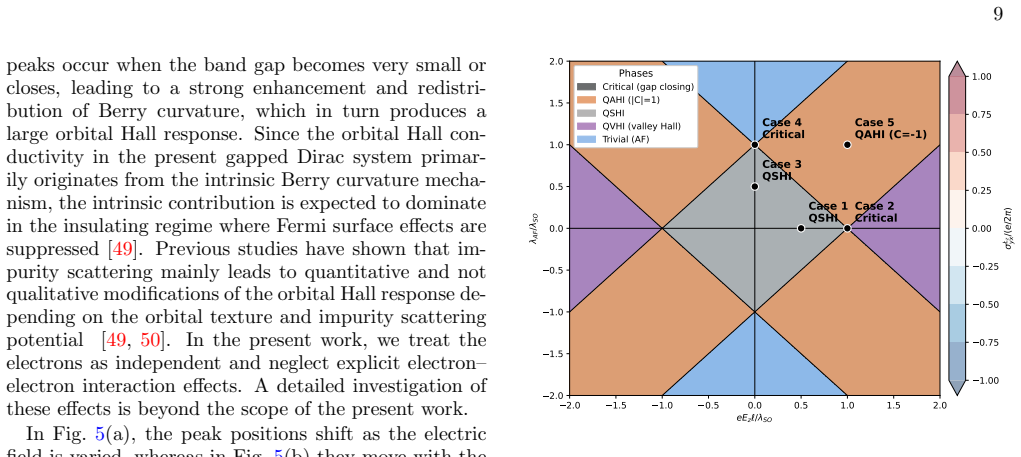
Using a low-energy massive Dirac model in conjunction with Berry-curvature-based linear response theory, the orbital Hall conductivity is considerably boosted around band-inversion points and shows different signatures across multiple electronic phases. The evolution of the orbital response is controlled by the redistribution of Berry curvature between spin and valley sectors, and the distinctive phase-dependent features remain robust under finite temperature.
Load-bearing premise
The low-energy massive Dirac model together with Berry-curvature linear response is enough to describe the orbital Hall conductivity without sizable higher-order or material-specific corrections.
Editorial extensions
If this is right
- Orbital Hall conductivity serves as a sensitive probe of band topology in Dirac systems.
- Buckled two-dimensional materials provide a platform for engineering tunable orbital currents.
- Distinct orbital signatures appear in the quantum spin Hall, valley Hall, and anomalous Hall regimes.
- Thermal effects reduce the overall size of the response but preserve its phase-dependent character.
Reading between the lines
- Similar Berry-curvature redistribution may appear in other buckled or gated Dirac systems when multiple external fields are applied simultaneously.
- Device designs that rely on orbital currents could use the identified field windows to achieve enhanced response without requiring strong magnetic fields.
- The phase diagram obtained here supplies concrete target values for electric and exchange fields in future transport experiments on silicene or germanene.
Signed reviews
Editorial analysis
A structured set of objections, weighed in public.
Referee Report
Summary. The manuscript studies the orbital Hall response in buckled 2D Dirac materials subject to an antiferromagnetic exchange field, perpendicular electric field, and intrinsic spin-orbit coupling. Employing a low-energy massive Dirac Hamiltonian together with Berry-curvature linear-response theory, it reports that orbital Hall conductivity is considerably enhanced near band-inversion points, displays distinct signatures across quantum spin Hall, valley Hall, and anomalous Hall phases, and is governed by the redistribution of Berry curvature among spin and valley sectors. Finite-temperature effects are examined, with the claim that phase-dependent features survive thermal broadening even though the overall magnitude is suppressed. The work positions orbital Hall conductivity as a sensitive topological probe and buckled Dirac systems as a platform for orbitronic applications.
Significance. If the low-energy model is shown to remain quantitatively reliable near the gap-closing points, the unified treatment of multiple external fields and the explicit link between Berry-curvature redistribution and orbital response would constitute a useful addition to the literature on topological transport in 2D materials. The finite-temperature analysis and the identification of multiple controllable phases add practical value for potential orbitronic devices. The absence of any machine-checked derivations, reproducible code, or direct comparison to a parent lattice model, however, keeps the immediate impact modest.
major comments (1)
- [Abstract and low-energy model section] The central claim that orbital Hall conductivity is 'considerably boosted' around band-inversion points and controlled by Berry-curvature redistribution rests on the adequacy of the low-energy massive Dirac model. Near these points the Dirac gap closes, so remote-band contributions, interband matrix elements of the orbital operator, and lattice-scale corrections can become non-negligible; without an explicit benchmark against the parent tight-binding Hamiltonian the reported boost and phase signatures could be truncation artifacts.
minor comments (2)
- Notation for the orbital Hall conductivity and the decomposition into spin/valley sectors should be defined explicitly at first use rather than assumed from the Berry-curvature formulas.
- The temperature dependence is stated to preserve 'distinctive phase-dependent features'; a quantitative plot or table showing the temperature scale at which these features wash out would make the robustness claim easier to assess.
Simulated Author's Rebuttal
We thank the referee for the constructive feedback on the low-energy model's validity. We address the major comment point by point below.
read point-by-point responses
-
Referee: [Abstract and low-energy model section] The central claim that orbital Hall conductivity is 'considerably boosted' around band-inversion points and controlled by Berry-curvature redistribution rests on the adequacy of the low-energy massive Dirac model. Near these points the Dirac gap closes, so remote-band contributions, interband matrix elements of the orbital operator, and lattice-scale corrections can become non-negligible; without an explicit benchmark against the parent tight-binding Hamiltonian the reported boost and phase signatures could be truncation artifacts.
Authors: We agree that an explicit benchmark against the parent tight-binding model is needed to confirm that the reported enhancement and phase signatures are not artifacts of the low-energy approximation, particularly near gap-closing points where remote-band effects may contribute. The Dirac model is the standard effective description for these systems and correctly captures the Berry-curvature redistribution that drives the orbital response, but quantitative reliability requires validation. In the revised manuscript we will add a direct comparison (for silicene as a representative case) between the low-energy Dirac results and the full tight-binding Hamiltonian, showing that the boost near inversion points and the distinct signatures across QSH/VH/AH phases remain qualitatively intact. revision: yes
Circularity Check
No circularity; standard model + linear response derivation is self-contained
full rationale
The paper applies a conventional low-energy massive Dirac Hamiltonian together with Berry-curvature linear-response formulas to compute orbital Hall conductivity. No equation reduces to a prior result by definition, no fitted parameter is relabeled as a prediction, and no load-bearing claim rests on a self-citation chain. The derivation chain therefore remains independent of its own outputs.
Assumptions & free parameters
assumptions (2)
- domain assumption Low-energy massive Dirac model accurately describes the buckled Dirac materials under the considered fields
- domain assumption Berry-curvature-based linear response theory is valid for computing the orbital Hall conductivity
Cite this review
Pith. "Pith review of Intrinsic Topological Control of the Orbital Hall Effect in Buckled Dirac Materials." pith.science (2026). https://pith.science/paper/IHA3MJOF
@misc{pith2026260525121,
  author       = {Pith},
  title        = {Pith review of: Intrinsic Topological Control of the Orbital Hall Effect in Buckled Dirac Materials},
  year         = {2026},
  howpublished = {\url{https://pith.science/paper/IHA3MJOF}},
  note         = {Machine review of arXiv:2605.25121}
}
read the original abstract
We study the orbital Hall response in buckled two-dimensional Dirac materials using a unified framework that includes an antiferromagnetic exchange field, a perpendicular electric field, and intrinsic spin-orbit coupling. We show that the orbital Hall conductivity is considerably boosted around band-inversion points and shows different signatures across multiple electronic phases using a low-energy massive Dirac model in conjunction with Berry-curvature-based linear response theory. We find a series of quantum spin Hall, valley Hall, and anomalous Hall regimes by methodically adjusting external fields, and demonstrate how the evolution of the orbital response is controlled by the redistribution of Berry curvature between spin and valley sectors. We examine the impacts of finite temperature in more detail and find that although the response s size is suppressed by thermal broadening, the distinctive phase-dependent features remain robust. Our findings demonstrate that orbital Hall conductivity offers a sensitive band topology probe in Dirac systems and emphasize buckled two-dimensional materials as a flexible platform for engineering tunable orbital currents for orbitronic applications.
Figures


Figures from the paper (5 more)




Reference graph
Works this paper leans on
-
[1]
M. Z. Hasan and C. L. Kane, Colloquium: topological insulators, Reviews of modern physics82, 3045 (2010)
2010
-
[2]
Qi and S.-C
X.-L. Qi and S.-C. Zhang, Topological insulators and superconductors, Reviews of modern physics83, 1057 (2011)
2011
-
[3]
Bansil, H
A. Bansil, H. Lin, and T. Das, Colloquium: Topological band theory, Reviews of Modern Physics88, 021004 (2016)
2016
-
[4]
Xiao and B
J. Xiao and B. Yan, First-principles calculations for topological quantum materials, Nature reviews physics 3, 283 (2021)
2021
-
[5]
Konig, S
M. Konig, S. Wiedmann, C. Brune, A. Roth, H. Buh- mann, L. W. Molenkamp, X.-L. Qi, and S.-C. Zhang, Quantum spin hall insulator state in hgte quantum 13 wells, Science318, 766 (2007)
2007
-
[6]
Knez, R.-R
I. Knez, R.-R. Du, and G. Sullivan, Evidence for he- lical edge modes in inverted inas/gasb quantum wells, Physical review letters107, 136603 (2011)
2011
-
[7]
S. Wu, V. Fatemi, Q. D. Gibson, K. Watanabe, T. Taniguchi, R. J. Cava, and P. Jarillo-Herrero, Obser- vation of the quantum spin hall effect up to 100 kelvin in a monolayer crystal, Science359, 76 (2018)
2018
-
[8]
Xiao, M.-C
D. Xiao, M.-C. Chang, and Q. Niu, Berry phase ef- fects on electronic properties, Rev. Mod. Phys.82, 1959 (2010)
1959
Show all 55 references
-
[9]
Sundaram and Q
G. Sundaram and Q. Niu, Wave-packet dynamics in slowly perturbed crystals: Gradient corrections and berry-phase effects, Physical Review B59, 14915 (1999)
1999
-
[10]
Xiao, M.-C
D. Xiao, M.-C. Chang, and Q. Niu, Berry phase effects on electronic properties, Reviews of modern physics82, 1959 (2010)
1959
-
[11]
F. D. M. Haldane, Model for a quantum hall effect without landau levels: Condensed-matter realization of the” parity anomaly”, Physical review letters61, 2015 (1988)
2015
-
[12]
Chang, J
C.-Z. Chang, J. Zhang, X. Feng, J. Shen, Z. Zhang, M. Guo, K. Li, Y. Ou, P. Wei, L.-L. Wang,et al., Ex- perimental observation of the quantum anomalous hall effect in a magnetic topological insulator, Science340, 167 (2013)
2013
-
[13]
Y. Deng, Y. Yu, M. Z. Shi, Z. Guo, Z. Xu, J. Wang, X. H. Chen, and Y. Zhang, Quantum anomalous hall effect in intrinsic magnetic topological insulator mnbi2te4, Science367, 895 (2020)
2020
-
[14]
Yao, C.-H
Y.-T. Yao, C.-H. Chu, A. Bansil, H. Lin, and T.- R. Chang, Orbital topology induced orbital hall effect in two-dimensional insulators, Reports on Progress in Physics89, 018001 (2026)
2026
-
[15]
B. A. Bernevig, T. L. Hughes, and S.-C. Zhang, Orbi- tronics: The intrinsic orbital current in p-doped silicon, Physical review letters95, 066601 (2005)
2005
-
[16]
D. Go, D. Jo, H.-W. Lee, M. Kl¨ aui, and Y. Mokrousov, Orbitronics: Orbital currents in solids, Europhysics Let- ters135, 37001 (2021)
2021
-
[17]
Sinova, S
J. Sinova, S. O. Valenzuela, J. Wunderlich, C. H. Back, and T. Jungwirth, Spin hall effects, Rev. Mod. Phys. 87, 1213 (2015)
2015
-
[18]
Vignale, Ten years of spin hall effect, Journal of su- perconductivity and novel magnetism23, 3 (2010)
G. Vignale, Ten years of spin hall effect, Journal of su- perconductivity and novel magnetism23, 3 (2010)
2010
-
[19]
J. E. Hirsch, Spin hall effect, Phys. Rev. Lett.83, 1834 (1999)
1999
-
[20]
Tanaka, H
T. Tanaka, H. Kontani, M. Naito, T. Naito, D. S. Hi- rashima, K. Yamada, and J.-i. Inoue, Intrinsic spin hall effect and orbital hall effect in 4 d and 5 d transition metals, Physical Review BCondensed Matter and Ma- terials Physics77, 165117 (2008)
2008
-
[21]
Kontani, T
H. Kontani, T. Tanaka, D. S. Hirashima, K. Yamada, and J. Inoue, Giant orbital hall effect in transition met- als: Origin of large spin and anomalous hall effects, Phys. Rev. Lett.102, 016601 (2009)
2009
-
[22]
D. Go, D. Jo, C. Kim, and H.-W. Lee, Intrinsic spin and orbital hall effects from orbital texture, Phys. Rev. Lett.121, 086602 (2018)
2018
-
[23]
ˇZuti´ c, J
I. ˇZuti´ c, J. Fabian, and S. Das Sarma, Spintronics: Fun- damentals and applications, Rev. Mod. Phys.76, 323 (2004)
2004
-
[24]
V. T. Phong, Z. Addison, S. Ahn, H. Min, R. Agarwal, and E. J. Mele, Optically controlled orbitronics on a triangular lattice, Physical Review Letters123, 236403 (2019)
2019
-
[25]
T. P. Cysne, M. Costa, L. M. Canonico, M. B. Nardelli, R. Muniz, and T. G. Rappoport, Disentangling orbital and valley hall effects in bilayers of transition metal dichalcogenides, Physical review letters126, 056601 (2021)
2021
-
[26]
X. Mu, Y. Pan, and J. Zhou, Pure bulk orbital and spin photocurrent in two-dimensional ferroelectric materials, npj Computational Materials7, 61 (2021)
2021
-
[27]
Z. Chen, R. Li, Y. Bai, N. Mao, M. Zeer, D. Go, Y. Dai, B. Huang, Y. Mokrousov, and C. Niu, Topology- engineered orbital hall effect in two-dimensional ferro- magnets, Nano letters24, 4826 (2024)
2024
-
[28]
R. Li, X. Zou, Z. Chen, X. Feng, B. Huang, Y. Dai, and C. Niu, Floquet engineering of the orbital hall effect and valleytronics in two-dimensional topological mag- nets, Materials Horizons11, 3819 (2024)
2024
-
[29]
Jungwirth, J
T. Jungwirth, J. Wunderlich, and K. Olejn´ ık, Spin hall effect devices, Nature materials11, 382 (2012)
2012
-
[30]
Y.-G. Choi, D. Jo, K.-H. Ko, D. Go, K.-H. Kim, H. G. Park, C. Kim, B.-C. Min, G.-M. Choi, and H.-W. Lee, Observation of the orbital hall effect in a light metal ti, Nature619, 52 (2023)
2023
-
[31]
S. Ji, C. Quan, R. Yao, J. Yang, and X. Li, Reversal of orbital hall conductivity and emergence of tunable topo- logical quantum states in orbital hall insulators, Physi- cal Review B109, 155407 (2024)
2024
-
[32]
J. Li, Z. Chen, B. Huang, Y. Dai, and C. Niu, Topo- logical phase transition with tunable orbital hall effect in two-dimensional ferromagnet svsin2, Journal of Ap- plied Physics139, Topological phase transition with tunable orbital Hall effect in two-dimensional ferromag- net ...
2026
-
[33]
Ezawa, Spin-valley optical selection rule and strong circular dichroism in silicene, Physical Review BCon- densed Matter and Materials Physics86, 161407 (2012)
M. Ezawa, Spin-valley optical selection rule and strong circular dichroism in silicene, Physical Review BCon- densed Matter and Materials Physics86, 161407 (2012)
2012
-
[34]
C.-C. Liu, W. Feng, and Y. Yao, Quantum spin hall effect in silicene and two-dimensional germanium, Phys. Rev. Lett.107, 076802 (2011)
2011
-
[35]
Bhowal and S
S. Bhowal and S. Satpathy, Intrinsic orbital moment and prediction of a large orbital hall effect in two- dimensional transition metal dichalcogenides, Physical Review B101, 121112 (2020)
2020
-
[36]
Zhong, K
D. Zhong, K. L. Seyler, X. Linpeng, N. P. Wilson, T. Taniguchi, K. Watanabe, M. A. McGuire, K.-M. C. Fu, D. Xiao, W. Yao,et al., Layer-resolved magnetic proximity effect in van der waals heterostructures, Na- ture nanotechnology15, 187 (2020)
2020
-
[37]
Xu and X
Y. Xu and X. Li, Topology-transport correspondence in silicene under the modulation of electric and antiferro- magnetic fields, Europhysics Letters132, 47001 (2020)
2020
-
[38]
M. Ezawa, Spin valleytronics in silicene: Quantum spin hall–quantum anomalous hall insulators and single- valley semimetals, Physical Review BCondensed Matter and Materials Physics87, 155415 (2013)
2013
-
[39]
Ezawa, A topological insulator and helical zero mode in silicene under an inhomogeneous electric field, New Journal of Physics14, 033003 (2012)
M. Ezawa, A topological insulator and helical zero mode in silicene under an inhomogeneous electric field, New Journal of Physics14, 033003 (2012)
2012
-
[40]
D. Xiao, Y. Yao, Z. Fang, and Q. Niu, Berry-phase effect in anomalous thermoelectric transport, Physical review letters97, 026603 (2006)
2006
-
[41]
D. Xiao, W. Yao, and Q. Niu, Valley contrasting physics 14 in graphene: magnetic moment and topological trans- port, arXiv preprint arXiv:0709.1274 (2007)
2007 arXiv
-
[42]
Zhang, S
C. Zhang, S. Tewari, and S. Das Sarma, Berry- phase-mediated topological thermoelectric transport in gapped single and bilayer graphene, Physical Review BCondensed Matter and Materials Physics79, 245424 (2009)
2009
-
[43]
Faridi and R
A. Faridi and R. Asgari, Magnetoresistance in noncen- trosymmetric two-dimensional systems, Phys. Rev. B 107, 235417 (2023)
2023
-
[44]
Bhowal and G
S. Bhowal and G. Vignale, Orbital hall effect as an alter- native to valley hall effect in gapped graphene, Physical Review B103, 195309 (2021)
2021
-
[45]
J. Shi, P. Zhang, D. Xiao, and Q. Niu, Proper definition of spin current in spin-orbit coupled systems, Physical review letters96, 076604 (2006)
2006
-
[46]
T. P. Cysne, I. Souza, and T. G. Rappoport, Description of the orbital hall effect from orbital magnetic moments of bloch states: the role of a new correction term in bi- layer systems, arXiv preprint arXiv:2511.03901 (2025)
2025 arXiv
-
[47]
Pozo Oca˜ na and I
´O. Pozo Oca˜ na and I. Souza, Multipole theory of optical spatial dispersion in crystals, SciPost Physics14, 118 (2023)
2023
-
[48]
Ramezanali, M
M. Ramezanali, M. Vazifeh, R. Asgari, M. Polini, and A. H. MacDonald, Finite-temperature screening and the specific heat of doped graphene sheets, Journal of Physics A: Mathematical and Theoretical42, 214015 (2009)
2009
-
[49]
Burgos Atencia, A
R. Burgos Atencia, A. Agarwal, and D. Culcer, Orbital angular momentum of bloch electrons: equilibrium for- mulation, magneto-electric phenomena, and the orbital hall effect, Advances in Physics: X9, 2371972 (2024)
2024
-
[50]
Tang and G
P. Tang and G. E. Bauer, Role of disorder in the intrinsic orbital hall effect, Physical Review Letters133, 186302 (2024)
2024
-
[51]
Lyalin, S
I. Lyalin, S. Alikhah, M. Berritta, P. M. Oppeneer, and R. K. Kawakami, Magneto-optical detection of the or- bital hall effect in chromium, Physical review letters 131, 156702 (2023)
2023
-
[52]
M. Luo, Antiferromagnetic spin valve from heterostruc- ture of two-dimensional hexagonal crystals, arXiv preprint arXiv:1809.00597 Antiferromagnetic spin valve from heterostructure of two-dimensional hexagonal crystals (2018)
2018 arXiv
-
[53]
R. Li, C. Huang, D. Wang, M. Li, Y. Tao, and H. Fu, Perfect spin and/or valley triplet pairing states in an antiferromagnetic-silicene/superconductor hybrid structure, Physical Review B110, 205425 (2024)
2024
-
[54]
C. L. Kane and E. J. Mele, Quantum spin hall effect in graphene, Physical review letters95, 226801 (2005)
2005
-
[55]
B. A. Bernevig and S.-C. Zhang, Quantum spin hall effect, Physical review letters96, 106802 (2006)
2006
Reviewed June 29, 2026 · model on record in the stance chip above.
Discussion (0). Continue with ORCID to comment.