REVIEW 6 major objections 3 minor 86 references
On the statistical physics and thermodynamics of polymer networks: a Eulerian theory for entropic elasticity
T0 review · 6 major / 3 minor · reviewed 2026-08-06 · deepseek-v4-flash
Pith's one-line read The paper argues that maximizing the entropy of Kuhn segments, not chains, yields rubber elasticity and predicts a symmetry-breaking biaxial instability.
desk verdict The empirical two-parameter model fits multiaxial rubber data very well, but the claimed maximum-entropy derivation is mathematically unsound, so the paper's first-principles status and the biaxial instability prediction rest on shaky ground. read the letter →
The pith
A machine-rendered reading of the paper's core claim, the machinery that carries it, and where it could break.
The reading
What carries the argument
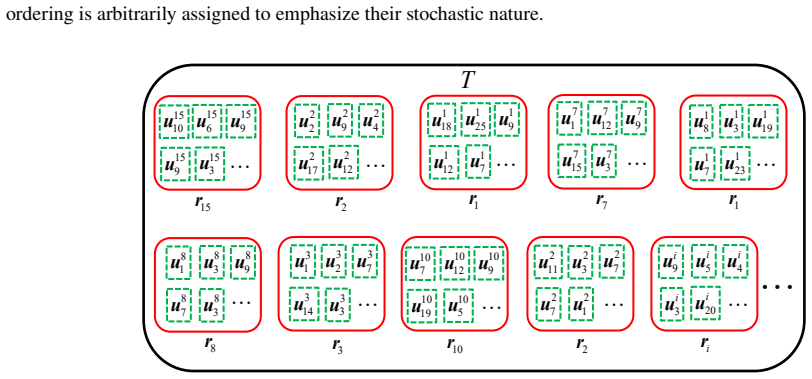
The load-bearing object is a hierarchical statistical ensemble in which the $M N$ Kuhn segments of the network are the elementary distinguishable particles, grouped first by the configuration of the chain they belong to and then by their own orientation. Entropy is Boltzmann's $S = k_B \ln \Omega$ for this ensemble, and the Lagrangian functional of Eq. (25) maximizes it under four constraints: normalization of chain and segment probabilities, the chain end-to-end relation $\boldsymbol{r} = N \int p_{\boldsymbol{u}}^{\boldsymbol{r}} b\boldsymbol{u}\,d\boldsymbol{u}$, and the stress expression that enforces local chain equilibrium. Stationarity with respect to segment orientation recovers the single-chain Langevin distribution, while stationarity with respect to chain configuration gives the Boltzmann orientation probability. The explicit kinematics then come from the integrability condition in the logarithmic-rotation frame, which selects the logarithmic strain as the unique deformation measure and yields $\ln\lambda_{\boldsymbol{n}} = \boldsymbol{n}\cdot\boldsymbol{h}\cdot\boldsymbol{n}$.
What would settle it
Run an equal-biaxial test on a lightly cross-linked elastomer to a primary stretch of about 8 to 9 with a small fixed asymmetry between the two axes, and measure the transverse nominal stress and the chain orientation (e.g., by birefringence or X-ray scattering). The theory predicts a sharp, symmetry-breaking transition: the orientation order parameter jumps from near-isotropic values to near-perfect alignment with the larger stretch and the transverse stress drops toward zero. Observing a smooth, monotonic stress and orientation response with no abrupt collapse would contradict the prediction.
Extended reading notes
Core claim
The paper's central claim is that a maximum-entropy variational principle over the segments of a polymer network, constrained by chain geometry and by the continuum stress, yields the Eulerian micro-macro connection $\ln \lambda_{\boldsymbol{n}} = \boldsymbol{n}\cdot\boldsymbol{h}\cdot\boldsymbol{n}$ and the orientation probability $P_{\boldsymbol{n}} \propto \exp(-g_{\boldsymbol{n}}/(N k_B T))$, where $\boldsymbol{h}$ is the logarithmic strain. From these, the Cauchy stress takes the form $\boldsymbol{\sigma} = \frac{5}{2}G \int P_{\boldsymbol{n}} \sqrt{N}\,\mathcal{L}^{-1}(\lambda_{\boldsymbol{n}}/\sqrt{N}) \lambda_{\boldsymbol{n}} \,\boldsymbol{n}\otimes\boldsymbol{n}\, d\boldsymbol{n} + p\boldsymbol{I}$, with two physical parameters, the shear modulus $G$ and the number of segments per chain $N$. The derivation recovers the classical Langevin single-chain model, reduces to the Biot-chain model at moderate deformation and to Hencky's quadratic energy at small strain, and predicts that chains align with the primary stretch direction under large deformation, so that in equal biaxial tension any small asymmetry triggers an orientation phase transition and stress softening in the transverse direction.
Load-bearing premise
The argument depends on the claim that a chain currently oriented along direction $\boldsymbol{n}$ stretches exactly with the macroscopic deformation in that direction, $\ln\lambda_{\boldsymbol{n}} = \boldsymbol{n}\boldsymbol{h}\boldsymbol{n}$; the paper itself notes this Eulerian affine kinematics is only approximate for soft networks, and if chains reorganize non-affinely the derived instability would not occur.
Editorial extensions
If this is right
- With only the shear modulus and the segment number as parameters, the model reproduces uniaxial, pure-shear and equal-biaxial data for vulcanized rubber and PDMS, so a single test could in principle calibrate multiaxial response.
- The statistics imply that the effective statistical unit is the segment, not the chain; applying the same variational principle to chain-level energies would give predictions that deviate from experiment.
- At moderate deformation the model's energy matches the Biot-chain model and at small strain it becomes Hencky's $W = G\,\mathrm{tr}\,\boldsymbol{h}^2$, giving those empirical forms a statistical foundation.
- Near-equal biaxial tension at large stretch is an unstable state: any infinitesimal asymmetry in principal stretches drives a sharp reorientation of chains and a decrease of the transverse stress.
Reading between the lines
- A direct test would be a biaxial experiment on a lightly cross-linked elastomer stretched to large equal biaxial strains with a small controlled asymmetry, measuring both stress and orientation (e.g., by birefringence or X-ray scattering): the theory predicts an abrupt jump in the order parameter from about 0.25 toward 1 and a collapse of the transverse stress, while a purely affine or non-oriente
- The same mechanism may shift to lower strains in systems where an external field already biases chain orientation, such as dielectric elastomers under electric fields; the paper hints at this connection but does not quantify it.
- Because the theory treats weakly interacting segments, its quantitative accuracy should degrade systematically for very short chains (e.g., $N \approx 30$), where fluctuation corrections of order $1/\sqrt{N}$ become visible; the paper notes the Tetra-PEG case as one such deviation.
Signed reviews
Editorial analysis
A structured set of objections, weighed in public.
Referee Report
Summary. The paper proposes a Eulerian statistical-mechanical theory of polymer network elasticity. The network is treated as a hierarchical ensemble of Kuhn segments, and a maximum-entropy variational problem is posed under geometric constraints. The authors claim to derive from this principle the orientation probability P_n proportional to exp(-g_n/(N k_B T)) and the Eulerian micro-macro connection ln lambda = n·h·n, leading to a two-parameter hyperelastic model (Eq. 56). The model is fitted to multiaxial rubber and gel data, shown to reduce to the Biot-chain model at moderate strains and to Hencky energy at small strains, and used to predict a biaxial orientation instability at large equal biaxial tension.
Significance. If the derivation were valid, the paper would be a significant contribution: it would provide a statistical-mechanical route to a two-parameter hyperelastic model, a physical rationale for logarithmic strain, and a striking new instability prediction. The empirical model itself fits several data sets and the analytical links to Biot-chain and Hencky energies are useful. However, the claimed first-principles derivation is invalid at several load-bearing steps: the variational treatment of the dependent field P'_r is not legitimate, the stress-consistency equation contains an algebraic error, the Legendre-transform step is asserted rather than derived, and the micro-macro relation is an affine kinematic assumption rather than a consequence of the rate relation. Because the orientation probability and the stress formula rest on these steps, the central claim is not established, and the biaxial instability prediction is not a robust statistical-mechanical result.
major comments (6)
- [§2.5, Eqs. (40)-(42)] The variation with respect to P'_r is not a valid independent variation, because P'_r is defined as the derivative dP_r/dh. The stationarity condition E : M ∫ δP'_r w_r dr = 0 cannot imply δP'_r = O; for arbitrary admissible variations it would force E = O, and if E = O the constraint in Eq. (24) is vacuous. The conclusion that P'_r is independent of r, and hence that dP_r/dh = O in Eqs. (41)-(42), is therefore unsupported. Since Eq. (42) is subsequently used to drop the dP_n/dh terms when differentiating W in Eq. (55), the stress formula in Eq. (56) and the orientation probability in Eq. (51) are not established.
- [§2.2-2.5, Eqs. (20) and (41)] Equation (20) is algebraically incorrect: differentiating F = U0 + M∫P_r w_r dr + k_B T M N ∫P_r ln P_r dr with respect to h yields a term k_B T M N ∫(1 + ln P_r) dP_r/dh dr, not k_B T M N ∫(1 + P_r) dP_r/dh dr. The consistency argument in Eq. (41) relies on the incorrect factor and on P_r > 0 to conclude dP_r/dh = O; with the correct factor (1 + ln P_r), which changes sign, no such conclusion follows. This breaks the chain of reasoning leading to Eqs. (43) and (44).
- [§2.5, Eqs. (43)-(44)] Even if the condition dg_r/dh = O were accepted, the identification E = h and the Legendre form g_r = w_r - h : dw_r/dh do not follow. For w(λ) with λ = exp(n·h·n), one has dg_r/dh = - (d^2 w/d(ln λ)^2) ln λ (n ⊗ n), which is generically nonzero at finite strain for a convex chain energy. Thus Eq. (44) is asserted, not derived, and Eq. (51) for P_n is not a maximum-entropy consequence. The factor 1/N in the exponent of Eq. (51) is also imposed by the segment-level interpretation discussed in Section 5.3 rather than derived from the variational principle.
- [§2.6, Eq. (48)] The micro-macro relation ln λ = n·h·n is not a consequence of the rate relation d ln λ/dt = n·d·n for a material fiber under general deformation. For a material fiber with initial direction n0, ln λ = (1/2) ln(n0·C·n0), whereas n·h·n = n·ln(V)·n; these are not equal for a general deformation gradient, even for diagonal F. The derivation therefore assigns the logarithmic strain of a fixed spatial direction to chains currently oriented along that direction, which is an Eulerian affine kinematic assumption. Section 3.4.2 concedes that affine kinematics is only approximately valid for soft networks, so Eq. (48) is not a derived result but a load-bearing assumption on which w_n, P_n, and the instability analysis all depend.
- [§2.3, Eq. (24)] The variational constraint in Eq. (24) is not a purely geometric condition independent of the target theory: it is the virial stress formula that the derivation later recovers as Eq. (53). Imposing the stress formula as a constraint in the maximum-entropy problem means the relation between microstructure and stress is assumed rather than derived. This circularity should be addressed explicitly; otherwise the variational principle cannot support the claim that Eqs. (51)-(56) constitute a first-principles derivation.
- [§3.1 and Abstract] The abstract and Section 3.1 state that the model 'outperforms' existing models with the same number of parameters, but no quantitative comparison is presented in this manuscript. Figure 5 shows fits to Treloar's data, and the text defers the quantitative comparison to the companion paper Zhan et al. (2025). The performance claim is therefore not verifiable from the present manuscript and should either be substantiated with error measures here or stated as a qualitative visual match.
minor comments (3)
- [Various] There are several typographical errors: the caption of Fig. 5 reads 'Trealor's data' and should read 'Treloar's data'; Eq. (58) contains 'Gussian' for 'Gaussian'; Section 2.7 contains 'ture' for 'true'.
- [§2.1, Eqs. (10)-(14)] The continuous limit of the entropy is written as an integral over 'admissible chain configurations' without specifying a reference measure or the additive constant of the entropy. The normalization of P_r in the continuum limit should be stated explicitly, since the entropy value and the subsequent variational Euler-Lagrange equations depend on that convention.
- [§3.3, Eq. (61)] The fourth-order integral identity in Eq. (61) appears to use the tracelessness condition tr h = 0; this should be stated explicitly, as the first equality and the second equality are not obviously equivalent for a general tensor A.
Circularity Check
The maximum-entropy derivation of the orientation probability is circular: the key identification E=h (Eq. 44) is inserted via the Legendre transform and does not follow from Eq. (43), so P_n is an assumed logarithmic-strain ansatz rather than a derived result.
-
self definitional
[Section 2.5, Eqs. (39)-(44), page 13 of arXiv:2507.10974v1]
"This condition implies that 𝑔𝒓 should maintain an extremum with respect to 𝒉 at thermodynamic equilibrium. Combining with the expression in Eq. (39), it is concluded that 𝑔𝒓 should be given by the following Legendre transformation 𝑔𝒓 = 𝑤𝒓 − 𝒉 : 𝜕𝑤𝒓/𝜕𝒉, (44) and the tensorial Lagrange multiplier 𝑬 turns out to be the logarithmic strain 𝒉."
Equation (43) is the stationarity condition ∂g/∂h=O. For the function defined in Eq. (39), g = w − E:∂w/∂h, this condition is exactly the stationarity equation that defines a Legendre transform in the unknown conjugate variable E; it determines E from the curvature of w and does not select E=h. Writing g = w − h:∂w/∂h in Eq. (44) simply asserts that h is the conjugate variable — that is the very micro-macro result the paper claims to prove. The assertion is also internally inconsistent: for the Langevin chain energy (54) with λ=e^{n·h·n}, ∂g/∂h = −w″(ln λ) ln λ (n⊗n), which does not vanish at finite strain, so Eq. (44) does not satisfy Eq. (43). Since P_n in Eq.
full rationale
The central claimed derivation of the orientation probability P_n is not self-contained: the only load-bearing step that connects the variational principle to the logarithmic-strain micro-macro mapping is Eq. (44), where the tensor multiplier E is set equal to h. Equation (43), ∂g/∂h=O, is the stationarity condition of a Legendre transform with an unknown conjugate variable E; it cannot by itself force E=h. The paper simply replaces E by h and calls the result a Legendre transformation. This is a self-definitional insertion of the result to be derived, and it is numerically inconsistent with the Langevin energy used later: for w(λ) with λ=e^{n·h·n}, ∂g/∂h=−w″(ln λ) ln λ (n⊗n), which is not zero at finite strain. Because P_n in Eq. (51) and all subsequent predictions, including the biaxial instability, are built on g_n, the claimed maximum-entropy derivation reduces to this assumed identification. A further independent problem is that the micro-macro relation lnλ=n·h·n is obtained by integrating the rate assumption d lnλ/dt = n·d·n that treats a chain as a material line element; Section 3.4.2 concedes this is the classical affine assumption, so the 'first-principles' status is further weakened. The variational step at Eq. (40), which concludes δP'_r=O and then ∂P/∂h=O, is also mathematically unsound, since δP'_r is a variation, not the field P'_r. These latter issues are errors or overclaims rather than circular reductions, but they compound the circular core. The paper's numerical fits to Treloar and PDMS data use external data, so the empirical model itself is not circular at the data level; the circularity is in the derivation of the model's form. Self-citations to Zhan et al. 2023b and 2025 are frequent, but I do not treat them as load-bearing for the variational derivation; the quantitative comparison in the companion paper is a support issue, not circularity.
Assumptions & free parameters
free parameters (2)
- G (infinitesimal shear modulus) =
0.407 MPa (Treloar), 0.0652 MPa (PDMS), 0.28 MPa (TPE), 0.435 MPa (NR), 7.48 kPa (Tetra-PEG), 0.504 MPa (vulcanized…
- N (number of Kuhn segments per chain) =
168 (Treloar), 61.9 (Biot-chain), 62.3 (affine), 26.2 (eight-chain), 56 (NR), 32 (Tetra-PEG), 166 (TPE)
assumptions (5)
- domain assumption The network can be treated as a hierarchical ensemble of M N distinguishable segments, with microstate multiplicity given by Eq. (5).
- domain assumption The virial stress formula (Cauchy stress = M ∫ P_r ∂w_r/∂h dr + p I, Eq. 22) is imposed as a variational constraint (Eq. 24).
- domain assumption The logarithmic stretch of a chain in spatial direction n is ln λ = n·h·n (Eqs. 48-50), derived from the rate relation (Eq. 45) and integrability in the logarithmic-rotation frame.
- ad hoc to paper The orientation probability P_n is governed by the segment-level Gibbs energy g_n/N (Eq. 51), i.e., segments rather than chains are the fundamental statistical units.
- standard math The single-chain free energy is the Langevin chain model (Eq. 35), dependent on the freely jointed chain model and Boltzmann statistics.
Cite this review
Pith. "Pith review of On the statistical physics and thermodynamics of polymer networks: a Eulerian theory for entropic elasticity." pith.science (2026). https://pith.science/paper/IHBA2UN3
@misc{pith2026250710974,
  author       = {Pith},
  title        = {Pith review of: On the statistical physics and thermodynamics of polymer networks: a Eulerian theory for entropic elasticity},
  year         = {2026},
  howpublished = {\url{https://pith.science/paper/IHBA2UN3}},
  note         = {Machine review of arXiv:2507.10974}
}
read the original abstract
This study presents a Eulerian theory to elucidate the molecular kinematics in polymer networks and their connection to continuum deformation, grounded in fundamental statistical physics and thermodynamics. Three key innovations are incorporated: 1. The network behavior is described through a global thermodynamic equilibrium condition that maximizes the number of accessible microstates for all segments, instead of directly dealing with the well-established single-chain models commonly adopted in traditional approaches. A variational problem is then posed in the Eulerian framework to identify this equilibrium state under geometric fluctuation constraints. Its solution recaptures the classical single-chain model and reveals the dependence of chain kinematics upon continuum deformation. 2. The chain stretch and orientation probability are found to be explicitly specified through the Eulerian logarithmic strain and spatial direction. The resulting hyperelastic model, with only two physical parameters, outperforms the extant models with same number of parameters. It further provides a physical justification for prior models exhibiting superior predictive capabilities: the model becomes equivalent to the Biot-chain model at moderate deformations, while converging to the classical Hencky strain energy in the small strain limit. 3.A novel biaxial instability emerges as a phase transition in chain orientation. At sufficiently large deformation, chains increasingly align with the primary stretched direction, depleting their density in other directions. Consequently, the stresses in non-primary stretched directions would decrease as the loss in chain density outweighs the gain in chain force. For equal biaxial tension, instability is therefore triggered because perfect equality of the two principal stretches without any perturbation is practically unachievable.
Figures


Figures from the paper (14 more)


Reference graph
Works this paper leans on
-
[1]
, author Martinez, M
author Alastru \'e , V. , author Martinez, M. , author Doblar \'e , M. , author Menzel, A. , year 2009 . title Anisotropic micro-sphere-based finite elasticity applied to blood vessel modelling . journal Journal of the Mechanics and Physics of Solids volume 57 , pages 178--203
2009
-
[2]
, author Nguyen, K
author Amores, V.J. , author Nguyen, K. , author Mont \'a ns, F.J. , year 2021 . title On the network orientational affinity assumption in polymers and the micro--macro connection through the chain stretch . journal Journal of the Mechanics and Physics of Solids volume 148 , pages 104279
2021
-
[3]
, year 1979
author Anand, L. , year 1979 . title On h. hencky’s approximate strain-energy function for moderate deformations
1979
-
[4]
, year 1986
author Anand, L. , year 1986 . title Moderate deformations in extension-torsion of incompressible isotropic elastic materials . journal Journal of the Mechanics and Physics of Solids volume 34 , pages 293--304
1986
-
[5]
, author Bucchi, A
author Anssari-Benam, A. , author Bucchi, A. , author Horgan, C.O. , author Saccomandi, G. , year 2022 . title Assessment of a new isotropic hyperelastic constitutive model for a range of rubberlike materials and deformations . journal Rubber Chemistry and Technology volume 95 , pages 200--217
2022
-
[6]
, year 2013
author Arnol'd, V.I. , year 2013 . title Mathematical methods of classical mechanics . volume volume 60 . publisher Springer Science & Business Media
2013
-
[7]
author Arruda, E.M. , author Boyce, M.C. , year 1993 . title A three-dimensional constitutive model for the large stretch behavior of rubber elastic materials . journal Journal of the Mechanics and Physics of Solids volume 41 , pages 389--412
work page 1993
-
[8]
author Arunachala, P.K. , author Rastak, R. , author Linder, C. , year 2021 . title Energy based fracture initiation criterion for strain-crystallizing rubber-like materials with pre-existing cracks . journal Journal of the Mechanics and Physics of Solids volume 157 , pages 104617
work page 2021
Show all 86 references
-
[9]
, author Oh, B
author Ba z ant, P. , author Oh, B. , year 1986 . title Efficient numerical integration on the surface of a sphere . journal ZAMM-Journal of Applied Mathematics and Mechanics/Zeitschrift f \"u r Angewandte Mathematik und Mechanik volume 66 , pages 37--49
1986
-
[10]
, author Blundell, K.M
author Blundell, S.J. , author Blundell, K.M. , year 2010 . title Concepts in thermal physics . publisher Oup Oxford
2010
-
[11]
U ber die Beziehung zwischen dem zweiten Hauptsatze des mechanischen W \
author Boltzmann, L. , year 1877 . title \"U ber die Beziehung zwischen dem zweiten Hauptsatze des mechanischen W \"a rmetheorie und der Wahrscheinlichkeitsrechnung, respective den S \"a tzen \"u ber das W \"a rmegleichgewicht . publisher Kk Hof-und Staatsdruckerei
-
[12]
, year 2015
author Boltzmann, L. , year 2015 . title On the relationship between the second fundamental theorem of the mechanical theory of heat and probability calculations regarding the conditions for thermal equilibrium . journal Entropy volume 17 , pages 1971--2009
2015
-
[13]
, author Arruda, E.M
author Boyce, M.C. , author Arruda, E.M. , year 2000 . title Constitutive models of rubber elasticity: a review . journal Rubber chemistry and technology volume 73 , pages 504--523
2000
-
[14]
, author Xiao, H
author Bruhns, O.T. , author Xiao, H. , author Meyers, A. , year 2001 . title Constitutive inequalities for an isotropic elastic strain-energy function based on hencky's logarithmic strain tensor . journal Proceedings of the Royal Society of London. Series A: Mathematical, Phy...
2001
-
[15]
, author Xiao, H
author Bruhns, O.T. , author Xiao, H. , author Meyers, A. , year 2003 . title Some basic issues in traditional eulerian formulations of finite elastoplasticity . journal International Journal of Plasticity volume 19 , pages 2007--2026
2003
-
[16]
, year 1870
author Clausius, R. , year 1870 . title On a mechanical theorem applicable to heat . journal The London, Edinburgh, and Dublin Philosophical Magazine and Journal of Science volume 40 , pages 122--127
-
[17]
, author Greeves, N
author Clayden, J. , author Greeves, N. , author Warren, S. , year 2012 . title Organic chemistry . publisher Oxford university press
2012
-
[18]
, author Dayal, K
author Cohen, N. , author Dayal, K. , author DeBotton, G. , year 2016 . title Electroelasticity of polymer networks . journal Journal of the Mechanics and Physics of Solids volume 92 , pages 105--126
2016
-
[19]
, author Humphrey, J.D
author Criscione, J.C. , author Humphrey, J.D. , author Douglas, A.S. , author Hunter, W.C. , year 2000 . title An invariant basis for natural strain which yields orthogonal stress response terms in isotropic hyperelasticity . journal Journal of the Mechanics and Physics of So...
2000
-
[20]
, author A c kg \"o z, K
author Dal, H. , author A c kg \"o z, K. , author Badienia, Y. , year 2021 . title On the performance of isotropic hyperelastic constitutive models for rubber-like materials: A state of the art review . journal Applied Mechanics Reviews volume 73 , pages 020802
2021
-
[21]
, author Itskov, M
author Darabi, E. , author Itskov, M. , year 2021 . title A generalized tube model of rubber elasticity . journal Soft Matter volume 17 , pages 1675--1684
2021
-
[22]
, year 1971
author De Gennes, P. , year 1971 . title Short range order effects in the isotropic phase of nematics and cholesterics . journal Molecular Crystals and Liquid Crystals volume 12 , pages 193--214
1971
-
[23]
, author Le Tallec, P
author Diani, J. , author Le Tallec, P. , year 2019 . title A fully equilibrated microsphere model with damage for rubberlike materials . journal Journal of the Mechanics and Physics of Solids volume 124 , pages 702--713
2019
-
[24]
, year 2013
author Doi, M. , year 2013 . title Soft matter physics . publisher oxford university press
2013
-
[25]
, author Shaw, J.A
author Elliott, R.S. , author Shaw, J.A. , author Triantafyllidis, N. , year 2006 . title Stability of crystalline solids—ii: Application to temperature-induced martensitic phase transformations in a bi-atomic crystal . journal Journal of the Mechanics and Physics of Solids vo...
2006
-
[26]
, year 1953
author Flory, P.J. , year 1953 . title Principles of polymer chemistry . publisher Cornell university press
1953
-
[27]
, author Rehner , Jr., J
author Flory , P.J. , author Rehner , Jr., J. , year 1943 . title Statistical mechanics of cross-linked polymer networks i. rubberlike elasticity . journal The Journal of Chemical Physics volume 11 , pages 512--520
1943
-
[28]
, year 1996
author Gent, A.N. , year 1996 . title A new constitutive relation for rubber . journal Rubber chemistry and technology volume 69 , pages 59--61
1996
-
[29]
, author Miehe, C
author G \"o ktepe, S. , author Miehe, C. , year 2005 . title A micro--macro approach to rubber-like materials. part iii: The micro-sphere model of anisotropic mullins-type damage . journal Journal of the Mechanics and Physics of Solids volume 53 , pages 2259--2283
2005
-
[30]
, author Zoller, M.J
author Govindjee, S. , author Zoller, M.J. , author Hackl, K. , year 2019 . title A fully-relaxed variationally-consistent framework for inelastic micro-sphere models: Finite viscoelasticity . journal Journal of the Mechanics and Physics of Solids volume 127 , pages 1--19
2019
-
[31]
, author Mark, H
author Guth, E. , author Mark, H. , year 1934 . title Zur innermolekularen, statistik, insbesondere bei kettenmolekiilen i . journal Monatshefte f \"u r Chemie und verwandte Teile anderer Wissenschaften volume 65 , pages 93--121
1934
-
[32]
, author Neff, P
author Hartmann, S. , author Neff, P. , year 2003 . title Polyconvexity of generalized polynomial-type hyperelastic strain energy functions for near-incompressibility . journal International journal of solids and structures volume 40 , pages 2767--2791
2003
-
[33]
, author Kaliske, M
author Heinrich, G. , author Kaliske, M. , year 1997 . title Theoretical and numerical formulation of a molecular based constitutive tube-model of rubber elasticity . journal Computational and Theoretical Polymer Science volume 7 , pages 227--241
1997
-
[34]
, year 1987
author Hoger, A. , year 1987 . title The stress conjugate to logarithmic strain . journal International Journal of Solids and Structures volume 23 , pages 1645--1656
1987
-
[35]
, author Murphy, J
author Horgan, C. , author Murphy, J. , year 2009 . title A generalization of hencky’s strain-energy density to model the large deformations of slightly compressible solid rubbers . journal Mechanics of Materials volume 41 , pages 943--950
2009
-
[36]
, author Green, A
author James, A. , author Green, A. , author Simpson, G. , year 1975 . title Strain energy functions of rubber. i. characterization of gum vulcanizates . journal Journal of Applied Polymer Science volume 19 , pages 2033--2058
1975
-
[37]
, author Guth, E
author James, H.M. , author Guth, E. , year 1943 . title Theory of the elastic properties of rubber . journal The Journal of Chemical Physics volume 11 , pages 455--481
1943
-
[38]
, author Treloar, L
author Jones, D. , author Treloar, L. , year 1975 . title The properties of rubber in pure homogeneous strain . journal Journal of Physics D: Applied Physics volume 8 , pages 1285
1975
-
[39]
, author Urayama, K
author Katashima, T. , author Urayama, K. , author Chung, U.i. , author Sakai, T. , year 2012 . title Strain energy density function of a near-ideal polymer network estimated by biaxial deformation of tetra-peg gel . journal Soft Matter volume 8 , pages 8217--8222
2012
-
[40]
, author Urayama, K
author Kawamura, T. , author Urayama, K. , author Kohjiya, S. , year 2001 . title Multiaxial deformations of end-linked poly (dimethylsiloxane) networks. 1. phenomenological approach to strain energy density function . journal Macromolecules volume 34 , pages 8252--8260
2001
-
[41]
, author Itskov, M
author Khi \^e m, V.N. , author Itskov, M. , year 2016 . title Analytical network-averaging of the tube model:: Rubber elasticity . journal Journal of the Mechanics and Physics of Solids volume 95 , pages 254--269
2016
-
[42]
U ber die gestalt fadenf \
author Kuhn, W. , year 1934 . title \"U ber die gestalt fadenf \"o rmiger molek \"u le in l \"o sungen . journal Kolloid-Zeitschrift volume 68 , pages 2--15
1934
-
[43]
, author Verron, E
author Marckmann, G. , author Verron, E. , year 2006 . title Comparison of hyperelastic models for rubber-like materials . journal Rubber chemistry and technology volume 79 , pages 835--858
2006
-
[44]
, year 2002
author McLeish, T.C. , year 2002 . title Tube theory of entangled polymer dynamics . journal Advances in physics volume 51 , pages 1379--1527
2002
-
[45]
, author Apel, N
author Miehe, C. , author Apel, N. , author Lambrecht, M. , year 2002 . title Anisotropic additive plasticity in the logarithmic strain space: modular kinematic formulation and implementation based on incremental minimization principles for standard materials . journal Compute...
2002
-
[46]
, author G \"o ktepe, S
author Miehe, C. , author G \"o ktepe, S. , author Lulei, F. , year 2004 . title A micro-macro approach to rubber-like materials—part i: the non-affine micro-sphere model of rubber elasticity . journal Journal of the Mechanics and Physics of Solids volume 52 , pages 2617--2660
2004
-
[47]
, author Govindjee, S
author Montella, G. , author Govindjee, S. , author Neff, P. , year 2016 . title The exponentiated hencky strain energy in modeling tire derived material for moderately large deformations . journal Journal of Engineering Materials and Technology volume 138 , pages 031008
2016
-
[48]
, year 1940
author Mooney, M. , year 1940 . title A theory of large elastic deformation . journal Journal of applied physics volume 11 , pages 582--592
1940
-
[49]
, author Eidel, B
author Neff, P. , author Eidel, B. , author Martin, R. , year 2014 . title The axiomatic deduction of the quadratic hencky strain energy by heinrich hencky . journal arXiv preprint arXiv:1402.4027
2014 arXiv
-
[50]
, author Ghiba, I.D
author Neff, P. , author Ghiba, I.D. , author Lankeit, J. , year 2015 . title The exponentiated hencky-logarithmic strain energy. part i: Constitutive issues and rank-one convexity . journal Journal of Elasticity volume 121 , pages 143--234
2015
-
[51]
, year 1972
author Ogden, R.W. , year 1972 . title Large deformation isotropic elasticity--on the correlation of theory and experiment for incompressible rubberlike solids . journal Proceedings of the Royal Society of London. A. Mathematical and Physical Sciences volume 326 , pages 565--584
1972
-
[52]
, year 1997
author Ogden, R.W. , year 1997 . title Non-linear elastic deformations . publisher Courier Corporation
1997
-
[53]
, author Guo, Q
author Ogouari, L. , author Guo, Q. , author Za \" ri, F. , author Mai, T.T. , author Gong, J.P. , author Urayama, K. , year 2024 . title A multiscale model for the multiaxial anisotropic damage of double-network gels . journal Mechanics of Materials volume 196 , pages 105058
2024
-
[54]
, author Linder, C
author Rastak, R. , author Linder, C. , year 2018 . title A non-affine micro-macro approach to strain-crystallizing rubber-like materials . journal Journal of the Mechanics and Physics of Solids volume 111 , pages 67--99
2018
-
[55]
, year 1948
author Rivlin, R.S. , year 1948 . title Large elastic deformations of isotropic materials iv. further developments of the general theory . journal Philosophical transactions of the royal society of London. Series A, Mathematical and physical sciences volume 241 , pages 379--397
1948
-
[56]
, author Hossain, M
author Steinmann, P. , author Hossain, M. , author Possart, G. , year 2012 . title Hyperelastic models for rubber-like materials: consistent tangent operators and suitability for treloar’s data . journal Archive of Applied Mechanics volume 82 , pages 1183--1217
2012
-
[57]
, author Sun, C
author Subramaniyan, A.K. , author Sun, C. , year 2008 . title Continuum interpretation of virial stress in molecular simulations . journal International Journal of Solids and Structures volume 45 , pages 4340--4346
2008
-
[58]
, author Lu, T
author Sun, D. , author Lu, T. , author Wang, T. , year 2021 . title Nonlinear photoelasticity of rubber-like soft materials: comparison between theory and experiment . journal Soft Matter volume 17 , pages 4998--5005
2021
-
[59]
, author Zhao, X
author Suo, Z. , author Zhao, X. , author Greene, W.H. , year 2008 . title A nonlinear field theory of deformable dielectrics . journal Journal of the Mechanics and Physics of Solids volume 56 , pages 467--486
2008
-
[60]
, author Miller, R.E
author Tadmor, E.B. , author Miller, R.E. , year 2011 . title Modeling materials: continuum, atomistic and multiscale techniques . publisher Cambridge university press
2011
-
[61]
, author Linder, C
author Tkachuk, M. , author Linder, C. , year 2012 . title The maximal advance path constraint for the homogenization of materials with random network microstructure . journal Philosophical Magazine volume 92 , pages 2779--2808
2012
-
[62]
, author Riding, G
author Treloar, L. , author Riding, G. , year 1979 . title A non-gaussian theory for rubber in biaxial strain. i. mechanical properties . journal Proceedings of the Royal Society of London. A. Mathematical and Physical Sciences volume 369 , pages 261--280
1979
-
[63]
, year 1975
author Treloar, L.G. , year 1975 . title The physics of rubber elasticity
1975
-
[64]
, year 1944
author Treloar, L.R. , year 1944 . title Stress-strain data for vulcanized rubber under various types of deformation . journal Rubber Chemistry and Technology volume 17 , pages 813--825
1944
-
[65]
, year 1979
author Tsai, D. , year 1979 . title The virial theorem and stress calculation in molecular dynamics . journal The Journal of Chemical Physics volume 70 , pages 1375--1382
1979
-
[66]
, author Brighenti, R
author Vernerey, F.J. , author Brighenti, R. , author Long, R. , author Shen, T. , year 2018 . title Statistical damage mechanics of polymer networks . journal Macromolecules volume 51 , pages 6609--6622
2018
-
[67]
, author Long, R
author Vernerey, F.J. , author Long, R. , author Brighenti, R. , year 2017 . title A statistically-based continuum theory for polymers with transient networks . journal Journal of the Mechanics and Physics of Solids volume 107 , pages 1--20
2017
-
[68]
, author Guth, E
author Wang, M.C. , author Guth, E. , year 1952 . title Statistical theory of networks of non-gaussian flexible chains . journal The Journal of Chemical Physics volume 20 , pages 1144--1157
1952
-
[69]
, author Zhong, D
author Wang, Z. , author Zhong, D. , author Xiao, R. , author Qu, S. , year 2024 . title Correlation between synthesis parameters and hyperelasticity of hydrogels: Experimental investigation and theoretical modeling . journal Journal of the Mechanics and Physics of Solids volu...
2024
-
[70]
, year 2012
author Weiner, J.H. , year 2012 . title Statistical mechanics of elasticity . publisher Courier Corporation
2012
-
[71]
, author Van Der Giessen, E
author Wu, P. , author Van Der Giessen, E. , year 1993 . title On improved network models for rubber elasticity and their applications to orientation hardening in glassy polymers . journal Journal of the Mechanics and Physics of Solids volume 41 , pages 427--456
1993
-
[72]
, author Zhong, D
author Xiang, Y. , author Zhong, D. , author Wang, P. , author Mao, G. , author Yu, H. , author Qu, S. , year 2018 . title A general constitutive model of soft elastomers . journal Journal of the Mechanics and Physics of Solids volume 117 , pages 110--122
2018
-
[73]
, year 2012
author Xiao, H. , year 2012 . title An explicit, direct approach to obtaining multiaxial elastic potentials that exactly match data of four benchmark tests for rubbery materials—part 1: incompressible deformations . journal Acta Mechanica volume 223 , pages 2039--2063
2012
-
[74]
, author Bruhns, O.T
author Xiao, H. , author Bruhns, O.T. , author Meyers, A. , year 1997 . title Logarithmic strain, logarithmic spin and logarithmic rate . journal Acta Mechanica volume 124 , pages 89--105
1997
-
[75]
, author Bruhns, O.T
author Xiao, H. , author Bruhns, O.T. , author Meyers, A. , year 1999 . title A natural generalization of hypoelasticity and eulerian rate type formulation of hyperelasticity . journal Journal of Elasticity volume 56 , pages 59--93
1999
-
[76]
, author Chen, L
author Xiao, H. , author Chen, L. , year 2002 . title Hencky's elasticity model and linear stress-strain relations in isotropic finite hyperelasticity . journal Acta Mechanica volume 157 , pages 51--60
2002
-
[77]
, author Mai, T.T
author Xiao, R. , author Mai, T.T. , author Urayama, K. , author Gong, J.P. , author Qu, S. , year 2021 . title Micromechanical modeling of the multi-axial deformation behavior in double network hydrogels . journal International Journal of Plasticity volume 137 , pages 102901
2021
-
[78]
, author Goldbart, P.M
author Xing, X. , author Goldbart, P.M. , author Radzihovsky, L. , year 2007 . title Thermal fluctuations and rubber elasticity . journal Physical review letters volume 98 , pages 075502
2007
-
[79]
, author Chen, K
author Yang, J. , author Chen, K. , author Yu, C. , author Zhou, K. , author Kang, G. , year 2025 . title A hyperelastic constitutive model for soft elastomers considering the entanglement-dependent finite extensibility . journal Journal of the Mechanics and Physics of Solids ...
2025
-
[80]
, author Wang, S
author Zhan, L. , author Wang, S. , author Bruhns, O.T. , author Xiao, H. , year 2022 . title High-efficiency algorithms for simulating metal failure effects under multiaxial repeated loadings . journal International Journal for Numerical Methods in Engineering volume 123 , pa...
2022
-
[81]
, author Wang, S
author Zhan, L. , author Wang, S. , author Qu, S. , author Steinmann, P. , author Xiao, R. , year 2023 a. title A general continuum damage model for soft composites . journal Journal of the Mechanics and Physics of Solids volume 175 , pages 105290
2023
-
[82]
, author Wang, S
author Zhan, L. , author Wang, S. , author Qu, S. , author Steinmann, P. , author Xiao, R. , year 2023 b. title A new micro--macro transition for hyperelastic materials . journal Journal of the Mechanics and Physics of Solids volume 171 , pages 105156
2023
-
[83]
, author Wang, S
author Zhan, L. , author Wang, S. , author Qu, S. , author Steinmann, P. , author Xiao, R. , year 2025 . title A statistical theory for polymer elasticity: from molecular kinematics to continuum behavior . journal Physical Review E volume , in press , pages arXiv: 2507.02361
2025 arXiv
-
[84]
, author Xiao, R
author Zhan, L. , author Xiao, R. , year 2022 . title A microstructural damage model toward simulating the mullins effect in double-network hydrogels . journal Acta Mechanica Solida Sinica volume 35 , pages 682--693
2022
-
[85]
, year 2016
author Zhao, F. , year 2016 . title Continuum constitutive modeling for isotropic hyperelastic materials . journal Advances in Pure Mathematics volume 6 , pages 571
2016
-
[86]
, author Suo, Z
author Zhao, X. , author Suo, Z. , year 2007 . title Method to analyze electromechanical stability of dielectric elastomers . journal Applied Physics Letters volume 91
2007
Reviewed August 6, 2026 · model on record in the stance chip above.
Discussion (0). Continue with ORCID to comment.