Benchmarking Floquet Master Equations for Periodically Driven Open Quantum Systems
Pith reviewed 2026-06-28 01:03 UTC · model grok-4.3
The pith
Floquet master equations' accuracy tracks the assumptions made in their derivation when tested on driven spins coupled to an Ohmic bath.
A machine-rendered reading of the paper's core claim, the machinery that carries it, and where it could break.
Core claim
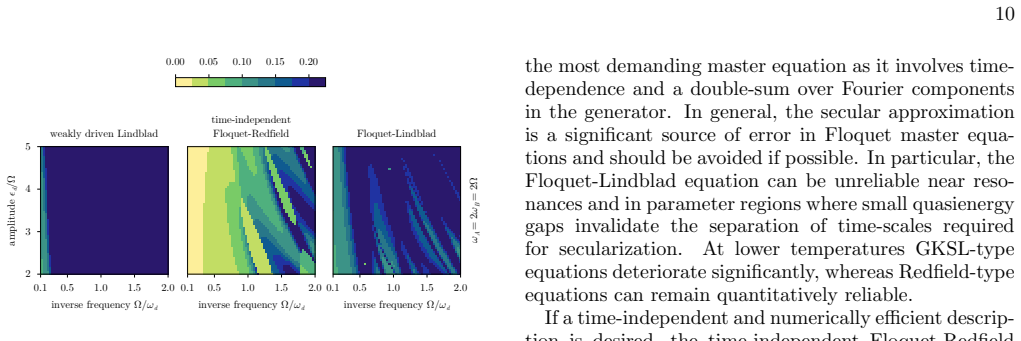
By comparing dynamical maps from various Floquet master equations to numerically exact non-Markovian simulations of two locally driven spins in a shared Ohmic reservoir at finite temperature, the accuracy of each master equation is found to closely reflect its underlying assumptions, with the Floquet-Lindblad equation exhibiting amplified errors near resonances where the secular approximation breaks down.
What carries the argument
Systematic benchmarking of Floquet master equations against exact non-Markovian dynamics for a two-spin Ohmic-bath model, with error tracked as a function of driving frequency and amplitude.
If this is right
- Validity of the tested Floquet master equations remains restricted to regimes of weak or high-frequency driving.
- Floquet-Lindblad errors become strongly amplified near resonances due to breakdown of the secular approximation.
- Master equations that avoid the secular approximation exhibit more systematic dependence of error on driving frequency and amplitude.
- Approaches avoiding the secular approximation perform better overall in the tested parameter space.
Where Pith is reading between the lines
- For simulations near resonance conditions, non-secular versions of the equations may be more reliable than the Floquet-Lindblad form.
- Extending the same benchmarking protocol to other bath spectra or larger spin systems could map the boundaries of applicability more completely.
- The observed error patterns suggest that hybrid master equations retaining some non-secular terms could improve accuracy without requiring full non-Markovian treatment.
Load-bearing premise
The two-spin Ohmic-bath model and the numerically exact non-Markovian solver together provide a sufficiently general reference for judging the master equations across driving regimes.
What would settle it
A different model, such as a single driven spin or a non-Ohmic bath, producing error patterns that do not align with the derivation assumptions of each master equation would falsify the central claim.
Figures
read the original abstract
The dynamics of open quantum systems is commonly described by quantum master equations derived under the assumption of weak system-bath coupling and a separation of timescales between system and bath. When the system is additionally subjected to a periodic driving, the validity of the resulting Floquet master equations is further restricted to regimes of weak or high-frequency driving. Here, we benchmark a set of commonly used Floquet master equations for a model of two locally driven spins coupled to a shared Ohmic reservoir at finite temperature. We systematically probe the accuracy of the equations as a function of the driving parameters, thus identifying limits of their applicability. Dynamical maps predicted by each master equation are compared against numerically exact non-Markovian simulations, tracking the full relaxation dynamics. We find that the accuracy of each master equation closely reflects the assumptions underlying its derivation. For the Floquet-Lindblad equation, errors can be strongly amplified near resonances where the secular approximation breaks down, while approaches that avoid the secular approximation perform better and exhibit a more systematic dependence of the error on driving frequency and amplitude.
Editorial analysis
A structured set of objections, weighed in public.
Referee Report
Summary. The manuscript benchmarks a set of Floquet master equations (including Floquet-Lindblad and non-secular variants) for a two locally driven spins model coupled to a shared Ohmic bath at finite temperature. Dynamical maps from each equation are compared to numerically exact non-Markovian reference trajectories across a systematic scan of driving frequency and amplitude; the central finding is that accuracy tracks the assumptions in each derivation, with secular-approximation breakdown in the Floquet-Lindblad equation producing strongly amplified errors near resonances while non-secular approaches show more systematic error scaling.
Significance. If the numerical comparisons hold, the work supplies concrete, falsifiable evidence on the practical validity regimes of common Floquet master equations, directly linking observed error patterns to specific approximations (secular vs. non-secular). The use of an independent exact solver and parameter scan are strengths that make the results actionable for the driven open-systems community.
major comments (1)
- [Abstract] Abstract and benchmarking design: the central claim that 'accuracy of each master equation closely reflects the assumptions underlying its derivation' and that secular breakdown amplifies errors near resonances rests on a single two-spin shared-Ohmic model. Shared-bath correlations can modify collective decoherence and resonance conditions relative to independent baths; without additional benchmarks or explicit discussion of this choice, it remains possible that the reported performance ordering and frequency/amplitude dependence are model-specific rather than a direct test of the secular vs. non-secular distinction.
minor comments (2)
- The manuscript should clarify whether error bars or convergence checks are provided for the numerically exact solver trajectories, especially near the identified resonances.
- Figure captions and axis labels should explicitly state the temperature, bath cutoff, and coupling strength used in all scans to allow direct reproduction.
Simulated Author's Rebuttal
We thank the referee for their careful reading, positive assessment of the work's significance, and constructive comment. We address the point on the benchmarking design below and propose a targeted revision to strengthen the manuscript.
read point-by-point responses
-
Referee: [Abstract] Abstract and benchmarking design: the central claim that 'accuracy of each master equation closely reflects the assumptions underlying its derivation' and that secular breakdown amplifies errors near resonances rests on a single two-spin shared-Ohmic model. Shared-bath correlations can modify collective decoherence and resonance conditions relative to independent baths; without additional benchmarks or explicit discussion of this choice, it remains possible that the reported performance ordering and frequency/amplitude dependence are model-specific rather than a direct test of the secular vs. non-secular distinction.
Authors: We agree that the shared-bath model introduces collective effects that could quantitatively influence decoherence rates and resonance conditions compared to independent baths. The model was selected because shared reservoirs are physically relevant for many driven systems (e.g., spins or qubits coupled to a common environment) and naturally produce the resonance conditions needed to test secular-approximation breakdown. The core distinction between secular and non-secular Floquet equations arises from the structure of the derivation (commutativity of the dissipator with the Floquet Hamiltonian versus retention of cross terms), which is independent of whether the bath is shared or independent; the shared bath merely adds collective jump operators but does not alter the validity regimes of the secular step itself. Nevertheless, to prevent any misinterpretation that the reported error patterns are exclusively model-specific, we will add an explicit paragraph in the Discussion section (and a brief note in the abstract) that (i) states the rationale for the shared-bath choice, (ii) notes that collective correlations can shift quantitative thresholds, and (iii) clarifies that the qualitative link between approximation assumptions and observed error amplification near resonances is expected to persist for independent baths. No additional numerical benchmarks are required for a minor revision, but the added text will make the scope of the claim transparent. revision: yes
Circularity Check
No circularity: benchmarking rests on independent exact solver, not self-referential fits or citations
full rationale
This is a numerical benchmarking study whose central claims (accuracy tracks derivation assumptions, secular approximation failures amplify errors near resonances) are obtained by direct comparison of each master equation's dynamical maps to an independent numerically exact non-Markovian solver on the chosen two-spin model. No equations are derived within the paper; no parameters are fitted to the target observables and then relabeled as predictions; no load-bearing uniqueness theorems or ansatzes are imported via self-citation. The reference solver and model constitute external benchmarks, so the reported performance ordering does not reduce to any input by construction.
Axiom & Free-Parameter Ledger
axioms (2)
- domain assumption Standard Born-Markov and secular approximations hold outside the regimes being tested
- domain assumption The numerically exact non-Markovian solver provides ground-truth trajectories for the chosen model
Reference graph
Works this paper leans on
-
[1]
Generalizing this ap- proach to the Floquet case is an interesting direction for future works
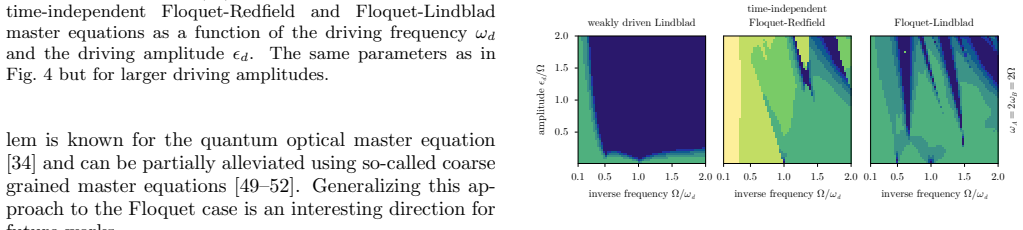
and can be partially alleviated using so-called coarse grained master equations [49–52]. Generalizing this ap- proach to the Floquet case is an interesting direction for future works. D. Lower temperature We further consider a bath at lower temperature where perturbative master equations generally become less ac- curate. Note that, in order to reach decay...
-
[2]
Oka and S
T. Oka and S. Kitamura, Floquet Engineering of Quan- tum Materials, Annual Review of Condensed Matter Physics10, 387 (2019)
2019
-
[3]
M. S. Rudner and N. H. Lindner, The Floquet Engineer’s Handbook (2020), arXiv:2003.08252 [cond-mat.mes-hall]
arXiv 2020
-
[4]
Eckardt, Colloquium: Atomic quantum gases in pe- riodically driven optical lattices, Reviews of Modern Physics89, 011004 (2017)
A. Eckardt, Colloquium: Atomic quantum gases in pe- riodically driven optical lattices, Reviews of Modern Physics89, 011004 (2017)
2017
-
[5]
Weitenberg and J
C. Weitenberg and J. Simonet, Tailoring quantum gases by Floquet engineering, Nature Physics17, 1342 (2021)
2021
-
[6]
D. M. Long, P. J. D. Crowley, A. J. Koll´ ar, and A. Chan- dran, Boosting the Quantum State of a Cavity with Floquet Driving, Physical Review Letters128, 183602 (2022)
2022
-
[7]
L. Zhou, B. Liu, Y. Liu, Y. Lu, Q. Li, X. Xie, N. Lydick, R. Hao, C. Liu, K. Watanabe, T. Taniguchi, Y.-H. Chou, S. R. Forrest, and H. Deng, Cavity Floquet engineering, Nature Communications15, 10.1038/s41467-024-52014- 0 (2024)
-
[8]
Gandon, C
A. Gandon, C. Le Calonnec, R. Shillito, A. Petrescu, and A. Blais, Engineering, Control, and Longitudinal Readout of Floquet Qubits, Physical Review Applied17, 064006 (2022)
2022
-
[9]
Fazio, J
R. Fazio, J. Keeling, L. Mazza, and M. Schir` o, Many- body open quantum systems, SciPost Physics Lecture Notes , 099 (2025)
2025
-
[10]
Shirai, J
T. Shirai, J. Thingna, T. Mori, S. Denisov, P. H¨ anggi, and S. Miyashita, Effective Floquet–Gibbs states for dis- sipative quantum systems, New J. Phys.18, 053008 (2016)
2016
-
[11]
Engelhardt, G
G. Engelhardt, G. Platero, and J. Cao, Discontinuities in Driven Spin-Boson Systems due to Coherent Destruction of Tunneling: Breakdown of the Floquet-Gibbs Distribu- tion, Phys. Rev. Lett.123, 120602 (2019). 11
2019
-
[12]
S. A. Sato, U. De Giovannini, S. Aeschlimann, I. Gierz, H. H¨ ubener, and A. Rubio, Floquet states in dissipative open quantum systems, J. Phys. B: At. Mol. Opt. Phys. 53, 225601 (2020)
2020
-
[13]
Petiziol and A
F. Petiziol and A. Eckardt, Cavity-Based Reservoir En- gineering for Floquet-Engineered Superconducting Cir- cuits, Physical Review Letters129, 233601 (2022)
2022
-
[14]
Li and X
L. Li and X. Cao, Coherent destruction of tunneling of quantum energy transport in a driven nonequilibrium spin-boson model, Phys. Rev. B110, 075403 (2024)
2024
-
[15]
Ritter, D
M. Ritter, D. M. Long, Q. Yue, A. Chandran, and A. J. Koll´ ar, Autonomous stabilization of floquet states using static dissipation, Phys. Rev. X15, 031028 (2025)
2025
-
[16]
S.-Y. Bai, C. Chen, H. Wu, and J.-H. An, Quan- tum control in open and periodically driven sys- tems, Advances in Physics: X6, 1870559 (2021), https://doi.org/10.1080/23746149.2020.1870559
-
[17]
Koyanagi and Y
S. Koyanagi and Y. Tanimura, Numerically “exact” sim- ulations of a quantum Carnot cycle: Analysis using ther- modynamic work diagrams, J. Chem. Phys.157, 084110 (2022)
2022
-
[18]
V. Boettcher, R. Hartmann, K. Beyer, and W. T. Strunz, Dynamics of a strongly coupled quantum heat engine—Computing bath observables from the hierarchy of pure states, J. Chem. Phys.160, 10.1063/5.0192075 (2024)
-
[19]
Kolisnyk, F
D. Kolisnyk, F. Queißer, G. Schaller, and R. Sch¨ utzhold, Floquet analysis of a superradiant many-qutrit refriger- ator, Physical Review Applied21, 044050 (2024)
2024
-
[20]
Alamo, F
M. Alamo, F. Petiziol, and A. Eckardt, Minimal quan- tum heat pump based on high-frequency driving and non- Markovianity, Phys. Rev. E109, 064121 (2024)
2024
-
[21]
Alamo, F
M. Alamo, F. Petiziol, and A. Eckardt, Minimal quan- tum heat pump based on high-frequency driving and non- Markovianity, Physical Review E109, 064121 (2024)
2024
-
[22]
Boettcher, R
V. Boettcher, R. Hartmann, K. Beyer, and W. T. Strunz, Dynamics of a strongly coupled quantum heat engine— Computing bath observables from the hierarchy of pure states, The Journal of Chemical Physics160, 094108 (2024)
2024
-
[23]
L. Wanckel and A. Eckardt, Dissipative Floquet engi- neering of gapped many-body phases using thermal baths (2026), arXiv:2604.01291 [cond-mat.quant-gas]
arXiv 2026
-
[24]
M. Bukov, L. D’Alessio, and A. Polkovnikov, Univer- sal high-frequency behavior of periodically driven sys- tems: from dynamical stabilization to Floquet engi- neering, Advances in Physics64, 139 (2015), eprint: https://doi.org/10.1080/00018732.2015.1055918
-
[25]
Vacchini,Open Quantum Systems: Foundations and Theory, Graduate Texts in Physics (Springer Nature Switzerland, Cham, 2024)
B. Vacchini,Open Quantum Systems: Foundations and Theory, Graduate Texts in Physics (Springer Nature Switzerland, Cham, 2024)
2024
-
[26]
Ketzmerick and W
R. Ketzmerick and W. Wustmann, Statistical mechanics of Floquet systems with regular and chaotic states, Phys. Rev. E82, 021114 (2010)
2010
-
[27]
Schnell, S
A. Schnell, S. Denisov, and A. Eckardt, High-frequency expansions for time-periodic Lindblad generators, Phys- ical Review B104, 165414 (2021)
2021
-
[28]
Mori, Floquet States in Open Quantum Systems, An- nual Review of Condensed Matter Physics14, 35 (2023)
T. Mori, Floquet States in Open Quantum Systems, An- nual Review of Condensed Matter Physics14, 35 (2023)
2023
-
[29]
Mickiewicz, V
K. Mickiewicz, V. Link, and W. T. Strunz, Exact floquet dynamics of strongly damped driven quantum systems, Phys. Rev. Lett.136, 200201 (2026)
2026
-
[30]
Link, H.-H
V. Link, H.-H. Tu, and W. T. Strunz, Open Quantum System Dynamics from Infinite Tensor Network Contrac- tion, Physical Review Letters132, 200403 (2024)
2024
-
[31]
Kahlert, V
F. Kahlert, V. Link, R. Hartmann, and W. T. Strunz, Simulating the Landau–Zener sweep in deeply sub-Ohmic environments, The Journal of Chemical Physics161, 184108 (2024)
2024
-
[32]
Strathearn, P
A. Strathearn, P. Kirton, D. Kilda, J. Keeling, and B. W. Lovett, Efficient non-Markovian quantum dynam- ics using time-evolving matrix product operators, Nature Communications9, 3322 (2018)
2018
-
[33]
M. R. Jørgensen and F. A. Pollock, Exploiting the Causal Tensor Network Structure of Quantum Processes to Ef- ficiently Simulate Non-Markovian Path Integrals, Phys. Rev. Lett.123, 240602 (2019)
2019
-
[34]
J. Keeling, E. M. Stoudenmire, M.-C. Ba˜ nuls, and D. R. Reichman, Process Tensor Approaches to Non- Markovian Quantum Dynamics (2025), arXiv:2509.07661 [quant-ph]
Pith/arXiv arXiv 2025
-
[35]
Hartmann and W
R. Hartmann and W. T. Strunz, Accuracy assessment of perturbative master equations: Embracing nonpositivity, Physical Review A101, 012103 (2020)
2020
-
[36]
Schnell, A
A. Schnell, A. Eckardt, and S. Denisov, Is there a Floquet Lindbladian?, Physical Review B101, 100301 (2020)
2020
-
[37]
Ritter, D
M. Ritter, D. M. Long, Q. Yue, A. Chandran, and A. J. Koll´ ar, Autonomous Stabilization of Floquet States Us- ing Static Dissipation, Physical Review X15, 031028 (2025)
2025
-
[38]
Bernazzani, B
L. Bernazzani, B. Gul´ acsi, and G. Burkard, Universal dis- sipators for driven open quantum systems and the correc- tion to linear response, Quantum Science and Technology 10, 045050 (2025)
2025
-
[39]
Watrous,The Theory of Quantum Information(Cam- bridge University Press, Cambridge, 2018)
J. Watrous,The Theory of Quantum Information(Cam- bridge University Press, Cambridge, 2018)
2018
-
[40]
De Vega and D
I. De Vega and D. Alonso, Dynamics of non-Markovian open quantum systems, Reviews of Modern Physics89, 015001 (2017)
2017
-
[41]
R. Hartmann and W. T. Strunz, Exact open quan- tum system dynamics using the hierarchy of pure states (hops), Journal of Chemical Theory and Computation13, 5834 (2017), pMID: 29016126, https://doi.org/10.1021/acs.jctc.7b00751
-
[42]
Tanimura, Numerically “exact” approach to open quantum dynamics: The hierarchical equations of motion (HEOM), The Journal of Chemical Physics153, 020901 (2020)
Y. Tanimura, Numerically “exact” approach to open quantum dynamics: The hierarchical equations of motion (HEOM), The Journal of Chemical Physics153, 020901 (2020)
2020
-
[43]
R. Hartmann and W. T. Strunz, Open quantum system response from the hierarchy of pure states, The Jour- nal of Physical Chemistry A125, 7066 (2021), pMID: 34353022, https://doi.org/10.1021/acs.jpca.1c03339
-
[44]
Ortega-Taberner, E
C. Ortega-Taberner, E. O’Neill, E. Butler, G. E. Fux, and P. R. Eastham, Unifying methods for optimal control in non-Markovian quantum systems via process tensors, The Journal of Chemical Physics161, 124119 (2024)
2024
-
[45]
A. Chin, J. Keeling, D. Segal, and H. Wang, Algorithms and software for open quantum system dynamics, The Journal of Chemical Physics163, 050401 (2025)
2025
-
[46]
Garbellini, K
M. Garbellini, K. Mickiewicz, V. Link, A. Eisfeld, and W. T. Strunz, Uniform process tensor approach for the calculation of multi-time correlation functions of non-Markovian open systems, The Journal of Chemical Physics164, 184104 (2026)
2026
-
[47]
G. E. Fux, E. P. Butler, P. R. Eastham, B. W. Lovett, and J. Keeling, Efficient Exploration of Hamiltonian Param- eter Space for Optimal Control of Non-Markovian Open Quantum Systems, Physical Review Letters126, 200401 12 (2021)
2021
-
[48]
V. Link, Tensor network influence functionals for open quantum systems with general Gaussian bosonic baths (2026), arXiv:2603.23432 [quant-ph]
arXiv 2026
-
[49]
C. S. Tello Breuer, T. Becker, and A. Eckardt, Bench- marking quantum master equations beyond ultraweak coupling, Physical Review B110, 064319 (2024)
2024
-
[50]
Benatti, R
F. Benatti, R. Floreanini, and U. Marzolino, Entangling two unequal atoms through a common bath, Physical Review A81, 012105 (2010)
2010
-
[51]
Benatti, R
F. Benatti, R. Floreanini, and U. Marzolino, Environment-induced entanglement in a refined weak-coupling limit, Europhysics Letters88, 20011 (2009)
2009
-
[52]
Schaller and T
G. Schaller and T. Brandes, Preservation of positivity by dynamical coarse graining, Physical Review A78, 022106 (2008)
2008
-
[53]
Majenz, T
C. Majenz, T. Albash, H.-P. Breuer, and D. A. Lidar, Coarse graining can beat the rotating-wave approxima- tion in quantum Markovian master equations, Physical Review A88, 012103 (2013)
2013
-
[54]
Nathan and M
F. Nathan and M. S. Rudner, Universal Lindblad equa- tion for open quantum systems, Physical Review B102, 115109 (2020)
2020
-
[55]
Becker, A
T. Becker, A. Schnell, and J. Thingna, Canonically Con- sistent Quantum Master Equation, Physical Review Let- ters129, 200403 (2022)
2022
-
[56]
Z. Sartipi, R. Gundermann, J. Anders, and P. Saal- frank, Canonically consistent quantum master equation for proton-transfer reactions (2026), arXiv:2603.21865 [quant-ph]
arXiv 2026
-
[57]
Saha and R
S. Saha and R. Bhattacharyya, Prethermal discrete time crystal in driven-dissipative dipolar systems, Physical Re- view A109, 012208 (2024)
2024
-
[58]
G. Das, S. Saha, and R. Bhattacharyya, Environment- assisted discrete time crystals in noninteracting quantum systems, Physical Review A113, 042216 (2026)
2026
-
[59]
Schnell, Global Becomes Local: Efficient Many-Body Dynamics for Global Master Equations, Physical Review Letters134, 250401 (2025)
A. Schnell, Global Becomes Local: Efficient Many-Body Dynamics for Global Master Equations, Physical Review Letters134, 250401 (2025)
2025
-
[60]
Shiraishi, M
K. Shiraishi, M. Nakagawa, T. Mori, and M. Ueda, Quantum master equation for many-body systems based on the Lieb-Robinson bound, Physical Review B111, 184311 (2025)
2025
-
[61]
Harbola, M
U. Harbola, M. Esposito, and S. Mukamel, Quantum master equation for electron transport through quantum dots and single molecules, Physical Review B74, 235309 (2006)
2006
-
[62]
Acciai, L
M. Acciai, L. Arrachea, and J. Splettstoesser, Quantum transport phenomena induced by time-dependent fields, La Rivista del Nuovo Cimento48, 653 (2025)
2025
- [63]
-
[64]
Thoenniss, M
J. Thoenniss, M. Sonner, A. Lerose, and D. A. Abanin, Efficient method for quantum impurity problems out of equilibrium, Physical Review B107, L201115 (2023)
2023
-
[65]
N. Ng, G. Park, A. J. Millis, G. K.-L. Chan, and D. R. Re- ichman, Real-time evolution of Anderson impurity mod- els via tensor network influence functionals, Physical Re- view B107, 125103 (2023)
2023
-
[66]
R. Chen, X. Xu, and C. Guo, Real-time impurity solver using Grassmann time-evolving matrix product opera- tors, Physical Review B109, 165113 (2024)
2024
-
[67]
Sonner, V
M. Sonner, V. Link, and D. A. Abanin, Semigroup In- fluence Matrices for Nonequilibrium Quantum Impurity Models, Physical Review Letters135, 170402 (2025)
2025
discussion (0)
Sign in with ORCID, Apple, or X to comment. Anyone can read and Pith papers without signing in.