REVIEW 3 major objections 4 minor 2 cited by
Temporal Query Network for Efficient Multivariate Time Series Forecasting
T0 review · 3 major / 4 minor · reviewed 2026-08-15 · deepseek-v4-flash
Pith's one-line read Periodically shifted learnable queries let a single attention layer match much larger multivariate forecasting models.
desk verdict Solid, simple idea with a portable query trick; the SOTA claim overreaches relative to the baseline set. read the letter →
The pith
A machine-rendered reading of the paper's core claim, the machinery that carries it, and where it could break.
The reading
What carries the argument
The Temporal Query (TQ) is a learnable parameter matrix $\theta_{\text{TQ}} \in \mathbb{R}^{C\times W}$, initialized to zero. For a sample at time $t$, the segment $\theta_{\text{TQ}}^{t,L}$ of length $L$ is extracted starting at index $t \bmod W$, so samples spaced $W$ apart reuse identical queries. In attention, these queries meet keys and values taken from the raw input $X_t$, and the softmax scores $QK^\top/\sqrt{L}$ mix the global prior with local evidence. The load-bearing identity is Equation (13): the correlation learned by a query equals the average of the sample-level correlations at that period phase, which is what makes the model robust to non-stationary disturbances.
What would settle it
Take a dataset with no clear periodicity, or deliberately set $W$ wrong (e.g., $W=167$ on hourly Electricity), and run TQNet against the same baselines; the paper's Figure 6 already shows error rising in that case, so a systematic sweep over aperiodic series would reveal whether the claimed gains depend entirely on the period prior. If TQNet still matches or beats channel-independent baselines without a correct $W$, the global-correlation-averaging explanation would need revision; if it collapses, the prior is load-bearing.
Extended reading notes
Core claim
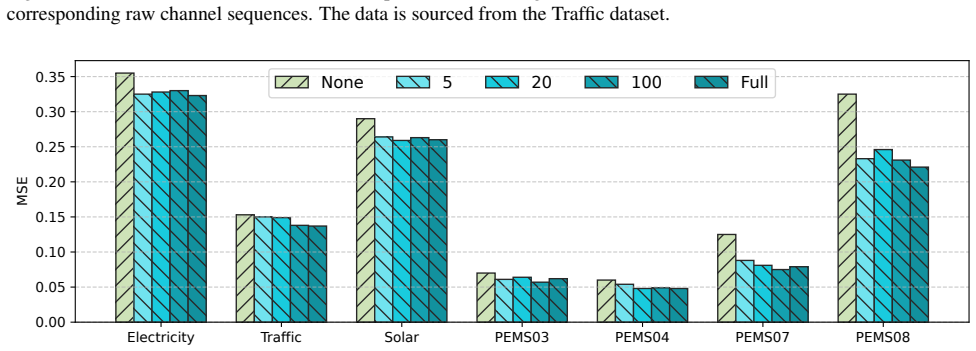
The paper's central discovery is that replacing the queries of self-attention with a learnable matrix $\theta_{\text{TQ}}\in\mathbb{R}^{C\times W}$, cyclically selected by $t \bmod W$, makes attention compute inter-variable correlations that are averaged over all periods aligned at that phase, while keys and values from the raw input preserve local, sample-specific detail. This design matches the dataset-level correlation matrix more closely than either pure self-attention (raw queries and keys) or a purely global query-key pair, as shown by the ablation in Table 3. The averaging identity in Appendix A.4 states $\operatorname{Corr}(Q_i) \approx \frac{1}{N}\sum_{n=0}^{N-1}\operatorname{Corr}(K_{i+nW})$, which is the mechanism that suppresses noise, outliers, and missing values. The paper then demonstrates that this single mechanism, inside an otherwise minimal network, yields state-of-the-art forecasts on 12 datasets and improves existing models when plugged into them.
Load-bearing premise
The technique presumes each dataset has one stable dominant period $W$, and that the user sets $W$ to that period; nothing in the model discovers or adapts $W$ automatically.
Editorial extensions
If this is right
- TQNet reaches top-two accuracy in 22 of 24 error metrics across the twelve datasets, so a one-layer attention plus MLP can be a competitive default multivariate forecaster.
- Plugging the TQ query into iTransformer, PatchTST, and DLinear improves all three, so the technique transfers across channel-mixing and channel-independent architectures.
- Training time stays close to DLinear's even with 862 channels, making the approach practical in high-dimensional settings.
- The benefit of multivariate modeling shrinks as the look-back window grows, so the technique is most valuable when historical data is short.
Reading between the lines
- The periodic-shared query is effectively a learnable seasonal smoothing of the channel-correlation matrix; one could extend it to multiple periods (e.g., daily plus weekly) with an ensemble of TQ vectors and expect further gains on multi-periodic datasets.
- If $W$ is unknown, an adaptive variant that learns or infers the period from autocorrelation or gradient descent would remove the main practical obstacle; the paper currently leaves $W$ as a user-supplied prior.
- Setting $W=1$ degrades TQ to a per-channel identifier, which suggests the method implicitly learns channel embeddings; this connection to channel-identity models could be explored explicitly.
Signed reviews
Editorial analysis
A structured set of objections, weighed in public.
Referee Report
Summary. TQNet is a multivariate time series forecaster built from a single multi-head attention layer whose queries are periodically shifted learnable vectors (one period length W per dataset) and whose keys and values are the raw input channels, followed by a two-layer MLP, an output projection, and optional reversible instance normalization. The authors argue that the shared periodic queries average over W-spaced samples and thereby capture stable cross-channel correlations while preserving local, sample-specific information in the keys and values. The paper reports experiments on 12 datasets with horizons {96,192,336,720} and {12,24,48,96} for PEMS, claims top-2 performance on 22/24 dataset-metric pairs in Table 2, and provides efficiency comparisons. Appendices contain pseudocode, full results, ablation and integration studies, sensitivity to W, robustness over seeds and learning rates, and a theoretical analysis in Appendix A.4. Section 5 candidly lists limitations, including dependence on dataset periodicity and diminishing benefits of multivariate modeling for long look-back windows.
Significance. If the empirical claims are sustained, TQNet would be a valuable contribution: a simple, lightweight architecture with a single attention layer and an MLP achieving competitive accuracy across 12 standard benchmarks is a useful data point for the channel-dependence versus channel-independence debate. The paper's strengths include released code, a fixed-seed experimental protocol, a robustness table over multiple seeds and learning rates, and extensive ablation/integration studies that probe the contribution of the temporal-query mechanism. However, the headline state-of-the-art claim is not yet established: Table 2 supports it only through a top-2 count against baselines whose numbers are taken from prior papers, several strong channel-dependence models cited in Related Work are not benchmarked, and no variance or significance information is given for the baseline comparisons. The theoretical analysis in Appendix A.4 is presented as a proof but contains informal and partly incorrect steps. These issues are fixable by additional benchmarking and by tempering the claims, so the paper warrants a major revision rather than rejection.
major comments (3)
- [Section 4.2, Table 2] The claim that TQNet achieves 'overall state-of-the-art performance' is supported only by a top-2 count (22/24) in Table 2. This is a weak basis for the headline claim, because top-2 conflates outright wins with second places and because the table omits several channel-dependence models that the paper itself cites in Related Work, including SAMformer, CARD, UniTST, SOFTS, TimeMixer, DUET, and TimeBridge, several of which target the same high-dimensional Electricity/Traffic/PEMS settings where TQNet reports its largest gains. The caption of Table 5 also indicates that baseline numbers are sourced from TimeXer, iTransformer, and CycleNet rather than rerun under a single protocol, and no standard deviations or significance tests are reported; for example, on Weather the MSE difference is 0.242 versus 0.241, and on ETTh2 TimeXer reports 0.368 versus TQNet's 0.378. I request either a complete benchmark under a unified protocol with variance reporting for all methods, or a substantial softening of the 'state-of-the-art' wording to 'competitive with state-of-the-art'.
- [Appendix A.4, Eqs. (10)-(13)] The theoretical analysis does not establish the claimed averaging behavior. Eq. (10) states that training maximizes the attention output, but this does not imply that the query correlation matrix equals the key correlation matrix as asserted in Eq. (11); attention weights can be large without Q and K having identical cross-channel correlation structure. Eq. (13) further assumes that the correlation learned by the shared periodic query equals the average of the per-sample key correlations, although correlation is not a linear operation and no derivation is given. Because this appendix is presented as the explanation for why the temporal-query mechanism improves robustness, it should either be replaced by a rigorous statement or explicitly labeled as heuristic intuition.
- [Table 3] The design claim that the default (Q=TQ,K=Raw) configuration 'yields the best performance' is contradicted by the Traffic row of Table 3: (Q=TQ,K=Raw) gives MSE 0.445, while (Q=Raw,K=Raw) gives MSE 0.426. The default setting does improve MAE on Traffic (0.276 versus 0.279), but the text does not state that the conclusion is based on MAE rather than MSE. Since the paper presents these ablations as evidence for the central design choice, the authors should reconcile this exception or report an aggregate statistic, such as mean rank or wins across the seven datasets.
minor comments (4)
- [Section 5] The limitations section candidly acknowledges the dependence on a known period length W and the risk of over-strong multivariate modeling when correlations are weak; these caveats should be reflected in the abstract and conclusion, which currently assert state-of-the-art performance without qualification.
- [Section 4.3, Figure 6] The sensitivity study for W is informative but is conducted only on Electricity; given that W is a central hyperparameter, a small additional table showing W sensitivity on one or two further datasets would materially strengthen the paper.
- [Appendix A.3] The procedure for selecting W is delegated to CycleNet's appendix and a provided ACF code snippet; the paper should state the ACF criterion used in practice, such as the chosen lag or significance threshold, so that the method is self-contained.
- [Section 4.2, Figure 7] The statement that TQNet has 'near-linear computational overhead' should be explicitly empirical: the attention mechanism is quadratic in the number of channels in general, and Figure 7 shows wall-clock training time on one GPU rather than asymptotic complexity. The y-axis label 'Training Time (seconds/epochs)' should also read 'seconds per epoch'.
Circularity Check
No significant circularity: TQNet's claims are empirical and benchmark-based; the W prior is a disclosed hyperparameter, not a renamed prediction.
full rationale
TQNet is a standard supervised forecasting model: all parameters (TQ vectors, attention projections, MLP weights, output projection) are fitted by L2 loss on training splits and evaluated on held-out test sets. The only input-derived hyperparameter is W, taken from known dataset periodicities following CycleNet, a self-citation, but W is explicitly labeled a hyperparameter, its choice is sensitivity-analyzed in Figure 6, and its limitation is disclosed in Section 5; it is not disguised as a prediction or derived result. The Appendix A.4 correlation-averaging argument is a heuristic explanation of the intended behavior of shared periodic queries (Eqs. 12-13), not a theorem whose conclusion is assumed by construction, and it does not generate a numerical forecast that reduces to a fitted value. The state-of-the-art claim rests on external benchmark comparisons in Table 2, which are falsifiable; possible omissions of baselines are a comparison-protocol concern, not circularity. No step in the paper reduces, by its own equations or by self-citation, to its own inputs, so there is no circular derivation chain to flag.
Assumptions & free parameters
free parameters (1)
- Period length W =
24, 96, 144, 168, 288 depending on dataset (Table 1)
assumptions (3)
- domain assumption Datasets have a stable dominant periodicity that can be identified in advance (Section 3.2, Table 1).
- ad hoc to paper Learnable queries trained by forecasting loss will align with keys' correlation structure, so Corr(Q) approx Corr(K) (Appendix A.4, Eq 11).
- domain assumption Keys and values from raw input encode local sample-level correlations while periodic queries encode global correlations (Section 3.2).
Cite this review
Pith. "Pith review of Temporal Query Network for Efficient Multivariate Time Series Forecasting." pith.science (2026). https://pith.science/paper/IHHEHCRS
@misc{pith2026250512917,
  author       = {Pith},
  title        = {Pith review of: Temporal Query Network for Efficient Multivariate Time Series Forecasting},
  year         = {2026},
  howpublished = {\url{https://pith.science/paper/IHHEHCRS}},
  note         = {Machine review of arXiv:2505.12917}
}
read the original abstract
Sufficiently modeling the correlations among variables (aka channels) is crucial for achieving accurate multivariate time series forecasting (MTSF). In this paper, we propose a novel technique called Temporal Query (TQ) to more effectively capture multivariate correlations, thereby improving model performance in MTSF tasks. Technically, the TQ technique employs periodically shifted learnable vectors as queries in the attention mechanism to capture global inter-variable patterns, while the keys and values are derived from the raw input data to encode local, sample-level correlations. Building upon the TQ technique, we develop a simple yet efficient model named Temporal Query Network (TQNet), which employs only a single-layer attention mechanism and a lightweight multi-layer perceptron (MLP). Extensive experiments demonstrate that TQNet learns more robust multivariate correlations, achieving state-of-the-art forecasting accuracy across 12 challenging real-world datasets. Furthermore, TQNet achieves high efficiency comparable to linear-based methods even on high-dimensional datasets, balancing performance and computational cost. The code is available at: https://github.com/ACAT-SCUT/TQNet.
Figures


Figures from the paper (5 more)



Forward citations
Cited by 2 Pith papers
-
MIDiff: Tackling Sparsity and Imbalance in Mobile Usage Generation via Multivariate-Imaging Diffusion
A diffusion model trained on C-GASF images of mobile usage generates synthetic user traces that match real trace statistics far better than prior time-series generative baselines.
-
Differencing the Diffusion Trajectory toward Uncertain Components for Time Series Forecasting
DiffDiff rewires diffusion forecasting so corruption gradually emphasizes second-order differences, concentrating generation on history-uncertain parts and improving forecasts on seven benchmarks.
Reference graph
Works this paper leans on
-
[1]
write newline
" write newline "" before.all 'output.state := FUNCTION n.dashify 't := "" t empty not t #1 #1 substring "-" = t #1 #2 substring "--" = not "--" * t #2 global.max substring 't := t #1 #1 substring "-" = "-" * t #2 global.max substring 't := while if t #1 #1 substring * t #2 global.max substring 't := if while FUNCTION format.date year duplicate empty "emp...
-
[2]
Msgnet: Learning multi-scale inter-series correlations for multivariate time series forecasting
Cai, W., Liang, Y., Liu, X., Feng, J., and Wu, Y. Msgnet: Learning multi-scale inter-series correlations for multivariate time series forecasting. In Proceedings of the AAAI Conference on Artificial Intelligence, volume 38, pp.\ 11141--11149, 2024
work page 2024
-
[3]
Challu, C., Olivares, K. G., Oreshkin, B. N., Ramirez, F. G., Canseco, M. M., and Dubrawski, A. Nhits: Neural hierarchical interpolation for time series forecasting. In Proceedings of the AAAI Conference on Artificial Intelligence, volume 37, pp.\ 6989--6997, 2023
work page 2023
-
[4]
Chen, S.-A., Li, C.-L., Yoder, N., Arik, S. O., and Pfister, T. Tsmixer: An all-mlp architecture for time series forecasting. arXiv preprint arXiv:2303.06053, 2023
arXiv 2023
-
[5]
Periodicity decoupling framework for long-term series forecasting
Dai, T., Wu, B., Liu, P., Li, N., Bao, J., Jiang, Y., and Xia, S.-T. Periodicity decoupling framework for long-term series forecasting. In The Twelfth International Conference on Learning Representations, 2024
work page 2024
-
[6]
Das, A., Kong, W., Leach, A., Mathur, S. K., Sen, R., and Yu, R. Long-term forecasting with tide: Time-series dense encoder. Transactions on Machine Learning Research, 2023
work page 2023
-
[7]
Parsimony or capability? decomposition delivers both in long-term time series forecasting
Deng, J., Ye, F., Yin, D., Song, X., Tsang, I., and Xiong, H. Parsimony or capability? decomposition delivers both in long-term time series forecasting. In The Thirty-eighth Annual Conference on Neural Information Processing Systems, 2024
work page 2024
-
[8]
Tsmixer: Lightweight mlp-mixer model for multivariate time series forecasting
Ekambaram, V., Jati, A., Nguyen, N., Sinthong, P., and Kalagnanam, J. Tsmixer: Lightweight mlp-mixer model for multivariate time series forecasting. In Proceedings of the 29th ACM SIGKDD Conference on Knowledge Discovery and Data Mining, pp.\ 459--469, 2023
work page 2023
Show all 64 references
-
[9]
Softs: Efficient multivariate time series forecasting with series-core fusion
Han, L., Chen, X.-Y., Ye, H.-J., and Zhan, D.-C. Softs: Efficient multivariate time series forecasting with series-core fusion. In The Thirty-eighth Annual Conference on Neural Information Processing Systems, 2024 a
2024
-
[10]
The capacity and robustness trade-off: Revisiting the channel independent strategy for multivariate time series forecasting
Han, L., Ye, H.-J., and Zhan, D.-C. The capacity and robustness trade-off: Revisiting the channel independent strategy for multivariate time series forecasting. IEEE Transactions on Knowledge and Data Engineering, 2024 b
2024
-
[11]
Deep residual learning for image recognition
He, K., Zhang, X., Ren, S., and Sun, J. Deep residual learning for image recognition. In Proceedings of the IEEE conference on computer vision and pattern recognition, pp.\ 770--778, 2016
2016
-
[12]
and Gimpel, K
Hendrycks, D. and Gimpel, K. Gaussian error linear units (gelus). arXiv preprint arXiv:1606.08415, 2016
2016 arXiv
-
[13]
Crossgnn: Confronting noisy multivariate time series via cross interaction refinement
Huang, Q., Shen, L., Zhang, R., Ding, S., Wang, B., Zhou, Z., and Wang, Y. Crossgnn: Confronting noisy multivariate time series via cross interaction refinement. Advances in Neural Information Processing Systems, 36, 2023
2023
-
[14]
Hdmixer: Hierarchical dependency with extendable patch for multivariate time series forecasting
Huang, Q., Shen, L., Zhang, R., Cheng, J., Ding, S., Zhou, Z., and Wang, Y. Hdmixer: Hierarchical dependency with extendable patch for multivariate time series forecasting. In Proceedings of the AAAI Conference on Artificial Intelligence, volume 38, pp.\ 12608--12616, 2024
2024
-
[15]
Hyndman, R. J. and Athanasopoulos, G. Forecasting: principles and practice. OTexts, 2018
2018
-
[16]
Samformer: Unlocking the potential of transformers in time series forecasting with sharpness-aware minimization and channel-wise attention
Ilbert, R., Odonnat, A., Feofanov, V., Virmaux, A., Paolo, G., Palpanas, T., and Redko, I. Samformer: Unlocking the potential of transformers in time series forecasting with sharpness-aware minimization and channel-wise attention. In Proceedings of the 41st International Confe...
2024
-
[17]
Are self-attentions effective for time series forecasting? In The Thirty-eighth Annual Conference on Neural Information Processing Systems, 2024
Kim, D., Park, J., Lee, J., and Kim, H. Are self-attentions effective for time series forecasting? In The Thirty-eighth Annual Conference on Neural Information Processing Systems, 2024
2024
-
[18]
Reversible instance normalization for accurate time-series forecasting against distribution shift
Kim, T., Kim, J., Tae, Y., Park, C., Choi, J.-H., and Choo, J. Reversible instance normalization for accurate time-series forecasting against distribution shift. In International Conference on Learning Representations, 2021
2021
-
[19]
Kingma, D. P. and Ba, J. Adam: A method for stochastic optimization. arXiv preprint arXiv:1412.6980, 2014
2014 arXiv
-
[20]
Crafting papers on machine learning
Langley, P. Crafting papers on machine learning. In Langley, P. (ed.), Proceedings of the 17th International Conference on Machine Learning (ICML 2000), pp.\ 1207--1216, Stanford, CA, 2000. Morgan Kaufmann
2000
-
[21]
Enhancing the locality and breaking the memory bottleneck of transformer on time series forecasting
Li, S., Jin, X., Xuan, Y., Zhou, X., Chen, W., Wang, Y.-X., and Yan, X. Enhancing the locality and breaking the memory bottleneck of transformer on time series forecasting. Advances in neural information processing systems, 32, 2019
2019
-
[22]
Revisiting long-term time series forecasting: An investigation on linear mapping
Li, Z., Qi, S., Li, Y., and Xu, Z. Revisiting long-term time series forecasting: An investigation on linear mapping. arXiv preprint arXiv:2305.10721, 2023 a
2023 arXiv
-
[23]
Mts-mixers: Multivariate time series forecasting via factorized temporal and channel mixing
Li, Z., Rao, Z., Pan, L., and Xu, Z. Mts-mixers: Multivariate time series forecasting via factorized temporal and channel mixing. arXiv preprint arXiv:2302.04501, 2023 b
2023 arXiv
-
[24]
Segrnn: Segment recurrent neural network for long-term time series forecasting
Lin, S., Lin, W., Wu, W., Zhao, F., Mo, R., and Zhang, H. Segrnn: Segment recurrent neural network for long-term time series forecasting. arXiv preprint arXiv:2308.11200, 2023
2023 arXiv
-
[25]
Sparsetsf: Modeling long-term time series forecasting with 1k parameters
Lin, S., Lin, W., Wu, W., Chen, H., and Yang, J. Sparsetsf: Modeling long-term time series forecasting with 1k parameters. In Forty-first International Conference on Machine Learning, 2024 a
2024
-
[26]
Cyclenet: Enhancing time series forecasting through modeling periodic patterns
Lin, S., Lin, W., Xinyi, H., Wu, W., Mo, R., and Zhong, H. Cyclenet: Enhancing time series forecasting through modeling periodic patterns. In The Thirty-eighth Annual Conference on Neural Information Processing Systems, 2024 b
2024
-
[27]
Petformer: Long-term time series forecasting via placeholder-enhanced transformer
Lin, S., Lin, W., Wu, W., Wang, S., and Wang, Y. Petformer: Long-term time series forecasting via placeholder-enhanced transformer. IEEE Transactions on Emerging Topics in Computational Intelligence, 9 0 (2): 0 1189--1201, 2025. doi:10.1109/TETCI.2024.3502437
2025
-
[28]
Unitst: Effectively modeling inter-series and intra-series dependencies for multivariate time series forecasting
Liu, J., Liu, C., Woo, G., Wang, Y., Hooi, B., Xiong, C., and Sahoo, D. Unitst: Effectively modeling inter-series and intra-series dependencies for multivariate time series forecasting. arXiv preprint arXiv:2406.04975, 2024 a
2024 arXiv
-
[29]
Scinet: Time series modeling and forecasting with sample convolution and interaction
Liu, M., Zeng, A., Chen, M., Xu, Z., Lai, Q., Ma, L., and Xu, Q. Scinet: Time series modeling and forecasting with sample convolution and interaction. Advances in Neural Information Processing Systems, 35: 0 5816--5828, 2022 a
2022
-
[30]
Timebridge: Non-stationarity matters for long-term time series forecasting
Liu, P., Wu, B., Hu, Y., Li, N., Dai, T., Bao, J., and Xia, S.-t. Timebridge: Non-stationarity matters for long-term time series forecasting. arXiv preprint arXiv:2410.04442, 2024 b
2024 arXiv
-
[31]
X., and Dustdar, S
Liu, S., Yu, H., Liao, C., Li, J., Lin, W., Liu, A. X., and Dustdar, S. Pyraformer: Low-complexity pyramidal attention for long-range time series modeling and forecasting. In International conference on learning representations, 2021
2021
-
[32]
Non-stationary transformers: Exploring the stationarity in time series forecasting
Liu, Y., Wu, H., Wang, J., and Long, M. Non-stationary transformers: Exploring the stationarity in time series forecasting. Advances in Neural Information Processing Systems, 35: 0 9881--9893, 2022 b
2022
-
[33]
itransformer: Inverted transformers are effective for time series forecasting
Liu, Y., Hu, T., Zhang, H., Wu, H., Wang, S., Ma, L., and Long, M. itransformer: Inverted transformers are effective for time series forecasting. In The Twelfth International Conference on Learning Representations, 2024 c
2024
-
[34]
and Wang, X
Luo, D. and Wang, X. Moderntcn: A modern pure convolution structure for general time series analysis. In The Twelfth International Conference on Learning Representations, 2024
2024
-
[35]
Knowledge-empowered dynamic graph network for irregularly sampled medical time series
Luo, Y., Liu, Z., Wang, L., Wu, B., Zheng, J., and Ma, Q. Knowledge-empowered dynamic graph network for irregularly sampled medical time series. Advances in Neural Information Processing Systems, 37: 0 67172--67199, 2024
2024
-
[36]
Time series analysis
Madsen, H. Time series analysis. CRC Press, 2007
2007
-
[37]
Nguyen, N., Sinthong, P., and Kalagnanam, J
Nie, Y., H. Nguyen, N., Sinthong, P., and Kalagnanam, J. A time series is worth 64 words: Long-term forecasting with transformers. In International Conference on Learning Representations, 2023
2023
-
[38]
Pytorch: An imperative style, high-performance deep learning library
Paszke, A., Gross, S., Massa, F., Lerer, A., Bradbury, J., Chanan, G., Killeen, T., Lin, Z., Gimelshein, N., Antiga, L., et al. Pytorch: An imperative style, high-performance deep learning library. Advances in neural information processing systems, 32, 2019
2019
-
[39]
S., Sheng, Z., and Yang, B
Qiu, X., Hu, J., Zhou, L., Wu, X., Du, J., Zhang, B., Guo, C., Zhou, A., Jensen, C. S., Sheng, Z., and Yang, B. Tfb: Towards comprehensive and fair benchmarking of time series forecasting methods. Proc. VLDB Endow. , 17 0 (9): 0 2363--2377, 2024
2024
-
[40]
Duet: Dual clustering enhanced multivariate time series forecasting
Qiu, X., Wu, X., Lin, Y., Guo, C., Hu, J., and Yang, B. Duet: Dual clustering enhanced multivariate time series forecasting. In SIGKDD, 2025
2025
-
[41]
Spatial-temporal identity: A simple yet effective baseline for multivariate time series forecasting
Shao, Z., Zhang, Z., Wang, F., Wei, W., and Xu, Y. Spatial-temporal identity: A simple yet effective baseline for multivariate time series forecasting. In Proceedings of the 31st ACM International Conference on Information & Knowledge Management, pp.\ 4454--4458, 2022
2022
-
[42]
Exploring progress in multivariate time series forecasting: Comprehensive benchmarking and heterogeneity analysis
Shao, Z., Wang, F., Xu, Y., Wei, W., Yu, C., Zhang, Z., Yao, D., Sun, T., Jin, G., Cao, X., et al. Exploring progress in multivariate time series forecasting: Comprehensive benchmarking and heterogeneity analysis. IEEE Transactions on Knowledge and Data Engineering, 2024
2024
-
[43]
Dropout: a simple way to prevent neural networks from overfitting
Srivastava, N., Hinton, G., Krizhevsky, A., Sutskever, I., and Salakhutdinov, R. Dropout: a simple way to prevent neural networks from overfitting. The journal of machine learning research, 15 0 (1): 0 1929--1958, 2014
1929
-
[44]
and Darlow, L
Toner, W. and Darlow, L. N. An analysis of linear time series forecasting models. In Forty-first International Conference on Machine Learning, 2024
2024
-
[45]
and Hinton, G
Van der Maaten, L. and Hinton, G. Visualizing data using t-sne. Journal of machine learning research, 9 0 (11), 2008
2008
-
[46]
N., Kaiser, ., and Polosukhin, I
Vaswani, A., Shazeer, N., Parmar, N., Uszkoreit, J., Jones, L., Gomez, A. N., Kaiser, ., and Polosukhin, I. Attention is all you need. Advances in neural information processing systems, 30, 2017
2017
-
[47]
Micn: Multi-scale local and global context modeling for long-term series forecasting
Wang, H., Peng, J., Huang, F., Wang, J., Chen, J., and Xiao, Y. Micn: Multi-scale local and global context modeling for long-term series forecasting. In International Conference on Learning Representations, 2023
2023
-
[48]
Y., and ZHOU, J
Wang, S., Wu, H., Shi, X., Hu, T., Luo, H., Ma, L., Zhang, J. Y., and ZHOU, J. Timemixer: Decomposable multiscale mixing for time series forecasting. In The Twelfth International Conference on Learning Representations, 2024 a
2024
-
[49]
Deep time series models: A comprehensive survey and benchmark
Wang, Y., Wu, H., Dong, J., Liu, Y., Long, M., and Wang, J. Deep time series models: A comprehensive survey and benchmark. arXiv preprint arXiv:2407.13278, 2024 b
2024 arXiv
-
[50]
Timexer: Empowering transformers for time series forecasting with exogenous variables
Wang, Y., Wu, H., Dong, J., Qin, G., Zhang, H., Liu, Y., Qiu, Y., Wang, J., and Long, M. Timexer: Empowering transformers for time series forecasting with exogenous variables. In The Thirty-eighth Annual Conference on Neural Information Processing Systems, 2024 c
2024
-
[51]
Transformers in time series: a survey
Wen, Q., Zhou, T., Zhang, C., Chen, W., Ma, Z., Yan, J., and Sun, L. Transformers in time series: a survey. In Proceedings of the Thirty-Second International Joint Conference on Artificial Intelligence, pp.\ 6778--6786, 2023
2023
-
[52]
Etsformer: Exponential smoothing transformers for time-series forecasting
Woo, G., Liu, C., Sahoo, D., Kumar, A., and Hoi, S. Etsformer: Exponential smoothing transformers for time-series forecasting. arXiv preprint arXiv:2202.01381, 2022
2022 arXiv
-
[53]
Autoformer: Decomposition transformers with auto-correlation for long-term series forecasting
Wu, H., Xu, J., Wang, J., and Long, M. Autoformer: Decomposition transformers with auto-correlation for long-term series forecasting. Advances in neural information processing systems, 34: 0 22419--22430, 2021
2021
-
[54]
Timesnet: Temporal 2d-variation modeling for general time series analysis
Wu, H., Hu, T., Liu, Y., Zhou, H., Wang, J., and Long, M. Timesnet: Temporal 2d-variation modeling for general time series analysis. In International Conference on Learning Representations, 2023
2023
-
[55]
Fits: Modeling time series with 10 k parameters
Xu, Z., Zeng, A., and Xu, Q. Fits: Modeling time series with 10 k parameters. In The Twelfth International Conference on Learning Representations, 2024
2024
-
[56]
Card: Channel aligned robust blend transformer for time series forecasting
Xue, W., Zhou, T., Wen, Q., Gao, J., Ding, B., and Jin, R. Card: Channel aligned robust blend transformer for time series forecasting. In International Conference on Learning Representations (ICLR), 2024
2024
-
[57]
Frequency adaptive normalization for non-stationary time series forecasting
Ye, W., Deng, S., Zou, Q., and Gui, N. Frequency adaptive normalization for non-stationary time series forecasting. In The Thirty-eighth Annual Conference on Neural Information Processing Systems, 2024
2024
-
[58]
Fouriergnn: Rethinking multivariate time series forecasting from a pure graph perspective
Yi, K., Zhang, Q., Fan, W., He, H., Hu, L., Wang, P., An, N., Cao, L., and Niu, Z. Fouriergnn: Rethinking multivariate time series forecasting from a pure graph perspective. Advances in Neural Information Processing Systems, 36, 2023
2023
-
[59]
I., Qin, J., and Wang, S
Yu, G., Zou, J., Hu, X., Aviles-Rivero, A. I., Qin, J., and Wang, S. Revitalizing multivariate time series forecasting: Learnable decomposition with inter-series dependencies and intra-series variations modeling. In Forty-first International Conference on Machine Learning, 202...
2024
-
[60]
Are transformers effective for time series forecasting? In Proceedings of the AAAI conference on artificial intelligence, volume 37, pp.\ 11121--11128, 2023
Zeng, A., Chen, M., Zhang, L., and Xu, Q. Are transformers effective for time series forecasting? In Proceedings of the AAAI conference on artificial intelligence, volume 37, pp.\ 11121--11128, 2023
2023
-
[61]
Less is more: Fast multivariate time series forecasting with light sampling-oriented mlp structures
Zhang, T., Zhang, Y., Cao, W., Bian, J., Yi, X., Zheng, S., and Li, J. Less is more: Fast multivariate time series forecasting with light sampling-oriented mlp structures. arXiv preprint arXiv:2207.01186, 2022
2022 arXiv
-
[62]
and Yan, J
Zhang, Y. and Yan, J. Crossformer: Transformer utilizing cross-dimension dependency for multivariate time series forecasting. In International Conference on Learning Representations, 2023
2023
-
[63]
Informer: Beyond efficient transformer for long sequence time-series forecasting
Zhou, H., Zhang, S., Peng, J., Zhang, S., Li, J., Xiong, H., and Zhang, W. Informer: Beyond efficient transformer for long sequence time-series forecasting. In Proceedings of the AAAI conference on artificial intelligence, volume 35, pp.\ 11106--11115, 2021
2021
-
[64]
Fedformer: Frequency enhanced decomposed transformer for long-term series forecasting
Zhou, T., Ma, Z., Wen, Q., Wang, X., Sun, L., and Jin, R. Fedformer: Frequency enhanced decomposed transformer for long-term series forecasting. In International conference on machine learning, pp.\ 27268--27286. PMLR, 2022
2022
Reviewed August 15, 2026 · model on record in the stance chip above.
Discussion (0). Continue with ORCID to comment.