REVIEW 5 major objections 6 minor 36 references
Identification of second-gradient elastic materials from planar hexagonal lattices. Part II: Mechanical characteristics and model validation
T0 review · 5 major / 6 minor · reviewed 2026-08-14 · deepseek-v4-flash
Pith's one-line read This paper establishes that a periodic hexagonal lattice of axially deformable bars with three stiffnesses is, at scales large relative to its cell, energetically equivalent to a homogeneous second-gradient elastic continuum given by…
desk verdict Useful closed-form SGE identification from a hexagonal lattice with a transparent but underdetermined continuation rule; the validation is decent but stops short of 'excellent'. read the letter →
The pith
A machine-rendered reading of the paper's core claim, the machinery that carries it, and where it could break.
The reading
What carries the argument
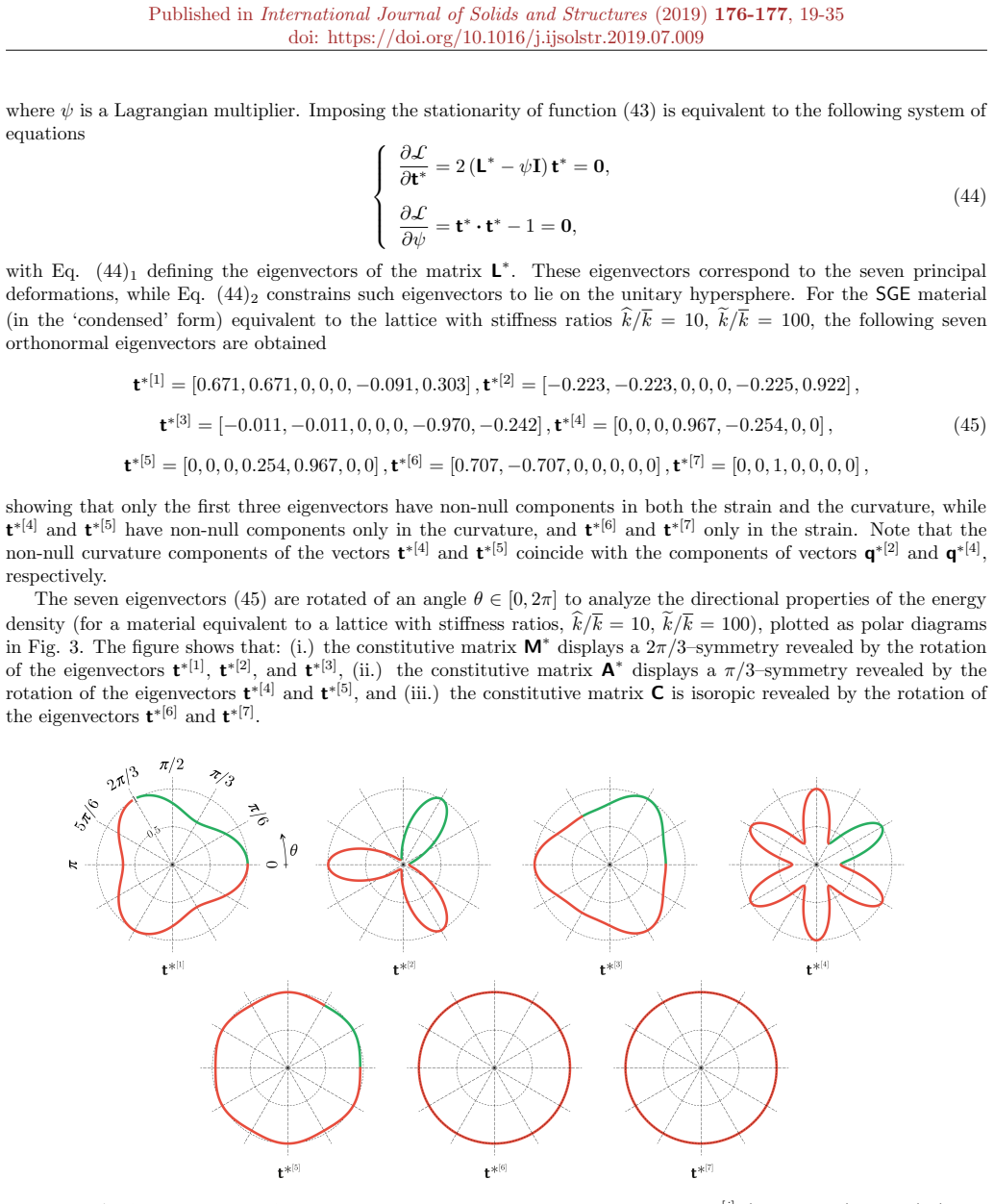
The central object is the trio of constitutive matrices $\mathbf{C}(k,\hat{k},\tilde{k})$, $\mathbf{M}(k,\hat{k},\tilde{k})$, and $\mathbf{A}(k,\hat{k},\tilde{k})$ of the standard second-gradient material, obtained from the condensed tensors $\mathbf{M}^*$ and $\mathbf{A}^*$ of Part I through the transformation $\mathbf{q}^* = \mathbf{Q}\,\mathbf{q}_{\mathrm{SGE}}$, $\mathbf{M} = \mathbf{M}^*\mathbf{Q} + \Delta\mathbf{M}$, $\mathbf{A} = \mathbf{Q}^T \mathbf{A}^*\mathbf{Q} + \Delta\mathbf{A}$, where the equilibrium constraints fix only part of $\mathbf{Q}$, $\Delta\mathbf{M}$, and $\Delta\mathbf{A}$. The identification leaves four coefficients undetermined ($Q_{35}$, $\Delta A_{11}$, $\Delta M_{15}$, $\Delta M_{16}$); the paper fixes them with the relaxation rule of Eq. (51), which corresponds to dropping the equilibrium constraint at the first identification step and yields closed-form rational expressions in the bar stiffnesses while preserving the positive-definiteness domain. The cell side $\ell$ enters explicitly, linearly in $\mathbf{M}$ and quadratically in $\mathbf{A}$, which is what gives the continuum its internal length. Symmetry analysis assigns $\mathbf{C}$ to $O(2)$, $\mathbf{M}$ to $Z_3$, and $\mathbf{A}$ to $D_6$; these symmetry restrictions together with the relaxation rule determine the remaining entries.
What would settle it
Subject a finite hexagonal lattice strip and its equivalent second-gradient continuum to three-point bending or a concentrated edge load, where the displacement field is not the quadratic equilibrium family used in the identification, and compare cell-averaged displacements and stored energies; if the SGE mismatch is no better than the Cauchy mismatch, the sufficiency assumption that the relaxed model works for arbitrary fields is refuted.
Extended reading notes
Core claim
The paper claims that the 'condensed' second-gradient material identified in Part I—by matching the lattice strain energy under quadratic displacement fields whose stress fields satisfy equilibrium—can be relaxed into a standard second-gradient elastic material with constitutive matrices $\mathbf{C}$, $\mathbf{M}$, and $\mathbf{A}$ written in closed form in Eq. (1). The Cauchy matrix $\mathbf{C}$ is isotropic with Lamé constants in Eq. (2); the coupling matrix $\mathbf{M}$ is non-centrosymmetric with $Z_3$ symmetry and vanishes exactly when the two non-perimeter bar stiffnesses are equal or when $k = \hat{k}\tilde{k}/(2(\hat{k}+\tilde{k}))$; the curvature matrix $\mathbf{A}$ has $D_6$ symmetry. The resulting material carries an internal length $\ell$, making it non-local and anisotropic in its higher-order response while locally isotropic. The paper validates this identification by solving simple shear and uniaxial strain boundary value problems exactly for both the lattice and the continuum, reporting that the second-gradient model tracks the exact lattice energy far more closely than the Cauchy model and captures a transverse displacement in uniaxial strain that a Cauchy solid cannot produce.
Load-bearing premise
The argument assumes that matching the lattice energy on the restricted family of equilibrium quadratic displacement fields, together with the specific rule chosen for the undetermined coefficients in Eq. (51), fixes a standard second-gradient material that also matches the lattice under arbitrary displacement fields; if that sufficiency step fails, the four validation problems would not be a genuine test.
Editorial extensions
If this is right
- A finite hexagonal truss can be replaced by the closed-form continuum of Eq. (1) at scales a few times the cell size, cutting computational cost while retaining size-dependent behaviour through the internal length $\ell$.
- The model predicts a measurable non-centrosymmetric effect: under uniaxial strain along one axis, the lattice develops a transverse displacement whenever $\hat{k}\ne\tilde{k}$ and $k\ne\hat{k}\tilde{k}/(2(\hat{k}+\tilde{k}))$, an effect invisible to a Cauchy or centrosymmetric continuum.
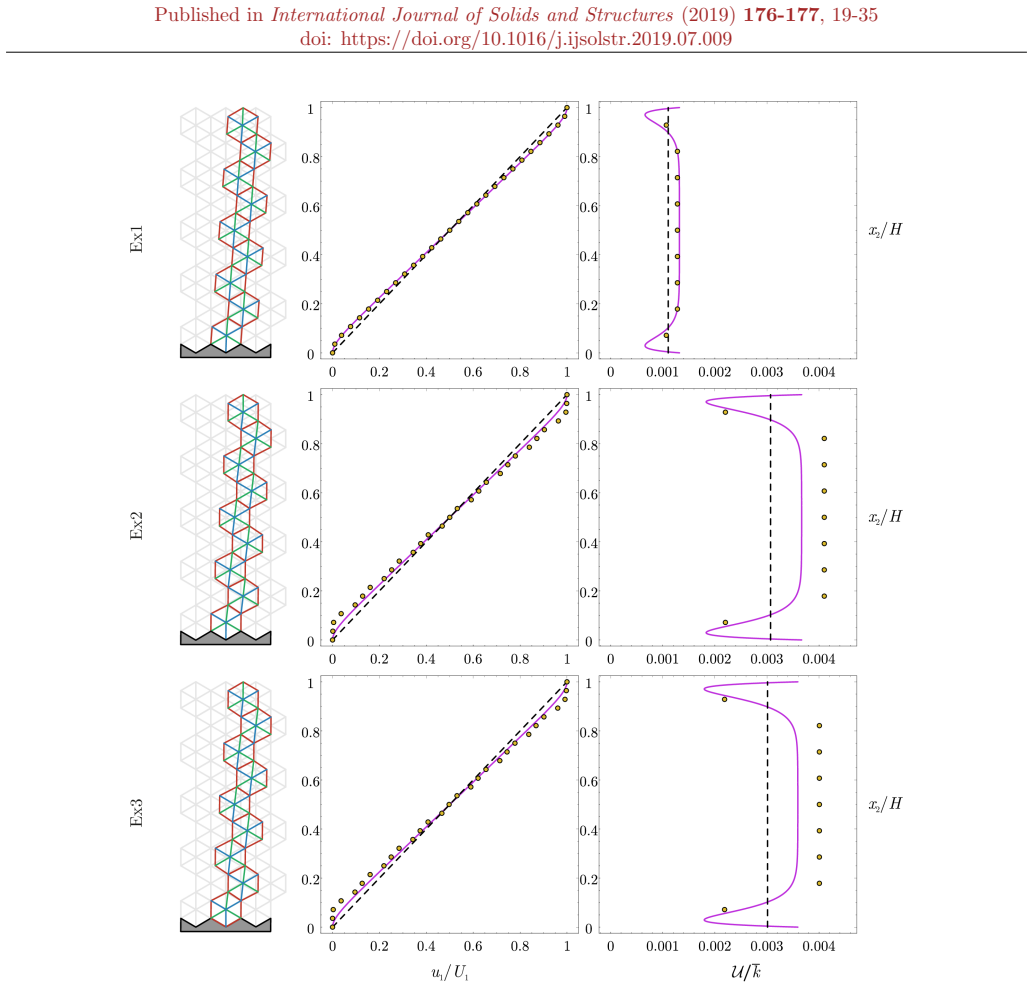
- Strain-energy comparisons in Tables 2 and 3 show the equivalent SGE material reduces the error from roughly 8-27% for the Cauchy model to about 1-9% in shear and below about 2% for uniaxial strain along the cell direction.
- Because the higher-order energy scales as $(\ell/\rho)^2$ relative to the classical energy, larger specimens should behave like the Cauchy solid while small specimens should show non-classical effects; the crossover ratio $\rho/\ell$ depends on the bar stiffness ratios.
- Positive definiteness of the equivalent material is not guaranteed: some stiffness ratios, including the regular equal-stiffness honeycomb, give an indefinite energy, but the energy stored in a finite disk becomes positive once the disk radius is large enough, so finite-size stability is the physically relevant check.
Reading between the lines
- Inference: the same matching procedure could be applied to other periodic truss topologies, such as triangular, kagome, square, or chiral lattices, with the symmetry classes of $\mathbf{M}$ and $\mathbf{A}$ encoding the lattice point group, so lattice geometry would translate directly into second-gradient constitutive data.
- Inference: the relaxation rule of Eq. (51) is one admissible choice among several, since $Q_{35}$ and $\Delta A_{11}$ remain undetermined by symmetry; alternative standard materials with identical condensed behaviour exist, and comparing them against the same benchmarks would isolate how much of the reported accuracy comes from the identification rather than from the specific rule.
- Inference: if the internal-length picture is right, elastic wave dispersion in a finite hexagonal lattice should deviate from the Cauchy prediction at wavenumbers near $1/\ell$, with the $\mathbf{M}$ term coupling shear and dilatational branches; measuring dispersion curves would validate the model in dynamics.
- Inference: because swapping $\hat{k}$ and $\tilde{k}$ flips the sign of $m$ while leaving the other constitutive matrices unchanged, the same lattice geometry could act as a mechanically switchable non-centrosymmetric medium whose bending direction under uniaxial strain is set by the stiffness ordering.
Signed reviews
Editorial analysis
A structured set of objections, weighed in public.
Referee Report
Summary. This paper completes the identification of a second-gradient elastic (SGE) continuum equivalent to a planar hexagonal lattice of axially deformable bars. Starting from the 'condensed' constitutive matrices C, M*, A* derived in Part I under equilibrium-satisfying quadratic displacement fields, the authors construct a 'standard' SGE material with constitutive matrices C, M, A given in closed form in Eq. (1). They analyze the symmetry classes of these tensors (isotropic C, Z3-symmetric M, D6-symmetric A), study positive definiteness of the condensed energy and its dependence on the bar stiffness ratios, and validate the model by comparing the lattice response with the SGE and Cauchy continuum responses under simple shear and uniaxial strain in four aligned loading configurations. The validation is reported as a reduction of strain-energy mismatch when the SGE model replaces the classical Cauchy model.
Significance. If the identification is accepted, the paper provides a closed-form, parameter-free second-gradient continuum model of a hexagonal lattice, with an internal length and non-centrosymmetric coupling terms, which is of genuine interest for micromechanics and metamaterial design. The authors give exact analytical lattice solutions (obtained with Mathematica) and explicit formulas for all constitutive coefficients, so the paper is checkable and reproducible in principle. The validation is not circular: the constitutive parameters are obtained from energy matching, not from fitting the validation responses, and the paper demonstrates a clear non-centrosymmetric effect (transverse displacement under uniaxial strain) that a Cauchy model cannot capture. The main weaknesses are the underdetermined extension from the condensed to the standard form and the mixed quality of the validation results, which fall short of the claimed 'excellent agreement'.
major comments (5)
- [§2.4, Eq. (51)] The extension from the condensed to the standard SGE form is underdetermined. Equations (14)-(16) leave four coefficients (Q35, ΔA11, ΔM15, ΔM16) unspecified by energy matching, and Eq. (51) fixes them by a rule described in words ('imposing an equivalence ... in which the equilibrium constraint on the coefficients βijk is neglected') rather than derived from an explicit energy-matching or minimization criterion. Since the matrices M and A in Eq. (1) depend on this choice, the claim that the resulting SGE material is energetically equivalent to the lattice for arbitrary displacement fields is not established. A concrete test would be an off-axis boundary value problem (e.g., simple shear or bending with a loading direction not aligned with the x1/x2 lattice axes) that activates the non-condensed curvature modes; the current validation only uses four aligned cases (Tables 2 and 3).
- [§3.1.3, Table 2] The reported errors undercut the 'excellent agreement' language in the Abstract and Section 1. For Ex2, simple shear parallel to the x2-axis, the SGE energy error is 19.3%, compared with 26.74% for Cauchy, so the improvement is modest and the absolute error remains large. For the same loading, Ex3 shows an SGE error of only 1.14%, indicating strong configuration dependence. The paper should either soften the global validation claim or explain why the x2-aligned shear case is an outlier.
- [§3.2.3, Table 3] Negative discrepancies (e.g., -6.83%, -7.47%, -8.23% for the uniaxial parallel to x1 cases) show that the SGE model is stiffer than the lattice in these configurations. This contradicts the impression of a consistently improved match and means the energy comparison is not one-sided. The statement that the advantage 'becomes clear' for uniaxial strain parallel to x2 is not supported by the last column of Table 3, where the SGE errors are -1.24%, 0.57%, and -0.72%. The authors should address why the equivalent SGE solid can be stiffer than the lattice and what this implies for the claimed energetic equivalence.
- [§3.2.1, Eq. (71)] The expression for τ211(x2) contains the coefficient a45, which is not defined in Eq. (1) or elsewhere in the paper; the A matrix in Eq. (1) uses only a11, a12, a16, a26, and a34. As written, the closed-form solution for uniaxial strain parallel to the x2-axis is not reproducible. Please define a45 or correct the typo (possibly it should be a26 or a16).
- [§2.4, after Eq. (51)] The assertion that the chosen values of Q35, ΔA11, ΔM15, and ΔM16 provide a positive-definiteness domain identical for the condensed and standard forms is not proved and is not obvious, because the standard form operates on a larger curvature space (six curvature components versus four in the condensed form). A symbolic or numerical verification of this equality should be provided, or the statement should be qualified.
minor comments (6)
- [§2.1, Eq. (33)] The word 'verifed' should be 'verified'.
- [§2.2] The word 'isoropic' in the sentence about the C matrix should be 'isotropic'.
- [§2.4] The phrase 'first indentification step' contains a typo: 'indentification' should be 'identification'.
- [Table 1 header] The header lists the ratios as 'ˆk/k and ˆk/k'; the second ratio should be '~k/k'.
- [§3.1.3, footnote 2] The statement that the dimensionless energy difference coincides with the dimensionless difference of the resultant tractions is non-obvious and should be derived or referenced, since it is used to interpret Tables 2 and 3.
- [Eq. (20)] In the last row of R[q](θ), there is a misplaced period after '( c(θ) +c(3θ))/2.'; the notation should be cleaned up.
Circularity Check
No significant circularity: the SGE parameters come from energy matching, not from fitting the validation responses, and the lattice comparisons are independent exact solutions.
full rationale
The constitutive matrices in Eq. (1) are not fitted to the validation boundary value problems. They are obtained from the closed-form energy matching established in Part I (Eqs. (6)-(7)) and from the stated extension rule in Section 2.4, Eq. (51), which removes the equilibrium constraint by imposing energy equivalence with the lattice for general quadratic displacement fields. The four remaining coefficients Q35, Delta-A11, Delta-M15, and Delta-M16 are fixed by that rule, not by the simple shear or uniaxial strain comparisons. The validation in Section 3 solves the lattice exactly with Mathematica and compares the lattice response with the continuum response, so it is an independent check of the chosen extension rather than a restatement of the identification inputs. The paper's reliance on Part I is a self-citation, but Part I is a separately published analytical derivation with stated assumptions, and Part II provides direct numerical lattice comparisons that do not depend on the cited closed forms for the validation data. The symmetry classes of M and A are imposed as constraints (Section 2.1.2) rather than independently predicted, but this is an explicit modeling choice, not a circular reduction of the central equivalence claim. The underdetermination of the condensed-to-standard extension and the residual, sometimes negative, energy mismatches in Tables 2-3 are robustness or correctness concerns, not circularity.
Assumptions & free parameters
free parameters (3)
- Q35 (condensed-to-standard transformation coefficient) =
Expression in k, ^k, ~k given in Eq. (51), not a numeric fit
- Delta A11 (curvature stiffness contribution) =
Expression in k, ^k, ~k given in Eq. (51), not a numeric fit
- Delta M15 and Delta M16 (coupling contributions) =
Set to 0 by the practical rule in Eq. (51)
assumptions (5)
- domain assumption The hexagonal lattice is made of axially deformable bars with hinged joints, so bars carry only axial force.
- domain assumption The equivalent SGE solid is defined by strain-energy matching under remote quadratic displacement fields whose generated stresses are in equilibrium, the 'condensed form'.
- domain assumption The 'standard' SGE energy in Eq. (11) with matrices C, M, A is admissible and complete for the homogenized material.
- domain assumption Plane strain or plane stress reduction with the stated relation for lambda'.
- domain assumption Positive definiteness of the constitutive matrix is the relevant stability criterion.
Cite this review
Pith. "Pith review of Identification of second-gradient elastic materials from planar hexagonal lattices. Part II: Mechanical characteristics and model validation." pith.science (2026). https://pith.science/paper/IIQITBRA
@misc{pith2026190801640,
  author       = {Pith},
  title        = {Pith review of: Identification of second-gradient elastic materials from planar hexagonal lattices. Part II: Mechanical characteristics and model validation},
  year         = {2026},
  howpublished = {\url{https://pith.science/paper/IIQITBRA}},
  note         = {Machine review of arXiv:1908.01640}
}
read the original abstract
Positive definiteness and symmetry of the constitutive tensors describing a second-gradient elastic (SGE) material, which is energetically equivalent to a hexagonal planar lattice made up of axially deformable bars, are analyzed by exploiting the closed form-expressions obtained in part I of the present study in the \lq condensed' form. It is shown that, while the first-order approximation leads to an isotropic Cauchy material, a second-order identification procedure provides an equivalent model exhibiting non-locality, non-centrosymmetry, and anisotropy. The derivation of the constitutive properties for the SGE from those of the \lq condensed' one (obtained by considering a quadratic remote displacement which generates stress states satisfying equilibrium) is presented. Comparisons between the mechanical responses of the periodic lattice and of the equivalent SGE material under simple shear and uniaxial strain show the efficacy of the proposed identification procedure and therefore validate the proposed constitutive model. This model reveals that, at higher-order, a lattice material can be made equivalent to a second-gradient elastic material exhibiting an internal length, a finding which is now open for applications in micromechanics.
Figures


Figures from the paper (8 more)




Reference graph
Works this paper leans on
- [1]
-
[3]
M. Bacca, D. Bigoni, F. Dal Corso, and D. Veber. Mindlin second-gradient elastic properties from dilute two- phase cauchy-elastic composites. part I: Closed form expression for the effective higher-order constitutive tensor. International Journal of Solids and Structures , 50(24):4010–4019, 2013
work page 2013
- [4]
-
[5]
A. Bacigalupo. Second-order homogenization of periodic materials based on asymptotic approximation of the strain energy: formulation and validity limits. Meccanica, 49(6):1407–1425, 2014
work page 2014
-
[6]
A. Bacigalupo and L. Gambarotta. Second-order computational homogenization of heterogeneous materials with periodic microstructure. ZAMM-Journal of Applied Mathematics and Mechanics/Zeitschrift f¨ ur Angewandte Mathematik und Mechanik , 90(10-11):796–811, 2010
work page 2010
-
[7]
A. Bacigalupo and L. Gambarotta. Simplified modelling of chiral lattice materials with local resonators. Inter- national Journal of Solids and Structures , 83:126–141, 2016
work page 2016
-
[8]
A. Bacigalupo and L. Gambarotta. Wave propagation in non-centrosymmetric beam-lattices with lumped masses: Discrete and micropolar modeling. International Journal of Solids and Structures , 118:128–145, 2017
work page 2017
-
[9]
D. Bigoni and W.J. Drugan. Analytical derivation of cosserat moduli via homogenization of heterogeneous elastic materials. Journal of Applied Mechanics , 74(4):741–753, 2007
work page 2007
Show all 36 references
-
[10]
Cosserat and F
E. Cosserat and F. Cosserat. Sur la theorie des corps deformables . Herman, Paris, 1909
1909
-
[11]
Dal Corso and L
F. Dal Corso and L. Deseri. Residual stresses in random elastic composites: Nonlocal micromechanics-based models and first estimates of the representative volume element size. Meccanica, 48(8):1901–1923, 2013
1901
-
[12]
Day, K.A
A.R. Day, K.A. Snyder, E.J. Garboczi, and M.F. Thorpe. The elastic moduli of a sheet containing circular holes. Journal of the Mechanics and Physics of Solids , 40(5):1031–1051, 1992
1992
-
[13]
W. J. Drugan and J. R. Willis. A micromechanics-based nonlocal constitutive equation and estimates of represen- tative volume element size for elastic composites. Journal of the Mechanics and Physics of Solids , 44(4):497–524, 1996
1996
-
[14]
N. A. Fleck and J. W. Hutchinson. A reformulation of strain gradient plasticity. Journal of the Mechanics and Physics of Solids , 49(10):2245–2271, 2001
2001
-
[15]
N. A. Fleck and J. R. Willis. A mathematical basis for strain-gradient plasticity theory-part I: Scalar plastic multiplier. Journal of the Mechanics and Physics of Solids , 57(1):161–177, 2009
2009
-
[16]
S. Forest. Homogenization methods and the mechanics of generalized continua-part 2. Theoretical and applied mechanics, 28(29):113–144, 2002
2002
-
[17]
Mechanics of generalized continua: construction by homogenizaton
Samuel Forest. Mechanics of generalized continua: construction by homogenizaton. Le Journal de Physique IV , 8(PR4):Pr4–39, 1998
1998
-
[18]
Cosserat overall modeling of heterogeneous materials
Samuel Forest and Karam Sab. Cosserat overall modeling of heterogeneous materials. Mechanics Research Communications, 25(4):449–454, 1998
1998
-
[19]
Gourgiotis and D
P.A. Gourgiotis and D. Bigoni. Folding and faulting of an elastic continuum. Proc.R.Soc.A, 472:20160018, 2016
2016
-
[20]
Gourgiotis and D
P.A. Gourgiotis and D. Bigoni. Stress channelling in extreme couple-stress materials part II: Localized folding vs faulting of a continuum in single and cross geometries. Journal of the Mechanics and Physics of Solids , 88:169 – 185, 2016
2016
-
[21]
Gourgiotis, T
P.A. Gourgiotis, T. Zisis, and H. G. Georgiadis. On concentrated surface loads and green’s functions in the toupin-mindlin theory of strain-gradient elasticity. International Journal of Solids and Structures , 130-131:153– 171, 2018
2018
-
[22]
W.T. Koiter. Couple-stresses in the theory of elasticity, parts I and II. Proc. K. Ned. Akad. Wet., Ser. B: Phys. Sci., 67:17–44, 1964
1964
-
[23]
Lekhnitskii, P
S.G. Lekhnitskii, P. Fern, J.J. Brandstatter, and E.H. Dill. Theory of elasticity of an anisotropic elastic body. Physics Today, 17:84, 1964
1964
-
[24]
R.D. Mindlin. Micro-structure in linear elasticity. Archive for Rational Mechanics and Analysis , 16(1):51–78, 1964. 24 Published in International Journal of Solids and Structures (2019) 176-177, 19-35 doi: https://doi.org/10.1016/j.ijsolstr.2019.07.009
2019 doi
-
[25]
Mindlin and N.N
R.D. Mindlin and N.N. Eshel. On first strain-gradient theories in linear elasticity. International Journal of Solids and Structures, 4(1):109 – 124, 1968
1968
-
[26]
Ostoja-Starzewski, S.D
M. Ostoja-Starzewski, S.D. Boccara, and I. Jasiuk. Couple-stress moduli and characteristic length of a two-phase composite. Mechanics Research Communications, 26(4):387–396, 1999
1999
-
[27]
Papathanasiou, P.A
T.K. Papathanasiou, P.A. Gourgiotis, and F. Dal Corso. Finite element simulation of a gradient elastic half-space subjected to thermal shock on the boundary. Applied Mathematical Modelling , 40(23-24):10181–10198, 2016
2016
-
[28]
Rizzi, D
G. Rizzi, D. Veber, F. Dal Corso, and D. Bigoni. Identification of second-gradient elastic materials from planar hexagonal lattices. part I: Analytical derivation of equivalent constitutive tensors. International Journal of Solids and Structures, 176–177:1–18, 2019
2019
-
[29]
Smyshlyaev
V.P. Smyshlyaev. Propagation and localization of elastic waves in highly anisotropic periodic composites via two-scale homogenization. Mechanics of Materials , 41(4):434–447, 2009
2009
-
[30]
Smyshlyaev and K.D
V.P. Smyshlyaev and K.D. Cherednichenko. On rigorous derivation of strain gradient effects in the overall behaviour of periodic heterogeneous media. Journal of the Mechanics and Physics of Solids , 48(6-7):1325–1357, 2000
2000
-
[31]
Snyder, E.J
K.A. Snyder, E.J. Garboczi, and A. R. Day. The elastic moduli of simple two-dimensional isotropic composites: Computer simulation and effective medium theory. Journal of applied physics , 72(12):5948–5955, 1992
1992
-
[32]
T.-H. Tran, V. Monchiet, and G. Bonnet. A micromechanics-based approach for the derivation of constitutive elastic coefficients of strain-gradient media. International Journal of Solids and Structures , 49(5):783–792, 2012
2012
-
[33]
Trovalusci, M
P. Trovalusci, M. Ostoja-Starzewski, M.L. De Bellis, and A. Murrali. Scale-dependent homogenization of random composites as micropolar continua. European Journal of Mechanics-A/Solids , 49:396–407, 2015
2015
-
[34]
Wheel, J.C
M.A. Wheel, J.C. Frame, and P.E. Riches. Is smaller always stiffer? on size effects in supposedly generalised continua. International Journal of Solids and Structures , 67-68:84 – 92, 2015
2015
-
[35]
J.R. Willis. Variational and related methods for the overall properties of composites. Advances in applied mechanics, 21:1–78, 1981
1981
-
[36]
Zisis, P
Th. Zisis, P. A. Gourgiotis, and H. G. Georgiadis. Contact mechanics in the framework of couple stress elasticity , volume 90. Advanced Structured Materials, 2018
2018
-
[37]
Zisis, P.A
Th. Zisis, P.A. Gourgiotis, Konstantinos P. Baxevanakis, and H.G. Georgiadis. Some basic contact problems in couple stress elasticity. International Journal of Solids and Structures , 51(11-12):2084–2095, 2014. 25
2014
Reviewed August 14, 2026 · model on record in the stance chip above.
Discussion (0). Continue with ORCID to comment.