REVIEW 3 major objections 6 minor 73 references
Quantum Simulation of Semiconductor Excitons in Ultracold Dipolar Fermi Gases
T0 review · 3 major / 6 minor · reviewed 2026-08-01 · deepseek-v4-flash
Pith's one-line read Ultracold dipolar fermions in a honeycomb lattice can form bound exciton analogues whose binding energy and spatial size are tunable from a Wannier-like weak-coupling regime to a flat-band strong-coupling regime.
desk verdict A promising cold-atom platform for exciton physics, with the three-level flat-band model as the cleanest new result; the single-pair truncation is the main open question. read the letter →
The pith
A machine-rendered reading of the paper's core claim, the machinery that carries it, and where it could break.
The reading
What carries the argument
The central object is the single-particle-hole exciton ansatz |X_n⟩ = Σ_p α_np c†_p v_p |FS⟩, i.e., exactly one electron promoted out of the filled valence band. Its energy is obtained by diagonalizing the full Hamiltonian in this restricted subspace via a Bethe-Salpeter equation. Two controlled limits carry the argument: the effective-mass approximation reduces the problem to a two-body Schrödinger equation with reduced mass and an attractive dipolar potential; a Schrieffer-Wolff transformation in the flat-band limit reduces it to a single-particle model on the relative-position lattice, whose strong potential ring-localizes the exciton and yields an emergent three-level system with Hamilto
What would settle it
Perform exact diagonalization of the full dipolar Fermi-Hubbard Hamiltonian on a small honeycomb lattice including all particle-hole sectors; if no two-particle bound state appears below the two-particle continuum at the predicted band-gap-to-hopping values, the central claim is false. Experimentally, a lattice-modulation scan looking for the predicted sharp absorption lines would directly test the existence of the bound states.
Extended reading notes
Core claim
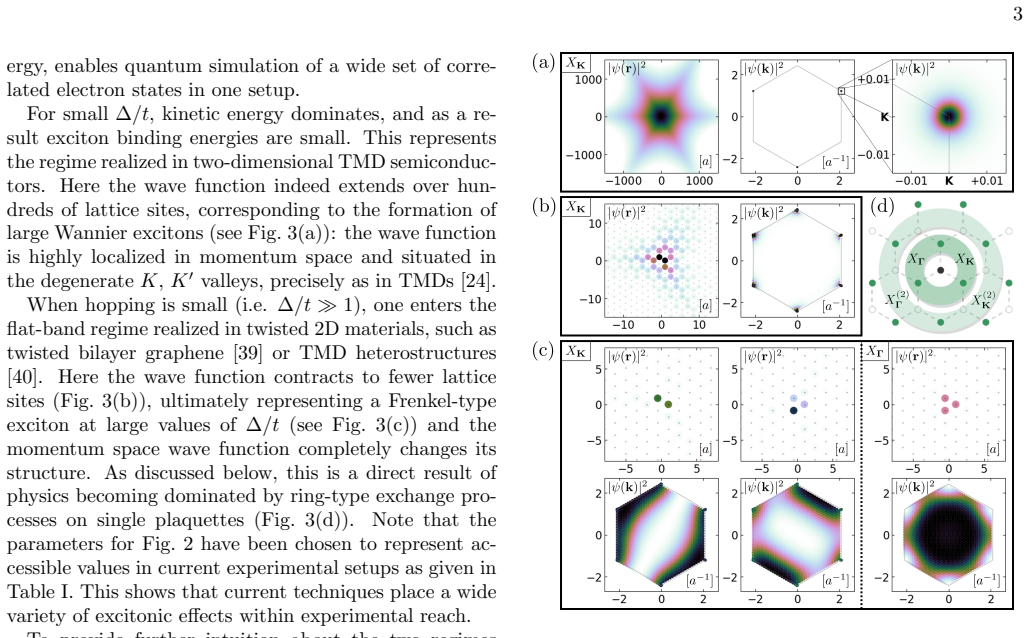
The paper predicts the existence of cold atomic excitons: in a half-filled honeycomb lattice of dipolar fermions with a sublattice offset, a fermion promoted from the filled valence band to the empty conduction band binds to the remaining hole through the effectively attractive interaction generated by repulsive dipolar forces. Exact diagonalization of a single particle-hole pair yields binding energies that range from small values, where the exciton wave function spreads over hundreds of lattice sites around the K and K' points, to strongly bound ring-localized states at large band-gap-to-hopping ratios. The same band structure interpolates between the exciton physics of transition metal di
Load-bearing premise
The central prediction rests on the assumption that the physics is captured by exactly one particle-hole pair: the calculation keeps a single electron promoted to the conduction band and a single hole in the valence band, and does not include multi-pair states, self-energy corrections, or band renormalization from the filled Fermi sea; if those many-body effects shift or destabilize the bound states, the predicted cold atomic excitons would not be true eigenstates of the gas.
Editorial extensions
If this is right
- If the prediction holds, one cold-atom setup covers both exciton paradigms: large Wannier excitons at small band-gap-to-hopping ratios and compact Frenkel-like states at large ratios, with the crossover controlled by lattice parameters.
- Lattice modulation spectroscopy should show discrete absorption lines at the predicted exciton energies, with oscillator strengths that depend on the modulation pattern and can identify individual exciton states.
- Quantum gas microscopy can image the real-space exciton wave function, giving direct access to information that is hard to resolve in solid-state semiconductor samples.
- The same platform can be extended to doping-dependent studies and interacting excitons, opening a cold-atom route to trions, exciton-polarons, and excitonic insulators.
Reading between the lines
- Editorial inference: because the calculation is restricted to one electron-hole pair, the cleanest validation would be a full many-body calculation on small lattices; if binding survives multi-pair corrections, the predicted two-regime crossover is robust, whereas if it does not, the single-pair ansatz is the limiting step.
- Editorial inference: the ring-localization hierarchy, with three-level systems emerging at successive electron-hole distances, suggests a predictable series of excited exciton shells; one could test for the next shell at distance 3a and compare its spectrum with the flat-band model.
- Editorial inference: tuning a single ratio in one device offers a direct, parameter-free comparison of effective-mass and flat-band approximations against exact numerics—something solid-state samples cannot do because material parameters are fixed.
Signed reviews
Editorial analysis
A structured set of objections, weighed in public.
Referee Report
Summary. The paper proposes a cold-atom quantum simulator for semiconductor excitons, using ultracold dipolar fermions in a honeycomb optical lattice with a sublattice offset that opens a TMD-like band gap. The central object is a single electron-hole pair on top of the filled valence band, described by Eq. (3), whose eigenenergies and wave functions are obtained from a projected Bethe-Salpeter equation (Supplemental Eq. (S33)), solved numerically on a designed momentum grid. Binding energies are computed as a function of Delta/t at fixed V1/Delta=0.2, and the results are compared with two asymptotic approximations: an effective-mass model for small Delta/t and a Schrieffer-Wolff flat-band model for large Delta/t. The authors predict bound 'cold atomic excitons' from the weak-coupling Wannier regime to the flat-band Frenkel regime, propose detection via lattice modulation spectroscopy and quantum-gas microscopy, and provide concrete experimental parameters for erbium and NaK setups. The paper includes a detailed Supplemental Material with derivations of the Bethe-Salpeter equation, the effective-mass and flat-band models, and the transition operator.
Significance. If the central approximation is valid, the paper opens a new avenue for quantum simulation of 2D semiconductor exciton physics, with the unique tunability of cold atoms connecting TMD-like and flat-band regimes in a single platform. The concrete experimental parameters and the proposed detection schemes (spectroscopy and microscopy) make the predictions falsifiable. The flat-band analysis, especially the emergent three-level system that explains the degeneracy and angular momentum structure of the exciton states, is an elegant and nontrivial analytical result. The Supplemental Material is thorough and provides a clear path for reproducing the numerics. The main weakness is that the existence and quantitative properties of excitons rest entirely on a single-pair Tamm-Dancoff truncation, which is not benchmarked against any many-body calculation.
major comments (3)
- [Eq. (3); Supplemental Sec. II, Eq. (S33)] The central prediction of bound excitons is obtained from a Hilbert space containing exactly one conduction electron and one valence hole on top of the non-interacting Fermi sea. This is a Tamm-Dancoff truncation. Couplings to multi-pair states, self-energy corrections, and interaction-induced renormalization of the Fermi sea are neglected. Since V1/Delta = 0.2 is not a small parameter and the crossover regime Delta/t ~ 1-10 has no controlled expansion, the approximation is not a priori justified. The two asymptotic models do not independently validate it: the effective-mass model is calibrated to the single-pair ED (see next comment), and the flat-band model is valid only for large Delta/t. I request a benchmark against full Fock-space exact diagonalization on small clusters, or an independent diagrammatic/RPA estimate of multi-pair corrections, to show that the single-pair binding ener
- [Effective mass approximation, Eq. (5)] The short-distance cutoff r0 = 0.705a is determined by matching the numerical exciton eigenenergy at Delta/t = 1.2. Therefore the close agreement between the blue effective-mass curve and the black ED curve in Fig. 2 for Delta/t <= 2 is partly by construction, not an independent confirmation of the effective-mass model. This is a standard renormalization/fitting procedure, but the paper should present it as such and not as an ab initio prediction. The model would be substantially strengthened by showing that the same r0 also reproduces the excited-state energies or the real-space wave function in the same regime.
- [Supplemental Sec. II, momentum grid paragraph] The two-part momentum grid (1200 uniform points plus 270 logarithmic steps) is described, but no convergence analysis or error bars are given. The eigenenergies in Fig. 2 are the central quantitative results and the basis for comparison with both asymptotic models. Please state how the results depend on the number of grid points, the logarithmic refinement, and the Voronoi weighting, and provide an estimate of the numerical uncertainty, especially for the higher excited states X^{(2)}_K and X^{(2)}_Gamma.
minor comments (6)
- [General / Eq. (3)] The term 'exact diagonalization' is used for solving the single-pair Bethe-Salpeter equation in a restricted Hilbert space. This is not full many-body ED and may overstate the numerical content. Suggest renaming to 'single-pair ED' or 'Bethe-Salpeter solution' throughout.
- [Table I] The table rows list three numerical values each (e.g., 'NN distance a 266 nm 532 nm 752 nm') while the header names only two experimental systems (Erbium, NaK). Please clarify which value corresponds to which setup and ensure the column structure is unambiguous.
- [Eq. (4)] The interaction V_q is not defined at first use in Eq. (4); it is defined later in the effective-mass section. Please define it at the point of introduction.
- [Flat-band section, Eq. (6)] The notation d_i for the pair creation operator is introduced, but the relation to the relative-position lattice and the beta_{i,r_j} coefficients in the Supplemental is not explicitly stated in the main text. A brief note would improve clarity.
- [Fig. 2] The text refers to 'three vertical cuts' in Fig. 2 with wave functions shown in Fig. 3(a-c), but the cut values are not marked in the figure. Adding the values (Delta/t = 1.5, 3, 10) to the figure would help the reader.
- [Supplemental Sec. III] The notation zeta^tri(3,delta) for the Epstein-zeta constant is not defined. A short definition or reference would be helpful.
Circularity Check
EMA cutoff is fitted to the ED data it then claims to reproduce; central ED/flat-band results are independent.
-
fitted input called prediction
[Main text, 'Effective mass approximation' section (paragraph after Eq. 5)]
"The short-distance cutoff r0 = 0.705a is numerically determined by matching the numerical exciton eigenenergy at Δ/t=1.2; for a detailed derivation of Eq. (5), see Ref. [48]. Solving Eq. (5) yields energies that agree very well with the full solution in the range of Δ/t≤2."
The effective-mass Schrödinger equation contains one free parameter, r0, which is fixed by matching the ED eigenenergy at Δ/t=1.2. The same ED spectrum is then used to claim that the effective-mass model 'agrees very well with the full solution' over Δ/t≤2. At the matching point the agreement holds by construction, so the validation of the effective-mass curve is calibrated rather than parameter-free. This is a partial fit-to-data circle. It does not, however, invalidate the central claim, because the full ED binding energies and the flat-band model are computed without any use of r0; only the effective-mass comparison is affected.
full rationale
The central derivation is self-contained: the existence and spectra of cold-atomic excitons are obtained by exact diagonalization of H0+Hint within the single-particle-hole subspace defined by |X_n> = Σ_p α_np c†_p v_p |FS>, Eq. (3), with the energy functional F[α] in Supplemental Eqs. (S19)–(S33). This is a conventional Tamm-Dancoff-style truncation, not a circular reduction: the answer is not inserted into the input but computed from the projected Hamiltonian. The flat-band model is derived independently via a Schrieffer-Wolff expansion in t/Δ, with no fitted parameters, and the three-level H3 follows from that model in the strongly interacting limit. No load-bearing self-citation chain or imported uniqueness theorem appears; references to prior work by the same authors are background context. The only identifiable circularity is the effective-mass cutoff r0, which is fitted to one ED eigenenergy and then used to assert agreement with the same ED calculation. Because the paper discloses this fitting explicitly and because it affects only the effective-mass consistency check rather than the main ED/flat-band prediction, the overall circularity is partial but limited, giving a score of 4 rather than higher.
Assumptions & free parameters
free parameters (2)
- r0 (short-distance cutoff in effective-mass potential) =
0.705 a
- V1/Δ (fixed interaction ratio) =
0.2
assumptions (5)
- domain assumption The honeycomb optical lattice with sublattice offset Δ is accurately described by the tight-binding Hamiltonian H0 (Eq. 1).
- domain assumption Dipolar interactions dominate and can be treated as point-like d^2/r^3 potentials with negligible short-range corrections V_s(r).
- domain assumption The system is at half-filling with the valence band completely filled and the conduction band empty (T << Δ).
- domain assumption A single zero-momentum particle-hole excitation ansatz (Eq. 3) captures the exciton states.
- domain assumption The perturbative limits (effective mass for W >> V, flat-band Schrieffer-Wolff for t/Δ, V/Δ << 1) are valid in their respective parameter windows.
Cite this review
Pith. "Pith review of Quantum Simulation of Semiconductor Excitons in Ultracold Dipolar Fermi Gases." pith.science (2026). https://pith.science/paper/IJQ6WTCU
@misc{pith2026260719467,
  author       = {Pith},
  title        = {Pith review of: Quantum Simulation of Semiconductor Excitons in Ultracold Dipolar Fermi Gases},
  year         = {2026},
  howpublished = {\url{https://pith.science/paper/IJQ6WTCU}},
  note         = {Machine review of arXiv:2607.19467}
}
read the original abstract
Inspired by the progress on the study of exciton physics in atomically thin transition metal dichalcogenide (TMD) semiconductors, we investigate the formation of analogs of excitons in cold atomic systems. To this end, we consider single-component fermions comprised of ultracold ground-state molecules or dipolar atoms in a hexagonal optical lattice. An energy offset between triangular sublattices opens up a band gap with degeneracies at the K/K' points as in TMDs. We predict the existence of cold atomic excitons and show that cold atoms allow us to study excitons from the weak-coupling regime, where effective mass models apply, to the strong-interaction regime, described by flat-band models. We demonstrate how these excitons can be observed using lattice modulation spectroscopy, and how their wave functions can be mapped out using quantum gas microscopy. Firmly establishing the idea of quantum simulation of semiconductor physics, this work lays the foundation for simulating complex electronic states such as trions, polarons and excitonic insulators.
Figures


Reference graph
Works this paper leans on
-
[1]
Jaksch, C
D. Jaksch, C. Bruder, J. I. Cirac, C. W. Gardiner, and P. Zoller, Cold Bosonic Atoms in Optical Lattices, Phys. Rev. Lett.81, 3108 (1998)
1998
-
[2]
Greiner, O
M. Greiner, O. Mandel, T. Esslinger, T. W. H¨ ansch, and I. Bloch, Quantum phase transition from a superfluid to a Mott insulator in a gas of ultracold atoms, Nature415, 39 (2002)
2002
-
[3]
Sch¨ afer, T
F. Sch¨ afer, T. Fukuhara, S. Sugawa, Y. Takasu, and Y. Takahashi, Tools for quantum simulation with ultra- cold atoms in optical lattices, Nat. Rev. Phys.2, 411 (2020)
2020
-
[4]
B. Yang, H. Sun, C.-J. Huang, H.-Y. Wang, Y. Deng, H.-N. Dai, Z.-S. Yuan, and J.-W. Pan, Cooling and en- tangling ultracold atoms in optical lattices, Science369, 550 (2020)
2020
-
[5]
Altman, K
E. Altman, K. R. Brown, G. Carleo, L. D. Carr, E. Dem- ler, C. Chin, B. DeMarco, S. E. Economou, M. A. Eriks- son, K.-M. C. Fu, M. Greiner, K. R. Hazzard, R. G. Hulet, A. J. Koll´ ar, B. L. Lev, M. D. Lukin, R. Ma, X. Mi, S. Misra, C. Monroe, K. Murch, Z. Nazario, K.-K. Ni, A. C. Potter, P. Roushan, M. Saffman, M. Schleier- Smith, I. Siddiqi, R. Simmonds,...
2021
-
[6]
L. Su, A. Douglas, M. Szurek, R. Groth, S. F. Ozturk, A. Krahn, A. H. H´ ebert, G. A. Phelps, S. Ebadi, S. Dick- erson, F. Ferlaino, O. Markovi´ c, and M. Greiner, Dipolar quantum solids emerging in a Hubbard quantum simula- tor, Nature622, 724 (2023)
2023
-
[7]
Z. Meng, L. Wang, W. Han, F. Liu, K. Wen, C. Gao, P. Wang, C. Chin, and J. Zhang, Atomic Bose-Einstein condensate in twisted-bilayer optical lattices, Nature 615, 231 (2023)
2023
-
[8]
Langen, G
T. Langen, G. Valtolina, D. Wang, and J. Ye, Quantum state manipulation and cooling of ultracold molecules, Nat. Phys.20, 702 (2024)
2024
Show all 73 references
-
[9]
S. L. Cornish, M. R. Tarbutt, and K. R. A. Hazzard, Quantum computation and quantum simulation with ul- tracold molecules, Nat. Phys.20, 730 (2024)
2024
-
[10]
J. C. Halimeh, M. Aidelsburger, F. Grusdt, P. Hauke, and B. Yang, Cold-atom quantum simulators of gauge theories, Nat. Phys.21, 25 (2025)
2025
-
[11]
Chalopin, P
T. Chalopin, P. Bojovi´ c, D. Bourgund, S. Wang, T. Franz, I. Bloch, and T. Hilker, Optical Superlattice for Engineering Hubbard Couplings in Quantum Simula- tion, Phys. Rev. Lett.134, 053402 (2025)
2025
-
[12]
K. S. Novoselov, A. K. Geim, S. V. Morozov, D. Jiang, Y. Zhang, S. V. Dubonos, I. V. Grigorieva, and A. A. Firsov, Electric Field Effect in Atomically Thin Carbon Films, Science306, 666 (2004)
2004
-
[13]
A. K. Geim and K. S. Novoselov, The rise of graphene, Nat. Mater.6, 183 (2007)
2007
-
[14]
A. K. Geim and I. V. Grigorieva, Van der Waals het- erostructures, Nature499, 419 (2013)
2013
-
[15]
Fiori, F
G. Fiori, F. Bonaccorso, G. Iannaccone, T. Pala- cios, D. Neumaier, A. Seabaugh, S. K. Banerjee, and L. Colombo, Electronics based on two-dimensional ma- terials, Nat. Nanotechnol.9, 768 (2014)
2014
-
[16]
Q. H. Wang, K. Kalantar-Zadeh, A. Kis, J. N. Coleman, and M. S. Strano, Electronics and optoelectronics of two- dimensional transition metal dichalcogenides, Nat. Nan- otechnol.7, 699 (2012)
2012
-
[17]
S. Fang, R. Kuate Defo, S. N. Shirodkar, S. Lieu, G. A. Tritsaris, and E. Kaxiras,Ab initiotight-binding Hamil- tonian for transition metal dichalcogenides, Phys. Rev. B 92, 205108 (2015)
2015
-
[18]
Kogar, M
A. Kogar, M. S. Rak, S. Vig, A. A. Husain, F. Flicker, Y. I. Joe, L. Venema, G. J. MacDougall, T. C. Chiang, E. Fradkin, J. van Wezel, and P. Abbamonte, Signatures of exciton condensation in a transition metal dichalco- genide, Science358, 1314 (2017)
2017
-
[19]
Cotlet, F
O. Cotlet, F. Pientka, R. Schmidt, G. Zarand, E. Dem- ler, and A. Imamoglu, Transport of Neutral Optical Ex- citations Using Electric Fields, Phys. Rev. X9, 041019 (2019)
2019
-
[20]
C. Fey, P. Schmelcher, A. Imamoglu, and R. Schmidt, Theory of exciton-electron scattering in atomically thin semiconductors, Phys. Rev. B101, 195417 (2020)
2020
-
[21]
Trovatello, F
C. Trovatello, F. Katsch, N. J. Borys, M. Selig, K. Yao, R. Borrego-Varillas, F. Scotognella, I. Kriegel, A. Yan, A. Zettl, P. J. Schuck, A. Knorr, G. Cerullo, and S. D. Conte, The ultrafast onset of exciton formation in 2D semiconductors, Nat. Commun.11, 5277 (2020)
2020
-
[22]
Imamoglu, O
A. Imamoglu, O. Cotlet, and R. Schmidt, Exciton- polarons in two-dimensional semiconductors and the Tavis-Cummings model, Comptes Rendus Phys.22, 89 (2021)
2021
-
[23]
Chernikov, T
A. Chernikov, T. C. Berkelbach, H. M. Hill, A. Rigosi, Y. Li, B. Aslan, D. R. Reichman, M. S. Hybertsen, and T. F. Heinz, Exciton Binding Energy and Nonhydrogenic Rydberg Series in Monolayer WS2, Phys. Rev. Lett.113, 076802 (2014). 6
2014
-
[24]
G. Wang, A. Chernikov, M. M. Glazov, T. F. Heinz, X. Marie, T. Amand, and B. Urbaszek, Colloquium: Excitons in atomically thin transition metal dichalco- genides, Rev. Mod. Phys.90, 021001 (2018)
2018
-
[25]
D. Y. Qiu, F. H. da Jornada, and S. G. Louie, Optical Spectrum of MoS 2: Many-Body Effects and Diversity of Exciton States, Phys. Rev. Lett.111, 216805 (2013)
2013
-
[26]
K. F. Mak, K. He, C. Lee, G. H. Lee, J. Hone, T. F. Heinz, and J. Shan, Tightly bound trions in monolayer MoS2, Nat. Mater.12, 207 (2013)
2013
-
[27]
Courtade, M
E. Courtade, M. Semina, M. Manca, M. M. Glazov, C. Robert, F. Cadiz, G. Wang, T. Taniguchi, K. Watan- abe, M. Pierre, W. Escoffier, E. L. Ivchenko, P. Renucci, X. Marie, T. Amand, and B. Urbaszek, Charged excitons in monolayer WSe2: Experiment and theory, Phys. Rev. B96, 085302 (2017)
2017
-
[28]
L. Ma, P. X. Nguyen, Z. Wang, Y. Zeng, K. Watanabe, T. Taniguchi, A. H. MacDonald, K. F. Mak, and J. Shan, Strongly correlated excitonic insulator in atomic double layers, Nature598, 585 (2021)
2021
-
[29]
B. Sun, W. Zhao, T. Palomaki, Z. Fei, E. Runburg, P. Malinowski, X. Huang, J. Cenker, Y.-T. Cui, J.-H. Chu, X. Xu, S. S. Ataei, D. Varsano, M. Palummo, E. Molinari, M. Rontani, and D. H. Cobden, Evidence for equilibrium exciton condensation in monolayer WTe2, Nat. Phys.18, 94 (2022)
2022
-
[30]
Kaneko and Y
T. Kaneko and Y. Ohta, A New Era of Excitonic Insula- tors, J. Phys. Soc. Jpn.94, 012001 (2025)
2025
-
[31]
F. P. Laussy, T. Taylor, I. A. Shelykh, and A. V. Kavokin, Superconductivity with excitons and polaritons: Review and extension, J. Nanophotonics6, 064502 (2012)
2012
-
[32]
Cr´ epel and L
V. Cr´ epel and L. Fu, New mechanism and exact theory of superconductivity from strong repulsive interaction, Sci. Adv.7, eabh2233 (2021)
2021
-
[33]
von Milczewski, X
J. von Milczewski, X. Chen, A. Imamoglu, and R. Schmidt, Superconductivity Induced by Strong Electron-Exciton Coupling in Doped Atomically Thin Semiconductor Heterostructures, Phys. Rev. Lett.133, 226903 (2024)
2024
-
[34]
Zerba, C
C. Zerba, C. Kuhlenkamp, A. Imamoglu, and M. Knap, Realizing Topological Superconductivity in Tunable Bose-Fermi Mixtures with Transition Metal Dichalco- genide Heterostructures, Phys. Rev. Lett.133, 056902 (2024)
2024
-
[35]
Cr´ epel, D
V. Cr´ epel, D. Guerci, J. Cano, J. H. Pixley, and A. Millis, Topological Superconductivity in Doped Magnetic Moir´ e Semiconductors, Phys. Rev. Lett.131, 056001 (2023)
2023
-
[36]
Vlasiuk, M
E. Vlasiuk, M. Salmhofer, E. Demler, and R. Schmidt, Enhancing superconductivity using thermal bosons (2026), arXiv:2603.06796 [cond-mat.mes-hall]
2026
-
[37]
Y. Cao, V. Fatemi, A. Demir, S. Fang, S. L. Tomarken, J. Y. Luo, J. D. Sanchez-Yamagishi, K. Watanabe, T. Taniguchi, E. Kaxiras, R. C. Ashoori, and P. Jarillo- Herrero, Correlated insulator behaviour at half-filling in magic-angle graphene superlattices, Nature556, 80 (2018)
2018
-
[38]
Y. Cao, V. Fatemi, S. Fang, K. Watanabe, T. Taniguchi, E. Kaxiras, and P. Jarillo-Herrero, Unconventional super- conductivity in magic-angle graphene superlattices, Na- ture556, 43 (2018)
2018
-
[39]
Yankowitz, S
M. Yankowitz, S. Chen, H. Polshyn, Y. Zhang, K. Watan- abe, T. Taniguchi, D. Graf, A. F. Young, and C. R. Dean, Tuning superconductivity in twisted bilayer graphene, Science363, 1059 (2019)
2019
-
[40]
K. F. Mak and J. Shan, Semiconductor moir´ e materials, Nat. Nanotechnol.17, 686 (2022)
2022
-
[41]
J. G. Checkelsky, B. A. Bernevig, P. Coleman, Q. Si, and S. Paschen, Flat bands, strange metals and the Kondo effect, Nat. Rev. Mater.9, 509 (2024)
2024
-
[42]
Zoubi and H
H. Zoubi and H. Ritsch, Excitons and cavity polaritons for ultracold atoms in an optical lattice, Phys. Rev. A 76, 013817 (2007)
2007
-
[43]
Zhang, H.-T
Y.-C. Zhang, H.-T. Wang, S.-Q. Shen, and W.-M. Liu, Particle—hole bound states of dipolar molecules in an optical lattice, Chin. Phys. B22, 090501 (2013)
2013
-
[44]
Bohrdt, E
A. Bohrdt, E. Demler, and F. Grusdt, Spectroscopy of Hubbard-Mott excitons and their ro-vibrational excita- tions (2024), arXiv:2406.16854 [cond-mat.str-el]
2024 arXiv
-
[45]
Sebby-Strabley, M
J. Sebby-Strabley, M. Anderlini, P. S. Jessen, and J. V. Porto, Lattice of double wells for manipulating pairs of cold atoms, Phys. Rev. A73, 033605 (2006)
2006
-
[46]
Aidelsburger, M
M. Aidelsburger, M. Atala, S. Nascimb` ene, S. Trotzky, Y.-A. Chen, and I. Bloch, Experimental Realization of Strong Effective Magnetic Fields in an Optical Lattice, Phys. Rev. Lett.107, 255301 (2011)
2011
-
[48]
[47, 49–53]
See Supplemental Material for details on the numerical solution of the ultracold atomic exciton problem, the effective mass approximation, the flat-band approxima- tion, the transition operator, and the exciton absorption spectra, which includes Refs. [47, 49–53]
-
[49]
C. R. Harris, K. J. Millman, S. J. van der Walt, R. Gom- mers, P. Virtanen, D. Cournapeau, E. Wieser, J. Tay- lor, S. Berg, N. J. Smith, R. Kern, M. Picus, S. Hoyer, M. H. van Kerkwijk, M. Brett, A. Haldane, J. F. del R ´ ıo, M. Wiebe, P. Peterson, P. G´ erard-Marchant, K. She...
2020
-
[50]
Virtanen, R
P. Virtanen, R. Gommers, T. E. Oliphant, M. Haber- land, T. Reddy, D. Cournapeau, E. Burovski, P. Pe- terson, W. Weckesser, J. Bright, S. J. van der Walt, M. Brett, J. Wilson, K. J. Millman, N. Mayorov, A. R. J. Nelson, E. Jones, R. Kern, E. Larson, C. J. Carey, ˙I. Po- lat, Y...
2020
-
[52]
Combescot and S.-Y
M. Combescot and S.-Y. Shiau,Excitons and Cooper Pairs: Two Composite Bosons in Many-Body Physics (Oxford University Press, 2015)
2015
-
[53]
Fl¨ aschner, M
N. Fl¨ aschner, M. Tarnowski, B. S. Rem, D. Vogel, K. Sen- gstock, and C. Weitenberg, High-precision multiband spectroscopy of ultracold fermions in a nonseparable op- tical lattice, Phys. Rev. A97, 051601(R) (2018)
2018
-
[54]
Schindewolf, R
A. Schindewolf, R. Bause, X.-Y. Chen, M. Duda, T. Kar- man, I. Bloch, and X.-Y. Luo, Evaporation of microwave- shielded polar molecules to quantum degeneracy, Nature 607, 677 (2022). 7
2022
-
[55]
Catani, G
J. Catani, G. Barontini, G. Lamporesi, F. Rabatti, G. Thalhammer, F. Minardi, S. Stringari, and M. Ingus- cio, Entropy Exchange in a Mixture of Ultracold Atoms, Phys. Rev. Lett.103, 140401 (2009)
2009
-
[56]
Reichs¨ ollner, A
L. Reichs¨ ollner, A. Schindewolf, T. Takekoshi, R. Grimm, and H.-C. N¨ agerl, Quantum Engineering of a Low- Entropy Gas of Heteronuclear Bosonic Molecules in an Optical Lattice, Phys. Rev. Lett.118, 073201 (2017)
2017
-
[57]
C. S. Chiu, G. Ji, A. Mazurenko, D. Greif, and M. Greiner, Quantum State Engineering of a Hubbard System with Ultracold Fermions, Phys. Rev. Lett.120, 243201 (2018)
2018
-
[58]
X.-Y. Chen, S. Biswas, S. Eppelt, A. Schindewolf, F. Deng, T. Shi, S. Yi, T. A. Hilker, I. Bloch, and X.-Y. Luo, Ultracold field-linked tetratomic molecules, Nature 626, 283 (2024)
2024
-
[59]
W. S. Bakr, J. I. Gillen, A. Peng, S. F¨ olling, and M. Greiner, A quantum gas microscope for detecting sin- gle atoms in a Hubbard-regime optical lattice, Nature 462, 74 (2009)
2009
-
[60]
L. W. Cheuk, M. A. Nichols, M. Okan, T. Gersdorf, V. V. Ramasesh, W. S. Bakr, T. Lompe, and M. W. Zwierlein, Quantum-Gas Microscope for Fermionic Atoms, Phys. Rev. Lett.114, 193001 (2015)
2015
-
[61]
Gross and W
C. Gross and W. S. Bakr, Quantum gas microscopy for single atom and spin detection, Nat. Phys.17, 1316 (2021). Supplemental Material for ‘Quantum Simulation of Semiconductor Excitons in Ultracold Dipolar Fermi Gases’ Florian Hirsch, 1, 2,∗ Oriana K. Diessel, 3, 4 Rafa l O ldzi...
2021
-
[62]
(2.094,3.628) b3 b2 −b 1 2π 3a (−1, √
-
[63]
(−2.094,3.628) b4 −b1 2π 3a (−2,0) (−4.189,0) b5 −b2 2π 3a (−1,− √
-
[64]
(−2.094,−3.628) b6 −b3 2π 3a (1,− √
-
[65]
(2.094,−3.628) Γ(0,0) (0,0) K1 (b5 +b 6)/3 2π 3 √ 3a (0,−2) (0,−2.418) K2 (b1 +b 2)/3 2π 3 √ 3a ( √ 3,1) (2.094,1.209) K3 (b3 +b 4)/3 2π 3 √ 3a (− √ 3,1) (−2.094,1.209) K′ 1 −K1 2π 3 √ 3a (0,2) (0,2.418) K′ 2 −K2 2π 3 √ 3a (− √ 3,−1) (−2.094,−1.209) K′ 3 −K3 2π 3 √ 3a ( √ 3,−1...
-
[66]
(1.047,1.814) M3 1 2 b3 π 3a (−1, √
-
[67]
(−1.047,1.814) M4 1 2 b4 π 3a (−2,0) (−2.094,0) M5 1 2 b5 π 3a (−1,− √
-
[68]
(−1.047,−1.814) M6 1 2 b6 π 3a (1,− √
-
[69]
RkP ∗ k′ X j eiRj ·(k′−k)WA +R kQ∗ k′ X j 3X i=1 eiRj ·(k′−k)eiδi·k′ Wi +S kP ∗ k′ X j 3X i=1 eiRj ·(k′−k)e−iδi·kWi +S kQ∗ k′ X j eiRj ·(k′−k)eiδ·(k′−k)WB # .(S91) =
(1.047,−1.814) TABLE S1: Overview of various honeycomb lattice vectors and high-symmetry points of the Brillouin zone used throughout this work. NN stands for nearest-neighbor. 3 I.3. Tight-binding Hamiltonian in momentum space In order to describe the band structure of our sy...
-
[70]
C. R. Harris, K. J. Millman, S. J. van der Walt, R. Gommers, P. Virtanen, D. Cournapeau, E. Wieser, J. Taylor, S. Berg, N. J. Smith, R. Kern, M. Picus, S. Hoyer, M. H. van Kerkwijk, M. Brett, A. Haldane, J. F. del R ´ ıo, M. Wiebe, P. Peterson, P. G´ erard-Marchant, K. Sheppar...
2020
-
[71]
Virtanen, R
P. Virtanen, R. Gommers, T. E. Oliphant, M. Haberland, T. Reddy, D. Cournapeau, E. Burovski, P. Peterson, W. Weckesser, J. Bright, S. J. van der Walt, M. Brett, J. Wilson, K. J. Millman, N. Mayorov, A. R. J. Nelson, E. Jones, R. Kern, E. Larson, C. J. Carey, ˙I. Polat, Y. Feng...
2020
-
[72]
J. D. Hunter, Matplotlib: A 2D Graphics Environment, Comput. Sci. Eng.9, 90 (2007)
2007
-
[73]
Combescot and S.-Y
M. Combescot and S.-Y. Shiau,Excitons and Cooper Pairs: Two Composite Bosons in Many-Body Physics(Oxford Uni- versity Press, 2015)
2015
-
[74]
Fl¨ aschner, M
N. Fl¨ aschner, M. Tarnowski, B. S. Rem, D. Vogel, K. Sengstock, and C. Weitenberg, High-precision multiband spectroscopy of ultracold fermions in a nonseparable optical lattice, Phys. Rev. A97, 051601(R) (2018)
2018
-
[75]
Soltan-Panahi, J
P. Soltan-Panahi, J. Struck, P. Hauke, A. Bick, W. Plenkers, G. Meineke, C. Becker, P. Windpassinger, M. Lewenstein, and K. Sengstock, Multi-component quantum gases in spin-dependent hexagonal lattices, Nat. Phys.7, 434 (2011)
2011
Reviewed August 1, 2026 · model on record in the stance chip above.
Discussion (0). Continue with ORCID to comment.