REVIEW 5 major objections 6 minor 1 cited by
STDArm: Transferring Visuomotor Policies From Static Data Training to Dynamic Robot Manipulation
T0 review · 5 major / 6 minor · reviewed 2026-08-16 · deepseek-v4-flash
Pith's one-line read STDArm shows that static-trained visuomotor policies can transfer to moving robot platforms through real-time action correction, recovering near-static success rates without retraining.
desk verdict A practical wrapper for deploying static-trained policies on moving robots, with consistent gains across platforms, but the headline experiments rely on 15 trials with manually shaken bases and no controlled disturbance, so the quantitative claims are indicative rather than proven. read the letter →
The pith
A machine-rendered reading of the paper's core claim, the machinery that carries it, and where it could break.
The reading
What carries the argument
The mechanism that carries the argument is the stabilizer's action-correction transform. At each high-frequency control step $\tau$, with total system latency $\Delta t$, extrinsic calibration $E$ between the SLAM frame and the arm frame, and platform pose stream at frequency $f$, the stabilizer forms $\delta(\tau,\Delta t,E) = E^{-1}\left(\Delta p_{\lceil -\Delta t \tau/f \rceil}^{-1}\,\Delta p^*_{\lfloor \Delta t/f \rfloor}\right)^{-1}E$, where $\Delta p$ is an observed past relative pose and $\Delta p^*$ a predicted future relative pose from the lightweight network. The final command is $A'_\tau = \delta(\tau,\Delta t,E)\, A_\tau$, so the arm's motion relative to the moving base is what the policy intended relative to the world. This correction works only because the action manager first provides a dense 50 Hz action stream by temporal ensembling overlapping action chunks with exponentially decaying weights $w_{t+i} = \exp(-\alpha i)$ and linearly interpolating between buffer entries; the prediction network itself is a parallel long short-term memory (LSTM) and gated recurrent unit (GRU) whose concatenated outputs feed a fully connected layer.
What would settle it
Record success with STDArm active while moving the base to viewpoints or lighting conditions not present in the static training data, for example rotating the camera to look at the object from above or swapping the background. If success drops to the uncorrected baseline level, the claim that STDArm preserves manipulation capability under platform motion is disproved for those conditions.
Extended reading notes
Core claim
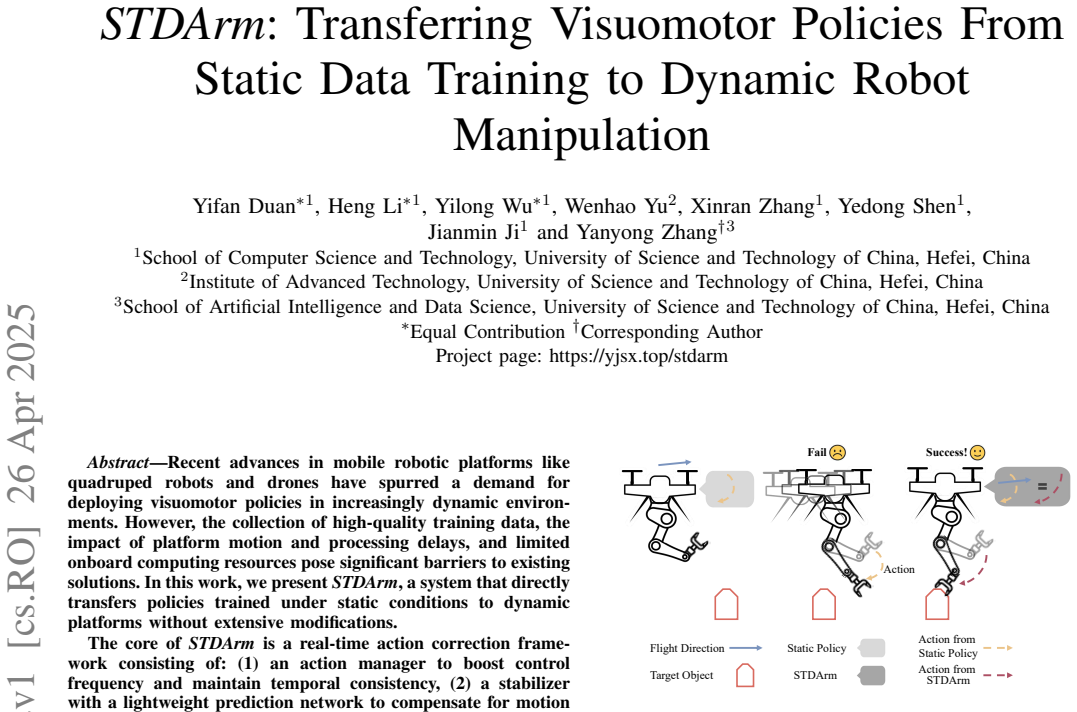
On the paper's own terms, STDArm's discovery is that a static-trained visuomotor policy can be transplanted to a moving platform by treating deployment as a latency and frequency alignment problem rather than a policy-learning problem. The policy network is untouched; instead, an action manager raises and stabilizes the action stream, a stabilizer predicts the platform's short-term motion with a lightweight LSTM-GRU network and applies the correction $\delta(\tau,\Delta t,E)$ to every action, and a warm-up routine calibrates the total system latency online. The quantitative claim is that this restores near-static success: DP+STDArm on the mobile-table arm goes from 0% to 53.3% on Pick and Place and from 20% to 93.3% on Get the Delivery, and the drone version of Get the Delivery rises from 13.3% to 40%, while static performance is preserved.
Load-bearing premise
The visuomotor policy must still recognize the target from images; STDArm only corrects actions, so if the moving camera's changing viewpoint or background defeats the policy's perception, the system cannot restore the task.
Editorial extensions
If this is right
- Static demonstration datasets, which are cheap to collect on fixed arms, become usable for drones, quadrupeds, and other moving bases without recollecting data on the moving platform.
- Action-chunked visuomotor policies can be deployed at higher effective control frequency on low-cost edge hardware, improving responsiveness without changing the policy network.
- Ablations on the leadscrew setup show the components are complementary: the full STDArm reaches 80% on Get the Delivery, while removing online latency estimation or the action manager drops success to 53.3% or below.
- The drone result, though modest at 40% versus 13.3%, suggests aerial manipulation is within reach of static-trained policies once motion compensation and latency are handled.
Reading between the lines
- An extension the paper suggests but does not demonstrate is that any action-chunked policy outputting end-effector poses could be wrapped by the same layer, since the policy network's weights are never modified.
- Because the correction depends on a visual-inertial SLAM pose stream, the system will inherit SLAM drift or tracking loss in low-texture or outdoor environments; the paper does not evaluate these failure modes.
- The pre-mission latency search could be replaced by continuous online calibration, which would track changing compute loads on shared edge devices; this is a testable improvement rather than a paper claim.
- The LS-3DoF ablation shows stronger gains on regular, predictable motion, suggesting the predictor exploits predictability; isolating motion predictability as an independent variable would separate this effect from pure latency compensation.
Signed reviews
Editorial analysis
A structured set of objections, weighed in public.
Referee Report
Summary. The paper presents STDArm, a modular system for transferring visuomotor policies trained under static conditions to mobile robotic platforms. The system consists of three components: an action manager that performs temporal ensembling and interpolation to raise control frequency, a prediction-network-based stabilizer that compensates for platform motion using high-frequency visual SLAM poses, and an online latency estimation module that calibrates system delay during a pre-mission warm-up. The authors evaluate STDArm on four platform configurations (mobile table, mobile frame, leadscrew, drone), two policies (Diffusion Policy and ACT), and three manipulation tasks, reporting that STDArm substantially improves success rates under dynamic conditions and preserves static performance. The core claim is that STDArm enables real-time motion compensation with centimeter-level precision without modifying the foundational policy.
Significance. The problem addressed is timely and practical: static-trained visuomotor policies are difficult to deploy on legged, wheeled, and aerial platforms because of platform motion, inference latency, and limited onboard compute. STDArm's design is appealing in its modularity: it does not require retraining the policy, works with multiple policy architectures, and runs entirely on edge hardware. If the reported gains are reproducible, the system would be a useful and low-cost tool for mobile manipulation. The experiments span multiple platforms, arms, and tasks, and the authors include ablations on a programmable leadscrew platform to control for some sources of variability. The paper also provides a project page and builds on public codebases. However, the central quantitative claim is currently supported only by a small number of trials under manually generated and unmeasured disturbances, which makes it difficult to attribute the observed improvements to STDArm specifically. The latency-estimation procedure also has a circularity issue in one of the demonstration tasks.
major comments (5)
- [Sec. V-A (Experimental Setup) and Table I] The headline dynamic results for MT-3DoF and MF-5DoF rely on manually shaking the platform, but the disturbance is neither recorded nor matched between the baseline and STDArm conditions. With only 15 trials per cell, a difference in shaking amplitude or frequency between runs could explain part of the reported gap (for example, Pick and Place on MT-3DoF from 0% to 53.3%). The double-blind protocol is commendable, but it does not guarantee that the baseline and STDArm trials face equivalent disturbances. The reproducible LS-3DoF platform is used only for ablations, not for the headline baseline-versus-STDArm comparison. A controlled or at least recorded-disturbance experiment is needed before the gains in Table I can be attributed to STDArm rather than to trial difficulty.
- [Table I and Fig. 7] Every reported success rate is based on 15 trials, with no error bars, confidence intervals, or significance tests. Several differences are within a few trials: for example, 66.7% vs. 53.3% in Stack Cylinder on MF-5DoF, and 40% vs. 13.3% on UAV-3DoF. Without statistical treatment or a larger number of trials, the claimed 'recovery' of static-level performance is not firmly established. At minimum, exact binomial confidence intervals should be reported, and the authors should state how many trials were performed per cell and whether trials were randomized in blocks.
- [Sec. III-D and Sec. V-D (Fig. 8)] The system latency is calibrated online by minimizing the red marker's pixel-plane movement in an end-hold task (Sec. III-D), and the same end-hold task and the same marker-movement metric are then used in Sec. V-D to demonstrate the stabilizer's benefit (Fig. 8). This is partly circular: the configuration is tuned to optimize exactly the metric used for evaluation. The demonstration would be more convincing if it used an independent metric, such as measured end-effector position error under held-out motion conditions, or if the end-hold task success was compared against a separate task objective.
- [Sec. V-A (UAV-3DoF) and Table I] For the UAV experiment, the text states that 'an operator manually maintains the relative positioning between the drone and the delivery target.' This means the 40% success rate with STDArm does not demonstrate autonomous compensation for platform drift; it shows only that STDArm can help under human-assisted station-keeping. The related claim in Sec. V-B that the UAV result highlights 'adaptability to ... inherent aerodynamic uncertainties' is therefore overstated. To support the aerial-platform claim, the experiment would need to quantify the platform's position error and separate autonomous stabilization from operator assistance.
- [Abstract and Sec. VI] The paper repeatedly claims 'centimeter-level operational precision' and 'centimeter-level precision,' but no direct precision measurement is reported. The tasks have tolerance specifications (e.g., 4 cm for stacking), but success rates are not equivalent to a precision measurement. The end-hold heatmaps in Fig. 8 are qualitative. To support this claim, the authors should report actual end-effector error statistics (mean, std, or a percent-within-threshold) under dynamic conditions.
minor comments (6)
- [Eq. (6)] The action interpolation formula appears to have its weights reversed: at τ = t it gives A_{t+1} instead of A_t. As written, A_τ = (τ−t)A_t + (t+1−τ)A_{t+1}; the intended formula is likely A_τ = (t+1−τ)A_t + (τ−t)A_{t+1}. Please correct the equation or clarify the definition of τ.
- [Fig. 7] The axis labels in Fig. 7 are garbled/unreadable in the provided version; the figure should be regenerated with clear, legible labels.
- [Sec. III-C, Eq. (9)] The definition of Δt_τ is not explicitly distinguished from Δt elsewhere in the text; please clarify that Δt_τ is the interval from action generation to execution for action Aτ, while Δt is the total latency estimated online.
- [Sec. V-A] The training of the pose prediction network is described only as 'approximately five minutes of motion data.' Please provide details on the supervision signal and how future poses are obtained for training, as this is central to the stabilizer's operation.
- [Intro, Sec. I] The abstract states the SLAM operates at '10× the base policy's observation rate.' With SLAM at 200 Hz and the DP policy at 5 Hz, the factor is 40×; for ACT at 30 Hz it is about 6.7×. Please make this statement consistent with the actual frequencies.
- [Throughout] There are several typographical artifacts, such as 'UA V-3DoF' with an extra space and inconsistent formatting in the platform names; these should be cleaned up.
Circularity Check
End-hold demonstration reuses the same marker-stability objective used to calibrate the latency; main manipulation benchmarks remain independent.
-
fitted input called prediction
[Sec. III-D (Latency Estimation) and Sec. V-D (Accuracy of End Hold), Fig. 8]
"We conduct a linear search for the latency starting from zero, identifying the latency that minimizes the marker's movement as the system delay. ... To more intuitively demonstrate the contribution of our method to end-effector stability, we conduct an end-effector holding task on MT-3DoF to visualize performance. ... tracking the movement trajectory of a red ball held in the gripper."
The system latency is calibrated by minimizing the red marker's positional variance in the end-hold task (Sec. III-D). The end-hold demonstration in Sec. V-D then evaluates the stabilizer using exactly the same red-marker movement criterion. The favorable STDArm heatmap is therefore partly a restatement of the calibration objective: the selected latency is, by construction, the value that minimizes that metric. This makes the end-hold figure a consistency check of the optimizer rather than an independent validation of the stabilizer. However, the main manipulation tasks (Pick and Place, Stack Cylinder, Get the Delivery) use external success criteria that were not optimized during latency calibration, so the central transfer claim retains independent content.
full rationale
STDArm's core derivation is not circular. The policy network is trained on static demonstrations; the pose prediction network is trained on separate motion data; Eq. (9)-(10) provide a kinematic compensation using the estimated latency; and the headline results are measured by task success rates, which are external to the calibration procedure. The action manager, temporal ensemble, and interpolation are evaluated by ablations on task success rather than by a self-defined metric. The only notable circular element is the end-hold visualization in Sec. V-D, whose marker-stability metric is exactly the objective minimized during latency estimation in Sec. III-D. That demonstration is illustrative, not load-bearing for the central claim. The manual-shaking protocol is a reproducibility and fairness concern, not a circularity concern, and the paper's self-citations are not load-bearing. Overall, the derivation is self-contained with one minor circularity in the supporting end-hold figure, so a score of 2 is appropriate.
Assumptions & free parameters
free parameters (3)
- Temporal ensemble decay α =
1
- System latency Δt =
not reported
- Extrinsics E between SLAM and arm frames =
not reported
assumptions (4)
- domain assumption The policy action u is an end-effector position/pose expressed in a frame where the multiplicative correction δ in Eq 9 can be applied to compensate platform motion.
- domain assumption The visual SLAM pose estimates are accurate and the single estimated latency Δt captures the total pipeline delay throughout task execution.
- domain assumption The pose prediction network, trained on about five minutes of platform motion data, generalizes to the perturbations encountered at test time.
- domain assumption The foundational policy network remains functional when the camera moves with the platform.
Cite this review
Pith. "Pith review of STDArm: Transferring Visuomotor Policies From Static Data Training to Dynamic Robot Manipulation." pith.science (2026). https://pith.science/paper/IJXBKVEU
@misc{pith2026250418792,
  author       = {Pith},
  title        = {Pith review of: STDArm: Transferring Visuomotor Policies From Static Data Training to Dynamic Robot Manipulation},
  year         = {2026},
  howpublished = {\url{https://pith.science/paper/IJXBKVEU}},
  note         = {Machine review of arXiv:2504.18792}
}
read the original abstract
Recent advances in mobile robotic platforms like quadruped robots and drones have spurred a demand for deploying visuomotor policies in increasingly dynamic environments. However, the collection of high-quality training data, the impact of platform motion and processing delays, and limited onboard computing resources pose significant barriers to existing solutions. In this work, we present STDArm, a system that directly transfers policies trained under static conditions to dynamic platforms without extensive modifications. The core of STDArm is a real-time action correction framework consisting of: (1) an action manager to boost control frequency and maintain temporal consistency, (2) a stabilizer with a lightweight prediction network to compensate for motion disturbances, and (3) an online latency estimation module for calibrating system parameters. In this way, STDArm achieves centimeter-level precision in mobile manipulation tasks. We conduct comprehensive evaluations of the proposed STDArm on two types of robotic arms, four types of mobile platforms, and three tasks. Experimental results indicate that the STDArm enables real-time compensation for platform motion disturbances while preserving the original policy's manipulation capabilities, achieving centimeter-level operational precision during robot motion.
Figures


Figures from the paper (4 more)


Forward citations
Cited by 1 Pith paper
-
CAC-VLA: Context-Gated Action Conditioning for Vision-Language-Action Models
VLM-predicted coarse-to-fine latent actions, injected through a learned context gate, improve continuous action-expert control on LIBERO (98.3%) and LIBERO-Plus (89.5%).
Reference graph
Works this paper leans on
-
[1]
Deep generative models in robotics: A survey on learning from multimodal demonstrations
Julen Urain, Ajay Mandlekar, Yilun Du, Mahi Shafiullah, Danfei Xu, Katerina Fragkiadaki, Georgia Chalvatzaki, and Jan Peters. Deep generative models in robotics: A survey on learning from multimodal demonstrations. arXiv preprint arXiv:2408.04380 , 2024
arXiv 2024
-
[2]
Rouhollah Rahmatizadeh, Pooya Abolghasemi, Ladislau B¨ol¨oni, and Sergey Levine. Vision-based multi-task manipulation for inexpensive robots using end-to-end learning from demonstration. In 2018 IEEE international conference on robotics and automation (ICRA) , pages 3758–3765. IEEE, 2018
work page 2018
-
[3]
Learning fine-grained bimanual manipulation with low-cost hardware
Tony Z Zhao, Vikash Kumar, Sergey Levine, and Chelsea Finn. Learning fine-grained bimanual manipulation with low-cost hardware. Robotics: Science and Systems (RSS) , 2023
work page 2023
-
[4]
Diffusion policy: Visuomotor policy learning via action diffusion
Cheng Chi, Zhenjia Xu, Siyuan Feng, Eric Cousineau, Yilun Du, Benjamin Burchfiel, Russ Tedrake, and Shuran Song. Diffusion policy: Visuomotor policy learning via action diffusion. The International Journal of Robotics Research, page 02783649241273668, 2023
2023
-
[5]
Fabricflownet: Bi- manual cloth manipulation with a flow-based policy
Thomas Weng, Sujay Man Bajracharya, Yufei Wang, Khush Agrawal, and David Held. Fabricflownet: Bi- manual cloth manipulation with a flow-based policy. In Conference on Robot Learning , pages 192–202. PMLR, 2022
work page 2022
-
[6]
Deep imitation learning for humanoid loco-manipulation through human teleoperation
Mingyo Seo, Steve Han, Kyutae Sim, Seung Hyeon Bang, Carlos Gonzalez, Luis Sentis, and Yuke Zhu. Deep imitation learning for humanoid loco-manipulation through human teleoperation. In 2023 IEEE-RAS 22nd International Conference on Humanoid Robots (Hu- manoids), pages 1–8. IEEE, 2023
2023
-
[7]
Umi on legs: Making manipulation policies mobile with manipulation-centric whole-body controllers
Huy Ha, Yihuai Gao, Zipeng Fu, Jie Tan, and Shuran Song. Umi on legs: Making manipulation policies mobile with manipulation-centric whole-body controllers. arXiv preprint arXiv:2407.10353, 2024
arXiv 2024
-
[8]
Humanplus: Humanoid shad- owing and imitation from humans
Zipeng Fu, Qingqing Zhao, Qi Wu, Gordon Wet- zstein, and Chelsea Finn. Humanplus: Humanoid shad- owing and imitation from humans. arXiv preprint arXiv:2406.10454, 2024
arXiv 2024
Show all 37 references
-
[9]
3d diffusion policy: Generalizable visuomotor policy learning via simple 3d representations
Yanjie Ze, Gu Zhang, Kangning Zhang, Chenyuan Hu, Muhan Wang, and Huazhe Xu. 3d diffusion policy: Generalizable visuomotor policy learning via simple 3d representations. In Robotics: Science and Systems (RSS) , 2024
2024
-
[10]
Openvla: An open-source vision-language-action model
Moo Jin Kim, Karl Pertsch, Siddharth Karamcheti, Ted Xiao, Ashwin Balakrishna, Suraj Nair, Rafael Rafailov, Ethan Foster, Grace Lam, Pannag Sanketi, et al. Openvla: An open-source vision-language-action model. arXiv preprint arXiv:2406.09246, 2024
2024 arXiv
-
[11]
π0: A vision- language-action flow model for general robot control
Kevin Black, Noah Brown, Danny Driess, Adnan Es- mail, Michael Equi, Chelsea Finn, Niccolo Fusai, Lachy Groom, Karol Hausman, Brian Ichter, et al. π0: A vision- language-action flow model for general robot control. arXiv preprint arXiv:2410.24164 , 2024
-
[12]
Rdt-1b: a diffusion foundation model for bimanual manipulation
Songming Liu, Lingxuan Wu, Bangguo Li, Hengkai Tan, Huayu Chen, Zhengyi Wang, Ke Xu, Hang Su, and Jun Zhu. Rdt-1b: a diffusion foundation model for bimanual manipulation. arXiv preprint arXiv:2410.07864 , 2024
2024 arXiv
-
[13]
Carp: Visuomotor policy learning via coarse-to-fine autoregressive prediction
Zhefei Gong, Pengxiang Ding, Shangke Lyu, Siteng Huang, Mingyang Sun, Wei Zhao, Zhaoxin Fan, and Donglin Wang. Carp: Visuomotor policy learning via coarse-to-fine autoregressive prediction. arXiv preprint arXiv:2412.06782, 2024
2024 arXiv
-
[14]
Fast: Efficient action tokeniza- tion for vision-language-action models
Karl Pertsch, Kyle Stachowicz, Brian Ichter, Danny Driess, Suraj Nair, Quan Vuong, Oier Mees, Chelsea Finn, and Sergey Levine. Fast: Efficient action tokeniza- tion for vision-language-action models. arXiv preprint arXiv:2501.09747, 2025
2025 arXiv
-
[15]
Ldp: A local diffusion planner for efficient robot navigation and collision avoidance
Wenhao Yu, Jie Peng, Huanyu Yang, Junrui Zhang, Yifan Duan, Jianmin Ji, and Yanyong Zhang. Ldp: A local diffusion planner for efficient robot navigation and collision avoidance. In 2024 IEEE/RSJ International Conference on Intelligent Robots and Systems (IROS) , pages 5466–547...
2024
-
[16]
Nomad: Goal masked diffusion policies for navigation and exploration
Ajay Sridhar, Dhruv Shah, Catherine Glossop, and Sergey Levine. Nomad: Goal masked diffusion policies for navigation and exploration. In 2024 IEEE Interna- tional Conference on Robotics and Automation (ICRA) , pages 63–70. IEEE, 2024
2024
-
[17]
Mo- bile aloha: Learning bimanual mobile manipulation with low-cost whole-body teleoperation
Zipeng Fu, Tony Z Zhao, and Chelsea Finn. Mo- bile aloha: Learning bimanual mobile manipulation with low-cost whole-body teleoperation. arXiv preprint arXiv:2401.02117, 2024
2024 arXiv
-
[18]
Consistency policy: Accelerated visuo- motor policies via consistency distillation
Aaditya Prasad, Kevin Lin, Jimmy Wu, Linqi Zhou, and Jeannette Bohg. Consistency policy: Accelerated visuo- motor policies via consistency distillation. Robotics: Science and Systems (RSS) , 2024
2024
-
[19]
Manicm: Real-time 3d diffusion policy via consistency model for robotic manipulation
Guanxing Lu, Zifeng Gao, Tianxing Chen, Wenxun Dai, Ziwei Wang, and Yansong Tang. Manicm: Real-time 3d diffusion policy via consistency model for robotic manipulation. arXiv preprint arXiv:2406.01586 , 2024
2024 arXiv
-
[20]
Adaflow: Imitation learning with variance-adaptive flow-based policies
Xixi Hu, Bo Liu, Xingchao Liu, and Qiang Liu. Adaflow: Imitation learning with variance-adaptive flow-based policies. arXiv preprint arXiv:2402.04292 , 2024
2024 arXiv
-
[21]
Bidirectional decoding: Improving action chunking via closed-loop resampling
Yuejiang Liu, Jubayer Ibn Hamid, Annie Xie, Yoonho Lee, Maximilian Du, and Chelsea Finn. Bidirectional decoding: Improving action chunking via closed-loop resampling. arXiv preprint arXiv:2408.17355 , 2024
2024 arXiv
-
[22]
A mobile manipulation system for one-shot teaching of complex tasks in homes
Max Bajracharya, James Borders, Dan Helmick, Thomas Kollar, Michael Laskey, John Leichty, Jeremy Ma, Umashankar Nagarajan, Akiyoshi Ochiai, Josh Petersen, et al. A mobile manipulation system for one-shot teaching of complex tasks in homes. In 2020 IEEE International Conference...
2020
-
[23]
Footstep planning for the honda asimo humanoid
Joel Chestnutt, Manfred Lau, German Cheung, James Kuffner, Jessica Hodgins, and Takeo Kanade. Footstep planning for the honda asimo humanoid. In Proceedings of the 2005 IEEE international conference on robotics and automation , pages 629–634. IEEE, 2005
2005
-
[24]
Optimization based full body control for the atlas robot
Siyuan Feng, Eric Whitman, X Xinjilefu, and Christo- pher G Atkeson. Optimization based full body control for the atlas robot. In 2014 IEEE-RAS International Conference on Humanoid Robots , pages 120–127. IEEE, 2014
2014
-
[25]
Force strategies for cooperative tasks in multiple mobile manipulation sys- tems
Oussama Khatib, K Yokoi, K Chang, D Ruspini, R Holm- berg, A Casal, and A Baader. Force strategies for cooperative tasks in multiple mobile manipulation sys- tems. In Robotics Research: The Seventh International Symposium, pages 333–342. Springer, 1996
1996
-
[26]
Towards a personal robotics development platform: Rationale and design of an intrinsically safe personal robot
Keenan A Wyrobek, Eric H Berger, HF Machiel Van der Loos, and J Kenneth Salisbury. Towards a personal robotics development platform: Rationale and design of an intrinsically safe personal robot. In 2008 IEEE International Conference on Robotics and Automation , pages 2165–2170...
2008
-
[27]
Learning to walk in minutes using massively parallel deep reinforcement learning
Nikita Rudin, David Hoeller, Philipp Reist, and Marco Hutter. Learning to walk in minutes using massively parallel deep reinforcement learning. In Conference on Robot Learning , pages 91–100. PMLR, 2022
2022
-
[28]
Deep whole-body control: learning a unified policy for manipu- lation and locomotion
Zipeng Fu, Xuxin Cheng, and Deepak Pathak. Deep whole-body control: learning a unified policy for manipu- lation and locomotion. In Conference on Robot Learning, pages 138–149. PMLR, 2023
2023
-
[29]
Image-based visual servoing of unmanned aerial ma- nipulators for tracking and grasping a moving target
Yanjie Chen, Yangning Wu, Zhenguo Zhang, Zhiqiang Miao, Hang Zhong, Hui Zhang, and Yaonan Wang. Image-based visual servoing of unmanned aerial ma- nipulators for tracking and grasping a moving target. IEEE Transactions on Industrial Informatics , 19(8): 8889–8899, 2022
2022
-
[30]
Eso-based robust and high-precision tracking control for aerial manipulation
Huazi Cao, Yongqi Li, Cunjia Liu, and Shiyu Zhao. Eso-based robust and high-precision tracking control for aerial manipulation. IEEE Transactions on Automation Science and Engineering , 21(2):2139–2155, 2023
2023
-
[31]
Millimeter-level pick and peg-in-hole task achieved by aerial manipulator
Meng Wang, Zeshuai Chen, Kexin Guo, Xiang Yu, Youmin Zhang, Lei Guo, and Wei Wang. Millimeter-level pick and peg-in-hole task achieved by aerial manipulator. IEEE Transactions on Robotics , 2023
2023
-
[32]
Long short-term memory
S Hochreiter. Long short-term memory. Neural Compu- tation MIT-Press, 1997
1997
-
[33]
Empirical evaluation of gated recurrent neural networks on sequence modeling
Junyoung Chung, Caglar Gulcehre, KyungHyun Cho, and Yoshua Bengio. Empirical evaluation of gated recurrent neural networks on sequence modeling. arXiv preprint arXiv:1412.3555, 2014
2014 arXiv
-
[34]
Deep residual learning for image recognition
Kaiming He, Xiangyu Zhang, Shaoqing Ren, and Jian Sun. Deep residual learning for image recognition. In Proceedings of the IEEE conference on computer vision and pattern recognition , pages 770–778, 2016
2016
-
[35]
Attention is all you need
A Vaswani. Attention is all you need. Advances in Neural Information Processing Systems , 2017
2017
-
[36]
Denoising diffusion implicit models
Jiaming Song, Chenlin Meng, and Stefano Ermon. Denoising diffusion implicit models. arXiv preprint arXiv:2010.02502, 2020
2010 arXiv
-
[37]
Lerobot: State-of-the-art machine learning for real-world robotics in pytorch
Remi Cadene, Simon Alibert, Alexander Soare, Quentin Gallouedec, Adil Zouitine, and Thomas Wolf. Lerobot: State-of-the-art machine learning for real-world robotics in pytorch. https://github.com/huggingface/lerobot, 2024
2024
Reviewed August 16, 2026 · model on record in the stance chip above.
Discussion (0). Continue with ORCID to comment.