REVIEW 3 major objections 6 minor 27 references
Thick branes in higher-dimensional $f(R)$ gravity
T0 review · 3 major / 6 minor · reviewed 2026-08-14 · deepseek-v4-flash
Pith's one-line read In higher-dimensional f(R) gravity, regular vacuum brane solutions exist only when the curvature exponent n lies between 1 and D/2.
desk verdict A concrete but niche construction of vacuum thick branes in D≥6 f(R) gravity; the existence window 1<n<D/2 is plausible for D=6 but the 'only' claim is not established. read the letter →
The pith
A machine-rendered reading of the paper's core claim, the machinery that carries it, and where it could break.
The reading
What carries the argument
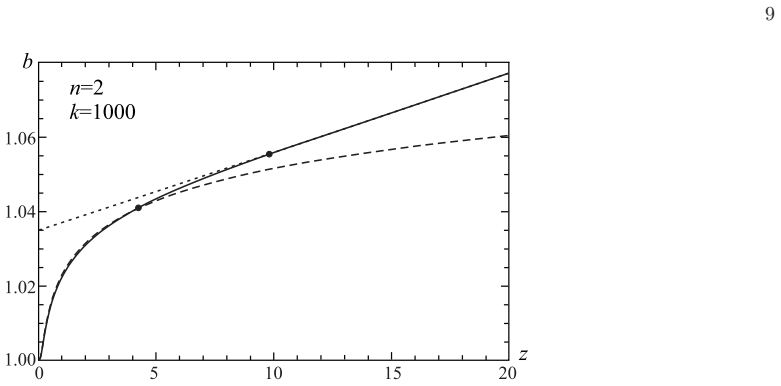
The central object is the two-warp-factor metric for orthogonal branes, Eq. (5), with Lorentzian warp factor a(z) and Euclidean warp factor b(z). The argument runs through the regularity expansion near the brane, which fixes δ = (2n-1)/(n-1), and through the asymptotic exponential decay rates a ≈ a_∞ $e^{{l_a|z|}}$, b ≈ b_∞ $e^{{l_b|z|}}$; the formula for $l_b^{{2(n-1)}}$ in Eq. (23) must be positive, producing the upper bound n < D/2. In the large-dimension limit, the dominant balance reduces to two approximate ordinary differential equations, giving explicit solutions such as b = b_0 (1 + C_2 z³)^{4/k}.
What would settle it
Numerically integrate Eqs. (6)-(8) at n = D/2 with the same boundary conditions and check whether a regular solution that stays smooth for all z and approaches anti-de Sitter asymptotics exists; a regular solution there would refute the 'only' claim. A more direct test is to derive Eq. (23) from the asymptotic field equations and see whether the right-hand side can remain positive at n ≥ D/2 for any α > 0 and k > 1.
Extended reading notes
Core claim
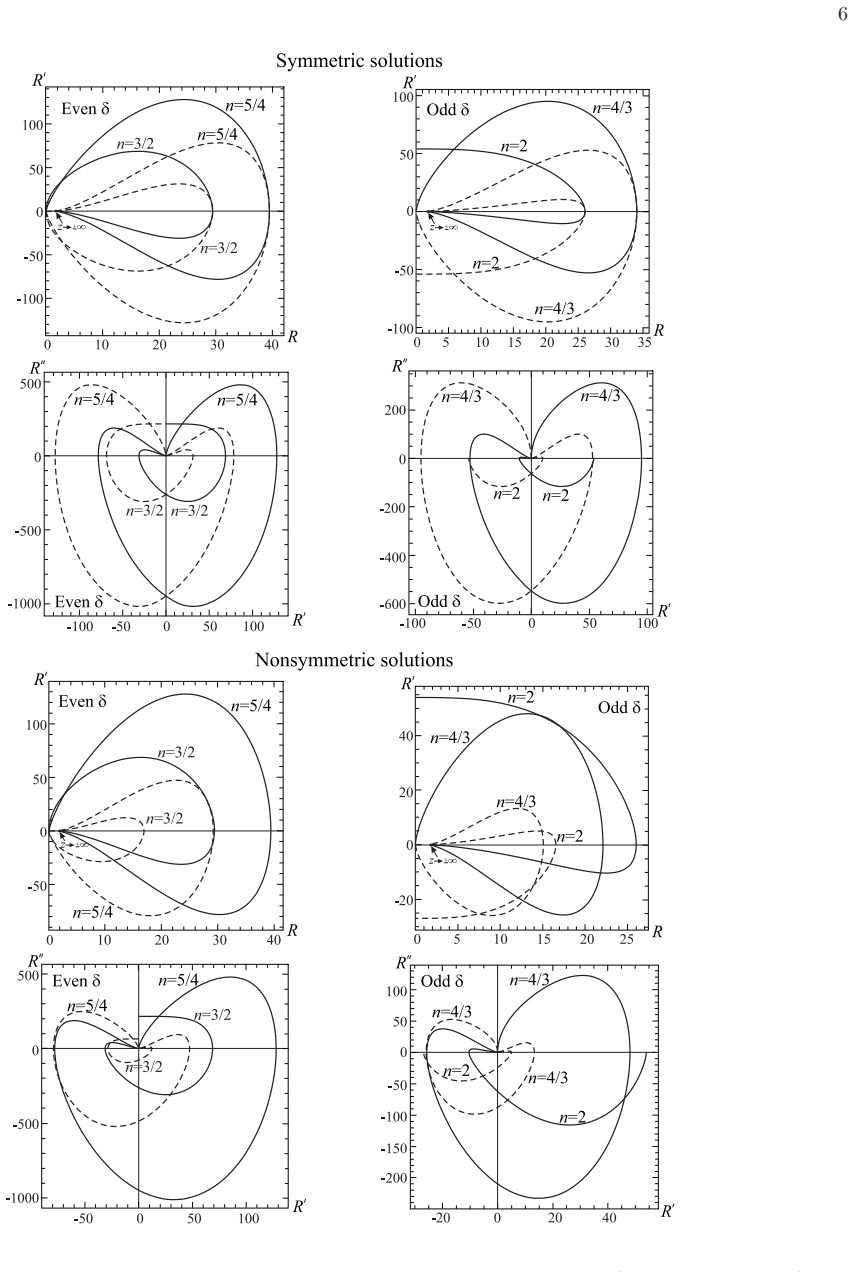
Within the metric ansatz ds² = a²(z)η_αβ dx^α dx^β - dz² - b(z)γ_ij dx^i dx^j, with warp factors a(z) and b(z) and a flat Euclidean brane, the f(R) = -αR^n field equations admit regular vacuum solutions that are asymptotically anti-de Sitter only for 1 < n < D/2. For n ≤ 1 the curvature is singular on the brane; for n ≥ 3/2 solutions may fail to pass through a fixed point, and for n ≥ 3 they diverge at finite z. The solutions can be Z2-symmetric or nonsymmetric, and in the large-D limit approximate analytic expressions match the numerics. A test scalar field on this background has finite energy and norm, i.e., it is trapped on the Lorentzian brane, irrespective of D.
Load-bearing premise
The claimed exclusion of n ≥ D/2 and n ≤ 1 rests on the assumed metric ansatz (two warp factors depending only on z, flat Euclidean brane) and on the positivity of the decay-rate formula (23), which is stated without derivation; if either fails, regular solutions outside 1 < n < D/2 could exist.
Editorial extensions
If this is right
- For a fixed dimension D, the window 1 < n < D/2 is the parameter region in which pure curvature gravity supports smooth, matter-free brane vacua of the two-brane type.
- The regularity condition δ = (2n-1)/(n-1) makes n = 1 a singular boundary and n = 3/2 the threshold where fixed-point passage is lost, separating distinct physical regimes.
- In large-D spacetimes, the asymptotic anti-de Sitter curvature scale is set only by α and n, not by the number of extra dimensions, so higher D does not alter the effective vacuum scale.
- Test scalar fields are confined to the Lorentzian brane for any D, so the localization mechanism is dimension-independent for this ansatz.
Reading between the lines
- A rigorous derivation of the decay-rate formula (23) from the field equations would turn the numerical existence window into a theorem; the paper's upper-bound argument currently leans on an unstated derivation.
- The same regularity criterion δ = (2n-1)/(n-1) may apply to other power-law f(R) forms, giving model builders a heuristic for which exponents are worth investigating beyond the R^n case.
- The T²-wormhole interpretation suggests the two-brane construction could be re-read as a compactified torus in the extra directions, potentially connecting these solutions to known wormhole physics, though the paper only sketches this.
- Scalar trapping might be tested for non-minimal couplings or spin-1/2 fields; the paper treats only a minimally coupled complex scalar.
Signed reviews
Editorial analysis
A structured set of objections, weighed in public.
Referee Report
Summary. The paper studies vacuum thick-brane solutions in D-dimensional f(R) = -α R^n gravity with D ≥ 6, using a metric ansatz (5) with a four-dimensional Lorentzian brane and a (D-5)-dimensional Euclidean brane, both warp factors depending only on a fifth coordinate z. The authors derive the field equations, perform a near-brane series expansion, and numerically integrate the system for D=6 (k=1) for several values of n. They claim that regular vacuum asymptotically anti-de Sitter solutions exist only in the range 1 < n < D/2, that solutions may or may not pass through a fixed point, and that they may be Z2-symmetric or not. For large k they present approximate analytic solutions, and they show that a test scalar field is localized on the Lorentzian brane at any D.
Significance. If the stated existence range is correct, the paper gives a clean parameter window for higher-dimensional f(R) braneworld model building and provides useful large-D analytic approximations plus a scalar-trapping result. The work is self-contained: it does not fit observational data, the field-equation derivation is standard, and the D=6 numerical solutions and the large-k comparison are explicit. The main value lies in the proposed dichotomy 1 < n < D/2, but this central claim is currently supported only partially, so the paper's significance depends on closing the gaps discussed below.
major comments (3)
- [II.D, Eq. (23)] The positivity of l_b^{2(n-1)} as written does not imply the advertised upper bound n < D/2. Factoring the right-hand side of Eq. (23) gives l_b^{2(n-1)} = 4^{n-1} (k+3) / [α n (k-2n+5)], whose positivity requires k-2n+5 > 0, i.e., n < (k+5)/2 = (D+1)/2. For D=6 this would still allow 3 < n < 3.5, so Eq. (23) alone does not rule out regular solutions with n in that interval. The authors should derive Eq. (23) from the asymptotic limit of Eqs. (6)-(8) and show explicitly how the stricter bound n < D/2 emerges; as written, the central 'only' claim does not follow from the displayed formula.
- [II.D] The claim of existence and non-existence for k>1 is not supported by the evidence presented. The text says 'numerical computations indicate' but provides no plots, parameter scans, convergence tests, or specifications of the numerical method for any k>1. Since the abstract and conclusion assert a sharp range 'only in 1 < n < D/2', the reader needs at least representative numerical solutions for several D values, including cases just below and above n = D/2, together with a statement of the error tolerances used.
- [II.B, Eqs. (16) and (19)] The 'only' claim is a classification statement, but the analysis establishes necessary conditions within an assumed solution family rather than non-existence outside it. The near-brane expansion (16) and the exponential asymptotic form (19) are assumed, and no argument shows that every regular solution must take these forms. In particular, the paper does not exclude the possibility of regular solutions with different near-brane or asymptotic behavior, so the conclusion should either be softened to 'for the class of solutions constructed here' or supported by a more complete mathematical analysis.
minor comments (6)
- [II.B, Eq. (16)] The expansions are written as R(x), a(x), b(x), but the independent coordinate throughout the paper is z; the argument should be z for consistency.
- [II.C, Eq. (21)] The bracket notation in the integrated volume factors is confusing: expressions such as [(x1)_2 + (x1)_1] appear where a difference (volume) is expected. Please check the signs and the notation.
- [II.B, Fig. 1 caption] The caption is very dense. It would help to separate the symmetric and nonsymmetric boundary-condition specifications into a table or numbered lists for readability.
- [III, after Eq. (29)] The phrase 'for the physically interesting case n ≪ k' is vague; the reader would benefit from an explicit statement of which values of n and k are covered by the approximate equation, since n=2 and k=1000 is the only displayed example.
- [IV, after Eq. (34)] The trapping argument checks square-integrability from the asymptotic forms alone; it would be more complete to mention that the solutions near z=0 are finite for the boundary data used, so the integral over the brane neighborhood is manifestly convergent.
- [Throughout] There are several typographical artifacts, e.g., 'n /greaterorequalslant 3' in Section II.B and 'Rep t.' in reference [13]. These should be corrected in the final version.
Circularity Check
No significant circularity: the central claims are derived from the f(R) field equations and explicit boundary/asymptotic assumptions, with no fitted-input-as-prediction or load-bearing self-citation.
full rationale
The paper's central result—regular vacuum asymptotically anti-de Sitter solutions exist only for 1<n<D/2—follows from two necessary conditions obtained within the paper: the near-brane regularity relation delta=(2n-1)/(n-1), Eq. (18), and the positivity of l_b^{2(n-1)} in Eq. (23), which requires k-2n+5>0, i.e., n<D/2. Eq. (23) is stated without derivation in Section II.D, but it is an asymptotic consequence of the field equations (6)-(8), not a parameter fitted to the target claim; the omission is an exposition/rigor gap, not circularity. The scalar-field trapping result uses the asymptotic warp factors derived in this same paper and the standard scalar-field equation; Ref. [19] supplies only the form of the test-field Lagrangian, so no load-bearing self-citation occurs. There is no fitting to observational data, no 'prediction' that is a renamed input, and no uniqueness theorem imported from the authors' prior work. The 'only' claim may be stronger than the demonstrated classification, since the paper does not prove that all regular solutions must share the near-brane expansion (16) and exponential asymptotics (19), but that is a completeness/correctness concern rather than circularity. Therefore no circular steps are identified.
Assumptions & free parameters
free parameters (2)
- α =
1 (in numerics)
- Boundary values a0,b0,a1,b1 =
various (e.g., 1, 0.3)
assumptions (3)
- domain assumption Metric ansatz (5): a^2(z) ηαβ dxα dxβ - dz^2 - b(z) γij dx^i dx^j
- domain assumption f(R) = -α R^n with α, n > 0
- ad hoc to paper Eq. (23) for lb and la is correct
Cite this review
Pith. "Pith review of Thick branes in higher-dimensional $f(R)$ gravity." pith.science (2026). https://pith.science/paper/IJZ2KKYQ
@misc{pith2026190801312,
  author       = {Pith},
  title        = {Pith review of: Thick branes in higher-dimensional $f(R)$ gravity},
  year         = {2026},
  howpublished = {\url{https://pith.science/paper/IJZ2KKYQ}},
  note         = {Machine review of arXiv:1908.01312}
}
abstract
We study the thick brane model within $f(R)\sim R^n$ modified gravity in $D$-dimensional spacetimes with $D\geq 6$. The system under consideration consists of two branes orthogonal to each other: the four-dimensional Lorentzian brane and $(D-5)$-dimensional Euclidean one. It is numerically shown that, for a given $D$, regular vacuum asymptotically anti-de Sitter solutions exist only in the range $1<n<D/2$. Depending on the values of $n$ and boundary conditions imposed on the Lorentzian brane, the solutions can pass or not pass through a fixed point located on the Lorentzian brane, and also be $Z_2$-symmetric or nonsymmetric. In the large-$D$ limit, we find approximate analytic solutions. It is also shown that a test scalar field is trapped on the Lorentzian brane at any $D$.
Figures

Reference graph
Works this paper leans on
-
[1]
This leads to the fact that the space spanned on the coordinates x2, x3 becomes a T 2 torus. In this case the brane with the coordinates xα = x0, x1, x2, x3 can be regarded as a trivial T 2 wormhole embedded in the bulk with the coordinates {xα , z, xi}. This wormhole does not asymptotically flat, and from the geometric point of view it looks like a tube w...
work page 2017
-
[2]
J. M. Overduin and P. S. Wesson, Phys. Rept. 283, 303 (1997)
work page 1997
-
[3]
K. Akama, Pregeometry, in: K. Kikkawa, N. Nakanishi and H . Nariai, Lecture Notes in Physics, Springer-Verlag, 1983, pp. 267-271
work page 1983
-
[4]
V. A. Rubakov and M. E. Shaposhnikov, Phys. Lett. 125B, 136 (1983)
work page 1983
-
[5]
N. Arkani-Hamed, S. Dimopoulos, and G. Dvali, Phys. Lett . B 429 263 (1998)
work page 1998
-
[6]
I. Antoniadis, N. Arkani-Hamed, S. Dimopoulos, and G. Dv ali, Phys. Lett. B 436 257 (1998)
work page 1998
- [7]
-
[8]
L. Randall and R. Sundrum, Phys. Rev. Lett. 83, 3370 (1999); ibid. 4690. 12
work page 1999
Show all 27 references
-
[9]
Arkani-Hamed and M
N. Arkani-Hamed and M. Schmaltz, Phys. Rev. D 61 , 033005 (2000)
2000
-
[10]
Mirabelli and M
A. Mirabelli and M. Schmaltz, Phys. Rev. D 61 , 113011 (2000)
2000
-
[11]
Aguilar and D
S. Aguilar and D. Singleton, Phys. Rev. D 73 , 085007 (2006)
2006
-
[12]
Deffayet, G.R
C. Deffayet, G.R. Dvali, and G. Gabadadze, Phys. Rev. D 65 , 044023 (2002)
2002
-
[13]
Gogberashvili and M
M. Gogberashvili and M. Maziashvili, Gen. Rel. Grav. 37, 1129 (2005)
2005
-
[14]
Dzhunushaliev, V
V. Dzhunushaliev, V. Folomeev, and M. Minamitsuji, Rep t. Prog. Phys. 73, 066901 (2010)
2010
-
[15]
Introduction to Extra Dimensions and Thick B raneworlds,
Y. X. Liu, “Introduction to Extra Dimensions and Thick B raneworlds,” arXiv:1707.08541 [hep-th]
-
[16]
Faraoni and S
V. Faraoni and S. Capozziello, Fundam. Theor. Phys. 170 (2010)
2010
-
[17]
Nojiri and S
S. Nojiri and S. D. Odintsov, Phys. Rept. 505, 59 (2011)
2011
-
[18]
de la Cruz-Dombriz and D
A. de la Cruz-Dombriz and D. Saez-Gomez, Entropy 14, 1717 (2012)
2012
-
[19]
Nojiri, S
S. Nojiri, S. D. Odintsov, and V. K. Oikonomou, Phys. Rep . 692, 1 (2017)
2017
-
[20]
Dzhunushaliev, V
V. Dzhunushaliev, V. Folomeev, B. Kleihaus, and J. Kunz , JHEP 1004, 130 (2010)
2010
-
[21]
Zhong and Y
Y. Zhong and Y. X. Liu, Eur. Phys. J. C 76, no. 6, 321 (2016)
2016
-
[22]
Guarnizo, L
A. Guarnizo, L. Castaneda, and J. M. Tejeiro, Gen. Rel. G rav. 42, 2713 (2010)
2010
-
[23]
Cvetic, S
M. Cvetic, S. Nojiri, and S. D. Odintsov, Nucl. Phys. B 628, 295 (2002)
2002
-
[24]
Nojiri and S
S. Nojiri and S. D. Odintsov, Gen. Rel. Grav. 37, 1419 (2005)
2005
-
[25]
P. F. Gonzalez-Diaz, Phys. Rev. D 54, 6122 (1996)
1996
-
[26]
Dzhunushaliev, V
V. Dzhunushaliev, V. Folomeev, B. Kleihaus, and J. Kunz , Phys. Rev. D 99, no. 4, 044031 (2019)
2019
-
[27]
Israel, Nuovo Cim
W. Israel, Nuovo Cim. B 44S10, 1 (1966) [Nuovo Cim. B 44, 1 (1966)] Erratum: [Nuovo Cim. B 48, 463 (1967)]
1966
Reviewed August 14, 2026 · model on record in the stance chip above.
Discussion (0). Continue with ORCID to comment.