REVIEW 3 major objections 5 minor 27 references
How Far Do Simple Transformations Translate Across Text Embedding Models?
T0 review · 3 major / 5 minor · reviewed 2026-08-07 · deepseek-v4-flash
Pith's one-line read Independently trained text embedding models are not universally related by simple linear maps; compatibility clusters around models that share architecture, pooling, training objective, and data.
desk verdict A careful, honest empirical study showing that linear translation across text embedding models is pair-dependent, not universal; the main result stands, but the missing training details for the SGD upper bound need reporting. read the letter →
The pith
A machine-rendered reading of the paper's core claim, the machinery that carries it, and where it could break.
The reading
What carries the argument
The central object is the anchor-basis decomposition that underlies all four translators: expressing a source embedding $x$ as coefficients $c^*(x)=X^+ x$ in the basis of shared anchor embeddings $X$, then reconstructing on the target side as $\hat{y}=Y c^*(x)=Y X^+ x = T_{A\to B} x$. This construction shows that pseudo-inverse alignment, relative representations, and inverse relative projection are variations of one operation: transferring an anchor-coordinate expression across models. The paper also relies on linear CKA, defined as $\frac{\|Y^\top X\|_F^2}{\|X^\top X\|_F \|Y^\top Y\|_F}$, as a geometric similarity diagnostic, and on a fixed RBF-kernel SVM for downstream transfer, to probe where this operation succeeds and fails.
What would settle it
Retrain the Linear (SGD) translator for every model pair with a systematic hyperparameter search over learning rate, epochs, batch size, and training sequence length, and verify convergence on a held-out validation split. If any pair the paper labels incompatible, such as those involving e5-large-v2, reaches near same-model downstream accuracy after this search, the claim that heterogeneous embedding spaces are not universally related by simple linear maps would be overturned.
Extended reading notes
Core claim
The central discovery is a qualified negative: in the realistic setting of sentence and word embeddings from nine heterogeneous models, the hypothesis that embedding spaces are related up to a simple linear transformation does not hold universally. The paper shows that a closed-form linear map computed from paired anchors, a learned linear map trained on a large paired corpus, relative representations, and inverse relative projection all recover meaningful structure for some pairs, especially models sharing encoder family, mean pooling, and contrastive objectives, but fail sharply for others. Pairwise accuracy matrices reveal structured rather than random degradation, with entire class boundaries collapsing under translation for incompatible pairs. The analysis also shows that the apparent success of linear translators rests on a local linear structure, the anchor-basis decomposition, that is only partially preserved across models and depends on normalization and scale. The authors interpret the results as evidence that the geometry of text embedding spaces is not universally shared, and that the universality observed in simplified benchmarks does not extend to heterogeneous text models.
Load-bearing premise
The conclusion that many pairs cannot be linearly translated rests on the assumption that the SGD-trained linear map, fit on Wikitext-103 sentence pairs, is a fair approximate upper bound for what any linear map can achieve; the paper reports no learning rate, epochs, batch size, or convergence check, so if that map is undertrained the reported failures would reflect training inadequacy rather than representational incompatibility.
Editorial extensions
If this is right
- Cross-model transfer will be reliable only within clusters of models that share architecture family, pooling, training objective, and data distribution; models differing on these dimensions are likely to lose most downstream accuracy.
- The Linear (SGD) map, trained on a large paired corpus, can serve as an approximate upper bound for the linear family, so anchor-based methods that fall below it indicate a gap that better anchor selection might partially close.
- Task sensitivity matters: some tasks tolerate translation error, while fine-grained or exact-answer tasks degrade even for geometrically similar pairs, so translation quality should be assessed per task rather than averaged.
- Retrieval and downstream transfer do not always agree; hubness in the target space (notably for e5-large-v2) can depress k-NN retrieval even when the linear map looks reasonable, so k-NN alone is not a reliable compatibility probe.
- Architecture difference alone is not sufficient for incompatibility: the causal-decoder Qwen3 model clusters closer to encoder models than some BERT-style models do, indicating compatibility is a joint property of several design choices.
Reading between the lines
- A testable extension would be to replace the linear map with a small nonlinear translator (for example, a shallow MLP) on the same nine-model matrix; if the incompatible pairs recover, the paper's conclusion would shift from 'spaces are not simply related' to 'linear maps are too weak.'
- The structured failure pattern suggests that a lightweight predictor of pair compatibility—based on observable model properties such as pooling, normalization, and pretraining objective—could be built from the reported matrices without running full transfer experiments; the paper does not attempt such a predictor.
- Because e5-large-v2's outlier geometry comes from its pretraining-induced cosine range, an affine map with a bias term, rather than a purely linear one, might rescue some of the failing pairs; this is an editorial guess, not a claim in the paper.
- The negative conclusion is strongest for the nine-model, up-to-4B-parameter regime; whether universality reappears at much larger scales or across models sharing a common teacher remains an open question that the paper does not answer.
Editorial analysis
A structured set of objections, weighed in public.
Referee Report
Summary. The paper empirically investigates whether simple transformations, namely linear maps and relative-representation-based translators, can map embeddings between nine heterogeneous text embedding models. It evaluates four translators (Linear pinv, RR, IRP, and Linear SGD) with four diagnostics (linear CKA, downstream SVM transfer, embedding fidelity, and k-NN retrieval). The main finding is that compatibility is strongly pair-dependent: a few pairs sharing architecture, pooling, and training objective transfer well, while many other pairs degrade sharply. The paper concludes that heterogeneous embedding spaces are not universally related by simple linear mappings, qualifying strong latent-universality claims in the literature.
Significance. If the central claim is accepted, the paper makes a useful empirical contribution by testing latent-universality theses beyond simplified image benchmarks and across a deliberately diverse model panel. Its strengths include the multi-diagnostic design, the clear mathematical identity between coefficient-based and pseudo-inverse translation in Section 4, the inclusion of both closed-form and SGD-trained linear translators, and an unusually candid limitations section. The main risk is that the SGD-trained 'upper bound' translator is not shown to be converged, which weakens the evidential value of the negative claim; this is fixable in revision.
major comments (3)
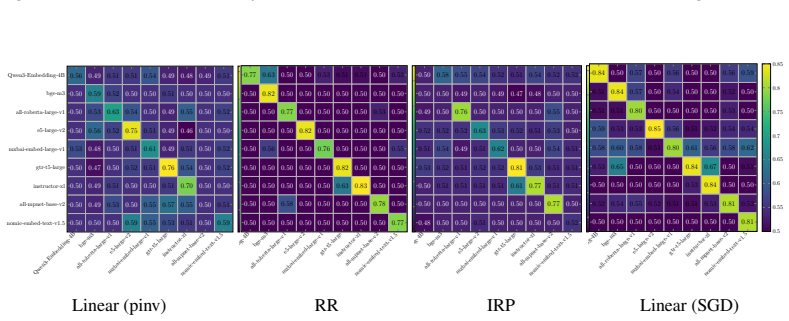
- [§3 and §5.2 (Table 2)] The claim that Linear (SGD) is an 'approximate upper bound on what a linear map can achieve' is load-bearing for the paper's negative conclusion, but no training details or convergence evidence are provided: the manuscript reports no optimizer, learning rate, batch size, number of epochs, final loss, or repeated runs. The same-model diagonal in Table 2 cannot be calibrated because no identity/no-translation baseline is reported. If the SGD maps are undertrained, the sharp cross-model failures attributed to representational incompatibility could instead be optimization artifacts. Please report the full optimization configuration and convergence curves, add an identity baseline for the SVM evaluation, and ideally compare against a closed-form least-squares or ridge solution on the same large paired corpus to substantiate the upper-bound interpretation.
- [§5.2, §6, and §8] All results are single point estimates, and Section 8 explicitly states that no uncertainty estimates are reported. Because the central claim is about patterns and clusters of compatibility (e.g., 'e5-large-v2 is consistently a poor source and target'), the paper needs repeated runs over seeds and anchor selections, or at least bootstrap confidence intervals for the key accuracy and retrieval matrices, to show that the observed pair differences are not noise. This is particularly important for the small-anchor methods, where the choice of 850 anchors may have a large effect.
- [§6 and Figure 5] The compatibility score Compat(A,B) is defined as an average across all methods and tasks, but Figure 5 is explicitly a dendrogram 'from bidirectional IRP transfer accuracy' only. This mismatch means the clustering narrative in Section 6 and the abstract, that compatibility clusters follow architecture, objective, pooling, and data, is not directly supported by the figure as presented. Please either construct the dendrogram from the aggregate compatibility score across all methods and tasks or justify why IRP alone is representative.
minor comments (5)
- [§9] The conclusion states that 'the confusion matrices tell a sharper story' and that 'entire class boundaries collapse under translation,' but no confusion matrices are presented anywhere in the paper; please either include them or temper the claim to what the accuracy matrices actually show.
- [Table 2] The last method column is labeled 'Learned-Linear' while the text and figures use 'Linear (SGD)'; please harmonize the notation.
- [Figure 2] The Linear (SGD) panels use a color scale that starts at 0.7, which visually compresses variation relative to the other methods; using a common color scale across panels would make the pairwise differences easier to compare.
- [Appendix D, Tables 3–5] The column header 'Percentil' is a typo for 'Percentile', and the Top-1 hubness table is degenerate (all 95th percentiles equal 1.0), so the textual claim that e5-large-v2 has one of the highest hubness indications at Top-1 is not supported by the reported statistic; additional statistics or a different summary would be needed.
- [§3] The statement that Basic English words and the 850 most distant Wikitext-103 sentences 'found no consistent difference in performance' would benefit from a supporting table or footnote, since it is the basis for fixing the anchor set.
Circularity Check
No significant circularity: the translators are fit on paired data and evaluated on held-out words and tasks, so the central negative claim is not equivalent to its inputs by construction.
full rationale
The paper is an empirical study rather than a derivation: each translator is fit on paired anchor or sentence data and then evaluated on held-out words, downstream tasks, retrieval, and fidelity metrics. No fitted quantity is renamed as a prediction; the reported transfer matrices and fidelity scores are genuine held-out measurements. Section 4's identification of coefficient-based translation with Linear (pinv) is a closed-form algebraic identity (T_A->B = Y X^+), not a circular argument, and it is used only to explain why the anchor-based methods share a common geometric assumption. The 'approximate upper bound' status of Linear (SGD) is an explicit assumption about training budget and is not used to define the conclusion; the negative universality claim rests on the observed held-out patterns. Compatibility clusters are presented as post hoc interpretation of the measured matrices, not as the premise of the experiments. No load-bearing self-citation or imported uniqueness theorem appears, and the paper explicitly notes limitations (e.g., no uncertainty estimates, limited anchor-selection tuning) rather than hiding them. Concerns about whether Linear (SGD) was trained to convergence are reproducibility or validity issues, not circularity, because the prediction target is not a function of the training configuration by construction.
Assumptions & free parameters
free parameters (3)
- Anchor set size =
850
- Linear (SGD) hyperparameters
- SVM hyperparameters
assumptions (5)
- standard math The least-squares pseudo-inverse solution T* = Y X^+ minimizes the Frobenius objective ||Y - T X||_F^2.
- domain assumption The local linear geometry around a small set of shared anchors is approximately shared across models.
- ad hoc to paper The Basic English 850 word list and the 850 most distant Wikitext-103 sentences form semantically broad, representative anchor sets.
- domain assumption Fixed-length sentence and word embeddings are the relevant unit for evaluating the universality hypothesis.
- domain assumption Paired embeddings for the same raw text provide a meaningful correspondence across models despite differing tokenizers.
Cite this review
Pith. "Pith review of How Far Do Simple Transformations Translate Across Text Embedding Models?." pith.science (2026). https://pith.science/paper/IKIGWCO4
@misc{pith2026260805980,
  author       = {Pith},
  title        = {Pith review of: How Far Do Simple Transformations Translate Across Text Embedding Models?},
  year         = {2026},
  howpublished = {\url{https://pith.science/paper/IKIGWCO4}},
  note         = {Machine review of arXiv:2608.05980}
}
read the original abstract
We investigate whether simple transformations can translate representations across heterogeneous text embedding models. Understanding how independently trained models organize semantic information is an enabler for AI-to-AI latent communication without decoding into human-readable text. Focusing on lightweight translators such as linear mappings, we test the literature hypothesis of latent universality in a realistic text setting beyond simplified benchmarks. Across nine embedding models differing in architecture, pooling strategy, and training objective, we evaluate compatibility using CKA, downstream transfer, fidelity, and retrieval. Simple translators recover meaningful shared structure and support transfer for some compatible pairs, but fail sharply for others. Compatibility depends jointly on architecture, training objective, pooling, and data distribution. Overall, the results show that heterogeneous embedding spaces are not universally related by simple mappings as often suggested in some literature.
Figures


Figures from the paper (13 more)


Reference graph
Works this paper leans on
- [1]
-
[2]
A. Chen, J. Merullo, A. Stolfo, and E. Pavlick.Transferring Linear Features Across Language Models With Model Stitching. 1, 2025. arXiv: 2506.06609 [cs].URL: http://arxiv.org/ abs/2506.06609(visited on 04/29/2026)
arXiv 2025
-
[3]
M. Huh, B. Cheung, T. Wang, and P. Isola.The Platonic Representation Hypothesis. 25,
-
[4]
Similarity of Neural Network Representa- tions Revisited
S. Kornblith, M. Norouzi, H. Lee, and G. Hinton. “Similarity of Neural Network Representa- tions Revisited”. In:Proceedings of the 36th International Conference on Machine Learning. International Conference on Machine Learning. PMLR, 24, 2019, pp. 3519–3529
work page 2019
-
[5]
Zou et al.Latent Collaboration in Multi-Agent Systems
J. Zou et al.Latent Collaboration in Multi-Agent Systems. 8, 2025. arXiv: 2511.20639 [cs]. URL:http://arxiv.org/abs/2511.20639(visited on 05/04/2026)
arXiv 2025
-
[6]
Du et al.Enabling Agents to Communicate Entirely in Latent Space
Z. Du et al.Enabling Agents to Communicate Entirely in Latent Space. 16, 2026. arXiv: 2511.09149 [cs].URL:http://arxiv.org/abs/2511.09149(visited on 05/04/2026)
arXiv 2026
-
[7]
Zhu et al.A Survey on Latent Reasoning
R.-J. Zhu et al.A Survey on Latent Reasoning. 10, 2025. arXiv: 2507.06203 [cs] .URL: http://arxiv.org/abs/2507.06203(visited on 05/04/2026)
arXiv 2025
-
[8]
M. Huh, P. Agrawal, and A. A. Efros.What Makes ImageNet Good for Transfer Learning?10,
Show all 27 references
-
[9]
Understanding Image Representations by Measuring Their Equiv- ariance and Equivalence
K. Lenc and A. Vedaldi. “Understanding Image Representations by Measuring Their Equiv- ariance and Equivalence”. In: Proceedings of the IEEE Conference on Computer Vision and Pattern Recognition. 2015, pp. 991–999
2015
-
[10]
Similarity and Matching of Neural Network Representations
A. Csiszárik, P. K\ Horösi-Szabó, Á. Matszangosz, G. Papp, and D. Varga. “Similarity and Matching of Neural Network Representations”. In:Advances in Neural Information Processing Systems. V ol. 34. Curran Associates, Inc., 2021, pp. 5656–5668
2021
-
[11]
S. L. Smith, D. H. P. Turban, S. Hamblin, and N. Y . Hammerla.Offline Bilingual Word Vectors, Orthogonal Transformations and the Inverted Softmax. 13, 2017. arXiv:1702.03859 [cs]. URL:http://arxiv.org/abs/1702.03859(visited on 04/29/2026)
2017 arXiv
-
[12]
Moschella, V
L. Moschella, V . Maiorca, M. Fumero, A. Norelli, F. Locatello, and E. Rodolà.Relative Representations Enable Zero-Shot Latent Space Communication. 7, 2023. arXiv: 2209.15430 [cs].URL:http://arxiv.org/abs/2209.15430(visited on 04/29/2026)
2023 arXiv
-
[13]
On the Direct Alignment of Latent Spaces
Z. Lähner and M. Moeller. “On the Direct Alignment of Latent Spaces”. In:Proceedings of UniReps: The First Workshop on Unifying Representations in Neural Models. Proceedings of UniReps: The First Workshop on Unifying Representations in Neural Models. PMLR, 14, 2024, pp. 158–169
2024
-
[14]
Latent Space Translation via Semantic Alignment
V . Maiorca, L. Moschella, A. Norelli, M. Fumero, F. Locatello, and E. Rodolà. “Latent Space Translation via Semantic Alignment”. In:Advances in Neural Information Processing Systems 36 (15, 2023), pp. 55394–55414
2023
-
[15]
Gorbett and S
M. Gorbett and S. Jana.Characterizing Linear Alignment Across Language Models. Version 3. 26, 2026. arXiv: 2603.18908 [cs].URL: http://arxiv.org/abs/2603.18908 (visited on 04/29/2026)
2026 arXiv
-
[16]
Maiorca, L
V . Maiorca, L. Moschella, M. Fumero, F. Locatello, and E. Rodolà.Latent Space Translation via Inverse Relative Projection. 21, 2024. arXiv: 2406.15057 [cs].URL: http://arxiv. org/abs/2406.15057(visited on 04/29/2026)
2024 arXiv
-
[17]
Cannistraci, L
I. Cannistraci, L. Moschella, M. Fumero, V . Maiorca, and E. Rodolà.From Bricks to Bridges: Product of Invariances to Enhance Latent Space Communication. 20, 2024. arXiv: 2310. 01211 [cs].URL:http://arxiv.org/abs/2310.01211(visited on 04/29/2026)
2024 arXiv
-
[18]
MTEB: Massive Text Embedding Benchmark
N. Muennighoff, N. Tazi, L. Magne, and N. Reimers. “MTEB: Massive Text Embedding Benchmark”. In:Proceedings of the 17th Conference of the European Chapter of the Asso- ciation for Computational Linguistics. EACL 2023. Ed. by A. Vlachos and I. Augenstein. Dubrovnik, Croatia: As...
2023
-
[19]
Enevoldsen et al.MMTEB: Massive Multilingual Text Embedding Benchmark
K. Enevoldsen et al.MMTEB: Massive Multilingual Text Embedding Benchmark. 13, 2025. arXiv: 2502 . 13595 [cs].URL: http : / / arxiv . org / abs / 2502 . 13595(visited on 04/29/2026)
2025
-
[20]
Mikolov, K
T. Mikolov, K. Chen, G. Corrado, and J. Dean.Efficient Estimation of Word Representations in Vector Space. 7, 2013. arXiv:1301.3781 [cs].URL: http://arxiv.org/abs/1301.3781 (visited on 04/29/2026)
2013 arXiv
-
[21]
Distributed Representations of Words and Phrases and Their Compositionality
T. Mikolov, I. Sutskever, K. Chen, G. S. Corrado, and J. Dean. “Distributed Representations of Words and Phrases and Their Compositionality”. In:Advances in Neural Information Processing Systems. V ol. 26. Curran Associates, Inc., 2013
2013
-
[22]
Word Translation without Parallel Data
G. Lample, A. Conneau, M. Ranzato, L. Denoyer, and H. Jégou. “Word Translation without Parallel Data”. In: International Conference on Learning Representations. 15, 2018
2018
-
[23]
Analogies Explained: Towards Understanding Word Embed- dings
C. Allen and T. Hospedales. “Analogies Explained: Towards Understanding Word Embed- dings”. In:Proceedings of the 36th International Conference on Machine Learning. Interna- tional Conference on Machine Learning. PMLR, 24, 2019, pp. 223–231
2019
-
[24]
Wang et al.Text Embeddings by Weakly-Supervised Contrastive Pre-training
L. Wang et al.Text Embeddings by Weakly-Supervised Contrastive Pre-training. 22, 2024. arXiv: 2212 . 03533 [cs].URL: http : / / arxiv . org / abs / 2212 . 03533(visited on 04/30/2026)
2024
-
[25]
Hubs in Space: Popular Nearest Neighbors in High-Dimensional Data
M. Radovanović, A. Nanopoulos, and M. Ivanovi. “Hubs in Space: Popular Nearest Neighbors in High-Dimensional Data”. In:Journal of Machine Learning Research11.86 (2010), pp. 2487–2531. A Analogy-Style Reconstruction Across Heterogeneous Encoders This appendix reports the em...
2010
-
[2016]
arXiv: 1608.08614 [cs].URL: http://arxiv.org/abs/1608.08614 (visited on 04/29/2026)
2026 arXiv
-
[2024]
arXiv: 2405.07987 [cs].URL: http://arxiv.org/abs/2405.07987 (visited on 04/29/2026)
2026 arXiv
Reviewed August 7, 2026 · model on record in the stance chip above.
Discussion (0). Continue with ORCID to comment.