REVIEW 3 major objections 6 minor 20 references
RAG-Audio: Retrieval-Augmented Generation for Faithful Brain-to-Audio Reconstruction
T0 review · 3 major / 6 minor · reviewed 2026-08-15 · deepseek-v4-flash
Pith's one-line read Brain-to-audio reconstruction fails when a frozen generator's prior overwhelms the weak fMRI-derived condition, and starting that generator from a retrieved real-audio exemplar restores stimulus identification to retrieval level while…
desk verdict Quantifies a real failure mode with a plausible fix, but the CLAP-based identification metric leaves the 'faithful' claim under-supported until same-genre and acoustic checks are added. read the letter →
The pith
A machine-rendered reading of the paper's core claim, the machinery that carries it, and where it could break.
The reading
What carries the argument
The central object is exemplar anchoring: a procedure that starts a frozen latent generator not from noise but from the latent code of a retrieved real-audio clip, partially corrupted to an intermediate time. Concretely, for a latent-diffusion generator the retrieved exemplar's latent $z_0$ is noised according to the forward process up to step $t_0 = \lfloor sT \rfloor$ (the SDEdit recipe), and for a rectified-flow generator the latent is interpolated to $\tau_0 = s$ along the flow trajectory; in both cases the reverse or flow-integration process then runs from that point conditioned on the brain-decoded CLAP embedding $\hat{z}$. The anchoring strength $s$ is the knob that trades faithfulness against novelty: small $s$ keeps the exemplar nearly intact and approaches retrieval, while $s \to 1$ erases the exemplar and decays to direct, prior-dominated generation. This continuous-trajectory mechanism is what distinguishes the latent generators, where the intervention works, from the autoregressive MusicGen control, where the exemplar can only enter as melody conditioning and the token prior still dominates.
What would settle it
Run the anchored reconstructions through a forced-choice identification by human listeners, or by an audio model whose training data are disjoint from the stimulus genres, and compare with the CLAP 10-way scores: if human identification of the heard clip does not rise with the CLAP-based gain, the central claim of restored faithful reconstruction fails. Alternatively, anchor from a randomly chosen exemplar at the same strength; if identification stays near retrieval level, the nearest-neighbour content is not carrying the effect.
Extended reading notes
Core claim
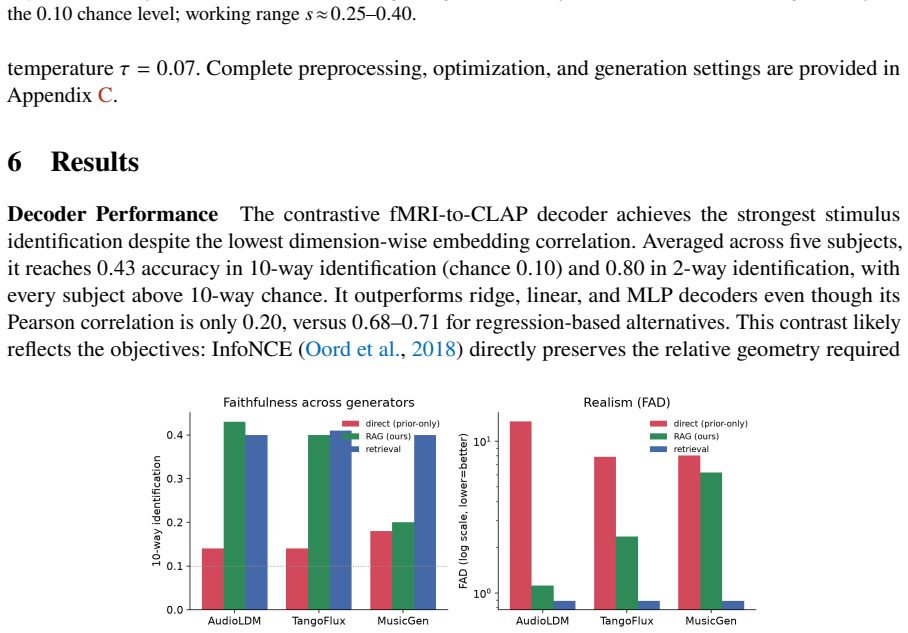
On the paper's own terms, the central discovery is that stimulus information survives fMRI decoding and is then thrown away by the generator: the contrastive fMRI-to-CLAP decoder reaches 0.43 in 10-way identification, but feeding the same embedding to frozen AudioLDM, TangoFlux, or MusicGen drops identification to 0.14–0.18, near the 0.10 chance level. RAG-Audio counters this prior domination by retrieving the nearest real training exemplar to the decoded embedding, encoding it into the generator's latent space, adding noise or flow interpolation up to an intermediate time $t_0 = sT$ (equivalently $\tau_0 = s$ for the flow generator), and running the frozen reverse process from there with the decoded embedding still as conditioning. With anchoring strength $s \approx 0.25$ to $0.40$, 10-way identification rises to 0.43 for AudioLDM and 0.40 for TangoFlux, matching the 0.40 retrieval baseline; FAD falls from 13.50 to 1.25 for AudioLDM and from 7.89 to 2.36 for TangoFlux. The MusicGen control, which cannot be initialized at an intermediate latent time, gains almost nothing (0.18 to 0.20), which the authors take to show that trajectory initialization, not the presence of a retrieved clip, is the operative mechanism.
Load-bearing premise
The central claim rests on treating 10-way identification in CLAP space as the measure of stimulus faithfulness; if that embedding space, which is also the retrieval bank's geometry and the decoder's training objective, does not track the perceptual or acoustic properties of the heard clip, the reconstruction gains are not established.
Editorial extensions
If this is right
- At $s \approx 0.25$ to $0.40$, RAG-Audio matches nearest-neighbour retrieval on 10-way identification while emitting a newly generated sample, with novelty about 0.18 versus about 0.06 for verbatim retrieval; the output is an edit of the exemplar, not a copy.
- Prior domination is shown to be a property of the decode-then-generate recipe rather than of one generator: latent diffusion, rectified flow, and autoregressive generators all drop decoded identification from 0.43 to 0.14–0.18 in direct conditioning.
- The mechanism only transfers to generators that expose an initializable continuous latent trajectory; autoregressive models need a different intervention, because supplying the same retrieved exemplar as melody conditioning leaves identification essentially unchanged.
- The anchoring strength controls a monotone faithfulness-novelty trade-off, so downstream uses can select an operating point: low $s$ for fidelity, higher $s$ for diversity, with FAD roughly stable across the working range.
- Faithfulness is restored only within the support of the memory bank; content outside the training stimuli cannot be anchored, so the method inherits the retrieval bank's coverage limits.
Reading between the lines
- An implied test of the paper's framing is whether human listeners, who do not share CLAP's embedding geometry, also identify the heard clip at the higher rate; if they do not, the measured gain is a property of the evaluation space rather than of reconstructed sound.
- The same trajectory-anchoring logic should apply to brain-to-image latent diffusion decoders, where realistic-but-drifting reconstructions have been reported qualitatively; a 10-way identification metric in an image embedding space would turn that qualitative pattern into the same quantitative prior-domination curve.
- The memory-bank ablation reported in the paper is an honest negative result: anchoring's benefit does not widen when the bank shrinks, which suggests the gain tracks retrieval quality rather than scarcity. A stronger test of generalization would hold out entire genres and check whether moderate $s$ still reconstructs them from less similar exemplars.
- Because CLAP is a joint audio-language embedding, one could add a textual description of the decoded embedding as a second condition and use exemplar anchoring to reconcile a weak semantic condition with a strong prior; this would test the mechanism outside brain decoding, in ordinary text-to-audio generation.
Signed reviews
Editorial analysis
A structured set of objections, weighed in public.
Referee Report
Summary. The paper introduces RAG-Audio, a retrieval-augmented pipeline for fMRI-to-audio reconstruction. A contrastive decoder maps fMRI to a CLAP embedding; the nearest training exemplar is retrieved in CLAP space; and a frozen diffusion or flow generator is initialized at an intermediate time from that exemplar while conditioned on the decoded embedding. On the Brain2Music dataset, the authors report that 10-way stimulus identification rises from 0.14–0.18 for direct generation to 0.40–0.43 for RAG-Audio, matching the retrieval baseline of about 0.40, and that FAD drops by roughly an order of magnitude for AudioLDM and TangoFlux. An autoregressive MusicGen control shows only a small gain, which the authors attribute to the absence of an initializable latent trajectory. The paper concludes that retrieval-guided trajectory initialization mitigates prior domination.
Significance. If the central claim holds, the paper makes a useful contribution: it provides a quantitative, generator-general characterization of a failure mode that has largely been qualitative in brain-to-image work, and it proposes a simple, well-motivated intervention that trades faithfulness against novelty in a controllable way. The single-harness comparison across three generator families, the per-subject decoding analysis, the auditory-cortex localization check, and the honest memory-bank negative result are strengths. The main risk is that the evaluation metric and the retrieval mechanism share the same CLAP cosine geometry, so the headline identification gains may partly reflect inherited genre-level or retrieval-level similarity rather than stimulus-level reconstruction. This concern is acknowledged in the Limitations but is not resolved by the current experiments.
major comments (3)
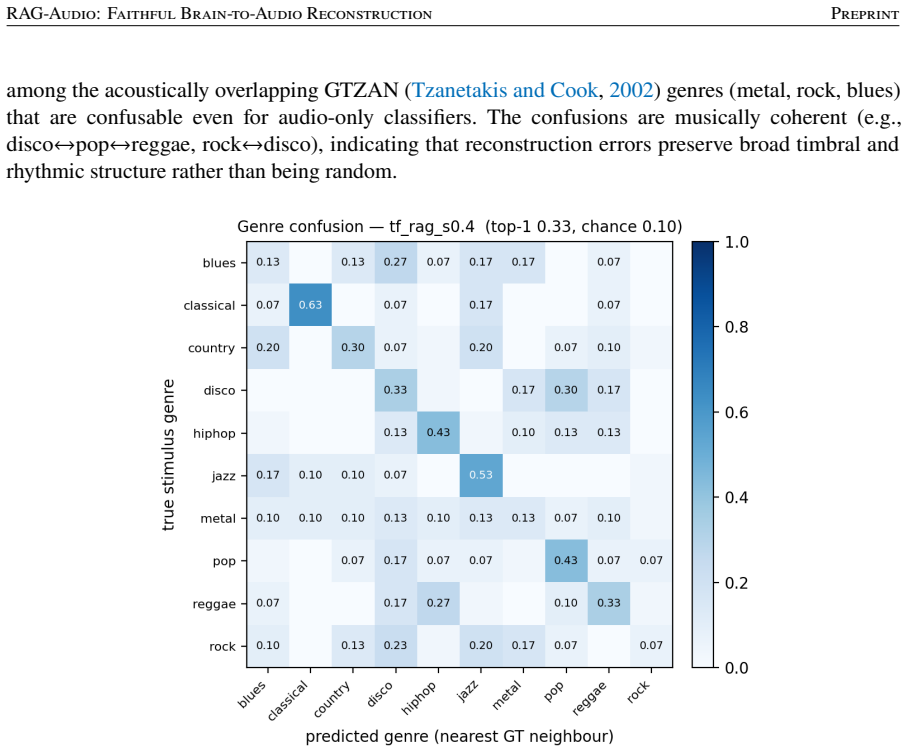
- [§3, Eq. (4); Appendix G] The identification metric is defined as CLAP cosine similarity, and every stage of the pipeline uses the same geometry: the decoder is trained with InfoNCE on CLAP embeddings (Eq. 6), retrieval selects the nearest CLAP embedding (Eq. 7), and the evaluation is CLAP cosine. Because RAG-Audio initializes from the retrieved exemplar, its output inherits the exemplar's CLAP neighborhood. The paper's own Appendix G reports top-1 genre accuracy of only 0.33 (3.3× chance) for the RAG arm, so a system that recovers genre-level information could already score well above chance on a 10-way identification task if distractors are drawn across genres. The authors state in Limitations that Eq. (4) measures semantic agreement in CLAP space rather than sample-accurate waveform recovery, but this does not address the more specific risk that the reported 0.40–0.43 identification is carried by coarse genre/timbre similarity. I ask the authors to report identification with same-genre distractors (e.g., distractor sets matched on predicted or true genre) and to add at least one acoustic-level measure (spectrogram correlation, onset alignment, or similar) that does not depend on CLAP cosine, in order to substantiate the claim of faithful reconstruction rather than genre-level matching.
- [§5, Implementation; §6, Table 7] The anchoring strength s is a free parameter, and the reported headline numbers use the working range s≈0.25–0.40, with the best AudioLDM result at s=0.2 (0.49 identification) and TangoFlux at s=0.4. It is not stated whether s was selected on the held-out test set or on a separate validation split. If s was chosen on the same 300 test generations used to report accuracy, the reported values are optimistic and the comparison to retrieval (which has no such tuned parameter) is not on equal footing. In addition, no confidence intervals or significance tests are provided; with n=300 generations, the difference between 0.14 and 0.43 is large, but the difference between 0.40 (RAG TangoFlux) and 0.43 (AudioLDM RAG) and the difference between RAG and retrieval (0.40 vs 0.40–0.43) need uncertainty quantification to support the claim that RAG 'matches' retrieval rather than merely being statistically indistinguishable under high variance. Please clarify the selection procedure and report per-subject or bootstrap intervals for the central comparisons.
- [§4.3, §6, Mechanism Control] The conclusion that trajectory initialization, rather than retrieval alone, is the operative mechanism rests entirely on the MusicGen negative control. MusicGen is autoregressive, so the retrieved exemplar can only enter through melody conditioning, which is a different conditioning interface from the latent-space initialization used for AudioLDM and TangoFlux. The comparison therefore varies two things at once: the generator family and the way the exemplar is injected. A cleaner control would use a latent-diffusion or flow generator and ablate the initialization: condition on the retrieved audio's embedding (or concatenate it to the decoded embedding) without starting the trajectory from the exemplar. Without such an ablation, the claim that the improvement is not attributable to the mere availability of the retrieved exemplar is under-supported, although the current evidence is suggestive.
minor comments (6)
- [Abstract, Table 1, Table 5] The FAD value for direct AudioLDM is reported as 13.49 in the abstract and Table 5 but 13.5 in Table 1; please make these consistent.
- [Appendix A] The reproducibility section states that the full codebase is released in a public repository, but the repository field is 'TBA'; please provide the actual URL or state the reason for the delay.
- [Appendix F and Appendix H] There are two objects numbered 'Table 8' with different content: one for memory-bank size ablation and one for the SDEdit strength sweep. Please renumber the tables consistently and ensure the in-text references point to the correct table.
- [Table 6] The novelty definition contains a typo: '1−costo the nearest training clip' should read '1 − cosine similarity to the nearest training clip'.
- [§2, Related Work] The second and third paragraphs of Section 2 contain substantially overlapping text about brain-to-image reconstruction and prior domination; please consolidate to avoid redundancy.
- [Figure 7] The caption says 'cyan lines are stimulus onsets (shared per row)', but it is not clear from the figure how the shared onsets are computed or why they are shared; please clarify in the caption or the figure itself.
Circularity Check
No load-bearing circularity; the CLAP-geometry overlap is an acknowledged evaluation limitation, and the only author-overlapping citation (TangoFlux) is not load-bearing.
full rationale
The paper's derivation is self-contained: the decoder is trained with InfoNCE (Eq. 6), retrieval is defined by CLAP cosine (Eq. 7), the generator is initialized from the retrieved exemplar via SDEdit/flow interpolation (Eqs. 9 and 11), and identification is evaluated by CLAP cosine (Eq. 4). These are explicit design choices rather than hidden reductions. The author-overlapping citation, TangoFlux (Hung et al., 2024), is used only as a frozen public generator checkpoint and is not load-bearing for the core argument. The closest thing to a circularity concern is that the training objective, retrieval mechanism, and evaluation metric all live in the same CLAP cosine geometry, so the identification gain of RAG-Audio is partly inherited from the retrieval exemplar by construction. The paper acknowledges this in Limitations: 'Our N-way identification measures semantic agreement in CLAP space rather than sample-accurate waveform recovery.' Appendix G's top-1 genre accuracy of 0.33 further indicates that CLAP identification may reflect genre-level similarity rather than full stimulus recovery. However, this is a limitation on what the metric proves about faithfulness, not a circular derivation: the headline comparisons (direct versus RAG, the MusicGen negative control, and the FAD reductions) are empirical results on held-out test stimuli against external benchmarks. Under the required standard of a specific equation-level reduction or a fitted parameter renamed as a prediction, no circular step is established.
Assumptions & free parameters
free parameters (5)
- Anchoring strength s =
0.25 for AudioLDM headline, 0.4 for TangoFlux, grid swept from 0.15 to 1.0
- Number of selected voxels K =
2000
- Hemodynamic lag l =
3 TRs (4.5 s)
- Temporal window w =
8 TRs
- InfoNCE temperature tau =
0.07
assumptions (5)
- domain assumption CLAP cosine similarity is a valid proxy for semantic stimulus identity in the N-way identification metric (Eq. 4).
- domain assumption BOLD responses at lag 3 TRs, window 8 TRs, and the top 2000 voxels by max correlation contain usable stimulus information.
- domain assumption SDEdit-style partial noising and rectified-flow interpolation preserve the retrieved exemplar's stimulus-relevant structure in the frozen generator's latent space.
- domain assumption Pretrained generators AudioLDM, TangoFlux, and MusicGen encode strong priors that dominate weak brain-derived conditions.
- ad hoc to paper MusicGen's melody conditioning is a fair way to inject the retrieved exemplar, making it a valid negative control for trajectory initialization.
Cite this review
Pith. "Pith review of RAG-Audio: Retrieval-Augmented Generation for Faithful Brain-to-Audio Reconstruction." pith.science (2026). https://pith.science/paper/IKR4CUCX
@misc{pith2026260809331,
  author       = {Pith},
  title        = {Pith review of: RAG-Audio: Retrieval-Augmented Generation for Faithful Brain-to-Audio Reconstruction},
  year         = {2026},
  howpublished = {\url{https://pith.science/paper/IKR4CUCX}},
  note         = {Machine review of arXiv:2608.09331}
}
abstract
Brain-to-audio reconstruction is limited by \emph{prior domination}: when a pretrained generator is conditioned on a weak neural signal, it produces realistic but stimulus-inaccurate audio. We introduce RAG-Audio, which decodes fMRI into a semantic audio embedding, retrieves a matching real-audio exemplar, and initializes the frozen generator's sampling trajectory from that exemplar while retaining the decoded embedding as conditioning. On Brain2Music, RAG-Audio improves 10-way stimulus identification from $0.14$--$0.18$ for direct generation, near the $0.10$ chance level, to $0.40$--$0.43$, comparable to retrieval. It also reduces Fr\'echet Audio Distance by roughly an order of magnitude, from $13.49$ to $1.25$ for AudioLDM. RAG-Audio approaches nearest-neighbor retrieval in identification while remaining generative; its higher FAD is expected because retrieval directly replays real audio. An autoregressive negative control, which lacks an initializable latent trajectory, shows no comparable gain, attributing the improvement to trajectory initialization. These results suggest that retrieval-guided initialization can mitigate prior domination in brain-to-audio generation.
Figures


Figures from the paper (6 more)



Reference graph
Works this paper leans on
-
[4]
R&B -- Rhythm and Brain: Cross-subject Decoding of Music from Human Brain Activity
Matteo Ferrante, Matteo Ciferri, and Nicola Toschi. R&b–rhythm and brain: Cross-subject decoding of music from human brain activity.arXiv preprint arXiv:2406.15537,
-
[5]
All runs use a single GPU per job; we release seeds, code, and configurations
Auditory-cortex overlap is computed against the Harvard-Oxford atlas (Desikan et al., 2006). All runs use a single GPU per job; we release seeds, code, and configurations. 22
work page 2006
-
[10]
Flow matching for generative modeling
Yaron Lipman, Ricky TQ Chen, Heli Ben-Hamu, Maximilian Nickel, and Matthew Le. Flow matching for generative modeling. InThe eleventh international conference on learning representations. Che Liu, Changde Du, Xiaoyu Chen, and Huiguang He. Reverse the auditory processing pathway: Coarse-to-fine audio reconstruction from fmri.arXiv preprint arXiv:2405.18726,
-
[12]
Jong-Yun Park, Mitsuaki Tsukamoto, Misato Tanaka, and Yukiyasu Kamitani. Sound reconstruction from human brain activity via a generative model with brain-like auditory features.arXiv preprint arXiv:2306.11629,
-
[13]
Naturalistic music decoding from eeg data via latent diffusion models
16 RAG-Audio: Faithful Brain-to-Audio Reconstruction Preprint Emilian Postolache, Natalia Polouliakh, Hiroaki Kitano, Akima Connelly, Emanuele Rodolà, Luca Cosmo, and Taketo Akama. Naturalistic music decoding from eeg data via latent diffusion models. InICASSP 2025-2025 IEEE International Conference on Acoustics, Speech and Signal Processing (ICASSP), pag...
work page 2025
-
[14]
Litu Rout, Yujia Chen, Nataniel Ruiz, Constantine Caramanis, Sanjay Shakkottai, and Wen-Sheng Chu. Semantic image inversion and editing using rectified stochastic differential equations.arXiv preprint arXiv:2410.10792,
-
[15]
Denoising diffusion implicit models.arXiv preprint arXiv:2010.02502, 2020a
Jiaming Song, Chenlin Meng, and Stefano Ermon. Denoising diffusion implicit models.arXiv preprint arXiv:2010.02502, 2020a. Yang Song, Jascha Sohl-Dickstein, Diederik P Kingma, Abhishek Kumar, Stefano Ermon, and Ben Poole. Score-based generative modeling through stochastic differential equations.arXiv preprint arXiv:2011.13456, 2020b. YuTakagiandShinjiNish...
arXiv 2010
-
[17]
YiYuan,HaoheLiu,XuboLiu,QiushiHuang,MarkDPlumbley,andWenwuWang.Retrieval-augmented text-to-audio generation. InICASSP 2024-2024 IEEE International Conference on Acoustics, Speech and Signal Processing (ICASSP), pages 581–585. IEEE,
work page 2024
Show all 20 references
-
[18]
Voxels are selected by the relevance score of Eq
at temperature𝜏=0.07 , using the Adam optimizer with weight decay; full layer widths, learning rate, and batch size are given in our released configuration. Voxels are selected by the relevance score of Eq. 5 (𝐾=2000 ), with a haemodynamic lag ofℓ=3 TRs and a temporal window o...
2000
-
[19]
genres (metal, rock, blues) that are confusable even for audio-only classifiers. The confusions are musically coherent (e.g., disco↔pop↔reggae, rock↔disco), indicating that reconstruction errors preserve broad timbral and rhythmic structure rather than being random. Figure 9:G...
2023
-
[2002]
Large- scalecontrastivelanguage-audiopretrainingwithfeaturefusionandkeyword-to-captionaugmentation
Yusong Wu, Ke Chen, Tianyu Zhang, Yuchen Hui, Taylor Berg-Kirkpatrick, and Shlomo Dubnov. Large- scalecontrastivelanguage-audiopretrainingwithfeaturefusionandkeyword-to-captionaugmentation. InICASSP 2023-2023 IEEE International Conference on Acoustics, Speech and Signal Proces...
2023
-
[2015]
Representation learning with contrastive predictive coding.arXiv preprint arXiv:1807.03748,
Aaron van den Oord, Yazhe Li, and Oriol Vinyals. Representation learning with contrastive predictive coding.arXiv preprint arXiv:1807.03748,
-
[2017]
Classifier-free diffusion guidance.arXiv preprint arXiv:2207.12598,
Jonathan Ho and Tim Salimans. Classifier-free diffusion guidance.arXiv preprint arXiv:2207.12598,
-
[2018]
Generalization through memorization: Nearest neighbor language models.arXiv preprint arXiv:1911.00172,
Urvashi Khandelwal, Omer Levy, Dan Jurafsky, Luke Zettlemoyer, and Mike Lewis. Generalization through memorization: Nearest neighbor language models.arXiv preprint arXiv:1911.00172,
1911 arXiv
-
[2019]
A reproducibleevaluationofantssimilaritymetricperformanceinbrainimageregistration.Neuroimage, 54(3):2033–2044,
Brian B Avants, Nicholas J Tustison, Gang Song, Philip A Cook, Arno Klein, and James C Gee. A reproducibleevaluationofantssimilaritymetricperformanceinbrainimageregistration.Neuroimage, 54(3):2033–2044,
-
[2020]
Mulan: A joint embedding of music audio and natural language.arXiv preprint arXiv:2208.12415,
Qingqing Huang, Aren Jansen, Joonseok Lee, Ravi Ganti, Judith Yue Li, and Daniel PW Ellis. Mulan: A joint embedding of music audio and natural language.arXiv preprint arXiv:2208.12415,
-
[2021]
Matteo Ciferri, Matteo Ferrante, and Nicola Toschi
arXiv:2108.02938. Matteo Ciferri, Matteo Ferrante, and Nicola Toschi. Reconstructing music perception from brain activity using a prior guided diffusion model.Scientific Reports, 15(1):42108,
-
[2022]
Tangoflux: Super fast and faithful text to audio generation with flow matching and clap-ranked preference optimization.arXiv preprint arXiv:2412.21037,
Chia-Yu Hung, Navonil Majumder, Zhifeng Kong, Ambuj Mehrish, Amir Ali Bagherzadeh, Chuan Li, Rafael Valle, Bryan Catanzaro, and Soujanya Poria. Tangoflux: Super fast and faithful text to audio generation with flow matching and clap-ranked preference optimization.arXiv preprint...
-
[2023]
Semi-parametric neural image synthesis.arXiv preprint arXiv:2204.11824,
Andreas Blattmann, Robin Rombach, Kaan Oktay, Jonas Müller, and Björn Ommer. Semi-parametric neural image synthesis.arXiv preprint arXiv:2204.11824,
-
[2024]
Neuropictor: Refining fmri-to-image reconstruction via multi-individual pretraining and multi-level modulation.arXiv preprint arXiv:2403.18211,
Jingyang Huo, Yikai Wang, Xuelin Qian, Yun Wang, Chong Li, Jianfeng Feng, and Yanwei Fu. Neuropictor: Refining fmri-to-image reconstruction via multi-individual pretraining and multi-level modulation.arXiv preprint arXiv:2403.18211,
Reviewed August 15, 2026 · model on record in the stance chip above.
Discussion (0). Continue with ORCID to comment.