The impact of population heterogeneity on the redundancy principle
Pith reviewed 2026-06-25 22:12 UTC · model grok-4.3
The pith
Averaging over heterogeneous populations of memoryless random walkers produces ensemble self-reinforcement and reduces first passage times by an order of magnitude.
A machine-rendered reading of the paper's core claim, the machinery that carries it, and where it could break.
Core claim
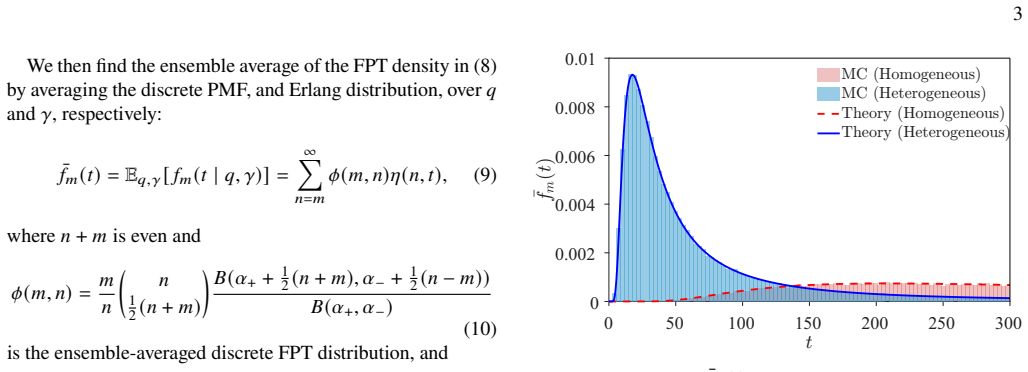
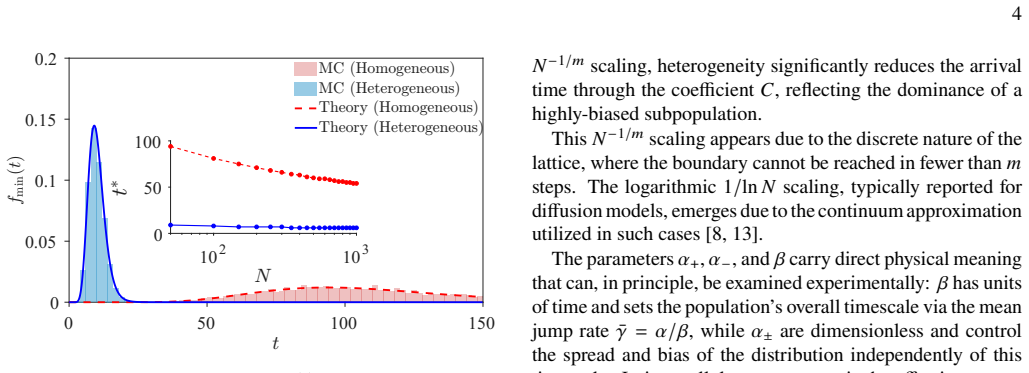
Averaging over a heterogeneous population of memoryless random walkers gives rise to ensemble self-reinforcement. This heterogeneity drastically changes both the FPT and minimum FPT densities relative to a homogeneous ensemble with identical mean rates. The modal and minimum FPTs are an order of magnitude smaller for heterogeneous populations relative to homogeneous ones. Our exact analytical predictions establish that population heterogeneity is a parameter that biology can exploit and not merely noise to be averaged away.
What carries the argument
ensemble self-reinforcement from rate heterogeneity in memoryless random walkers
If this is right
- FPT densities differ significantly from homogeneous ensembles.
- Minimum FPT densities are altered by the heterogeneity.
- Modal FPTs become an order of magnitude smaller.
- Minimum FPTs are also an order of magnitude smaller.
- Biology can use heterogeneity for faster extreme responses.
Where Pith is reading between the lines
- Models of biological signaling that assume identical cells may underestimate response speeds.
- Similar self-reinforcement effects might occur in other systems with distributed parameters, such as chemical reaction networks.
- Experimental tests could involve varying the spread of rates in cell populations and measuring response times.
Load-bearing premise
The walkers are memoryless and the heterogeneity is introduced through a distribution of rates whose averaging produces the self-reinforcement effect.
What would settle it
If experiments on populations of cells or particles with varying rates show no difference in minimum first passage times compared to uniform rate populations with the same mean, the claim of order-of-magnitude reduction would be falsified.
Figures
read the original abstract
Biological signaling is often governed by extreme value statistics, where a rapid response relies on the fastest few out of a large redundant group of searchers. While extreme first passage time (FPT) theory is well established for homogeneous ensembles, its sensitivity to population heterogeneity remains open. We show that averaging over a heterogeneous population of memoryless random walkers gives rise to ensemble self-reinforcement. This heterogeneity drastically changes both the FPT and minimum FPT densities relative to a homogeneous ensemble with identical mean rates. The modal and minimum FPTs are an order of magnitude smaller for heterogeneous populations relative to homogeneous ones. Our exact analytical predictions establish that population heterogeneity is a parameter that biology can exploit and not merely noise to be averaged away.
Editorial analysis
A structured set of objections, weighed in public.
Referee Report
Summary. The manuscript claims that averaging over a heterogeneous population of memoryless random walkers (with rates drawn from a gamma distribution) produces an ensemble self-reinforcement effect via survival bias in the mixture of exponential survivals. This heterogeneity substantially alters both the single-walker FPT density and the minimum-FPT density relative to a homogeneous ensemble matched on mean rate, with the modal and minimum FPTs reported as an order of magnitude smaller in the heterogeneous case. Exact analytical predictions are derived from the Laplace transform of the rate density.
Significance. If the results hold, the work shows that rate heterogeneity is a tunable parameter that biological systems can exploit to accelerate extreme-value responses in redundant search processes, rather than mere noise. The closed-form expressions obtained directly from the memoryless property and the gamma mixture provide a clear, parameter-controlled framework that strengthens the central claim and enables direct quantitative comparison with homogeneous baselines.
minor comments (3)
- The abstract states that the modal and minimum FPTs are 'an order of magnitude smaller' without specifying the gamma shape parameter range; the main text should clarify for which values of α this quantitative shift holds and whether it is generic or parameter-dependent.
- Notation for the rate distribution p(λ) and the averaging procedure should be introduced with explicit definitions in the methods or theory section to improve readability for readers unfamiliar with the Laplace-transform approach.
- Figure captions comparing heterogeneous and homogeneous ensembles should explicitly state the matched mean rate and the specific α, β values used, to allow immediate visual assessment of the claimed order-of-magnitude difference.
Simulated Author's Rebuttal
We thank the referee for their positive summary and significance assessment of our work on ensemble self-reinforcement due to rate heterogeneity in memoryless random walkers. The recommendation for minor revision is noted. No specific major comments were listed in the report, so we have no point-by-point responses to provide at this time. We will address any minor editorial suggestions in the revised manuscript.
Circularity Check
No significant circularity in derivation chain
full rationale
The paper's central derivation computes the ensemble survival function as the integral of exponential survivals over a gamma rate distribution, which is a direct, parameter-free consequence of the memoryless property and the mixture model. This yields the reported shifts in FPT and minimum-FPT densities without any fitted inputs renamed as predictions, self-definitional loops, or load-bearing self-citations. The comparison to the homogeneous case matched on mean rate follows immediately from the explicit Laplace transform and extreme-value statistics, remaining self-contained against external benchmarks.
Axiom & Free-Parameter Ledger
axioms (1)
- domain assumption Walkers are memoryless random walkers
Reference graph
Works this paper leans on
-
[1]
Reynaud, Z
K. Reynaud, Z. Schuss, N. Rouach, and D. Holcman, Commu- nicative & Integrative Biology8, e1017156 (2015)
2015
-
[2]
P.J.Hollenbeck,TheJournalofCellBiology108,2335(1989)
1989
-
[3]
Klumpp and R
S. Klumpp and R. Lipowsky, Proceedings of the National Academy of Sciences102, 17284 (2005)
2005
-
[4]
S. L. Reck-Peterson, W. B. Redwine, R. D. Vale, and A. P. Carter,NatureReviewsMolecularCellBiology19,382(2018)
2018
-
[5]
M.J.HigleyandB.L.Sabatini,ColdSpringHarborPerspectives in Biology4, a005686 (2012)
2012
-
[6]
Basnayake, D
K. Basnayake, D. Mazaud, A. Bemelmans, N. Rouach, E. Ko- rkotian, and D. Holcman, PLoS Biology17, e2006202 (2019)
2019
-
[7]
B.MeersonandS.Redner,PhysicalReviewLetters114,198101 (2015)
2015
-
[8]
Schuss, K
Z. Schuss, K. Basnayake, and D. Holcman, Physics of Life Reviews28, 52 (2019)
2019
-
[9]
S. I. Resnick et al.,Extreme values, regular variation and point processes, vol. 4 (Springer, 1987)
1987
-
[10]
Holcman and Z
D. Holcman and Z. Schuss, SIAM Review56, 213 (2014)
2014
-
[11]
Metzler, S
R. Metzler, S. Redner, and G. Oshanin,First-passage phenom- ena and their applications, vol. 35 (World Scientific, 2014)
2014
-
[12]
Guérin, N
T. Guérin, N. Levernier, O. Bénichou, and R. Voituriez, Nature 534, 356 (2016)
2016
-
[13]
K.Basnayake,Z.Schuss,andD.Holcman,JournalofNonlinear Science29, 461 (2019)
2019
-
[14]
S. D. Lawley, Physical Review E101, 012413 (2020)
2020
-
[15]
D. S. Grebenkov, R. Metzler, and G. Oshanin, New Journal of Physics22, 103004 (2020)
2020
-
[16]
W. V. Holt and K. J. Van Look, Reproduction127, 527 (2004)
2004
-
[17]
Fernández-López, J
P. Fernández-López, J. Garriga, I. Casas, M. Yeste, and F. Bar- tumeus, Communications Biology5, 1027 (2022)
2022
-
[18]
B. Wang, J. Kuo, S. C. Bae, and S. Granick, Nature materials 11, 481 (2012)
2012
-
[19]
D. Han, N. Korabel, R. Chen, M. Johnston, A. Gavrilova, V. J. Allan, S. Fedotov, and T. A. Waigh, Elife9, e52224 (2020)
2020
-
[20]
Sabri, X
A. Sabri, X. Xu, D. Krapf, and M. Weiss, Physical Review Letters125, 058101 (2020)
2020
-
[21]
N.Korabel,D.Han,A.Taloni,G.Pagnini,S.Fedotov,V.Allan, and T. A. Waigh, Entropy23, 958 (2021)
2021
-
[22]
H.Anwar,I.Hepburn,H.Nedelescu,W.Chen,andE.DeSchut- ter, Journal of Neuroscience33, 15848 (2013)
2013
-
[23]
Baldovin, Physical Review Letters132, 117101 (2024)
V.Sposini,S.Nampoothiri,A.Chechkin,E.Orlandini,F.Seno, and F. Baldovin, Physical Review Letters132, 117101 (2024)
2024
-
[24]
M. J. Müller, S. Klumpp, and R. Lipowsky, Proceedings of the National Academy of Sciences105, 4609 (2008)
2008
-
[25]
Berger, C
F. Berger, C. Keller, S. Klumpp, and R. Lipowsky, Physical Review Letters108, 208101 (2012)
2012
-
[26]
Tong, bioRxiv (2025)
Y.Shen,C.Yan,P.Huang,K.M.Ori-McKenney,P.-Y.Lai,and P. Tong, bioRxiv (2025)
2025
-
[27]
R. D. Vale, Cell112, 467 (2003)
2003
-
[28]
Lukacs, The Annals of Mathematical Statistics26, 319 (1955)
E. Lukacs, The Annals of Mathematical Statistics26, 319 (1955)
1955
-
[29]
J. E. Mosimann, Biometrika49, 65 (1962)
1962
-
[30]
Feller,An Introduction to Probability Theory and Its Appli- cations, Volume 1, An Introduction to Probability Theory and Its Applications (Wiley, 1968)
W. Feller,An Introduction to Probability Theory and Its Appli- cations, Volume 1, An Introduction to Probability Theory and Its Applications (Wiley, 1968)
1968
-
[31]
Fedotov and D
S. Fedotov and D. Han, Phys. Rev. E107, 034115 (2023)
2023
-
[32]
A.Gavrilova,N.Korabel,V.J.Allan,andS.Fedotov,Scientific Reports15(2025), ISSN 20452322
2025
-
[33]
D. R. Cox and H. D. Miller,The theory of stochastic processes (Methuen, London, 1965), ISBN 0416237606
1965
-
[34]
T. R. Zahn, J. K. Angleson, M. A. MacMorris, E. Domke, J. F. Hutton, C. Schwartz, and J. C. Hutton, Traffic5, 544 (2004)
2004
-
[35]
Kwinter, K
D. Kwinter, K. Lo, P. Mafi, and M. Silverman, Neuroscience 162, 1001 (2009). Spatial self-reinforcement For fixed𝑞, the discrete master equation is 𝑃(𝑘, 𝑛+1|𝑞)=𝑞𝑃(𝑘−1, 𝑛|𝑞)+(1−𝑞)𝑃(𝑘+1, 𝑛|𝑞).(A1) Theensemble-averageddistribution ¯𝑃(𝑘, 𝑛)isobtainedbyin- tegratingtheconditionalprobabilityover𝜉(𝑞). Averagingthe master equation at step𝑛+1gives ¯𝑃(𝑘, 𝑛+1)= ∫ 1 ...
2009
discussion (0)
Sign in with ORCID, Apple, or X to comment. Anyone can read and Pith papers without signing in.