Magnetic Anisotropy and Metamagnetic Transitions in Er3Pt2Sb4.55 with A Distorted Square Net Lattice
Pith reviewed 2026-06-26 15:56 UTC · model grok-4.3
The pith
Er3Pt2Sb4.55 with a distorted square-net Er lattice shows anisotropic antiferromagnetic ordering and metamagnetic transitions consistent with a Jeff=1/2 Er3+ motif.
A machine-rendered reading of the paper's core claim, the machinery that carries it, and where it could break.
Core claim
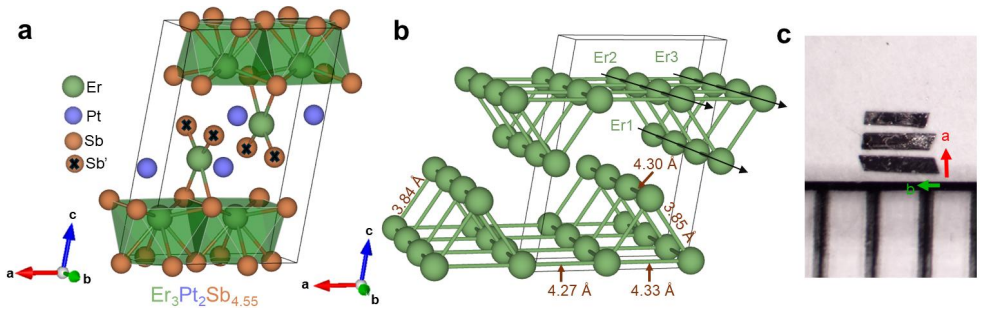
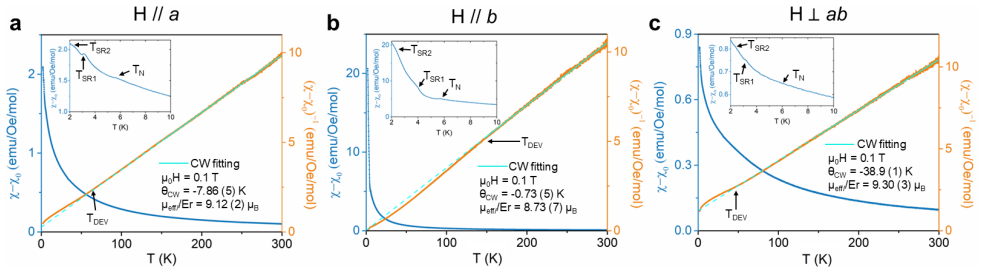
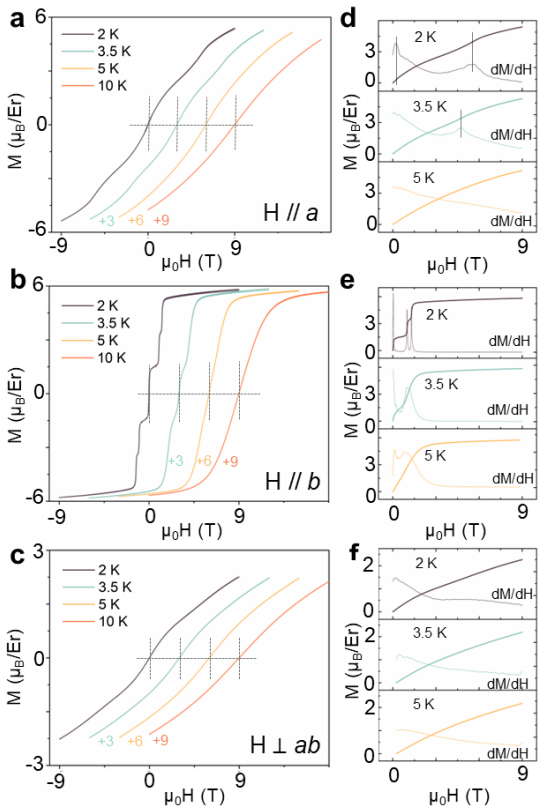
Magnetic properties measurements suggest anisotropic behavior, long-range antiferromagnetic ordering and metamagnetic transitions based on a Jeff = 1/2 Er3+ motif. A magnetic structure is proposed based on the observed magnetic and thermodynamic properties. This new material expands the R3Pt2Sb4+x family with distorted square-net lattice of rare-earth elements and offers a new opportunity to study the relationship between magnetic ordering, crystal-electric field effect and crystal structure in rare-earth-based compounds.
What carries the argument
The distorted square-net framework of Er atoms together with the Jeff=1/2 effective spin motif of Er3+ ions, from which the anisotropy, ordering, and metamagnetic transitions are derived.
If this is right
- The compound exhibits strong magnetic anisotropy tied to the crystal structure.
- Long-range antiferromagnetic order sets in at low temperature.
- Multiple metamagnetic transitions appear as a function of applied field.
- Thermodynamic quantities are consistent with an effective spin-1/2 description.
- The R3Pt2Sb4+x family is enlarged, enabling systematic comparison of structure and magnetism across rare-earth analogs.
Where Pith is reading between the lines
- If the Jeff=1/2 motif is dominant, isostructural compounds with other rare-earth ions should display analogous field-induced transitions whose critical fields scale with the ion's moment size.
- The lattice distortion may lift degeneracy in a way that selects a particular antiferromagnetic propagation vector; varying the Sb content could therefore tune the ordering temperature or the number of metamagnetic steps.
- Transport measurements already reported could be re-examined for signatures of magnon or spin-polaron scattering once the proposed structure is tested by neutrons.
Load-bearing premise
The observed magnetic anisotropy, ordering, and metamagnetic transitions are assumed to arise primarily from the distorted square-net Er framework and a Jeff=1/2 motif, without requiring detailed crystal-field calculations or neutron diffraction confirmation of the proposed magnetic structure.
What would settle it
Neutron diffraction that reveals a magnetic structure incompatible with the one inferred from bulk magnetization and specific-heat data would falsify the proposed Jeff=1/2-based interpretation.
Figures
read the original abstract
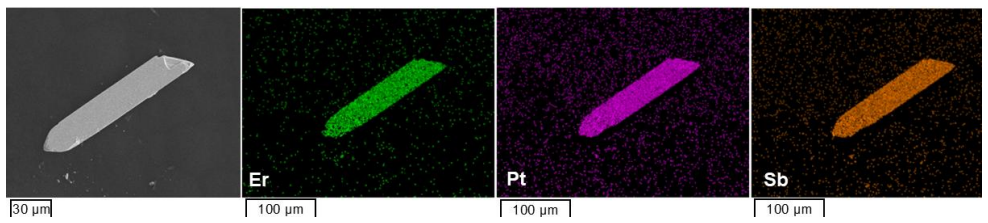
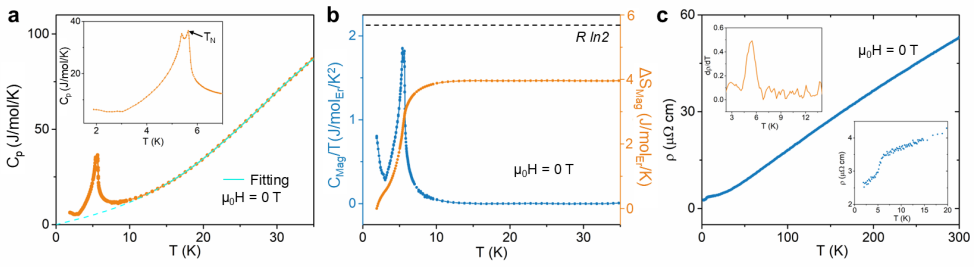
Magnetic materials with square-net sublattices are of great interest due to its potential to realize magnetic frustration. Here we report the crystal growth and structural, magnetic, thermodynamic and electronic transport properties of a new rare-earth-based intermetallic compound, Er3Pt2Sb4.55(5). The new material possesses a distorted square-net framework of Er. Magnetic properties measurements suggest anisotropic behavior, long-range antiferromagnetic ordering and metamagnetic transitions based on a Jeff = 1/2 Er3+ motif. A magnetic structure is proposed based on the observed magnetic and thermodynamic properties. This new material expands the R3Pt2Sb4+x family with distorted square-net lattice of rare-earth elements and offers a new opportunity to study the relationship between magnetic ordering, crystal-electric field effect and crystal structure in rare-earth-based compounds.
Editorial analysis
A structured set of objections, weighed in public.
Referee Report
Summary. The manuscript reports the crystal growth, structural characterization, and physical properties (magnetic, thermodynamic, and transport) of the new compound Er3Pt2Sb4.55(5), which features a distorted square-net lattice of Er atoms. Magnetic measurements are interpreted as showing anisotropic behavior, long-range antiferromagnetic ordering, and metamagnetic transitions arising from a Jeff = 1/2 Er3+ motif, with a specific magnetic structure proposed on the basis of these bulk data.
Significance. If the central claims hold, the work expands the R3Pt2Sb4+x family and supplies a new platform for examining the interplay of crystal-electric-field effects, magnetic ordering, and lattice geometry in rare-earth square-net compounds. The experimental focus on a new material with potential frustration is a positive contribution to the field.
major comments (1)
- [magnetic properties and discussion sections] The central attribution of anisotropy, TN, and metamagnetic steps to a Jeff = 1/2 Er3+ motif together with the proposed magnetic structure (abstract and the magnetic-properties/discussion section) rests entirely on bulk magnetization, susceptibility, and heat-capacity data. For Er3+ (J = 15/2), multiple CEF schemes can produce effective low-spin behavior whose anisotropy and moment size are compatible with the reported Curie-Weiss and M(H) curves; no CEF diagonalization, inelastic neutron scattering, or neutron diffraction is presented to discriminate among possibilities or to fix the propagation vector on the square net. This interpretive step is load-bearing for the manuscript's main claim.
Simulated Author's Rebuttal
We thank the referee for their thorough review and constructive feedback on our manuscript. We address the major comment point-by-point below, with a commitment to revise where appropriate to strengthen the presentation.
read point-by-point responses
-
Referee: [magnetic properties and discussion sections] The central attribution of anisotropy, TN, and metamagnetic steps to a Jeff = 1/2 Er3+ motif together with the proposed magnetic structure (abstract and the magnetic-properties/discussion section) rests entirely on bulk magnetization, susceptibility, and heat-capacity data. For Er3+ (J = 15/2), multiple CEF schemes can produce effective low-spin behavior whose anisotropy and moment size are compatible with the reported Curie-Weiss and M(H) curves; no CEF diagonalization, inelastic neutron scattering, or neutron diffraction is presented to discriminate among possibilities or to fix the propagation vector on the square net. This interpretive step is load-bearing for the manuscript's main claim.
Authors: We agree that the Jeff = 1/2 assignment and proposed magnetic structure are inferences drawn solely from bulk data. The Curie-Weiss effective moment of ~1.85 μ_B/Er is close to the 1.73 μ_B value expected for J_eff = 1/2 (g_J = 2), the low-temperature saturation magnetization is consistent with this reduced moment, and the metamagnetic steps plus anisotropy are interpreted within this picture. However, as the referee correctly notes, other CEF ground states could yield compatible bulk signatures. In the revised manuscript we will (i) qualify the abstract and discussion to describe the Jeff = 1/2 motif as a working hypothesis supported by the bulk measurements rather than a definitively established ground state, (ii) add an explicit statement that CEF diagonalization, inelastic neutron scattering, or neutron diffraction would be needed to discriminate among possible schemes and to determine the propagation vector, and (iii) retain the experimental results on the new compound while reducing the load-bearing character of the interpretive claim. These changes will be made without altering the reported data or measurements. revision: partial
Circularity Check
No circularity: purely experimental report with no derivations or self-referential fits
full rationale
This is an experimental materials paper reporting crystal growth, structure, magnetization, specific heat, and resistivity data on Er3Pt2Sb4.55. The abstract and text describe observations of anisotropy, antiferromagnetic ordering, and metamagnetic transitions, then offer a qualitative interpretation invoking a Jeff=1/2 motif and a proposed magnetic structure 'based on the observed magnetic and thermodynamic properties.' No equations, fitted parameters, or model derivations appear that could reduce a claimed prediction to an input by construction. No self-citations are invoked to justify uniqueness theorems or ansatzes. The claims rest on direct measurements and standard bulk-property interpretation, which are externally falsifiable by neutron diffraction or CEF calculations and therefore do not meet any of the enumerated circularity patterns.
Axiom & Free-Parameter Ledger
Reference graph
Works this paper leans on
-
[1]
Taming Spin Susceptibilities in Frustrated Quantum Magnets: Mean- Field Form and Approximate Nature of the Quantum -to-Classical Correspondence
(1) Schneider, B.; Sbierski, B. Taming Spin Susceptibilities in Frustrated Quantum Magnets: Mean- Field Form and Approximate Nature of the Quantum -to-Classical Correspondence. Phys. Rev. Lett. 2025, 134, 176502. (2) Struck, J.; Ölschläger, C.; Le Targat, R.; Soltan -Panahi, P.; Eckardt, A.; Lewenstein, M.; Windpassinger, P.; Sengstock, K. Quantum Simulat...
2025
-
[2]
(6) Chen, J.; Calder, S.; Paddison, J. A. M.; Angelo, G.; Klivansky, L.; Zhang, J.; Cao, H.; Gui, X. ASb3Mn9O19 (A = K or Rb): New Mn -Based 2D Magnetoplumbites with Geometric and Magnetic Frustration. Advanced Materials 2025, 37, 2417906. (7) Arh, T.; Sana, B.; Pregelj, M.; Khuntia, P.; Jagličić, Z.; Le, M. D.; Biswas, P. K.; Manuel, P.; Mangin-Thro, L.;...
2025
-
[3]
J.; Li, N.; Zhao, X.; Dun, Z.; Choi, E
(8) Rao, X.; Hussain, G.; Huang, Q.; Chu, W. J.; Li, N.; Zhao, X.; Dun, Z.; Choi, E. S.; Asaba, T.; Chen, L.; Li, L.; Yue, X. Y .; Wang, N. N.; Cheng, J.-G.; Gao, Y . H.; Shen, Y .; Zhao, J.; Chen, G.; Zhou, H. D.; Sun, X. F. Survival of Itinerant Excitations and Quantum Spin State Transitions in YbMgGaO4 with Chemical Disorder. Nat Commun 2021, 12,
2021
-
[4]
Spin Liquid State in an Organic Mott Insulator with a Triangular Lattice
(9) Shimizu, Y .; Miyagawa, K.; Kanoda, K.; Maesato, M.; Saito, G. Spin Liquid State in an Organic Mott Insulator with a Triangular Lattice. Phys. Rev. Lett. 2003, 91, 107001. (10) Gao, B.; Chen, T.; Tam, D. W.; Huang, C.-L.; Sasmal, K.; Adroja, D. T.; Ye, F.; Cao, H.; Sala, G.; Stone, M. B.; Baines, C.; Verezhak, J. A. T.; Hu, H.; Chung, J.-H.; Xu, X.; C...
2003
-
[5]
Instability of a Quantum Spin Liquid in an Organic Triangular-Lattice Antiferromagnet
(15) Itou, T.; Oyamada, A.; Maegawa, S.; Kato, R. Instability of a Quantum Spin Liquid in an Organic Triangular-Lattice Antiferromagnet. Nature Phys 2010, 6, 673–676. (16) Zheng, J.; Ran, K.; Li, T.; Wang, J.; Wang, P.; Liu, B.; Liu, Z.-X.; Normand, B.; Wen, J.; Yu, W. Gapless Spin Excitations in the Field-Induced Quantum Spin Liquid Phase of RuCl3. Phys....
2010
-
[6]
(20) Anderson, P. W. The Resonating Valence Bond State in La2CuO4 and Superconductivity. Science 1987, 235, 1196–1198. (21) Fang, Y .; Wang, F.; Wang, R.; Zhai, T.; Huang, F. 2D NbOI2: A Chiral Semiconductor with Highly In-Plane Anisotropic Electrical and Optical Properties. Advanced Materials 2021, 33, 2101505. (22) Dong, S.; Hu, Z.-Y .; Wei, P.; Han, J....
1987
discussion (0)
Sign in with ORCID, Apple, or X to comment. Anyone can read and Pith papers without signing in.