REVIEW 2 major objections 4 minor 59 references
A median-based parameterisation of the exponentiated Kumaraswamy distribution with a hierarchical weakly informative prior makes bounded score modelling practical.
Reviewed by Pith at T0; open to challenge. T0 means a machine referee read the full paper against a public rubric. the ladder, T0–T4 →
T0 review · deepseek-v4-flash
2026-08-01 19:49 UTC pith:IN6KG4LF
load-bearing objection A solid Bayesian workflow for the exponentiated Kumaraswamy, but the evidence for the extra shape parameter is parameterization-dependent — the Bayes factor flips from moderate to overwhelming depending on whether you use sigma or kappa. the 2 major comments →
Bayesian inference on the exponentiated Kumaraswamy distribution with applications
The pith
A machine-rendered reading of the paper's core claim, the machinery that carries it, and where it could break.
Core claim
On the paper's own terms: the exponentiated Kumaraswamy distribution is reparameterised so that the median serves as the location parameter, and the scale is either sigma or kappa, linked by an exact conversion. With a hierarchical Gamma prior placed on the scale, the apparent non-identifiability of the parameterisation becomes manageable: although scale and shape can trade off, the posterior for the median and the predictive distribution remain stable and close to the empirical distribution across sample sizes. The paper further reports that the extra exponentiation parameter is supported by Bayes-factor comparisons against the simpler Kumaraswamy case, and that fitting the model via Hamilt
What carries the argument
The engine is the median-based location-scale-shape parameterisation of the exponentiated Kumaraswamy distribution: because the CDF is closed form, the median omega can serve as the location, and the scale theta is either sigma or kappa with an exact link between them. A hierarchical Gamma prior, Ga(theta | a, psi) Ga(psi | b, c), recommended at a=4.5, b=2.5, c=1, provides heavy-tailed scale behaviour that avoids aggressive shrinkage, while the shape gamma receives a Kumaraswamy prior supported on (0.4, 20), centred near the simpler model. This combination is what converts a potentially non-identifiable parameterisation into one where the median and predictive are reliably estimated.
Load-bearing premise
The recommended hierarchical Gamma prior is flexible and weakly informative enough that posterior medians and predictive distributions are reliable across practical bounded-outcome-score settings, whichever scale parameterisation is used.
What would settle it
Fit the recommended model to simulated data generated with a true shape parameter far outside the prior's (0.4, 20) support, for example gamma = 0.1, at sample size n = 500; if the posterior for the median shifts materially between the sigma and kappa parameterisations, or the predictive distribution fails to track the empirical distribution, the paper's core claim of parameterisation-insensitive, off-the-shelf inference would be contradicted.
If this is right
- Bounded outcome scores can be modelled directly on the original scale, bypassing transformations and their attendant interpretation problems.
- Posterior inference for the median and predictive distribution is robust to choosing sigma or kappa as the scale, so practitioners need not commit to one parameterisation.
- The model automatically supplies a Bayes-factor check of whether the extra exponentiation parameter is needed, giving a formal route to simplifying to the Kumaraswamy distribution.
- For small-to-moderate samples the shape parameter can remain prior-dominated while the location and predictive still recover the data, so the practically relevant quantities remain usable.
- The recommended prior settings give a weakly informative default and an informative alternative that requires relatively little elicitation effort.
Where Pith is reading between the lines
- If the insensitivity of the median and predictive generalises, the same hierarchical-prior pattern could be carried over to other bounded-support families with median-dispersion parameterisations, yielding transformation-free Bayesian defaults beyond the exponentiated Kumaraswamy family.
- The hard restriction of the shape prior to (0.4, 20) is a substantive modelling commitment; domains where boundary accumulation is the signal rather than a nuisance, such as U-, L- or J-shaped score distributions, would require relaxing it, and the paper's off-the-shelf claim does not cover that regime.
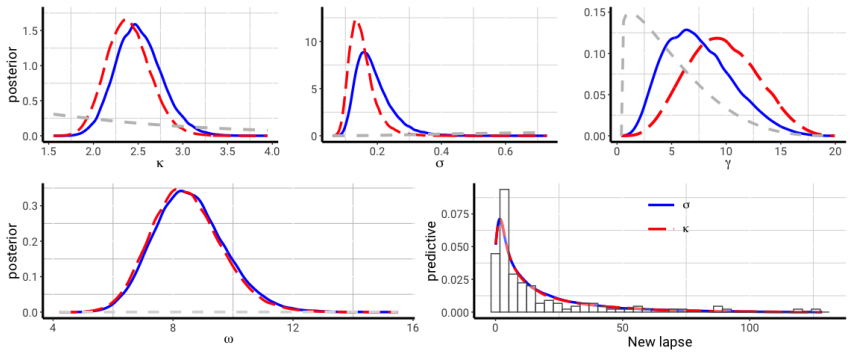
- The reported Bayes factors against the simpler model differ noticeably between the sigma and kappa scale parameterisations in one application, suggesting the evidence for the extra shape parameter may depend on the chosen scale; a robustness-style range would be a natural next check.
- A direct test of the off-the-shelf promise would be to run the default sampler over a benchmark of bounded-outcome-score datasets with no per-dataset tuning and record how often sampling converges and the predictive passes a goodness-of-fit check.
Editorial analysis
A structured set of objections, weighed in public.
Referee Report
Summary. The paper develops a Bayesian framework for the exponentiated Kumaraswamy (eK) distribution parameterized by the median (location), a scale parameter θ (chosen as either σ or κ), and a shape parameter γ. The authors propose a hierarchical gamma prior on θ, a beta-type prior on the median, and a bounded Kumaraswamy prior on γ, and implement the model in Stan/HMC. They evaluate the approach on synthetic data and two real datasets (traffic headway intervals and CARE75+ frailty scores), reporting posterior summaries, predictive distributions, and Savage-Dickey Bayes factors against the nested Kumaraswamy model (γ=1). The central claims are that this prior setting mitigates the identifiability issues inherent in the median-scale parameterization, that the median and predictive inferences are insensitive to the choice of σ versus κ, and that the extra shape parameter is empirically warranted.
Significance. If the claims were fully supported, the paper would offer a useful off-the-shelf Bayesian workflow for bounded outcome scores, leveraging the closed-form CDF and quantile functions of the eK distribution. Strengths include the exact median-based reparameterization in Eqs. (2)–(3), the explicit hierarchical prior construction, the use of HMC, and the practical orientation with two real-data applications. The paper is also careful in discussing the identifiability trade-off and does not overstate the role of the location parameter. However, the evidence for a key component of the contribution—the formal Bayes-factor justification for the extra shape parameter—is parameterization-dependent, and the synthetic evaluation that underlies the 'off-the-shelf utility' claim is only partially reported. These issues need to be addressed before the paper's main conclusions can be accepted.
major comments (2)
- [Section 5, Table 1 and Section 6] The reported Bayes-factor evidence for γ ≠ 1 is not invariant to the arbitrary choice of scale parameterization. Equations (2)–(3) give a deterministic one-to-one map between σ and κ conditional on (ω, γ), but the prior in Eq. (9) places the same hierarchical Gamma on θ whether θ=σ or θ=κ. These are different priors on the observable sampling model. The paper reports log Savage-Dickey Bayes factors of 4.2 (σ-scale) and 13.2 (κ-scale), i.e. an odds ratio of roughly exp(9) ≈ 8100, and posterior means of γ of 6.91 vs 9.54. The conclusion in Section 6 that 'the extra shape parameter in the eK is warranted' is therefore based on a quantity that is strongly affected by an arbitrary modelling choice. This does not invalidate the estimation or predictive results, but it does invalidate the model-selection claim as stated. The authors should either calibrate the hierarchical hyperparameters so th
- [Section 4, Figure 5] The synthetic evidence does not fully support the central claim that the hierarchical prior 'addresses' the identifiability issue in routine practical settings. In the reported low-scale/low-shape scenario (ω=1/6, κ=3/4, γ=3/4), the posterior of the shape parameter is described as 'determined by the prior in all but the largest sample size' (n=2000). Thus for small-to-moderate samples the prior does not resolve the lack of information about γ; it merely absorbs it. The statement in Section 4 that 'the posterior distribution of the median covered its actual value and the predictive distribution resembled the empirical distribution closely, regardless' is useful, but it is illustrated for a single scenario, and the full sensitivity analysis is only 'available from the corresponding author upon request'. To justify 'off-the-shelf utility', the authors need to report the complete simulation
minor comments (4)
- [Abstract / Section 2] Typographical and wording issues: 'addressed trough' should be 'addressed through'; 'closed from expression' should be 'closed-form expression'; 'aK' appears where 'a K' or 'the K' is intended in several places.
- [References / Section 5] The citation 'Cordeiro (2013)' and the reference entry 'Cordeiro, A. J. L. W. B.-S. G. M. (2013)' appear malformed. This is likely the exponentiated Kumaraswamy paper by Lemonte, Barreto-Souza, and Cordeiro, but the author string and in-text citation need correction.
- [Figure 5 caption] The sentence 'For the largest sample size, note the location of the posterior for the shape follows the prior for all but the largest sample size' is confusing and appears redundant. It should be rewritten as something like 'the posterior for the shape follows the prior for all sample sizes except the largest'.
- [Section 3] The stated properties of the shape prior K(γ|1.1,4) should be checked: the text says 'mode at 1 and median at 3', but a direct calculation for this Kumaraswamy prior, after affine transformation to (0.4, 20), gives a mode near 1.17 and a median near 4.08. If the intended values are different, the parameters or the description should be corrected.
Circularity Check
No circularity found: the central reparameterisation is exact algebra, and the priors and Bayes-factor comparisons are not fitted to their own conclusions.
full rationale
The paper's derivation chain is self-contained. The scale-location-shape parameterisation is obtained by solving the median quantile equation: Eq. (3) gives κ(ω,σ,γ) and σ(ω,κ,γ) as exact algebraic inversions of Eq. (2), not as fitted quantities. The hierarchical Gamma prior on the scale parameter is hand-specified (a=4.5, b=2.5, c=1) and evaluated on synthetic and real data; no parameter is fitted to a subset of data and then reported as a prediction. The Bayes factor for the extra shape parameter γ uses Savage-Dickey density ratios against the nested model γ=1; this is a posterior odds comparison, not a quantity defined by the conclusion. No load-bearing self-citations or imported uniqueness theorems appear; the references to Lemonte et al., Jones, etc. are background or distributional definitions. The paper itself acknowledges the parameterisation dependence of some posterior summaries ("There are some differences in the posterior distributions of σ and γ, from the two parameterisations... This emphasises the identifiability issue") and the prior-dominated shape posterior in small samples (Figure 5). Those are identifiability or robustness limitations, not circularity, because the reported inference procedure does not reduce by construction to its inputs. The derivation is therefore not circular.
Axiom & Free-Parameter Ledger
free parameters (4)
- hierarchical prior shape a =
4.5
- hierarchical prior rate b =
2.5
- hierarchical prior hyperparameter c =
1
- gamma prior parameters =
s=1.1, k=4, bounds (0.4,20)
axioms (3)
- domain assumption The eK distribution is an appropriate model for bounded outcome scores, and the median parameterization is one-to-one for fixed l,u.
- domain assumption The hierarchical Gamma prior Ga(θ|a,ψ)Ga(ψ|b,c) yields a proper posterior that HMC can sample efficiently.
- standard math The Savage-Dickey density ratio provides a reliable approximation of the Bayes factor for γ=1.
read the original abstract
We discuss Bayesian estimation of the exponentiated Kumaraswamy distribution, based on a scale-location parameterisation. The parameterisation facilitates prior elicitation and interpretation of results, but potentially entails identifiability issues that are addressed trough a hierarchical weak informative prior setting. Our HMC implementation enables off-the-shelf utility for practitioners, and is illustrated on synthetic and real data.
Figures



Reference graph
Works this paper leans on
-
[1]
2026 , doi =
R: A Language and Environment for Statistical Computing , author =. 2026 , doi =
2026
-
[2]
Gauss M. Cordeiro and Edwin M.M. Ortega and Giovana O. Silva , title =. Journal of Statistical Computation and Simulation , volume =. 2014 , publisher =. doi:10.1080/00949655.2012.745125 , URL =
arXiv 2014
-
[3]
Kumaraswamy distribution: different methods of estimation , url =
Dey, Sanku and Mazucheli, Josmar and Nadarajah, Saralees , doi =. Kumaraswamy distribution: different methods of estimation , url =. Computational and Applied Mathematics , number =
-
[4]
Inference for
Sultana, Farha and Tripathi, Yogesh Mani and Wu, Shuo-Jye and Sen, Tanmay , journal =. Inference for
-
[5]
Artur J. Lemonte. Wagner Barreto-Souza. Gauss M. Cordeiro , journal =. The exponentiated. 2013 , volume =
2013
-
[6]
Communications in Statistics - Theory and Methods , volume =
Bing Xing Wang and Xiu Kun Wang and Keming Yu , title =. Communications in Statistics - Theory and Methods , volume =. 2017 , publisher =. doi:10.1080/03610926.2015.1032425 , URL =
arXiv 2017
-
[7]
The Journals of Gerontology Series A: Biological Sciences and Medical Sciences , volume=
Frailty in relation to the accumulation of deficits , author=. The Journals of Gerontology Series A: Biological Sciences and Medical Sciences , volume=. 2007 , publisher=
2007
-
[8]
Clinical Rehabilitation , volume=
An extended activities of daily living scale for stroke patients , author=. Clinical Rehabilitation , volume=. 1987 , publisher=
1987
-
[9]
Development and preliminary testing of the new five-level version of
Herdman, M and Gudex, C and Lloyd, A and Janssen, M and Kind, P and Parkin, D and Bonsel, G and Badia, X , journal=. Development and preliminary testing of the new five-level version of. 2011 , publisher=
2011
-
[10]
and Shah, Koonal K
Devlin, Nancy J. and Shah, Koonal K. and Feng, Yan and Mulhern, Brendan and van Hout, Ben , journal =. Valuing health-related quality of life: An. 2018 , publisher =
2018
-
[11]
Mini-mental state
"Mini-mental state": A practical method for grading the cognitive state of patients for the clinician , author=. Journal of Psychiatric Research , volume=. 1975 , publisher=
1975
-
[12]
Functional evaluation: the
Mahoney, Florence I and Barthel, Dorothy W , journal=. Functional evaluation: the
-
[13]
BMC Medical Research Methodology , year =
Hunger, Matthias and D\"oring, Angela and Holle, Rolf , title =. BMC Medical Research Methodology , year =. doi:10.1186/1471-2288-12-144 , url =
-
[14]
Lamb and Simon R
Muhammad Akram and Ester Cerin and Karen E. Lamb and Simon R. White , title =. International Journal of Behavioral Nutrition and Physical Activity , volume =. 2023 , doi =
2023
-
[15]
Parker, Richard M. A. and Wong, Rachel and Sabbouh, Tarek and Harris, Oriel and Banks, James and Mu\ niz-Terrera, Graciela , journal=. Modeling Risk Factors for Intraindividual Variability: A Mixed-Effects. 2024 , publisher=
2024
-
[16]
Xu, Steven and Samtani, Mahesh and Yuan, Min and Nandy, Partha , title =. AAPS Journal , year =. doi:10.1208/s12248-014-9655-y , pmid =
-
[17]
Journal of Hydrology , volume =
A generalized probability density function for double-bounded random processes , author =. Journal of Hydrology , volume =. 1980 , publisher =
1980
-
[18]
Discussion: On the distribution of
Nadarajah, Saralees , journal =. Discussion: On the distribution of. 2008 , publisher =
2008
-
[19]
Kyungpook Mathematical Journal , volume =
Garg, Mridula , title =. Kyungpook Mathematical Journal , volume =. 2008 , issn =
2008
-
[20]
Jones, M. C. , journal=. Kumaraswamy's distribution: A. 2009 , publisher=
2009
- [21]
-
[22]
and Barreto-Souza, Wagner and Cordeiro, Gauss M
Lemonte, Artur J. and Barreto-Souza, Wagner and Cordeiro, Gauss M. , title =. Brazilian Journal of Probability and Statistics , volume =. 2013 , doi =
2013
-
[23]
, journal =
Mitnik, Pablo A. , journal =. New Properties of the. 2013 , doi =
2013
-
[24]
and Baek, Chul-In , journal=
Mitnik, Pablo A. and Baek, Chul-In , journal=. The. 2013 , publisher=
2013
-
[25]
Econometrica , volume =
Some Generalized Functions for the Size Distribution of Income , author =. Econometrica , volume =. 1984 , publisher =
1984
-
[26]
Sundar, V. and Subbiah, K. , title =. Ocean Engineering , year =. doi:10.1016/0029-8018(89)90005-X , url =
-
[27]
Fletcher, S. G. and Ponnambalam, K. , title =. Journal of Hydrology , year =. doi:10.1016/0022-1694(95)02946-X , url =
-
[28]
Ganji and K
A. Ganji and K. Ponnambalam and D. Khalili and M. Karamouz , title =. Stochastic Environmental Research and Risk Assessment , volume =. 2006 , publisher =
2006
-
[29]
Journal of Hydrology , volume =
Fbio Mariano Bayer and D\'ebora Missio Bayer and Guilherme Pumi , title =. Journal of Hydrology , volume =. 2017 , month = dec, doi =
2017
-
[30]
Sanku Dey and Josmar Mazucheli and M. Z. Anis , title =. Communications in Statistics - Simulation and Computation , volume =. 2016 , doi =
2016
-
[31]
Statistical Papers , volume =
Akram Kohansal , title =. Statistical Papers , volume =. 2019 , doi =
2019
-
[32]
Archives of Neuroscience , volume =
Soudabeh Hamedi-Shahraki and Mohammad Reza Eshraghian and Mir Saeed Yekaninejad and Farshad Amirkhizi and Aliakbar Rasekhi and Amir Pakpour , title =. Archives of Neuroscience , volume =. 2019 , doi =
2019
-
[33]
Cordeiro and Gabriela M
Morad Alizadeh and Gauss M. Cordeiro and Gabriela M. Rodrigues and Edwin M. M. Ortega and Haitham M. Yousof , title =. Stats , volume =. 2025 , doi =
2025
-
[34]
Cordeiro, G. M. and de Castro, M. , title =. Journal of Statistical Computation and Simulation , year =. doi:10.1080/00949650903530745 , url =
-
[35]
Nadarajah, Saralees and Cordeiro, Gauss M. and Ortega, Edwin M. M. , title =. Journal of Statistical Computation and Simulation , year =. doi:10.1080/00949655.2011.562504 , url =
arXiv 2011
-
[36]
and Nadarajah, Saralees and Ortega, Edwin M
Cordeiro, Gauss M. and Nadarajah, Saralees and Ortega, Edwin M. M. , title =. Statistical Methods and Applications , year =. doi:10.1007/s10260-011-0183-y , url =
-
[37]
Bourguignon, Marcelo and Silva, Rodrigo B. and Zea, Luz M. and Cordeiro, Gauss M. , title =. Journal of Statistical Theory and Applications , year =. doi:10.2991/jsta.2013.12.2.1 , url =
-
[38]
Tiago Viana Flor de Santana and Edwin M. M. Ortega and Gauss M. Cordeiro and Giovana O. Silva , title =. Journal of Statistical Theory and Applications , volume =. 2012 , issn =
2012
-
[39]
and Cordeiro, Gauss M
Afify, Ahmed Z. and Cordeiro, Gauss M. and Yousof, Haitham M. and Alzaatreh, Ayman and Nofal, Zohdy M. , title =. Journal of Data Science , volume =. 2016 , url =
2016
-
[40]
Relative humidity prediction across the
Shad, Mohammad and Sharma, Yogeshver Dutt and Narula, Pankaj , journal =. Relative humidity prediction across the
-
[41]
Analyzing Bounded Outcome Score Data , volume =
Hu, Chuanpu , journal =. Analyzing Bounded Outcome Score Data , volume =
-
[42]
Journal of Educational and Behavioral Statistics , volume =
Jay Verkuilen and Michael Smithson , title =. Journal of Educational and Behavioral Statistics , volume =. 2012 , doi =
2012
-
[43]
, journal =
Crema, Enrico R. , journal =. Modelling Temporal Uncertainty in Archaeological Analysis , volume =
-
[44]
M. S. Bartlett , journal =. Statistical Estimation of Density Functions , volume =
-
[45]
Statistical Properties of the Generalized
J. Statistical Properties of the Generalized. 1982 , isbn =
1982
-
[46]
2026 , note =
GeneralizedHyperbolic: The Generalized Hyperbolic Distribution , author =. 2026 , note =
2026
-
[47]
Juarez , title =
Ziqian Sun and Miguel A. Juarez , title =
-
[48]
Community ageing research 75+ study (CARE75+): an experimental ageing and frailty research cohort , volume =
Heaven, Anne and Brown, Lesley and Young, John and Teale, Elizabeth and Hawkins, Rebecca and Spilsbury, Karen and Mountain, Gail and Young, Tracey and Goodwin, Victoria and Hanratty, Barbara and Chew-Graham, Carolyn and Brundle, Caroline and Mahmood, Farhat and Jacob, Ikhlaq and Daffu-O. Community ageing research 75+ study (CARE75+): an experimental agein...
2019
-
[49]
Frailty in elderly people , volume =
Clegg, Andrew and Young, John and Iliffe, Steve and Rikkert, Marcel Olde and Rockwood, Kenneth , journal =. Frailty in elderly people , volume =
-
[50]
and Tangen, Catherine M
Fried, Linda P. and Tangen, Catherine M. and Walston, Jeremy and Newman, Anne B. and Hirsch, Calvin and Gottdiener, John and Seeman, Teresa and Tracy, Russell and Kop, Willem J. and Burke, Gregory and McBurnie, Mary Ann , title =. The Journals of Gerontology: Series A , volume =. 2001 , doi =
2001
-
[51]
The Journals of Gerontology: Series A , volume =
Rockwood, Kenneth and Mitnitski, Arnold , title =. The Journals of Gerontology: Series A , volume =. 2007 , month =. doi:10.1093/gerona/62.7.722 , url =
-
[52]
The longitudinal relationship between loneliness, social isolation, and frailty in older adults in
Davies, Katie and Maharani, Asri and Chandola, Tarani and Todd, Chris and Pendleton, Neil , journal =. The longitudinal relationship between loneliness, social isolation, and frailty in older adults in
-
[53]
and Lientz, B
Dickey, James M. and Lientz, B. P. , title =. The Annals of Mathematical Statistics , volume =. 1970 , publisher =
1970
-
[54]
Journal of the American Statistical Association , volume =
Verdinelli, Isabella and Wasserman, Larry , title =. Journal of the American Statistical Association , volume =. 1995 , publisher =
1995
-
[55]
Journal of Statistical Computation and Simulation , volume =
Weihua Shi and Tianrui Ye and Wenhao Gui , title =. Journal of Statistical Computation and Simulation , volume =. 2024 , publisher =. doi:10.1080/00949655.2023.2285347 , URL =
arXiv 2024
-
[56]
Symmetry , VOLUME =
Jiang, Huanmin and Gui, Wenhao , TITLE =. Symmetry , VOLUME =. 2021 , NUMBER =
2021
-
[57]
and El Saeed, Ahmed R
Abo-Kasem, Osama E. and El Saeed, Ahmed R. and El Sayed, Amira I. , journal =. Optimal sampling and statistical inferences for
-
[58]
Classical and
Nadar, Mustafa and Kzlaslan, Fatih , journal =. Classical and
-
[59]
and Atia, Samah A
Hassan, Amal S. and Atia, Samah A. , journal =. Statistical inference and data analysis for inverted
discussion (0)
Sign in with ORCID, Apple, or X to comment. Anyone can read and Pith papers without signing in.