REVIEW 4 major objections 5 minor 39 references
Interpret Policies in Deep Reinforcement Learning using SILVER with RL-Guided Labeling: A Model-level Approach to High-dimensional and Multi-action Environments
T0 review · 4 major / 5 minor · reviewed 2026-08-04 · deepseek-v4-flash
Pith's one-line read SILVER with RL-guided labeling extends interpretable policy extraction to high-dimensional, multi-action Atari games while preserving task performance.
desk verdict Incremental SILVER extension whose RL-guided labeling idea is sensible, but the inverse mapping from Shapley vectors to states is never defined and the human-study results are absent; needs major revision. read the letter →
The pith
A machine-rendered reading of the paper's core claim, the machinery that carries it, and where it could break.
The reading
What carries the argument
The key mechanism is the combination of three steps: (1) K-means clustering of 16-dimensional Shapley attribution vectors into |A| action clusters; (2) identification of boundary points X minimizing the squared distance difference between pairs of cluster centroids; and (3) the novel RL-guided labeling step, which maps each boundary point back to a state via the 'Inverse Shapley Mapping' φ^{-1} and then assigns it the action a_{ij}=π(s_{ij}) output by the trained RL policy. This labeled boundary set (s_{ij}, a_{ij}) is what the interpretable models are fitted on.
What would settle it
Exhibit two distinct states s1 and s2 (or feature vectors) that yield the same or nearly identical Shapley vector but for which the RL policy outputs different actions; if such a pair exists among the boundary points, the RL-guided labels depend on which state the inverse mapping happens to return, so the behavioral consistency claim is vacuous. Alternatively, run the pipeline with the inverse mapping replaced by random selection among states with the same Shapley vector and check whether the resulting surrogate fidelity changes.
Extended reading notes
Core claim
The central claim is that the ambiguity of boundary points in Shapley vector space can be resolved by labeling each reconstructed boundary state with the RL policy's own action output, so that the boundary dataset reflects actual agent behavior rather than geometric proximity alone. The authors argue that this single modification—RL-guided labeling—extends SILVER from binary-action, low-dimensional control tasks to high-dimensional, multi-action Atari environments (up to 18 discrete actions) and yields interpretable surrogates that preserve task performance while improving human comprehension and trust.
Load-bearing premise
The paper assumes that the 'Inverse Shapley Mapping' can recover a unique original state from a Shapley attribution vector, even though Shapley values are many-to-one; if that mapping is not well-defined, the boundary states used to train the interpretable policies are not determined by the method.
Editorial extensions
If this is right
- If correct, decision-tree surrogates can serve as audit-ready, if-then descriptions of deep RL policies in complex visual domains.
- The method provides a template for extending Shapley-based interpretability to any environment with discrete actions, by using the policy itself to disambiguate geometric boundaries.
- The reported fidelity scores show that surrogate alignment with the original policy does not guarantee task performance, highlighting a distinction between imitation fidelity and task competence.
- Human-subject results suggest that such surrogates can support user trust, making them candidates for human-in-the-loop verification of RL agents.
- The framework's boundary-focused training may implicitly concentrate surrogate capacity on states where the policy is uncertain, potentially yielding compact rules.
Reading between the lines
- The 'Inverse Shapley Mapping' is not a true inverse of the many-to-one Shapley attribution; if two states with different RL actions share a Shapley vector, the labels assigned to boundary states are arbitrary, undermining the behavioral consistency claim.
- A testable extension would replace the heuristic inverse mapping with a nearest-neighbor search in feature space or a learned decoder, which would make the boundary-labeling step well-defined and could improve fidelity.
- The method's boundary-only training set may explain why linear/logistic surrogates often underperform decision trees: boundaries in Shapley space may not be linearly separable, and the small number of boundary points (36 for 9 actions, 153 for 18 actions) may underdetermine complex multi-class functions.
- Because the extracted 16 features lack semantic meaning (as the paper acknowledges), the interpretability of the resulting rules is syntactic rather than grounded; connecting features to human-understandable concepts (e.g., via VLMs) is a natural next step the paper itself flags.
Editorial analysis
A structured set of objections, weighed in public.
Referee Report
Summary. The paper proposes SILVER with RL-guided labeling, an extension of the SILVER framework for high-dimensional visual RL environments with multi-action spaces. The pipeline extracts 16-dimensional CNN features from Atari frames, computes Shapley values under an on-manifold characteristic function, clusters Shapley vectors with K-means into |A| clusters, identifies boundary points between cluster centroids, maps those boundary points back to states via an 'Inverse Shapley Mapping,' assigns action labels by querying the RL policy, fits decision trees/linear/logistic surrogates, and evaluates performance/fidelity plus a human study. The central claimed contribution is that RL-guided labeling yields behaviorally consistent boundary datasets and interpretable policies.
Significance. The stated goal—scaling SILVER to high-dimensional, multi-action Atari domains and giving a human evaluation—is timely. The paper ships code, uses on-manifold Shapley values, and considers three surrogate model classes, which are strengths. However, the central 'Inverse Shapley Mapping' is not actually defined, the human study reports no results, and the quantitative experimental record is largely absent. As a result, the manuscript does not currently support its claims of competitive task performance and improved human understanding. If the inverse-mapping problem were solved and the evaluation completed, the framework could be a useful contribution to explainable RL, but that work is not in the paper.
major comments (4)
- [Methodology, 'Inverse Mapping and RL-Guided Labeling'; Algorithm 1 line 10] The inverse mapping is undefined and is load-bearing. Boundary points X_ij are found in Shapley space by Eq. (5), and Algorithm 1 line 10 sets s_ij ← φ^{-1}(X_ij). The only definition provided, φ^{-1}_i: φ_i(v) → {i}, maps a scalar Shapley value to a feature index; it does not map a 16-dimensional Shapley vector to an original state. Because Shapley values are many-to-one, no unique preimage is guaranteed. The 'SHAP inverse boundary points' tables (e.g., Tables 3, 5, 7, 9, 11, 13) list sparse feature vectors, but the paper never verifies that these are states from the collected episodes or that their SHAP vectors equal the X_ij. All subsequent boundary labels (s_ij, a_ij) and the fitted decision trees/regressions depend on this undefined operation. Please specify a concrete inverse (e.g., nearest observed state in Shapley-vector space, an optimization that matches SHAP values, or a learn
- [Human Study] The human-subject study is described (30 participants, two tasks, metrics: response time, accuracy, trust ratings) but no results are reported. The Experiments subsection on the human study only states that the decision tree was selected; there are no response times, accuracies, trust scores, or statistical comparisons. Consequently the abstract's claim of 'substantially improving human understanding' is unsupported. Add the completed results with participant-level summaries and appropriate significance tests.
- [Experiments, Figures 4–6] The performance and fidelity claims are not quantitatively reported. Figures 4 and 5 show reward curves but the numeric mean/CI values are absent; Figure 6 shows fidelity curves but no numeric table is given, and the Discussion mentions only two fidelity numbers (82.9%, 54.7%). No hyperparameters are reported for K-means (initialization, iterations), SHAP (number of samples, background distribution), decision-tree depth/regularization, or linear/logistic regression; no train/test splits are described. These omissions prevent verification of the paper's central claim that competitive task performance is maintained. Please report full numeric results, hyperparameters, and data splits.
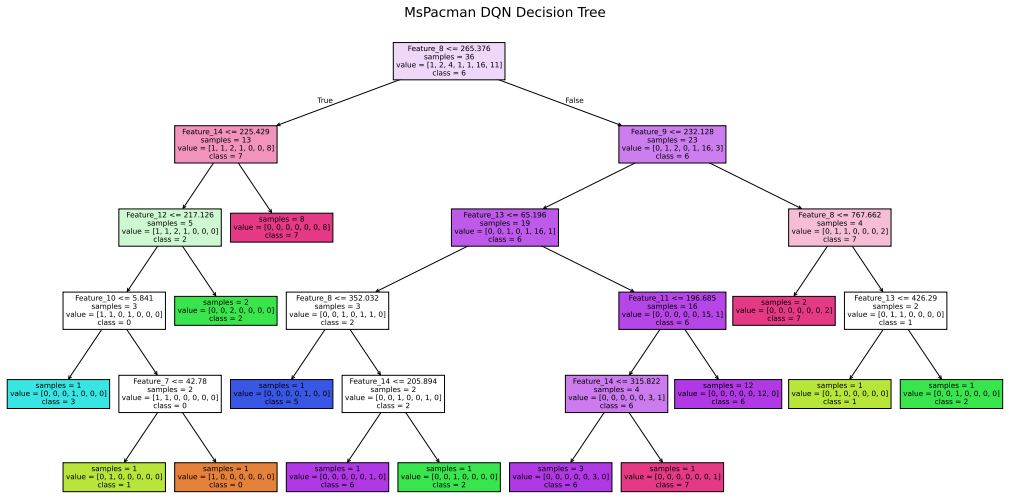
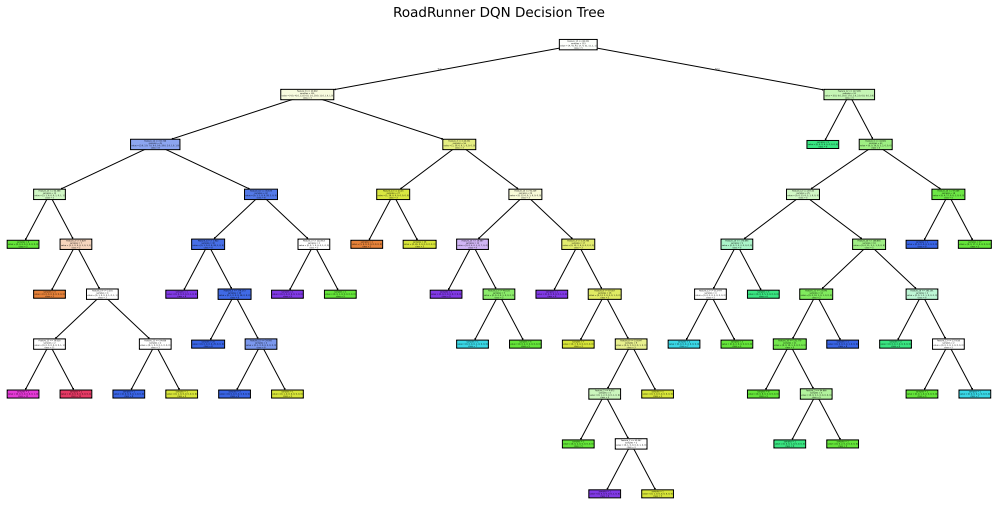
- [Appendix F / Decision Trees] The decision trees do not appear to cover all actions of the environments. MsPacman has 9 discrete actions, but the MsPacman A2C tree in Figure 11 has leaves with only four action classes and the DQN tree in Figure 12 only seven classes; RoadRunner has 18 actions, and the displayed trees cover only a small subset. If the boundary dataset only produces leaves for a subset of actions, then the 'interpretable policy' is incomplete for the action space and the multi-action claim is overstated. Report per-action coverage and accuracy for each surrogate in each environment.
minor comments (5)
- [§MsPacman] The text says 'we computed the Shapley values of its features using Equation (5)', but Equation (5) is the boundary-point objective; the Shapley definition is Equation (1).
- [Abstract/Introduction] Typo: 'proposeSILVER' is missing a space; should be 'propose SILVER'.
- [References] The Beechey et al. 2025 references are duplicated/inconsistent (one entry uses 'Beechey, T.; Smith, A.' and another 'Beechey, D.; Smith, T.; and S ¸ims ¸ek'). These should be consolidated.
- [Action K-Means Clustering] K-means with k=|A| does not guarantee that each cluster corresponds to a distinct action; the paper asserts this but never reports cluster purity or alignment between clusters and actions.
- [Figure clarity] The decision-tree figures are rendered at low resolution and are not legible; please provide vector figures or a table of rules.
Circularity Check
No significant circularity: the pipeline is standard surrogate distillation; the undefined SHAP inverse is a correctness flaw, not a circular derivation.
full rationale
The derivation chain is a supervised surrogate-distillation pipeline: SHAP vectors are clustered, boundary points are selected geometrically (Algorithm 1, Eq. 5), and the same RL policy is queried to label those boundary states. Using the explained policy's outputs as training labels for an interpretable surrogate is standard imitation/distillation, not circular, because the surrogate is then evaluated on separate 100-episode rollouts for reward and fidelity (Figs. 4-6); no fitted parameter is renamed as an independent prediction. The only serious concern is the 'Inverse Shapley Mapping' in the Inverse Mapping and RL-Guided Labeling step: the displayed definition φ^{-1}_i: φ_i(v) → {i} maps a scalar to a feature index, not a Shapley vector to a state, and Shapley attribution is many-to-one. This is an omitted-proof/correctness risk that undermines the provenance of the reconstructed boundary states, but it is not a circularity: the surrogate does not use its own outputs to define its inputs, and the boundary states are supposed to be recovered rather than predicted from the fitted model. The paper's central claim therefore does not reduce to its inputs by construction. Self-citation is not load-bearing: SILVER is cited from Li, Siddique, and Cao 2025, not from the present authors, and the only self-citation (Qian et al. 2025, process-mining related work) is incidental. No uniqueness theorem is imported, and no known result is merely renamed. Score 0.
Assumptions & free parameters
free parameters (3)
- Number of clusters k =
k=|A| (9 for MsPacman, 18 for RoadRunner)
- Surrogate model coefficients and tree thresholds =
Tables 14-21 and decision-tree figures
- Episode count for data collection =
1,000 episodes per algorithm
assumptions (5)
- domain assumption The on-manifold Shapley characteristic function vπ(C) is computable for partial feature subsets (Eqs. 2-3).
- ad hoc to paper K-means on Shapley vectors with k=|A| yields clusters that correspond to distinct action regions.
- ad hoc to paper An 'Inverse Shapley Mapping' exists and recovers the original state from a Shapley vector.
- ad hoc to paper Minimizing ||X-μ_i||² - ||X-μ_j||² identifies genuine decision boundaries.
- domain assumption Trained base RL agents (DQN/PPO/A2C) are competent, representative policies.
Cite this review
Pith. "Pith review of Interpret Policies in Deep Reinforcement Learning using SILVER with RL-Guided Labeling: A Model-level Approach to High-dimensional and Multi-action Environments." pith.science (2026). https://pith.science/paper/INIMD5NV
@misc{pith2026251019244,
  author       = {Pith},
  title        = {Pith review of: Interpret Policies in Deep Reinforcement Learning using SILVER with RL-Guided Labeling: A Model-level Approach to High-dimensional and Multi-action Environments},
  year         = {2026},
  howpublished = {\url{https://pith.science/paper/INIMD5NV}},
  note         = {Machine review of arXiv:2510.19244}
}
read the original abstract
Deep reinforcement learning (RL) achieves remarkable performance but lacks interpretability, limiting trust in policy behavior. The existing SILVER framework (Li, Siddique, and Cao 2025) explains RL policy via Shapley-based regression but remains restricted to low-dimensional, binary-action domains. We propose SILVER with RL-guided labeling, an enhanced variant that extends SILVER to multi-action and high-dimensional environments by incorporating the RL policy's own action outputs into the boundary points identification. Our method first extracts compact feature representations from image observations, performs SHAP-based feature attribution, and then employs RL-guided labeling to generate behaviorally consistent boundary datasets. Surrogate models, such as decision trees and regression-based functions, are subsequently trained to interpret RL policy's decision structure. We evaluate the proposed framework on two Atari environments using three deep RL algorithms and conduct human-subject study to assess the clarity and trustworthiness of the derived interpretable policy. Results show that our approach maintains competitive task performance while substantially improving transparency and human understanding of agent behavior. This work advances explainable RL by transforming SILVER into a scalable and behavior-aware framework for interpreting deep RL agents in high-dimensional, multi-action settings.
Figures


Figures from the paper (12 more)




Reference graph
Works this paper leans on
-
[1]
, " * write output.state after.block = add.period write newline
ENTRY address archivePrefix author booktitle chapter edition editor eid eprint howpublished institution isbn journal key month note number organization pages publisher school series title type volume year label extra.label sort.label short.list INTEGERS output.state before.all mid.sentence after.sentence after.block FUNCTION init.state.consts #0 'before.a...
-
[2]
write newline
" write newline "" before.all 'output.state := FUNCTION n.dashify 't := "" t empty not t #1 #1 substring "-" = t #1 #2 substring "--" = not "--" * t #2 global.max substring 't := t #1 #1 substring "-" = "-" * t #2 global.max substring 't := while if t #1 #1 substring * t #2 global.max substring 't := if while FUNCTION word.in bbl.in capitalize " " * FUNCT...
-
[3]
Alabdulkarim, A.; Singh, M.; Mansi, G.; Hall, K.; Ehsan, U.; and Riedl, M. O. 2025. Experiential explanations for reinforcement learning. Neural Computing and Applications, 1--31
2025
-
[4]
Altmann, P.; Davignon, C.; Zorn, M.; Ritz, F.; Linnhoff-Popien, C.; and Gabor, T. 2025. Surrogate Fitness Metrics for Interpretable Reinforcement Learning. arXiv preprint arXiv:2504.14645
arXiv 2025
-
[6]
M.; and S im s ek, \"O
Beechey, D.; Smith, T. M.; and S im s ek, \"O . 2023. Explaining reinforcement learning with shapley values. In International Conference on Machine Learning, 2003--2014. PMLR
2023
-
[7]
Beechey, T.; Smith, A.; and S im s ek, O. 2025. SVERL: A Theoretical Framework for Explaining Reinforcement Learning with Shapley Values. arXiv preprint arXiv:2505.07797
arXiv 2025
-
[8]
C etin, E.; Barrado, C.; Salam \' , E.; and Pastor, E. 2024. Analyzing deep reinforcement learning model decisions with Shapley additive explanations for counter drone operations. Applied Intelligence, 54(23): 12095--12111
2024
-
[9]
Chen, W.; Mees, O.; Kumar, A.; and Levine, S. 2024. Vision-language models provide promptable representations for reinforcement learning. arXiv preprint arXiv:2402.02651
arXiv 2024
Show all 39 references
-
[10]
Cheng, Z.; Yu, J.; and Xing, X. 2025. A Survey on Explainable Deep Reinforcement Learning. arXiv preprint arXiv:2502.06869
2025 arXiv
-
[11]
G.; P \'e rez-Aracil, J.; Salcedo-Sanz, S.; and Pedreira, C
Costa, V. G.; P \'e rez-Aracil, J.; Salcedo-Sanz, S.; and Pedreira, C. E. 2024. Evolving interpretable decision trees for reinforcement learning. Artificial Intelligence, 327: 104057
2024
-
[12]
Das, D. 2022. Values of N-Person Games with Indivisibility and Complementarity. Available at SSRN 4073731
2022
-
[13]
Dong, Y.; Zhang, R.; and Feng, W. 2025. Counterfactual Explanations for Continuous-Action Reinforcement Learning. arXiv preprint arXiv:2505.12701
2025 arXiv
-
[14]
Echchahed, A.; and Castro, P. S. 2025. A Survey of State Representation Learning for Deep Reinforcement Learning. arXiv preprint arXiv:2506.17518
2025 arXiv
-
[15]
Frye, C.; de Mijolla, D.; Begley, T.; Cowton, L.; Stanley, M.; and Feige, I. 2020. Shapley explainability on the data manifold. arXiv preprint arXiv:2006.01272
2020 arXiv
-
[16]
Ghorbani, A.; and Zou, J. 2019. Data Shapley: Equitable Valuation of Data for Machine Learning. Proceedings of ICML
2019
-
[17]
Glanois, C.; Weng, P.; Zimmer, M.; Li, D.; Yang, T.; Hao, J.; and Liu, W. 2024. A survey on interpretable reinforcement learning. Machine Learning, 1--44
2024
-
[18]
S.; Claessens, B.; and Develder, C
Gokhale, G.; Karimi Madahi, S. S.; Claessens, B.; and Develder, C. 2024. Distill2Explain: Differentiable decision trees for explainable reinforcement learning in energy application controllers. In Proceedings of the 15th ACM International Conference on Future and Sustainable E...
2024
-
[19]
Hein, D.; Udluft, S.; and Runkler, T. A. 2018. Interpretable policies for reinforcement learning by genetic programming. Engineering Applications of Artificial Intelligence, 76: 158--169
2018
-
[20]
Jang, S.; and Choi, C. 2024. Analyzing State Space Similarities for Multi-Task Deep Reinforcement Learning in Atari Games. In 2024 15th International Conference on Information and Communication Technology Convergence (ICTC), 1501--1502. IEEE
2024
-
[21]
W.; and Liang, P
Koh, P. W.; and Liang, P. 2017. Understanding black-box predictions via influence functions. Proc. of ICML
2017
-
[22]
Kohler, H.; Delfosse, Q.; Radji, W.; Akrour, R.; and Preux, P. 2025. Evaluating Interpretable Reinforcement Learning by Distilling Policies into Programs. arXiv preprint arXiv:2503.08322
2025 arXiv
-
[23]
Li, P.; Siddique, U.; and Cao, Y. 2025. From Explainability to Interpretability: Interpretable Policies in Reinforcement Learning Via Model Explanation. arXiv preprint arXiv:2501.09858
2025 arXiv
-
[24]
M.; and Lee, S.-I
Lundberg, S. M.; and Lee, S.-I. 2017. A unified approach to interpreting model predictions. Advances in neural information processing systems, 30
2017
-
[25]
Mahbooba, B.; Timilsina, M.; Sahal, R.; and Serrano, M. 2021. Explainable artificial intelligence (XAI) to enhance trust management in intrusion detection systems using decision tree model. Complexity, 2021(1): 6634811
2021
-
[26]
Y.; Hasan, M
Murad, N. Y.; Hasan, M. H.; Azam, M. H.; Yousuf, N.; and Yalli, J. S. 2024. Unraveling the black box: A review of explainable deep learning healthcare techniques. IEEE Access
2024
-
[27]
Qian, Y.; Miller, T.; Qian, Z.; and Zhao, L. 2025. Exploring Explainable Multi-player MCTS-minimax Hybrids in Board Game Using Process Mining. arXiv preprint arXiv:2503.23326
2025
-
[28]
Raffin, A.; Hill, A.; Gleave, A.; Kanervisto, A.; Ernestus, M.; and Dormann, N. 2021. Stable-baselines3: Reliable reinforcement learning implementations. Journal of machine learning research, 22(268): 1--8
2021
-
[29]
D., Anurag Koul; and Fern, A
Samuel Greydanus, J. D., Anurag Koul; and Fern, A. 2018. Visualizing and understanding atari agents. In Proc. of ICML
2018
-
[30]
J.; Kumar, A.; and Fragkiadaki, K
Sarch, G.; Saha, S.; Khandelwal, N.; Jain, A.; Tarr, M. J.; Kumar, A.; and Fragkiadaki, K. 2025. Grounded Reinforcement Learning for Visual Reasoning. arXiv preprint arXiv:2505.23678
2025 arXiv
-
[31]
Sauli \`e res, L. 2024. Explaining reinforcement learning. Ph.D. thesis, Universit \'e de Toulouse
2024
-
[32]
Shaheen, A.; Badr, A.; Abohendy, A.; Alsaadawy, H.; and Alsayad, N. 2025. Reinforcement learning in strategy-based and atari games: A review of google deepminds innovations. arXiv preprint arXiv:2502.10303
2025
-
[33]
Shapley, L. S. 1953. A Value for n-Person Games, volume 2
1953
-
[34]
Song, X.; HSIEH, W.-C.; Bi, Z.; Jiang, C.; Liu, J.; Peng, B.; Zhang, S.; Pan, X.; Xu, J.; Wang, J.; et al. 2024. A Comprehensive Guide to Explainable AI: From Classical Models to LLMs
2024
-
[35]
S.; and Barto, A
Sutton, R. S.; and Barto, A. G. 2018. Reinforcement Learning: An Introduction. The MIT Press, 2nd edition
2018
-
[36]
Tahirovic, E.; and Krivic, S. 2023. Interpretability and Explainability of Logistic Regression Model for Breast Cancer Detection. In ICAART (3), 161--168
2023
-
[37]
Tang, C.; Abbatematteo, B.; Hu, J.; Chandra, R.; Mart \' n-Mart \' n, R.; and Stone, P. 2025. Deep reinforcement learning for robotics: A survey of real-world successes. In Proceedings of the AAAI Conference on Artificial Intelligence, volume 39, 28694--28698
2025
-
[38]
Vouros, G. A. 2022. Explainable deep reinforcement learning: state of the art and challenges. ACM Computing Surveys, 55(5): 1--39
2022
-
[39]
Wang, J.; Lin, X.; Qiao, R.; Foo, C.-S.; and Low, B. K. H. 2024. Helpful or Harmful Data? Fine-tuning-Free Shapley Attribution for Explaining Language Model Predictions. Proceedings of ICML
2024
-
[40]
Zhai, S.; Bai, H.; Lin, Z.; Pan, J.; Tong, P.; Zhou, Y.; Suhr, A.; Xie, S.; LeCun, Y.; Ma, Y.; et al. 2024. Fine-tuning large vision-language models as decision-making agents via reinforcement learning. Advances in neural information processing systems, 37: 110935--110971
2024
Reviewed August 4, 2026 · model on record in the stance chip above.
Discussion (0). Sign in to comment.