Odd-Parity Chiral Magnons in Collinear Antiferromagnetic Multiferroics: Symmetry Classification and Ferroelectric Switching
Pith reviewed 2026-05-22 04:59 UTC · model grok-4.3
The pith
In collinear antiferromagnetic multiferroics, intra-sublattice Dzyaloshinskii-Moriya interaction induces odd-parity chiral magnons reversible by ferroelectric switching.
A machine-rendered reading of the paper's core claim, the machinery that carries it, and where it could break.
Core claim
Intra-sublattice Dzyaloshinskii-Moriya interaction in collinear antiferromagnetic multiferroics induces odd-parity chiral magnons that adopt f-wave, p-wave, and fully-gapped planar forms depending on the Néel vector, and these can be switched reversibly by ferroelectric polarization to enable non-volatile magnetoelectric control of magnon properties.
What carries the argument
Intra-sublattice Dzyaloshinskii-Moriya interaction that breaks inversion symmetry in a way that produces odd-parity chiral magnon splitting, coupled to the ferroelectric order parameter for switching.
If this is right
- Non-volatile ferroelectric control of magnon spin splitting in antiferromagnetic insulators.
- Control of magnon Hall transport and spin polarization via electric fields.
- Realization of such effects in identified two-dimensional and bulk material candidates.
- Magnetic group analysis classifies the splitting into f-wave, p-wave, and fully-gapped odd-parity types.
Where Pith is reading between the lines
- Such systems could lead to magnon-based spintronic devices with low dissipation and electric control.
- Extensions to other multiferroic antiferromagnets might reveal similar chiral magnon phenomena if intra-sublattice DMI is present.
- Potential for combining with spintronics to achieve electric-field tunable magnon transport without current.
Load-bearing premise
That collinear antiferromagnetic order coexists with ferroelectricity in the material candidates such that the intra-sublattice DMI produces dominant odd-parity magnon splitting without interference from other interactions.
What would settle it
Experimental measurement showing no reversal of magnon chirality or spin splitting upon ferroelectric switching in the proposed material candidates would falsify the predicted control mechanism.
Figures


read the original abstract
The coupling between ferroelectrics and magnetism presents a promising avenue for low-dissipation spintronic devices. However, such couplings remain rare, and the direct realization of magnetic order driven by ferroelectric switching in insulators continues to pose a significant challenge. Here, we identify a class of collinear antiferromagnetic multiferroics in which intra-sublattice Dzyaloshinskii-Moriya interaction (DMI) induces odd-parity chiral magnons that are reversible via ferroelectric switching. Leveraging the charge-neutral nature of magnons, such multiferroics enable non-volatile ferroelectric control over magnon spin splitting, Hall transport, and spin polarization in antiferromagnetic insulators. Remarkably, magnetic group analysis and spin wave calculations reveal that the chiral splitting adopts three planar odd-parity forms, f-wave, p-wave, and fully-gapped types, with an intriguing N\'eel vector dependence. Furthermore, density functional theory calculations validate various material candidates, ranging from two-dimensional to bulk systems. Our work provides new insights into the realization of odd-parity chiral magnons in collinear antiferromagnets and opens new avenues for magnetoelectric coupling mechanisms in multiferroics
Editorial analysis
A structured set of objections, weighed in public.
Referee Report
Summary. The manuscript identifies a class of collinear antiferromagnetic multiferroics in which intra-sublattice Dzyaloshinskii-Moriya interaction induces odd-parity chiral magnons that are reversible via ferroelectric switching. Magnetic group analysis and spin-wave calculations on a model Hamiltonian reveal three planar odd-parity forms (f-wave, p-wave, and fully gapped) with Néel vector dependence. DFT calculations are used to validate material candidates ranging from 2D to bulk systems, enabling non-volatile ferroelectric control over magnon spin splitting, Hall transport, and spin polarization in antiferromagnetic insulators.
Significance. If the central claims hold, the work provides a symmetry-based route to ferroelectric control of magnon chirality and transport properties in collinear antiferromagnets. The classification of odd-parity magnon splitting and the proposal of specific material candidates represent a useful advance for magnetoelectric coupling mechanisms, with potential implications for low-dissipation spintronic devices.
major comments (1)
- The DFT validation of material candidates focuses on structural relaxation and polarization. To support the central claim that collinear AFM order coexists stably with ferroelectricity and that intra-sublattice DMI dominates to produce the predicted odd-parity magnon splitting, explicit total-energy comparisons across multiple magnetic configurations (collinear AFM versus FM, spiral, or canted states) are required; without these, the applicability of the predicted reversible magnon properties to the real materials remains unconfirmed.
Simulated Author's Rebuttal
We thank the referee for the positive assessment of our manuscript and for the constructive major comment. We address the point below and have revised the manuscript to incorporate additional calculations as suggested.
read point-by-point responses
-
Referee: The DFT validation of material candidates focuses on structural relaxation and polarization. To support the central claim that collinear AFM order coexists stably with ferroelectricity and that intra-sublattice DMI dominates to produce the predicted odd-parity magnon splitting, explicit total-energy comparisons across multiple magnetic configurations (collinear AFM versus FM, spiral, or canted states) are required; without these, the applicability of the predicted reversible magnon properties to the real materials remains unconfirmed.
Authors: We agree that explicit total-energy comparisons across magnetic configurations would provide stronger validation for the stability of the collinear AFM order in the proposed candidates and for the dominance of intra-sublattice DMI. In the revised manuscript we have added these calculations for representative 2D and bulk materials. The new results show that the collinear AFM configuration is the ground state relative to FM, spiral, and canted states, with energy differences that support coexistence with ferroelectricity. We have also extracted the DMI parameters from the DFT data to confirm that the intra-sublattice term is the leading contribution responsible for the odd-parity magnon splitting. These additions appear in a new subsection with accompanying tables and figures, and the discussion of material applicability has been updated accordingly. revision: yes
Circularity Check
No significant circularity; derivation self-contained via symmetry and DFT
full rationale
The paper derives odd-parity chiral magnon forms (f-wave, p-wave, gapped) from magnetic group analysis applied to a model Hamiltonian with intra-sublattice DMI, then validates material candidates via standard DFT structural and polarization calculations. No step reduces a prediction to a fitted parameter defined by the same data, nor relies on load-bearing self-citation or ansatz smuggled from prior work. The central claims follow directly from symmetry classification and spin-wave theory without circular reduction to inputs.
Axiom & Free-Parameter Ledger
axioms (2)
- standard math Magnetic point group symmetry governs the allowed forms of magnon dispersion in collinear antiferromagnets.
- domain assumption Intra-sublattice DMI is the dominant interaction producing chiral magnons in the proposed structures.
Lean theorems connected to this paper
-
IndisputableMonolith/Foundation/AlexanderDuality.leanalexander_duality_circle_linking unclear?
unclearRelation between the paper passage and the cited Recognition theorem.
three planar odd-parity forms, f-wave, p-wave, and fully-gapped types
What do these tags mean?
- matches
- The paper's claim is directly supported by a theorem in the formal canon.
- supports
- The theorem supports part of the paper's argument, but the paper may add assumptions or extra steps.
- extends
- The paper goes beyond the formal theorem; the theorem is a base layer rather than the whole result.
- uses
- The paper appears to rely on the theorem as machinery.
- contradicts
- The paper's claim conflicts with a theorem or certificate in the canon.
- unclear
- Pith found a possible connection, but the passage is too broad, indirect, or ambiguous to say the theorem truly supports the claim.
Reference graph
Works this paper leans on
- [1]
-
[2]
R. Ramesh and N. A. Spaldin, Multiferroics: progress and prospects in thin films, Nat. Mater.6, 21 (2007)
work page 2007
- [3]
-
[4]
Schmid, Multi-ferroic magnetoelectrics, Ferroelectrics162, 317 (1994)
H. Schmid, Multi-ferroic magnetoelectrics, Ferroelectrics162, 317 (1994)
work page 1994
-
[5]
N. A. Spaldin, S.-W. Cheong, and R. Ramesh, Multiferroics: Past, present, and future, Phys. Today63, 38 (2010)
work page 2010
-
[6]
C. Xu, P. Chen, H. Tan, Y . Yang, H. Xiang, and L. Bellaiche, Electric-field switching of magnetic topological charge in type-I multiferroics, Phys. Rev. Lett.125, 037203 (2020)
work page 2020
-
[7]
B. B. Van Aken, T. T. M. Palstra, A. Filippetti, and N. A. Spaldin, The origin of ferroelectricity in magnetoelectric YMnO3, Nat. Mater.3, 164 (2004)
work page 2004
- [8]
-
[9]
Q. Song, C. A. Occhialini, E. Ergec ¸en, B. Ilyas, D. Amoroso, P. Barone, J. Kapeghian, K. Watanabe, T. Taniguchi, A. S. Botana, S. Picozzi, N. Gedik, and R. Comin, Evidence for a single-layer van der Waals multiferroic, Nature602, 601 (2022)
work page 2022
- [10]
-
[11]
S. Dong, H. Xiang, and E. Dagotto, Magnetoelectricity in multiferroics: a theoretical perspective, Nat. Sci. Rev.6, 629 (2019)
work page 2019
-
[12]
J. Wang, J. B. Neaton, H. Zheng, V . Nagarajan, S. B. Ogale, B. Liu, D. Viehland, V . Vaithyanathan, D. G. Schlom, U. V . Waghmare, N. A. Spaldin, K. M. Rabe, M. Wuttig, and R. Ramesh, Epitaxial BiFeO3 multiferroic thin film heterostructures, Science299, 1719 (2003)
work page 2003
-
[13]
J. Y . Ni, P. S. Wang, J. L. Lu, and H. J. Xiang, Realizing magnetoelectric coupling with hydrogen intercalation, Phys. Rev. Lett.122, 117601 (2019). 12
work page 2019
-
[14]
A. Malashevich and D. Vanderbilt, First principles study of improper ferroelectricity in TbMnO3, Phys. Rev. Lett.101, 037210 (2008)
work page 2008
-
[15]
H. J. Xiang, S.-H. Wei, M.-H. Whangbo, and J. L. F. Da Silva, Spin-orbit coupling and ion displacements in multiferroic TbMnO3, Phys. Rev. Lett.101, 037209 (2008)
work page 2008
-
[16]
L. ˇSmejkal, J. Sinova, and T. Jungwirth, Beyond conventional ferromagnetism and antiferromagnetism: A phase with nonrelativistic spin and crystal rotation symmetry, Phys. Rev. X12, 031042 (2022)
work page 2022
-
[17]
L. ˇSmejkal, J. Sinova, and T. Jungwirth, Emerging research landscape of altermagnetism, Phys. Rev. X 12, 040501 (2022)
work page 2022
- [18]
-
[19]
Y . Liu, J. Yu, and C.-C. Liu, Twisted magnetic van der Waals bilayers: An ideal platform for altermagnetism, Phys. Rev. Lett.133, 206702 (2024)
work page 2024
-
[20]
R. He, D. Wang, N. Luo, J. Zeng, K.-Q. Chen, and L.-M. Tang, Nonrelativistic spin-momentum coupling in antiferromagnetic twisted bilayers, Phys. Rev. Lett.130, 046401 (2023)
work page 2023
-
[21]
X. Duan, J. Zhang, Z. Zhu, Y . Liu, Z. Zhang, I. ˇZuti´c, and T. Zhou, Antiferroelectric altermagnets: Antiferroelectricity alters magnets, Phys. Rev. Lett.134, 106801 (2025)
work page 2025
-
[22]
M. Gu, Y . Liu, H. Zhu, K. Yananose, X. Chen, Y . Hu, A. Stroppa, and Q. Liu, Ferroelectric switchable altermagnetism, Phys. Rev. Lett.134, 106802 (2025)
work page 2025
-
[23]
W. Zhao, X. Zhou, Z. Guo, T. Zhu, J. Chen, H. Li, Z. Cheng, X. Wang, and W. Wang, Multiferroic phase transition between multiple types of collinear compensated magnets, Nat. Commun. (2026)
work page 2026
-
[24]
W. Sun, C. Yang, X. Wang, S. Huang, and Z. Cheng, Altermagnetic multiferroics with symmetry-locked magnetoelectric coupling, Nat. Mater. (2026)
work page 2026
-
[25]
Z. Zhu, X. Duan, J. Zhang, B. Hao, I. Zutic, and T. Zhou, Two-dimensional ferroelectric altermagnets: From model to material realization, Nano Lett.25, 9456 (2025)
work page 2025
-
[26]
S. Wang, W.-W. Wang, J. Fan, X. Zhou, X.-P. Li, and L. Wang, Two-dimensional dual-switchable ferroelectric altermagnets: altering electrons and magnons, Nano Lett.25, 14618 (2025)
work page 2025
-
[27]
X. Chen, J. Ren, Y . Zhu, Y . Yu, A. Zhang, P. Liu, J. Li, Y . Liu, C. Li, and Q. Liu, Enumeration and representation theory of spin space groups, Phys. Rev. X14, 031038 (2024)
work page 2024
- [28]
-
[29]
Z. Xiao, J. Zhao, Y . Li, R. Shindou, and Z.-D. Song, Spin space groups: Full classification and applications, Phys. Rev. X14, 031037 (2024)
work page 2024
-
[30]
Q. N. Meier, A. Carta, C. Ederer, and A. Cano, Net and compensated altermagnetism from staggered orbital order: Layer-dependent spin splitting in Srn+1CrnO3n+1, Phys. Rev. Lett.136, 116705 (2026)
work page 2026
-
[31]
I. I. Mazin, How to define and calculate the degree of spin polarization in ferromagnets, Phys. Rev. Lett. 83, 1427 (1999)
work page 1999
-
[32]
Berakdar, Probing the spin polarization in ferromagnets, Phys
J. Berakdar, Probing the spin polarization in ferromagnets, Phys. Rev. Lett.83, 5150 (1999)
work page 1999
-
[33]
A. V . Chumak, V . I. Vasyuchka, A. A. Serga, and B. Hillebrands, Magnon spintronics, Nat. Phys.11, 453 (2015)
work page 2015
-
[34]
L. ˇSmejkal, A. Marmodoro, K.-H. Ahn, R. Gonz´alez-Hern´andez, I. Turek, S. Mankovsky, H. Ebert, S. W. D’Souza, O.ˇSipr, J. Sinova, and T. Jungwirth, Chiral magnons in altermagneticRuO2, Phys. Rev. Lett.131, 256703 (2023)
work page 2023
-
[35]
Dzyaloshinsky, A thermodynamic theory of “weak” ferromagnetism of antiferromagnetics, J
I. Dzyaloshinsky, A thermodynamic theory of “weak” ferromagnetism of antiferromagnetics, J. Phys. Chem. Solids4, 241 (1958)
work page 1958
-
[36]
Moriya, Anisotropic superexchange interaction and weak ferromagnetism, Phys
T. Moriya, Anisotropic superexchange interaction and weak ferromagnetism, Phys. Rev.120, 91 (1960)
work page 1960
-
[37]
J. Ni, Y . Jin, Q. Du, and G. Chang, Magnon nonlinearHall effect in two-dimensional antiferromagnetic insulators, Phys. Rev. B112, 054424 (2025)
work page 2025
- [38]
-
[39]
V . A. Zyuzin and A. A. Kovalev, Magnon spinNernst effect in antiferromagnets, Phys. Rev. Lett.117, 217203 (2016)
work page 2016
- [40]
- [41]
-
[42]
T. Holstein and H. Primakoff, Field dependence of the intrinsic domain magnetization of a ferromagnet, Phys. Rev.58, 1098 (1940)
work page 1940
-
[43]
N. N. Bogoljubov, V . V . Tolmachov, and D. V .ˇSirkov, A new method in the theory of superconductivity, Fortschr. Phys.6, 605 (1958)
work page 1958
-
[44]
J. G. Valatin, Comments on the theory of superconductivity, Nuovo. Cim.7, 843 (1958). 14
work page 1958
-
[45]
Q. Du, Z. Zhang, J. Ni, Z. Jiang, and L. Bellaiche, Nonreciprocal magnons in layered antiferromagnets VPX3 (X = S, Se, Te), Phys. Rev. B112, L100408 (2025)
work page 2025
-
[46]
T. Matsumoto and S. Hayami, Nonreciprocal magnons due to symmetric anisotropic exchange interaction in honeycomb antiferromagnets, Phys. Rev. B101, 224419 (2020)
work page 2020
-
[47]
T. J. Sato and K. Matan, Nonreciprocal magnons in noncentrosymmetric magnets, J. Phys. Soc. Jpn.88, 081007 (2019)
work page 2019
-
[48]
G. Gitgeatpong, Y . Zhao, P. Piyawongwatthana, Y . Qiu, L. W. Harriger, N. P. Butch, T. J. Sato, and K. Matan, Nonreciprocal magnons and symmetry-breaking in the noncentrosymmetric antiferromagnet, Phys. Rev. Lett.119, 047201 (2017)
work page 2017
-
[49]
See Supplemental Material at ... for (i) the derivation of the Berry curvature and (ii) the results of the DFT calculations and bilayer fully antiferromagnets
- [50]
-
[51]
N. Okuma, Magnon spin-momentum locking: Various spin vortices and Dirac magnons in noncollinear antiferromagnets, Phys. Rev. Lett.119, 107205 (2017)
work page 2017
- [52]
-
[53]
D. Xiao, M. C. Chang, and Q. Niu, Berry phase effects on electronic properties, Rev. Mod. Phys.82, 1959 (2010)
work page 1959
-
[54]
W. F. Brinkman and R. J. Elliott, Theory of spin-space groups, Proc. R. Soc. A294, 343 (1966)
work page 1966
-
[55]
R. Matsumoto and S. Murakami, Theoretical prediction of a rotating magnon wave packet in ferromagnets, Phys. Rev. Lett.106, 197202 (2011)
work page 2011
- [56]
-
[57]
Q. Cui, B. Zeng, P. Cui, T. Yu, and H. Yang, Efficient spinSeebeck and spin Nernst effects of magnons in altermagnets, Phys. Rev. B108, L180401 (2023)
work page 2023
-
[58]
K. Wu, J. Dong, M. Zhu, F. Zheng, and J. Zhang, Magnon splitting and magnon spin transport in altermagnets, Chin. Phys. Lett.42, 070702 (2025)
work page 2025
-
[59]
B. Li, A. Mook, A. Raeliarijaona, and A. A. Kovalev, Magnonic analog of the Edelstein effect in antiferromagnetic insulators, Phys. Rev. B101, 024427 (2020). 15
work page 2020
-
[60]
M. J. Grzybowski, C. Autieri, J. Domagala, C. Krasucki, A. Kaleta, S. Kret, K. Gas, M. Sawicki, R. Bo ˙zek, J. Suffczy ´nski, and W. Pacuski, Wurtzite vs. rock-salt MnSe epitaxy: electronic and altermagnetic properties, Nanoscale16, 6259 (2024)
work page 2024
-
[61]
D. Bezzerga, I. Khan, and J. Hong, High performance room temperature multiferroic properties of w-MnSe altermagnet, Adv. Funct. Mater.35, 2505813 (2025)
work page 2025
-
[62]
Y . Zhou, H.-M. Zhang, C.-A. Ji, H. Xiang, S. Dong, J. M. Rondinelli, and X.-Z. Lu, Piezomagnetism- driven magnetoelectric coupling in altermagnetic multiferroic K3Cr2F7, Phys. Rev. B112, 094412 (2025)
work page 2025
- [63]
-
[64]
H. Tan, M. Li, H. Liu, Z. Liu, Y . Li, and W. Duan, Two-dimensional ferromagnetic-ferroelectric multiferroics in violation of thed 0 rule, Phys. Rev. B99, 195434 (2019)
work page 2019
-
[65]
Q. Song, S. Stavri ´c, P. Barone, A. Droghetti, D. S. Antonenko, J. W. Venderbos, C. A. Occhialini, B. Ilyas, E. Ergec ¸en, N. Gedik, S.-W. Cheong, R. M. Fernandes, S. Picozzi, and R. Comin, Electrical switching of ap-wave magnet, Nature642, 64 (2025)
work page 2025
-
[66]
J. Priessnitz, A. B. Hellenes, R. Comin, and L. ˇSmejkal, Ferroelectric p-wave magnets, preprint arXiv:2603.19107 (2026)
-
[67]
R. Matsumoto, R. Shindou, and S. Murakami, Thermal Hall effect of magnons in magnets with dipolar interaction, Phys. Rev. B89, 054420 (2014)
work page 2014
-
[68]
H. Katsura, N. Nagaosa, and P. A. Lee, Theory of the thermal Hall effect in quantum magnets, Phys. Rev. Lett.104, 066403 (2010)
work page 2010
-
[69]
P. E. Bl ¨ochl, Projector augmented-wave method, Phys. Rev. B50, 17953 (1994)
work page 1994
-
[70]
G. Kresse and J. Furthm ¨uller, Efficiency of ab-initio total energy calculations for metals and semiconductors using a plane-wave basis set, Comp. Mater. Sci.6, 15 (1996)
work page 1996
-
[71]
J. P. Perdew, K. Burke, and M. Ernzerhof, Generalized gradient approximation made simple, Phys. Rev, Lett.77, 3865 (1996)
work page 1996
-
[72]
A. I. Liechtenstein, V . I. Anisimov, and J. Zaanen, Density-functional theory and strong interactions: Orbital ordering in Mott-Hubbard insulators, Phys. Rev. B52, R5467 (1995)
work page 1995
-
[73]
R. D. King-Smith and D. Vanderbilt, Theory of polarization of crystalline solids, Phys. Rev. B47, 1651(R) (1993). 16
work page 1993
-
[74]
H. J. Xiang, E. J. Kan, S.-H. Wei, M.-H. Whangbo, and X. G. Gong, Predicting the spin-lattice order of frustrated systems from first principles, Phys. Rev. B84, 224429 (2011)
work page 2011
- [75]
-
[76]
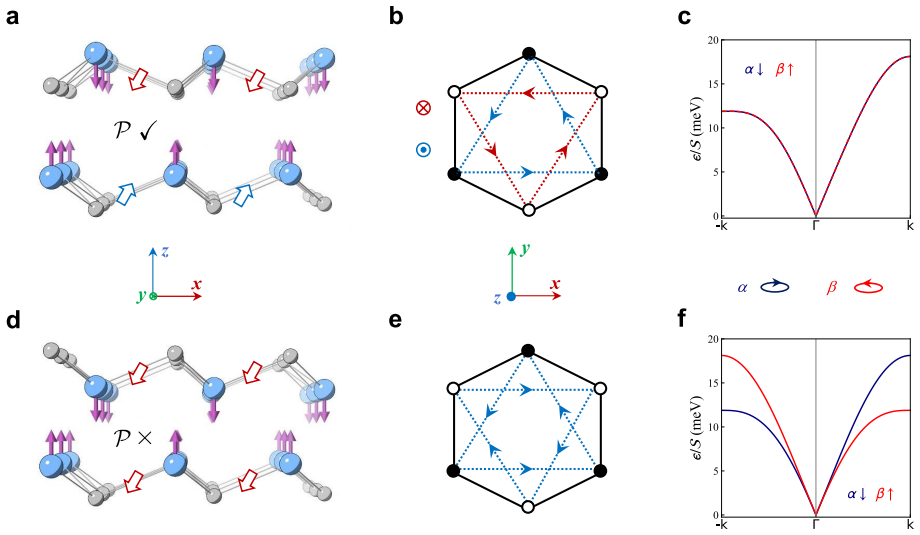
G. Henkelman, B. P. Uberuaga, and H. J´onsson, A climbing image nudged elastic band method for finding saddle points and minimum energy paths, J. Chem. Phys.113, 9901 (2000). 17 FIG. 1. Realizing odd-parity chiral magnons in layered antiferromagnets. Side view of bilayer antiferromagnets with P preserved (a) and P broken (d) , where blue balls refer to th...
work page 2000
discussion (0)
Sign in with ORCID, Apple, or X to comment. Anyone can read and Pith papers without signing in.