REVIEW 3 major objections 5 minor 25 references
Dual Approach to Inverse Covariance Intersection Fusion
T0 review · 3 major / 5 minor · reviewed 2026-08-07 · deepseek-v4-flash
Pith's one-line read The paper formalizes a strict common-noise assumption dual to inverse covariance intersection and proves that the new joint covariance bounds dominate Covariance Intersection bounds while leaving the optimal fused error bound unchanged.
desk verdict Solid, carefully scoped dual to ICI, but the headline no-improvement claim only holds for a one-parameter subfamily and is overgeneralized. read the letter →
The pith
A machine-rendered reading of the paper's core claim, the machinery that carries it, and where it could break.
The reading
What carries the argument
The machine that carries the argument is the parametrized upper-bound family $\Pi$ in (8), whose off-diagonal block is built from the dual harmonic-mean matrix $B = (\omega P_1^{-1} + (1-\omega)P_2^{-1})^{-1}$. The proof that $\Pi - P$ is positive semidefinite reduces to verifying the Schur complement $2\mu(X - X B^{-1} X) \geq 0$; this holds because $B \geq X$, a consequence of the necessary CI condition $x^T B^{-1}x \leq \max\{x^T P_1^{-1}x, x^T P_2^{-1}x\}$ together with $X \leq P_1, P_2$. The second mechanism is the algebraic identity $W_{\mathrm{CI}}(\Pi_{\mathrm{CI}} - \Pi)(W_{\mathrm{CI}})^T = 0$: the CI fusion weight lies in the kernel of the improvement, which is why the optimal fused bound degenerates to the CI value.
What would settle it
Compute, for random positive definite $P_1, P_2$ and random $X$ with $0 \leq X \leq P_1, P_2$, the minimal eigenvalue of $\Pi - P$ for $\Pi$ from (8)-(9); any negative eigenvalue would refute the upper-bound claim. Separately, evaluate $W_{\mathrm{CI}}(\Pi_{\mathrm{CI}} - \Pi)(W_{\mathrm{CI}})^T$ for random $P_1, P_2$; any nonzero matrix would refute the claimed equality at the optimal weight.
Extended reading notes
Core claim
On the paper's own terms, the discovery is this. If the cross-covariance of two full-state estimation errors is an unknown matrix $X$ with $X = X^T \geq 0$ and $0 \leq X \leq P_1, P_2$ (interpreted as identical common noise in both errors), then the block matrix $\Pi$ in (8), formed with any $B$ satisfying $x^T B^{-1} x \leq \max\{x^T P_1^{-1}x, x^T P_2^{-1}x\}$ for all $x$, is an upper bound of every admissible joint covariance $P$. For the parametric subfamily $B = (\omega P_1^{-1} + (1-\omega)P_2^{-1})^{-1}$ with $\omega = 1/2$ and $\mu = \lambda$, this bound is tighter than the CI bound $\Pi_{\mathrm{CI}}$ in the Loewner order, with $\Pi_{\mathrm{CI}} - \Pi$ given by the explicit positive semidefinite factorization (12). Yet the same factorization is annihilated by the CI-optimal fusion weight $W_{\mathrm{CI}}$: $W_{\mathrm{CI}}(\Pi_{\mathrm{CI}} - \Pi)(W_{\mathrm{CI}})^T = 0$, so the fused bound $(P_1^{-1} + P_2^{-1})^{-1}$ is unchanged. The proposed family therefore improves the joint uncertainty description without improving the optimal fused bound.
Load-bearing premise
The load-bearing premise is that the two estimation errors really can be written as a single common noise with the same covariance $X$ in both, plus independent parts, with $0 \leq X \leq P_1, P_2$; if that decomposition fails, the bounds are not guaranteed, and the proof also leans on a covariance-intersection lemma quoted from the literature rather than proved here.
Editorial extensions
If this is right
- For any two estimates whose errors admit the common-noise decomposition (6), the joint covariance can be conservatively bounded by (8), and this bound is at least as tight as the corresponding CI bound when $\omega = 1/2$ and $\mu = \lambda$.
- The CI-optimal fusion weight is also optimal for the proposed bound family at $\omega = 1/2$, and the resulting best fused mean-square-error bound equals the CI bound $(P_1^{-1} + P_2^{-1})^{-1}$, so the partial knowledge does not improve the optimal single bound.
- For suboptimal fusion weights, the new family can produce strictly smaller fused bounds than CI, giving a concrete benefit when the weight is constrained by computation or by partial-state structure.
- The upper bounds remain valid if the inputs $P_1, P_2$ are inflated during construction, a robustness property that inverse covariance intersection does not have.
- A nontrivial lower bound $O$ in (13) applies to every admissible $P$, and for a fixed fusion weight $W$ it yields a lower bound $O_F = W O W^T$ on the fused error covariance.
Reading between the lines
- We infer that the degeneracy is structural for full-state fusion with $H = [I, I]$: any correlation model of the form 'identical common noise with covariance $X \leq P_1, P_2$' is invisible to the linearly optimal unbiased estimator, because the CI weight already saturates the bound. Relaxing the assumption to different scaling factors of the common noise in the two errors would likely break the e
- The family-level improvement suggests a practical design rule: when the fusion weight is fixed in advance, the common-noise assumption can certify a smaller fused error ellipsoid than CI; quantifying this gain in terms of the spectra of $P_1, P_2$ and the parameters $\omega, \mu$ would turn the qualitative improvement into a design algorithm.
- Because the construction is dual to inverse covariance intersection by exchanging $P_i$ with $P_i^{-1}$, techniques developed for one family, such as explicit ellipsoidal circumscription of the union of admissible covariances, should carry over to the other, potentially closing the tightness gap left open here.
- The monotonicity in $P_i$ implies the bounds remain conservative when only upper bounds of the individual covariances are available, which we expect to matter in decentralized architectures where nodes report conservative estimates.
Editorial analysis
A structured set of objections, weighed in public.
Referee Report
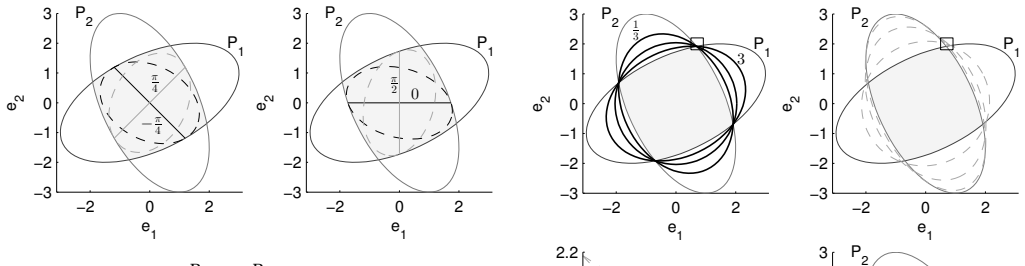
Summary. The paper proposes a new partial-correlation model for linear fusion of two full-state estimates: the cross-covariance is an unknown common-noise matrix X satisfying X = X^T ≥ 0 and X ≤ P1, P2 (eq. (6)). Section III-A constructs Loewner upper bounds Π (eq. (8)) and proves Π − P ≥ 0 by a Schur-complement argument; for the parameter choice ω = 1/2 and μ = λ it proves ΠCI − Π ≥ 0 through the factorization (12). Section III-B constructs a lower bound O (eq. (13)) and proves P − O ≥ 0. Section III-C studies linear fusion with H = [I, I]^T: it shows that with the CI weight WCI, the fused new bound equals the fused CI bound, and that WCI is the optimal weight for the new bound in the subfamily ω = 1/2, μ = λ. Section IV illustrates the admissible sets of X and the ellipse geometry for a 2×2 example. The paper concludes that the partial knowledge does not improve the best single upper bound, but does improve suboptimal fusions and families of bounds.
Significance. If the claims are properly qualified, the paper provides a clean mathematical formalization of the 'common noise' assumption that is dual to inverse covariance intersection, along with simple upper and lower matrix bounds (8) and (13). The algebraic derivations (10), (12), (14), and (16)–(18) are valid for the stated parameter choices, and the observation that the new bounds remain valid when the Pi are inflated is a useful property. The paper is honest about the negative flavor of the main fusion result, which, if established generally, would be a cautionary finding for practitioners. However, the advertised global negative result is currently proven only for a subfamily, and at least one related superiority claim (Π better than ΠCI) is stated too broadly and fails for other admissible parameters. The contribution is therefore promising but incompletely established.
major comments (3)
- [Section III-A, Eqs. (8)–(12)] The statement that 'the proposed bounds Π (8) are better than the general bounds ΠCI (5)' is unqualified, but the proof that follows verifies ΠCI − Π ≥ 0 only for ω = 1/2 and μ = λ. For other admissible parameters the inequality can fail: in the scalar case P1 = 2, P2 = 5 with ω = 0, μ = λ = 1, one has B = P2 = 5 and ΠCI − Π has a negative top-left entry, so it is not positive semidefinite. Please either prove the dominance for the full parameter range or explicitly restrict the 'better' claim to the matched subfamily and adjust the summary accordingly.
- [Section III-C, abstract, Section V] The paper's headline negative result—that the fusion cannot improve the standard case in the sense of the best single bound—is not established by the given proof. The derivation shows WCI(ΠCI − Π)(WCI)^T = 0 and that WCI is optimal for Π only for the subfamily ω = 1/2, μ = λ; the simplifying ratio equality (17) requires ω = 1/2, and the identification with WCI in (18) requires μ = λ. The proof does not cover other ω ∈ [0,1], other μ, other matrices B satisfying the general condition in (8), or other admissible linear weights W with WH = I. The numerical examples in Figures 3 and 4 are illustrative only and cannot establish a universal negative. Please prove the general optimality statement or explicitly restrict the abstract and Section V to the proven subfamily.
- [Section III-A, Eq. (10); Section III-B, Eq. (14)] The proofs rely on the implication B ≥ X from the assumption Pi ≥ X, quoted from [10] without proof, and on inverses X^{-1} even though X is allowed to be singular (X ≥ 0 in (6), and the figures use rank-1 matrices X). This implication is load-bearing for Π − P ≥ 0 and should be supplied: for B from (9), X^{-1} ≥ ωP1^{-1} + (1−ω)P2^{-1} = B^{-1} when X is nonsingular, and the general condition on B in (8) yields the same conclusion by comparing quadratic forms. The use of X^{-1} can be justified by a continuity argument or by adding a standing nonsingularity assumption. These are local but necessary repairs for the upper- and lower-bound theorems as stated.
minor comments (5)
- [Eq. (5)] The blkdiag display has a mismatched parenthesis; it should read blkdiag(w^{-1}P1, (1−w)^{-1}P2).
- [Section II-B] The phrase 'family of P12 that is prospected' should be 'family of P12 that is considered'.
- [Section IV-A, Eq. (23)] The sentence 'A family of lower bounds of P1, P2 is then given by XΩ' is confusing; these matrices XΩ are candidates for the common-noise covariance and should be described as a family of admissible common-noise matrices that are bounded above by both P1 and P2.
- [Section III-C] The claim that 'the weights WCI are optimal with respect to the specific bounds in the new family (8)' should state the sense of optimality, e.g., the Loewner-minimal fused bound for a fixed Π, or the minimizer of a stated scalar criterion over the parameter of the family.
- [Section IV-B] The sentence 'The figures demonstrate that no fusion can outperform the CI fusion in the terms of single upper bound' overstates what a numerical example can show; please rephrase as an illustration of the proven subfamily result.
Circularity Check
No circularity; the new bounds and fusion comparisons are derived from the stated assumptions, and the only cited lemma is an external, easily verified CI condition.
full rationale
The derivation of the upper bound Π in (8) is self-contained: Π−P is computed explicitly in (10), its Schur complement is reduced to 2µ(X−XB⁻¹X), and B≥X follows from the defining inequality on B together with the assumption Pi≥X. The invoked 'necessary CI condition' [10] is an external, elementary lemma, not an author-specific result, and it does not presuppose the paper's conclusion. The comparison ΠCI−Π is verified directly via (11)–(12), and the lower bound O in (13) is checked through (14). The fusion analysis in Section III-C is algebraic: for ω=1/2 and µ=λ, equations (16)–(18) show that the CI weight WCI is also optimal for the specific bound Π, and WCI(ΠCI−Π)WCIᵀ=0 follows by substituting the parameter values; this is a derived equality, not an identity inserted by definition. The paper's broader statement that the optimal fused bound is not improved is indeed proven only for the ω=1/2, µ=λ subfamily, so that global claim is under-supported; however, that is a correctness or generalization gap, not a circular reduction. The authors' self-citations to their ICI work provide background and proof templates, but all load-bearing inequalities in this paper are established in the text itself, so the central derivation does not reduce to its own inputs.
Assumptions & free parameters
assumptions (3)
- ad hoc to paper The admissible set of cross-covariances is X with X = X^T, X ≥ 0, and Pi ≥ X for i = 1,2 (eq. 6).
- domain assumption The 'necessary CI condition': if B satisfies x^T B^{-1} x ≤ max{x^T P1^{-1}x, x^T P2^{-1}x}, then B ≥ X whenever Pi ≥ X (used in the Schur complement proof of Π − P ≥ 0).
- standard math Standard facts about Loewner order, Schur complements, and congruence preserving positive semidefiniteness.
Cite this review
Pith. "Pith review of Dual Approach to Inverse Covariance Intersection Fusion." pith.science (2026). https://pith.science/paper/INLEEGCN
@misc{pith2026250605955,
  author       = {Pith},
  title        = {Pith review of: Dual Approach to Inverse Covariance Intersection Fusion},
  year         = {2026},
  howpublished = {\url{https://pith.science/paper/INLEEGCN}},
  note         = {Machine review of arXiv:2506.05955}
}
read the original abstract
Linear fusion of estimates under the condition of no knowledge of correlation of estimation errors has reached maturity. On the other hand, various cases of partial knowledge are still active research areas. A frequent motivation is to deal with "common information" or "common noise", whatever it means. A fusion rule for a strict meaning of the former expression has already been elaborated. Despite the dual relationship, a strict meaning of the latter one has not been considered so far. The paper focuses on this area. The assumption of unknown "common noise" is formulated first, analysis of theoretical properties and illustrations follow. Although the results are disappointing from the perspective of a single upper bound of mean square error matrices, the partial knowledge demonstrates improvement over no knowledge in suboptimal cases and from the perspective of families of upper bounds.
Figures


Reference graph
Works this paper leans on
-
[10]
Fusion under unknown correlation – covariance intersection as a special case,
L. Chen, P. O. Arambel, and R. K. Mehra, “Fusion under unknown correlation – covariance intersection as a special case,” in Proceedings of the 5th International Conference on Information Fusion , Annapolis, Maryland, USA, July 2002
work page 2002
-
[1]
R. A. Horn and C. R. Johnson, Matrix Analysis , 2nd ed. Cambridge University Press, 2013
work page 2013
-
[2]
A. B. Kurzhanski and I. V ´alyi, Ellipsoidal Calculus for Estimation and Control , ser. Systems & Control: Foundations & Applications. Birkh¨auser, 1997
work page 1997
-
[3]
On visualisation of linear estimation and fusion: From equations to ellipses,
J. Ajgl and O. Straka, “On visualisation of linear estimation and fusion: From equations to ellipses,” in Combinined SDF and MFI Conference 2023, Bonn, Germany, November 2023
work page 2023
-
[4]
T. Kailath, A. H. Sayed, and B. Hassibi, Linear Estimation. Prentice Hall, 2000
work page 2000
-
[5]
Simon, Optimal State Estimation: Kalman, H-infinity, and nonlinear approaches
D. Simon, Optimal State Estimation: Kalman, H-infinity, and nonlinear approaches. Wiley, 2006
work page 2006
-
[6]
On optimal track-to- track fusion,
K.-C. Chang, R. K. Saha, and Y . Bar-Shalom, “On optimal track-to- track fusion,” IEEE Transactions on Aerospace and Electronic Systems , vol. 33, no. 4, pp. 1271–1276, October 1997
work page 1997
-
[7]
Optimal linear estimation fusion—part i: Unified fusion rules,
X.-R. Li, Y . Zhu, J. Wang, and C. Han, “Optimal linear estimation fusion—part i: Unified fusion rules,” IEEE Transactions on Information Theory, vol. 49, no. 9, pp. 2192–2208, September 2003
work page 2003
Show all 25 references
-
[8]
Forty years of distributed estimation: A review of note- worthy developments,
C.-Y . Chong, “Forty years of distributed estimation: A review of note- worthy developments,” inProceedings of the 2017 Symposium on Sensor Data Fusion: Trends, Solutions, Applications (SDF) , Bonn, Germany, October 2017
2017
-
[9]
A non-divergent estimation algorithm in the presence of unknown correlations,
S. J. Julier and J. K. Uhlmann, “A non-divergent estimation algorithm in the presence of unknown correlations,” in Proceedings of the American Control Conference, Albuquerque, New Mexico, USA, June 1997, pp. 2369–2373
1997
-
[11]
Minimum covariance bounds for the fusion under unknown correlations,
M. Reinhardt, B. Noack, P. O. Arambel, and U. D. Hanebeck, “Minimum covariance bounds for the fusion under unknown correlations,” IEEE Signal Processing Letters , vol. 22, no. 9, pp. 1210–1214, 2015
2015
-
[12]
Conservative linear unbiased estimation under partially known covariances,
R. Forsling, A. Hansson, F. Gustafsson, J. L ¨ofberg, Z. Sjanic, and G. Hendeby, “Conservative linear unbiased estimation under partially known covariances,” IEEE Transactions on Signal Processing , vol. 70, pp. 3123–3132, June 2022
2022
-
[13]
S. J. Julier and J. K. Uhlmann, Handbook of multisensor data fusion . CRC Press, 2001, ch. General Decentralized Data Fusion with Covari- ance Intersection
2001
-
[14]
Covariance consistency methods for fault-tolerant distributed data fusion,
J. K. Uhlmann, “Covariance consistency methods for fault-tolerant distributed data fusion,” Information Fusion, vol. 4, no. 3, pp. 201–215, September 2003
2003
-
[15]
Covariance intersection for partially correlated random vectors,
Z. Wu, Q. Cai, and M. Fu, “Covariance intersection for partially correlated random vectors,” IEEE Transactions on Automatic Control , vol. 63, no. 3, pp. 619–629, March 2018
2018
-
[16]
Decentralized data fusion with inverse covariance intersection,
B. Noack, J. Sijs, M. Reinhardt, and U. D. Hanebeck, “Decentralized data fusion with inverse covariance intersection,” Automatica, vol. 79, pp. 35–41, May 2017
2017
-
[17]
Inverse covariance intersection: New insights and properties,
B. Noack, J. Sijs, and U. D. Hanebeck, “Inverse covariance intersection: New insights and properties,” in Proceedings of the 20th International Conference on Information Fusion , Xi’an, China, July 2017, pp. 527– 534
2017
-
[18]
Approximate analytical solutions for the weight optimiza- tion problems of CI and ICI,
U. Orguner, “Approximate analytical solutions for the weight optimiza- tion problems of CI and ICI,” in Proceedings of the 2017 Symposium on Sensor Data Fusion: Trends, Solutions, Applications (SDF) , Bonn, Germany, October 2017
2017
-
[19]
Decentralised estimation with correlation limited by optimal processing of independent data,
J. Ajgl and O. Straka, “Decentralised estimation with correlation limited by optimal processing of independent data,” Automatica, vol. 99, pp. 132–137, 2019
2019
-
[20]
Comparison of fusions under unknown and partially known correlations,
——, “Comparison of fusions under unknown and partially known correlations,” in IFAC-PapersOnLine, 7th IFAC Workshop on Distributed Estimation and Control in Networked Systems (NecSys18) , vol. 51, no. 23, Groningen, The Netherlands, August 2018, pp. 295–300
2018
-
[21]
Analysis of partial knowledge of correlations in an estimation fusion problem,
——, “Analysis of partial knowledge of correlations in an estimation fusion problem,” in Proceedings of the 21st International Conference on Information Fusion , Cambridge, UK, July 2018, pp. 100–107
2018
-
[22]
Calculation of support function for fusion under partial knowl- edge,
——, “Calculation of support function for fusion under partial knowl- edge,” in Proceedings of the 2019 IEEE International Conference on Multisensor Fusion and Integration for Intelligent Systems , Taipei, Taiwan, May 2019, pp. 224–229
2019
-
[23]
On fusion of partial estimates under implicit partial knowledge of correlation,
——, “On fusion of partial estimates under implicit partial knowledge of correlation,” in Proceedings of the 22th International Conference on Information Fusion, Ottawa, Canada, July 2019
2019
-
[24]
Inverse covariance intersection fusion of multiple estimates,
——, “Inverse covariance intersection fusion of multiple estimates,” in Proceedings of the 23rd International Conference on Information Fusion, Virtual Conference, July 2020
2020
-
[25]
On weak points of the ellipsoidal intersection fusion,
——, “On weak points of the ellipsoidal intersection fusion,” in Proceed- ings of the 2017 IEEE International Conference on Multisensor Fusion and Integration for Intelligent Systems , Daegu, Korea, November 2017, pp. 28–33
2017
Reviewed August 7, 2026 · model on record in the stance chip above.
Discussion (0). Continue with ORCID to comment.