REVIEW 2 major objections 6 minor 39 references
Quantum simulation of elastic wave equations via Schr\"odingerisation
T0 review · 2 major / 6 minor · reviewed 2026-08-07 · deepseek-v4-flash
Pith's one-line read The paper shows that Schrödingerisation maps both velocity-stress and displacement forms of the elastic wave equations into Hamiltonian systems, yielding quantum gate complexities that grow polynomially in the spatial dimension while…
desk verdict Schrödingerisation applied to elastic wave equations with sound PDE derivations, but the complexity theorems have a real p-domain scaling gap and omit an exponentially small recovery probability; worth refereeing with major revision. read the letter →
The pith
A machine-rendered reading of the paper's core claim, the machinery that carries it, and where it could break.
The reading
What carries the argument
The central object is the Schrödingerisation (warped phase) transformation $v=e^{-|p|}u$, which maps a linear PDE $du/dt=(H_1+iH_2)u$ into $dv/dt=-H_1\partial_p v+iH_2 v$, a one-dimension-higher Schrödinger-type equation. Discretizing $p$ by the Fourier spectral method and changing to Fourier coefficients gives a Hamiltonian system $d/dt\,c=-i(H_1\otimes D_p-H_2\otimes I)c$, suitable for Hamiltonian simulation with quantum signal processing; the original solution is recovered at $p^*\ge\max\{\lambda_{\max}(H_1)T,0\}$ or by integration over $p$. The decomposition into Hermitian $H_1$ and anti-Hermitian $iH_2$ is what makes the transformation possible, and the sparsity of $H_1,H_2$ sets the gate complexity through the Low–Chuang query bound.
What would settle it
For the spectral-discretized displacement equation, compute the maximum eigenvalue of $H_1$ and the norm of the Schrödingerised Hamiltonian $H_s$ with $M=O(\epsilon^{-1/r})$ spatial grid points, the $p$-domain length set to the $p_*$ of Theorem 5.3, and $N=O(\epsilon^{-1})$ Fourier points in $p$; if $\|H_s\|_{\max}$ grows faster than $O(\epsilon^{-1})$, or the numerical error does not reach $O(\epsilon)$, then the gate bound in Theorem 5.1 is incomplete.
Extended reading notes
Core claim
The central discovery is that the non-unitary dynamics of elastic waves, including external forcing and spatially varying density and Lamé parameters, are exactly convertible into unitary Schrödinger-type evolution through the warped phase transformation $v=e^{-|p|}u$ and a discrete Fourier transform in the auxiliary variable $p$. This yields a Hamiltonian system $H=-i(H_1\otimes D_p-H_2\otimes I)$ whose sparsity is inherited from the original PDE, allowing Hamiltonian simulation via quantum signal processing. The paper proves gate-complexity bounds for four discretizations: the symmetric matrix form of the velocity-stress equation with spectral method (Theorem 4.1), the staggered-grid velocity-stress formulation for variable coefficients (Theorem 4.2), the displacement-equation hyperbolic system with spectral method (Theorem 5.1), and with central differences (Theorem 5.2). It also establishes, in Theorem 5.3, that the recovery point $p_*$ required to read out the solution grows as $O(\epsilon^{-1/r})$ for the spectral method and $O(\epsilon^{-1/2})$ for central differences, meaning the spectral method needs a larger auxiliary $p$-domain. The stated complexity is polynomial in $1/\epsilon$, $T$, and $\log d$, versus classical cost exponential in $d$, which the authors interpret as exponential quantum advantage in spatial dimension.
Load-bearing premise
The complexity proofs for the displacement equation assume a fixed auxiliary $p$-domain with $N=O(1/\epsilon)$ Fourier points, while Theorem 5.3 requires the recovery point $p_*$ to grow as $(1/\epsilon)^{1/r}$ or $(1/\epsilon)^{1/2}$; if the $p$-domain must expand to contain $p_*$, the resolution count and the norm estimate $\|H_s\|_{\max}=O(1/\epsilon)$ used in Theorems 5.1 and 5.2 need reworking.
Editorial extensions
If this is right
- For smooth solutions and evolution time $T\sim O(1)$, the quantum gate count grows as $\log d$ while classical cost grows as $\epsilon^{-(d/r+1)}T^2$, giving exponential quantum advantage in spatial dimension $d$.
- Variable medium parameters (position-dependent density and Lamé coefficients) are handled by the staggered-grid Schrödingerisation at cost $O(\epsilon^{-3/2}T)$, enabling heterogeneous media simulation.
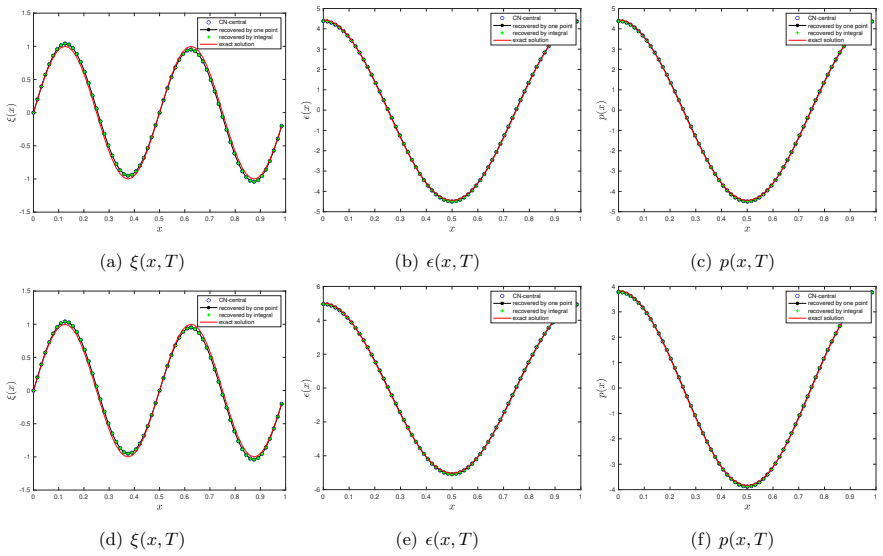
- The displacement-equation formulation provides a practical rule for choosing the auxiliary $p$-domain: the recovery point scales as $\epsilon^{-1/r}$ (spectral) or $\epsilon^{-1/2}$ (central difference), and the numerical experiments confirm that both one-point and integral recovery match classical solutions.
- External source terms in the symmetric matrix form are incorporated without spoiling unitarity via the homogeneous embedding $r=\epsilon\mathbf{1}$, so the Hamiltonian simulation framework extends to problems with forcing.
Reading between the lines
- The exponential-in-$d$ advantage relies on $T$ being $O(1)$: for long-time simulations with $T\sim\epsilon^{-\alpha}$, the quantum cost grows linearly in $T$ while the classical cost grows quadratically in $T$, so the advantage in dimension persists but the total speedup is moderated; the paper does not analyze this long-time regime.
- Theorem 5.3's growth of $p_*$ may force the auxiliary $p$-domain length to grow with $1/\epsilon$, which could invalidate the fixed $N=O(\epsilon^{-1})$ Fourier lattice assumed in Theorems 5.1 and 5.2; a consistency check connecting $p_*$, domain length, and $N$ would settle whether the stated displacement-equation complexity is complete.
- A natural testable extension is to apply the same Schrödingerisation construction to viscoelastic or anisotropic elastic wave equations, where the dispersion matrix $L(x,k)$ has different algebraic structure and the $H_1/H_2$ decomposition may change sparsity and the resulting gate counts.
- The numerical experiments validate correctness on classical hardware but not the resource bounds; a resource estimate in logical qubits and T-gates for a concrete three-dimensional seismic problem would be needed to judge practical relevance.
Editorial analysis
A structured set of objections, weighed in public.
Referee Report
Summary. This paper develops quantum simulation algorithms for elastic wave equations using the Schrödingerisation framework of Jin, Liu, and Yu. It treats two formulations: the symmetric matrix form (SMF) of the velocity–stress equations in homogeneous media with external sources, using Fourier spectral discretization in space; and variable-coefficient problems, using a staggered-grid discretization of the velocity–stress equations and spectral or central-difference discretizations of a first-order hyperbolic system for the displacement. The main results are Hamiltonian simulation gate-complexity bounds (Theorems 4.1, 4.2, 5.1, 5.2) that scale polynomially in 1/ε and T and logarithmically in the spatial dimension d, and a recovery-point estimate (Theorem 5.3) for the auxiliary variable p. Classical numerical experiments in one and two dimensions compare the Schrödingerised solutions with standard finite-difference and spectral solutions and show good agreement.
Significance. Schrödingerisation-based quantum algorithms for elastic waves are a natural and potentially important application area, and the paper is among the first to give explicit complexity theorems for both velocity–stress and displacement formulations, including source terms and variable coefficients. The numerical verification of the recovery procedure is a clear strength, and the structural derivations (warped-phase transformation, homogenization of sources, Hamiltonian splitting) follow the established framework. If the complexity theorems can be repaired, the claimed exponential advantage in dimension for fixed final time is significant for geophysical and materials-science applications. However, the proofs currently contain a load-bearing gap in the treatment of the auxiliary p-domain, and the central-difference discretization as written is not a consistent first-derivative approximation; these issues must be resolved before the complexity claims can be accepted.
major comments (2)
- [§3.2, Theorems 4.2, 5.1, 5.2] The recovery condition (3.10) requires p* ≥ max_n λ_n(H1) T, and Theorem 5.3 gives p*_s = O(ε^{-1/r}) and p*_c = O(ε^{-1/2}) because ||H1||max = O(M). The complexity proofs instead set N = O(ε^{-1}) (Eqs. (4.27) and (5.14)) and estimate ||H_s||max using ||D_p||max = O(N), which presupposes the p-domain half-length L is O(1). Once L must grow to O(p*) to contain the wave packet, the Fourier discretization of the initial profile e^{-|p|} requires the cutoff N/L = O(ε^{-1}), i.e., N = O(ε^{-1} L), and ||D_p||max = N/(2L) = O(ε^{-1}). This gives N = O(ε^{-(1+1/r)}) in Theorem 5.1 and N = O(ε^{-3/2}) in Theorems 4.2 and 5.2. The ε-exponents in the query-complexity factors are unchanged, but the qubit counts m_H and hence the stated gate complexities are missing the corresponding log(1/ε) terms, and the proof of the norm bound in Theorem 4.2 is not valid as written. The bookkeeping needs to be redone with L and N coupled to p*.
- [§5.2, Eq. (5.15)] The matrix D defined in (5.15) is real symmetric (for periodic indexing it is essentially S + S^T) and does not approximate the first-derivative operator ∂_x appearing in the hyperbolic system (2.17). A standard second-order central difference for -i∂_x with periodic boundary conditions has the form (1/(2h))(-i)(S - S^T), with eigenvalues (1/h) sin(2πk/M); the matrix in (5.15) has eigenvalues 2 cos(2πk/M) and, when substituted into L_c in (5.16), makes the discretized operator skew-Hermitian in the constant-coefficient case, which is inconsistent with the H1/H2 split in (5.19) and with the eigenvalue estimate (5.26). The central-difference discretization, Theorem 5.2, and the p*_c estimate in Theorem 5.3 therefore need to be re-derived with the correct difference operator, or the definition of D needs to be clarified and justified.
minor comments (6)
- [Abstract and Section 3 title] The abstract and Section 3 title contain typos: 'expore', 'demontrate', 'dimensin', 'methed', and 'wraped'; these should be corrected.
- [§2.1.2 and §3] The symbol p is used both for the pressure variable in (2.14) and for the auxiliary Schrödingerisation variable in Section 3; this is confusing and should be disambiguated.
- [Remark 4.5] Remark 4.5 refers to 'Eqs. (2.17)' when discussing the classical complexity of the staggered-grid velocity–stress equations; it should refer to (2.6)/(4.20).
- [Theorems 4.1 and 5.1] In the proofs of Theorems 4.1 and 5.1, the displayed qubit count contains an additional +log(1/ε) term that is dropped in the theorem statement; the two forms should be made consistent.
- [Theorem 5.3] The estimates (5.22)–(5.23) omit the factor T (or should state the assumption T = O(1)); also, 'Hermite matrix' in the proof should be 'Hermitian matrix'.
- [Theorems 4.1 and 4.2] The sparsity counts s = 3 and s = 6 appear to count only the spatial operator and not the tensor-product structure with D_p; since only constant factors are affected, this should be clarified.
Circularity Check
No significant circularity: the elastic-wave reductions and complexity theorems are self-contained, with prior work used as a framework, not as a fitted input.
full rationale
The paper's derivation chain is self-contained and does not reduce any claimed prediction to its own inputs. The Schrödingerisation framework itself is quoted from the authors' earlier work (JLY23, JLM24a, JLM24b), but it is a parameter-free mathematical method with stated assumptions and is applied here to a new target: elastic wave equations in SMF, staggered-grid, and hyperbolic forms. The elastic-wave-specific transformations are derived from classical external formulations (SYJ20 for SMF, RPK96 and JL06 for the hyperbolic system, Vir86 and Ran89 for staggered grids), not from the complexity claims. The gate-complexity theorems (4.1, 4.2, 5.1, 5.2) rely on the external Hamiltonian-simulation bound of Low and Chuang (Lemma 3.1, LC17) and on standard spectral and central-difference accuracy estimates; the grid sizes M and N are chosen from the target accuracy epsilon, not fitted to the final complexity statements. No parameter is fitted to a subset of data and then relabeled as a prediction, and no uniqueness theorem or ansatz is imported from the authors' prior work to force a particular form. The paper explicitly flags its scope limitations—periodic boundary conditions and the open issue for non-periodic boundaries in Section 2.1.2—which are restrictions on applicability, not circular reasoning. The only substantive concern one might raise is an internal bookkeeping issue about whether the recovery point p* grows with epsilon^{-1/r} or epsilon^{-1/2} and whether the p-domain length must grow accordingly; if valid, that is a correctness or consistency defect in the complexity estimates, not a case where a conclusion is assumed as an input. Because the derivation chain rests on explicit transformations and external complexity bounds, there is no circular step, and a score of 0 is appropriate.
Assumptions & free parameters
free parameters (3)
- source homogenization scale c =
c ~ ||f_h||∞
- recovery point p* =
e.g. 3.203, 6.759, 4.306 in experiments
- p-domain half-length L =
not fixed; e.g. [-4.2,5], [-3π,3π]
assumptions (5)
- domain assumption Periodic boundary conditions and initial-value formulation suffice for the elastic wave systems.
- domain assumption Solution smoothness w ∈ H^r with r >= 2, so the spectral spatial error is O(M^{-r}).
- domain assumption e^{-|p|} is C^0 but not C^1, so Fourier discretization in p gives N = O(epsilon^{-1}).
- standard math Low-Chuang optimal Hamiltonian simulation query complexity (Lemma 3.1).
- standard math Fourier spectral derivative matrices P_mu = Phi D_mu Phi^{-1} diagonalize as D_mu.
invented entities (1)
-
Auxiliary dimension p (warped phase variable)
Cite this review
Pith. "Pith review of Quantum simulation of elastic wave equations via Schr\"odingerisation." pith.science (2026). https://pith.science/paper/INLJINWL
@misc{pith2026250518711,
  author       = {Pith},
  title        = {Pith review of: Quantum simulation of elastic wave equations via Schr\"odingerisation},
  year         = {2026},
  howpublished = {\url{https://pith.science/paper/INLJINWL}},
  note         = {Machine review of arXiv:2505.18711}
}
read the original abstract
In this paper we study quantum simulation algorithms on the elastic wave equations using the Schr\"odingerisation method. The Schr\"odingerisation method transforms any linear PDEs into a system of Schr\"odinger-type PDEs -with unitary evolution-using the warped phase transformation that maps the equations in one higher dimension. This makes them suitable for quantum simulations. We expore the application in two forms of the elastic wave equations. For the velocity-stress equation in isotropic media, we explore the symmetric matrix form under the external forcing via Schr\"odingerisation combined with spectral method. For problems with variable medium parameters, we apply Schr\"odingerisation method based on the staggered grid method to simulate velocity and stress fields, and give the complexity estimates. For the wave displacement equation, we transform it into a hyperbolic system and apply the Schr\"odingerisation method, which is then discretized by the spectral method and central difference scheme. Details of the quantum algorithms will be provided, along with the complexity analysis which demontrate exponential quantum advantage in space dimensin over the classical algorithms.
Figures


Figures from the paper (1 more)
Reference graph
Works this paper leans on
-
[1]
Dong An, Jin-Peng Liu, and Lin Lin. Linear combination of hamiltonian simulation for non-unitary dynamics with optimal state preparation cost. Physical review letters , 131 15:150603, 2023
work page 2023
-
[2]
Keiiti Aki and Paul G Richards. Quantitative seismology . 2002
work page 2002
-
[3]
An introduction to the theory of seismology
Keith Edward Bullen and Bruce A Bolt. An introduction to the theory of seismology . Cambridge university press, 1985
work page 1985
-
[4]
Dominic W. Berry. High-order quantum algorithm for solving linear differential equations. Journal of Physics A: Mathematical and Theoretical , 47, 2010
work page 2010
-
[5]
Keating , and Andreas Fichtner
Cyrill B \"o sch , Malte Schade , Giacomo Aloisi , Scott D. Keating , and Andreas Fichtner . Quantum Wave Simulation with Sources and Loss Functions . arXiv e-prints , page arXiv:2411.17630, November 2024
arXiv 2024
-
[6]
Yu Cao, Shi Jin, and Nana Liu. Quantum simulation for time-dependent hamiltonians -- with applications to non-autonomous ordinary and partial differential equations, 2023
work page 2023
-
[7]
Pedro C. S. Costa, Stephen Jordan, and Aaron Ostrander. Quantum algorithm for simulating the wave equation. Phys. Rev. A , 99:012323, Jan 2019
work page 2019
-
[8]
Andrew M. Childs and Jin-Peng Liu. Quantum spectral methods for differential equations. Communications in Mathematical Physics , 375:1427 -- 1457, 2019
work page 2019
Show all 39 references
-
[9]
Quantum algorithm and circuit design solving the poisson equation
Yudong Cao, Anargyros Papageorgiou, Iasonas Petras, Joseph Traub, and Sabre Kais. Quantum algorithm and circuit design solving the poisson equation. New Journal of Physics , 15(1):013021, jan 2013
2013
-
[10]
Frozen gaussian approximation for 3d seismic tomography
Lihui Chai, Ping Tong, and Xu Yang. Frozen gaussian approximation for 3d seismic tomography. Inverse Problems , 34(5):055004, mar 2018
2018
-
[11]
Fillion-Gourdeau and E
F. Fillion-Gourdeau and E. Lorin. Simple digital quantum algorithm for symmetric first-order linear hyperbolic systems. Numerical Algorithms , 82(3):1009--1045, Nov 2019
2019
-
[12]
Quantum simulation of a class of highly-oscillatory transport equations via schr\"odingerisation, 2025
Anjiao Gu and Shi Jin. Quantum simulation of a class of highly-oscillatory transport equations via schr\"odingerisation, 2025
2025
-
[13]
Quantum algorithms for multiscale partial differential equations
Junpeng Hu, Shi Jin, and Lei Zhang. Quantum algorithms for multiscale partial differential equations. Multiscale Modeling & Simulation , 22(3):1030--1067, 2024
2024
-
[14]
A hamiltonian-preserving scheme for high frequency elastic waves in heterogeneous media
Shi Jin and Xiaomei Liao. A hamiltonian-preserving scheme for high frequency elastic waves in heterogeneous media. Journal of Hyperbolic Differential Equations , 3(04):741--777, 2006
2006
-
[15]
Analog quantum simulation of partial differential equations
Shi Jin and Nana Liu. Analog quantum simulation of partial differential equations. Quantum Science and Technology , 2023
2023
-
[16]
Quantum simulation of discrete linear dynamical systems and simple iterative methods in linear algebra via schrodingerisation, 04 2023
Shi Jin and Nana Liu. Quantum simulation of discrete linear dynamical systems and simple iterative methods in linear algebra via schrodingerisation, 04 2023
2023
-
[17]
Quantum simulation for partial differential equations with physical boundary or interface conditions
Shi Jin, Xiantao Li, Nana Liu, and Yue Yu. Quantum simulation for partial differential equations with physical boundary or interface conditions. Journal of Computational Physics , 498:112707, 2024
2024
-
[18]
Quantum simulation for quantum dynamics with artificial boundary conditions
Shi Jin, Xiantao Li, Nana Liu, and Yue Yu. Quantum simulation for quantum dynamics with artificial boundary conditions. SIAM Journal on Scientific Computing , 46(4):B403--B421, 2024
2024
-
[19]
On schr " odingerization based quantum algorithms for linear dynamical systems with inhomogeneous terms
Shi Jin, Nana Liu, and Chuwen Ma. On schr " odingerization based quantum algorithms for linear dynamical systems with inhomogeneous terms. arXiv preprint arXiv:2402.14696 , 2024
2024 arXiv
-
[20]
Schr\"odingerisation based computationally stable algorithms for ill-posed problems in partial differential equations, 2024
Shi Jin, Nana Liu, and Chuwen Ma. Schr\"odingerisation based computationally stable algorithms for ill-posed problems in partial differential equations, 2024
2024
-
[21]
Quantum simulation of maxwell’s equations via schrödingerisation
Jin, Shi , Liu, Nana , and Ma, Chuwen . Quantum simulation of maxwell’s equations via schrödingerisation. ESAIM: M2AN , 58(5):1853--1879, 2024
2024
-
[22]
Quantum algorithms for stochastic differential equations: A schr\"odingerisation approach, 2024
Shi Jin, Nana Liu, and Wei Wei. Quantum algorithms for stochastic differential equations: A schr\"odingerisation approach, 2024
2024
-
[23]
Quantum simulation of partial differential equations: Applications and detailed analysis
Shi Jin, Nana Liu, and Yue Yu. Quantum simulation of partial differential equations: Applications and detailed analysis. Physical Review A , 108(3):032603, 2023
2023
-
[24]
Quantum simulation of the fokker-planck equation via schrodingerization
Shi Jin, Nana Liu, and Yue Yu. Quantum simulation of the fokker-planck equation via schrodingerization. arXiv preprint arXiv:2404.13585 , 2024
2024 arXiv
-
[25]
Guang Hao Low and Isaac L. Chuang. Optimal hamiltonian simulation by quantum signal processing. Phys. Rev. Lett. , 118:010501, Jan 2017
2017
-
[26]
Finite difference methods for ordinary and partial differential equations: steady-state and time-dependent problems
Randall J LeVeque. Finite difference methods for ordinary and partial differential equations: steady-state and time-dependent problems . SIAM, 2007
2007
-
[27]
Dynamics of an expanding circular fault
Raul Madariaga. Dynamics of an expanding circular fault. Bulletin of the Seismological Society of America , 66(3):639--666, 1976
1976
-
[28]
A time-stepping technique to solve wave propagation problems using the boundary element method
Webe Jo \ a o Mansur. A time-stepping technique to solve wave propagation problems using the boundary element method . PhD thesis, University of Southampton, 1983
1983
-
[29]
Accuracy of finite-difference and finite-element modeling of the scalar and elastic wave equations
Kurt J Marfurt. Accuracy of finite-difference and finite-element modeling of the scalar and elastic wave equations. Geophysics , 49(5):533--549, 1984
1984
-
[30]
C. L. M. H. Navier. Mémoire sur les lois de l'équilibre et du mouvement des corps solides élastiques. Mémoires de l'Académie des Sciences de l'Institut de France , 7:375--393, 1827
-
[31]
Approximate quantum fourier transform with o(n log(n)) t gates
Yunseong Nam, Yuan Su, and Dmitri Maslov. Approximate quantum fourier transform with o(n log(n)) t gates. npj Quantum Information , 6(1):26, Mar 2020
2020
-
[32]
C. J. Randall. Absorbing boundary condition for the elastic wave equation: Velocity‐stress formulation. GEOPHYSICS , 54(9):1141--1152, 1989
1989
-
[33]
Transport equations for elastic and other waves in random media
Leonid Ryzhik, George Papanicolaou, and Joseph B Keller. Transport equations for elastic and other waves in random media. Wave motion , 24(4):327--370, 1996
1996
-
[34]
Practical quantum computing: Solving the wave equation using a quantum approach
Adrien Suau, Gabriel Staffelbach, and Henri Calandra. Practical quantum computing: Solving the wave equation using a quantum approach. ACM Transactions on Quantum Computing , 2(1), February 2021
2021
-
[35]
Quantum algorithm for partial differential equations of nonconservative systems with spatially varying parameters
Yuki Sato, Hiroyuki Tezuka, Ruho Kondo, and Naoki Yamamoto. Quantum algorithm for partial differential equations of nonconservative systems with spatially varying parameters. Phys. Rev. Appl. , 23:014063, Jan 2025
2025
-
[36]
On the construction and comparison of difference schemes
Gilbert Strang. On the construction and comparison of difference schemes. SIAM Journal on Numerical Analysis , 5(3):506--517, 1968
1968
-
[37]
Stable symmetric matrix form framework for the elastic wave equation combined with perfectly matched layer and discretized in the curve domain
Cheng Sun, Zailin Yang, and Guanxixi Jiang. Stable symmetric matrix form framework for the elastic wave equation combined with perfectly matched layer and discretized in the curve domain. Symmetry , 12, 2020
2020
-
[38]
Multiblock sbp-sat methodology of symmetric matrix form of elastic wave equations on curvilinear grids
Cheng Sun, Zai-Lin Yang, Guan-Xi-Xi Jiang, and Yong Yang. Multiblock sbp-sat methodology of symmetric matrix form of elastic wave equations on curvilinear grids. Shock and Vibration , 2020
2020
-
[39]
P-sv wave propagation in heterogeneous media; velocity-stress finite-difference method
Jean Virieux. P-sv wave propagation in heterogeneous media; velocity-stress finite-difference method. Geophysics , 51:1933--1942, 1986
1933
Reviewed August 7, 2026 · model on record in the stance chip above.
Discussion (0). Sign in to comment.