REVIEW 2 major objections 4 minor 1 cited by
Computing Spectral Measures and Spectral Types
T0 review · 2 major / 4 minor · reviewed 2026-08-14 · deepseek-v4-flash
Pith's one-line read For self-adjoint and unitary operators whose matrix columns decay at a known rate, the paper establishes that spectral measures, spectral types, functional calculus, and absolutely-continuous densities are computable by explicit…
desk verdict The paper delivers the first general algorithms for spectral measures on a broad operator class, but the proof of Theorem 3.2 leans on an unjustified uniform-in-s approximation and is incomplete as written. read the letter →
The pith
A machine-rendered reading of the paper's core claim, the machinery that carries it, and where it could break.
The reading
What carries the argument
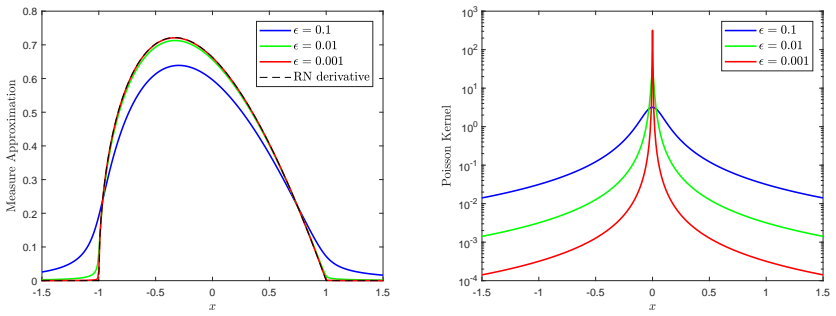
The load-bearing object is the resolvent engine of Theorem 2.1: rather than taking square truncations of the infinite matrix, it solves a rectangular least-squares system that approximates $R(z,T)x$ and proves a tail bound using the known decay profile and $\operatorname{dist}(z,\sigma(T))$. Spectral measures are then accessed through the boundary-limit identity of Proposition 2.3, which expresses the projection-valued measure as a Poisson-kernel convolution of the resolvent; the algorithms integrate this convolution with quadrature while letting the smoothing parameter tend to zero. The Solvability Complexity Index (SCI) hierarchy, which counts the minimum number of successive limits any algorithm must take, is the classification tool that separates the one-limit results from the intrinsically harder decomposition and spectral-set problems.
What would settle it
Run the one-limit algorithm on a Jacobi matrix whose spectral measure is known to be the pure-point measure with atoms at the nonnegative integers and weights $\exp(-\alpha)\alpha^m/m!$, letting $n$ grow as $\epsilon\downarrow 0$: the output must concentrate at the integer points with weights converging to those values, or the central claim fails. For the decomposition classification, take a discrete Schrödinger operator with sparse potential whose known theory predicts purely singular continuous spectrum on $(0,4)$; the two-limit algorithm must return $\sigma_{sc}\cap(0,4)=(0,4)$ with $\sigma_{ac}$ and $\sigma_{pp}$ empty, otherwise the sharp lower bound is wrong.
Extended reading notes
Core claim
The central claim is that for every $T$ in the class $\Omega_{f,\alpha,\beta}$ of self-adjoint or unitary operators with known column decay $\|(I-P_{f(n)})TP_n\|=O(\alpha_n)$, and every vector with decay $\|P_nx-x\|=O(\beta_n)$, the map $(T,x,U)\mapsto E_T(U)x$ is computable in one limit by arithmetic algorithms; the scalar measures $\mu^T_{x,y}(U)=\langle E_T(U)x,y\rangle$ come from inner products. The engine that makes this possible is a resolvent algorithm with error control, built from rectangular least-squares truncations rather than square truncations. The same engine powers one-limit algorithms for the functional calculus $F(T)x$ and for $L^1$ approximation of the Radon--Nikodym derivative on open sets strictly separated from the singular and point supports. The paper's classifications are sharp: Theorem 3.2 places the measure-decomposition problems in $\Delta^A_3\setminus\Delta^G_2$, and Theorem 5.1 places $\sigma_{ac}$ and $\sigma_{pp}$ in $\Delta^A_3\setminus\Delta^G_2$ while $\sigma_{sc}$ lies in $\Delta^A_4$ and requires three limits when $f(n)-n\geq\sqrt{2n}+1/2$. For partial differential operators whose coefficients are polynomially bounded and of locally bounded variation, the same resolvent engine transfers, giving computable spectral measures, functional calculus, and densities, along with the corresponding decomposition towers, from point-sample data.
Load-bearing premise
The load-bearing premise is that the algorithm is handed the exact asymptotic decay profile of the matrix columns and vector (the function $f$ and null sequences $\alpha,\beta$), so that the resolvent tail bound is certified; if that structural information is missing or inaccurate, the one-limit computability results do not apply.
Editorial extensions
If this is right
- Any self-adjoint or unitary operator with a known column-decay profile now has its spectral measures, functional calculus, and absolutely-continuous densities computable by a single convergent limit, so spectral computations no longer require a closed-form expression for the measure.
- The sharp SCI classifications mean the two-limit and three-limit towers are not an implementation deficiency: no algorithm, in any model of computation, can perform the decompositions with fewer limits.
- For linear evolution equations on $L^2(\mathbb{R}^d)$ in the stated coefficient class, the semigroup action can be computed with guaranteed convergence from point samples of the coefficients, not from analytic spectral data.
- Given the recurrence coefficients of orthogonal polynomials, the associated measure can be recovered numerically, giving computational substance to the classical correspondences between such coefficients and measures.
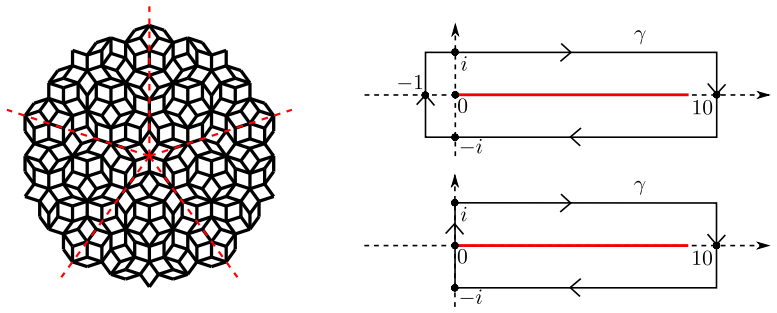
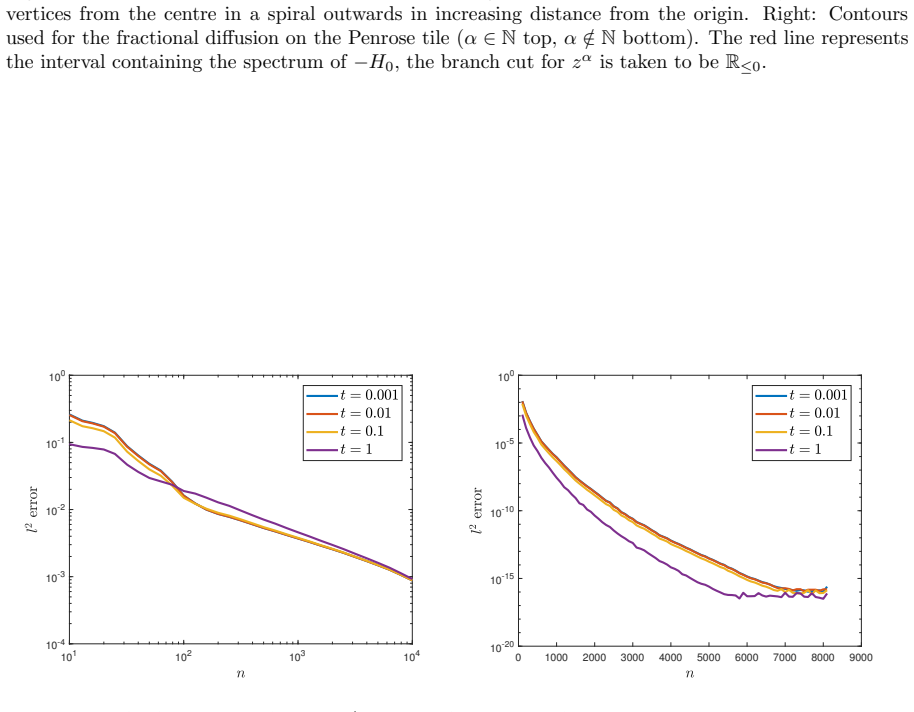
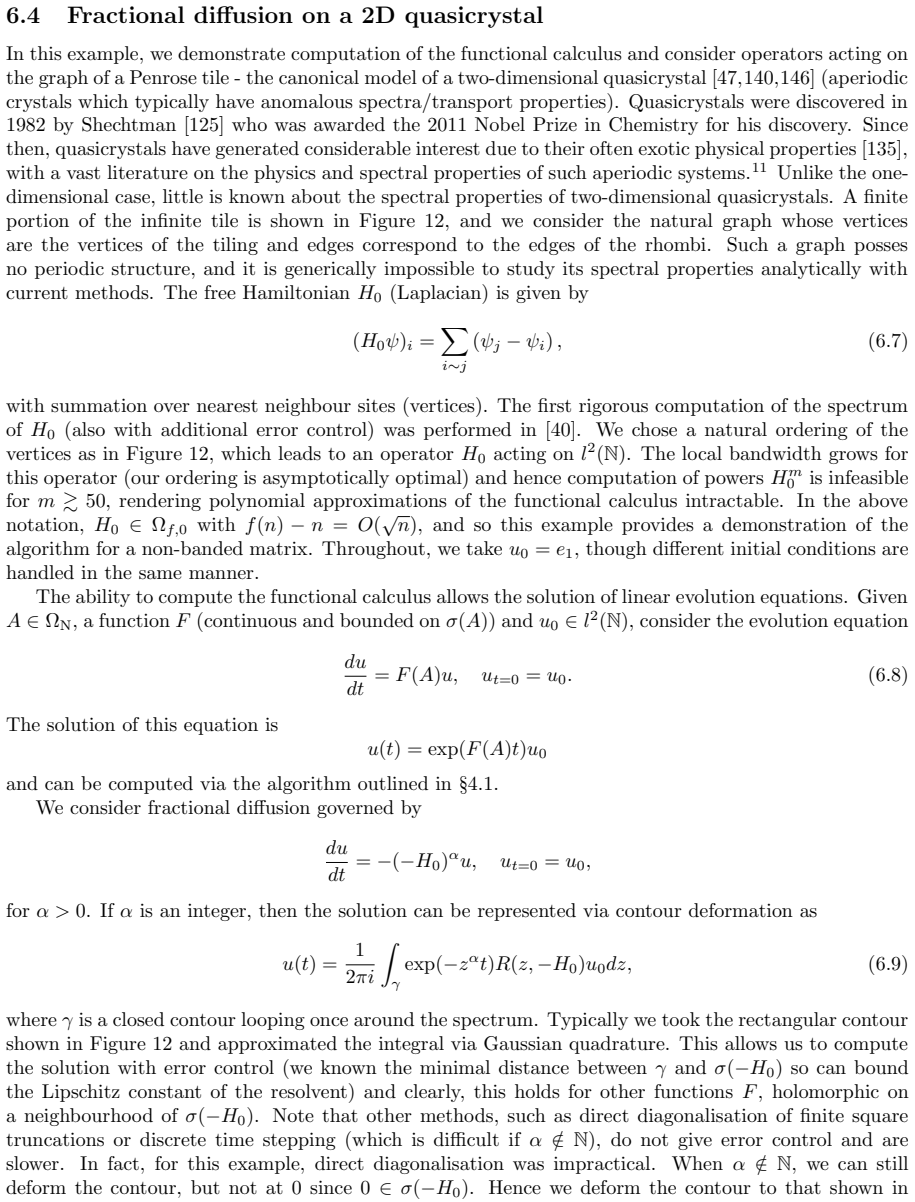
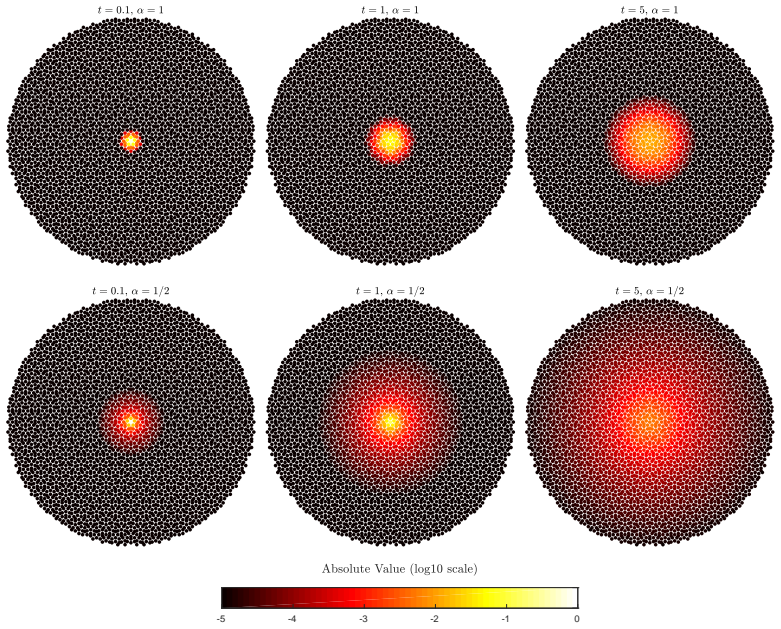
- On quasicrystal graph models with growing bandwidth, where powering the matrix is infeasible, the functional-calculus algorithm solves fractional diffusion by contour integrals of the resolvent, with exponential convergence in the holomorphic case.
Reading between the lines
- The same resolvent-plus-Poisson-kernel template should extend to other spectral observables expressible as boundary integrals of the resolvent, such as local densities of states or autocorrelation spectra, whenever the kernel has enough regularity for quadrature convergence.
- The lower bounds on the singular continuous spectrum suggest a guiding principle for numerical work on quasiperiodic or random operators: any method that obtains this spectrum in practice must either exploit extra structure or accept an intrinsically slower, multi-limit convergence.
- Because the paper leaves general normal operators with interior spectral points open, a natural test is whether its generalized boundary-integral formula can be turned into a one-limit algorithm for operators whose spectrum is a rectifiable curve; the paper does not claim this.
- One could benchmark the algorithms against exactly solvable critical models with singular continuous spectra, using the SCI lower bounds to predict where convergence must slow; this is an editorial suggestion, not a paper claim.
Signed reviews
Editorial analysis
A structured set of objections, weighed in public.
Referee Report
Summary. The paper develops algorithms for computing spectral measures, their Lebesgue decompositions, functional calculi, Radon–Nikodym derivatives, and the pure point/absolutely continuous/singular continuous spectra of self-adjoint (and unitary) operators on ℓ²(N) whose matrix columns decay at a known asymptotic rate. The main constructive tool is an arithmetic algorithm for the resolvent with asymptotic error control (Theorem 2.1), combined with Stone's formula. The paper formulates these tasks in the Solvability Complexity Index (SCI) hierarchy, proving classifications such as: the full spectral measure on open sets is in Δ₂^A; measure decompositions are in Δ₃^A but not Δ₂^G; and singular continuous spectra require three limits under a bandwidth growth condition. Numerical experiments cover Jacobi, Laguerre, CMV/Geronimus/Rogers–Szegő measures and fractional diffusion on a Penrose-tile graph, and Appendix B extends the results to a class of PDEs through Hermite-function bases.
Significance. If the main proofs are completed, this is a substantial contribution: it provides the first general algorithms for computing spectral measures and spectral decompositions for a broad class of infinite-dimensional operators, with explicit SCI classifications and with detailed numerical demonstrations. The resolvent error bound (2.1) is explicit and checkable, the algorithms are arithmetic (hence implementable with rigorous interval arithmetic), and the numerical section goes well beyond toy examples. The paper also gives credit-worthy honest discussion of where error control is impossible (Theorem 5.2). The main caveat is a proof gap in the inclusion part of Theorem 3.2 that is load-bearing for the SCI classification of measure decompositions; until that gap is repaired, the full strength of the decomposition results is not established.
major comments (2)
- [§3.2.1, Step 1 (proof of inclusion in Theorem 3.2)] The proof requires an arithmetic algorithm ~Γ_{n,m} satisfying ||Q_n e^{-iTs} χ_U(T)x − ~Γ_{n,m}(T,x,U,s)|| ≤ C(T,x,U)/m uniformly for s∈[0,m]. The text justifies this by saying that 'the proof of Theorem 4.1 is easily adapted' because the function λ↦e^{-iλs}χ_U(λ) 'has known total variation for a given s and uniform bound'. This justification is not valid in the stated generality. For an unbounded open set U=(a,∞) and s>0, the function has infinite total variation on U, so it cannot be uniformly approximated on U by compactly supported piecewise-constant functions in sup norm; a natural replacement using L²(μ_{x,x}) approximation would require control of the spectral tail of x that is not provided by the hypotheses. Even for bounded U, the total variation grows with |s|, so obtaining a uniform-in-s error O(1/m) for s∈[0,m] needs an argument that the cited 'easy adaptation' does not supply. This uniform bound is load-bearing: it is the mechanism that converts the RAGE limit in (3.3) into the computable double limit Γ_{n,m}, and hence it underpins the inclusion part of Theorem 3.2 and the claimed SCI=3 classification for decompositions. The manuscript should either supply a complete proof of the uniform-in-s approximation (for example, via Stone's formula on bounded subintervals combined with a tail estimate derived from the stated decay assumptions) or restrict Theorem 3.2 to bounded U and make the corresponding adjustment to the classification statement.
- [Appendix B (proof of Theorem B.1)] The reduction of the PDE problem to ℓ²(N) depends on the assertion that the Hermite-basis inner products (B.3)–(B.5) can be computed from point samples with asymptotic error control, a result imported from the companion paper [37]. This lemma is not stated or proved in the present manuscript. Since Theorem 1.1 and the PDE claims in the abstract rest on this step, the paper should either include a proof or a precise statement with a clear pointer, so that a reader can verify that the imported result has the required uniformity over the class Ω_PDE. As written, the PDE extension is conditional on an unstated external result.
minor comments (4)
- [§3.2.1] In the displayed definition of Γ_{n,m}, the inner algorithm is written as ~Γ_{m,n}(T,x,U,j/m), although the preceding estimate concerns ~Γ_{n,m}. With the written indices, taking the first limit m→∞ would involve Q_m→0 strongly and would produce 0 rather than the RAGE average; the indices should presumably be ~Γ_{n,m} throughout.
- [§3.2.1] The parenthetical claim that the approximating function 'has known total variation for a given s and uniform bound' is at best misleading: the total variation depends on s and is infinite for unbounded U. The proof should state explicitly how the uniformity in s is obtained, rather than appealing to total variation alone.
- [§1.3] There is a typo in the first sentence: 'This results of this paper' should read 'These results of this paper'.
- [§1.6 and §3.2] The notation Ω_{f,α,β} already encodes pairs (T,x), and Theorem 3.2 then writes the domain as Ω_{f,α,β}×V_β×U with variables (T,x,y,U). This is understandable but slightly confusing; a sentence clarifying that the first factor carries the pair (T,x) and the V_β factor carries y would help the reader.
Circularity Check
No significant circularity: spectral measures are assembled from resolvent values via Stone's formula, with no fitted constant or target-dependent input; self-citations are structural, not circular.
full rationale
The central derivation is self-contained against the problem data and does not reduce to its inputs. In Theorem 3.1, E_T(U)x is obtained as the limit of integrals of K_H(u+i/n; T,x) over inner approximations U_n of the open set U, where the integrand is built from R(z,T)x via the resolvent algorithms of Theorem 2.1; the inputs are matrix entries of T and the known decay sequences (alpha_n, beta_n), and no spectral-measure value or fitted constant is used in the construction. The lower bounds in Theorems 3.2 and 5.1 reduce to independent external results (Graf; Krutikov and Remling; the SCI classification of the infinite-ones decision problem in [12]), not to the paper's own outputs. The PDE application (Theorem 1.1) imports the Hermite inner-product approximation lemma from the author's companion paper [37]; this is a genuine self-citation and is load-bearing for that application, but it is a cited prior proof whose stated assumptions do not include the spectral measures being computed, so it does not constitute circularity under the standards used here. The 'easily adapted' RAGE step in the proof of Theorem 3.2 may be a mathematical gap, but it is not a circularity: it concerns convergence of an approximation, not an equivalence between the claim and its input. Accordingly, no circular step is identified.
Assumptions & free parameters
free parameters (1)
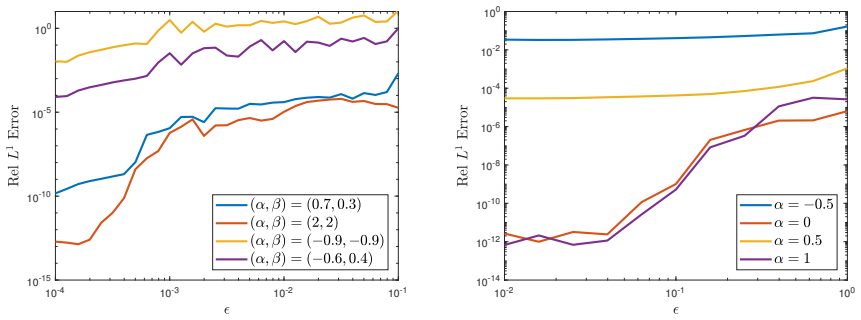
- epsilon (Poisson smoothing scale) and truncation size n in the numerical experiments =
e.g., epsilon = 1e-7 with n = 1000 for the Charlier example (Section 6.1)
assumptions (9)
- domain assumption Known asymptotic column-decay rate (f, alpha, beta) for T and x, equations (1.19)-(1.20)
- domain assumption Computational model: general/arithmetic algorithms with evaluation sets Lambda_1 and Lambda_2 and inexact input (Definition A.2, equation (1.18))
- standard math Spectral theorem, Stone's formula, and resolvent norm identity ||R(z,T)|| = 1/dist(z,sigma(T)) for normal T
- standard math RAGE theorem characterizing the continuous subspace via time averages of Q_n exp(-iTs) (equation (3.3))
- standard math Poltoratski-Simon-Zinchenko limit (equation (3.5)): (pi*theta/2) integral f chi_{|H mu| >= theta} dt converges to integral f d mu_s for positive measures
- standard math Graf's Anderson localization (Theorem 3.3): small disorder gives pure point spectrum for H_v + finite-rank A
- standard math Krutikov-Remling dichotomy (Theorem 3.4): sparse potentials give purely ac or purely sc spectrum on (0,4) according to sum g_j^2
- standard math SCI lower bound for the decision problem 'does a sequence have infinitely many nonzeros' and its column version (Ben-Artzi et al. [12], Appendix A)
- domain assumption Hermite-basis inner products (B.3)-(B.5) computable with asymptotic error control from point samples via quasi-Monte Carlo (from Colbrook-Hansen [37])
Cite this review
Pith. "Pith review of Computing Spectral Measures and Spectral Types." pith.science (2026). https://pith.science/paper/INQZJKCD
@misc{pith2026190806721,
  author       = {Pith},
  title        = {Pith review of: Computing Spectral Measures and Spectral Types},
  year         = {2026},
  howpublished = {\url{https://pith.science/paper/INQZJKCD}},
  note         = {Machine review of arXiv:1908.06721}
}
abstract
Spectral measures arise in numerous applications such as quantum mechanics, signal processing, resonances, and fluid stability. Similarly, spectral decompositions (pure point, absolutely continuous and singular continuous) often characterise relevant physical properties such as long-time dynamics of quantum systems. Despite new results on computing spectra, there remains no general method able to compute spectral measures or spectral decompositions of infinite-dimensional normal operators. Previous efforts focus on specific examples where analytical formulae are available (or perturbations thereof) or on classes of operators with a lot of structure. Hence the general computational problem is predominantly open. We solve this problem by providing the first set of general algorithms that compute spectral measures and decompositions of a wide class of operators. Given a matrix representation of a self-adjoint or unitary operator, such that each column decays at infinity at a known asymptotic rate, we show how to compute spectral measures and decompositions. We discuss how these methods allow the computation of objects such as the functional calculus, and how they generalise to a large class of partial differential operators, allowing, for example, solutions to evolution PDEs such as Schr\"odinger equations on $L^2(\mathbb{R}^d)$. Computational spectral problems in infinite dimensions have led to the SCI hierarchy, which classifies the difficulty of computational problems. We classify computation of measures, measure decompositions, types of spectra, functional calculus, and Radon--Nikodym derivatives in the SCI hierarchy. The new algorithms are demonstrated to be efficient on examples taken from OPs on the real line and the unit circle (e.g. giving computational realisations of Favard's theorem and Verblunsky's theorem), and are applied to evolution equations on a 2D quasicrystal.
Figures
Figures from the paper (13 more)
Forward citations
Cited by 1 Pith paper
-
The foundations of spectral computations via the Solvability Complexity Index hierarchy
Sharp Solvability Complexity Index classifications are established for spectra of unbounded differential and graph operators, the spectral gap problem, and discrete spectra, with constructive algorithms realizing the ...
Reference graph
Works this paper leans on
-
[37]
Matthew J. Colbrook and Anders C. Hansen. The foundations of spectral computations via the solvability complexity index hierarchy: Part I. arXiv:1908.09592, 2019
arXiv 1908
-
[1]
Akhiezer
Naum I. Akhiezer. The classical moment problem and some related questions in analysis . Translated by N. Kemmer. Hafner Publishing Co., New York, 1965
1965
-
[2]
Amrein and V
W.O. Amrein and V. Georgescu. On the characterization of bound states and scattering states in quantum mechanics. Helv. Phys. Acta , 46:635–658, 1973/74
1973
-
[3]
Anderson
Philip W. Anderson. Absence of diffusion in certain random lattices. Physical Review, 109(5):1492, 1958
1958
-
[4]
Vegard Antun, Matthew J Colbrook, and Anders C Hansen. Can stable and accurate neural networks be computed? - On the barriers of deep learning and Smale’s 18th problem. arXiv preprint arXiv:2101.08286, 2021
arXiv 2021
-
[5]
Aronszajn
N. Aronszajn. Approximation methods for eigenvalues of completely continuous symmetric operators. In Proceedings of the Symposium on Spectral Theory and Differential Problems , pages 179–202. Oklahoma Agricultural and Mechanical College, Stillwater, Okla., 1951
1951
-
[6]
Improper filtrations for C ∗-algebras: spectra of unilateral tridiagonal operators
William Arveson. Improper filtrations for C ∗-algebras: spectra of unilateral tridiagonal operators. Acta Sci. Math. (Szeged), 57(1-4):11–24, 1993
1993
-
[7]
C ∗-algebras and numerical linear algebra
William Arveson. C ∗-algebras and numerical linear algebra. Journal of Functional Analysis , 122(2):333– 360, 1994
1994
Show all 152 references
-
[8]
The role of C ∗-algebras in infinite-dimensional numerical linear algebra
William Arveson. The role of C ∗-algebras in infinite-dimensional numerical linear algebra. In C ∗-algebras: 1943–1993 (San Antonio, TX, 1993) , volume 167 of Contemp. Math. , pages 114–129. Amer. Math. Soc., Providence, RI, 1994
1943
-
[9]
Spectral analysis of large dimensional random matrices , volume 20
Zhidong Bai and Jack W Silverstein. Spectral analysis of large dimensional random matrices , volume 20. Springer, 2010
2010
-
[10]
Computing solutions of Schr¨ odinger equations on unbounded domains - on the brink of numerical algorithms
Simon Becker and Anders Hansen. Computing solutions of Schr¨ odinger equations on unbounded domains - on the brink of numerical algorithms. arXiv preprint arXiv:2010.16347 , 2020
2010 arXiv
-
[11]
On Folner nets, Szeg¨ o’s theorem and other eigenvalue distribution theorems
Erik B´ edos. On Folner nets, Szeg¨ o’s theorem and other eigenvalue distribution theorems. Exposition. Math., 15(3):193–228, 1997
1997
-
[12]
Ben-Artzi, M
J. Ben-Artzi, M. J. Colbrook, A. C. Hansen, O. Nevanlinna, and M. Seidel. Computing Spectra – On the Solvability Complexity Index hierarchy and towers of algorithms.arXiv preprint arXiv:1508.03280v5, 2020
2020 arXiv
-
[13]
Computing scattering resonances
Jonathan Ben-Artzi, Marco Marletta, and Frank R¨ osler. Computing scattering resonances. arXiv:2006.03368, 2020
2006 arXiv
-
[14]
Computing the sound of the sea in a seashell
Jonathan Ben-Artzi, Marco Marletta, and Frank R¨ osler. Computing the sound of the sea in a seashell. arXiv:2009.02956, 2020
2009 arXiv
-
[15]
Carl M. Bender. Making sense of non-Hermitian Hamiltonians. Rep. Prog. Phys., 70(6):947, 2007
2007
-
[16]
Numerical inverse scattering for the Toda lattice
Deniz Bilman and Thomas Trogdon. Numerical inverse scattering for the Toda lattice. Communications in Mathematical Physics , 352(2):805–879, 2017
2017
-
[17]
Complexity and Real Computation
Lenore Blum, Felipe Cucker, Michael Shub, and Steve Smale. Complexity and Real Computation. Springer- Verlag New York, Inc., Secaucus, NJ, USA, 1998
1998
-
[18]
Martin Bl¨ umlinger and Robert F. Tichy. Topological algebras of functions of bounded variation I. Manuscripta Mathematica, 65(2):245–255, 1989
1989
-
[19]
Pseudospectra and singular values of large convolution operators
Albrecht B¨ ottcher. Pseudospectra and singular values of large convolution operators. Journal of Integral Equations and Applications , 6(3):267–301, 1994
1994
-
[20]
Infinite matrices and projection methods
Albrecht B¨ ottcher. Infinite matrices and projection methods. In Lectures on operator theory and its applications (Waterloo, ON, 1994) , volume 3 of Fields Inst. Monogr. , pages 1–72. Amer. Math. Soc., Providence, RI, 1996
1994
-
[21]
Albrecht B¨ ottcher, Hermann Brunner, Arieh Iserles, and Syvert P. Nørsett. On the singular values and eigenvalues of the Fox-Li and related operators. New York J. Math. , 16:539–561, 2010
2010
-
[22]
Chithra, and M.N.N
Albrecht B¨ ottcher, A.V. Chithra, and M.N.N. Namboodiri. Approximation of approximation numbers by truncation. Integral Equations and Operator Theory , 39(4):387–395, 2001
2001
-
[23]
Introduction to large truncated Toeplitz matrices
Albrecht B¨ ottcher and Bernd Silbermann. Introduction to large truncated Toeplitz matrices . Universitext. Springer-Verlag, New York, 1999
1999
-
[24]
Projection methods for discrete Schr¨ odinger operators
Lyonell Boulton. Projection methods for discrete Schr¨ odinger operators. Proc. London Math. Soc. (3) , 88(2):526–544, 2004
2004
-
[25]
Lawrence G. Brown. Lidskii’s theorem in the type II case. Proceedings US–Japan, Kyoto/Japan, pages 1–35, 1983
1983
-
[26]
Nathanial P. Brown. Quasi-diagonality and the finite section method. Mathematics of Computation , 76(257):339–360, 2007
2007
-
[27]
Hermann Brunner, Arieh Iserles, and Syvert P. Nørsett. The computation of the spectra of highly oscillatory Fredholm integral operators. Journal of Integral Equations and Applications , 23(4):467–519, 2011. 51
2011
-
[28]
Cantero, Leandro Moral, and Luis Vel´ azquez
Maria J. Cantero, Leandro Moral, and Luis Vel´ azquez. Five-diagonal matrices and zeros of orthogonal polynomials on the unit circle. Linear Algebra and its Applications , 362:29–56, 2003
2003
-
[29]
Spectral theory of random Schr¨ odinger operators
Ren´ e Carmona and Jean Lacroix. Spectral theory of random Schr¨ odinger operators. Probability and its Applications. Birkh¨ auser Boston, Inc., Boston, MA, 1990
1990
-
[30]
A physics magic trick: Take 2 sheets of carbon and twist
Kenneth Chang. A physics magic trick: Take 2 sheets of carbon and twist. The New York Times , Oct 2019
2019
-
[31]
Theodore S. Chihara. An introduction to orthogonal polynomials . Gordon and Breach Science Publishers, New York-London-Paris, 1978
1978
-
[32]
Coddington and Norman Levinson
Earl A. Coddington and Norman Levinson. Theory of ordinary differential equations . McGraw-Hill Book Company, Inc., New York-Toronto-London, 1955
1955
-
[33]
The Foundations of Infinite-Dimensional Spectral Computations
Matthew Colbrook. The Foundations of Infinite-Dimensional Spectral Computations . PhD thesis, Univer- sity of Cambridge, 2020
2020
-
[34]
Colbrook
Matthew J. Colbrook. Pseudoergodic operators and periodic boundary conditions. Mathematics of Com- putation, 89(322):737–766, 2020
2020
-
[35]
Colbrook
Matthew J. Colbrook. Computing semigroups with error control. Preprint, 2021
2021
-
[36]
Colbrook
Matthew J. Colbrook. On the computation of geometric features of spectra of linear operators on hilbert spaces. arXiv:1908.09598, 2021
1908 arXiv
-
[38]
Colbrook and Anders C
Matthew J. Colbrook and Anders C. Hansen. On the infinite-dimensional QR algorithm. Numerische Mathematik, 143(1):17–83, 2019
2019
-
[39]
Colbrook, Andrew Horning, and Alex Townsend
Matthew J. Colbrook, Andrew Horning, and Alex Townsend. Computing spectral measures of self-adjoint operators. SIAM Review, to appear
-
[40]
Colbrook, Bogdan Roman, and Anders C
Matthew J. Colbrook, Bogdan Roman, and Anders C. Hansen. How to compute spectra with error control. Physical Review Letters, 122(25):250201, 2019
2019
-
[41]
Connections between quantum dynamics and spectral properties of time-evolution operators
Jean-Michel Combes. Connections between quantum dynamics and spectral properties of time-evolution operators. In Differential equations with applications to mathematical physics , volume 192 of Math. Sci. Engrg., pages 59–68. Academic Press, Boston, 1993
1993
-
[42]
Cycon, Richard G
Hans L. Cycon, Richard G. Froese, Werner Kirsch, and Barry Simon.Schr¨ odinger operators with application to quantum mechanics and global geometry . Texts and Monographs in Physics. Springer-Verlag, Berlin, study edition, 1987
1987
-
[43]
Brian Davies
E. Brian Davies. Linear operators and their spectra , volume 106 of Cambridge Studies in Advanced Math- ematics. Cambridge University Press, Cambridge, 2007
2007
-
[44]
Cory R. Dean, L. Wang, P. Maher, C. Forsythe, F. Ghahari, Y. Gao, J. Katoch, M. Ishigami, P. Moon, M. Koshino, et al. Hofstadter’s butterfly and the fractal quantum Hall effect in Moire superlattices. Nature, 497(7451):598–602, 2013
2013
-
[45]
Orthogonal polynomials and random matrices: a Riemann-Hilbert approach , volume 3 of Courant Lecture Notes in Mathematics
Percy Deift. Orthogonal polynomials and random matrices: a Riemann-Hilbert approach , volume 3 of Courant Lecture Notes in Mathematics. New York University, Courant Institute of Mathematical Sciences, New York; American Mathematical Society, Providence, RI, 1999
1999
-
[46]
Li, and Carlos Tomei
Percy Deift, Luenchau C. Li, and Carlos Tomei. Toda flows with infinitely many variables. Journal of Functional Analysis, 64(3):358–402, 1985
1985
-
[47]
Band gap formation and multiple scattering in photonic quasicrystals with a Penrose-type lattice
Alessandro Della Villa, Stefan Enoch, G´ erard Tayeb, Vincenzo Pierro, Vincenzo Galdi, and Filippo Capolino. Band gap formation and multiple scattering in photonic quasicrystals with a Penrose-type lattice. Physical Review Letters, 94(18):183903, 2005
2005
-
[48]
Dell’Oro and V
F. Dell’Oro and V. Pata. Second order linear evolution equations with general dissipation. Appl. Math. Opt., pages 1–41, 2019
2019
-
[49]
Trond Digernes, V. S. Varadarajan, and S. R. S. Varadhan. Finite approximations to quantum systems. Rev. Math. Phys. , 6(4):621–648, 1994
1994
-
[50]
Orthogonal polynomials, measures and recurrence relations
Joanne Dombrowski and Paul Nevai. Orthogonal polynomials, measures and recurrence relations. SIAM Journal on Mathematical Analysis , 17(3):752–759, 1986
1986
-
[51]
Solving the quintic by iteration
Peter Doyle and Curt McMullen. Solving the quintic by iteration. Acta Mathematica, 163(3-4):151–180, 1989
1989
-
[52]
Infinite random matrix theory, tridiagonal bordered Toeplitz matri- ces, and the moment problem
Alexander Dubbs and Alan Edelman. Infinite random matrix theory, tridiagonal bordered Toeplitz matri- ces, and the moment problem. Linear Algebra and its Applications , 467:188–201, 2015
2015
-
[53]
Asymptotic completeness for quantum mechanical potential scattering
Volker Enss. Asymptotic completeness for quantum mechanical potential scattering. I. Short range poten- tials. Communications in Mathematical Physics , 61(3):285–291, 1978
1978
-
[54]
Universality for random matrices and log-gases.arXiv preprint arXiv:1212.0839 , 2012
L´ aszl´ o Erdos. Universality for random matrices and log-gases.arXiv preprint arXiv:1212.0839 , 2012. 52
2012 arXiv
-
[55]
On the energy of a large atom
Charles Fefferman and Luis Seco. On the energy of a large atom. Bull. Amer. Math. Soc. (N.S.) , 23(2):525– 530, 1990
1990
-
[56]
Interval arithmetic in quantum mechanics
Charles Fefferman and Luis Seco. Interval arithmetic in quantum mechanics. In Applications of inter- val computations (El Paso, TX, 1995) , volume 3 of Appl. Optim. , pages 145–167. Kluwer Acad. Publ., Dordrecht, 1996
1995
-
[57]
Fulton, David Pearson, and Steven Pruess
Charles T. Fulton, David Pearson, and Steven Pruess. Computing the spectral function for singular Sturm- Liouville problems. Journal of Computational and Applied Mathematics , 176(1):131–162, 2005
2005
-
[58]
Fulton, David Pearson, and Steven Pruess
Charles T. Fulton, David Pearson, and Steven Pruess. New characterizations of spectral density functions for singular Sturm-Liouville problems. Journal of Computational and Applied Mathematics, 212(2):194–213, 2008
2008
-
[59]
Fulton and Steven Pruess
Charles T. Fulton and Steven Pruess. The computation of spectral density functions for singular Sturm- Liouville problems involving simple continuous spectra. ACM Trans. Math. Software, 24(1):107–129, 1998
1998
-
[60]
Fulton, Steven Pruess, and William Shoaff
Charles T. Fulton, Steven Pruess, and William Shoaff. Parallel computation of Sturm-Liouville spectral density functions. Parallel Algorithms and Applications , 4(1-2):41–51, 1994
1994
-
[61]
Geisel, R
T. Geisel, R. Ketzmerick, and G. Petschel. New class of level statistics in quantum systems with unbounded diffusion. Physical Review Letters, 66(13):1651, 1991
1991
-
[62]
Geronimus
J. Geronimus. On polynomials orthogonal on the circle, on trigonometric moment-problem and on allied Carath´ eodory and Schur functions.Rec. Math. [Mat. Sbornik] N. S. , 15(57):99–130, 1944
1944
-
[63]
Geronimus
J. Geronimus. Certain limiting properties of orthogonal polynomials. Vestnik Kharkov. Gos. Univ. , 1966(14):40–50, 1966
1966
-
[64]
m-functions and inverse spectral analysis for finite and semi-infinite Jacobi matrices
Fritz Gesztesy and Barry Simon. m-functions and inverse spectral analysis for finite and semi-infinite Jacobi matrices. J. Anal. Math. , 73:267–297, 1997
1997
-
[65]
Girardin and R
V. Girardin and R. Senoussi. Semigroup stationary processes and spectral representation. Bernoulli, 9(5):857–876, 2003
2003
-
[66]
Golub and Charles F
Gene H. Golub and Charles F. Van Loan. Matrix computations. Johns Hopkins Studies in the Mathematical Sciences. Johns Hopkins University Press, Baltimore, MD, fourth edition, 2013
2013
-
[67]
Gian M. Graf. Anderson localization and the space-time characteristic of continuum states. Journal of Statistical Physics, 75(1-2):337–346, 1994
1994
-
[68]
William B. Gragg. Positive definite Toeplitz matrices, the Arnoldi process for isometric operators, and Gaussian quadrature on the unit circle. Journal of Computational and Applied Mathematics , 46(1-2):183– 198, 1993
1993
-
[69]
Toeplitz and circulant matrices: A review
Robert M Gray et al. Toeplitz and circulant matrices: A review. Foundations and Trends in Communica- tions and Information Theory , 2(3):155–239, 2006
2006
-
[70]
Norm-controlled inversion in smooth Banach algebras, I.J
Karlheinz Gr¨ ochenig and Andreas Klotz. Norm-controlled inversion in smooth Banach algebras, I.J. Lond. Math. Soc. (2) , 88(1):49–64, 2013
2013
-
[71]
Brown measures of unbounded operators affiliated with a finite von Neumann algebra
Uffe Haagerup and Hanne Schultz. Brown measures of unbounded operators affiliated with a finite von Neumann algebra. Mathematica Scandinavica, pages 209–263, 2007
2007
-
[72]
Invariant subspaces for operators in a general II 1-factor
Uffe Haagerup and Hanne Schultz. Invariant subspaces for operators in a general II 1-factor. Publications Math´ ematiques de l’IH´ES, 109:19–111, 2009
2009
-
[73]
C ∗-algebras and numerical analysis , volume 236 of Monographs and Textbooks in Pure and Applied Mathematics
Ronald Hagen, Steffen Roch, and Bernd Silbermann. C ∗-algebras and numerical analysis , volume 236 of Monographs and Textbooks in Pure and Applied Mathematics . Marcel Dekker Inc., New York, 2001
2001
-
[74]
Higham, and Lloyd N
Nicholas Hale, Nicholas J. Higham, and Lloyd N. Trefethen. Computing Aα, log(A), and related matrix functions by contour integrals. SIAM Journal on Numerical Analysis , 46(5):2505–2523, 2008
2008
-
[75]
Thomas C. Hales. A proof of the Kepler conjecture. Annals of Mathematics (2) , 162(3):1065–1185, 2005
2005
-
[76]
Paul R. Halmos. Measure Theory. D. Van Nostrand Company, Inc., New York, N. Y., 1950
1950
-
[77]
Paul R. Halmos. What does the spectral theorem say? Amer. Math. Monthly , 70:241–247, 1963
1963
-
[78]
Anders C. Hansen. On the approximation of spectra of linear Hilbert space operators. PhD thesis, University of Cambridge, 2008
2008
-
[79]
Anders C. Hansen. On the approximation of spectra of linear operators on Hilbert spaces. Journal of Functional Analysis, 254(8):2092–2126, 2008
2008
-
[80]
Anders C. Hansen. Infinite-dimensional numerical linear algebra: theory and applications. Proc. R. Soc. Lond. Ser. A Math. Phys. Eng. Sci. , 466(2124):3539–3559, 2010
2010
-
[81]
Anders C. Hansen. On the solvability complexity index, the n-pseudospectrum and approximations of spectra of operators. Journal of the American Mathematical Society , 24(1):81–124, 2011
2011
-
[82]
Haydock, Volker Heine, and M.J
R. Haydock, Volker Heine, and M.J. Kelly. Electronic structure based on the local atomic environment for tight-binding bands. Journal of Physics C: Solid State Physics , 5(20):2845, 1972
1972
-
[83]
Exponential integrators
Marlis Hochbruck and Alexander Ostermann. Exponential integrators. Acta Numerica, 19:209–286, 2010. 53
2010
-
[84]
FEAST for differential eigenvalue problems
Andrew Horning and Alex Townsend. FEAST for differential eigenvalue problems. arXiv:1901.04533, 2019
1901 arXiv
-
[85]
Hundertmark, M
D. Hundertmark, M. Meyries, L. Machinek, and R. Schnaubelt. Operator semigroups and dispersive equations. In 16th Internet Seminar on Evolution Equations , 2013
2013
-
[86]
Kadison and John R
Richard V. Kadison and John R. Ringrose. Fundamentals of the theory of operator algebras. Vol. I , vol- ume 15 of Graduate Studies in Mathematics . American Mathematical Society, Providence, RI, 1997
1997
-
[87]
Kadison and John R
Richard V. Kadison and John R. Ringrose. Fundamentals of the theory of operator algebras. Vol. II , volume 16 of Graduate Studies in Mathematics . American Mathematical Society, Providence, RI, 1997
1997
-
[88]
Kallianpur and V
G. Kallianpur and V. Mandrekar. Spectral theory of stationary H-valued processes. J. Multivar. Anal. , 1(1):1–16, 1971
1971
-
[89]
Random Schr¨ odinger operators
Werner Kirsch. Random Schr¨ odinger operators. A course. In Schr¨ odinger operators (Sønderborg, 1988), volume 345 of Lecture Notes in Phys. , pages 264–370. Springer, Berlin, 1989
1988
-
[90]
An invitation to random Schr¨ odinger operators
Werner Kirsch. An invitation to random Schr¨ odinger operators. arXiv:0709.3707, 25:1–119, 2007
2007 arXiv
-
[91]
The integrated density of states for random Schr¨ odinger operators
Werner Kirsch and Bernd Metzger. The integrated density of states for random Schr¨ odinger operators. In Spectral theory and mathematical physics: a Festschrift in honor of Barry Simon’s 60th birthday , volume 76 of Proc. Sympos. Pure Math., pages 649–696. Amer. Math. Soc., Pr...
2007
-
[92]
Schr¨ odinger operators with sparse potentials: asymptotics of the Fourier transform of the spectral measure
Denis Krutikov and Christian Remling. Schr¨ odinger operators with sparse potentials: asymptotics of the Fourier transform of the spectral measure. Communications in Mathematical Physics , 223(3):509–532, 2001
2001
-
[93]
Quantum dynamics and decompositions of singular continuous spectra
Yoram Last. Quantum dynamics and decompositions of singular continuous spectra. Journal of Functional Analysis, 142(2):406–445, 1996
1996
-
[94]
Spectral pollution and second-order relative spectra for self- adjoint operators
Michael Levitin and Eugene Shargorodsky. Spectral pollution and second-order relative spectra for self- adjoint operators. IMA J. Numer. Anal. , 24(3):393–416, 2004
2004
-
[95]
Approximating spectral densities of large matrices
Lin Lin, Yousef Saad, and Chao Yang. Approximating spectral densities of large matrices. SIAM Review, 58(1):34–65, 2016
2016
-
[96]
Infinite matrices and their finite sections
Marko Lindner. Infinite matrices and their finite sections . Frontiers in Mathematics. Birkh¨ auser Verlag, Basel, 2006
2006
-
[97]
Superconductors, orbital magnets and correlated states in magic-angle bilayer graphene
Xiaobo Lu, Petr Stepanov, Wei Yang, Ming Xie, Mohammed Ali Aamir, Ipsita Das, Carles Urgell, Kenji Watanabe, Takashi Taniguchi, Guangyu Zhang, et al. Superconductors, orbital magnets and correlated states in magic-angle bilayer graphene. Nature, 574(7780):653–657, 2019
2019
-
[98]
Neumann-Dirichlet maps and analysis of spectral pollution for non-self-adjoint elliptic PDEs with real essential spectrum
Marco Marletta. Neumann-Dirichlet maps and analysis of spectral pollution for non-self-adjoint elliptic PDEs with real essential spectrum. IMA J. Numer. Anal. , 30(4):917–939, 2010
2010
-
[99]
Eigenvalues in spectral gaps of differential operators
Marco Marletta and Rob Scheichl. Eigenvalues in spectral gaps of differential operators. Journal of Spectral Theory, 2(3):293–320, 2012
2012
-
[100]
McLachlan and G
Robert I. McLachlan and G. Reinout W. Quispel. Splitting methods. Acta Numerica, 11:341–434, 2002
2002
-
[101]
Families of rational maps and iterative root-finding algorithms
Curt McMullen. Families of rational maps and iterative root-finding algorithms. Annals of Mathematics (2), 125(3):467–493, 1987
1987
-
[102]
Braiding of the attractor and the failure of iterative algorithms
Curt McMullen. Braiding of the attractor and the failure of iterative algorithms. Invent. Math., 91(2):259– 272, 1988
1988
-
[103]
Random number generation and quasi-Monte Carlo methods , volume 63 of CBMS- NSF Regional Conference Series in Applied Mathematics
Harald Niederreiter. Random number generation and quasi-Monte Carlo methods , volume 63 of CBMS- NSF Regional Conference Series in Applied Mathematics . Society for Industrial and Applied Mathematics (SIAM), Philadelphia, PA, 1992
1992
-
[104]
ApproxFun.jl v0.8
Sheehan Olver. ApproxFun.jl v0.8. github (online) https://github.com/JuliaApproximation/ApproxFun.jl, 2018
2018
-
[105]
A fast and well-conditioned spectral method
Sheehan Olver and Alex Townsend. A fast and well-conditioned spectral method. SIAM Review, 55(3):462– 489, 2013
2013
-
[106]
A Practical Framework for Infinite-dimensional Linear Algebra
Sheehan Olver and Alex Townsend. A Practical Framework for Infinite-dimensional Linear Algebra. In Proceedings of the 1st First Workshop for High Performance Technical Computing in Dynamic Languages , HPTCDL ’14, pages 57–62, Piscataway, NJ, USA, 2014. IEEE Press
2014
-
[107]
SpectralMeasures.jl
Sheehan Olver and Marcus Webb. SpectralMeasures.jl. github (online) https://github.com/JuliaApproximation/SpectralMeasures.jl, 2018
2018
-
[108]
Poltoratski
Alexei G. Poltoratski. On the distributions of boundary values of Cauchy integrals. Proc. Amer. Math. Soc., 124(8):2455–2463, 1996
1996
-
[109]
Poltoratski, Barry Simon, and Maxim Zinchenko
Alexei G. Poltoratski, Barry Simon, and Maxim Zinchenko. The Hilbert transform of a measure. J. Anal. Math., 111:247–265, 2010
2010
-
[110]
Ponomarenko, R.V
L.A. Ponomarenko, R.V. Gorbachev, G.L. Yu, D.C. Elias, R. Jalil, A.A. Patel, A. Mishchenko, A.S. May- orov, C.R. Woods, J.R. Wallbank, et al. Cloning of Dirac fermions in graphene superlattices. Nature, 497(7451):594–597, 2013. 54
2013
-
[111]
Steven Pruess and Charles T. Fulton. Mathematical software for Sturm-Liouville problems. ACM Trans- actions on Mathematical Software (TOMS) , 19(3):360–376, 1993
1993
-
[112]
Limit operators and their applications in operator theory, volume 150 of Operator Theory: Advances and Applications
Vladimir Rabinovich, Steffen Roch, and Bernd Silbermann. Limit operators and their applications in operator theory, volume 150 of Operator Theory: Advances and Applications . Birkh¨ auser Verlag, Basel, 2004
2004
-
[113]
Methods of modern mathematical physics
Michael Reed and Barry Simon. Methods of modern mathematical physics. I. Academic Press, Inc. [Harcourt Brace Jovanovich, Publishers], New York, second edition, 1980
1980
-
[114]
The absolutely continuous spectrum of one-dimensional Schr¨ odinger operators with decaying potentials
Christian Remling. The absolutely continuous spectrum of one-dimensional Schr¨ odinger operators with decaying potentials. Communications in Mathematical Physics , 193(1):151–170, 1998
1998
-
[115]
Lewis Fry Richardson and J Arthur Gaunt. VIII. the deferred approach to the limit. Philosophical Transac- tions of the Royal Society of London. Series A, containing papers of a mathematical or physical character , 226(636-646):299–361, 1927
1927
-
[116]
R. C. Riddell. Spectral concentration for self-adjoint operators. Pacific J. Math. , 23:377–401, 1967
1967
-
[117]
Leonard J. Rogers. Second Memoir on the Expansion of certain Infinite Products. Proc. Lond. Math. Soc., 25:318–343, 1893/94
-
[118]
Rosenblatt
M. Rosenblatt. Stochastic curve estimation. IMS, 1991
1991
-
[119]
A remark on bound states in potential-scattering theory
David Ruelle. A remark on bound states in potential-scattering theory. Nuovo Cimento A (10), 61:655–662, 1969
1969
-
[120]
On ( N,ϵ )-pseudospectra of operators on Banach spaces
Markus Seidel. On ( N,ϵ )-pseudospectra of operators on Banach spaces. Journal of Functional Analysis , 262(11):4916–4927, 2012
2012
-
[121]
Fredholm theory for band-dominated and related operators: a survey
Markus Seidel. Fredholm theory for band-dominated and related operators: a survey. Linear Algebra Appl., 445:373–394, 2014
2014
-
[122]
Finite sections of band-dominated operators – norms, condition numbers and pseudospectra
Markus Seidel and Bernd Silbermann. Finite sections of band-dominated operators – norms, condition numbers and pseudospectra. In Operator theory, pseudo-differential equations, and mathematical physics , volume 228 of Oper. Theory Adv. Appl. , pages 375–390. Birkhauser/Springer...
2013
-
[123]
Geometry of higher order relative spectra and projection methods
Eugene Shargorodsky. Geometry of higher order relative spectra and projection methods. J. Operator Theory, 44(1):43–62, 2000
2000
-
[124]
On the limit behaviour of second order relative spectra of self-adjoint operators
Eugene Shargorodsky. On the limit behaviour of second order relative spectra of self-adjoint operators. Journal of Spectral Theory, 3(4):535–552, 2013
2013
-
[125]
Dan Shechtman, Ilan Blech, Dennis Gratias, and John W. Cahn. Metallic phase with long-range orienta- tional order and no translational symmetry. Physical Review Letters, 53:1951–1953, Nov 1984
1951
-
[126]
B. Simon. Schr¨ odinger semigroups. Bull. Am. Math. Soc. , 7(3):447–526, 1982
1982
-
[127]
Absence of ballistic motion
Barry Simon. Absence of ballistic motion. Communications in Mathematical Physics, 134(1):209–212, 1990
1990
-
[128]
Operators with singular continuous spectrum
Barry Simon. Operators with singular continuous spectrum. I. General operators. Annals of Mathematics (2), 141(1):131–145, 1995
1995
-
[129]
The classical moment problem as a self-adjoint finite difference operator
Barry Simon. The classical moment problem as a self-adjoint finite difference operator. Adv. Math. , 137(1):82–203, 1998
1998
-
[130]
Orthogonal polynomials on the unit circle
Barry Simon. Orthogonal polynomials on the unit circle. Part 1 , volume 54 of American Mathematical Society Colloquium Publications. American Mathematical Society, Providence, RI, 2005
2005
-
[131]
Orthogonal polynomials on the unit circle
Barry Simon. Orthogonal polynomials on the unit circle. Part 2 , volume 54 of American Mathematical Society Colloquium Publications. American Mathematical Society, Providence, RI, 2005
2005
-
[132]
The fundamental theorem of algebra and complexity theory
Steve Smale. The fundamental theorem of algebra and complexity theory. Bull. Amer. Math. Soc. (N.S.) , 4(1):1–36, 1981
1981
-
[133]
On the efficiency of algorithms of analysis
Steve Smale. On the efficiency of algorithms of analysis. Bull. Amer. Math. Soc. (N.S.) , 13(2):87–121, 1985
1985
-
[134]
Complexity theory and numerical analysis
Steve Smale. Complexity theory and numerical analysis. In Acta numerica, 1997, volume 6 of Acta Numer., pages 523–551. Cambridge Univ. Press, Cambridge, 1997
1997
-
[135]
Zbigniew M. Stadnik. Physical properties of quasicrystals, volume 126. Springer Science & Business Media, 2012
2012
-
[136]
Stieltjes
Thomas J. Stieltjes. Recherches sur les fractions continues. Ann. Fac. Sci. Toulouse Sci. Math. Sci. Phys. , 8(4):J1–J122, 1894
-
[137]
Marshall H. Stone. Linear transformations in Hilbert space , volume 15 of American Mathematical Society Colloquium Publications. American Mathematical Society, Providence, RI, 1990
1990
-
[138]
Modern quantum chemistry: introduction to advanced electronic structure theory
Attila Szabo and Neil S Ostlund. Modern quantum chemistry: introduction to advanced electronic structure theory. Courier Corporation, 2012
2012
-
[139]
American Mathematical Society, New York, 1939
Gabor Szeg˝ o.Orthogonal Polynomials. American Mathematical Society, New York, 1939. 55
1939
-
[140]
Valence fluctuations and electric reconstruction in the extended Anderson model on the two-dimensional Penrose lattice
Shinichi Takemura, Nayuta Takemori, and Akihisa Koga. Valence fluctuations and electric reconstruction in the extended Anderson model on the two-dimensional Penrose lattice. Physical Review B, 91(16):165114, 2015
2015
-
[141]
D. J. Tannor. Introduction to Quantum Mechanics: a Time-Dependent Perspective . University Science Books, 2007
2007
-
[142]
Teplyaev
A.V. Teplyaev. The pure point spectrum of random orthogonal polynomials on the circle. Dokl. Akad. Nauk SSSR, 320(1):49–53, 1991
1991
-
[143]
Jacobi operators and completely integrable nonlinear lattices , volume 72 of Mathematical Surveys and Monographs
Gerald Teschl. Jacobi operators and completely integrable nonlinear lattices , volume 72 of Mathematical Surveys and Monographs. American Mathematical Society, Providence, RI, 2000
2000
-
[144]
Numerical inverse scattering for the Korteweg– de Vries and modified Korteweg–de Vries equations
Thomas Trogdon, Sheehan Olver, and Bernard Deconinck. Numerical inverse scattering for the Korteweg– de Vries and modified Korteweg–de Vries equations. Physica D: Nonlinear Phenomena, 241(11):1003–1025, 2012
2012
-
[145]
Alan M. Turing. On Computable Numbers, with an Application to the Entscheidungsproblem. Proc. London Math. Soc. (2) , 42(3):230–265, 1936
1936
-
[146]
Valy Vardeny, Ajay Nahata, and Amit Agrawal
Z. Valy Vardeny, Ajay Nahata, and Amit Agrawal. Optics of photonic quasicrystals.Nature Phot., 7(3):177– 187, 2013
2013
-
[147]
On positive harmonic functions: A contribution to the algebra of Fourier series
Samuel Verblunsky. On positive harmonic functions: A contribution to the algebra of Fourier series. Proceedings of the London Mathematical Society, 2(1):125–157, 1935
1935
-
[148]
On positive harmonic functions
Samuel Verblunsky. On positive harmonic functions. Proceedings of the London Mathematical Society , 2(1):290–320, 1936
1936
-
[149]
Hubert S. Wall. Analytic Theory of Continued Fractions . D. Van Nostrand Company, Inc., New York, N. Y., 1948
1948
-
[150]
Isospectral algorithms, Toeplitz matrices and orthogonal polynomials
Marcus Webb. Isospectral algorithms, Toeplitz matrices and orthogonal polynomials. PhD thesis, University of Cambridge, 2017
2017
-
[151]
Spectra of Jacobi operators via connection coefficient matrices
Marcus Webb and Sheehan Olver. Spectra of Jacobi operators via connection coefficient matrices. Com- munications in Mathematical Physics , pages 1–51, 2021
2021
-
[152]
A spectral transform method for singular Sturm-Liouville problems with applications to energy diffusion in plasma physics
Jon Wilkening and Antoine Cerfon. A spectral transform method for singular Sturm-Liouville problems with applications to energy diffusion in plasma physics. SIAM Journal on Applied Mathematics , 75(2):350– 392, 2015. 56
2015
Reviewed August 14, 2026 · model on record in the stance chip above.
Discussion (0). Continue with ORCID to comment.