REVIEW 4 major objections 6 minor 21 references
RADIANT: Retrieval AugmenteD entIty-context AligNmenT -- Introducing RAG-ability and Entity-Context Divergence
T0 review · 4 major / 6 minor · reviewed 2026-08-06 · deepseek-v4-flash
Pith's one-line read RADIANT: a training objective that reduces RAG entity drift by a third.
desk verdict ECD is a plausible metric, but RADIANT's training objective is incoherent and the lone self-evaluated result cannot support the central claim. read the letter →
The pith
A machine-rendered reading of the paper's core claim, the machinery that carries it, and where it could break.
The reading
What carries the argument
The load-bearing object is Entity-Context Divergence (ECD), a score built from three terms: for entities shared between retrieved context $C_r$ and generated output $C_g$, the Jaccard divergence of the word windows around each entity $d_{\mathrm{Jaccard}}(W_r(e), W_g(e)) = 1 - |W_r(e)\cap W_g(e)|/|W_r(e)\cup W_g(e)|$; for entities in $C_r$ absent from $C_g$, a rank-weighted penalty normalized by the number of common entities; and a symmetric penalty for entities the generator adds that appear in neither context nor prompt. This score is used twice: as the evaluation metric for RAG-ability, and as the alignment term $\gamma(\mathrm{ECD}(C_r,C_g^-)-\mathrm{ECD}(C_r,C_g^+))$ inside the RADIANT objective, a DPO-style loss that prefers generations with lower divergence as well as higher likelihood. The paper presents the gradient of this objective as Eqs. (5)-(7) and states that each ECD component is differentiated with respect to the policy parameters.
What would settle it
Run the RADIANT training on Gemma-7b-it using a concrete differentiable surrogate or policy-gradient estimator for the divergence term, then measure the divergence peak on a held-out retrieval set; reproducing the drop from about 91 to about 61 would support the claim, and failing to obtain any drop would refute it.
Extended reading notes
Core claim
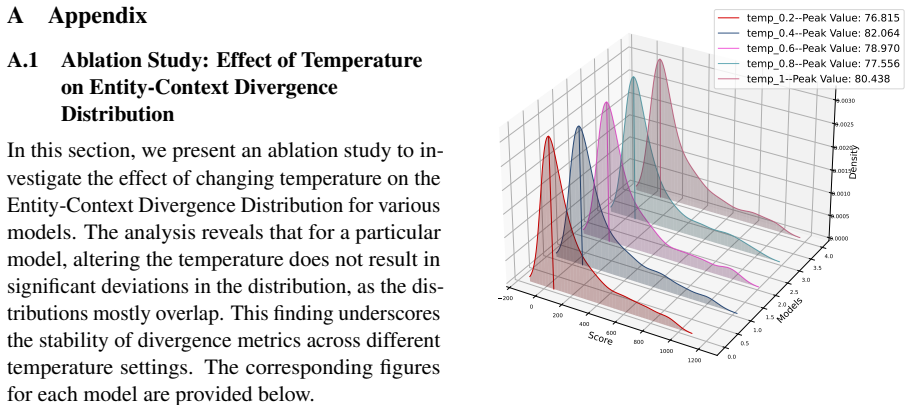
The central claim is that ECD, as defined, captures information drift between provided context and generated output at the level of named entities, and that a DPO-style objective augmented with an ECD gap term can serve as a behavior-correction mechanism that lowers this drift. The paper argues that traditional similarity metrics miss subtle contextual shifts around entities, whereas ECD's combination of Jaccard divergence on context windows, missing-entity penalties, and added-entity penalties is interpretable and sensitive. Empirically, it shows that across six contemporary LLMs, RAG-ability as measured by ECD is low, and that applying the RADIANT objective to one model reduces the ECD peak from 91.009 to 60.800, with further training epochs decreasing ECD scores. The paper asserts that this behavior correction holds across varied retrieval scenarios, including noisy web contexts, knowledge conflicts, and hallucination reduction, and that trained models become more robust to information ordering ('lost in the middle').
Load-bearing premise
The load-bearing premise is that the divergence score can be optimized by gradient descent, but the score is built from discrete steps such as finding entities, checking membership, and counting overlapping words, and the paper gives no differentiable surrogate or estimator for those steps.
Editorial extensions
If this is right
- If RADIANT works as claimed, a single alignment term added to DPO can reduce factual drift in RAG, making generated answers more faithful to retrieved evidence.
- RAG-ability can be used as an evaluation axis alongside other metrics: models with high ECD peaks in missing and added entity distributions would be flagged as unreliable for retrieval-augmented deployment.
- The same ECD objective should generalize to noisy web contexts and knowledge-conflict settings, lowering hallucination rates by penalizing added entities that come from neither prompt nor context.
- Because ECD rewards context-window overlap at the entity level, trained models are expected to be less sensitive to whether key information appears at the beginning, middle, or end of the retrieved context.
- Using Weighted Alpha generalization analysis, the paper argues that the alignment procedure does not destroy generalizability, keeping the trade-off within a 10% drift.
Reading between the lines
- The reported training result is one model (Gemma-7b-it); a direct extension would be to check whether the 33% ECD-peak drop reproduces across Llama-3, Qwen2, and Gemini-class models, and whether it holds on multiple news datasets rather than one NYT-derived set.
- Because ECD's components are discrete (NER, set membership, token-window overlap), any practical implementation of RADIANT must replace them with a differentiable surrogate or a policy-gradient estimator; the paper does not specify one, so the published gradient equations are at best symbolic. A testable question is whether a surrogate-based implementation actually yields the reported drop.
- The ECD alignment term is a scalar difference between two generations, so it could be composed with other alignment objectives (e.g., RLHF, constitutional AI) rather than only DPO, potentially yielding combined safety and RAG-ability training.
- The metric's rank-based weighting ties penalties to where entities appear in the context, suggesting ECD could be adapted to diagnose positional bias beyond the 'lost in the middle' effect.
Editorial analysis
A structured set of objections, weighed in public.
Referee Report
Summary. The paper introduces Entity-Context Divergence (ECD), a metric intended to quantify how faithfully LLM-generated text reflects named entities and their surrounding context in a retrieval-augmented generation (RAG) setting, and defines 'RAG-ability' as a model's ability to preserve factual consistency in that setting. The authors evaluate six LLMs across four context scenarios and report low RAG-ability. They then propose RADIANT, a training objective that combines a DPO-style preference term with an ECD alignment term, and claim that training Gemma-7b-it with this objective reduces ECD and thereby improves RAG performance across noisy, conflicting, and hallucination-prone retrieval scenarios. The empirical support for the central claim is Fig. 7, which shows an ECD peak dropping from 91.009 to 60.800 after training. The manuscript also discusses information-ordering robustness and generalization-vs-overfitting behavior, but the main contribution is the ECD metric and the RADIANT training framework.
Significance. If the ECD metric were well-defined and the RADIANT objective were a valid, optimizable training loss, the paper would contribute a novel way to measure and improve entity-context alignment in RAG. The release of datasets on Hugging Face and the proposal of a new metric are positive features. However, as it stands, the metric has unresolved definitional ambiguities, the training objective is presented in inconsistent and mathematically ill-defined forms, the gradient derivation is not a valid chain through discrete operations, and the only reported training result is a single base/trained comparison measured with the very metric that the objective minimizes. These issues affect every load-bearing claim, so the current manuscript does not provide a sound basis for its conclusions. No code, no baseline comparisons, no error bars, and no independent factuality or preference metrics are provided.
major comments (4)
- [Section 4.4, Eq. (3)] The ECD formula is not well specified. The quantity σ is introduced in Section 4.1 as 'the standard deviation of the ECD distribution,' but it is then used inside the ECD computation itself (Eq. 3 and the penalties in Sections 4.2 and 4.3), which is circular unless σ is defined externally. The window size w used to build Wr(e) and Wg(e) is never given a value or a definition, and the 'rank(e)' terms in the missing- and added-entity penalties are not defined: rank by position, frequency, or salience is never stated. Most seriously, when a retrieved context and a generated output share no entities (ncommon = 0), the divisions by ncommon in Eq. (3) are undefined, so ECD cannot be computed for a common and important failure mode. These ambiguities make the metric non-reproducible as written.
- [Section 6.1 and Appendix C.2, Eq. (4)] The RADIANT objective is stated in at least three inconsistent forms, and none of them is a valid DPO loss. Section 6.1 gives max_pi E[log pi(y+|x)/pi(y-|x) + gamma(ECD(Cr,C-g) - ECD(Cr,C+g))], with no sigmoid and no reference policy. Appendix C.2 Eq. (4) gives -E[log pi(y+|x)/pi(y-|x) + gamma(ECD(Cr,C-g) - ECD(Cr,C+g))], still without sigmoid or pi_ref. The same appendix later presents a different expression containing 'COMMON-NE JSD' and 'sigma JSDCNE' terms. The paper never identifies which of these losses was used to produce the results in Fig. 7, so the experimental outcome cannot be attributed to a specific, well-defined training objective.
- [Appendix C.4, Eqs. (5)-(7)] The gradient derivation is not valid for the objective as written. ECD depends on discrete steps: named-entity extraction, set membership in Er and Eg, the common/missing/added entity sets, and token-window intersections. These are not differentiable functions of the policy parameters θ. Equation (7) merely asserts that ∇θ(ECD(Cr,C-g) - ECD(Cr,C+g)) = ∇θ ECD(Cr,C-g) - ∇θ ECD(Cr,C+g), but no chain rule through NER, set operations, or sampling is supplied, and no surrogate loss, straight-through estimator, or policy-gradient estimator is proposed. Without a well-defined gradient path, gradient descent on the advertised objective cannot be run, and the training result in Fig. 7 cannot be explained by the mechanism claimed.
- [Section 7, Fig. 7] The only reported training result is a single comparison between a base Gemma-7b-it model and a trained model, and the improvement is measured with the same ECD score that the RADIANT objective directly minimizes. There is no DPO-only baseline, no reference-model-regularized DPO baseline, no multiple seeds or error bars, and no independent evaluation using standard factuality metrics, preference metrics, or human judgments. The observed reduction from a peak of 91.009 to 60.800 is therefore consistent with direct fitting of the target metric and does not support the abstract's stronger claim that RADIANT 'boosts RAG performance' across varied retrieval scenarios, including noisy web contexts and knowledge conflicts. Additional claims in Section 8 about robustness to information ordering and in Section 9 about learning across models are not supported by any presented quantitative results.
minor comments (6)
- [Section 3.1] Model names are inconsistent and sometimes inaccurate: 'LLAMA-3.8b' and 'LLAMA 3 8b' should be a single, correct model identifier, and the same applies to 'LLAMA-3.1-70b' and 'llama-3.1-70b'.
- [Section 7, Fig. 7] The figure legend uses 'FPO-Trained-Model,' but the paper does not define FPO or explain whether it is the same as RADIANT; this should be clarified or corrected.
- [Section 8] The claim that RADIANT-trained models overcome information-ordering limitations after being given '10 paraphrases of the same context' is stated without any corresponding figure, table, or quantitative result.
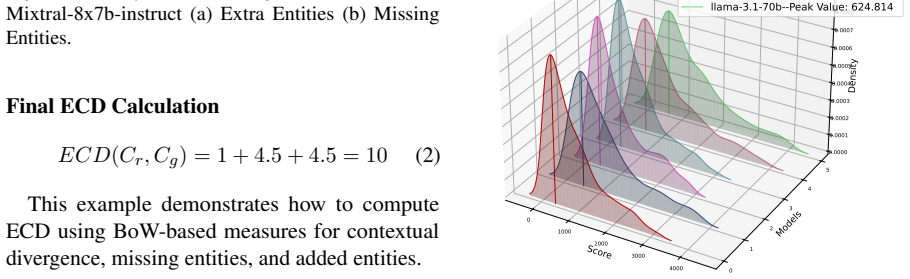
- [Section 9, Fig. 8] The text refers to Fig. 8 as showing ECD decreasing over training epochs for several models, but the figure is not shown in the manuscript text; a plot with axis labels, units, and model names is needed.
- [Section 10, Fig. 9] The Weighted Alpha and heavy-tailed self-regularization analysis is not connected to the RADIANT objective or to ECD, and the phrase 'various DPO-kernels' is not defined anywhere in the paper.
- [Section B.1] The worked ECD example assumes 'ranks are {2,3,4}' without explaining what rank means, and it also assumes a value for σ without connecting it to any ECD distribution; this highlights the definitional gap noted in the major comments.
Circularity Check
RADIANT reports improved RAG-ability using the same ECD metric that its training objective explicitly minimizes; the headline evidence (Fig. 7) is therefore largely self-referential, with no independent factuality or preference evaluation.
-
fitted input called prediction
[Section 6.1 (objective), Section 7 (Fig. 7), and Abstract (RAG-ability definition)]
"The goal is to maximize this objective concerning the policy π: maxπ E(x,y+,y−)[ logπ(y+|x)/π(y−|x) + γ(ECD(Cr,C−g)−ECD(Cr,C+g)) ] ... When training an LLM using the RADIANT objective, the primary goal is to reduce the ECD within a RAG setup. ... Comparison of Gemma-7b-it ECD for Base and RADIANT-trained (FPO)."
The RADIANT objective directly contains an ECD alignment term, and Section 7 states that the primary goal of training is to reduce ECD. The only empirical evidence for the paper's claim that RADIANT 'boosts RAG performance across varied retrieval scenarios' is Fig. 7, which reports ECD peaks before (91.009) and after (60.800) training. RAG-ability, the capability the paper claims to improve, is defined in the abstract as the capability measured by ECD. Consequently, the claimed improvement is a reduction in exactly the quantity that the training objective is designed to minimize; the evaluation metric is the training metric.
full rationale
The central circular step connects the training objective to the evaluation metric. Section 6.1 defines RADIANT as maximizing E[logπ(y+|x)/π(y−|x) + γ(ECD(Cr,C−g)−ECD(Cr,C+g))], and Section 7 says 'the primary goal is to reduce the ECD within a RAG setup.' The only empirical support for the central claim is Fig. 7, which shows ECD peak values dropping from 91.009 to 60.800 after training. RAG-ability, the capability the paper says RADIANT improves, is defined in the abstract as the capability evaluated by ECD ('a capability we define as RAG-ability'). Thus the paper's central 'improvement' reduces to: the model was trained to minimize ECD, and afterward its ECD was lower. The presence of the logπ likelihood ratio means the objective is not purely ECD minimization, so the circularity is not total, but the reported evidence does not include any external factuality or preference metric that would sever the link between the training target and the evaluation metric. Appendix C.4's gradient derivation is not a valid chain through the discrete ECD computation, but that is a correctness risk rather than circularity. There are no load-bearing self-citations, imported uniqueness theorems, or renamed known results. Overall, this is a partial 'training on the test metric' circularity, scored 6.
Assumptions & free parameters
free parameters (4)
- gamma
- sigma =
0.5 in the worked example
- window size w
- rank(e)
assumptions (3)
- domain assumption ECD is a valid proxy for factual consistency
- ad hoc to paper ECD is differentiable with respect to policy parameters
- domain assumption DPO-based optimization with an added ECD term will improve RAG ability
Cite this review
Pith. "Pith review of RADIANT: Retrieval AugmenteD entIty-context AligNmenT -- Introducing RAG-ability and Entity-Context Divergence." pith.science (2026). https://pith.science/paper/INRT66NG
@misc{pith2026250702949,
  author       = {Pith},
  title        = {Pith review of: RADIANT: Retrieval AugmenteD entIty-context AligNmenT -- Introducing RAG-ability and Entity-Context Divergence},
  year         = {2026},
  howpublished = {\url{https://pith.science/paper/INRT66NG}},
  note         = {Machine review of arXiv:2507.02949}
}
read the original abstract
As Large Language Models (LLMs) continue to advance, Retrieval-Augmented Generation (RAG) has emerged as a vital technique to enhance factual accuracy by integrating external knowledge into the generation process. However, LLMs often fail to faithfully integrate retrieved evidence into their generated responses, leading to factual inconsistencies. To quantify this gap, we introduce Entity-Context Divergence (ECD), a metric that measures the extent to which retrieved information is accurately reflected in model outputs. We systematically evaluate contemporary LLMs on their ability to preserve factual consistency in retrieval-augmented settings, a capability we define as RAG-ability. Our empirical analysis reveals that RAG-ability remains low across most LLMs, highlighting significant challenges in entity retention and context fidelity. This paper introduces Radiant (Retrieval AugmenteD entIty-context AligNmenT), a novel framework that merges RAG with alignment designed to optimize the interplay between retrieved evidence and generated content. Radiant extends Direct Preference Optimization (DPO) to teach LLMs how to integrate provided additional information into subsequent generations. As a behavior correction mechanism, Radiant boosts RAG performance across varied retrieval scenarios, such as noisy web contexts, knowledge conflicts, and hallucination reduction. This enables more reliable, contextually grounded, and factually coherent content generation.
Figures


Figures from the paper (17 more)






Reference graph
Works this paper leans on
-
[1]
Akari Asai, Zeqiu Wu, Yizhong Wang, Avirup Sil, and Hannaneh Hajishirzi. 2023. Self-rag: Learning to retrieve, generate, and critique through self-reflection. arXiv preprint arXiv:2310.11511
arXiv 2023
-
[2]
Tom Brown, Benjamin Mann, Nick Ryder, Melanie Subbiah, Jared D Kaplan, Prafulla Dhariwal, Arvind Neelakantan, Pranav Shyam, Girish Sastry, Amanda Askell, et al. 2020. Language models are few-shot learners. Advances in neural information processing systems, 33:1877--1901
2020
-
[3]
Abhimanyu Dubey, Abhinav Jauhri, Abhinav Pandey, Abhishek Kadian, Ahmad Al-Dahle, Aiesha Letman, Akhil Mathur, Alan Schelten, Amy Yang, Angela Fan, et al. 2024. The llama 3 herd of models. arXiv preprint arXiv:2407.21783
arXiv 2024
-
[4]
Albert Q Jiang, Alexandre Sablayrolles, Arthur Mensch, Chris Bamford, Devendra Singh Chaplot, Diego de las Casas, Florian Bressand, Gianna Lengyel, Guillaume Lample, Lucile Saulnier, et al. 2023. Mistral 7b. arXiv preprint arXiv:2310.06825
arXiv 2023
-
[5]
Zhuoran Jin, Pengfei Cao, Yubo Chen, Kang Liu, Xiaojian Jiang, Jiexin Xu, Qiuxia Li, and Jun Zhao. 2024. Tug-of-war between knowledge: Exploring and resolving knowledge conflicts in retrieval-augmented language models. arXiv preprint arXiv:2402.14409
arXiv 2024
-
[6]
Zixuan Ke, Weize Kong, Cheng Li, Mingyang Zhang, Qiaozhu Mei, and Michael Bendersky. 2024. Bridging the preference gap between retrievers and llms. arXiv preprint arXiv:2401.06954
arXiv 2024
-
[7]
u ttler, Mike Lewis, Wen-tau Yih, Tim Rockt \
Patrick Lewis, Ethan Perez, Aleksandra Piktus, Fabio Petroni, Vladimir Karpukhin, Naman Goyal, Heinrich K \"u ttler, Mike Lewis, Wen-tau Yih, Tim Rockt \"a schel, et al. 2020. Retrieval-augmented generation for knowledge-intensive nlp tasks. Advances in Neural Information Processing Systems, 33:9459--9474
2020
-
[8]
Chaofan Li, Zheng Liu, Shitao Xiao, and Yingxia Shao. 2023. Making large language models a better foundation for dense retrieval. arXiv preprint arXiv:2312.15503
arXiv 2023
Show all 21 references
-
[9]
Liu, Kevin Lin, John Hewitt, Ashwin Paranjape, Michele Bevilacqua, Fabio Petroni, and Percy Liang
Nelson F. Liu, Kevin Lin, John Hewitt, Ashwin Paranjape, Michele Bevilacqua, Fabio Petroni, and Percy Liang. 2023. Lost in the middle: How language models use long contexts. arXiv preprint arXiv:2307.03172
2023 arXiv
-
[10]
Charles H Martin, Tongsu Peng, and Michael W Mahoney. 2021. Predicting trends in the quality of state-of-the-art neural networks without access to training or testing data. Nature Communications, 12(1):4122
2021
-
[11]
Rui Meng, Ye Liu, Shafiq Rayhan Joty, Caiming Xiong, Yingbo Zhou, and Semih Yavuz. 2024. Sfrembedding-mistral: enhance text retrieval with transfer learning. Salesforce AI Research Blog, 3
2024
-
[12]
OpenAI, Josh Achiam, Steven Adler, Sandhini Agarwal, Lama Ahmad, Ilge Akkaya, Florencia Leoni Aleman, Diogo Almeida, Janko Altenschmidt, Sam Altman, Shyamal Anadkat, Red Avila, Igor Babuschkin, Suchir Balaji, Valerie Balcom, Paul Baltescu, Haiming Bao, Mohammad Bavarian, Jeff ...
2024 arXiv
-
[13]
Gemini Team, Rohan Anil, Sebastian Borgeaud, Jean-Baptiste Alayrac, Jiahui Yu, Radu Soricut, Johan Schalkwyk, Andrew M Dai, Anja Hauth, Katie Millican, et al. 2023. Gemini: a family of highly capable multimodal models. arXiv preprint arXiv:2312.11805
2023 arXiv
-
[14]
Gemini Team, Petko Georgiev, Ving Ian Lei, Ryan Burnell, Libin Bai, Anmol Gulati, Garrett Tanzer, Damien Vincent, Zhufeng Pan, Shibo Wang, et al. 2024 a . Gemini 1.5: Unlocking multimodal understanding across millions of tokens of context. arXiv preprint arXiv:2403.05530
2024 arXiv
-
[15]
Gemma Team, Thomas Mesnard, Cassidy Hardin, Robert Dadashi, Surya Bhupatiraju, Shreya Pathak, Laurent Sifre, Morgane Rivi \`e re, Mihir Sanjay Kale, Juliette Love, et al. 2024 b . Gemma: Open models based on gemini research and technology. arXiv preprint arXiv:2403.08295
2024 arXiv
-
[16]
Gemma Team, Morgane Riviere, Shreya Pathak, Pier Giuseppe Sessa, Cassidy Hardin, Surya Bhupatiraju, L \'e onard Hussenot, Thomas Mesnard, Bobak Shahriari, Alexandre Ram \'e , et al. 2024 c . Gemma 2: Improving open language models at a practical size. arXiv preprint arXiv:2408.00118
2024 arXiv
-
[17]
Fangyuan Xu, Weijia Shi, and Eunsol Choi. 2023. Recomp: Improving retrieval-augmented lms with compression and selective augmentation. arXiv preprint arXiv:2310.04408
2023 arXiv
-
[18]
An Yang, Baosong Yang, Binyuan Hui, Bo Zheng, Bowen Yu, Chang Zhou, Chengpeng Li, Chengyuan Li, Dayiheng Liu, Fei Huang, et al. 2024. Qwen2 technical report. arXiv preprint arXiv:2407.10671
2024 arXiv
-
[19]
Penghao Zhao, Hailin Zhang, Qinhan Yu, Zhengren Wang, Yunteng Geng, Fangcheng Fu, Ling Yang, Wentao Zhang, and Bin Cui. 2024. Retrieval-augmented generation for ai-generated content: A survey. arXiv preprint arXiv:2402.19473
2024 arXiv
-
[20]
URL: " 'urlintro :=
ENTRY address author booktitle chapter edition editor howpublished institution journal key month note number organization pages publisher school series title type volume year eprint doi pubmed url lastchecked label extra.label sort.label short.list INTEGERS output.state before...
-
[21]
write newline
" write newline "" before.all 'output.state := FUNCTION n.dashify 't := "" t empty not t #1 #1 substring "-" = t #1 #2 substring "--" = not "--" * t #2 global.max substring 't := t #1 #1 substring "-" = "-" * t #2 global.max substring 't := while if t #1 #1 substring * t #2 gl...
Reviewed August 6, 2026 · model on record in the stance chip above.
Discussion (0). Sign in to comment.