When to Plan, When to Polish: Noise Level as a Granularity Axis for Diffusion Language Models
Pith reviewed 2026-06-26 13:52 UTC · model grok-4.3
The pith
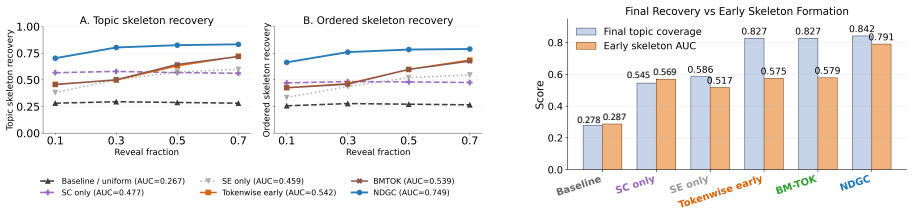
Noise level in diffusion language models sets token group size to enable early coarse commitment before token refinement.
A machine-rendered reading of the paper's core claim, the machinery that carries it, and where it could break.
Core claim
The paper introduces Noise Dependent Granularity Control (NDGC) that aligns training exposure and inference commitment with denoising progress by conditioning token-group size on noise level. At high noise, the method commits to coherent groups to support early meaning formation; at low noise it reverts to individual token refinement. This yields planning-like coarse-to-fine behavior in a single-level diffusion language model without hierarchical architecture or extra planners.
What carries the argument
Noise Dependent Granularity Control (NDGC), the mechanism that reads the current noise level to decide whether to operate on coherent token groups or single tokens during both training corruption and inference commitment.
If this is right
- Generation exhibits earlier skeleton formation during denoising.
- Recovery proceeds in more ordered fashion from coarse to fine.
- Outputs are healthier across controlled tests and WritingPrompts without added planners.
- A single model achieves coarse-to-fine behavior by reusing the existing noise schedule.
Where Pith is reading between the lines
- The same noise-conditioned granularity idea might extend to other diffusion-based sequence models beyond language.
- Noise schedules may carry latent information about appropriate processing scale that could be exploited in non-diffusion generators.
- If the approach holds, future work could test whether noise level alone suffices for multi-scale control in tasks requiring long-range coherence.
Load-bearing premise
Simply tying the size of token groups to the noise schedule in training and inference will produce coherent early structures without new inconsistencies or the need for architectural changes.
What would settle it
A controlled comparison in which NDGC-trained models show no earlier or more coherent skeleton formation than standard tokenwise diffusion at equivalent high-noise steps would falsify the central claim.
Figures


read the original abstract
Standard tokenwise diffusion LMs keep training corruption and inference commitment at token granularity throughout denoising. At high noise, this leaves scattered local fragments rather than coherent evidence, making it hard to form early coarse structure, exactly what planning-sensitive generation requires. Hierarchical planning methods add coarse stages to separate planning from wording, but they need extra planners, block latents, or two stage designs. We propose Noise Dependent Granularity Control (NDGC), a single-level diffusion method that uses the noise level as a granularity cue. NDGC aligns training exposure and inference commitment with denoising progress. High noise steps use coherent token groups to support early meaning commitment, while low noise steps return to token level refinement. This creates planning like coarse to fine denoising without an explicit planner or hierarchical architecture. Across controlled tests, ablations, and WritingPrompts, NDGC shows earlier skeleton formation, better ordered recovery, and healthier outputs.
Editorial analysis
A structured set of objections, weighed in public.
Referee Report
Summary. The paper claims that standard tokenwise diffusion LMs suffer from scattered local fragments at high noise, hindering early coarse structure formation needed for planning-sensitive generation. It proposes Noise Dependent Granularity Control (NDGC), a single-level method that conditions token-group granularity on the noise schedule: high-noise steps use coherent token groups for early meaning commitment, while low-noise steps revert to token-level refinement. This is said to produce planning-like coarse-to-fine denoising without explicit planners or hierarchical architectures. Experiments across controlled tests, ablations, and WritingPrompts reportedly demonstrate earlier skeleton formation, better ordered recovery, and healthier outputs.
Significance. If the empirical claims hold and the mechanism is shown to induce semantically coherent groups without additional inconsistencies, NDGC would offer a parameter-light way to align training exposure with inference commitment in diffusion LMs, potentially simplifying structured text generation relative to two-stage or hierarchical alternatives.
major comments (2)
- [Abstract] Abstract: the central claim that noise-conditioned groups produce coherent early commitment (rather than arbitrary fragments) is load-bearing, yet the abstract supplies no description of how groups are formed, selected, or ensured to be semantically coherent; if group formation is fixed or random, the training signal may not induce meaningful structure, directly undermining the 'no extra architecture' advantage.
- [Abstract] Abstract: no equations, implementation details for group-level corruption, quantitative results, error bars, or dataset statistics are provided, so the reported improvements in skeleton formation and ordered recovery cannot be evaluated for statistical or practical significance.
minor comments (1)
- [Abstract] Abstract: acronym NDGC is introduced before its expansion is given in the same sentence; consider spelling out on first use for clarity.
Simulated Author's Rebuttal
We thank the referee for the careful reading and constructive feedback. We address the two major comments on the abstract below and will prepare a revised version of the manuscript.
read point-by-point responses
-
Referee: [Abstract] Abstract: the central claim that noise-conditioned groups produce coherent early commitment (rather than arbitrary fragments) is load-bearing, yet the abstract supplies no description of how groups are formed, selected, or ensured to be semantically coherent; if group formation is fixed or random, the training signal may not induce meaningful structure, directly undermining the 'no extra architecture' advantage.
Authors: We agree that the abstract would be strengthened by a concise statement on group formation. NDGC determines group size from the noise level and selects contiguous token blocks that respect local semantic coherence via a noise-dependent partitioning rule (detailed in Section 3); this is not a fixed or random scheme but one that aligns training corruption with inference commitment. We will revise the abstract to include a brief clause describing this process. revision: yes
-
Referee: [Abstract] Abstract: no equations, implementation details for group-level corruption, quantitative results, error bars, or dataset statistics are provided, so the reported improvements in skeleton formation and ordered recovery cannot be evaluated for statistical or practical significance.
Authors: Abstract length constraints preclude equations, error bars, or full dataset statistics. We will nevertheless revise the abstract to add one sentence reporting the main quantitative gains (e.g., skeleton formation and ordered recovery metrics on WritingPrompts) together with a pointer to the full results, ablations, and implementation details in Sections 4–5. revision: partial
Circularity Check
No circularity detected; proposal is self-contained methodological description
full rationale
The provided abstract and context contain no equations, fitted parameters, self-citations, or derivation steps that reduce a claimed result to its own inputs by construction. NDGC is presented as a conditioning technique that ties granularity to the existing noise schedule, without any shown self-definitional loop, renamed prediction, or load-bearing uniqueness theorem. The central claim (coarse-to-fine behavior emerging from noise-conditioned groups) is an empirical hypothesis about training/inference alignment rather than a mathematical reduction. No load-bearing steps match any of the enumerated circularity patterns.
Axiom & Free-Parameter Ledger
Reference graph
Works this paper leans on
-
[1]
Advances in Neural Information Processing Systems , volume=
Simple and effective masked diffusion language models , author=. Advances in Neural Information Processing Systems , volume=
-
[2]
Discrete Diffusion Modeling by Estimating the Ratios of the Data Distribution
Discrete diffusion modeling by estimating the ratios of the data distribution , author=. arXiv preprint arXiv:2310.16834 , year=
work page internal anchor Pith review Pith/arXiv arXiv
-
[3]
Advances in neural information processing systems , volume=
Structured denoising diffusion models in discrete state-spaces , author=. Advances in neural information processing systems , volume=
-
[4]
Advances in neural information processing systems , volume=
Diffusion-lm improves controllable text generation , author=. Advances in neural information processing systems , volume=
-
[5]
Proceedings of the 61st annual meeting of the association for computational linguistics (volume 1: Long papers) , pages=
Diffusionbert: Improving generative masked language models with diffusion models , author=. Proceedings of the 61st annual meeting of the association for computational linguistics (volume 1: Long papers) , pages=
-
[6]
A reparameterized discrete diffusion model for text generation.arXiv preprint arXiv:2302.05737, 2023
A reparameterized discrete diffusion model for text generation , author=. arXiv preprint arXiv:2302.05737 , year=
-
[7]
Proceedings of the 2018 Conference on Empirical Methods in Natural Language Processing , pages=
Deterministic non-autoregressive neural sequence modeling by iterative refinement , author=. Proceedings of the 2018 Conference on Empirical Methods in Natural Language Processing , pages=
2018
-
[8]
Mask-predict: Parallel decoding of conditional masked language models , author=. Proceedings of the 2019 conference on empirical methods in natural language processing and the 9th international joint conference on natural language processing (EMNLP-IJCNLP) , pages=
2019
-
[9]
Proceedings of the workshop on methods for optimizing and evaluating neural language generation , pages=
BERT has a mouth, and it must speak: BERT as a Markov random field language model , author=. Proceedings of the workshop on methods for optimizing and evaluating neural language generation , pages=
-
[10]
International Conference on Machine Learning , pages=
Insertion transformer: Flexible sequence generation via insertion operations , author=. International Conference on Machine Learning , pages=. 2019 , organization=
2019
-
[11]
Advances in neural information processing systems , volume=
Levenshtein transformer , author=. Advances in neural information processing systems , volume=
-
[12]
Proceedings of the AAAI Conference on Artificial Intelligence , volume=
Plan-and-write: Towards better automatic storytelling , author=. Proceedings of the AAAI Conference on Artificial Intelligence , volume=
-
[13]
Proceedings of the 57th Annual Meeting of the Association for Computational Linguistics , pages=
Strategies for structuring story generation , author=. Proceedings of the 57th Annual Meeting of the Association for Computational Linguistics , pages=
-
[14]
Proceedings of the 2022 Conference on Empirical Methods in Natural Language Processing , pages=
Re3: Generating longer stories with recursive reprompting and revision , author=. Proceedings of the 2022 Conference on Empirical Methods in Natural Language Processing , pages=
2022
-
[15]
Proceedings of the 2020 Conference on Empirical Methods in Natural Language Processing (EMNLP) , pages=
Content planning for neural story generation with aristotelian rescoring , author=. Proceedings of the 2020 Conference on Empirical Methods in Natural Language Processing (EMNLP) , pages=
2020
-
[16]
International Conference on Learning Representations , volume=
Block diffusion: Interpolating between autoregressive and diffusion language models , author=. International Conference on Learning Representations , volume=
-
[17]
Proceedings of the 2025 Conference on Empirical Methods in Natural Language Processing , pages=
Flexible-length text infilling for discrete diffusion models , author=. Proceedings of the 2025 Conference on Empirical Methods in Natural Language Processing , pages=
2025
-
[18]
Proceedings of the 2025 Conference on Empirical Methods in Natural Language Processing , pages=
Reward-weighted sampling: Enhancing non-autoregressive characteristics in masked diffusion llms , author=. Proceedings of the 2025 Conference on Empirical Methods in Natural Language Processing , pages=
2025
-
[19]
Proceedings of the 2025 Conference on Empirical Methods in Natural Language Processing , pages=
Conditional [MASK] Discrete Diffusion Language Model , author=. Proceedings of the 2025 Conference on Empirical Methods in Natural Language Processing , pages=
2025
-
[20]
Proceedings of the 18th Conference of the European Chapter of the Association for Computational Linguistics (Volume 1: Long Papers) , pages=
Diffusion-nat: Self-prompting discrete diffusion for non-autoregressive text generation , author=. Proceedings of the 18th Conference of the European Chapter of the Association for Computational Linguistics (Volume 1: Long Papers) , pages=
-
[21]
Findings of the Association for Computational Linguistics: EMNLP 2023 , pages=
Diffuseq-v2: Bridging discrete and continuous text spaces for accelerated seq2seq diffusion models , author=. Findings of the Association for Computational Linguistics: EMNLP 2023 , pages=
2023
-
[22]
Proceedings of the 61st Annual Meeting of the Association for Computational Linguistics (Volume 1: Long Papers) , pages=
Ssd-lm: Semi-autoregressive simplex-based diffusion language model for text generation and modular control , author=. Proceedings of the 61st Annual Meeting of the Association for Computational Linguistics (Volume 1: Long Papers) , pages=
-
[23]
International Conference on Learning Representations , volume=
Scaling up masked diffusion models on text , author=. International Conference on Learning Representations , volume=
-
[24]
International Conference on Learning Representations , volume=
Scaling diffusion language models via adaptation from autoregressive models , author=. International Conference on Learning Representations , volume=
-
[25]
Advances in Neural Information Processing Systems , volume=
Large language diffusion models , author=. Advances in Neural Information Processing Systems , volume=
-
[26]
International Conference on Learning Representations , volume=
Beyond autoregression: Fast llms via self-distillation through time , author=. International Conference on Learning Representations , volume=
-
[27]
International Conference on Learning Representations , volume=
Beyond autoregression: Discrete diffusion for complex reasoning and planning , author=. International Conference on Learning Representations , volume=
-
[28]
International Conference on Learning Representations , volume=
Energy-based diffusion language models for text generation , author=. International Conference on Learning Representations , volume=
-
[29]
International Conference on Learning Representations , volume=
Masked diffusion models are secretly time-agnostic masked models and exploit inaccurate categorical sampling , author=. International Conference on Learning Representations , volume=
-
[30]
Advances in neural information processing systems , volume=
Simplified and generalized masked diffusion for discrete data , author=. Advances in neural information processing systems , volume=
-
[31]
International Conference on Learning Representations , volume=
Your absorbing discrete diffusion secretly models the conditional distributions of clean data , author=. International Conference on Learning Representations , volume=
-
[32]
International Conference on Learning Representations , volume=
Discrete copula diffusion , author=. International Conference on Learning Representations , volume=
-
[33]
Advances in Neural Information Processing Systems , volume=
Discrete flow matching , author=. Advances in Neural Information Processing Systems , volume=
-
[34]
Advances in Neural Information Processing Systems , volume=
Likelihood-based diffusion language models , author=. Advances in Neural Information Processing Systems , volume=
-
[35]
Diffusion of Thought: Chain-of-Thought Reasoning in Diffusion Language Models , booktitle =
Jiacheng Ye and Shansan Gong and Liheng Chen and Lin Zheng and Jiahui Gao and Han Shi and Chuan Wu and Xin Jiang and Zhenguo Li and Wei Bi and Lingpeng Kong , editor =. Diffusion of Thought: Chain-of-Thought Reasoning in Diffusion Language Models , booktitle =. 2024 , url =
2024
-
[36]
Do Huu Dat and Duc Anh Do and Anh Tuan Luu and Wray L. Buntine , editor =. Discrete Diffusion Language Model for Efficient Text Summarization , booktitle =. 2025 , url =. doi:10.18653/V1/2025.FINDINGS-NAACL.352 , timestamp =
-
[37]
Qianyue Wang and Jinwu Hu and Zhengping Li and Yufeng Wang and Daiyuan Li and Yu Hu and Mingkui Tan , editor =. Generating Long-form Story Using Dynamic Hierarchical Outlining with Memory-Enhancement , booktitle =. 2025 , url =. doi:10.18653/V1/2025.NAACL-LONG.63 , timestamp =
-
[38]
Yukyung Lee and Soonwon Ka and Bokyung Son and Pilsung Kang and Jaewook Kang , editor =. Navigating the Path of Writing: Outline-guided Text Generation with Large Language Models , booktitle =. 2025 , url =. doi:10.18653/V1/2025.NAACL-INDUSTRY.20 , timestamp =
-
[39]
Findings of the Association for Computational Linguistics,
Jiaming Li and Yukun Chen and Ziqiang Liu and Minghuan Tan and Lei Zhang and Yunshui Li and Run Luo and Longze Chen and Jing Luo and Ahmadreza Argha and Hamid Alinejad. Findings of the Association for Computational Linguistics,. 2025 , url =
2025
-
[40]
2025 , eprint=
Beyond Outlining: Heterogeneous Recursive Planning for Adaptive Long-form Writing with Language Models , author=. 2025 , eprint=
2025
-
[41]
arXiv preprint arXiv:2410.06203 , year=
Yi Liang and You Wu and Honglei Zhuang and Li Chen and Jiaming Shen and Yiling Jia and Zhen Qin and Sumit Sanghai and Xuanhui Wang and Carl Yang and Michael Bendersky , title =. CoRR , volume =. 2024 , url =. doi:10.48550/ARXIV.2410.06203 , eprinttype =. 2410.06203 , timestamp =
-
[42]
Ex3: Automatic Novel Writing by Extracting, Excelsior and Expanding , booktitle =
Huang Lei and Jiaming Guo and Guanhua He and Xishan Zhang and Rui Zhang and Shaohui Peng and Shaoli Liu and Tianshi Chen , editor =. Ex3: Automatic Novel Writing by Extracting, Excelsior and Expanding , booktitle =. 2024 , url =. doi:10.18653/V1/2024.ACL-LONG.494 , timestamp =
-
[43]
Riedl , editor =
Kaige Xie and Mark O. Riedl , editor =. Creating Suspenseful Stories: Iterative Planning with Large Language Models , booktitle =. 2024 , url =
2024
-
[44]
The Thirteenth International Conference on Learning Representations,
Fantine Huot and Reinald Kim Amplayo and Jennimaria Palomaki and Alice Shoshana Jakobovits and Elizabeth Clark and Mirella Lapata , title =. The Thirteenth International Conference on Learning Representations,. 2025 , url =
2025
-
[45]
Writing Like the Best: Exemplar-Based Expository Text Generation , booktitle =
Yuxiang Liu and Kevin Chen. Writing Like the Best: Exemplar-Based Expository Text Generation , booktitle =. 2025 , url =
2025
-
[46]
Segment-Level Diffusion:
Xiaochen Zhu and Georgi Karadzhov and Chenxi Whitehouse and Andreas Vlachos , editor =. Segment-Level Diffusion:. Proceedings of the 63rd Annual Meeting of the Association for Computational Linguistics (Volume 1: Long Papers),. 2025 , url =
2025
-
[47]
EdiText: Controllable Coarse-to-Fine Text Editing with Diffusion Language Models , booktitle =
Che Hyun Lee and Heeseung Kim and Jiheum Yeom and Sungroh Yoon , editor =. EdiText: Controllable Coarse-to-Fine Text Editing with Diffusion Language Models , booktitle =. 2025 , url =
2025
-
[48]
Addressing the Training-Inference Discrepancy in Discrete Diffusion for Text Generation , booktitle =
Masaki Asada and Makoto Miwa , editor =. Addressing the Training-Inference Discrepancy in Discrete Diffusion for Text Generation , booktitle =. 2025 , url =
2025
-
[49]
Think while You Generate: Discrete Diffusion with Planned Denoising , booktitle =
Sulin Liu and Juno Nam and Andrew Campbell and Hannes St. Think while You Generate: Discrete Diffusion with Planned Denoising , booktitle =. 2025 , url =
2025
-
[50]
Kakade and Sitan Chen , editor =
Jaeyeon Kim and Kulin Shah and Vasilis Kontonis and Sham M. Kakade and Sitan Chen , editor =. Train for the Worst, Plan for the Best: Understanding Token Ordering in Masked Diffusions , booktitle =. 2025 , url =
2025
-
[51]
Steering Masked Discrete Diffusion Models via Discrete Denoising Posterior Prediction , booktitle =
Jarrid Rector. Steering Masked Discrete Diffusion Models via Discrete Denoising Posterior Prediction , booktitle =. 2025 , url =
2025
-
[52]
Nikita Mounier and Parsa Idehpour , title =. CoRR , volume =. 2025 , url =. doi:10.48550/ARXIV.2507.08018 , eprinttype =. 2507.08018 , timestamp =
-
[53]
Susskind and Navdeep Jaitly , editor =
Ruixiang Zhang and Shuangfei Zhai and Yizhe Zhang and James Thornton and Zijing Ou and Joshua M. Susskind and Navdeep Jaitly , editor =. Target Concrete Score Matching:. Forty-second International Conference on Machine Learning,. 2025 , url =
2025
-
[54]
Generalized Interpolating Discrete Diffusion , booktitle =
Dimitri von R. Generalized Interpolating Discrete Diffusion , booktitle =. 2025 , url =
2025
-
[55]
Jaakkola and Sergey Levine and Aviv Regev and Hanchen Wang and Tommaso Biancalani , title =
Chenyu Wang and Masatoshi Uehara and Yichun He and Amy Wang and Avantika Lal and Tommi S. Jaakkola and Sergey Levine and Aviv Regev and Hanchen Wang and Tommaso Biancalani , title =. The Thirteenth International Conference on Learning Representations,. 2025 , url =
2025
-
[56]
Proceedings of the 56th Annual Meeting of the Association for Computational Linguistics , pages =
Hierarchical Neural Story Generation , author =. Proceedings of the 56th Annual Meeting of the Association for Computational Linguistics , pages =
-
[57]
Lin, Chin-Yew , booktitle =
-
[58]
Proceedings of the 42nd Annual Meeting of the Association for Computational Linguistics , pages =
Automatic Evaluation of Machine Translation Quality Using Longest Common Subsequence and Skip-Bigram Statistics , author =. Proceedings of the 42nd Annual Meeting of the Association for Computational Linguistics , pages =. 2004 , doi =
2004
-
[59]
Proceedings of the 2016 Conference of the North American Chapter of the Association for Computational Linguistics: Human Language Technologies , pages =
A Diversity-Promoting Objective Function for Neural Conversation Models , author =. Proceedings of the 2016 Conference of the North American Chapter of the Association for Computational Linguistics: Human Language Technologies , pages =
2016
-
[60]
Proceedings of the 60th Annual Meeting of the Association for Computational Linguistics: Short Papers , pages =
Rethinking and Refining the Distinct Metric , author =. Proceedings of the 60th Annual Meeting of the Association for Computational Linguistics: Short Papers , pages =
-
[61]
International Conference on Learning Representations , year =
The Curious Case of Neural Text Degeneration , author =. International Conference on Learning Representations , year =
-
[62]
International Conference on Learning Representations , year =
Neural Text Generation with Unlikelihood Training , author =. International Conference on Learning Representations , year =
-
[63]
Sentence-
Reimers, Nils and Gurevych, Iryna , booktitle =. Sentence-
-
[64]
and Artzi, Yoav , booktitle =
Zhang, Tianyi and Kishore, Varsha and Wu, Felix and Weinberger, Kilian Q. and Artzi, Yoav , booktitle =
-
[65]
Computational Linguistics , volume =
Modeling Local Coherence: An Entity-Based Approach , author =. Computational Linguistics , volume =
-
[66]
Advances in Neural Information Processing Systems , volume=
MiniLM: Deep Self-Attention Distillation for Task-Agnostic Compression of Pre-Trained Transformers , author=. Advances in Neural Information Processing Systems , volume=
discussion (0)
Sign in with ORCID, Apple, or X to comment. Anyone can read and Pith papers without signing in.