When to Skip Syndrome Extraction in Surface-GKP Codes
Pith reviewed 2026-06-26 00:10 UTC · model grok-4.3
The pith
An adaptive skipping scheme for surface-GKP codes reduces stabilizer measurements while keeping logical error rates comparable or lower than always measuring.
A machine-rendered reading of the paper's core claim, the machinery that carries it, and where it could break.
Core claim
The paper establishes that an adaptive scheme selecting among four actions—measuring both Z and X stabilizers, measuring only one type, or skipping both—based on a reliability comparison from GKP analog information, reduces the number of surface-code stabilizer measurements while achieving logical error rates comparable to or lower than those of the full-measurement baseline in circuit-level simulations; the improvement is most pronounced when gate and measurement noise are larger than idle noise.
What carries the argument
The reliability comparison metric from GKP analog information that decides whether to perform new syndrome extraction or reuse the previous value.
If this is right
- The total number of surface-code stabilizer measurements decreases without raising logical error rates.
- The benefit grows when gate and measurement noise exceed idle noise because skipped extractions avoid injecting extra errors.
- Analog information from inner GKP correction serves to lower outer-code measurement overhead in addition to aiding decoding.
- Skipping unnecessary extractions directly reduces noise injected into the data qubits.
Where Pith is reading between the lines
- The same reliability-based decision rule could be tested in other concatenated bosonic codes that supply analog information.
- Resource estimates for large-scale GKP-based architectures would decrease if the skipping rate observed in simulation holds at scale.
- The four-action decision space could be extended to include partial measurements on individual stabilizers when the reliability metric permits.
Load-bearing premise
The reliability metric derived from GKP analog information accurately predicts whether reusing a prior syndrome will produce lower total error than performing a new noisy extraction.
What would settle it
A circuit-level simulation under the same noise model in which applying the adaptive decision rule produces higher logical error rates than the full-measurement baseline.
Figures





read the original abstract
Fault-tolerant quantum error correction requires repeated syndrome extraction to address errors induced by the syndrome-extraction circuit itself. However, repeated syndrome extraction incurs significant overhead in terms of gate count and ancilla consumption (e.g., Gottesman-Kitaev-Preskill (GKP) states). Moreover, noisy syndrome extraction can itself inject additional errors into the data qubits. To address these issues, we propose a concrete adaptive skipping scheme for the surface-GKP code, a representative GKP-concatenated architecture, that uses analog information naturally generated during inner GKP correction. At each round, the scheme selects one of four actions: measuring both Z-type and X-type surface-code stabilizers, measuring only one type, or skipping both types and reusing previous syndromes. The decision is based on a reliability comparison between reusing the previous syndrome value and performing a new noisy syndrome extraction. Using circuit-level simulations, we show that the adaptive skipping scheme can reduce the number of surface-code stabilizer measurements while maintaining logical error rates comparable to or lower than those of the full-measurement baseline. The improvement is most pronounced when gate and measurement noise are larger than idle noise, so that avoiding unnecessary syndrome extraction reduces the noise injected into the code. These results indicate that analog information from inner GKP correction can be used not only to improve decoding but also to reduce the measurement overhead of outer-code syndrome extraction.
Editorial analysis
A structured set of objections, weighed in public.
Referee Report
Summary. The manuscript proposes an adaptive four-action scheme for syndrome extraction in the surface-GKP code that uses analog information from inner GKP correction to decide at each round whether to measure both Z- and X-type surface-code stabilizers, only one type, or skip both and reuse prior syndromes. The decision rests on a reliability comparison between reusing the previous syndrome and performing a new noisy extraction. Circuit-level simulations are reported to show that the scheme reduces the number of stabilizer measurements while achieving logical error rates comparable to or lower than the full-measurement baseline, with the largest gains when gate and measurement noise exceed idle noise.
Significance. If the central simulation results hold under reproducible conditions, the work demonstrates a concrete way to reduce measurement overhead in concatenated GKP-surface architectures by exploiting analog information for adaptive decisions rather than solely for decoding. This is a targeted but potentially useful contribution to resource-efficient fault tolerance, particularly under noise hierarchies where extraction itself is a dominant error source. The simulation evidence for overhead reduction is a positive element, though its strength depends on the missing validation details noted below.
major comments (2)
- [§4 (decision rule and simulation results)] The central claim (abstract and §4) requires that the GKP-derived reliability metric correctly identifies rounds where skipping yields lower or equal logical error than fresh extraction. No direct validation—such as a correlation plot, confusion matrix, or per-round comparison of metric output versus simulated error-rate delta (skip vs. extract)—is provided across the tested noise models. Without this, the reported gains cannot be confidently attributed to the metric rather than decoder behavior or parameter choice.
- [§5 (circuit-level simulations)] Simulation methods (§5): circuit-level noise models, exact gate/measurement/idle error rates, decoder implementation, and the procedure for setting the reliability threshold are not specified in sufficient detail to reproduce the reported error-rate comparisons or to exclude post-hoc selection effects. This directly affects verifiability of the claim that skipping maintains or improves logical error rates.
minor comments (2)
- [Figures 3–5] Figure captions and axis labels in the simulation result plots should explicitly state the noise parameter values and the number of Monte Carlo shots used for each data point.
- [Table 1] The four-action decision table (Table 1) would benefit from an additional column showing the logical-error delta that the reliability metric is intended to predict for each action pair.
Simulated Author's Rebuttal
We thank the referee for the detailed and constructive report. The two major comments correctly identify gaps in validation and reproducibility that limit the strength of the central claims. We address each point below and will incorporate revisions to strengthen the manuscript.
read point-by-point responses
-
Referee: [§4 (decision rule and simulation results)] The central claim (abstract and §4) requires that the GKP-derived reliability metric correctly identifies rounds where skipping yields lower or equal logical error than fresh extraction. No direct validation—such as a correlation plot, confusion matrix, or per-round comparison of metric output versus simulated error-rate delta (skip vs. extract)—is provided across the tested noise models. Without this, the reported gains cannot be confidently attributed to the metric rather than decoder behavior or parameter choice.
Authors: We agree that the manuscript does not contain direct validation of the reliability metric (e.g., correlation plots or per-round error-rate delta comparisons). The reported gains are shown only through aggregate logical error rates under the adaptive policy versus the baseline. While these aggregate results are consistent with the metric functioning as intended, they do not isolate its predictive accuracy from other factors. In the revision we will add the requested per-round analysis and correlation plots for the noise models already simulated, allowing readers to assess how well the metric identifies beneficial skip rounds. revision: yes
-
Referee: [§5 (circuit-level simulations)] Simulation methods (§5): circuit-level noise models, exact gate/measurement/idle error rates, decoder implementation, and the procedure for setting the reliability threshold are not specified in sufficient detail to reproduce the reported error-rate comparisons or to exclude post-hoc selection effects. This directly affects verifiability of the claim that skipping maintains or improves logical error rates.
Authors: The referee is correct that §5 currently lacks the level of detail needed for independent reproduction. The manuscript states the qualitative noise hierarchy and the existence of a reliability threshold but does not list the precise Pauli error rates, the exact circuit noise model (e.g., depolarizing vs. amplitude-damping), the decoder (minimum-weight matching parameters, etc.), or the numerical procedure used to choose the threshold. We will expand §5 with these specifications, including the exact parameter values employed in all reported simulations and the method for threshold selection, so that the results can be reproduced and post-hoc selection concerns can be evaluated. revision: yes
Circularity Check
No significant circularity; claims rest on circuit-level simulations without self-referential reduction
full rationale
The paper proposes an adaptive skipping scheme whose decision rule uses a reliability comparison derived from GKP analog information. All reported performance gains are obtained from circuit-level simulations that directly compare the adaptive scheme against a full-measurement baseline under varied noise models. No equations, fitted parameters, or self-citations are presented that would make any prediction equivalent to its inputs by construction. The reliability metric is introduced as an independent quantity extracted from inner GKP correction; its use in the four-action decision rule does not reduce the simulated logical-error outcomes to a tautology. This is the expected non-finding for a simulation-supported engineering proposal.
Axiom & Free-Parameter Ledger
Reference graph
Works this paper leans on
-
[1]
Our circuit-level noise model follows Ref
Adaptive surface-GKP syndrome-extraction round In this section, we describe the simulation procedure for one adaptive surface-GKP syndrome-extraction round. Our circuit-level noise model follows Ref. [30], except for twochanges. First, weintroduceanindependentidle-noise parameter σidle. This allows the relative strength of idle and circuit noise to be var...
-
[2]
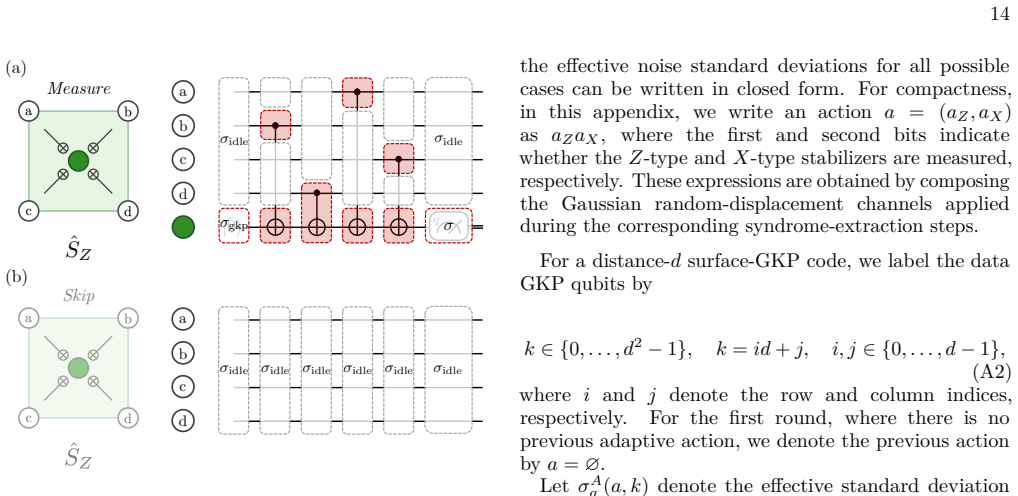
Noise channel tracking Since the proposed adaptive skipping scheme is restricted to four global actions, a∈{00,10,01,11}={skip,z_only,x_only,both}, (A1) the effective noise standard deviations for all possible cases can be written in closed form. For compactness, in this appendix, we write an action a = ( aZ,aX) as aZaX, where the first and second bits in...
2021
-
[3]
From this syndrome history, we construct three-dimensional syndrome graphs and the corresponding decoding graphs as follows
Decoding After T noisy syndrome-extraction rounds and one final noiseless data-qubit readout, we obtain a syndrome history consisting ofT + 1rounds. From this syndrome history, we construct three-dimensional syndrome graphs and the corresponding decoding graphs as follows. The nodes of the decoding graph correspond to detection events in the syndrome grap...
-
[4]
IVB, we fixed the idle-noise variance to2σ2 idle = σ2, so that idle noise is smaller than circuit noise
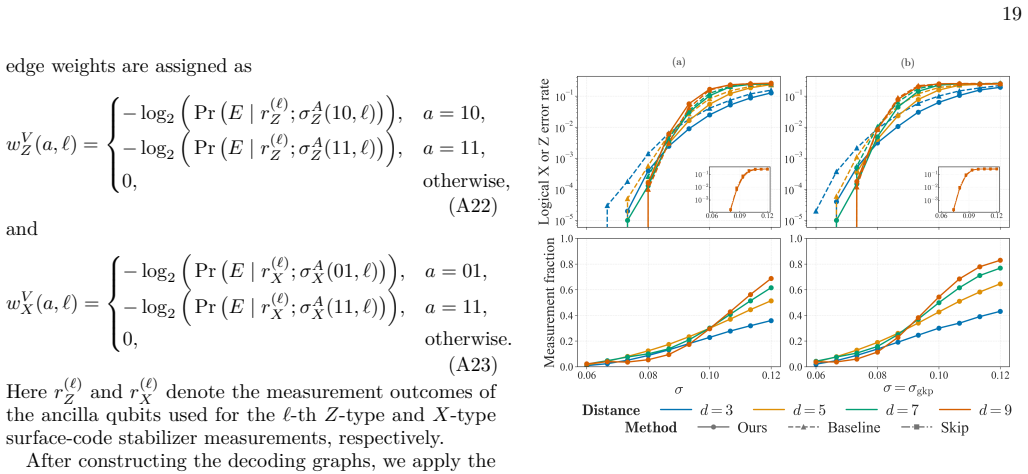
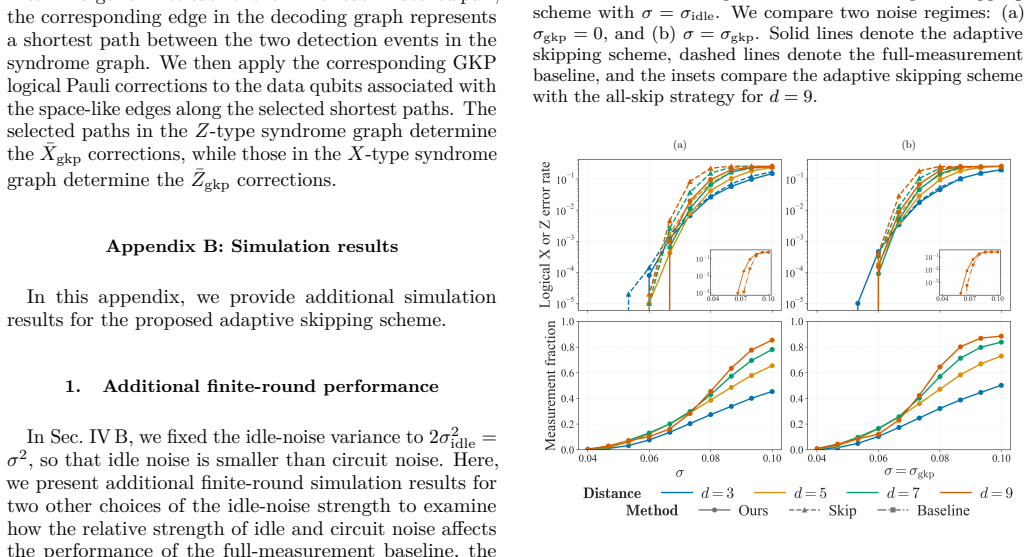
Additional finite-round performance In Sec. IVB, we fixed the idle-noise variance to2σ2 idle = σ2, so that idle noise is smaller than circuit noise. Here, we present additional finite-round simulation results for two other choices of the idle-noise strength to examine how the relative strength of idle and circuit noise affects the performance of the full-...
-
[5]
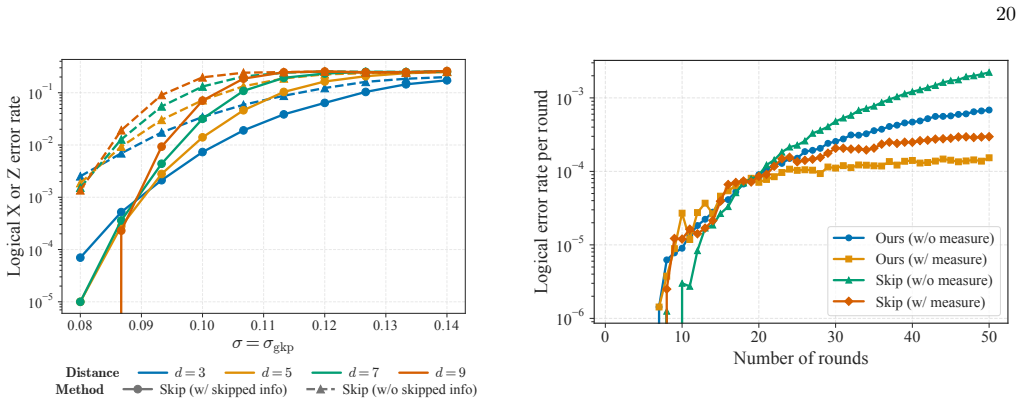
Long-time behavior without periodic measurement Next, we consider the role of periodic full-syndrome extraction in long-time simulations. Figure 14 shows the logical error rate per round for the all-skip strategy and the adaptive skipping scheme at distanced = 7, both with and without periodic full syndrome extraction. Without periodicfullsyndromeextracti...
-
[6]
P. W. Shor, inProceedings 35th annual symposium on foundations of computer science(Ieee, 1994) pp. 124–134
1994
-
[7]
P. W. Shor, SIAM review41, 303 (1999)
1999
-
[8]
L. K. Grover, inProceedings of the twenty-eighth annual ACM symposium on Theory of computing(1996) pp. 212– 219
1996
-
[9]
R. P. Feynman, International Journal of Theoretical Physics21(1982)
1982
-
[10]
Lloyd, Science273, 1073 (1996)
S. Lloyd, Science273, 1073 (1996)
1996
-
[11]
Putterman, K
H. Putterman, K. Noh, C. T. Hann, G. S. MacCabe, S. Aghaeimeibodi, R. N. Patel, M. Lee, W. M. Jones, H. Moradinejad, R. Rodriguez,et al., Nature638, 927 (2025)
2025
-
[12]
B. W. Reichardt, A. Paetznick, D. Aasen, I. Basov, J. M. Bello-Rivas, P. Bonderson, R. Chao, W. van Dam, M. B. Hastings, R. V. Mishmash,et al., arXiv preprint arXiv:2411.11822 (2024)
work page internal anchor Pith review Pith/arXiv arXiv 2024
-
[13]
Google Quantum AI and Collaborators, Nature638, 920 (2025)
2025
-
[14]
Bluvstein, S
D. Bluvstein, S. J. Evered, A. A. Geim, S. H. Li, H. Zhou, T. Manovitz, S. Ebadi, M. Cain, M. Kalinowski, D. Hangleiter,et al., Nature626, 58 (2024)
2024
-
[15]
Demonstration of logical qubits and repeated error correction with better-than-physical error rates
A. Paetznick, M. Da Silva, C. Ryan-Anderson, J. Bello- Rivas, J. Campora III, A. Chernoguzov, J. Dreiling, C. Foltz, F. Frachon, J. Gaebler,et al., arXiv preprint arXiv:2404.02280 (2024)
work page internal anchor Pith review Pith/arXiv arXiv 2024
-
[16]
V. G. Matsos, C. H. Valahu, T. Navickas, A. D. Rao, M. J. Millican, X. C. Kolesnikow, M. J. Biercuk, and T. R. Tan, Physical Review Letters133, 050602 (2024)
2024
- [17]
-
[18]
Sundaresan, T
N. Sundaresan, T. J. Yoder, Y. Kim, M. Li, E. H. Chen, G. Harper, T. Thorbeck, A. W. Cross, A. D. Córcoles, and M. Takita, Nature Communications14, 2852 (2023)
2023
-
[19]
V. V. Sivak, A. Eickbusch, B. Royer, S. Singh, I. Tsioutsios, S. Ganjam, A. Miano, B. L. Brock, A. Z. Ding, L. Frunzio,et al., Nature616, 50 (2023)
2023
-
[20]
Krinner, N
S. Krinner, N. Lacroix, A. Remm, A. Di Paolo, E. Genois, C. Leroux, C. Hellings, S. Lazar, F. Swiadek, J. Herrmann, et al., Nature605, 669 (2022)
2022
-
[21]
A. O. Quintavalle, M. Vasmer, J. Roffe, and E. T. Campbell, PRX Quantum2, 020340 (2021)
2021
-
[22]
Bombín, Physical Review X5, 031043 (2015)
H. Bombín, Physical Review X5, 031043 (2015)
2015
-
[23]
Chao and B
R. Chao and B. W. Reichardt, PRX Quantum1, 010302 (2020)
2020
-
[24]
Chao and B
R. Chao and B. W. Reichardt, Physical review letters 121, 050502 (2018)
2018
-
[25]
Lachance-Quirion, M.-A
D. Lachance-Quirion, M.-A. Lemonde, J. O. Simoneau, L. St-Jean, P. Lemieux, S. Turcotte, W. Wright, A. Lacroix, J. Fréchette-Viens, R. Shillito,et al., Physical Review Letters132, 150607 (2024)
2024
-
[26]
Zeng, Z.-Y
Y. Zeng, Z.-Y. Zhou, E. Rinaldi, C. Gneiting, and F. Nori, Physical Review Letters131, 050601 (2023)
2023
-
[27]
Berthusen, S
N. Berthusen, S. J. S. Tan, E. Huang, and D. Gottesman, PRX Quantum6, 030307 (2025)
2025
- [28]
-
[29]
Liou and C.-Y
P.-H. Liou and C.-Y. Lai, IEEE Transactions on Quantum Engineering (2025)
2025
-
[30]
Tansuwannont, B
T. Tansuwannont, B. Pato, and K. R. Brown, Quantum 7, 1075 (2023)
2023
-
[31]
S. Bhambay, P. Murali, N. Walton, and T. Vasantam, arXiv preprint arXiv:2602.16929 (2026)
-
[32]
Boundary-Aware Stabilizer Scheduling for Distributed Quantum Error Correction
S. Gupta, S. Bhambay, N. Alavisamani, N. Walton, and T. Vasantam, arXiv preprint arXiv:2604.22471 (2026)
work page internal anchor Pith review Pith/arXiv arXiv 2026
-
[33]
Fukui, A
K. Fukui, A. Tomita, and A. Okamoto, Physical review letters119, 180507 (2017)
2017
-
[34]
Fukui, A
K. Fukui, A. Tomita, A. Okamoto, and K. Fujii, Physical review X8, 021054 (2018)
2018
-
[35]
Noh and C
K. Noh and C. Chamberland, Physical Review A101, 012316 (2020)
2020
-
[36]
Berent, T
L. Berent, T. Hillmann, J. Eisert, R. Wille, and J. Roffe, PRX Quantum5, 020349 (2024)
2024
-
[37]
A. L. Grimsmo and S. Puri, PRX Quantum2, 020101 (2021)
2021
-
[38]
Hillmann, arXiv preprint arXiv:2512.15063 (2025)
T. Hillmann, arXiv preprint arXiv:2512.15063 (2025)
-
[39]
Matsuura, H
T. Matsuura, H. Yamasaki, and M. Koashi, Physical Review A102, 032408 (2020)
2020
-
[40]
Gottesman,Stabilizer codes and quantum error correction(California Institute of Technology, 1997)
D. Gottesman,Stabilizer codes and quantum error correction(California Institute of Technology, 1997)
1997
-
[41]
Tomita and K
Y. Tomita and K. M. Svore, Physical Review A90, 062320 (2014)
2014
-
[42]
Bombín and M
H. Bombín and M. A. Martin-Delgado, Physical Review A—Atomic, Molecular, and Optical Physics76, 012305 (2007)
2007
-
[43]
deMarti iOlius, P
A. deMarti iOlius, P. Fuentes, R. Orús, P. M. Crespo, and J. E. Martinez, Quantum8, 1498 (2024)
2024
-
[44]
A. G. Fowler, Quantum Information & Computation15, 145 (2015)
2015
-
[45]
Edmonds, Canadian Journal of mathematics17, 449 (1965)
J. Edmonds, Canadian Journal of mathematics17, 449 (1965)
1965
discussion (0)
Sign in with ORCID, Apple, or X to comment. Anyone can read and Pith papers without signing in.