REVIEW 5 major objections 4 minor 22 references
Microscopic description of the fission process including intrinsic excitations. Part II: 240Pu excited and asymmetric fission paths within the Schrodinger Collective
T0 review · 5 major / 4 minor · reviewed 2026-08-10 · deepseek-v4-flash
Pith's one-line read Continuous Deflation gives the SCIM excited paths that replace failing two-quasiparticle states.
desk verdict Continuous Deflation is a genuine methodological advance honestly presented, but 'SCIM-ready' remains a promise for Part III: the paper's own kernels need smoothing and one state shows a 77% Hamiltonian-kernel deviation affecting the inertia tensor. read the letter →
The pith
A machine-rendered reading of the paper's core claim, the machinery that carries it, and where it could break.
The reading
What carries the argument
The central object is the Continuous Deflation algorithm, an iterative constrained HFB minimization. It augments the energy functional with orthogonality penalty terms and two constraints: a vanishing overlap between the excited state and the adiabatic reference in a selected $(\tau,\Omega)$ subspace, and a fixed overlap $x_0=0.995$ between consecutive excited states so that the excited path shares the adiabatic path's collective coordinate. A mixed constraint strategy imposes orthogonality in one isospin subspace while constraining the complementary isospin overlap to unity, which indirectly locks the excited state's shape to the adiabatic deformation. This machinery produces ten continuous paths whose overlaps with the adiabatic reference average about $5\times10^{-4}$.
What would settle it
Run the same Continuous Deflation construction in a nucleus with a strongly non-uniform neutron-to-proton ratio and check whether the quadrupole, octupole, and hexadecapole moments of the excited path stay locked to the adiabatic ones; if they drift, the mixed constraint strategy fails and the shared collective coordinate is lost.
Extended reading notes
Core claim
The central claim is that Continuous Deflation provides the class of excited intrinsic states the SCIM framework needs: continuous, regular HFB vacua that stay nearly orthogonal to the adiabatic path while preserving collective deformation. The paper first argues that 2QP states cannot do this job, even after particle-number projection, because projection leaves a large, oscillating overlap with the adiabatic state and because avoided crossings reshuffle quasiparticle content. It then constructs ten deflated paths for $^{240}$Pu, one per $(\tau,\Omega)$ block with $\Omega$ from $1/2$ to $9/2$, seeded at the saddle point and propagated through scission, enforcing a fixed overlap $x_0=0.995$ between neighboring states. The resulting excited states are dominated by low-order quasiparticle content, show kernel regularity comparable to the adiabatic set, and yield fragment distributions that are broader than the adiabatic ones, with reduced proton odd-even staggering.
Load-bearing premise
The method banks on the assumption that the excited state's shape will follow the adiabatic path if the unconstrained proton/neutron part is pinned to match the reference state, an indirect shortcut that only works because neutrons and protons are distributed fairly uniformly relative to each other in nuclei.
Editorial extensions
If this is right
- The ten $^{240}$Pu excited paths are ready to serve as SCIM building blocks, adding pair-breaking intrinsic excitations to fission dynamics without double counting the adiabatic state.
- Fragment neutron distributions from the excited paths are broader than the adiabatic TDGCM ones and carry odd components, correcting the known overly narrow adiabatic yields.
- Proton variational excitations suppress the adiabatic odd-even staggering in charge yields, bringing calculated fragment distributions closer to experimental charge yields.
- Neutron variational excitations systematically delay fragment separation near scission, which is expected to affect the predicted total kinetic energy and pre-scission neutron emission.
- The adopted overlap prescription for singular Hamiltonian kernels needs only diagonal matrix elements, lowering the cost of multi-excitation SCIM calculations.
Reading between the lines
- Inference: the same mixed-constraint construction could be stress-tested in a very neutron-rich isotope; this would reveal whether the uniform neutron-to-proton ratio assumption is a general basis for the method or a $^{240}$Pu-specific convenience.
- Inference: the empirical lower bound $\sigma^{(4)} \ge \sqrt{\sigma^{(2)}(1-\sigma^{(2)})}$ reported here may be a structural identity of deflated HFB vacua; testing it on a second nucleus would show whether it is a useful invariant or a numerical coincidence.
- Inference: the division of excitations into neck-coupled and pre-fragment-localized classes suggests a practical selection rule for dynamics: states with stable $\sigma^{(2)}$ and $\sigma^{(4)}$ through scission may be the ones to retain in reduced dynamical models.
- Inference: one could use the fragment particle-number distributions of the excited paths as direct inputs to a statistical scission model, turning the observed broadening into a quantitative prediction for measured yield widths.
Editorial analysis
A structured set of objections, weighed in public.
Referee Report
Summary. This manuscript presents the "Continuous Deflation" method for constructing excited intrinsic states, expressed as HFB vacua, along a fission path, with the aim of providing building blocks for the Schrödinger Collective-Intrinsic Model (SCIM). The authors first argue that conventional 2QP excitations, even with particle-number projection, fail because of particle-number fluctuations and level repulsions. They then construct ten excited paths on top of the asymmetric 240Pu fission path, analyze their quasiparticle content, overlap and Hamiltonian kernel regularity, and study scission-region fragment properties such as chemical potentials, neutron necking, and fragment number distributions. The central claim is that the resulting states provide a sufficiently clear separation from the adiabatic states and satisfy the continuity and regularity requirements of SCIM.
Significance. If fully established, the method would address a recognized difficulty in collective fission modeling, namely the inclusion of pair-breaking excitations in a formalism that is compatible with the GCM/SCIM framework. The paper provides a transparent demonstration of the failures of 2QP excitations, a detailed microscopic characterization of the new excited states, and a systematic comparison of fragment observables. The reported computational cost (about 10 hours for a 700-state path on one core) is useful for practical assessment. However, the central suitability claim is weakened by the manuscript's own admissions about kernel regularity, as detailed in the major comments.
major comments (5)
- [IV.B.2, Fig. 23] The reported 77% relative deviation in the Hamiltonian kernel for the neutron Ω=5/2 excitation at q̄≈270 and |s|>13, which the authors state has a non-negligible impact on the inertia tensor, is a direct counterexample to the abstract's claim that Continuous Deflation generates 'regular' excited paths. Because the inertia tensor is a central input to the SCIM dynamical equations, this exception cannot be dismissed as a harmless large-|s| artifact; the paper must either resolve the anomaly or explicitly qualify the claim of regularity.
- [IV.B.1] The statement that the overlap kernels still require Savitzky–Golay low-pass filtering in Part III before V_SCIM, D_SCIM, and B_SCIM can be reliably extracted means that the raw kernels are not sufficiently regular for SCIM as constructed. This is an internal admission that contradicts the abstract's characterization of the excited paths as regular. The paper should either demonstrate that the filtering is a benign numerical step whose effect on the dynamics is negligible, or revise the central claim.
- [IV.B.3, Eq. (18)] The overlap prescription, which replaces off-diagonal Hamiltonian kernels by a weighted overlap, is adopted after testing on only two cases, and the authors explicitly defer a systematic accuracy assessment to future work. Since these kernels enter the SCIM generator-coordinate equations, a prescription whose accuracy is unquantified leaves the suitability claim insufficiently supported. A quantitative validation, for example by comparing the corrected kernels with a high-precision evaluation in non-divergent regions, is needed.
- [III.B] The mixed constraint strategy, which imposes orthogonality in one isospin subspace and constrains the complementary-isospin overlap to unity, is justified by the assumed uniformity of the neutron-to-proton ratio and is only illustrated for one neutron excitation (Fig. 7). The paper should show, for all ten excited paths and in particular for the proton excitations, that the multipole moments track the adiabatic path; otherwise the existence of the shared collective coordinate required by SCIM is not guaranteed.
- [III.B] The claim of a 'sufficiently clear separation' between adiabatic and excited states is based on average overlaps of about 5×10^-4, but individual overlaps reach about 10^-2 for the Ω=1/2, 3/2, and 5/2 excitations. The paper provides no quantitative criterion for how small these overlaps must be for SCIM to avoid double counting; without such a criterion, the assertion is not fully supported.
minor comments (4)
- [III.B] Typo: 'Extensions of the algorithm are planed' should read 'planned'.
- [V] Typo: 'we detail le behavior' should read 'we detail the behavior'.
- [IV.B.3, Eqs. (19)-(20)] The notation δs≠0 and δs=0 in Eqs. (19) and (20) is ambiguous; please specify that these are Kronecker deltas on the discretized relative coordinate.
- [IV.A.1, Eqs. (10)-(11)] The definitions of σ(2) and σ(4) depend on quasiparticle operators ξ+ and ξ̄+, but the relationship between the HFB vacuum of the excited state and the quasiparticle vacuum of the adiabatic state is not explicitly stated; a brief sentence would improve reproducibility.
Circularity Check
No significant circularity; the Continuous Deflation construction is self-contained and fragment observables are not fitted inputs.
full rationale
The paper's derivation chain is self-contained. The Continuous Deflation method generates excited HFB vacua by minimizing the HFB energy under orthogonality constraints (Eq. 8), a continuity constraint ⟨D_i|D_{i+1}⟩=x0 with x0=0.995 chosen to match the adiabatic overlap, and a mixed isospin constraint. The fragment properties in Section V (chemical potentials, neutron necking, particle-number distributions) are computed from these variational states and compared with adiabatic results and experiment; they are not used as inputs to the construction. The parameters x0, ε, and the overlap prescription of Eq. (18) are numerical/algorithmic choices, not fitted to the predicted observables. Eq. (15) is reported as an empirical observation, not imposed. The paper's reliance on the authors' earlier Link/Drop and SCIM works is methodological continuity rather than circular support: the suitability of the excited states as SCIM building blocks is tested in Section IV via overlap and Hamiltonian kernels. The paper itself flags limitations—Section IV.B.1 states that remaining overlap-kernel variations are 'too large to allow for a well-defined extraction' of V_SCIM, D_SCIM, and B_SCIM without Savitzky–Golay filtering, and Section IV.B.3 reports residual off-diagonal Hamiltonian-kernel divergences with 'a more systematic assessment of its accuracy ... deferred to future work.' Section IV.B.2 reports a 77% deviation in ΔH_ii for the neutron Ω=5/2 excitation with 'non-negligible impact on the dynamics, in particular on the inertia tensor.' These are unresolved validity/regularity concerns, not circular reductions: no equation in the paper is equivalent to its own input by construction, and no fitted parameter is renamed as a prediction. Accordingly, the circularity score is 0.
Assumptions & free parameters
free parameters (3)
- x0 (overlap continuity parameter) =
0.995
- Seed state for Continuous Deflation =
saddle point at Q20 = 4230 fm^2
- epsilon (threshold prescription cutoff) =
5e-3
assumptions (4)
- domain assumption HFB theory provides a valid variational space for fission states.
- domain assumption The SCIM requires excited states to be orthogonal to the adiabatic states to avoid double counting.
- ad hoc to paper The overlap with the complementary isospin subspace constrained to unity indirectly fixes the shape of the excited state.
- domain assumption The adiabatic-level approximation for Hamiltonian kernels is a valid regularity test.
Cite this review
Pith. "Pith review of Microscopic description of the fission process including intrinsic excitations. Part II: 240Pu excited and asymmetric fission paths within the Schrodinger Collective." pith.science (2026). https://pith.science/paper/IOETOEYR
@misc{pith2026260807131,
  author       = {Pith},
  title        = {Pith review of: Microscopic description of the fission process including intrinsic excitations. Part II: 240Pu excited and asymmetric fission paths within the Schrodinger Collective},
  year         = {2026},
  howpublished = {\url{https://pith.science/paper/IOETOEYR}},
  note         = {Machine review of arXiv:2608.07131}
}
read the original abstract
This second article of the trilogy presents the implementation of a third protocol, referred to as Continuous Deflation, designed to construct continuous and regular excited paths within the Schrodinger Collective-Intrinsic Model (SCIM), with applications to nuclear fission. We show that the use of standard 2QP excitations, even when combined with particle-number projection, prevents a consistent application of the SCIM framework. Motivated by the central role of pair breaking in low-energy fission, we explore how to construct intrinsic excited states that incorporate this mechanism while satisfying the continuity and regularity state requirements of the SCIM. To this end, we first analyze the Deflation procedure alone, which constructs excited states through orthogonality constraints. We then extend this construction along a deformation path by introducing an additional continuity constraint, thereby defining the Continuous Deflation method, which generates continuous paths based on excited states. In particular, we construct ten such continuous paths built on top of the adiabatic and asymmetric fission path of 240Pu. The resulting excited states are systematically analyzed in terms of their microscopic structure. We then investigate several fragment properties near scission, including neutron and proton chemical potentials, neutron necking as well as fragment particle-number distributions, and compare them with their adiabatic counterparts.
Figures


Figures from the paper (26 more)








Reference graph
Works this paper leans on
-
[1]
Microscopic “Deflation” study in the 16O nucleus It is instructive to illustrate the microscopic action of the Deflation method on the simple case of the dou- bly magic nucleus 16O. At the HFB level, the ground state of the 16O nucleus is spherical and does not ex- hibit pairing correlations. Consequently, the canonical basis is characterized by occupatio...
-
[2]
“Deflation” spectrum in the 240Pu nucleus An example of the “Deflation” procedure applied to generate several excited states in240Pu above the ground- state HFB deformation is shown in FIG. 5. In this cal- culation, orthogonality is imposed only within the full neutron isospin subspace, while all remaining degrees of freedom are left unconstrained. This p...
-
[3]
Analysis tools To characterize the microscopic structure of the varia- tional excited states generated by the Continuous Defla- tion method, we introduce five complementary quantities probing different aspects of their QP content and excita- tion mechanism. The first quantity is the 2QP content: σ(2) = X ij ⟨Φ∗|ξ + i ¯ξ+ j |Φ⟩ 2 ,(10) where|Φ⟩and|Φ ∗⟩deno...
-
[4]
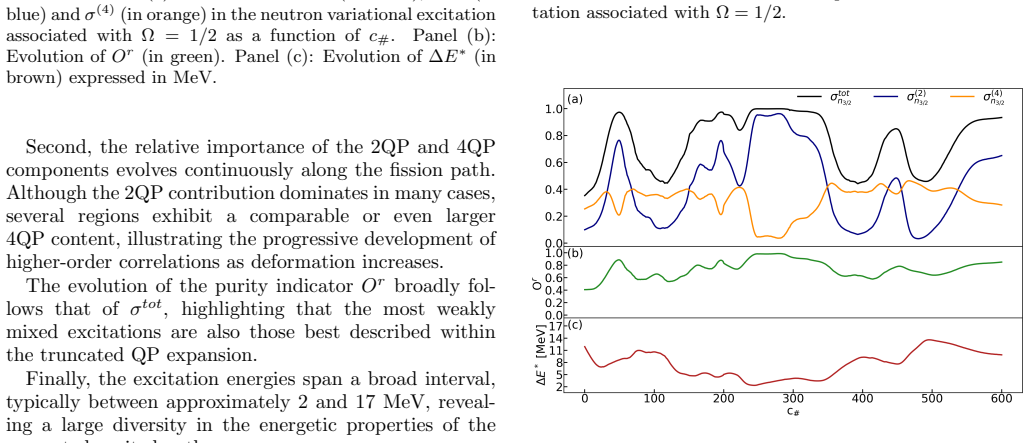
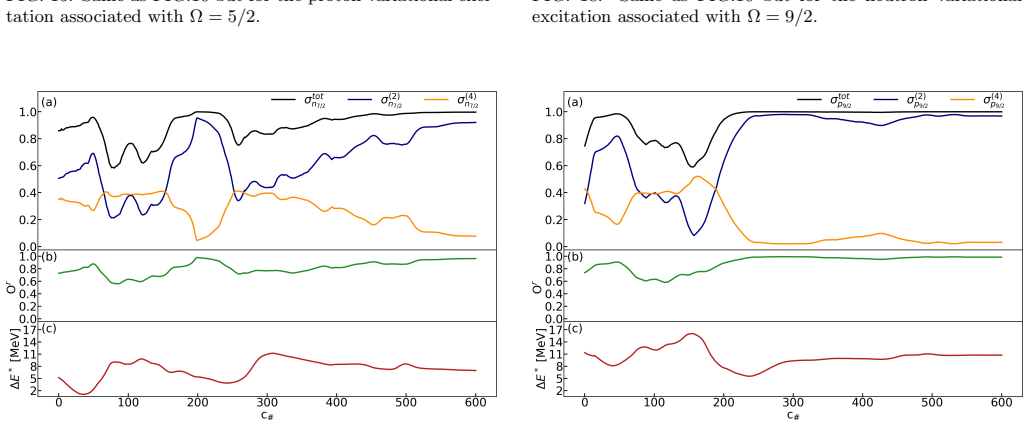
Microscopic composition of the variational excited paths FIGs. 10 to 19 summarize the microscopic composi- tion of the ten variational excited paths generated with the “Continuous Deflation” method. For each excitation, panel (a) displays the evolution ofσ (2) (in blue),σ (4) (in orange), andσ tot (in black), while panel (b) shows the purity indicatorO r,...
-
[5]
Correlations between the microscopic indicators The evolution along the different excited paths al- ready suggests that the microscopic quantities introduced above are not independent. To identify the dominant FIG. 11. Same as FIG.10 but for the proton variational exci- tation associated with Ω = 1/2. FIG. 12. Same as FIG.10 but for the neutron variationa...
-
[6]
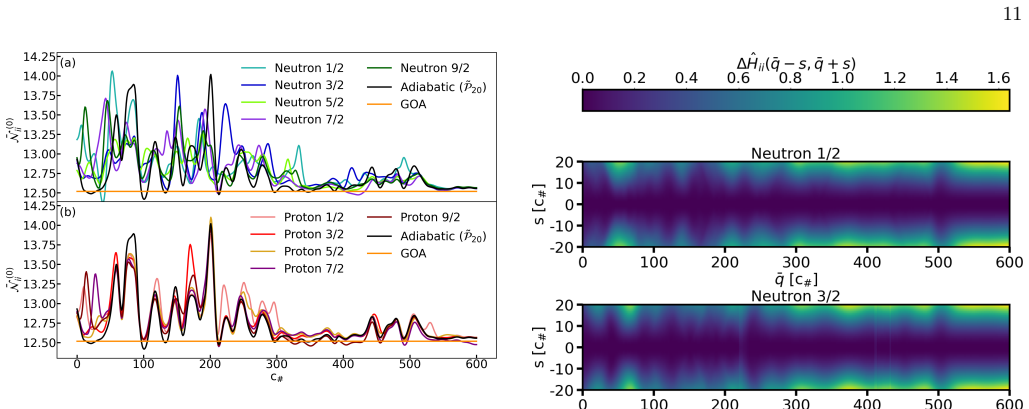
Overlap kernels A key requirement for the SCIM framework to be effec- tive is the regularity of the underlying overlap kernels (see Ref.[1], Eq. (14)). In this respect, we first examine the zero-order diagonal overlap kernel moments for all vari- ational excitations, together with those of the associated adiabatic set, as a function of the collective coor...
-
[7]
Hamiltonian kernels To investigate the regularity properties of the Hamil- tonian kernels, we examine whether the adiabatic-level approximation relating Hamiltonian and overlap kernels remains valid for the variational excitations. This choice is motivated by the fact that the relevant property for dynamical applications is ultimately the regularity of th...
-
[8]
Numerical instabilities in off-diagonal Hamiltonian kernels In practice, no particular difficulty is encountered in the evaluation of overlap and Hamiltonian kernels, except in two specific situations: Hamiltonian kernels between adiabatic states and variational excited states, and ker- nels between two distinct variational excited states. In both cases, ...
Show all 22 references
-
[9]
Carpentier, N
P. Carpentier, N. Pillet, R. Bernard, L. Robledo, D. Lacroix, N. Dubray, D. Regnier, and W. Younes, Mi- croscopic description of fission process including intrin- sic excitations. Part I: 240Pu adiabatic and asymmetric fission path within the Schr¨ odinger Collective Intrinsic...
2026
-
[10]
Carpentier, N
P. Carpentier, N. Pillet, R. Bernard, L. Robledo, D. Lacroix, N. Dubray, D. Regnier, and W. Younes, Mi- croscopic description of fission process including intrinsic excitations. Part II: 240Pu excited and asymmetric fission paths within the Schr¨ odinger Collective Intrinsic M...
2026
-
[11]
Carpentier, N
P. Carpentier, N. Pillet, R. Bernard, L. Robledo, D. Lacroix, N. Dubray, D. Regnier, and W. Younes, Mi- croscopic description of fission process including intrinsic excitations. Part III: 240Pu fission dynamics along 1D asymmetric paths within the Schr¨ odinger Collective In- ...
2026
-
[12]
Carpentier, N
P. Carpentier, N. Pillet, D. Lacroix, N. Dubray, and D. Regnier, Construction of continuous collective energy landscapes for large amplitude nuclear many-body prob- lems, Phys. Rev. Lett.133, 152501 (2024)
2024
-
[13]
Carpentier,Microscopic and dynamical descrip- tion of the fission process including intrinsic exci- tations, Ph.D
P. Carpentier,Microscopic and dynamical descrip- tion of the fission process including intrinsic exci- tations, Ph.D. thesis, Th` ese de doctorat, Universit´ e Paris-Saclay (2024), available athttps://theses.hal. science/tel-04761482v1
2024
-
[14]
Bernard, H
R. Bernard, H. Goutte, D. Gogny, and W. Younes, Mi- croscopic and nonadiabatic Schr¨ odinger equation derived from the generator coordinate method based on zero- and two-quasiparticle states, Phys. Rev. C84, 044308 (2011)
2011
-
[15]
Anguiano, J
M. Anguiano, J. Egido, and L. Robledo, Particle number projection with effective forces, Nuclear Physics A696, 467 (2001)
2001
-
[16]
Beaujeault-Taudi` ere and D
Y. Beaujeault-Taudi` ere and D. Lacroix, Solving the lip- kin model using quantum computers with two qubits only with a hybrid quantum-classical technique based on the generator coordinate method, Phys. Rev. C109, 024327 (2024)
2024
-
[17]
Higgott, D
O. Higgott, D. Wang, and S. Brierley, Variational Quan- tum Computation of Excited States, Quantum3, 156 (2019)
2019
-
[18]
Savitzky and M
A. Savitzky and M. J. E. Golay, Smoothing and differentiation of data by simplified least squares procedures., Analytical Chemistry36, 1627 (1964), https://doi.org/10.1021/ac60214a047
1964 doi
-
[19]
Satu la and J
W. Satu la and J. Dobaczewski, Simple regularization scheme for multireference density functional theories, Phys. Rev. C90, 054303 (2014)
2014
-
[20]
Warda, L
M. Warda, L. Egido, L. M. Robledo, and K. Pomorski, Self-consistent calculations of fission barriers in the fm region, Physical Review C66, 014310 (2002)
2002
-
[21]
Simenel, Particle transfer reactions with the time- dependent hartree-fock theory using a particle num- ber projection technique, Phys
C. Simenel, Particle transfer reactions with the time- dependent hartree-fock theory using a particle num- ber projection technique, Phys. Rev. Lett.105, 192701 (2010)
2010
-
[22]
Boucheneb, M
N. Boucheneb, M. Asghar, G. Barreau, T. Doan, B. Ler- oux, A. Sicre, P. Geltenbort, and A. Oed, A high- resolution multi-parametric study of 239pu(nth, f) with the cosi-fan-tutte spectrometer, Nuclear Physics A535, 77 (1991)
1991
Reviewed August 10, 2026 · model on record in the stance chip above.
Discussion (0). Continue with ORCID to comment.