REVIEW 3 major objections 5 minor 12 references
Magnetohydrodynamic Simulation of a Coronal Mass Ejection Observed During the Near-radial Alignment of Solar Orbiter and Earth
T0 review · 3 major / 5 minor · reviewed 2026-08-09 · deepseek-v4-flash
Pith's one-line read A flux-rope MHD model reproduces the rotating magnetic field of a stealth CME at Solar Orbiter and Earth.
desk verdict A careful, honest single-event application of the CTFR model to a stealth ICME in a rare SolO–Earth radial alignment; the field rotation is reproduced well, but the assumed poloidal flux means the amplitude match is not an independent test. read the letter →
The pith
A machine-rendered reading of the paper's core claim, the machinery that carries it, and where it could break.
The reading
What carries the argument
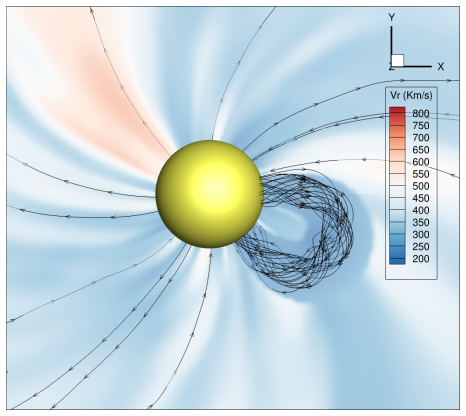
The load-bearing machinery is the constant-turn flux rope (CTFR) model: a croissant-shaped flux rope with circular cross-section and twin legs (the FRiED geometry) whose internal magnetic field is the uniform-turn analytic solution of Vandas & Romashets, configured with poloidal and toroidal fluxes, helicity sign, tilt, half-angle, and aspect ratio. The flux rope supplies the initial magnetic field and low-plasma-$\beta$ energy density of a fully formed ejecta inserted at 0.1 au into the ambient solar wind; the paper's test is whether that initial field, advected and expanded by the MHD evolution, reproduces the observed rotating field at Solar Orbiter and Earth. The assumed poloidal flux of $10\times10^{21}$ Mx, converted to toroidal flux via the empirical relation of Qiu et al. (2007), sets the field amplitude $B_0$; the helicity sign follows from the hemispheric helicity rule.
What would settle it
Compute the axial magnetic flux through the simulated ejecta at 1 au and compare it with the flux obtained by integrating the observed $B_T$ profile across the in-situ ICME at Earth; if the simulated flux disagrees with the observed flux by more than the model's claimed accuracy, the field magnitude is inherited from the assumed $10\times10^{21}$ Mx poloidal flux rather than being a dynamical prediction. A second check is to run the same CTFR setup for a radially aligned ICME pair whose magnetic profiles are not well correlated (as in Regnault et al. 2023); if the model still produces a smooth, matching rotation, the current success is specific to this event's simple structure rather than a general property of the model.
Extended reading notes
Core claim
On its own terms, the paper's discovery is that the CTFR model can correctly capture the radial evolution of the magnetic field associated with this ICME: when simulation output is extracted along the trajectories of Solar Orbiter and Earth, the signs and magnitudes of $B_T$ and $B_N$ within the ejecta match in situ observations, and the $B_R$ component stays small as observed, so the smooth rotation of the magnetic field across the ICME is preserved at both heliocentric distances. The paper presents this as evidence that the CTFR model is a good candidate for forecasting the magnetic structure, and therefore the geo-effectiveness, of ICMEs with simple magnetic structure. It also reports that the simulated ICME arrives 5 hours late at Solar Orbiter and 5 hours ahead at Earth, and that the J-map comparison shows the CME entered the model 12 hours late but then moved too fast in an over-speedy simulated solar wind, with the two errors canceling near Earth.
Load-bearing premise
The load-bearing assumption is that the flux rope's magnetic flux is $10\times10^{21}$ Mx, an assumed value chosen because the stealth CME offers no EUV or magnetogram signature with which to measure the flux; if the true flux differs, the simulated field magnitude, and hence the claimed accuracy, changes even if the field geometry is right.
Editorial extensions
If this is right
- If the central claim is right, a data-constrained flux-rope MHD model can predict the sign and magnitude of the magnetic field components that determine an ICME's geo-effectiveness, rather than only its arrival time.
- The same model should be applied to other radially aligned ICME observations, especially events where the field profiles at the two spacecraft are poorly correlated, to see whether the present match reflects the model or the event's unusually simple flux-rope structure.
- Forecasters should treat an agreement in arrival time as a compound result: here a 12-hour late insertion and a faster-than-real simulated solar wind canceled, so a single arrival-time score does not validate the ambient-wind or the CME initialization.
- For stealth CMEs, where magnetic flux cannot be measured, the assumed poloidal flux and the hemispheric helicity rule are enough to reproduce the observed rotation pattern, which is the structure needed for a storm forecast; the amplitude remains conditional on the assumed flux.
Reading between the lines
- Beyond the paper, the close match of $B_T$ and $B_N$ at two radial distances suggests the interior magnetic profile of an ICME is largely set by the initial flux-rope parameters and only weakly modified by interaction with the solar wind; this could be tested by repeating the simulation with the same flux rope in different ambient-wind realizations and checking whether the in-ejecta field profile
- A testable extension is to compare the simulated and observed total axial flux at 1 au for this event; because the poloidal flux was assumed, such a comparison would separate the model's structural skill from the amplitude set by the assumption.
- The authors leave implicit that their success is for an ICME with a simple, well-correlated magnetic structure; the harder forecasting case is events where radial alignment still shows poor correlation, and their own discussion points to applying CTFR to those events as the next test.
- Another implication, not pursued in the paper, is that the cancellation of errors in arrival time is itself a warning for operational forecasting: matching the observed shock time at Earth does not constrain the simulated CME's speed history, so ensemble forecasts should sample both the ambient solar wind and the insertion time.
Editorial analysis
A structured set of objections, weighed in public.
Referee Report
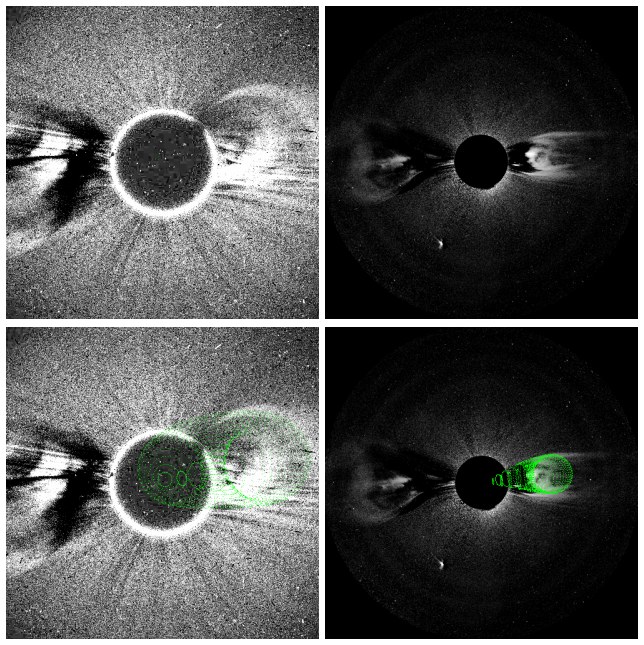
Summary. The paper simulates the 2020 April 14 stealth CME using the MS-FLUKSS inner-heliosphere MHD model with an inserted constant-turn flux rope (CTFR), and compares the results with in situ magnetic field and plasma data at Solar Orbiter and Earth, which were in a near-radial alignment. The authors also compare synthetic and observed STEREO HI J-maps to assess the CME's heliospheric kinematics. The central claim is that the CTFR model reproduces the smoothly rotating magnetic field signature, especially BT and BN, at both spacecraft with very good accuracy, and that it can correctly capture the radial evolution of the magnetic field of this ICME. The paper explicitly acknowledges that the poloidal flux and helicity sign of the stealth CME could not be observed and were assumed, and that the simulated ambient solar wind is too fast, leading to compensating arrival-time errors.
Significance. If the central claim were established, the study would strengthen the case for using flux-rope-based MHD models rather than hydrodynamic cone models for space-weather forecasting of ICME magnetic fields. The use of two radially aligned spacecraft is a valuable and relatively rare test bed, and the synthetic J-map comparison is a useful diagnostic that goes beyond single-point in situ comparisons. The authors are also commendably explicit about the limitations of their setup, including the assumed poloidal flux, the ad-hoc total energy definition, the high simulated temperatures, and the cancellation of kinematic errors. However, because the magnetic field amplitude is set by an assumed flux that is not independently constrained for this event, the abstract's 'very good accuracy' claim and the Section 5 conclusion about correctly capturing radial magnetic-field evolution are currently stronger than the evidence supports.
major comments (3)
- [Section 3.2, Section 4.2, Section 5] The assumed poloidal magnetic flux of 10 x 10^21 Mx, explicitly stated in Section 3.2 to be unconstrained by observations, directly determines B0 = 0.0031 G in the Vandas & Romashets (2017) field solution and therefore the amplitude of the simulated BT and BN components. Matching the observed field magnitude at SolO and Earth is thus a consistency check on a chosen normalization, not an independent validation of the model's predictive capability. To support the Section 5 claim that the CTFR model 'can correctly capture the radial evolution of the magnetic field associated with this ICME,' the authors should vary the assumed poloidal flux (and hence B0) over a plausible range and show how the Earth comparison degrades, or provide an independent observational constraint on the flux with quantified uncertainty.
- [Section 4.2, Figure 5, Section 5] The two-spacecraft radial-evolution test is weakened by the 5-hour time shift applied to the SolO simulation data and by the compensating kinematic errors documented in Section 4.3: the CME is inserted 12 hours late, the simulated ambient solar wind is too fast, and the synthetic J-map slope is steeper than observed. The magnetic field comparison at SolO is therefore only performed after shifting the time axis, and the agreement at Earth benefits from an accidental cancellation of insertion-time and ambient-wind errors. The paper should show the unshifted SolO comparison, and should explicitly separate the magnetic-field-shape agreement from the arrival-time/radial-localization agreement when claiming that radial evolution is captured.
- [Section 4.2, Section 4.3] The helicity sign is assumed from the hemispheric rule, which the paper itself notes holds for only 60-75% of flux ropes, and the toroidal flux is derived from an empirical relation to the assumed poloidal flux. Since the sense of the magnetic field rotation in the simulation depends directly on this assumed sign, the successful reproduction of the rotation direction is not an independent confirmation of the model's helicity treatment. A sensitivity test in which the opposite helicity sign is used would help quantify how much of the claimed agreement depends on this assumption.
minor comments (5)
- [Section 1] The text contains a typo: 'The the conclusions are presented in Section 5' should read 'The conclusions are presented in Section 5.'
- [Section 4.2] The sentence 'we assumed the total mass in the flux rope to be 10 10 kg' has a missing superscript; it should read 10^10 kg.
- [Section 4.3, Figure 6] The text refers twice to the 'top-left panel' of Figure 6 when describing the synthetic J-map; the second occurrence should refer to the top-right panel.
- [Section 4.2, equation for etotal] The ad-hoc total energy density formula includes the solar wind pressure and magnetic energy but no explicit thermal pressure term for the flux rope plasma itself; if this is intentional, a brief explanation of how the flux rope temperature is effectively set would help the reader.
- [Section 5] The phrase 'the simulated ICME arrival was underestimated by 5 hours at SolO and overestimated by 5 hours at Earth' is confusing because the simulation arrives late at SolO and early at Earth; consider rephrasing to 'the simulated arrival was 5 hours late at SolO and 5 hours early at Earth.'
Circularity Check
No significant circularity: the target magnetometer data are not used to set the flux-rope field parameters; the SolO/Earth comparison is an independent, two-point test of the CTFR model.
full rationale
The paper's load-bearing claim is that the constant-turn flux rope (CTFR) model reproduces the rotating magnetic field signature at both Solar Orbiter and Earth. Tracing the parameter chain, the CME direction, tilt, half-angle, aspect ratio, and speed come from GCS fits to coronagraph data (Section 4.1), independent of the in situ magnetometer data. The magnetic field amplitude inside the flux rope is set by an assumed poloidal flux of 10 x 10^21 Mx (Section 3.2), with B0 = 0.0031 G entering the analytic Vandas & Romashets field solution. The paper explicitly acknowledges that 'observations needed to constrain the magnetic flux of the flux rope are not available' and that the value was assumed. This is an unconstrained prior, not a fit to the target observations: the paper does not vary B0 to match the SolO or Earth magnetic field profiles, and there is no statement of tuning the flux to the magnetometer data. Likewise, the helicity sign is assigned by the external hemispheric helicity rule rather than by matching the observed rotation sense. The WSA realization and the factor-of-2 ambient-field scaling are calibrated against the ambient solar wind at Earth, not against the CME's internal field, so they do not pre-determine the CME magnetic profile. The 5-hour time shifts at SolO are reported as arrival-time errors rather than silently adjusted fits to the field shape. The central comparison is therefore a two-point radial test: one set of insertion parameters produces field profiles at 0.81 au and 1 au, and the observed amplitude, sign, and rotation are compared without being used to set the model inputs. The main caveat is that the assumed flux controls the absolute field strength, so if the true flux differed substantially the amplitude match would degrade; this is a sensitivity/limitation issue, not circularity. Self-citations to Singh et al. (2022) describe the model's prior development and validation, but the present simulation and its comparison to independent in situ data carry the argument, so the self-citation is not load-bearing in a circular sense.
Assumptions & free parameters
free parameters (6)
- Poloidal magnetic flux =
10 x 10^21 Mx
- Helicity sign =
negative
- Flux rope mass =
10^10 kg
- DBM drag parameter =
0.1 x 10^-7
- WSA magnetic field scaling factor =
2
- ADAPT-WSA realization =
R006
assumptions (6)
- standard math Ideal MHD equations with Powell 8-wave divergence cleaning are adequate for inner heliosphere CME propagation
- domain assumption The uniform turn solution of Vandas & Romashets 2017 can be applied inside the FRiED-shaped flux rope by assuming local toroidal geometry
- domain assumption Self-similar expansion of the flux rope from 10 to 70 R_sun
- ad hoc to paper Ad-hoc definition of total energy density ensuring very small plasma beta inside the flux rope
- domain assumption Magnetic divergence created at the flux rope insertion interface is propagated out by the Powell method without affecting stability
- domain assumption Empirical relation of Qiu et al. 2007 between poloidal and toroidal flux holds for this CME
Cite this review
Pith. "Pith review of Magnetohydrodynamic Simulation of a Coronal Mass Ejection Observed During the Near-radial Alignment of Solar Orbiter and Earth." pith.science (2026). https://pith.science/paper/IOHCNOLD
@misc{pith2026250200175,
  author       = {Pith},
  title        = {Pith review of: Magnetohydrodynamic Simulation of a Coronal Mass Ejection Observed During the Near-radial Alignment of Solar Orbiter and Earth},
  year         = {2026},
  howpublished = {\url{https://pith.science/paper/IOHCNOLD}},
  note         = {Machine review of arXiv:2502.00175}
}
read the original abstract
Interplanetary Coronal Mass Ejections (ICMEs) are the primary sources of geomagnetic storms at Earth. Negative out-of-ecliptic component (Bz) of magnetic field in the ICME or its associated sheath region is necessary for it to be geo-effective. For this reason, magnetohydrodynamic simulations of CMEs containing data-constrained flux ropes are more suitable for forecasting their geo-effectiveness as compared to hydrodynamic models of the CME. ICMEs observed in situ by radially aligned spacecraft can provide an important setup to validate the physics-based heliospheric modeling of CMEs. In this work, we use the constant-turn flux rope (CTFR) model to study an ICME that was observed in situ by Solar Orbiter (SolO) and at Earth, when they were in a near-radial alignment. This was a stealth CME that erupted on 2020 April 14 and reached Earth on 2020 April 20 with a weak shock and a smoothly rotating magnetic field signature. We found that the CTFR model was able to reproduce the rotating magnetic field signature at both SolO and Earth with very good accuracy. The simulated ICME arrived 5 hours late at SolO and 5 hours ahead at Earth, when compared to the observed ICME. We compare the propagation of the CME front through the inner heliosphere using synthetic J-maps and those observed in the heliospheric imager data and discuss the role of incorrect ambient SW background on kinematics of the simulated CME. This study supports the choice of the CTFR model for reproducing the magnetic field of ICMEs.
Figures

Figures from the paper (3 more)


Reference graph
Works this paper leans on
-
[1]
Arge, C. N., de Toma, G., & Luhmann, J. G. 2005, in Astronomical Society of the Pacific Confer- ence Series, Vol. 346, Large-scale Structures and their Role in Solar Activity, ed. K. Sankara- subramanian, M. Penn, & A. Pevtsov, 371 Arge, C. N., Henney, C. J., Hernandez, I. G., et al. 2013, AIP Conference Proceedings, 1539, 11, doi: 10.1063/1.4810977 Arge,...
-
[3]
1007/BF00733434 Davies, E. E., M¨ ostl, C., Owens, M. J., et al. 2021, Astro and Astrophys , 656, A2, doi:10.1051/ 0004-6361/202040113 Dedner, A., Kemm, F., Kr¨ oner, D., et al. 2002, Journal of Computational Physics, 175, 645, doi: 10.1006/jcph.2001.6961 Dissauer, K., Veronig, A. M., Temmer, M., Podladchikova, T., & Vanninathan, K. 2018, The Astrophysica...
arXiv 2021
-
[4]
2011, Coronal Mass Ejections: An Introduction, Vol
1007/s11214-008-9341-4 Howard, T. 2011, Coronal Mass Ejections: An Introduction, Vol. 376, doi: 10.1007/ 978-1-4419-8789-1 Isavnin, A. 2016, Astrophys J , 833, 267, doi: 10.3847/1538-4357/833/2/267 Jian, L. K., MacNeice, P. J., Mays, M. L., et al. 2016, Space Weather, 14, 592, doi: https: //doi.org/10.1002/2016SW001435 Jin, M., Manchester, W. B., van der ...
-
[5]
2016, ForeCAT - a model for magnetic deflections of coronal mass ejections, OpenBU
1007/s11214-007-9277-0 Kay, C. 2016, ForeCAT - a model for magnetic deflections of coronal mass ejections, OpenBU. https://open.bu.edu/handle/2144/14526 Kim, T. K., Pogorelov, N. V., Arge, C. N., et al. 2020, Astrophys J Suppl , 246, 40, doi: 10.3847/ 1538-4365/ab58c9 King, J. H., & Papitashvili, N. E. 2005, Journal of Geophysical Research: Space Physics,...
-
[6]
J., Bruno, R., Livi, S., et al
1007/s11214-021-00857-0 Owen, C. J., Bruno, R., Livi, S., et al. 2020, Astro and Astrophys , 642, A16, doi: 10.1051/ 0004-6361/201937259 Palmerio, E., Maharana, A., Lynch, B. J., et al. 2023, The Astrophysical Journal, 958, 91, doi:
work page 2020
-
[7]
3847/1538-4357/ad0229 Pevtsov, A. A., & Balasubramaniam, K. S. 2003, Advances in Space Research, 32, 1867, doi:
work page 2003
-
[8]
1016/S0273-1177(03)90620-X Pevtsov, A. A., Berger, M. A., Nindos, A., Norton, A. A., & van Driel-Gesztelyi, L. 2014, Spac Sci Rev , 186, 285, doi: 10.1007/s11214-014-0082-2 Pogorelov, N., Borovikov, S., Heerikhuisen, J., et al. 2014, in Proceedings of the 2014 Annual Conference on Extreme Science and Engineering Discovery Environment, XSEDE ’14 (New York,...
-
[9]
48550/arXiv.2311.14046 Rouillard, A. 2011, Journal of Atmospheric and Solar-Terrestrial Physics, 73, 1201, doi: https: //doi.org/10.1016/j.jastp.2010.08.015 Sarkar, R., Gopalswamy, N., & Srivastava, N. 2020, Astrophys J , 888, 121, doi: 10.3847/ 1538-4357/ab5fd7 Schatten, K. H. 1971, Cosmic Electrodynamics, 2, 232 Scolini, C., Rodriguez, L., Mierla, M., P...
work page Pith review arXiv 2011
Show all 12 references
-
[10]
N., Henney, C
1063/1.3395870 Arge, C. N., Henney, C. J., Koller, J., et al. 2011, in Astronomical Society of the Pacific Conference Series, Vol. 444, 5th International Conference of Numerical Modeling of Space Plasma Flows (ASTRONUM 2010), ed. N. V. Pogorelov, E. Audit, & G. P. Zank, 99 Arg...
2011 doi
-
[11]
S., Wu, S
1051/0004-6361/201935053 Shen, F., Feng, X. S., Wu, S. T., Xiang, C. Q., & Song, W. B. 2011, Journal of Geophysical Research: Space Physics, 116, doi: https://doi.org/10.1029/2010JA015809 Shen, F., Shen, C., Zhang, J., et al. 2014, Journal of Geophysical Research: Space Physic...
2011 doi
-
[12]
K., Pogorelov, N
3847/1538-4357/acc10a Singh, T., Kim, T. K., Pogorelov, N. V., & Arge, C. N. 2020b, Space Weather, 18, e02405, doi: 10.1029/2019SW002405 Singh, T., Kim, T. K., Pogorelov, N. V., & Arge, C. N. 2022, The Astrophysical Journal, 933, 123, doi: 10.3847/1538-4357/ac73f3 Singh, T., Y...
2022 doi
-
[13]
S., Pogorelov, N
3847/1538-4357/aad3b4 Singh, T., Yalim, M. S., Pogorelov, N. V., & Gopalswamy, N. 2020a, The Astrophysical Journal, 894, 49, doi: 10.3847/1538-4357/ab845f Thernisien, A., Vourlidas, A., & Howard, R. A. 2009, Sol Phys , 256, 111, doi: 10.1007/ s11207-009-9346-5 22 Vandas, M., &...
2009 doi
Reviewed August 9, 2026 · model on record in the stance chip above.
Discussion (0). Continue with ORCID to comment.