Charge imprinting biases topology of correlated insulator in hBN-aligned rhombohedral multilayer graphene
Pith reviewed 2026-06-26 15:51 UTC · model grok-4.3
The pith
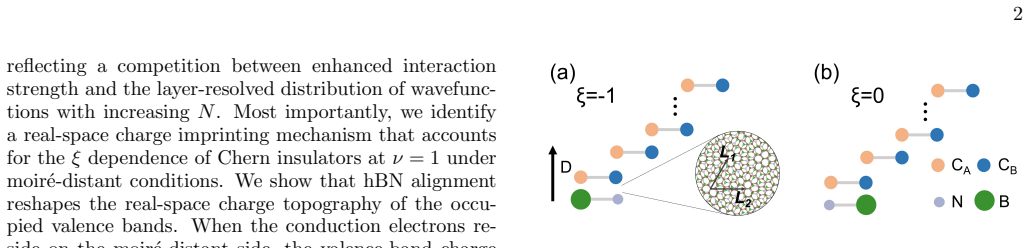
hBN alignment imprints valence-band charge texture that templates conduction-electron topology in multilayer graphene at filling one.
A machine-rendered reading of the paper's core claim, the machinery that carries it, and where it could break.
Core claim
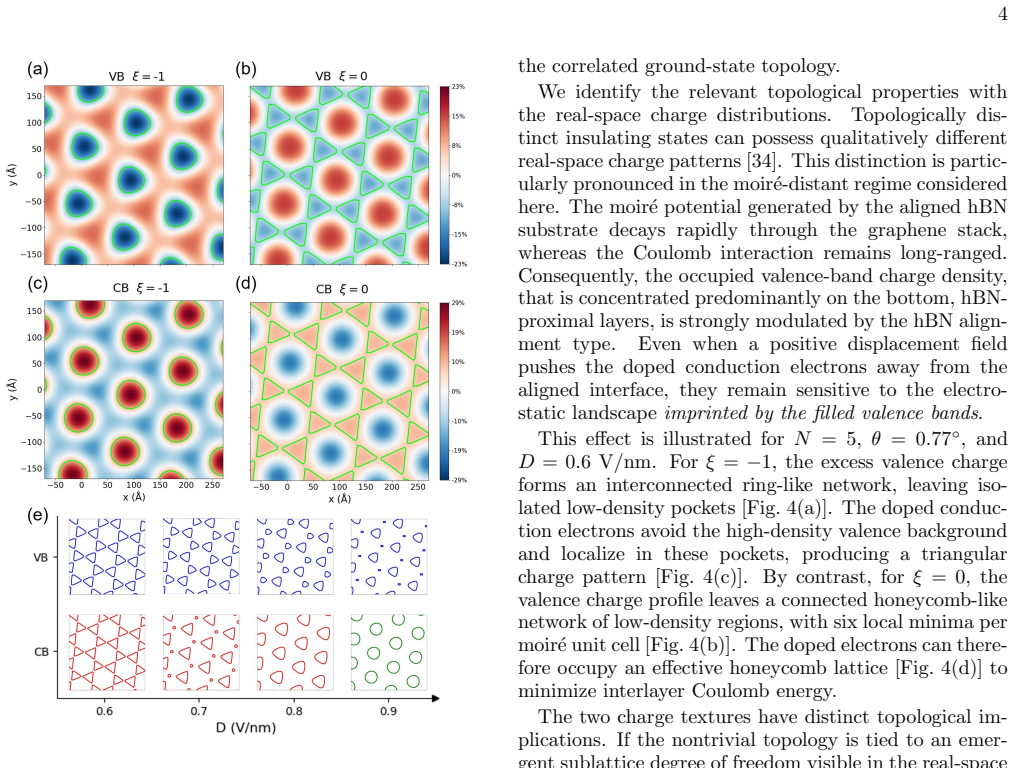
Under moiré-distant conditions at filling ν=1, the topology of the insulating state is strongly biased by charge imprinting: the hBN alignment shapes the occupied valence-band charge texture near the interface via moiré potential, which acts through long-range Coulomb interactions as a remote electrostatic template for doped conduction electrons. Depending on the alignment, this template favors either triangular charge localization associated with trivial insulators or honeycomb-like charge networks compatible with Chern insulators.
What carries the argument
Charge imprinting, the process in which the moiré potential organizes valence-band charge density that then electrostatically templates conduction-electron localization through long-range Coulomb repulsion.
If this is right
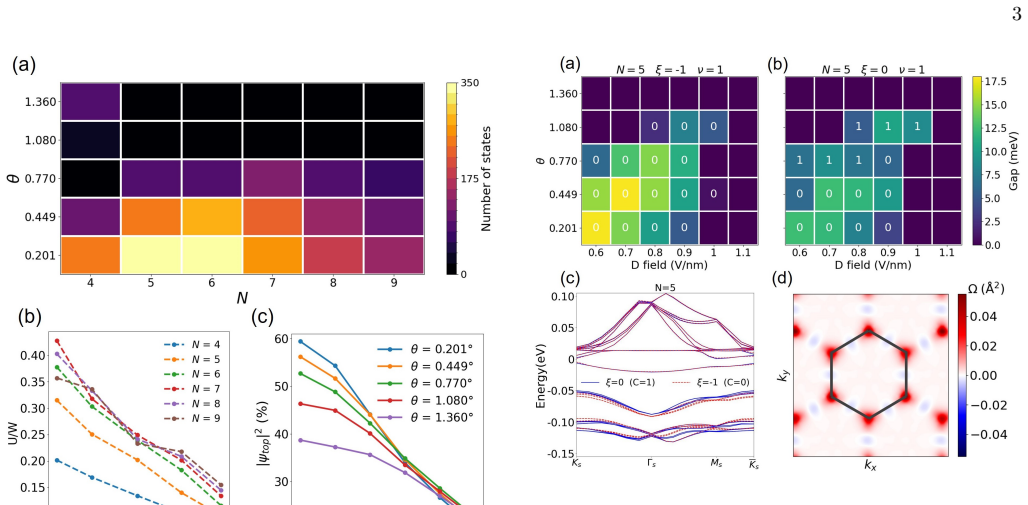
- Correlated insulators reach maximum robustness at small twist angles and around six layers where bandwidth narrowing and layer delocalization balance.
- One hBN alignment produces triangular charge order and trivial topology; the opposite alignment produces honeycomb order and Chern topology.
- Valence-band charge textures act as the remote control that transmits moiré information to the conduction band at filling one.
Where Pith is reading between the lines
- Similar remote templating could operate in other multilayer or heterostructure systems where carriers are displaced from the moiré layer.
- Measurements that resolve valence-band charge density near the hBN interface would directly test whether the template mechanism survives beyond mean-field theory.
Load-bearing premise
Hartree-Fock mean-field theory correctly predicts both the moiré-induced valence-band charge textures and the Coulomb-mediated selection of triangular versus honeycomb conduction-electron networks without needing corrections that would reverse the favored pattern.
What would settle it
Direct imaging or spectroscopy that shows identical charge networks and the same topology for both hBN alignments at ν=1 under moiré-distant conditions, or transport data showing no dependence of Chern number on alignment when carriers are displaced from the interface.
Figures
read the original abstract
Rhombohedral multilayer graphene aligned with hexagonal boron nitride (RMG-hBN) hosts correlated Chern phases, but the microscopic role of hBN stacking remains unclear, especially when the active carriers are displaced away from the moir\'e interface. Using Hartree-Fock calculations over layer numbers, twist angles, displacement fields, fillings, and hBN alignments, we show that correlated insulators are most robust at small twist angles and intermediate layer number ($N\simeq 6$), where bandwidth suppression is balanced by layer delocalization of the wavefunctions of the active carriers. Under moir\'e-distant conditions at filling $\nu=1$, the topology of the insulating state is strongly biased by charge imprinting: the hBN alignment shapes the occupied valence-band charge texture near the interface via moir\'e potential, which acts through long-range Coulomb interactions as a remote electrostatic template for doped conduction electrons. Depending on the alignment, this template favors either triangular charge localization associated with trivial insulators or honeycomb-like charge networks compatible with Chern insulators. Our results identify valence-band charge textures as a microscopic route by which a remote moir\'e interface controls correlated topology in multilayer graphene.
Editorial analysis
A structured set of objections, weighed in public.
Referee Report
Summary. The manuscript uses Hartree-Fock calculations across layer numbers, twist angles, displacement fields, fillings, and hBN alignments to study correlated insulators in rhombohedral multilayer graphene aligned to hBN. It claims that at filling ν=1 under moiré-distant conditions the topology is strongly biased by charge imprinting: the hBN alignment shapes occupied valence-band charge textures near the interface via the moiré potential; these textures act through long-range Coulomb interactions as a remote electrostatic template that selects either triangular charge localization (trivial insulator) or honeycomb-like networks (compatible with Chern insulators) in the doped conduction electrons. Robustness is reported at small twist angles and intermediate layer number N≃6.
Significance. If the Hartree-Fock results are reliable, the work supplies a concrete microscopic mechanism linking remote hBN alignment to the topology of correlated states in multilayer graphene, identifying valence-band charge textures as the mediating degree of freedom. This could rationalize experimental trends in Chern phases and suggest alignment-based tuning strategies. The broad parameter sweeps constitute a strength if numerical convergence is demonstrated.
major comments (2)
- [Results on ν=1 insulators and methods] The central claim (abstract and results on ν=1) that valence-band charge textures template conduction-electron order via long-range Coulomb interactions rests on the accuracy of the Hartree-Fock mean-field decoupling. No explicit test is provided showing that the triangular-versus-honeycomb selection survives when the mean-field approximation is relaxed (e.g., via fluctuation corrections or alternative decouplings), which is load-bearing because beyond-mean-field effects could reverse the favored network without altering the single-particle moiré potential.
- [Methods / computational details] Numerical details of the Hartree-Fock implementation—convergence with k-point sampling, handling of long-range Coulomb sums (Ewald or cutoff procedures), and finite-size effects—are not visible. Without these, it is impossible to judge whether the reported bias is robust or sensitive to post-hoc parameter choices or mean-field artifacts, directly affecting the reliability of the templating mechanism.
minor comments (2)
- [Introduction / abstract] Clarify the precise definition of “moiré-distant conditions” (e.g., displacement-field range or layer polarization threshold) when first introduced.
- [Figures] Figure captions should explicitly state the system size, twist-angle range, and filling used for each panel to allow direct comparison with the text claims.
Simulated Author's Rebuttal
We thank the referee for their careful reading and constructive comments. We address the two major comments point by point below.
read point-by-point responses
-
Referee: The central claim (abstract and results on ν=1) that valence-band charge textures template conduction-electron order via long-range Coulomb interactions rests on the accuracy of the Hartree-Fock mean-field decoupling. No explicit test is provided showing that the triangular-versus-honeycomb selection survives when the mean-field approximation is relaxed (e.g., via fluctuation corrections or alternative decouplings), which is load-bearing because beyond-mean-field effects could reverse the favored network without altering the single-particle moiré potential.
Authors: We agree that the results are obtained within the Hartree-Fock mean-field framework and that no explicit beyond-mean-field tests (e.g., fluctuation corrections) are performed. The reported bias originates from the self-consistent electrostatic potential generated by the valence-band charge texture acting on the conduction electrons through the long-range Coulomb term; this mechanism is intrinsic to the HF decoupling. While we cannot rule out quantitative changes from beyond-HF effects, the qualitative selection between triangular and honeycomb networks is tied to the remote moiré potential and is expected to be robust at the level of electrostatic templating. We will add a concise discussion paragraph in the revised manuscript acknowledging this limitation and identifying it as a topic for future work. revision: partial
-
Referee: Numerical details of the Hartree-Fock implementation—convergence with k-point sampling, handling of long-range Coulomb sums (Ewald or cutoff procedures), and finite-size effects—are not visible. Without these, it is impossible to judge whether the reported bias is robust or sensitive to post-hoc parameter choices or mean-field artifacts, directly affecting the reliability of the templating mechanism.
Authors: We thank the referee for highlighting this omission. The original manuscript did not include sufficient implementation details. In the revised version we will add a new subsection (or appendix) that specifies the k-point sampling grids, the Ewald summation parameters used for the long-range Coulomb interaction, the finite-size systems employed, and convergence tests confirming that the valence-band charge textures and the resulting conduction-electron bias remain stable under these choices. revision: yes
Circularity Check
No circularity: results presented as numerical outputs of Hartree-Fock
full rationale
The abstract and context describe Hartree-Fock calculations over layer numbers, twist angles, displacement fields, fillings, and alignments, with the charge-imprinting bias and topology selection reported as computed outputs rather than inputs. No equations, parameters, or claims are shown to reduce by construction to fitted quantities defined from the same data, and no self-citation chains or uniqueness theorems are invoked in the provided text. The derivation is therefore self-contained against external benchmarks.
Axiom & Free-Parameter Ledger
axioms (1)
- domain assumption Hartree-Fock mean-field theory suffices to capture the correlated insulator states and their topology selection at ν=1
Reference graph
Works this paper leans on
-
[1]
Z. Lu, T. Han, Y. Yao, A. P. Reddy, J. Yang, J. Seo, K. Watanabe, T. Taniguchi, L. Fu, and L. Ju, Nature 626, 759 (2024)
2024
-
[2]
J. Xie, Z. Huo, X. Lu, Z. Feng, Z. Zhang, W. Wang, Q. Yang, K. Watanabe, T. Taniguchi, K. Liu,et al., Na- ture Materials , 1 (2025)
2025
-
[3]
S. H. Aronson, T. Han, Z. Lu, Y. Yao, J. P. Butler, K. Watanabe, T. Taniguchi, L. Ju, and R. C. Ashoori, Physical Review X15, 031026 (2025)
2025
-
[4]
C. Li, Z. Sun, K. Liu, L. Qiao, Y. Wei, C. Zheng, C. Zhang, K. Watanabe, T. Taniguchi, H. Yang,et al., arXiv preprint arXiv:2505.01767 (2025)
arXiv 2025
-
[5]
M. Uzan, W. Zhi, M. Bocarsly, J. Dong, S. Dutta, N. Auerbach, N. S. Kander, M. Labendik, Y. Myasoe- dov, M. E. Huber,et al., arXiv preprint arXiv:2507.20647 (2025)
arXiv 2025
-
[6]
Z. Huo, W. Wang, J. Xie, Y. H. Kwan, J. Herzog- Arbeitman, Z. Zhang, Q. Yang, M. Wu, K. Watanabe, T. Taniguchi,et al., arXiv preprint arXiv:2510.15309 (2025)
arXiv 2025
-
[7]
Q. Liu, Z. Wang, X. Han, Z. Li, B. Li, S. Zhou, L. Hu, Z. Qu, C. Han, K. Watanabe,et al., Physical Review Letters136, 016602 (2026)
2026
-
[8]
Z. Dong, A. S. Patri, and T. Senthil, Phys. Rev. Lett. 133, 206502 (2024)
2024
-
[9]
B. Zhou, H. Yang, and Y.-H. Zhang, Phys. Rev. Lett. 133, 206504 (2024)
2024
-
[10]
J. Dong, T. Wang, T. Wang, T. Soejima, M. P. Zaletel, A. Vishwanath, and D. E. Parker, Phys. Rev. Lett.133, 206503 (2024)
2024
-
[11]
Z. Guo, X. Lu, B. Xie, and J. Liu, Physical Review B 110, 075109 (2024)
2024
-
[12]
Y. H. Kwan, J. Yu, J. Herzog-Arbeitman, D. K. Efetov, N. Regnault, and B. A. Bernevig, Physical Review B112, 075109 (2025)
2025
-
[13]
J. Yu, J. Herzog-Arbeitman, Y. H. Kwan, N. Regnault, and B. A. Bernevig, Phys. Rev. B112, 075110 (2025)
2025
-
[14]
Huang, X
K. Huang, X. Li, S. Das Sarma, and F. Zhang, Phys. Rev. B110, 115146 (2024)
2024
-
[15]
Uchida, T
T. Uchida, T. Kawakami, and M. Koshino, Physical Re- view Letters136, 156602 (2026)
2026
-
[16]
K. Kudo, R. Nakai, and K. Nomura, Physical Review B 110, 245135 (2024)
2024
-
[17]
K. Sun, Z. Gu, H. Katsura, and S. Das Sarma, Physical review letters106, 236803 (2011)
2011
-
[18]
Regnault and B
N. Regnault and B. A. Bernevig, Physical Review X1, 021014 (2011)
2011
-
[19]
Neupert, L
T. Neupert, L. Santos, C. Chamon, and C. Mudry, Phys- ical review letters106, 236804 (2011)
2011
-
[20]
Sheng, Z.-C
D. Sheng, Z.-C. Gu, K. Sun, and L. Sheng, Nature com- munications2, 389 (2011)
2011
-
[21]
J. Cai, E. Anderson, C. Wang, X. Zhang, X. Liu, W. Holtzmann, Y. Zhang, F. Fan, T. Taniguchi, K. Watanabe,et al., Nature622, 63 (2023)
2023
-
[22]
H. Park, J. Cai, E. Anderson, Y. Zhang, J. Zhu, X. Liu, C. Wang, W. Holtzmann, C. Hu, Z. Liu, T. Taniguchi, K. Watanabe, J.-H. Chu, T. Cao, L. Fu, W. Yao, C.-Z. Chang, D. Cobden, D. Xiao, and X. Xu, Nature622, 74 (2023)
2023
-
[23]
Y. Zeng, Z. Xia, K. Kang, J. Zhu, P. Kn¨ uppel, C. Vaswani, K. Watanabe, T. Taniguchi, K. F. Mak, and J. Shan, Nature622, 69 (2023)
2023
-
[24]
F. Xu, Z. Sun, T. Jia, C. Liu, C. Xu, C. Li, Y. Gu, K. Watanabe, T. Taniguchi, B. Tong,et al., Physical Review X13, 031037 (2023)
2023
-
[25]
Moon and M
P. Moon and M. Koshino, Physical Review B90, 155406 (2014). 7
2014
-
[26]
Y. Park, Y. Kim, B. L. Chittari, and J. Jung, Physical Review B108, 155406 (2023)
2023
-
[27]
Herzog-Arbeitman, Y
J. Herzog-Arbeitman, Y. Wang, J. Liu, P. M. Tam, Z. Qi, Y. Jia, D. K. Efetov, O. Vafek, N. Regnault, H. Weng, et al., Physical Review B109, 205122 (2024)
2024
-
[28]
J. Jung, A. Raoux, Z. Qiao, and A. H. MacDonald, Phys- ical Review B89, 205414 (2014)
2014
-
[29]
Y. Du, N. Xu, X. Lin, and A.-P. Jauho, Physical Review Research2, 043427 (2020)
2020
-
[32]
X. Lu, S. Zhang, Y. Wang, X. Gao, K. Yang, Z. Guo, Y. Gao, Y. Ye, Z. Han, and J. Liu, Nature Communica- tions14, 5550 (2023)
2023
-
[33]
See Supplementary Information for: (a) non-interacting continuum model for mutli-layer graphene-hBN moir´ e system, (b) Hartree-Fock approximations to the electron- electron interaction, (c) more phase diagrams of HF re- sults and (d) evolution of real-space charge densities
-
[34]
Y. Zeng, D. Guerci, V. Cr´ epel, A. J. Millis, and J. Cano, Physical Review Letters132, 236601 (2024)
2024
-
[35]
Guo and J
Z. Guo and J. Liu, Nature Communications (2025)
2025
-
[36]
L. Nashabeh and H. Ochoa, arXiv preprint arXiv:2605.16218 (2026)
Pith/arXiv arXiv 2026
- [37]
-
[38]
Herzog-Arbeitman, H
J. Herzog-Arbeitman, H. Li, Y. Kwan, J. Yu, N. Reg- nault, and A. Bernevig (2026), presented at the APS Global Physics Summit (March Meeting 2026), Denver, CO. Supplementary Information: Charge imprinting biases topology of correlated insulator in hBN-aligned rhombohedral multilayer graphene Lei Qiao, 1,∗ Xin Lu, 2,† Fu-Chun Zhang,1 and Jianpeng Liu 2, 3,...
2026
-
[39]
For the rhombohedral stacked graphene considered in our study, the adjacent layers adopt Bernal stacking, which involves (0,−a 0 √
andτ 1,B = (0,0) within the first layerl= 1, while the corresponding reciprocal lattice vectors are given byb 1 = 4π/ √ 3a0( √ 3/2,−1/2) andb 2 = 4π/ √ 3a0(0,1), respectively. For the rhombohedral stacked graphene considered in our study, the adjacent layers adopt Bernal stacking, which involves (0,−a 0 √
-
[40]
Consequently, in thel-th layer, the positions of the A and B sublattices areτ l,A = (2−l)×(0, a 0/ √
shift, meaning that the B sublattice of the lower layer overlaps with the A sublattice of the upper layer from a top view. Consequently, in thel-th layer, the positions of the A and B sublattices areτ l,A = (2−l)×(0, a 0/ √
-
[41]
andτ l,B = (1−l)×(0, a 0/ √ 3), respectively. Based on the structural, the Slater–Koster tight-binding Hamiltonian can be written as: HRM G = X i,j,l1,l2,α,β −t(Ri +τ l1,α +l 1d0ez −R j −τ l2,β −l 2d0ez)ˆc† l1,α(Ri) ˆcl2,β(Rj) (S1) where (i, j),(l 1, l2) and (α, β) are the unit-cell, layer and sublattice indices, respectively. We adopt the graphene interl...
-
[42]
Moon and M
P. Moon and M. Koshino, Physical Review B90, 155406 (2014)
2014
-
[43]
Vafek and J
O. Vafek and J. Kang, Physical Review Letters125, 257602 (2020)
2020
-
[44]
Z. Guo, X. Lu, B. Xie, and J. Liu, Physical Review B110, 075109 (2024)
2024
-
[45]
Y. Jang, Y. Park, J. Jung, and H. Min, Physical Review B108, L041101 (2023)
2023
discussion (0)
Sign in with ORCID, Apple, or X to comment. Anyone can read and Pith papers without signing in.