REVIEW 4 major objections 4 minor 44 references
PALQA: A Novel Parameterized Position-Aware Lossy Quantum Autoencoder using LSB Control Qubit for Efficient Image Compression
T0 review · 4 major / 4 minor · reviewed 2026-08-09 · deepseek-v4-flash
Pith's one-line read A position-aware lossy quantum autoencoder using an LSB control qubit can beat JPEG and NZ-NEQR baselines in PSNR per gate on six grayscale benchmark images.
desk verdict A circuit-complexity improvement over the authors' earlier NZ-NEQR is buried under an invalid rate-distortion comparison against JPEG that equates gates with bits—the headline claim does not survive. read the letter →
The pith
A machine-rendered reading of the paper's core claim, the machinery that carries it, and where it could break.
The reading
What carries the argument
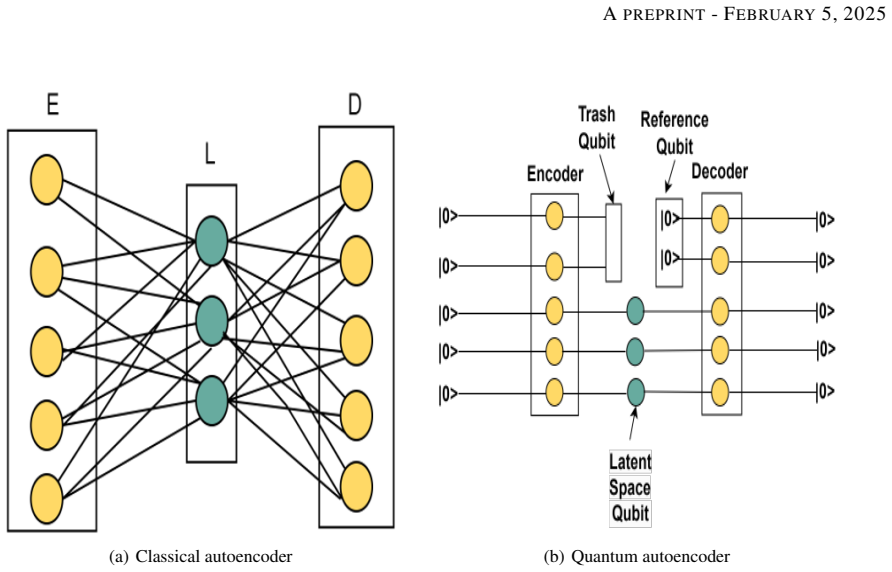
The central object is the PALQA circuit, a modified ZSCNEQR state-connection circuit with the LSB of the X-position qubit designated as the swap/trash qubit. The encoder transmits only the positions of 1s in that LSB bit-plane, and a function generator at the decoder expands them back into a complete LSB plane using two conditions: if all LSBs are zero, generate an all-zero plane; otherwise read and preserve the 1s and their positions. This makes the discarded positional information recoverable with fewer transmitted connections. The gate budget is counted by $B_{\mathrm{state}} = (\log_2 X_0 + 1 + \log_2 Y_0 + 1 - X_{\mathrm{LSB}} + X_{\mathrm{LSB,ones}}) \otimes T_{cnz}$, and the total gates per pixel is $\mathrm{gpp} = B_{\mathrm{total}} / I_s$. The reset gate added after each coefficient connection distinguishes PALQA from the prior ZSCNEQR circuit.
What would settle it
Count the bits that would actually be transmitted in an end-to-end implementation of PALQA, including X- and Y-position bits, swap-qubit 1s, sign and auxiliary bits, and the decoder's function-generation overhead, and compare that bit count with JPEG's bits per pixel at matched PSNR on the same six images; if the gate count does not equal transmitted bits, the claimed RD advantage over JPEG can reverse.
Extended reading notes
Core claim
The core discovery is that position information in a quantum image need not be transmitted in full: the LSB of the X-position qubit carries the least perceptual weight, so the encoder swaps it out as the trash qubit and sends only the locations of its 1s. A decoder-side function-generation rule reconstructs the full LSB plane from those 1s, making position recovery lossless even though the overall codec is lossy due to DCT quantization. With this mechanism, the modified ZSCNEQR encoder connects only non-zero quantized coefficients and removes LSB state-connection gates, so the gate count per pixel falls sharply compared with NZ-NEQR while PSNR stays effectively the same or higher. The paper's claim is that this design yields superior rate-distortion performance against JPEG and other NEQR-based quantum autoencoders on the cameraman, baboon, scenery, peppers, airport, and building grayscale images.
Load-bearing premise
The cost comparison treats every gate in the Quirk circuit as one transmitted bit, identical in cost to one bit in a JPEG file; if gate count and bit count are not the same resource, the rate-distortion claim against JPEG does not follow.
Editorial extensions
If this is right
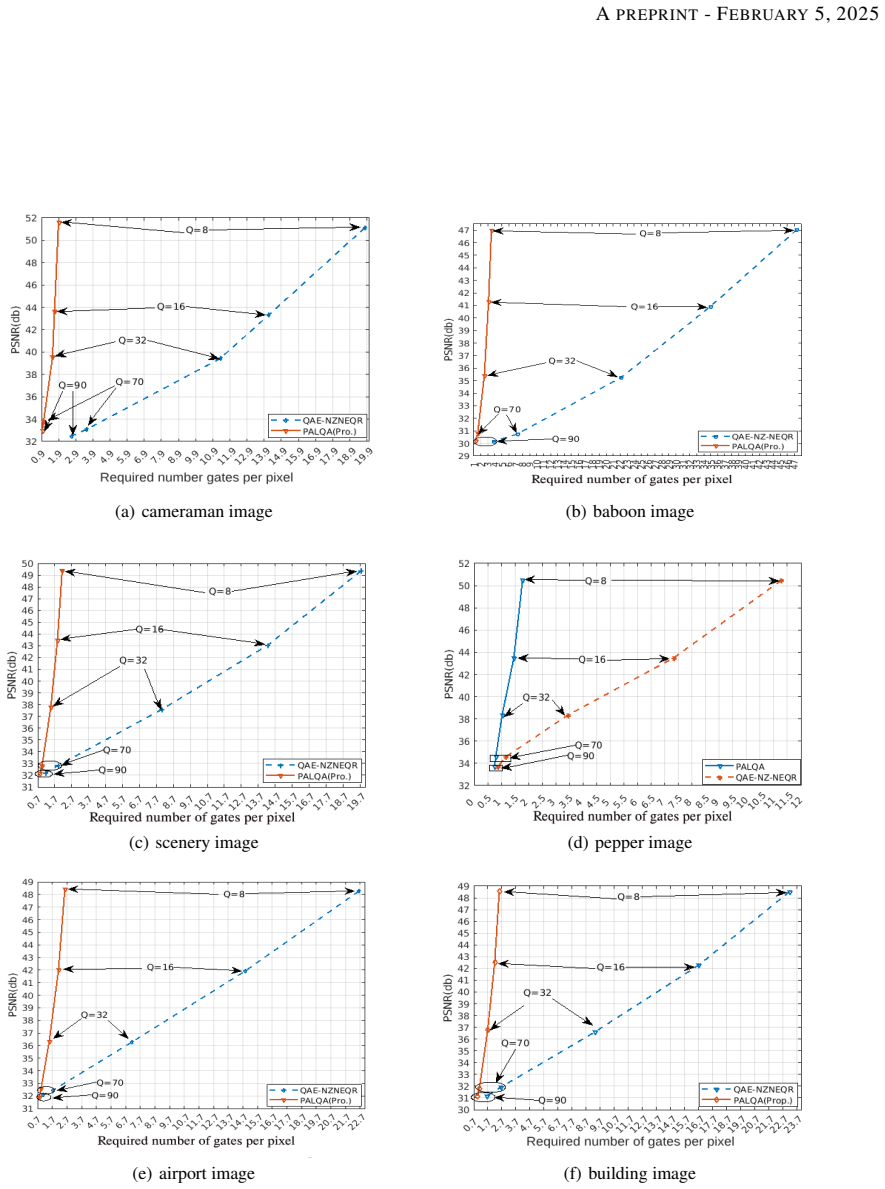
- On the six grayscale benchmarks tested, PALQA reaches a given PSNR with fewer gates than the NZ-NEQR quantum autoencoder; at Q=8 on the airport image it uses 2.56 gates per pixel versus 22.6 for NZ-NEQR.
- Against JPEG, PALQA consistently trades a modest increase in gates per pixel, roughly 0.2 to 0.7 additional gpp, for a PSNR gain of about 4 to 9 dB across the tested images and quantization levels.
- The LSB swap makes positional recovery lossless even though the compression is lossy, because the decoder regenerates the discarded LSB plane from the transmitted positions of 1s.
- Because the circuit is built from a standard NEQR-style representation with DCT quantization, the same encoder-decoder structure can be applied to image sizes representable in that framework, including the 1024x1024 airport image demonstrated here.
Reading between the lines
- The true compression gain may come more from zero-discarding and block DCT quantization than from the LSB swap itself; a controlled ablation that removes the swap while keeping the quantizer fixed would isolate the swap's contribution.
- If the gate-to-bit equivalence is rejected, the method's advantage over JPEG likely shrinks, but its advantage over NZ-NEQR, which is also measured in gates, would probably survive because both use the same cost unit.
- The same LSB-position technique could transfer to other transform-domain quantum representations, such as wavelet or Hadamard transforms, wherever the least significant bit of a position label carries minimal visual energy.
Editorial analysis
A structured set of objections, weighed in public.
Referee Report
Summary. The paper proposes PALQA, a parameterized position-aware lossy quantum autoencoder for grayscale image compression. The method applies block-wise DCT, scalar quantization, and a modified ZSCNEQR state-preparation circuit, then uses the LSB positional qubit of the X-coordinate as a swap qubit and transmits the positions of ones so that the decoder can regenerate the discarded LSB information. The authors report gates-per-pixel (gpp) and PSNR for six benchmark images at several quantization factors and compare these with JPEG (using bits-per-pixel) and with a prior NZ-NEQR-based quantum autoencoder. The central claim is that PALQA achieves superior PSNR and gate counts relative to both baselines.
Significance. If the evaluation were valid, the paper would offer a useful gate-efficient quantum image representation with a concrete circuit and multi-resolution results. The authors give a detailed circuit construction and report PSNR values computed from reconstructed images, which is a reasonable first step. However, the claimed rate-distortion advantage rests on an unsupported identification of quantum gate count with transmitted bit count, and the reported operating points do not show equal-rate superiority. The manuscript provides no code, no machine-checked proofs, and no noise-model analysis, so the quantitative claims are not independently verifiable from the text. Because the central metric is not established, the paper's main contribution cannot be assessed as presented.
major comments (4)
- [Section 3, after Eq. (7)] The identification of circuit gates with transmitted bits is the central unsupported step. The sentence 'the total number of required gates indicates the total number of bits to implement the proposed circuit' equates the gate count of a Quirk simulation with compressed-file length. A gate is a computational primitive, not a unit of bitstream size, and the encoder in Figure 9 transmits classical side information (quantized coefficients, signs, Y-position information, and the LSB swap pattern), not the state-preparation circuit. Consequently the gpp axis in Figures 12 and 13 is not commensurable with the bpp axis of JPEG, and every comparison against JPEG that concludes 'superior in gates and PSNR' is invalid.
- [Section 4, Figure 12(a)] Even if gpp were accepted as a rate measure, no equal-rate operating point is shown. For the cameraman image, PALQA at Q=8 uses 1.89 gpp to reach 51.6 dB, while JPEG at Q=2 uses 1.50 bpp to reach 46.02 dB. The paper repeatedly describes such points as a 'gain' in PSNR plus an 'additional gpp' cost, but a point that spends more rate and returns higher PSNR is not evidence of better rate-distortion performance. To support the abstract's claim, the authors would need to exhibit either higher PSNR at equal or lower rate, or lower rate at equal PSNR.
- [Section 3, Eqs. (6)-(8)] The gpp definition is circular. Equation (7) defines Btotal as qones + Bstate + Bsign + Bauxilary + Bgpp, and Equation (8) defines gpp = Btotal/Is; since Bgpp is described as 'gates per pixel', gpp depends on itself. In addition, Bstate in Eq. (6) mixes qubit labels (XLSB, XLSB,ones) with arithmetic and uses the tensor-product symbol in a way that is not defined; as written the formula cannot be evaluated from the text and is not reproducible.
- [Section 3, decoder conditions] The claimed losslessness refers only to positional recovery ('Since the swap qubit information is fully retrieved, that is why the system is lossless'), while the overall method is lossy because of quantization; this should be stated explicitly. More importantly, the side information actually transmitted—the list of positions of ones in the LSB qubit—is a classical bitstring, and its length is not shown to be included in the gate-count metric. Until the accounting of transmitted bits is reconciled with the gpp definition, the comparison to classical codecs cannot be assessed.
minor comments (4)
- [Section 3, first paragraph] The sentence 'Figure 3 shows the proposed approach architecture compared to the traditional autoencoder Figure.7' appears to refer to Figure 8, not Figure 3; several figure references are mismatched.
- [Throughout] There are repeated typos, including 'Ramora' for 'Romero', 'PLAQA' in the airport-image paragraph, and 'PNSR' for 'PSNR' in the building-image description.
- [Section 4] The paper does not provide the PSNR formula, the Quirk circuit files, or the MATLAB code used to count gates, so the numerical results cannot be reproduced or audited from the text.
- [Section 4] The JPEG quantization table and the scalar quantization factor used for PALQA are not described in enough detail to confirm that the comparison is fair, even setting aside the gpp-versus-bpp issue.
Circularity Check
No significant circularity: gpp and PSNR are computed directly from the circuit and test images, and the self-citations to prior ZSCNEQR/SCMNEQR work are building-block dependencies rather than recycled predictions.
full rationale
The paper's derivation chain is not circular. Equations (1)-(5) define the state-preparation circuit from the quantized DCT coefficients and positional qubits; Equation (6) counts state-connection gates; Equation (7) sums the circuit components; and Equation (8) defines gpp = Btotal/Is. PSNR is then measured from the reconstructed image after dequantization and inverse DCT. Nothing is fitted to the reported PSNR or to the claimed comparison result; the outputs are computed from the circuit construction and the input images, not from the target conclusion. The main weakness is the assertion after Equation (7) that 'the total number of required gates indicates the total number of bits to implement the proposed circuit,' which equates circuit gate count with compressed bitstream length. That is an unsupported unit equivalence and an external validity concern, but it is not an equation that makes the conclusion true by construction, nor is any prediction statistically forced by a fitted input. The authors do rely on their own earlier representation circuits, ZSCNEQR and SCMNEQR, as building blocks; that is self-citation, but the prior circuits are independently checkable state-preparation methods and are not invoked as a uniqueness theorem or as a fitted substitute for the present results. Therefore no step reduces the derivation to its own inputs, and the circularity score is low.
Assumptions & free parameters
free parameters (3)
- Quantization factor Q for PALQA =
8, 16, 32, 60, 70, 90, 110, 120 (per image, chosen after inspection)
- DCT block size =
8x8
- Number of qubits q for quantized transform coefficient =
8
assumptions (4)
- domain assumption DCT plus scalar quantization followed by inverse DCT is a valid lossy image model and PSNR is the correct fidelity measure.
- domain assumption A quantum circuit implemented in the Quirk simulator has the same resource cost as an actual noisy quantum device, and each gate corresponds to one transmitted bit.
- ad hoc to paper The decoder's function generator can reconstruct the discarded LSB positional qubit information from the transmitted list of positions of ones.
- standard math Standard quantum-circuit formalism, including unitary transforms U = I^(q+1) tensor H^n, measurement, and auxiliary qubit reset, is correct as used.
Cite this review
Pith. "Pith review of PALQA: A Novel Parameterized Position-Aware Lossy Quantum Autoencoder using LSB Control Qubit for Efficient Image Compression." pith.science (2026). https://pith.science/paper/IOJYGJXC
@misc{pith2026250202188,
  author       = {Pith},
  title        = {Pith review of: PALQA: A Novel Parameterized Position-Aware Lossy Quantum Autoencoder using LSB Control Qubit for Efficient Image Compression},
  year         = {2026},
  howpublished = {\url{https://pith.science/paper/IOJYGJXC}},
  note         = {Machine review of arXiv:2502.02188}
}
read the original abstract
With the growing interest in quantum computing, quantum image processing technology has become a vital research field due to its versatile applications and ability to outperform classical computing. A quantum autoencoder approach has been used for compression purposes. However, existing autoencoders are limited to small-scale images, and the mechanisms of state compression remain unclear. There is also a need for efficient quantum autoencoders using standard representation approaches and for studying parameterized position-aware control qubits and their corresponding quality measurement metrics. This work introduces a novel parameterized position-aware lossy quantum autoencoder (PALQA) circuit that utilizes the least significant bit control qubit for image compression. The PALQA circuit employs a transformed coefficient block-based modified state connection approach to efficiently compress images at various resolutions. The method leverages compression opportunities in the state-label connection by applying position-aware least significant control qubit. Compared to JPEG and other enhanced quantum representation-based quantum autoencoders, the PALQA circuit demonstrates superior performance in terms of the number of gates required and PSNR metrics.
Figures


Figures from the paper (10 more)


Reference graph
Works this paper leans on
-
[1]
Quantum image compression with autoencoders based on parameterized quantum circuits
Huan Wang, Jiayu Tan, Yu Huang, and Wei Zheng. Quantum image compression with autoencoders based on parameterized quantum circuits. Quantum Information Processing, vol. 23, no. 2, pp. 41, 2024
work page 2024
-
[2]
Paolo Biamonte, Peter Wittek, Nicola Pancotti, Patrick Rebentrost, David Lloyd, and Seth Lloyd. Quantum machine learning. Nature, vol. 549, no. 7671, pp. 195-202, 2017
work page 2017
-
[3]
Quantum support vector machine for big data classification
Patrick Rebentrost, Mohammad Mohseni, and Seth Lloyd. Quantum support vector machine for big data classification. Physical Review Letters, vol. 113, no. 13, pp. 130503, 2014
work page 2014
-
[4]
Quantum principal component analysis.Nature Physics, vol
Seth Lloyd, Mohammad Mohseni, and Patrick Rebentrost. Quantum principal component analysis.Nature Physics, vol. 10, no. 9, pp. 631-633, 2014
work page 2014
-
[5]
Córcoles, Krysta Temme, Aram W
V ojtˇech Havlíˇcek, Antonio D. Córcoles, Krysta Temme, Aram W. Harrow, Alán Kandala, Jerry M. Chow, and Jay M. Gambetta. Supervised learning with quantum-enhanced feature spaces. Nature, vol. 567, no. 7747, pp. 209-212, 2019
work page 2019
-
[6]
Efficient data loading with quantum autoencoder
Shijie Wu, Chao Li, and Hongyu Cheng. Efficient data loading with quantum autoencoder. ICASSP 2023-2023 IEEE International Conference on Acoustics, Speech and Signal Processing (ICASSP), pp. 1-5, 2023
work page 2023
-
[7]
Robert Hecht-Nielsen. Neurocomputing. Addison-Wesley Longman Publishing Co., Inc., 1989
work page 1989
-
[8]
Lov K. Grover. Theory of computing. Proceedings of the 28th Annual ACM Symposium, pp. 212-219, 1996
work page 1996
Show all 44 references
-
[9]
Nielsen and Isaac L
Michael A. Nielsen and Isaac L. Chuang. Quantum computation and quantum information, vol. 2. Cambridge University Press, Cambridge, 2001
2001
-
[10]
Olson, and Alán Aspuru-Guzik
Jonathan Romero, Joseph P . Olson, and Alán Aspuru-Guzik. Quantum autoencoders for efficient compression of quantum data. Quantum Science and Technology, vol. 2, no. 4, pp. 045001, 2017
2017
-
[11]
Noise-assisted quantum autoencoder
Chenfeng Cao and Xin Wang. Noise-assisted quantum autoencoder. Physical Review Applied, vol. 15, no. 5, pp. 054012, 2021
2021
-
[12]
Quantum random access memory
Vittorio Giovannetti, Seth Lloyd, and Lorenzo Maccone. Quantum random access memory. Physical Review Letters, vol. 100, no. 16, pp. 160501, 2008
2008
-
[13]
Kyaw, Tomáš Haug, Sabrina Alperin-Lea, Anantha Anand, Maarten Degroote, Heidi Heimonen, Jan S
Kunal Bharti, Alberto Cervera-Lierta, Thinh H. Kyaw, Tomáš Haug, Sabrina Alperin-Lea, Anantha Anand, Maarten Degroote, Heidi Heimonen, Jan S. Kottmann, Tobias Menke, and others. Noisy intermediate-scale quantum algorithms. Reviews of Modern Physics, vol. 94, no. 1, pp. 015004, 2022
2022
-
[14]
Quantum circuit autoencoder
Jing Wu, Hongyu Fu, Menghao Zhu, Haoran Zhang, Wei Xie, and Xiaodong Li. Quantum circuit autoencoder. Physical Review A, vol. 109, no. 3, pp. 032623, 2024
2024
-
[15]
Green, and Simone Severini
Edward Grant, Maria Benedetti, Shouvanik Cao, Andrew Hallam, James Lockhart, Vladan Stojevic, Andrew G. Green, and Simone Severini. Hierarchical quantum classifiers. npj Quantum Information, vol. 4, no. 1, pp. 65, 2018
2018
-
[16]
R.A. Fisher. Iris. UCI machine learning repository. DOI: https://doi.org/10.24432/C56C76, 1988
1988 doi
-
[17]
Quantum autoencoders for efficient image compression
Filip Igic. Quantum autoencoders for efficient image compression. Lancaster University, pp. 1-36, 2021
2021
-
[18]
P. Q. Le, F. Dong, and K. Hirota. A flexible representation of quantum images for polynomial preparation, image compression, and processing operations. Quantum Information Processing, vol. 10, pp. 63–84, 2011
2011
-
[19]
Zhang, K
Y. Zhang, K. Lu, Y. Gao, and M. Wang. NEQR: a novel enhanced quantum representation of digital images. Quantum Information Processing, vol. 12, pp. 2833–2860, 2013
2013
-
[20]
M. E. Haque, M. Paul, F. Tohidi, A. Ulhaq, and T. Debnath. Enhancing image representation and compression: An innovative Nz-Nqer framework with block truncation quantum coding. In Proceedings of the 2023 International Conference on Digital Image Computing: Techniques and Appli...
2023
-
[21]
M. E. Haque, M. Paul, A. Ulhaq, and T. Debnath. Efficient quantum image representation and compression circuit using zero-discarded state preparation approach. arXiv preprint arXiv:2306.12634, 2023
2023 arXiv
-
[22]
Yang, and C
Giacomo Chiribella, Y . Yang, and C. Huang. Universal super-replication of unitary gates.Physical Review Letters, vol. 114, no. 12, pp. 120504, 2015
2015
-
[23]
Quantum autoencoders for communication- efficient cloud computing
Yao Zhu, Guoming Bai, Yang Wang, Tao Li, and Giacomo Chiribella. Quantum autoencoders for communication- efficient cloud computing. Quantum Machine Intelligence, vol. 5, no. 2, pp. 27, 2023
2023
-
[24]
Bravo-Prieto
C. Bravo-Prieto. Quantum autoencoders with enhanced data encoding.Machine Learning: Science and Technology, vol. 2, no. 3, pp. 035028, 2021. 18 A PREPRINT - FEBRUARY 5, 2025
2021
-
[25]
Pepper, N
A. Pepper, N. Tischler, and G. J. Pryde. Experimental realization of a quantum autoencoder: The compression of qutrits via machine learning. Physical Review Letters, vol. 122, no. 6, pp. 060501, 2019
2019
-
[26]
Buhrman, R
H. Buhrman, R. Cleve, J. Watrous, and R. De Wolf. Quantum fingerprinting. Physical Review Letters, vol. 87, no. 16, pp. 167902, 2001
2001
-
[27]
Huang, H
C. Huang, H. Ma, Q. Yin, J. Tang, D. Dong, C. Chen, G. Xiang, C. Li, and G. Guo. Realization of a quantum autoencoder for lossless compression of quantum data. Physical Review A, vol. 102, no. 3, pp. 032412, 2020
2020
-
[28]
Bondarenko and P
D. Bondarenko and P. Feldmann. Quantum autoencoders to denoise quantum data. Physical Review Letters, vol. 124, no. 13, pp. 130502, 2020
2020
-
[29]
Du and D
Y. Du and D. Tao. On exploring practical potentials of quantum auto-encoder with advantages. arXiv preprint arXiv:2106.15432, 2021
2021 arXiv
-
[30]
Achache, L
T. Achache, L. Horesh, and J. Smolin. Denoising quantum states with quantum autoencoders–Theory and applications. arXiv preprint arXiv:2012.14714, 2020
2012 arXiv
-
[31]
Zhang, L
H. Zhang, L. Wan, T. Haug, W. Mok, S. Paesani, Y. Shi, H. Cai, L. K. Chin, M. F . Karim, L. Xiao, and others. Resource-efficient high-dimensional subspace teleportation with a quantum autoencoder. Science Advances, vol. 8, no. 40, pp. eabn9783, 2022
2022
-
[32]
G. Park, J. Huh, and D. K. Park. Variational quantum one-class classifier. Machine Learning: Science and Technology, vol. 4, no. 1, pp. 015006, 2023
2023
-
[33]
X. Li, X. Cheng, X. Chen, Z. Guan, P . Zhu, and H. Gu. Quantum circuit output prediction based on time-series neural network integration. In Proceedings of the 2024 3rd International Conference on Cryptography, Network Security and Communication Technology, pp. 538–542, 2024
2024
-
[34]
Anand, J
A. Anand, J. S. Kottmann, and A. Aspuru-Guzik. Quantum compression with classically simulatable circuits. arXiv preprint arXiv:2207.02961, 2022
2022 arXiv
-
[35]
C. Chen, M. Watabe, K. Shiba, M. Sogabe, K. Sakamoto, and T. Sogabe. On the expressibility and overfitting of quantum circuit learning. ACM Transactions on Quantum Computing, vol. 2, no. 2, pp. 1–24, 2021
2021
-
[36]
Carrasquilla, D
J. Carrasquilla, D. Luo, F. Pérez, A. Milsted, B. K. Clark, M. V olkovs, and L. Aolita. Probabilistic simulation of quantum circuits using a deep-learning architecture. Physical Review A, vol. 104, no. 3, pp. 032610, 2021
2021
-
[37]
B. Yoon, N. T. T. Nguyen, C. C. Chang, and E. Rrapaj. Lossy compression of statistical data using quantum annealer. Scientific Reports, vol. 12, no. 1, p. 3814, 2022
2022
-
[38]
L. Gong, J. Pei, T. Zhang, and N. Zhou. Quantum convolutional neural network based on variational quantum circuits. Optics Communications, vol. 550, p. 129993, 2024
2024
-
[39]
F . Liu, K. Bian, F . Meng, W. Zhang, and O. Dahlsten. Information compression via hidden subgroup quantum autoencoders. npj Quantum Information, vol. 10, no. 1, p. 74, 2024
2024
-
[40]
M. E. Haque and M. Paul. BLOCK-WISE COMPRESSION OF THE QUANTUM GRAY-SCALE IMAGE USING LOSSY PREPARATION APPROACH. In2024 International Conference on Multimedia and Expo, pp. 1–6, IEEE, 2024
2024
-
[41]
N. Michael. Quirk: Quantum Circuit Simulator. In 2024 International Conference on Multimedia and Expo, August 2024, Quirk
2024
-
[42]
Y . Yu, J. Gao, X. Mu, and S. Wang. Adaptive LSB quantum image watermarking algorithm based on Haar wavelet transforms. Quantum Information Processing, vol. 22, no. 5, p. 180, 2023
2023
-
[43]
Image dataset
Southern California University. Image dataset. Available online: https: // sipi. usc. edu/ database/ ( 2022)
2022
-
[44]
Object and Concept Recognition for Content-Based Image Retrieval
Washington University. Object and Concept Recognition for Content-Based Image Retrieval. Available online: http: // imagedatabase. cs. washington. edu/ 2022. 19
2022
Reviewed August 9, 2026 · model on record in the stance chip above.
Discussion (0). Continue with ORCID to comment.