REVIEW 3 major objections 4 minor 67 references
Dynamical origin of Theia, the last giant impactor on Earth
T0 review · 3 major / 4 minor · reviewed 2026-08-06 · deepseek-v4-flash
Pith's one-line read This paper uses N-body simulations to argue that Theia, the Moon-forming impactor, had roughly 50-50 odds of being a carbonaceous body, and that the required carbonaceous tail must have carried 0.2-0.3 Earth masses mostly in embryos.
desk verdict A transparent and useful N-body test of a carbonaceous Theia, but the headline 50-50 odds are computed over systems that mostly fail the Mars constraint and are likely overstated until conditioned. read the letter →
The pith
A machine-rendered reading of the paper's core claim, the machinery that carries it, and where it could break.
The reading
What carries the argument
The load-bearing machinery is the mixed-scenario set of N-body simulations of terrestrial planet formation: a standard narrow annulus of non-carbonaceous embryos and planetesimals from 0.7 to 1.2 AU, plus 15 carbonaceous embryos of 1-2% Earth masses and 500 carbonaceous planetesimals carrying 0.04 Earth masses, with perihelia between 0.7 and 1.5 AU and aphelia within 5.5 AU, representing material scattered inward by Jupiter and Saturn. The simulations track which bodies collide with the growing planets and when. The annulus model provides the baseline terrestrial-planet architecture; the injected carbonaceous tail supplies the ingredient whose mass and embryo-to-planetesimal split are tuned; and the criteria of radial mass concentration and angular momentum deficit identify which runs count as viable Solar System analogs.
What would settle it
A concrete way to test the claim would be to measure nucleosynthetic isotope anomalies (for example molybdenum, ruthenium, or titanium) in lunar samples that carry the Moon-forming impactor's signature: if the Moon is found to carry no carbonaceous component, the roughly 50-50 prediction for a carbonaceous Theia would be very hard to sustain. A second, dynamical falsifier would be a demonstration that Jupiter could not scatter 0.2-0.3 Earth masses of carbonaceous material into the terrestrial region during its gas-accretion phase.
Extended reading notes
Core claim
On the paper's own terms, the central discovery is that a dynamical model of terrestrial accretion can reproduce Earth's roughly 5-10% carbonaceous mass fraction and Mars's much smaller one while simultaneously making it common for the last giant impactor on Earth to be carbonaceous. In the mixed scenario without an early giant-planet instability, 38.5% of simulations ended with a pure CC embryo as Earth's final impactor and another 13.5% with a non-carbonaceous embryo that had previously accreted a CC embryo, so a carbonaceous-bearing Theia occurred in more than half of cases. The same simulations also produced Earth analogues with about 6% CC mass, Mars analogues with under 1% CC mass when no CC embryo struck Mars, a Moon-forming impact timing of 20-70 Myr in most realizations, and a late accretion phase dominated by dry, non-carbonaceous material, in line with cosmochemical data.
Load-bearing premise
The entire result rests on the assumed initial population of carbonaceous objects: a prescribed set of embryos and planetesimals with chosen masses and orbits is inserted as a proxy for material scattered inward by the giant planets, rather than being produced self-consistently by a model of Jupiter's growth and migration; if that injected population is wrong, the 50-50 odds for a carbonaceous Theia change.
Editorial extensions
If this is right
- If the scenario is right, cosmochemical arguments that Theia was carbonaceous are dynamically supported, not just isotopically inferred.
- The required scattered carbonaceous mass of 0.2-0.3 Earth masses and an embryo-to-planetesimal mass ratio of at least 8 become constraints on the outer Solar System's primordial planetesimal reservoir and on how efficiently the giant planets' cores formed.
- Mars's low carbonaceous fraction would be explained as a stochastic outcome: Mars avoids carbonaceous embryos most of the time, while Earth does not, because of the embryo-dominated mass distribution.
- The Moon-forming impactor need not have been a single large carbonaceous embryo; it could have been a rocky embryo that gained its carbonaceous material earlier, which widens the range of allowed impactor masses.
- A late accretion phase dominated by dry, non-carbonaceous planetesimals follows naturally, consistent with the volatile-depleted late veneer inferred from the Earth-Moon system.
Reading between the lines
- Inference: the 50-50 odds imply a statistical prediction, namely that a population of similar terrestrial-planet systems should show late giant impactors with carbonaceous isotopic signatures in roughly half of cases.
- Inference: replacing the imposed carbonaceous initial conditions with a self-consistent model of gas-drag-assisted inward scattering during Jupiter's growth would either confirm the 0.2-0.3 Earth-mass requirement or reveal it as an artifact of the proxy.
- Inference: the embryo-to-planetesimal ratio of at least 8 suggests that the outer Solar System held several Earth masses of unaccreted embryos near Jupiter and Saturn, a population that might be connected to captured irregular satellites or Trojans, though the paper does not model those bodies.
- Inference: applying the same mixed-scenario approach to exoplanetary systems could predict a correlation between a rocky planet's measured volatile budget and the probability that its last giant impactor carries a carbonaceous isotopic signature.
Editorial analysis
A structured set of objections, weighed in public.
Referee Report
Summary. The paper tests, with N-body simulations of late-stage terrestrial accretion, the cosmochemical proposal that Earth's final giant impactor (Theia) was a carbonaceous (CC) object. Starting from a narrow-annulus population of NC embryos and planetesimals, the authors add inward-scattered CC planetesimals and embryos in three scenarios (small-only, large-only, and mixed), with a subset of runs imposing a simplified giant-planet instability at 20 Myr. They report that the mixed scenario with no instability can match several Solar System constraints, and that in slightly more than half of those runs Earth's last giant impactor contains a CC component: 38.5% as a pure CC embryo and 13.5% as an NC embryo that previously accreted a CC embryo. They interpret this as roughly 50-50 odds that Theia was carbonaceous and derive constraints on the total scattered CC mass and embryo-to-planetesimal mass ratio.
Significance. If the central claim is robust, the paper provides a dynamical validation of a specific and debated cosmochemical scenario, and it sharpens the discussion of how Earth's carbonaceous budget was delivered. The study is transparent about its main simplifications, uses a standard integrator and standard initial-condition choices, and directly compares three different CC delivery populations, which is a useful approach. However, the headline quantitative claim depends on a statistical conditioning that the paper does not report, and the derived 'constraints' are closely tied to hand-tuned input choices; these issues are load-bearing for the abstract's claim rather than mere presentational shortcomings.
major comments (3)
- [Sec. 3.3 and Sec. 3.2] The headline 50-50 probability for a carbonaceous Theia is computed over a set of runs that includes many systems violating the paper's own Mars constraint. Section 3.3 reports 38.5% pure-CC and 13.5% mixed-CC final impactors, but Section 3.2 states that in 62.5% of the mixed runs satisfying the Earth/Mars mass-ratio selection, the Mars analog was hit by a CC embryo and its CC fraction jumped above 10%, inconsistent with the observed Mars CC fraction of at most a few percent. The paper does not report the conditional probability P(carbonaceous Theia | Mars CC fraction <= 2-3%). Since the abstract describes these as 'viable systems,' the odds should be computed only on runs that pass the Mars constraint, or at minimum the conditional and unconditional numbers should both be given. This is a direct internal statistical gap rather than an external modeling assumption.
- [Sec. 2.2 and Sec. 4] The paper presents ~0.2-0.3 Earth masses of total CC material and an embryo-to-planetesimal mass ratio of about 8 as constraints, but these values are largely imprinted by the hand-tuned initial conditions. The mixed scenario was initialized with 15 CC embryos of 1-2% Earth masses and 0.04 Earth masses of CC planetesimals, with the authors stating that they 'adjusted the mass of CC objects to try to keep the mass of the terrestrial planets close to their actual values.' The later estimate of an ~8:1 ratio and the total CC mass is then derived from the same simulations, so it is a back-calculation rather than an independent constraint. To support the abstract's claim that 'for this scenario to work' these values are required, the paper should test the sensitivity of the outcome to the assumed number, mass, and orbital distribution of CC embryos and planetesimals, or at least explicitly frame these as posterior properties of the chosen model rather than as robust constraints.
- [Sec. 2.2 and Sec. 3.3] The 50-50 odds are sensitive to the imposed orbital distribution of CC bodies, which is not varied or self-consistently produced. All mixed runs place CC embryos with perihelia uniformly drawn between 0.7 and 1.5 AU and aphelia up to 5.5 AU; this directly sets how many CC embryos are initially on Earth-crossing orbits and therefore controls the probability of a CC-bearing final impactor. The paper acknowledges that the injection is not modeled self-consistently, but it does not quantify how the headline probability would change under plausible alternative distributions (e.g., a population more concentrated near the asteroid belt or delivered later). This is a load-bearing uncertainty for the claim that there are 'roughly 50-50 odds' rather than merely for the precise value of the probability.
minor comments (4)
- [Highlights and Abstract] The extracted text contains numerous missing spaces and typographical artifacts (e.g., 'WeranN-bodysimulations', 'inroughly50%', 'mixedsimulations'); the manuscript should be carefully proofread before publication.
- [Sec. 3.2] The terminology is inconsistent: the paper refers to the 'large only' scenario in Section 2.2 and elsewhere to the 'big only' scenario in Section 3.2; these should be unified.
- [Figure 8] The denominators for the reported percentages (38.5%, 13.5%) are not stated in the caption or text; the reader cannot tell whether these are fractions of all 60 runs, of the 41 runs with Earth analogs, or of some other subset. This should be stated explicitly, and binomial confidence intervals should be given for the headline proportion.
- [Sec. 3.4 and Figure 11] The discussion of late accretion would benefit from a quantitative statement of how many of the mixed runs actually satisfy the NC-dominated late-accretion constraint, since Figure 11 shows a range of outcomes and the text describes only general trends.
Circularity Check
Partial circularity: the inferred CC mass and embryo:planetesimal constraints are back-calculated from the assumed CC population and observed fractions, but the Theia-composition odds are an emergent N-body result.
-
fitted input called prediction
[Sec. 4 (Summary and Discussion), 'Using our results as a guide...' paragraph; initial conditions in Sec. 2.2]
"Using our results as a guide, we can estimate the initial mass in CC planetesimals relative to CC embryos as follows. ... adopt a Mars total CC mass fraction of ~0.5% and a value of ~6% for Earth. ... There must therefore have been ~8 times more mass in CC embryos than in CC planetesimals. ... Put together, this reasoning implies that the total mass in CC material injected into the inner Solar System was ~0.2-0.3 M⊕, with a ~8:1 mass division between embryos and planetesimals."
The mixed scenario was initialized with 15 CC embryos of 1-2% Earth masses (total 0.15-0.30 M⊕) and 500 CC planetesimals of total 0.04 M⊕, so the total CC mass and embryo:planetesimal ratio were inputs (0.19-0.34 M⊕; roughly 4-7.5:1). The 'constraint' in Sec. 4 is obtained by inserting the same observed Earth and Mars CC fractions used to motivate the scenario into the simulation's median accretion fractions, recovering essentially the assumed total mass and an even stronger embryo dominance. The abstract presents this back-calculation as a necessary condition ('For this scenario to work, the total mass ... must have been ~0.2-0.3 M⊕'), so the claimed constraint is not an independent prediction but a restatement of the chosen population combined with the target observations.
full rationale
The central dynamical claim—that Earth's last giant impactor contains a CC component in roughly half of the mixed no-instability runs—is an emergent outcome of N-body integrations and is not itself fixed by the initial CC population; the same population can produce dry, pure-CC, or mixed final impactors. I therefore do not regard the 50-50 headline as circular. However, the paper's stated 'constraints' on the total CC mass and embryo:planetesimal ratio are weaker: the model was set up with a CC population in that range, and the Section 4 estimate uses the same observed Earth/Mars CC fractions as inputs, so those constraints are consistency conditions rather than independent predictions. The paper is transparent about imposing the CC population rather than modeling its injection self-consistently, and the Mars-conditioning issue raised by the skeptic is a statistical limitation, not a circularity. On balance: one partial circularity in a secondary constraint, while the central claim remains independent.
Assumptions & free parameters
free parameters (11)
- Annulus radius =
0.7 to 1.2 AU
- Surface density normalization Σ1 =
20.48 g/cm^2
- Total NC embryo mass =
2 M⊕
- Total NC planetesimal mass =
0.25 M⊕
- CC total mass in mixed scenario =
0.19-0.34 M⊕
- Number of CC embryos =
15 (mixed) or 25 (large only)
- CC embryo mass range =
1-2% M⊕
- CC planetesimal total mass (mixed) =
0.04 M⊕
- CC orbital distribution =
q in 0.7-1.5 AU, i Rayleigh σ=2.5, Q≤5.5 AU
- Giant planet instability timing =
20 Myr
- Jupiter and Saturn initial orbits =
a=5.43, 7.30 AU, 3:2 resonance
assumptions (6)
- domain assumption The annulus model (narrow ring of embryos and planetesimals) is a valid starting point for terrestrial planet formation.
- domain assumption Carbonaceous material was scattered inward by Jupiter and Saturn's rapid gas accretion and can be represented by an initial population of CC embryos and planetesimals on planet-crossing orbits.
- domain assumption The NC/CC isotopic dichotomy maps to inner/outer solar system material as commonly assumed.
- ad hoc to paper The giant planet dynamical instability can be approximated by an instantaneous jump of Jupiter and Saturn to their present-day orbits at 20 Myr.
- domain assumption Planetesimals do not interact gravitationally with each other (test particle approximation).
- domain assumption Collisions are treated as inelastic mergers.
Cite this review
Pith. "Pith review of Dynamical origin of Theia, the last giant impactor on Earth." pith.science (2026). https://pith.science/paper/IOTHVNIO
@misc{pith2026250701826,
  author       = {Pith},
  title        = {Pith review of: Dynamical origin of Theia, the last giant impactor on Earth},
  year         = {2026},
  howpublished = {\url{https://pith.science/paper/IOTHVNIO}},
  note         = {Machine review of arXiv:2507.01826}
}
abstract
Cosmochemical studies have proposed that Earth accreted roughly 5-10% of its mass from carbonaceous (CC) material, with a large fraction delivered late via its final impactor, Theia (the Moon-forming impactor). Here, we evaluate this idea using dynamical simulations of terrestrial planet formation, starting from a standard setup with a population of planetary embryos and planetesimals laid out in a ring centered between Venus and Earth's orbits, and also including a population of CC planetesimals and planetary embryos scattered inward by Jupiter. We find that this scenario can match a large number of constraints, including i) the terrestrial planets' masses and orbits; ii) the CC mass fraction of Earth; iii) the much lower CC mass fraction of Mars, as long as Mars only accreted CC planetesimals (but no CC embryos); iv) the timing of the last giant (Moon-forming) impact; and v) a late accretion phase dominated by non-carbonaceous (NC) bodies. For this scenario to work, the total mass in scattered CC objects must have been ~ 0.2 - 0.3 M$_{\oplus}$ , with an embryo-to-planetesimal mass ratio of at least 8, and CC embryos in the ~ 0.01 - 0.05 M$_{\oplus}$ mass range. In that case, our simulations show there are roughly 50-50 odds of Earth's last giant impactor (Theia) having been a carbonaceous object - either a pure CC embryo or an NC embryo that previously accreted a CC embryo. Our simulations thus provide dynamical validation of cosmochemical studies.
Figures


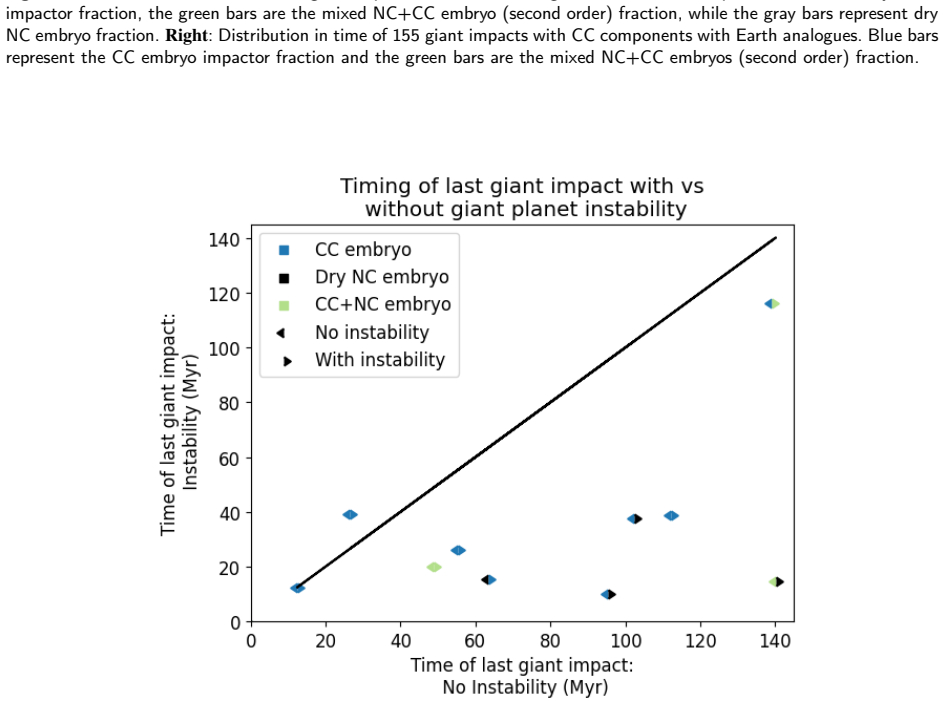
Figures from the paper (8 more)




Reference graph
Works this paper leans on
-
[5]
Space Science Reviews 205, 41–75
Dust Evolution and the Formation of Planetesimals. Space Science Reviews 205, 41–75. doi:10.1007/s11214-016-0256-1, arXiv:1604.02952. Bottke, W.F., Walker, R.J., Day, J.M.D., Nesvorny, D., Elkins-Tanton, L., 2010a. Stochastic Late Accretion to Earth, the Moon, and Mars. Science 330,
-
[7]
doi:10.1126/science.1196874. Brasser, R., Mojzsis, S.J.,
-
[12]
Monthly Notices of the Royal Astronomical Society 304, 793–799
A hybrid symplectic integrator that permits close encounters between massive bodies. Monthly Notices of the Royal Astronomical Society 304, 793–799. doi:10.1046/j.1365-8711.1999.02379.x. Chambers, J., Wetherill, G.,
arXiv 1999
-
[20]
Can a jumping-Jupiter trigger the Moon's formation impact?
Can a jumping-Jupiter trigger the Moon’s formation impact? Monthly Notices of the Royal Astronomical Society 507, 539–547. doi:10.1093/mnras/stab2188, arXiv:2107.04181. Drążkowska,J.,Alibert,Y.,2017.Planetesimalformationstartsatthesnowline.AstronomyandAstrophysics608,A92.doi: 10.1051/0004-6361/ 201731491, arXiv:1710.00009. Drążkowska, J., Alibert, Y., Moore, B.,
work page Pith review arXiv 2017
-
[21]
Astronomy & Astrophysics 594, A105
Close-in planetesimal formation by pile-up of drifting pebbles. Astronomy & Astrophysics 594, A105. doi:10.1051/0004-6361/201628983, arXiv:1607.05734. Drążkowska, J., Dullemond, C.P.,
-
[22]
Planetesimal formation during protoplanetary disk buildup
Planetesimal formation during protoplanetary disk buildup. Astronomy & Astrophysics 614, A62. doi:10.1051/0004-6361/201732221, arXiv:1803.00575. Edwards, G.H., Keller, C.B., Newton, E.R., Stewart, C.W.,
-
[23]
An early giant planet instability recorded in asteroidal meteorites
An early giant planet instability recorded in asteroidal meteorites. Nature Astronomy 8, 1264–1276. doi:10.1038/s41550-024-02340-6, arXiv:2309.10906. Fischer, R.A., Ciesla, F.J.,
-
[24]
Dry Late Accretion inferred from Venus' coupled atmosphere and internal evolution
Dynamics of the terrestrial planets from a large number of N-body simulations. Earth and Planetary Science Letters 392, 28–38. doi:10.1016/j.epsl.2014.02.011. Fischer,R.A.,Nimmo,F.,2018.Effectsofcoreformationonthehf-wisotopiccompositionoftheearthanddatingofthemoon-formingimpact.Earth and Planetary Science Letters 499, 257–265. URL:https://www.sciencedirec...
work page Pith review arXiv 2014
Show all 67 references
-
[27]
The Astrophysical Journal 703, 1131–1140
Formation of the Terrestrial Planets from a Narrow Annulus. The Astrophysical Journal 703, 1131–1140. doi:10.1088/ 0004-637X/703/1/1131, arXiv:0908.0743. Hunt,A.C.,Theis,K.J.,Rehkämper,M.,Benedix,G.K.,Andreasen,R.,Schönbächler,M.,2022. Thedissipationofthesolarnebulaconstrained...
-
[29]
Nature 508, 84–87
Highly siderophile elements in earth’s mantle as a clock for the moon-forming impact. Nature 508, 84–87. URL:https://doi.org/10.1038/nature13172, doi:10.1038/nature13172. Johansen, A., Blum, J., Tanaka, H., Ormel, C., Bizzarro, M., Rickman, H.,
-
[30]
(Eds.), Protostars and Planets VI, pp
The Multifaceted Planetesimal Formation Process, in: Beuther, H., Klessen, R.S., Dullemond, C.P., Henning, T. (Eds.), Protostars and Planets VI, pp. 547–570. doi:10.2458/azu_uapress_ 9780816531240-ch024, arXiv:1402.1344. Joiret,S.,Raymond,S.N.,Avice,G.,Clement,M.S.,2024.Crashc...
-
[31]
Icarus 252, 161–174
The feeding zones of terrestrial planets and insights into moon formation. Icarus 252, 161–174. URL: http://dx.doi.org/10.1016/j.icarus.2015.01.013, doi:10.1016/j.icarus.2015.01.013. Kleine, T., Steller, T., Burkhardt, C., Nimmo, F.,
2015 doi
-
[33]
Geochimica et Cosmochimica Acta 73, 5150–5188
Hf-W chronology of the accretion and early evolution of asteroids and terrestrial planets. Geochimica et Cosmochimica Acta 73, 5150–5188. doi:10.1016/j.gca. 2008.11.047. Kokubo, E., Ida, S.,
2008 doi
-
[34]
Icarus 131, 171–178
Oligarchic growth of protoplanets. Icarus 131, 171–178. URL:https://www.sciencedirect.com/science/ article/pii/S0019103597958401, doi:https://doi.org/10.1006/icar.1997.5840. Kokubo,E.,Ida,S.,2000. FormationofProtoplanetsfromPlanetesimalsintheSolarNebula. Icarus143,15–27. doi: ...
1997
-
[35]
ProceedingsoftheNationalAcademyofSciences114,6712–6716
Age of jupiter inferred from the distinct genetics and formation times of meteorites. ProceedingsoftheNationalAcademyofSciences114,6712–6716. URL: https://www.pnas.org/doi/abs/10.1073/pnas.1704461114, doi:https://doi.org/10.1073/pnas.1704461114, arXiv:https://www.pnas.org/doi/...
-
[37]
Planetesimals to Protoplanets. I. Effect of Fragmentation on Terrestrial Planet Formation. The Astrophysical Journal 625, 427–440. doi:10.1086/429402. Levison, H.F., Morbidelli, A., Tsiganis, K., Nesvorný, D., Gomes, R.,
-
[39]
Science 379, 369–372
Nucleosynthetic isotope anomalies of zinc in meteorites constrain the origin of Earth’s volatiles. Science 379, 369–372. doi:10.1126/science.abn1021. Mojzsis, S.J., Brasser, R., Kelly, N.M., Abramov, O., Werner, S.C., 2019a. Onset of Giant Planet Migration before 4480 Million ...
-
[41]
Morbidelli, A., Baillié, K., Batygin, K., Charnoz, S., Guillot, T., Rubie, D.C., Kleine, T.,
doi:10.3847/1538-4357/ab2c03, arXiv:1903.08825. Morbidelli, A., Baillié, K., Batygin, K., Charnoz, S., Guillot, T., Rubie, D.C., Kleine, T.,
1903 arXiv
-
[43]
Annual Review of Earth and Planetary Sciences 40, 251–275
Building Terrestrial Planets. Annual Review of Earth and Planetary Sciences 40, 251–275. doi:10.1146/annurev-earth-042711-105319, arXiv:1208.4694. Morbidelli,A.,Nesvorny,D.,Laurenz,V.,Marchi,S.,Rubie,D.C.,Elkins-Tanton,L.,Wieczorek,M.,Jacobson,S.,2018. Thetimelineofthelunar bo...
-
[45]
Earth and Planetary Science Letters 626, 118521
Isotopic trichotomy of main belt asteroids from implantation of outer solar system planetesimals. Earth and Planetary Science Letters 626, 118521. doi:10.1016/j.epsl.2023.118521, arXiv:2311.16053. Nesvorný,D.,Vokrouhlický,D.,Bottke,W.F.,Levison,H.F.,2018. Evidenceforveryearlym...
2023
-
[46]
Annual Review of Astronomy and Astrophysics 56, 137–174
Dynamical evolution of the early solar system. Annual Review of Astronomy and Astrophysics 56, 137–174. URL: http://dx.doi.org/10.1146/annurev-astro-081817-052028, doi:10.1146/annurev-astro-081817-052028. Nesvorný,D.,Roig,F.V.,Deienno,R.,2021. Theroleofearlygiant-planetinstabi...
-
[49]
grand tack
Water delivery and giant impacts in the "grand tack" scenario. Icarus 239, 74–84. URL: https://www.sciencedirect.com/science/article/pii/S0019103514002620, doi:https://doi.org/ 10.1016/j.icarus.2014.05.009. Ormel, C.W., Klahr, H.H.,
2014 doi
-
[50]
Nimmo,F.,Kleine,T.,Morbidelli,A.,2024a
URL: https://dx.doi.org/10.3847/1538-3881/abc8ef, doi:10.3847/1538-3881/abc8ef. Nimmo,F.,Kleine,T.,Morbidelli,A.,2024a. Tidallydrivenremeltingaround4.35billionyearsagoindicatestheMoonisold. Nature636,598–602. doi:10.1038/s41586-024-08231-0. Nimmo, F., Kleine, T., Morbidelli, A...
-
[52]
Astronomy and Astrophysics 623, A169
Consequences of planetary migration on the minor bodies of the early solar system. Astronomy and Astrophysics 623, A169. doi:10.1051/0004-6361/201833713, arXiv:1902.04591. Rauch, K.P., Holman, M.,
1902 arXiv
-
[53]
The Astronomical Journal 117, 1087–1102
Dynamical Chaos in the Wisdom-Holman Integrator: Origins and Solutions. The Astronomical Journal 117, 1087–1102. doi:10.1086/300720, arXiv:astro-ph/9803340. Raymond, S.N., Izidoro, A.,
-
[54]
Science Advances 3, e1701138
The empty primordial asteroid belt. Science Advances 3, e1701138. URL: https://www.science.org/doi/abs/10.1126/sciadv.1701138, doi: 10.1126/sciadv.1701138, arXiv:https://www.science.org/doi/pdf/10.1126/sciadv.1701138. Raymond, S.N., Izidoro, A., 2017a. Origin of water in the i...
-
[55]
Uni- versity of Arizona Press
Terrestrial Planet Formation at Home and Abroad. Uni- versity of Arizona Press. URL: http://dx.doi.org/10.2458/azu_uapress_9780816531240-ch026, doi:10.2458/azu_uapress_ 9780816531240-ch026. Duarte Branco et al.:Preprint submitted to Elsevier Page 19 of 20 Raymond, S.N., Morbid...
-
[56]
(Eds.), Demographics of Exoplanetary Systems, Lecture Notes of the 3rd Advanced School on Exoplanetary Science, pp
Planet Formation: Key Mechanisms and Global Models, in: Biazzo, K., Bozza, V., Mancini, L., Sozzetti, A. (Eds.), Demographics of Exoplanetary Systems, Lecture Notes of the 3rd Advanced School on Exoplanetary Science, pp. 3–82. doi:10.1007/ 978-3-030-88124-5_1 , arXiv:2002.0575...
-
[57]
Icarus 203, 644–662
Building the terrestrial planets: Constrained accretion in the inner Solar System. Icarus 203, 644–662. doi:10.1016/j.icarus.2009.05.016, arXiv:0905.3750. Raymond,S.N.,Quinn,T.,Lunine,J.I.,2005. Terrestrialplanetformationindiskswithvaryingsurfacedensityprofiles. TheAstrophysic...
2009 arXiv
-
[58]
Terrestrial accretion and dynamics
High-resolution simulations of the final assembly of Earth-like planets I. Terrestrial accretion and dynamics. Icarus 183, 265–282. doi:10.1016/j.icarus.2006.03.011, arXiv:astro-ph/0510284. Raymond, S.N., Schlichting, H.E., Hersant, F., Selsis, F.,
2006 arXiv
-
[60]
Icarus 248, 89–108
Accretion and differentiation of the terrestrial planets with implications for the compositions of early-formed Solar System bodies and accretion of water. Icarus 248, 89–108. doi:10.1016/j.icarus.2014.10.015, arXiv:1410.3509. Savage,P.S.,Moynier,F.,Boyet,M.,2022. Zincisotopea...
2014 arXiv
-
[61]
Icarus 339, 113605
Dynamical evidence for an early giant planet instability. Icarus 339, 113605. URL: https://www.sciencedirect.com/science/article/pii/S0019103519301332, doi:https: //doi.org/10.1016/j.icarus.2019.113605. Steller,T.,Burkhardt,C.,Yang,C.,Kleine,T.,2022. Nucleosyntheticzincisotope...
2019
-
[63]
Chemie der Erde / Geochemistry 69, 101–125
Highly siderophile elements in the Earth, Moon and Mars: Update and implications for planetary accretion and differentiation. Chemie der Erde / Geochemistry 69, 101–125. doi:10.1016/j.chemer.2008.10.001. Walsh, K.J., Morbidelli, A., Raymond, S.N., O’Brien, D.P., Mandell, A.M.,
2008 doi
-
[65]
Earth and Planetary Science Letters 311, 93–100
Stable-isotopic anomalies and the accretionary assemblage of the earth and mars: A subordinate role for carbonaceous chondrites. Earth and Planetary Science Letters 311, 93–100. URL: https://www.sciencedirect.com/science/article/pii/ S0012821X11005115, doi:https://doi.org/10.1...
-
[67]
Icarus 396, 115497
Terrestrial planet formation from a ring. Icarus 396, 115497. URL: http://dx.doi.org/10.1016/j.icarus.2023.115497, doi:10.1016/j.icarus.2023.115497. Worsham, E.A., Kleine, T.,
2023
-
[68]
Science Advances 7, eabh2837
Late accretionary history of Earth and Moon preserved in lunar impactites. Science Advances 7, eabh2837. doi:10.1126/sciadv.abh2837. Zhu, M.H., Morbidelli, A., Neumann, W., Yin, Q.Z., Day, J.M.D., Rubie, D.C., Archer, G.J., Artemieva, N., Becker, H., Wünnemann, K.,
-
[69]
Nature Astronomy 5, 1286–1296
Common feedstocks of late accretion for the terrestrial planets. Nature Astronomy 5, 1286–1296. doi:10.1038/s41550-021-01475-0. Duarte Branco et al.:Preprint submitted to Elsevier Page 20 of 20
-
[152]
Lichtenberg,T.,Drążkowska,J.,Schönbächler,M.,Golabek,G.J.,Hands,T.O.,2021
doi:10.1088/0004-6256/142/5/152. Lichtenberg,T.,Drążkowska,J.,Schönbächler,M.,Golabek,G.J.,Hands,T.O.,2021. BifurcationofplanetarybuildingblocksduringSolarSystem formation. Science 371, 365–370. doi:10.1126/science.abb3091, arXiv:2101.08571. Liu,B.,Raymond,S.N.,Jacobson,S.A.,2...
2021 arXiv
-
[217]
DeSouza, S.R., Roig, F., Nesvorný, D.,
doi:10.1126/science.1133355. DeSouza, S.R., Roig, F., Nesvorný, D.,
-
[1052]
Canup, R.M., Asphaug, E., 2001a
doi:10.1126/science.1226073. Canup, R.M., Asphaug, E., 2001a. Origin of the Moon in a giant impact near the end of the Earth’s formation. Nature 412, 708–712. doi:10.1038/35089010. Canup, R.M., Asphaug, E., 2001b. Origin of the Moon in a giant impact near the end of the Earth’...
-
[1990]
Annual Review of Earth and Planetary Sciences 18, 205–256
Formation of the earth. Annual Review of Earth and Planetary Sciences 18, 205–256. doi:10.1146/annurev.ea.18. 050190.001225. Wetherill,G.W.,Stewart,G.R.,1993. FormationofPlanetaryEmbryos:EffectsofFragmentation,LowRelativeVelocity,andIndependentVariation of Eccentricity and Inc...
1993
-
[1996]
Icarus 119, 261–268
The Stability of Multi-Planet Systems. Icarus 119, 261–268. doi:10.1006/icar.1996.0019. Clement, M.S., Kaib, N.A., Raymond, S.N., Walsh, K.J.,
1996
-
[1998]
Icarus 136, 304–327
Making the terrestrial planets: N-body integrations of planetary embryos in three dimensions. Icarus 136, 304–327. URL: https://www.sciencedirect.com/science/article/pii/S0019103598960079, doi:https://doi.org/10.1006/ icar.1998.6007. Chambers, J.E.,
-
[1999]
Icarus 142, 219–237
On the Character and Consequences of Large Impacts in the Late Stage of Terrestrial Planet Formation. Icarus 142, 219–237. doi:10.1006/icar.1999.6201. Armitage, P.J., Eisner, J.A., Simon, J.B.,
1999
-
[2001]
Icarus 152, 205–224
Making More Terrestrial Planets. Icarus 152, 205–224. doi:10.1006/icar.2001.6639. Chambers, J.E., Wetherill, G.W., Boss, A.P.,
2001
-
[2003]
Icarus 161, 431–455
Oligarchic growth of giant planets. Icarus 161, 431–455. doi:10.1016/S0019-1035(02) 00043-X, arXiv:astro-ph/0303269. Tsiganis, K., Gomes, R., Morbidelli, A., Levison, H.F.,
-
[2005]
Nature 435, 466–469
Origin of the cataclysmic Late Heavy Bombardment period of the terrestrial planets. Nature 435, 466–469. doi:10.1038/nature03676. Hansen, B.M.S.,
-
[2006]
Icarus 184, 39–58
Terrestrial planet formation with strong dynamical friction. Icarus 184, 39–58. doi:10.1016/ j.icarus.2006.04.005. O’Brien, D.P., Walsh, K.J., Morbidelli, A., Raymond, S.N., Mandell, A.M.,
2006
-
[2007]
The Astronomical Journal 134, 1790–1798
Dynamics of the Giant Planets of the Solar System in the Gaseous Protoplanetary Disk and Their Relationship to the Current Orbital Architecture. The Astronomical Journal 134, 1790–1798. doi:10.1086/ 521705, arXiv:0706.1713. Morbidelli, A., Wood, B.J., 2015a. Late Accretion and...
-
[2008]
Astronomy and Astrophysics 482, 333–340
Constraints on resonant-trapping for two planets embedded in a protoplanetary disc. Astronomy and Astrophysics 482, 333–340. doi:10.1051/0004-6361:20079062, arXiv:0802.2033. Pirani, S., Johansen, A., Bitsch, B., Mustill, A.J., Turrini, D.,
-
[2009]
The Astrophysical Journal 703, 1131–1140
Formation of the terrestrial planets from a narrow annulus. The Astrophysical Journal 703, 1131–1140. URL: http://dx.doi.org/10.1088/0004-637X/703/1/1131, doi:10.1088/0004-637x/703/1/1131. Hansen, B.M.S.,
-
[2010]
Analytical expressions for the accretion of small bodies in laminar disks
The effect of gas drag on the growth of protoplanets. Analytical expressions for the accretion of small bodies in laminar disks. Astronomy and Astrophysics 520, A43. doi:10.1051/0004-6361/201014903, arXiv:1007.0916. Pierens, A., Nelson, R.P.,
-
[2011]
Nature 475, 206–209
A low mass for Mars from Jupiter’s early gas-driven migration. Nature 475, 206–209. doi:10.1038/nature10201, arXiv:1201.5177. Warren, P.H.,
-
[2012]
Astronomy & Astrophysics 544, A32
Rapid growth of gas-giant cores by pebble accretion. Astronomy & Astrophysics 544, A32. doi:10.1051/ 0004-6361/201219127, arXiv:1205.3030. Duarte Branco et al.:Preprint submitted to Elsevier Page 18 of 20 Laskar, J.,
-
[2013]
Icarus 226, 671–681
Dynamical and collisional constraints on a stochastic late veneer on the terrestrial planets. Icarus 226, 671–681. doi:10.1016/j.icarus.2013.06.019, arXiv:1306.4325. Rubie, D.C., Jacobson, S.A., Morbidelli, A., O’Brien, D.P., Young, E.D., de Vries, J., Nimmo, F., Palme, H., Fr...
2013 arXiv
-
[2014]
Philosophical Transactions of the Royal Society of London Series A 372, 20130260–20130260
The iodine-plutonium-xenon age of the Moon-Earth system revisited. Philosophical Transactions of the Royal Society of London Series A 372, 20130260–20130260. doi:10.1098/rsta.2013.0260, arXiv:1511.00952. Benz, W., Slattery, W.L., Cameron, A.G.W.,
2013
-
[2015]
Monthly Notices of the Royal Astronomical Society 453, 3619–3634
Terrestrial planet formation constrained by Mars and the structure of the asteroid belt. Monthly Notices of the Royal Astronomical Society 453, 3619–3634. doi:10.1093/mnras/stv1835, arXiv:1508.01365. Jacobson, S.A., Morbidelli, A., Raymond, S.N., O’Brien, D.P., Walsh, K.J., Ru...
-
[2016]
The Astrophysical Journal Letters 828, L2
Prompt Planetesimal Formation beyond the Snow Line. The Astrophysical Journal Letters 828, L2. doi:10.3847/2041-8205/828/1/L2, arXiv:1608.03592. Avice, G., Marty, B.,
-
[2017]
Nature 541, 521–524
The isotopic nature of the Earth’s accreting material through time. Nature 541, 521–524. doi:10.1038/nature20830. Duarte Branco et al.:Preprint submitted to Elsevier Page 17 of 20 Dauphas, N., Hopp, T., Nesvorný, D.,
-
[2018]
Icarus 311, 340–356
Mars’ growth stunted by an early giant planet instability. Icarus 311, 340–356. doi:10.1016/j.icarus.2018.04.008, arXiv:1804.04233. Ćuk,M.,Stewart,S.T.,2012. MakingtheMoonfromaFast-SpinningEarth:AGiantImpactFollowedbyResonantDespinning. Science338,1047. doi:10.1126/science.122...
2018 arXiv
-
[2019]
Nature Astronomy 3, 736–741
Molybdenum isotopic evidence for the late accretion of outer solar system material to earth. Nature Astronomy 3, 736–741. URL:https://doi.org/10.1038/s41550-019-0779-y, doi:10.1038/s41550-019-0779-y. Canup, Robin M. Righter, K., Dauphas, N., Pahlevan, K., Ćuk, M., Lock, S.J., ...
-
[2020]
Nature Astronomy 4, 492–499
The partitioning of the inner and outer Solar System by a structured protoplanetary disk. Nature Astronomy 4, 492–499. doi:10.1038/s41550-019-0978-6. Budde, G., Burkhardt, C., Kleine, T.,
-
[2021]
arXiv e-printsarXiv:2103.02045
Origin of the Moon. arXiv e-printsarXiv:2103.02045. Canup, R.M.,
-
[2022]
Nature Astronomy 6, 72–79
Contemporary formation of early Solar System planetesimals at two distinct radial locations. Nature Astronomy 6, 72–79. doi:10.1038/s41550-021-01517-7, arXiv:2112.15413. Morbidelli, A., Lunine, J.I., O’Brien, D.P., Raymond, S.N., Walsh, K.J.,
-
[2023]
Icarus 397, 115519.URL: https://www.sciencedirect.com/science/article/pii/S0019103523000969,doi: https://doi.org/10.1016/j
An inner solar system origin of volatile elements in mars. Icarus 397, 115519.URL: https://www.sciencedirect.com/science/article/pii/S0019103523000969,doi: https://doi.org/10.1016/j. icarus.2023.115519. Kleine, T., Touboul, M., Bourdon, B., Nimmo, F., Mezger, K., Palme, H., Ja...
2023
-
[2024]
Icarus 408, 115805
Bayesian inference on the isotopic building blocks of Mars and Earth. Icarus 408, 115805. doi:10.1016/j.icarus.2023.115805, arXiv:2309.15290. Day,J.M.D.,Pearson,D.G.,Taylor,L.A.,2007.HighlySiderophileElementConstraintsonAccretionandDifferentiationoftheEarth-MoonSystem. Science 315,
2023
-
[2025]
Geochimica et Cosmochimica Acta 392, 38–51
The non-carbonaceous nature of Earth’s late-stage accretion. Geochimica et Cosmochimica Acta 392, 38–51. doi:10.1016/j.gca.2024.11.005. Birnstiel, T., Fang, M., Johansen, A.,
2024 doi
Reviewed August 6, 2026 · model on record in the stance chip above.
Discussion (0). Sign in to comment.