REVIEW 3 major objections 4 minor 75 references
The Gap-Giant Association: Are Planets Hiding in the Gaps?
T0 review · 3 major / 4 minor · reviewed 2026-08-07 · deepseek-v4-flash
Pith's one-line read In all four systems with an inner gap and an outer giant, the giant cannot tilt a hidden gap planet out of transit, so the secular-tilt explanation for the gap-giant association is strongly disfavoured.
desk verdict A careful, worthwhile test of the secular-tilt explanation for gaps in systems with outer giants; the negative result is credible under typical misalignment priors, though the abstract overstates how strongly the data exclude large outer-giant inclinations. read the letter →
The pith
A machine-rendered reading of the paper's core claim, the machinery that carries it, and where it could break.
The reading
What carries the argument
The load-bearing diagnostic is the dynamical coupling parameter $\epsilon_{12}$, the ratio of the precession rates that an outer giant would impose on two neighbouring inner planets to the mutual precession rate between those planets. When $\epsilon_{12}\lesssim 1$ the inner pair precesses as a coupled unit and the giant can induce only a small mutual inclination; when $\epsilon_{12}\gtrsim 1$ the pair decouples and mutual inclination can grow to the giant's inclination. The authors combine this diagnostic with Laplace-Lagrange secular equations for the inclination evolution, Monte Carlo sampling of viewing directions to compute transit probabilities, N-body and machine-learning stability checks for the injected gap planet, and Kepler detection-efficiency contours to set the largest radius a gap planet could have and still be missed. The coupling parameter identifies why the mechanism fails: median values are roughly $0.02$, $0.001$, $0.2$, and $0.07$ for Kepler-48, -65, -90, and -139, meaning the inner planets stay coupled and the giant's tilt is largely absorbed.
What would settle it
Measure the true mutual inclination between each outer giant and the inner transiting system (e.g., with astrometry or Rossiter-McLaughlin observations); if any of Kepler-48e, Kepler-65e, or Kepler-139e is inclined by more than roughly $20^\circ$ relative to the inner planets, the assumed $10^\circ$-scale misalignment distribution fails and the secular excitation hypothesis would need to be re-tested with those larger inclinations.
Extended reading notes
Core claim
The paper's central claim is that the 'secular inclination excitation' theory of the gap-giant association fails for the only four systems on which the association rests. In each system, an undetected planet of roughly $1$–$20\,M_\oplus$ could occupy the gap without dynamical instability: N-body survival rates over $10^9$ inner periods were $97\%$, $87\%$, $96\%$, and $62\%$ for Kepler-48, -65, -90, and -139, and secular integrations over $10^5$ secular periods gave $93\%$, $90\%$, $87\%$, and $39\%$. Yet when the secular equations are propagated and transit probabilities are averaged over viewing directions, the observed three-or-four-transiting-planet configuration is rarely reproduced, with probabilities of only $5.3\%$ (Kepler-48), $0.001\%$ (Kepler-65), and $9.1\%$ (Kepler-139); Kepler-90 is set aside because its outer giant is itself transiting, indicating alignment with the inner system. The conclusion is that the outer giant's gravity is insufficient to tilt a hypothetical gap planet out of transit, so the observed gaps are not explained by hidden planets made nontransiting.
Load-bearing premise
The conclusion rests on the assumption that each outer giant is misaligned from the inner system by at most about $10^\circ$ and that linear Laplace-Lagrange secular theory captures the inclination evolution; if real misalignments are much larger, or if higher-order secular resonances act, the induced mutual inclinations could be larger than modelled.
Editorial extensions
If this is right
- Every one of the four systems can dynamically accommodate an additional planet of roughly $1$–$20\,M_\oplus$ in its gap for at least $10^9$ inner orbital periods, so stability alone does not rule out hidden gap planets.
- Secular perturbations from the outer giants cannot hide such a planet: the observed gap configurations are reproduced in only $5.3\%$, $0.001\%$, and $9.1\%$ of Monte Carlo realizations for Kepler-48, Kepler-65, and Kepler-139, and Kepler-90 is excluded because its giant transits.
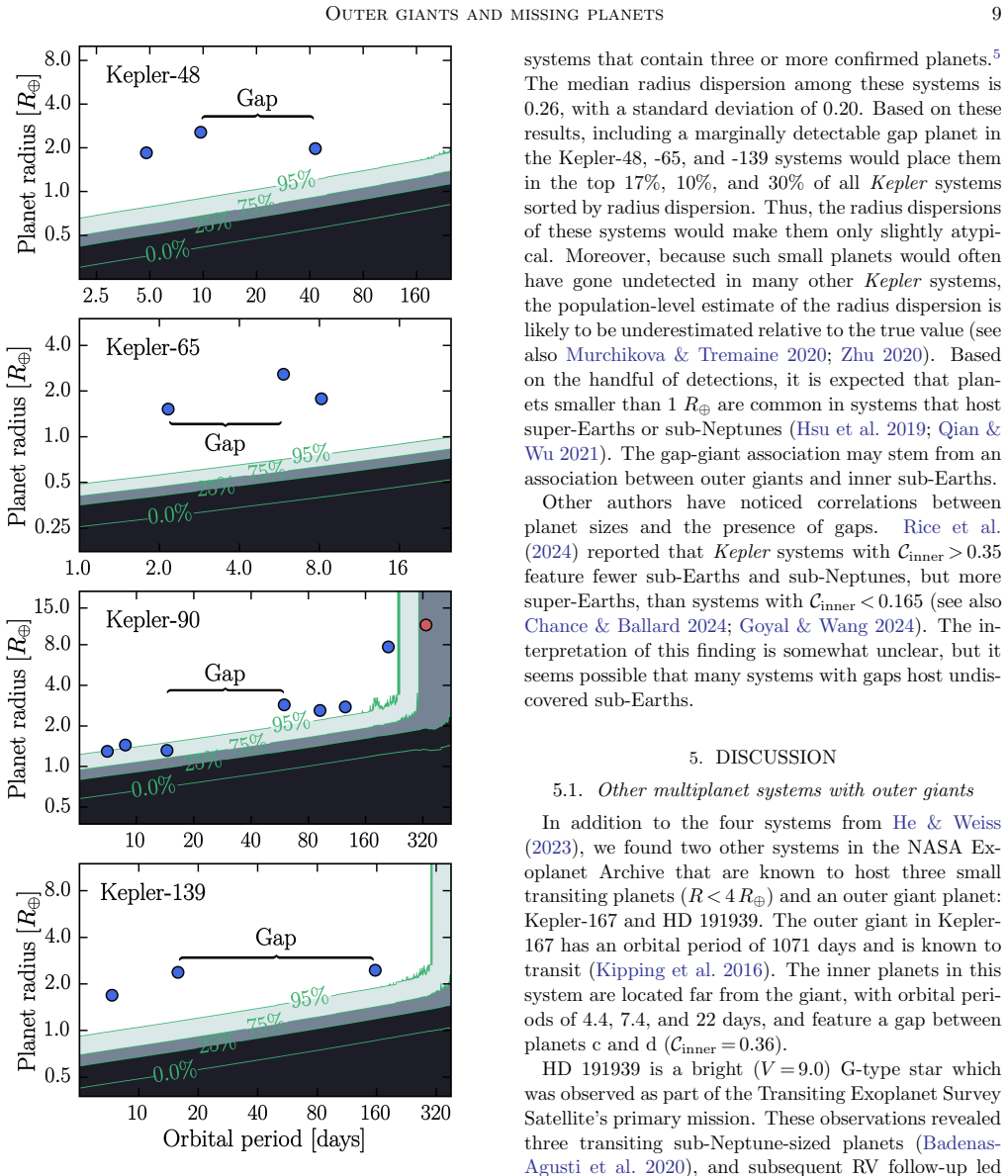
- In Kepler-48, Kepler-65, and Kepler-139, any transiting planet in the gap must be smaller than about $0.7\,R_\oplus$, $0.5\,R_\oplus$, and $1.0\,R_\oplus$, respectively, to have escaped detection; inserting such a planet would make the radius dispersion only mildly atypical.
- Kepler-90's gap could hide a planet as large as the known $1.3\,R_\oplus$ planets, because the detection efficiency at the gap midpoint is below $50\%$.
- The gap-giant association is therefore unlikely to be a product of outer giants tilting inner planets out of transit; if the association is real, it more likely reflects formation conditions or coincidence.
Reading between the lines
- If the authors' $10^\circ$-scale misalignment assumption is relaxed, the falsifying test is direct: a measured giant-inner misalignment above roughly $20^\circ$ in Kepler-48, -65, or -139 would re-open the secular-tilt scenario, so future astrometry will settle this.
- The coupling parameter offers a cheap triage for new discoveries: any system with an outer giant and $\epsilon_{12}\ll 1$ can be set aside as unable to hide a gap planet by tilting, concentrating search effort on sub-Earth-sized transits or empty gaps.
- A population-level radial-velocity test should distinguish the scenarios: if gaps are mostly empty or contain sub-Earths, RV-detected inner systems with outer giants should show gaps as often as transit-detected ones; the conflicting cases of HD 164922 (gap) and HD 219134 (no gap) show the sample is not yet decisive.
- Kepler-90 is the natural target for a direct search: a dedicated transit or transit-timing search at the gap period could recover a roughly $1\,R_\oplus$ planet and discriminate between the empty-gap and small-planet explanations.
Editorial analysis
A structured set of objections, weighed in public.
Referee Report
Summary. The paper studies four Kepler systems (Kepler-48, -65, -90, -139) that host both multiple transiting inner planets and an outer giant, and asks whether the prominent orbital gaps in these systems could hide undetected planets or arise from secular inclination excitation by the outer giant. Using N-body integrations (REBOUND/WHFast) and secular integrations (celmech), the authors find that a 1-20 Earth-mass planet placed in each gap is often dynamically stable over the integration durations. They then perform Monte Carlo transit probability calculations with linear Laplace-Lagrange theory for fixed outer-giant inclinations of 5, 10, and 20 degrees, finding that the observed gap configurations are reproduced in only 5.3% (Kepler-48), 0.001% (Kepler-65), and 9.1% (Kepler-139) of realizations. They conclude that the secular inclination excitation hypothesis is strongly disfavored, and that the gaps may instead contain very small undetected planets or no planet at all. The paper also uses KeplerPORTs to show that planets smaller than about 1 Earth radius could hide in the gaps of Kepler-48, -65, and -139.
Significance. If the conclusions hold, this is a valuable negative result for a specific, testable explanation of the gap-giant association, and it sharpens the case that these gaps are either empty or contain sub-Earth-sized planets. The study is methodologically transparent: it uses public codes (REBOUND, celmech, KeplerPORTs), forward-simulates from observed parameters without fitting the target conclusion, and explicitly reports survival fractions and detection efficiencies. The main claims are, however, more sensitive to assumptions about the unconstrained outer-giant inclination and about the adequacy of linear secular theory than the abstract suggests, so the strength of the conclusion needs to be recalibrated.
major comments (3)
- [Section 3.1, Figure 3] The transit probability calculations are performed only for outer-giant inclinations iG = 5, 10, and 20 degrees. The conclusion that the secular inclination excitation hypothesis is 'strongly disfavored' therefore depends on excluding larger misalignments. For Kepler-139, which has coupling parameter epsilon ~ 0.07, the observed-gap probability at iG = 20 degrees is already 9.1%, and within linear theory the induced mutual inclination grows with iG; a 30-40 degree misalignment could plausibly raise this probability substantially. The RV data do not constrain iG for these giants, and the Rayleigh sigma = 10 degree prior from Masuda et al. (2020) is a population average, not an upper limit. Please report the observed-gap probability as a function of iG over a wider range and/or marginalize over a stated prior with a sensitivity analysis.
- [Section 3.1, Kepler-90 paragraph] The exclusion of Kepler-90 rests on the argument that because the outer giant transits, a large misalignment with the inner system is statistically unlikely, since a randomly oriented orbit has only a 0.55% geometric transit probability. This conflates alignment with the line of sight with alignment with the inner system. A transiting outer giant can have a large mutual inclination with the inner transiting planets if its longitude of ascending node differs; conditioning on both the inner system and the giant transiting does not by itself suppress large mutual inclinations. Please either justify the exclusion with an explicit calculation of P(mutual inclination > theta | giant transits, inner system transits), or include Kepler-90 in the transit probability analysis.
- [Sections 2.2 and 2.3] The stability demonstrations cover only 10^9 inner orbital periods (13-20 Myr for the four systems) or 10^5 secular periods (16-200 Myr), which are far shorter than the likely Gyr system ages. For Kepler-139, the secular survival fraction is only 39% over a median 200 Myr and 53% even over 20 Myr. The abstract's statement that a typical small planet 'could reside in the gap without inducing dynamical instability' is therefore not established on the timescales relevant to the observed systems. Even though the authors note that their Hill-sphere instability criterion may overflag instabilities, the lower-limit survival fractions for Kepler-139 are low enough that the positive stability claim needs to be tempered or supported with longer-timescale evidence.
minor comments (4)
- [Table 1] The footnote marker in Table 1 appears as 'aKepler-90h' in the table body; please move the marker to the planet name so it reads as a footnote.
- [Sections 2.2 and 2.3] The text uses '109 P1' and '105 Tsec,1' where superscripts are missing; these should read '10^9 P1' and '10^5 Tsec,1'.
- [Section 3.1, Kepler-48 bullet] The bullet reports a 5.5% chance of seeing a gap at iG = 20 degrees and then a 5.3% chance for the specific configuration of planets 1, 2, and 4 transiting; please clarify how the 5.5% value is defined relative to Figure 3.
- [Section 5.1] For HD 191939, the text states that 'just an 8% chance of observing the system when a gap is present'; please specify whether this is the probability of the observed configuration or of any configuration with Cinner > 0.3, for consistency with Figure 3.
Circularity Check
No significant circularity: conclusion is a forward Monte Carlo result; self-citations are non-load-bearing observational inputs.
full rationale
The paper's derivation chain is forward-modeled rather than self-referential. Observed orbital parameters for Kepler-48, -65, -90, and -139 are used as initial conditions; hypothetical gap planets are drawn from prescribed mass and period distributions; and the transit probabilities in Section 3.1 are computed by Laplace-Lagrange secular integration plus random viewing geometry. The low probabilities quoted in Figure 3 (5.3%, 0.001%, and 9.1%) are simulation outputs, not quantities fitted to the observed gap configurations, so the disfavoring of the secular-inclination hypothesis is not forced by construction. The stability analysis similarly integrates N-body and secular equations and reports survival fractions; no parameter is tuned to make the survival rates high. The only self-references are observational inputs: Lammers & Winn (2025) supplies the Kepler-139f orbital constraint, and Masuda et al. (2020) supplies a population inclination prior. Neither is load-bearing for the negative conclusion: the transit-probability experiment tests fixed outer-giant inclinations of 5, 10, and 20 degrees rather than relying on the Rayleigh prior, and the Kepler-139f constraint is an external RV measurement. The skeptical concern that inclinations above 20 degrees or nonlinear secular effects could raise the gap probabilities is a prior or sensitivity limitation, not circularity, because the paper does not derive the disfavoring conclusion from an assumption that large misalignments are impossible.
Assumptions & free parameters
free parameters (4)
- Gap planet mass sampling parameters =
Mean and sigma equal to mean mass of known inner planets; 90% of draws in 1-20 Earth masses
- Outer giant inclination scale sigma =
10 degrees for stability runs; 5, 10, and 20 degrees in transit probability runs
- Inner planet Rayleigh eccentricity and inclination scales =
sigma_e = 0.02, sigma_I = 1.5 degrees
- Simulation durations =
10^9 inner periods for N-body; 10^5 secular periods; 10^6 years for transit Monte Carlo
assumptions (6)
- domain assumption Laplace-Lagrange linear secular theory accurately describes the long-term inclination evolution of these inner systems over the simulated intervals.
- standard math The Hill-sphere overlap criterion in Eq. (1) is a reliable proxy for dynamical instability in the secular integrations.
- ad hoc to paper Kepler-90 may be initialized with all planets on circular, coplanar orbits without invalidating the stability conclusion for that system.
- domain assumption Outer giant inclinations are drawn from a Rayleigh distribution with sigma = 10 degrees relative to the inner system.
- domain assumption Simulated durations are representative enough to infer that a gap planet can remain stable over the relevant lifetimes of these systems.
- domain assumption SPOCK and the empirical stability criteria of Obertas et al. (2017) and Lammers et al. (2024) give valid stability expectations for these systems.
Cite this review
Pith. "Pith review of The Gap-Giant Association: Are Planets Hiding in the Gaps?." pith.science (2026). https://pith.science/paper/IP2BJ7VD
@misc{pith2026250610969,
  author       = {Pith},
  title        = {Pith review of: The Gap-Giant Association: Are Planets Hiding in the Gaps?},
  year         = {2026},
  howpublished = {\url{https://pith.science/paper/IP2BJ7VD}},
  note         = {Machine review of arXiv:2506.10969}
}
abstract
A handful of stars are known to host both an inner system of multiple transiting planets and an outer giant planet. These systems all feature a prominent gap between the orbits of two of the transiting planets, distinguishing them from typical multiplanet systems with more uniform orbital spacings. The reason for the association between inner gaps and outer giants is unknown. In this paper, we assess whether undiscovered planets might occupy these gaps in systems with outer giants. For each of the four relevant systems - Kepler-48, Kepler-65, Kepler-90, and Kepler-139 - we found that a typical small planet ($\sim 1 - 20 M_\oplus$) could reside in the gap without inducing dynamical instability. However, in each case, the gravitational influence of the outer giant planet is insufficient to tilt the orbit of the hypothetical planet by enough to prevent transits, strongly disfavoring a proposed theory for the observed gap-giant association. The gaps might instead contain smaller, undetected planets ($\lesssim 1 R_\oplus$), or be entirely devoid of planets.
Figures


Figures from the paper (1 more)
Reference graph
Works this paper leans on
-
[1]
, " * write output.state after.block = add.period write newline
ENTRY address archivePrefix author booktitle chapter doi edition editor eprint howpublished institution journal key month number organization pages publisher school series title misctitle type volume year version url label extra.label sort.label short.list INTEGERS output.state before.all mid.sentence after.sentence after.block FUNCTION init.state.consts ...
-
[2]
write newline
" write newline "" before.all 'output.state := FUNCTION format.url url empty "" new.block "" url * "" * if FUNCTION format.eprint eprint empty "" archivePrefix empty "" archivePrefix "arXiv" = new.block " " eprint * " " * new.block " " eprint * " " * if if if FUNCTION format.doi doi empty "" " " doi * " " * if FUNCTION format.pid doi empty eprint empty ur...
-
[3]
ݷ0JݸqZ6s j:2̘N3 U4xm #t 0 `aa |W/ \ 0 & > G`raq j ɓ'=^XX M k;<K\ 0 & > G`ra#`6`` : F 3`` : F 3`` : F 3```8#q亮ժd LӔi 7v6Q . < 3ЃB˗/P(teYbp̆mrr]LT4 U
thebibliography [1] 20pt to REFERENCES 6pt =0pt -12pt 10pt plus 3pt =0pt =0pt =1pt plus 1pt =0pt =0pt -12pt =13pt plus 1pt =20pt =13pt plus 1pt \@M =10000 =-1.0em =0pt =0pt 0pt =0pt =1.0em @enumiv\@empty 10000 10000 `\.\@m \@noitemerr \@latex@warning Empty `thebibliography' environment \@ifnextchar \@reference \@latexerr Missing key on reference command E...
2021
-
[4]
Becker , J. C., & Adams , F. C. 2017, , 468, 549, 10.1093/mnras/stx461
-
[5]
Best , M., Sefilian , A. A., & Petrovich , C. 2024, , 960, 89, 10.3847/1538-4357/ad0965
-
[6]
2023, , 674, A178, 10.1051/0004-6361/202245040
Bitsch , B., & Izidoro , A. 2023, , 674, A178, 10.1051/0004-6361/202245040
-
[7]
S., Dumusque , X., Massa , A., et al
Bonomo , A. S., Dumusque , X., Massa , A., et al. 2023, , 677, A33, 10.1051/0004-6361/202346211
-
[8]
Bou \'e , G., & Fabrycky , D. C. 2014, , 789, 110, 10.1088/0004-637X/789/2/110
Show all 75 references
-
[9]
L., Knutson , H
Bryan , M. L., Knutson , H. A., Lee , E. J., et al. 2019, , 157, 52, 10.3847/1538-3881/aaf57f
2019 doi
- [10]
-
[11]
J., & Catanzarite , J
Burke , C. J., & Catanzarite , J. 2017, Planet Detection Metrics: Per-Target Detection Contours for Data Release 25 , Kepler Science Document KSCI-19111-002, id. 19. Edited by Michael R. Haas and Natalie M. Batalha
2017
-
[12]
2014, , 781, 18, 10.1088/0004-637X/781/1/18
Cabrera , J., Csizmadia , S., Lehmann , H., et al. 2014, , 781, 18, 10.1088/0004-637X/781/1/18
2014 doi
-
[13]
Chachan , Y., & Lee , E. J. 2023, , 952, L20, 10.3847/2041-8213/ace257
2023 doi
-
[14]
E., Wetherill , G
Chambers , J. E., Wetherill , G. W., & Boss , A. P. 1996, , 119, 261, 10.1006/icar.1996.0019
1996
-
[15]
2017, , 834, 17, 10.3847/1538-4357/834/1/17
Chen , J., & Kipping , D. 2017, , 834, 17, 10.3847/1538-4357/834/1/17
2017 doi
-
[16]
L., Jenkins , J
Christiansen , J. L., Jenkins , J. M., Caldwell , D. A., et al. 2012, , 124, 1279, 10.1086/668847
2012 doi
-
[17]
L., Clarke , B
Christiansen , J. L., Clarke , B. D., Burke , C. J., et al. 2016, , 828, 99, 10.3847/0004-637X/828/2/99
2016 doi
- [18]
-
[19]
2021, Proceedings of the National Academy of Science, 118, e2026053118, 10.1073/pnas.2026053118
Cranmer , M., Tamayo , D., Rein , H., et al. 2021, Proceedings of the National Academy of Science, 118, e2026053118, 10.1073/pnas.2026053118
2021 doi
-
[20]
P., Marcy , G
Cumming , A., Butler , R. P., Marcy , G. W., et al. 2008, , 120, 531, 10.1086/588487
2008 doi
-
[21]
C., Lissauer , J
Fabrycky , D. C., Lissauer , J. J., Ragozzine , D., et al. 2014, , 790, 146, 10.1088/0004-637X/790/2/146
2014 doi
-
[22]
2012, , 761, 92, 10.1088/0004-637X/761/2/92
Fang , J., & Margot , J.-L. 2012, , 761, 92, 10.1088/0004-637X/761/2/92
2012 doi
-
[23]
2013, , 767, 115, 10.1088/0004-637X/767/2/115
---. 2013, , 767, 115, 10.1088/0004-637X/767/2/115
2013 doi
-
[24]
J., & Petigura , E
Fulton , B. J., & Petigura , E. A. 2018, , 156, 264, 10.3847/1538-3881/aae828
2018 doi
-
[25]
M., Giuliatti Winter , S
Gaslac Gallardo , D. M., Giuliatti Winter , S. M., Winter , O., Callegari , N., & Mu \ n oz-Guti \'e rrez , M. A. 2024, , 535, 3198, 10.1093/mnras/stae2518
2024 doi
-
[26]
S., Seager , S., & Mallen-Ornelas , G
Gaudi , B. S., Seager , S., & Mallen-Ornelas , G. 2005, , 623, 472, 10.1086/428478
2005 doi
-
[27]
J., & Fabrycky , D
Gilbert , G. J., & Fabrycky , D. C. 2020, , 159, 281, 10.3847/1538-3881/ab8e3c
2020 doi
-
[28]
J., Petigura , E
Gilbert , G. J., Petigura , E. A., & Entrican , P. M. 2025, Proceedings of the National Academy of Science, 122, e2405295122, 10.1073/pnas.2405295122
2025 doi
-
[29]
P., & Boley , A
Granados Contreras , A. P., & Boley , A. C. 2018, , 155, 139, 10.3847/1538-3881/aaac82
2018 doi
-
[30]
2017, , 154, 5, 10.3847/1538-3881/aa71ef
Hadden , S., & Lithwick , Y. 2017, , 154, 5, 10.3847/1538-3881/aa71ef
2017 doi
-
[31]
2022, , 164, 179, 10.3847/1538-3881/ac8d01
Hadden , S., & Tamayo , D. 2022, , 164, 179, 10.3847/1538-3881/ac8d01
2022 doi
- [32]
-
[33]
X., Petrovich , C., & Deibert , E
Huang , C. X., Petrovich , C., & Deibert , E. 2017, , 153, 210, 10.3847/1538-3881/aa67fb
2017 doi
-
[34]
N., Morbidelli , A., Hersant , F., & Pierens , A
Izidoro , A., Raymond , S. N., Morbidelli , A., Hersant , F., & Pierens , A. 2015, , 800, L22, 10.1088/2041-8205/800/2/L22
2015 doi
-
[35]
H., & Zhu , Z.-H
Kong , Z., Johansen , A., Lambrechts , M., Jiang , J. H., & Zhu , Z.-H. 2024, , 687, A121, 10.1051/0004-6361/202349043
2024 doi
-
[36]
2017, , 153, 42, 10.3847/1538-3881/153/1/42
Lai , D., & Pu , B. 2017, , 153, 42, 10.3847/1538-3881/153/1/42
2017 doi
-
[37]
A., et al
Lambrechts , M., Morbidelli , A., Jacobson , S. A., et al. 2019, , 627, A83, 10.1051/0004-6361/201834229
2019 doi
-
[38]
2024, , 972, 53, 10.3847/1538-4357/ad5be6
Lammers , C., Hadden , S., & Murray , N. 2024, , 972, 53, 10.3847/1538-4357/ad5be6
2024 doi
-
[39]
Lammers , C., & Winn , J. N. 2025, , 984, L39, 10.3847/2041-8213/adce01
2025 doi
-
[40]
1990, , 88, 266, 10.1016/0019-1035(90)90084-M
Laskar , J. 1990, , 88, 266, 10.1016/0019-1035(90)90084-M
1990 doi
-
[41]
1994, , 287, L9
---. 1994, , 287, L9
1994
-
[42]
Laskar , J., & Petit , A. C. 2017, , 605, A72, 10.1051/0004-6361/201630022
2017 doi
-
[43]
2021, , 161, 202, 10.3847/1538-3881/abe6a7
Liang , Y., Robnik , J., & Seljak , U. 2021, , 161, 202, 10.3847/1538-3881/abe6a7
2021 doi
-
[44]
J., Fabrycky , D
Lissauer , J. J., Fabrycky , D. C., Ford , E. B., et al. 2011 a , , 470, 53, 10.1038/nature09760
2011 doi
-
[45]
J., Ragozzine , D., Fabrycky , D
Lissauer , J. J., Ragozzine , D., Fabrycky , D. C., et al. 2011 b , , 197, 8, 10.1088/0067-0049/197/1/8
2011 doi
-
[46]
2011, , 739, 31, 10.1088/0004-637X/739/1/31
Lithwick , Y., & Wu , Y. 2011, , 739, 31, 10.1088/0004-637X/739/1/31
2011 doi
- [47]
-
[48]
N., & Kawahara , H
Masuda , K., Winn , J. N., & Kawahara , H. 2020, , 159, 38, 10.3847/1538-3881/ab5c1d
2020 doi
-
[49]
2020, , 160, 160, 10.3847/1538-3881/abab9e
Murchikova , L., & Tremaine , S. 2020, , 160, 160, 10.3847/1538-3881/abab9e
2020 doi
-
[50]
D., & Dermott , S
Murray , C. D., & Dermott , S. F. 1999, Solar system dynamics
1999
-
[51]
J., Davies , M
Mustill , A. J., Davies , M. B., & Johansen , A. 2017, , 468, 3000, 10.1093/mnras/stx693
2017 doi
-
[52]
2023, , 10.1093/mnras/stad1921
Obertas , A., Tamayo , D., & Murray , N. 2023, , 10.1093/mnras/stad1921
2023 doi
-
[53]
2017, , 293, 52, 10.1016/j.icarus.2017.04.010
Obertas , A., Van Laerhoven , C., & Tamayo , D. 2017, , 293, 52, 10.1016/j.icarus.2017.04.010
2017 doi
- [54]
- [55]
-
[56]
2015, , 452, 376, 10.1093/mnras/stv1257
Rein , H., & Tamayo , D. 2015, , 452, 376, 10.1093/mnras/stv1257
2015 doi
-
[57]
J., Knutson , H
Rosenthal , L. J., Knutson , H. A., Chachan , Y., et al. 2022, , 262, 1, 10.3847/1538-4365/ac7230
2022 doi
-
[58]
2016, , 817, 104, 10.3847/0004-637X/817/2/104
Rowan , D., Meschiari , S., Laughlin , G., et al. 2016, , 817, 104, 10.3847/0004-637X/817/2/104
2016 doi
-
[59]
F., Bryson , S
Rowe , J. F., Bryson , S. T., Marcy , G. W., et al. 2014, , 784, 45, 10.1088/0004-637X/784/1/45
2014 doi
-
[60]
2021, , 656, A71, 10.1051/0004-6361/202038554
Schlecker , M., Mordasini , C., Emsenhuber , A., et al. 2021, , 656, A71, 10.1051/0004-6361/202038554
2021 doi
-
[61]
R., Wang , J., Fischer , D
Schmitt , J. R., Wang , J., Fischer , D. A., et al. 2014, , 148, 28, 10.1088/0004-6256/148/2/28
2014 doi
-
[62]
J., & Vanderburg , A
Shallue , C. J., & Vanderburg , A. 2018, , 155, 94, 10.3847/1538-3881/aa9e09
2018 doi
-
[63]
W., & Lissauer , J
Smith , A. W., & Lissauer , J. J. 2009, , 201, 381, 10.1016/j.icarus.2008.12.027
2009 doi
-
[64]
2020, Proceedings of the National Academy of Science, 117, 18194, 10.1073/pnas.2001258117
Tamayo , D., Cranmer , M., Hadden , S., et al. 2020, Proceedings of the National Academy of Science, 117, 18194, 10.1073/pnas.2001258117
2020 doi
-
[65]
E., Coughlin , J
Thompson , S. E., Coughlin , J. L., Hoffman , K., et al. 2018, , 235, 38, 10.3847/1538-4365/aab4f9
2018 doi
-
[66]
2023, Dynamics of Planetary Systems
Tremaine , S. 2023, Dynamics of Planetary Systems
2023
-
[67]
2015, , 808, 126, 10.1088/0004-637X/808/2/126
Van Eylen , V., & Albrecht , S. 2015, , 808, 126, 10.1088/0004-637X/808/2/126
2015 doi
-
[68]
M., Marcy , G
Weiss , L. M., Marcy , G. W., Petigura , E. A., et al. 2018, , 155, 48, 10.3847/1538-3881/aa9ff6
2018 doi
-
[69]
M., Isaacson , H., Howard , A
Weiss , L. M., Isaacson , H., Howard , A. W., et al. 2024, , 270, 8, 10.3847/1538-4365/ad0cab
2024 doi
- [70]
-
[71]
1991, , 102, 1528, 10.1086/115978
Wisdom , J., & Holman , M. 1991, , 102, 1528, 10.1086/115978
1991 doi
-
[72]
A., Butler , R
Wittenmyer , R. A., Butler , R. P., Tinney , C. G., et al. 2016, , 819, 28, 10.3847/0004-637X/819/1/28
2016 doi
-
[73]
A., Wang , S., Horner , J., et al
Wittenmyer , R. A., Wang , S., Horner , J., et al. 2020, , 492, 377, 10.1093/mnras/stz3436
2020 doi
-
[74]
2020, , 159, 188, 10.3847/1538-3881/ab7814
Zhu , W. 2020, , 159, 188, 10.3847/1538-3881/ab7814
2020 doi
-
[75]
2018, , 156, 92, 10.3847/1538-3881/aad22a
Zhu , W., & Wu , Y. 2018, , 156, 92, 10.3847/1538-3881/aad22a
2018 doi
Reviewed August 7, 2026 · model on record in the stance chip above.
Discussion (0). Continue with ORCID to comment.