SagnacAssisted Enhanced OTDR for Distributed Acoustic Sensing: A Standardized Benchmark and Engineering Evaluation Framework
Pith reviewed 2026-06-28 00:01 UTC · model grok-4.3
The pith
Sagnac-assisted φ-OTDR with dual-branch fusion reaches 89.79% accuracy on six acoustic event classes.
A machine-rendered reading of the paper's core claim, the machinery that carries it, and where it could break.
Core claim
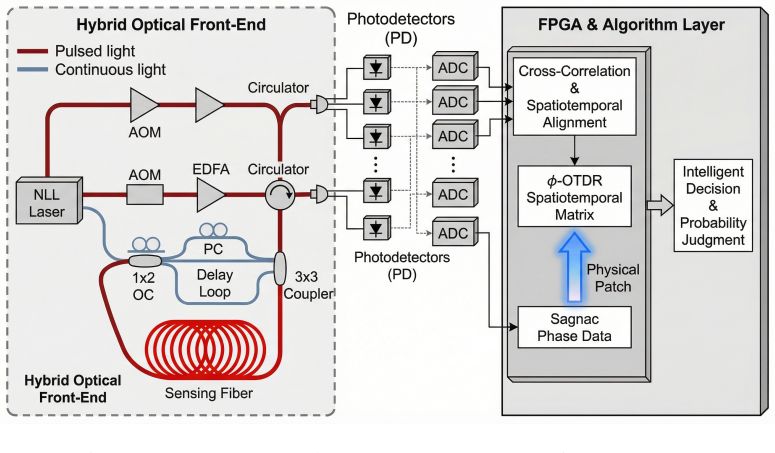
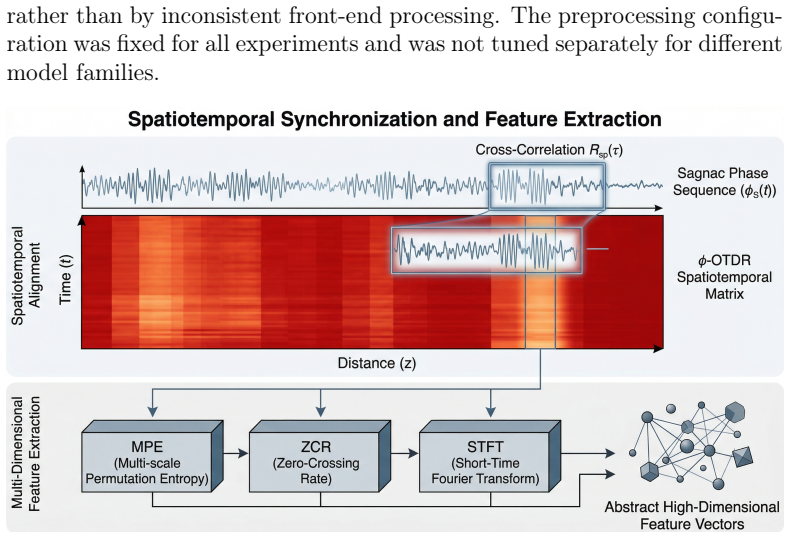
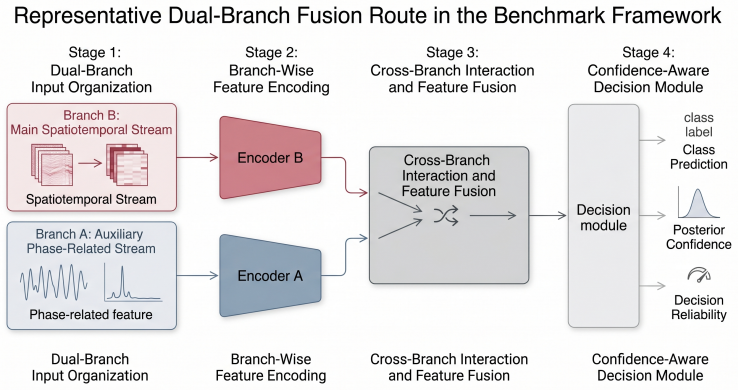
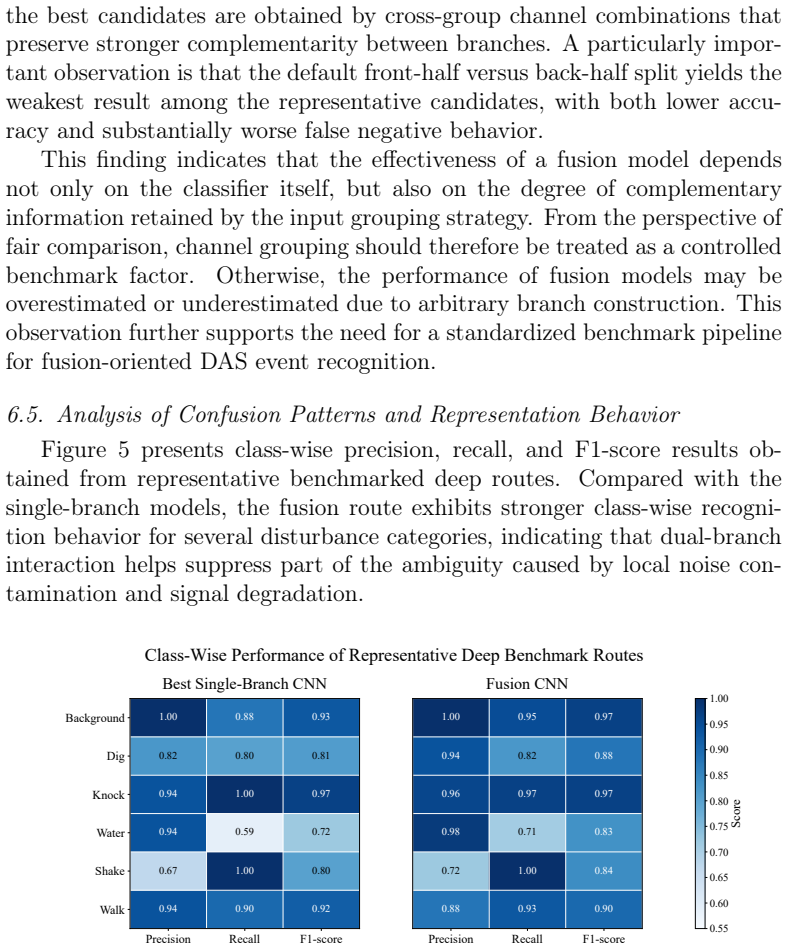
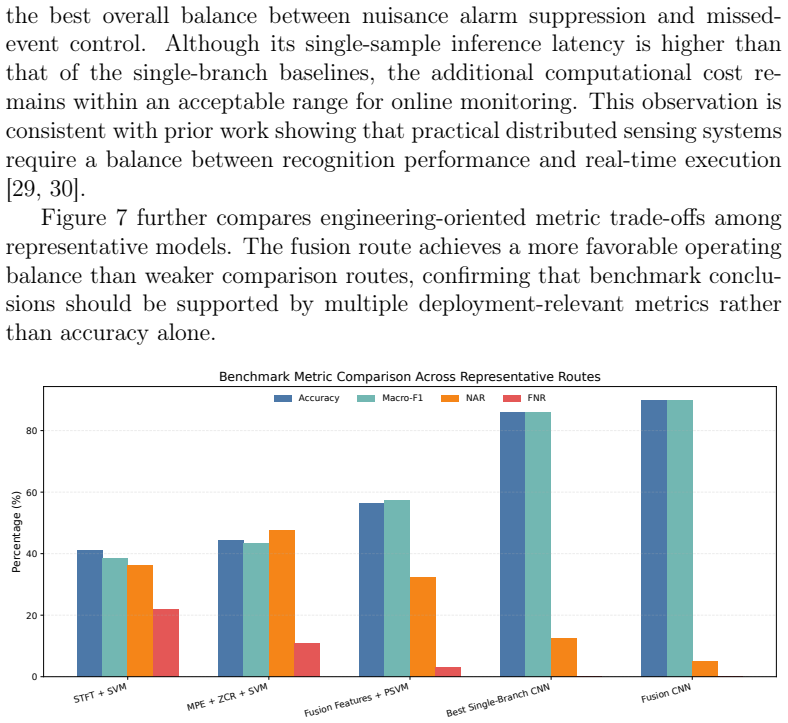
The Sagnac interferometer supplies a continuous phase response that supplements fading-prone φ-OTDR observations; heterogeneous alignment via cross-correlation on an FPGA platform enables a dual-branch fusion model that achieves 89.79% accuracy, 89.83% macro-F1, and 5.00% nuisance alarm rate on a balanced test set of six acoustic event classes over 10 km of fiber, outperforming the other evaluated methods under consistent preprocessing and partitioning.
What carries the argument
Dual-branch fusion model that combines Sagnac and φ-OTDR channels after cross-correlation alignment.
If this is right
- Channel grouping decisions must be evaluated jointly with accuracy, macro-F1, nuisance alarm rate, false-negative rate, and latency rather than accuracy alone.
- The benchmark protocol can be reused to compare future fusion architectures under identical data partitions and metric definitions.
- FPGA-based cross-correlation alignment is presented as a practical route to combine continuous-phase and fading-prone channels in field deployments.
- The public release of implementation scripts allows direct replication of the six-class event recognition results on new fiber installations.
Where Pith is reading between the lines
- The same dual-branch approach could be tested on fibers longer than 10 km to determine whether the nuisance-alarm benefit scales with distance.
- If alignment artifacts prove sensitive to temperature drift, periodic recalibration routines would become necessary for long-term operation.
- The benchmark's emphasis on nuisance alarm rate suggests the framework could be adapted to safety-critical applications where false positives carry high cost.
- Extending the six event classes to include overlapping or low-amplitude events would test whether the fusion advantage persists under more realistic interference.
Load-bearing premise
Signals from the Sagnac and φ-OTDR channels can be aligned accurately enough that the fusion step improves classification without adding new errors or degradation.
What would settle it
Measure classification accuracy after deliberately introducing small timing offsets or polarization changes between the two channels on the same 10 km fiber and check whether the reported gains disappear.
Figures
read the original abstract
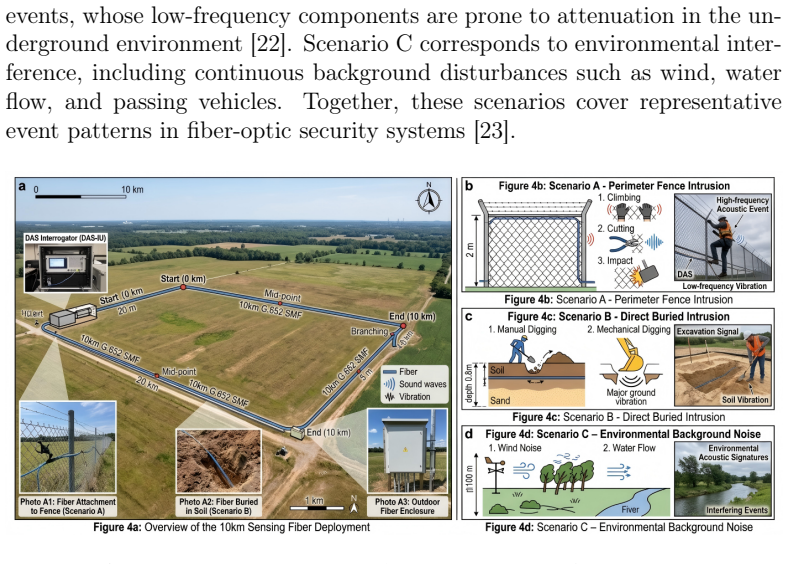
Phase-sensitive optical time-domain reflectometry ($\phi$-OTDR) is widely used in large-scale distributed acoustic sensing (DAS) because it provides distributed spatiotemporal monitoring over long sensing distances. Its field performance can still deteriorate because of polarization-induced fading (PIF), local signal degradation, and strong environmental interference. This study develops a Sagnac-assisted enhanced $\phi$-OTDR sensing architecture and a standardized benchmark framework for engineering-oriented DAS event recognition. The Sagnac interferometer provides a continuous phase response that supplements fading-prone observations in the $\phi$-OTDR channel, and heterogeneous signal alignment is achieved using a cross-correlation procedure implemented on an FPGA platform. The benchmark protocol compares conventional feature-engineering methods, probabilistic shallow classifiers, single-branch deep models, and dual-branch fusion models under consistent data partitioning, preprocessing, and metric definitions. Experiments on a 10-km sensing fiber with six representative acoustic event classes show that the dual-branch fusion model provides the most favorable trade-off among the evaluated methods, reaching 89.79\% accuracy, 89.83\% macro-F1, and a nuisance alarm rate of 5.00\% on the balanced test set. The results also show that channel grouping strongly affects dual-branch evaluation, indicating that deployment-oriented conclusions should be based on accuracy, macro-F1, nuisance alarm rate, false negative rate, and latency rather than accuracy alone. This work provides a physically motivated enhancement strategy for $\phi$-OTDR-based DAS and a reproducible benchmark protocol for future fusion-oriented sensing research. The implementation and scripts for reproducing the DAS event-recognition experiments are publicly available at https://github.com/wawa-abc/das.
Editorial analysis
A structured set of objections, weighed in public.
Referee Report
Summary. The paper proposes a Sagnac-assisted enhanced φ-OTDR architecture for distributed acoustic sensing that supplements polarization-induced fading in the φ-OTDR channel with continuous phase response from a Sagnac interferometer. Heterogeneous signals are aligned via cross-correlation on an FPGA. A standardized benchmark protocol evaluates conventional feature-engineering methods, probabilistic shallow classifiers, single-branch deep models, and dual-branch fusion models under consistent partitioning and metrics. Experiments on a 10-km fiber with six acoustic event classes report that the dual-branch fusion model achieves the best trade-off with 89.79% accuracy, 89.83% macro-F1, and 5.00% nuisance alarm rate on the balanced test set. Code and scripts are publicly released.
Significance. If the alignment procedure and experimental protocol are validated, the work supplies a physically motivated enhancement to φ-OTDR DAS together with a reproducible benchmark framework that encourages multi-metric evaluation (accuracy, macro-F1, nuisance alarm rate, false-negative rate, latency). The public GitHub release of implementation and scripts is a clear strength supporting future fusion-oriented sensing research.
major comments (2)
- [Heterogeneous signal alignment (FPGA cross-correlation procedure)] The headline performance of the dual-branch fusion model (89.79% accuracy / 89.83% macro-F1 / 5% nuisance alarm) depends on the premise that cross-correlation alignment on the FPGA reliably fuses the Sagnac continuous-phase channel with the φ-OTDR channel. No section quantifies alignment fidelity (residual phase-error distribution, post-alignment coherence, or classifier sensitivity to deliberate sample shifts), leaving open the possibility that reported gains arise from alignment artifacts rather than the claimed physical supplementation.
- [Experiments and results] The abstract and results section report concrete performance numbers from the 10-km fiber experiments, yet supply no details on data collection protocol, exclusion criteria, error bars, labeling process for the six event classes, or how the balanced test set was constructed. This prevents verification that the metrics support the central claim that the dual-branch model provides the most favorable trade-off among evaluated methods.
minor comments (2)
- [Benchmark protocol] The statement that 'channel grouping strongly affects dual-branch evaluation' is noted but the specific groupings, their rationale, and quantitative impact on the reported metrics are not detailed.
- [Overall] Notation for the six event classes and the exact definition of nuisance alarm rate could be made explicit in the main text for immediate reproducibility.
Simulated Author's Rebuttal
We thank the referee for the detailed and constructive report. We address the two major comments below and will incorporate the requested clarifications and additional analyses in a revised manuscript.
read point-by-point responses
-
Referee: [Heterogeneous signal alignment (FPGA cross-correlation procedure)] The headline performance of the dual-branch fusion model (89.79% accuracy / 89.83% macro-F1 / 5% nuisance alarm) depends on the premise that cross-correlation alignment on the FPGA reliably fuses the Sagnac continuous-phase channel with the φ-OTDR channel. No section quantifies alignment fidelity (residual phase-error distribution, post-alignment coherence, or classifier sensitivity to deliberate sample shifts), leaving open the possibility that reported gains arise from alignment artifacts rather than the claimed physical supplementation.
Authors: We agree that explicit quantification of alignment fidelity is necessary to substantiate the fusion claim. The current manuscript describes the FPGA cross-correlation procedure but does not report residual phase-error statistics, coherence metrics, or ablation results under controlled misalignment. In the revision we will add a dedicated subsection presenting these measurements from the 10-km experimental data and an ablation study that evaluates classifier sensitivity to deliberate sample shifts, thereby demonstrating that performance gains arise from the physical supplementation rather than alignment artifacts. revision: yes
-
Referee: [Experiments and results] The abstract and results section report concrete performance numbers from the 10-km fiber experiments, yet supply no details on data collection protocol, exclusion criteria, error bars, labeling process for the six event classes, or how the balanced test set was constructed. This prevents verification that the metrics support the central claim that the dual-branch model provides the most favorable trade-off among evaluated methods.
Authors: We acknowledge that the experimental protocol description is insufficient for independent verification. The revised manuscript will expand the Experiments section to include: (i) the full data-collection protocol and any exclusion criteria, (ii) the labeling procedure for the six acoustic event classes, (iii) the method used to construct the balanced test set, and (iv) error bars or confidence intervals on the reported metrics. These additions will allow readers to confirm that the dual-branch model indeed offers the most favorable trade-off under the stated evaluation criteria. revision: yes
Circularity Check
No circularity; results are empirical metrics from physical experiments on 10-km fiber
full rationale
The paper reports an experimental architecture (Sagnac-assisted φ-OTDR with FPGA cross-correlation alignment) and benchmark comparisons of feature-engineering, shallow classifiers, single-branch, and dual-branch models. All performance numbers (89.79% accuracy, 89.83% macro-F1, 5% nuisance alarm) are obtained from direct evaluation on a balanced test set drawn from physical measurements on a 10-km sensing fiber. No equations, derivations, or predictions are presented that reduce by construction to fitted parameters, self-citations, or ansatzes. The central claims rest on reproducible experimental data rather than any self-referential mathematical loop. This is the most common honest finding for an engineering evaluation paper.
Axiom & Free-Parameter Ledger
axioms (1)
- domain assumption Established principles of phase-sensitive OTDR and Sagnac interferometry hold under the experimental conditions
Reference graph
Works this paper leans on
-
[1]
Shao, et al., Artificial intelligence-driven distributed acoustic sensing technology and engineering application, PhotoniX 6 (1) (2025)
L. Shao, et al., Artificial intelligence-driven distributed acoustic sensing technology and engineering application, PhotoniX 6 (1) (2025)
2025
-
[2]
Zinsou, et al., Recent progress in the performance enhancement of phase-sensitive OTDR vibration sensing systems, Sensors 19 (7) (2019)
R. Zinsou, et al., Recent progress in the performance enhancement of phase-sensitive OTDR vibration sensing systems, Sensors 19 (7) (2019)
2019
-
[3]
M. R. Fernández-Ruiz, et al., Distributed acoustic sensing using chirped- pulse phase-sensitive OTDR technology, Sensors 19 (20) (2019)
2019
-
[4]
Wang, et al., Adaptability and anti-noise capacity enhancement for 29 ϕ-OTDR with deep learning, Journal of Lightwave Technology 38 (23) (2020)
P. Wang, et al., Adaptability and anti-noise capacity enhancement for 29 ϕ-OTDR with deep learning, Journal of Lightwave Technology 38 (23) (2020)
2020
-
[5]
Wada, et al., Balanced polarization maintaining fiber Sagnac inter- ferometer vibration sensor, Optics Express 19 (22) (2011)
K. Wada, et al., Balanced polarization maintaining fiber Sagnac inter- ferometer vibration sensor, Optics Express 19 (22) (2011)
2011
-
[6]
Huang, et al., Fiber optic in-line distributed sensor for detection and localization of the pipeline leaks, Sensors and Actuators A: Physical 135 (2) (2007)
S.-C. Huang, et al., Fiber optic in-line distributed sensor for detection and localization of the pipeline leaks, Sensors and Actuators A: Physical 135 (2) (2007)
2007
-
[7]
B. Yang, T. Wang, J. Zhang, Z. Ma, X. He, L. Liu, Y. Wang, M. Zhang, Phase demodulation of hybrid3×3coupler and sagnac interferometer forϕ-otdr, Frontiers in Physics 13 (2025) 1609493
2025
-
[8]
H. Wu, L. He, H. Chen, W. Xiao, Z. Guo, J. Duan, X. He, The im- proved denoising algorithm of acoustic sensor based on linear optical fiber sagnac interferometer, Optical Fiber Technology 60 (2020) 102363
2020
-
[9]
Z. Jin, J. Chen, Y. Chang, Q. Liu, Z. He, Silicon photonic integrated interrogator for fiber-optic distributed acoustic sensing, Photonics Re- search 12 (3) (2024) 465
2024
-
[10]
Y. Tang, K. Liu, C. Liu, H. Wu, R. Wang, M. Chen, F. Xu, Deep learning-based phase demodulation for distributed acoustic sensor, Sci- entific Reports 15 (1) (2025) 29767
2025
-
[11]
W. Zhu, E. Biondi, J. Li, J. Yin, Z. E. Ross, Z. Zhan, Seismic arrival- time picking on distributed acoustic sensing data using semi-supervised learning, Nature Communications 14 (1) (2023) 8192
2023
-
[12]
Huang, C
Y. Huang, C. Ma, J. Zhang, R. Liu, W. Chen, S. Hu, F. Peng, Q. Miao, A review of distributed acoustic sensing (das) for high-voltage power- cable fault monitoring, in: 2025 International Conference on Sensing, Measurement & Data Analytics in the era of Artificial Intelligence (IC- SMD), IEEE, 2025, pp. 1–6
2025
-
[13]
Tomasov, P
A. Tomasov, P. Zaviska, P. Dejdar, O. Klicnik, T. Horvath, P. Munster, Comprehensive dataset for event classification using distributed acoustic sensing (das) systems, Scientific Data 12 (1) (2025) 793. 30
2025
-
[14]
Zensor, et al., Assessing reliability of cm-scale optical fiber strain sensing in high gradient configurations through benchmarking and mechanical modelling, e-Journal of Nondestructive Testing 31 (2) (2026)
2026
-
[15]
Q. Sun, D. Liu, J. Wang, H. Liu, Distributed fiber-optic vibration sen- sor using a ring Mach-Zehnder interferometer, Optics Communications 281 (6) (2008) 1538–1544
2008
-
[16]
H. Wu, B. Zhou, K. Zhu, C. Shang, H.-Y. Tam, C. Lu, Pattern recog- nition in distributed fiber-optic acoustic sensor using an intensity and phase stacked convolutional neural network with data augmentation, Optics Express 29 (3) (2021) 3269
2021
-
[17]
Wang, et al., Interferometric distributed sensing system with phase optical time-domain reflectometry, Photonic Sensors 7 (2) (2017) 157– 162
C. Wang, et al., Interferometric distributed sensing system with phase optical time-domain reflectometry, Photonic Sensors 7 (2) (2017) 157– 162
2017
-
[18]
Q. Chen, et al., An elimination method of polarization-induced phase shift and fading in dual Mach–Zehnder interferometry disturbance sens- ing system, Journal of Lightwave Technology 31 (19) (2013) 3135–3141
2013
-
[19]
F. Martina, et al., An FPGA-based real-time acquisition system for a distributed acoustic sensor based onΦ-OTDR, in: Applications in Elec- tronics Pervading Industry, Environment and Society, Springer, 2019, pp. 415–420
2019
-
[20]
Xie, et al., Positioning error prediction theory for dual Mach–Zehnder interferometric vibration sensor, Journal of Lightwave Technology 29 (3) (2011) 362–368
S. Xie, et al., Positioning error prediction theory for dual Mach–Zehnder interferometric vibration sensor, Journal of Lightwave Technology 29 (3) (2011) 362–368
2011
-
[21]
K. Liu, M. Tian, T. Liu, J. Jiang, Z. Ding, Q. Chen, et al., A high- efficiency multiple events discrimination method in optical fiber perime- ter security system, Journal of Lightwave Technology 33 (23) (2015) 4885–4890
2015
-
[22]
Tejedor, J
J. Tejedor, J. Macias-Guarasa, H. F. Martins, J. Pastor-Graells, S. Martin-Lopez, M. Gonzalez-Herraez, Machine learning methods for pipeline surveillance systems based on distributed acoustic sensing: A review, Applied Sciences 7 (8) (2017) 841. 31
2017
-
[23]
X. Bao, L. Chen, Recent progress in distributed fiber optic sensors, Sensors 12 (7) (2012) 8601–8639
2012
-
[24]
M. Wu, Y. Lu, J. Li, H. Zheng, W. Peng, A distributed acoustic sensor for pipeline security monitoring, IEEE Photonics Technology Letters 27 (18) (2015) 1891–1894
2015
-
[25]
Cherkassky, Y
V. Cherkassky, Y. Ma, Practical selection of SVM parameters and noise estimation for SVM regression, Neural Networks 17 (1) (2004) 113–126
2004
-
[26]
Hastie, R
T. Hastie, R. Tibshirani, Classification by pairwise coupling, The Annals of Statistics 26 (2) (1998)
1998
-
[27]
Zhu, et al., Controllable diffusion framework for imbalanced Phi OTDR events classification, Scientific Reports 16 (1) (2025)
B. Zhu, et al., Controllable diffusion framework for imbalanced Phi OTDR events classification, Scientific Reports 16 (1) (2025)
2025
-
[28]
Jiang, H
F. Jiang, H. Tai, Y. Yin, C. Liu, An event recognition method forΦ- OTDR sensing system based on CNN, IEEE Sensors Journal 20 (3) (2019) 1304–1313
2019
-
[29]
Y. Qu, Y. Dong, T. Wei, H. Wu, J. Zhao, A distributed acoustic sensing systemforperimetersecuritybasedonPhase-OTDRwithanovelfeature extraction method, Sensors 19 (17) (2019) 3773
2019
-
[30]
Papp, et al., Real-time vehicle classification in distributed acoustic sensing using deep learning, Scientific Reports 11 (1) (2021) 1–12
A. Papp, et al., Real-time vehicle classification in distributed acoustic sensing using deep learning, Scientific Reports 11 (1) (2021) 1–12
2021
-
[31]
Zhang, et al., Distributed acoustic sensing using semi-supervised learning for anomaly detection, IEEE Internet of Things Journal 8 (20) (2021) 15383–15392
J. Zhang, et al., Distributed acoustic sensing using semi-supervised learning for anomaly detection, IEEE Internet of Things Journal 8 (20) (2021) 15383–15392
2021
-
[32]
Wang, et al., Edge computing for real-time distributed acoustic sens- ing data processing, Journal of Lightwave Technology 40 (10) (2022) 3290–3298
X. Wang, et al., Edge computing for real-time distributed acoustic sens- ing data processing, Journal of Lightwave Technology 40 (10) (2022) 3290–3298
2022
-
[33]
Ba, et al., Ultra-long-distance phase-sensitive optical time-domain reflectometry, Optics Express 27 (10) (2019) 14143–14152
D. Ba, et al., Ultra-long-distance phase-sensitive optical time-domain reflectometry, Optics Express 27 (10) (2019) 14143–14152
2019
-
[34]
Dong, et al., Simultaneous measurement of vibration and tempera- ture based on distributed optical fiber sensor, IEEE Photonics Technol- ogy Letters 32 (11) (2020) 671–674
Y. Dong, et al., Simultaneous measurement of vibration and tempera- ture based on distributed optical fiber sensor, IEEE Photonics Technol- ogy Letters 32 (11) (2020) 671–674. 32
2020
-
[35]
Liu, et al., Artificial intelligence in distributed optical fiber sensing: A review, Sensors 21 (16) (2021) 5394
H. Liu, et al., Artificial intelligence in distributed optical fiber sensing: A review, Sensors 21 (16) (2021) 5394. 33
2021
discussion (0)
Sign in with ORCID, Apple, or X to comment. Anyone can read and Pith papers without signing in.