Free-Space CV-QKD with Single-Mode Fiber Reception: Effective Coupling Statistics and Protocol-Dependent Reference Noise
Pith reviewed 2026-06-26 00:00 UTC · model grok-4.3
The pith
A scalar effective coupling law suffices for GG02 free-space CV-QKD but pilot-assisted protocols require an extra differential reference observable.
A machine-rendered reading of the paper's core claim, the machinery that carries it, and where it could break.
Core claim
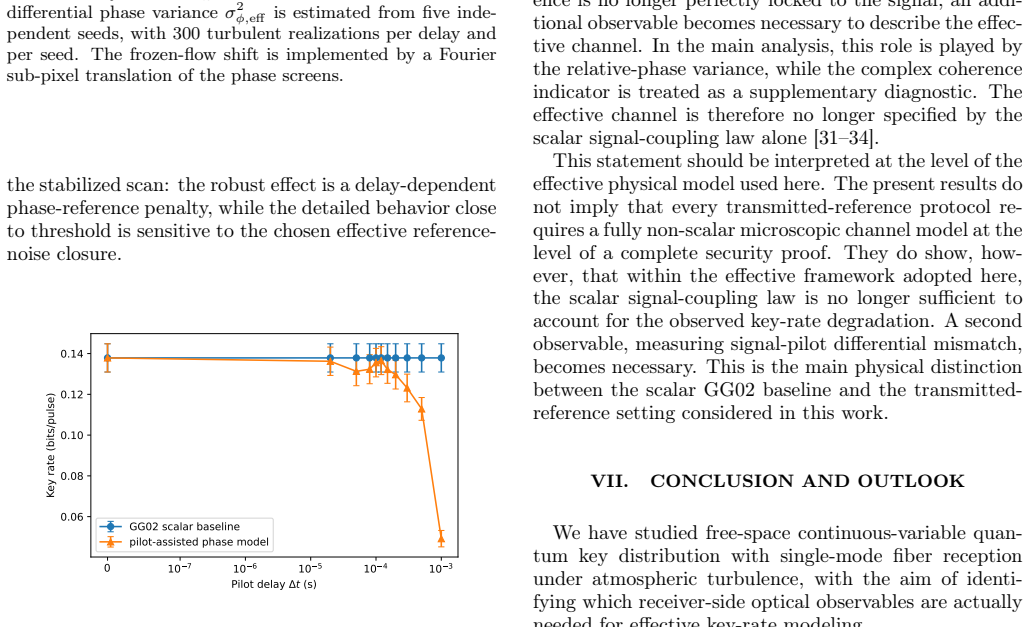
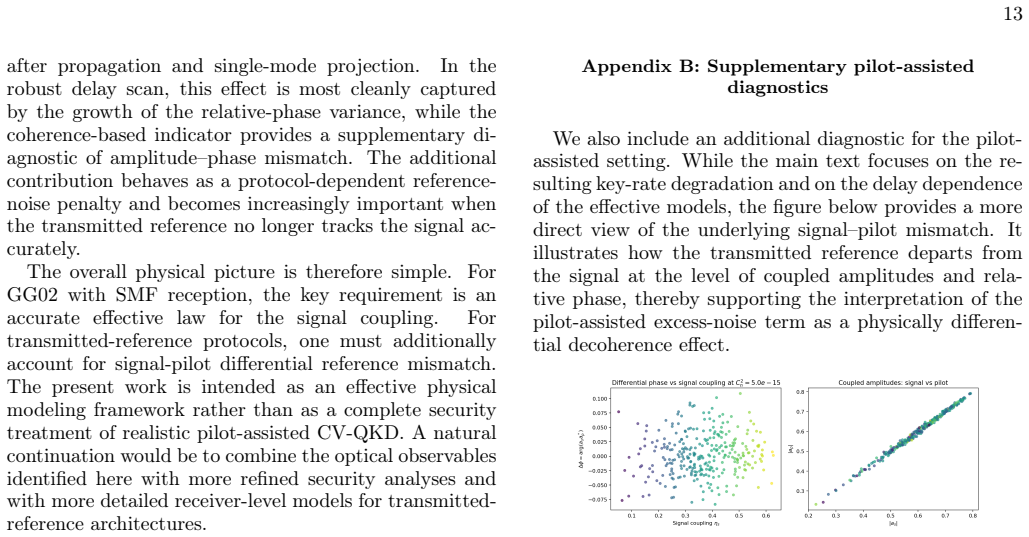
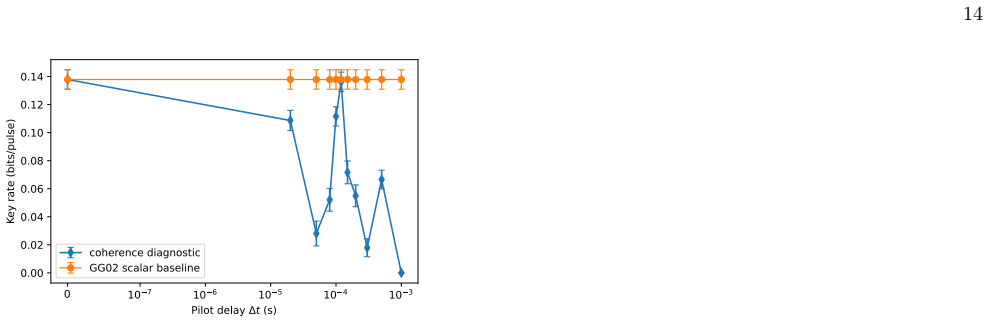
Within the split-step phase-screen model, a scalar effective law for SMF coupling efficiency supplies an accurate downstream Gaussian-channel description for the GG02 protocol, whereas transmitted-reference architectures incur an extra protocol-dependent reference-noise penalty arising from signal-pilot phase mismatch and loss of post-coupling coherence; the signal coupling law alone is therefore insufficient in the pilot-assisted case.
What carries the argument
The scalar effective law for SMF coupling efficiency, obtained by projecting the collected field onto the guided fiber mode after finite-aperture collection.
If this is right
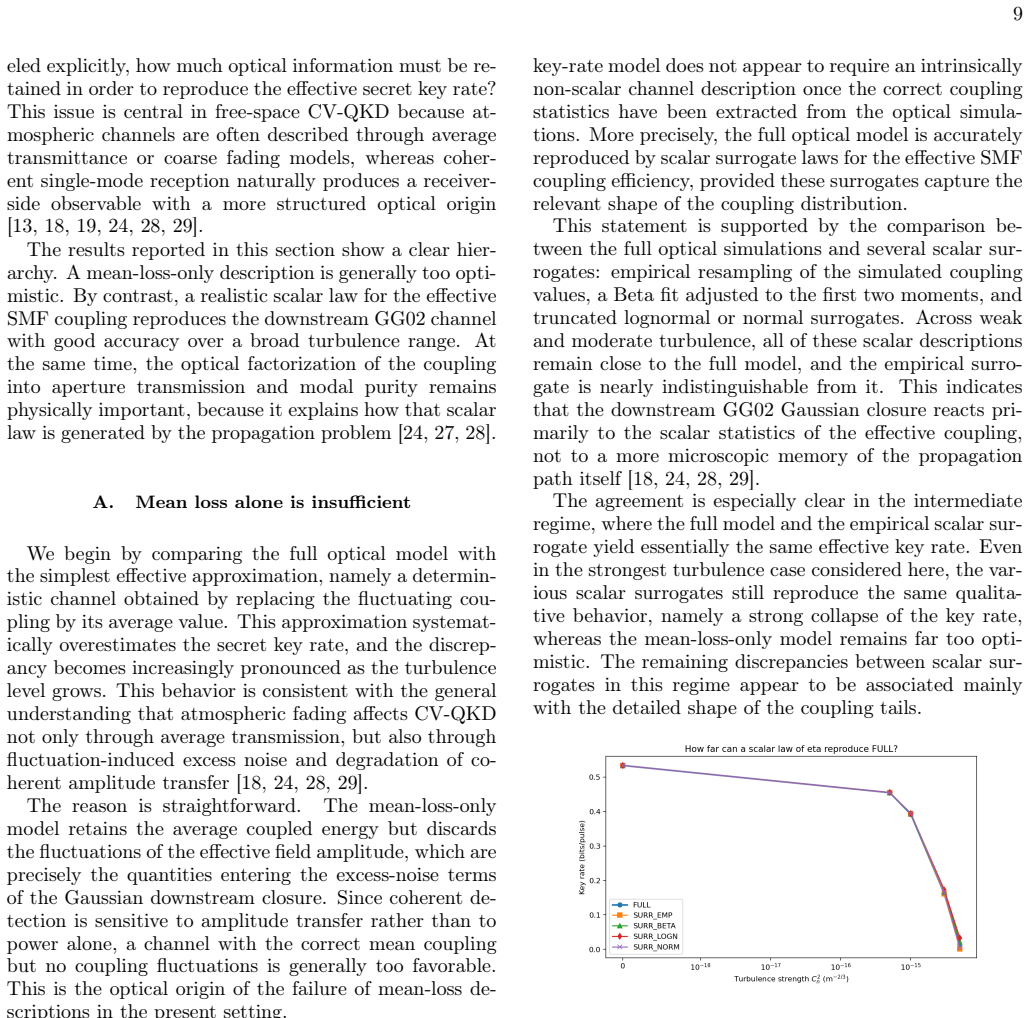
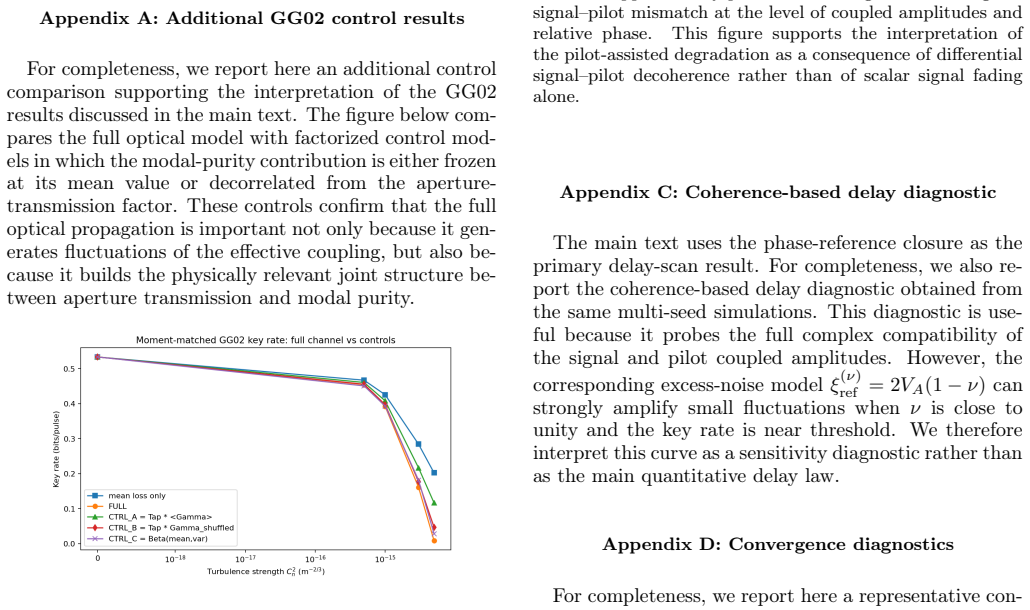
- Mean-loss models alone overestimate key rates for GG02 under turbulence.
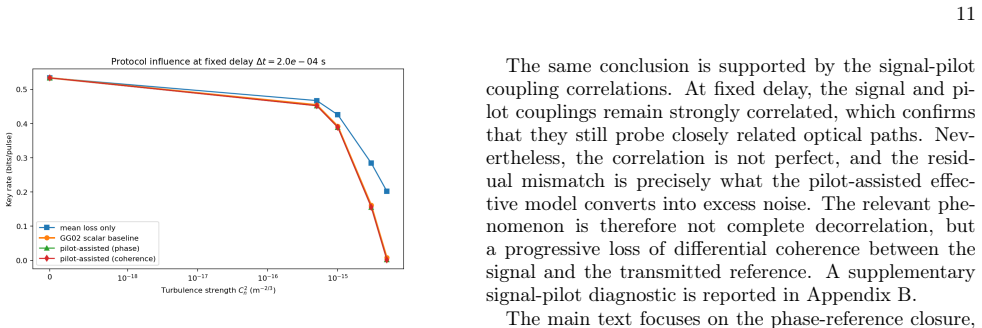
- Pilot-assisted protocols must track an additional differential reference observable beyond the signal coupling statistics.
- The effective model remains Gaussian for GG02 once the scalar coupling law is applied.
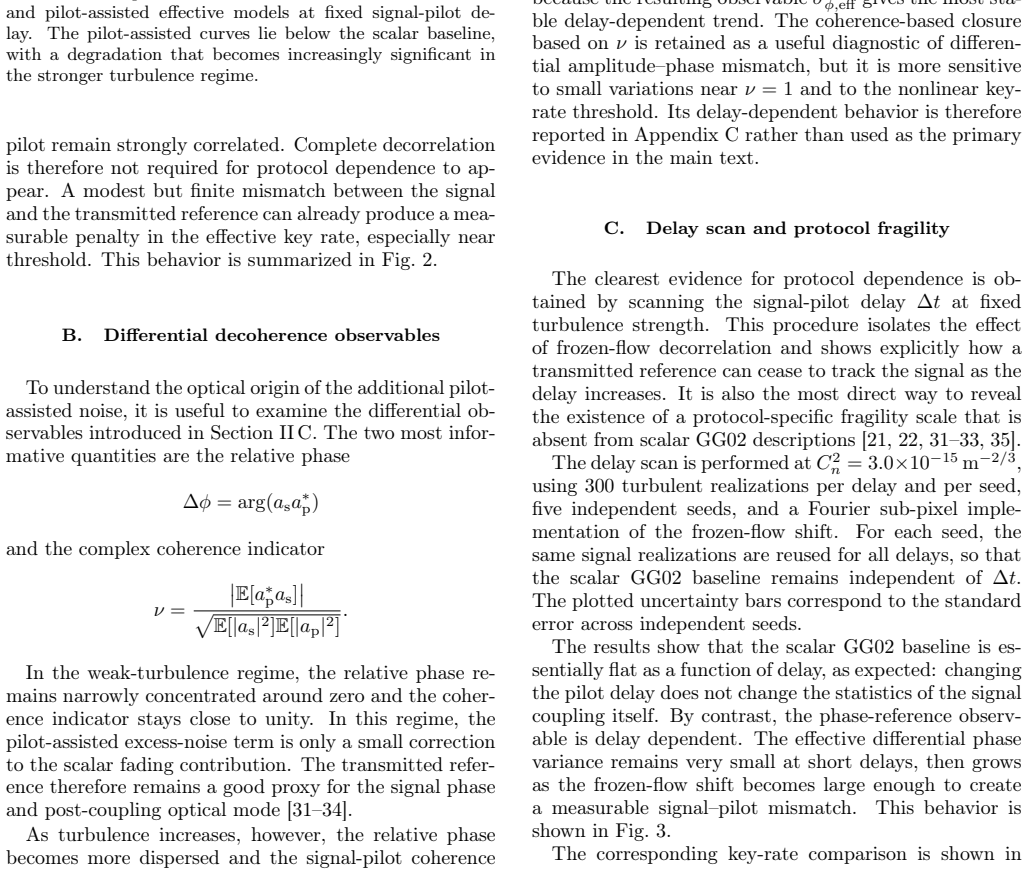
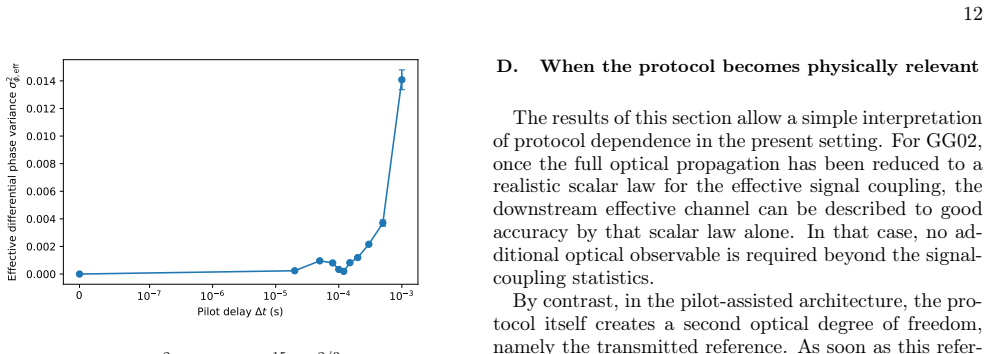
- Signal and pilot turbulence realizations remain correlated yet non-identical, producing measurable phase mismatch after fiber projection.
Where Pith is reading between the lines
- Receiver designs could adaptively switch between scalar-coupling and full-differential tracking depending on the chosen protocol.
- The same phase-screen framework might be reused to test whether adaptive optics at the receiver can reduce the extra reference noise in pilot-assisted cases.
- Experimental campaigns could measure the correlation length between signal and pilot coupling efficiencies to bound the size of the additional noise term.
Load-bearing premise
The turbulence can be represented by split-step propagation through random phase screens in which the signal and pilot experience correlated but non-identical realizations generated by a frozen-flow construction.
What would settle it
Numerical comparison of key rates computed from the scalar coupling law against full end-to-end simulation of the GG02 protocol under the same phase-screen realizations would show systematic deviation if the scalar law is inadequate.
Figures
read the original abstract
We study free-space continuous-variable quantum key distribution (CV-QKD) with single-mode fiber (SMF) reception under atmospheric turbulence. The optical channel is modeled by split-step propagation through random phase screens, followed by finite-aperture collection and projection onto the guided receiving mode. We first examine the standard GG02 setting and ask which receiver-side observable is sufficient for effective key-rate prediction. We show that a mean-loss description is generally too optimistic, whereas a scalar effective law for the SMF coupling efficiency provides an accurate downstream Gaussian-channel description within the effective model considered here. We then extend the optical model to a pilot-assisted architecture in which the signal and pilot propagate through correlated but non-identical turbulent realizations generated by a frozen-flow construction. In this case, the signal coupling law alone is no longer sufficient: signal--pilot phase mismatch and loss of post-coupling coherence produce an additional protocol-dependent reference-noise penalty. The results distinguish two regimes: a scalar coupling description is largely adequate for GG02, while transmitted-reference architectures require an additional differential reference observable beyond the signal coupling statistics.
Editorial analysis
A structured set of objections, weighed in public.
Referee Report
Summary. The paper models free-space CV-QKD with SMF reception via split-step propagation through random phase screens, finite-aperture collection, and projection onto the guided mode. For the GG02 protocol it shows that a mean-loss description is too optimistic while a scalar effective law for SMF coupling efficiency yields an accurate downstream Gaussian-channel description; for pilot-assisted architectures using frozen-flow correlated but non-identical turbulence realizations, signal-pilot phase mismatch and post-coupling coherence loss produce an additional protocol-dependent reference-noise penalty, so that the signal coupling law alone is insufficient and a differential reference observable is required.
Significance. If the numerical results hold within the stated effective model, the work supplies concrete guidance on which receiver-side observables suffice for key-rate prediction in turbulent free-space CV-QKD, cleanly separating the GG02 case from transmitted-reference architectures. The use of a frozen-flow construction to generate correlated turbulence realizations is a reproducible modeling choice that strengthens the comparison between protocols.
minor comments (2)
- [Abstract] Abstract: the phrase 'within the effective model considered here' is appropriately scoped but would benefit from an explicit forward reference to the section that defines the split-step parameters and frozen-flow construction.
- The manuscript would be improved by a short table (perhaps in §4 or §5) that tabulates the effective coupling law parameters, the resulting excess noise values, and the key-rate impact for both GG02 and pilot-assisted cases under identical turbulence realizations.
Simulated Author's Rebuttal
We thank the referee for the positive and accurate summary of our manuscript, the recognition of its significance, and the recommendation for minor revision. No major comments were raised in the report.
Circularity Check
No significant circularity
full rationale
The paper's central claims rest on numerical simulations of the optical channel (split-step phase screens, finite-aperture collection, projection onto SMF mode, and frozen-flow correlated turbulence realizations) to compare mean-loss, scalar coupling efficiency, and full statistics for GG02 key rates, plus the need for an extra differential observable in pilot-assisted cases. These are direct empirical comparisons inside the stated model rather than derivations that reduce to fitted parameters or self-citations by construction. No equations or load-bearing steps in the provided text exhibit self-definition, renaming of known results, or uniqueness imported from prior author work; the results are scoped explicitly to the simulation framework and therefore self-contained.
Axiom & Free-Parameter Ledger
Reference graph
Works this paper leans on
-
[1]
an empirical surrogate obtained by resampling the simulated values ofηfull,
-
[2]
a Beta surrogate adjusted to the first two moments ofη full,
-
[3]
a truncated lognormal surrogate,
-
[4]
a truncated normal surrogate. These surrogates are introduced to test whether the downstream GG02 model depends essentially on the scalar statistics of the effective coupling, or whether it retains traces of a more structured optical dependence [24, 28, 29]. If a surrogate law yields the same effective key rate as the full optical channel, then the corres...
-
[5]
a scalar fading contribution, already present in the GG02 baseline and entirely determined by the sig- nal coupling law,
-
[6]
This separation will allow us to identify below when a scalar description remains sufficient and when an ad- ditional differential reference observable becomes neces- sary
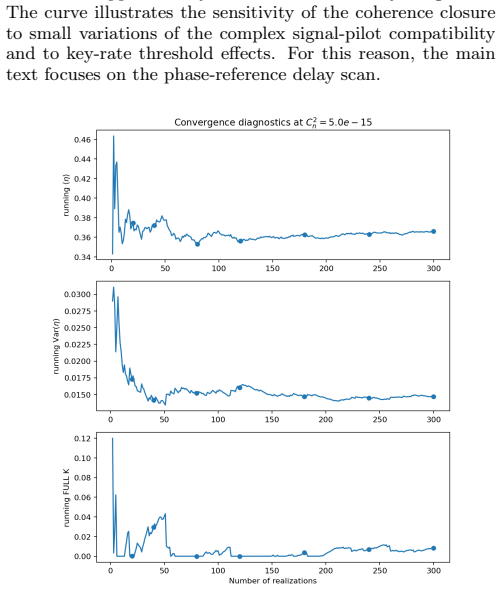
a protocol-dependent reference contribution, con- trolled by the differential observables∆ϕandν. This separation will allow us to identify below when a scalar description remains sufficient and when an ad- ditional differential reference observable becomes neces- sary. IV. NUMERICAL METHODOLOGY AND CONVERGENCE DIAGNOSTICS This section summarizes the numer...
-
[7]
Grosshans and P
F. Grosshans and P. Grangier, Continuous variable quan- tum cryptography using coherent states, Phys. Rev. Lett. 88, 057902 (2002)
2002
-
[8]
Grosshans, N
F. Grosshans, N. J. Cerf, J. Wenger, R. Tualle-Brouri, and P. Grangier, Virtual entanglement and reconcilia- tionprotocolsforquantumcryptographywithcontinuous variables, Quantum Inf. Comput.3, 535 (2003)
2003
-
[9]
García-Patrón and N
R. García-Patrón and N. J. Cerf, Unconditional optimal- ity of gaussian attacks against continuous-variable quan- tum key distribution, Physical Review Letters97, 190503 (2006)
2006
-
[10]
Weedbrook, S
C. Weedbrook, S. Pirandola, R. García-Patrón, N. J. Cerf, T. C. Ralph, J. H. Shapiro, and S. Lloyd, Gaussian quantum information, Rev. Mod. Phys.84, 621 (2012)
2012
-
[11]
Diamanti and A
E. Diamanti and A. Leverrier, Distributing secret keys with quantum continuous variables: Principle, security and implementations, Entropy17, 6072 (2015)
2015
-
[12]
Leverrier, R
A. Leverrier, R. García-Patrón, R. Renner, and N. J. Cerf, Security of continuous-variable quantum key dis- tribution against general attacks, Phys. Rev. Lett.110, 030502 (2013). 15
2013
-
[13]
Leverrier, Composable security proof for continuous- variable quantum key distribution with coherent states, Phys
A. Leverrier, Composable security proof for continuous- variable quantum key distribution with coherent states, Phys. Rev. Lett.114, 070501 (2015)
2015
-
[14]
Leverrier, Security of continuous-variable quantum key distribution via a gaussian de finetti reduction, Phys
A. Leverrier, Security of continuous-variable quantum key distribution via a gaussian de finetti reduction, Phys. Rev. Lett.118, 200501 (2017)
2017
-
[15]
Laudenbach, C
F. Laudenbach, C. Pacher, C.-H. F. Fung, A. Poppe, M. Peev, B. Schrenk, M. Hentschel, P. Walther, and H. Hübel, Continuous-variable quantum key distribu- tion with Gaussian modulation—The theory of practi- cal implementations, Adv. Quantum Technol.1, 1800011 (2018)
2018
-
[16]
Pirandola, U
S. Pirandola, U. L. Andersen, L. Banchi, M. Berta, D. Bunandar, R. Colbeck, D. Englund, T. Gehring, C. Lupo, C. Ottaviani, J. L. Pereira, M. Razavi, J. S. Shaari, M. Tomamichel, V. C. Usenko, G. Vallone, P. Vil- loresi, and P. Wallden, Advances in quantum cryptogra- phy, Advances in Optics and Photonics12, 1012 (2020)
2020
-
[17]
Zhang, J
G. Zhang, J. Y. Haw, H. Cai, F. Xu, S. M. Assad, J. F. Fitzsimons, X. Zhou, Y. Zhang, S. Yu, J. Wu, W. Ser, L. C. Kwek, and A. Q. Liu, An integrated silicon pho- tonic chip platform for continuous-variable quantum key distribution, Nature Photonics13, 839 (2019)
2019
-
[18]
V. C. Usenko, B. Heim, C. Peuntinger, C. Wittmann, C. Marquardt, G. Leuchs, and R. Filip, Entanglement of gaussian states and the applicability to quantum key distribution over fading channels, New Journal of Physics 14, 093048 (2012), arXiv:1208.4307 [quant-ph]
Pith/arXiv arXiv 2012
-
[19]
B. Heim, C. Peuntinger, N. Killoran, I. Khan, C. Wittmann, C. Marquardt, and G. Leuchs, At- mospheric continuous-variable quantum communication, New Journal of Physics16, 113018 (2014)
2014
-
[20]
S. Wang, P. Huang, T. Wang, and G. Zeng, Atmo- spheric effects on continuous-variable quantum key dis- tribution, New Journal of Physics20, 083037 (2018), arXiv:1804.04879 [quant-ph]
Pith/arXiv arXiv 2018
-
[21]
Shen, M.-W
S.-Y. Shen, M.-W. Dai, X.-T. Zheng, Q.-Y. Sun, G.- C. Guo, and Z.-F. Han, Free-space continuous-variable quantum key distribution of unidimensional Gaussian modulation using polarized coherent states in an urban environment, Phys. Rev. A100, 012325 (2019)
2019
-
[22]
Dequal, L
D. Dequal, L. Trigo Vidarte, V. Roman Rodriguez, G. Vallone, P. Villoresi, A. Leverrier, and E. Dia- manti, Feasibility of satellite-to-ground continuous- variable quantum key distribution, npj Quantum Infor- mation7, 3 (2021)
2021
-
[23]
Hosseinidehaj, Z
N. Hosseinidehaj, Z. Babar, R. Malaney, S. X. Ng, and L. Hanzo, Satellite-based continuous-variable quantum communications: State-of-the-art and a predictive out- look, IEEE Commun. Surv. Tutor.21, 881 (2019)
2019
-
[24]
Hosseinidehaj, N
N. Hosseinidehaj, N. Walk, and T. C. Ralph, Compos- able finite-size effects in free-space continuous-variable quantum-key-distribution systems, Phys. Rev. A103, 012605 (2021)
2021
-
[25]
Pirandola, Limits and security of free-space quantum communications, Phys
S. Pirandola, Limits and security of free-space quantum communications, Phys. Rev. Research3, 013279 (2021)
2021
-
[26]
Derkach, V
I. Derkach, V. C. Usenko, and R. Filip, Squeezing- enhanced quantum key distribution over atmospheric channels, New Journal of Physics22, 053006 (2020)
2020
-
[27]
L. C. Andrews and R. L. Phillips,Laser Beam Prop- agation through Random Media, 2nd ed. (SPIE Press, Bellingham, WA, 2005)
2005
-
[28]
J. D. Schmidt,Numerical Simulation of Optical Wave Propagation with Examples in MATLAB(SPIE Press, Bellingham, WA, 2010)
2010
-
[29]
Vasylyev, A
D. Vasylyev, A. A. Semenov, and W. Vogel, Toward global quantum communication: beam wandering pre- serves nonclassicality, Physical Review Letters108, 220501 (2012)
2012
-
[30]
Vasylyev, A
D. Vasylyev, A. A. Semenov, and W. Vogel, Atmo- spheric quantum channels with weak and strong turbu- lence, Phys. Rev. Lett.117, 090501 (2016)
2016
-
[31]
Vasylyev, A
D. Vasylyev, A. A. Semenov, W. Vogel, K. Günthner, A. Thurn, O. Bayraktar, and C. Marquardt, Free-space quantumlinksunderdiverseweatherconditions,Physical Review A96, 043856 (2017)
2017
-
[32]
M. T. Sayat, M. Birch, M. Copeland, E. Jager, O. Thearle, F. Bennet, P. K. Lam, N. J. Rattenbury, and J. E. Cater, Improving free-space continuous variable quantum key distribution with adaptive optics, Scientific Reports16, 6160 (2026)
2026
-
[33]
Dikmelik and F
Y. Dikmelik and F. M. Davidson, Fiber-coupling effi- ciency for free-space optical communication through at- mospheric turbulence, Appl. Opt.44, 4946 (2005)
2005
-
[34]
Vasylyev, A
D. Vasylyev, A. A. Semenov, and W. Vogel, Theory of atmospheric quantum channels based on the law of total probability, Phys. Rev. A97, 063852 (2018)
2018
-
[35]
G. Chai, Y. Zhang, and P. Huang, Parameter estimation of atmospheric continuous-variable quantum key distri- bution, Phys. Rev. A99, 032326 (2019)
2019
-
[36]
L. Ruppert, C. Peuntinger, B. Heim, K. Günthner, V. C. Usenko, D. Elser, G. Leuchs, R. Filip, and C. Marquardt, Fading channel estimation for free-space continuous- variable secure quantum communication, New Journal of Physics21, 123036 (2019), arXiv:2011.04386 [quant-ph]
arXiv 2019
-
[37]
B.Qi, P.Lougovski, R.Pooser, W.Grice,andM.Bobrek, Generating the local oscillator ‘locally’ in continuous- variable quantum key distribution based on coherent de- tection, Phys. Rev. X5, 041009 (2015)
2015
-
[38]
D. B. S. Soh, C. Brif, P. J. Coles, N. Lütkenhaus, R. M. Camacho, J. Urayama, and M. Sarovar, Self-referenced continuous-variable quantum key distribution protocol, Phys. Rev. X5, 041010 (2015)
2015
-
[39]
Marie and R
A. Marie and R. Alléaume, Self-coherent phase refer- ence sharing for continuous-variable quantum key distri- bution, Phys. Rev. A95, 012316 (2017)
2017
-
[40]
Laudenbach, B
F. Laudenbach, B. Schrenk, C. Pacher, M. Hentschel, C.-H. F. Fung, F. Karinou, A. Poppe, M. Peev, and H. Hübel, Pilot-assisted intradyne reception for high- speed continuous-variable quantum key distribution with true local oscillator, Quantum3, 193 (2019)
2019
-
[41]
G. I. Taylor, The spectrum of turbulence, Proc. R. Soc. Lond. A164, 476 (1938)
1938
-
[42]
Z. Zuo, Y. Wang, D. Huang, and Y. Guo, Atmospheric ef- fects on satellite-mediated continuous-variable quantum key distribution, Journal of Physics A: Mathematical and Theoretical53, 465302 (2020)
2020
-
[43]
R. G. Lane, A. Glindemann, and J. C. Dainty, Simulation of a Kolmogorov phase screen, Waves Random Media2, 209 (1992)
1992
discussion (0)
Sign in with ORCID, Apple, or X to comment. Anyone can read and Pith papers without signing in.