REVIEW 2 major objections 3 minor 1 cited by
An atomic array optical clock with single-atom readout
T0 review · 2 major / 3 minor · reviewed 2026-08-14 · deepseek-v4-flash
Pith's one-line read An atomic array of about 40 individually trapped strontium-88 atoms can act as a self-stabilized optical clock with fractional short-term instability $2.5\times10^{-15}/\sqrt{\tau}$, quantitatively matched by a Monte Carlo simulation that…
desk verdict Strong experimental milestone; the MC 'ab initio' label and unmeasured white-noise coefficient are the soft spots, not the core result. read the letter →
The pith
A machine-rendered reading of the paper's core claim, the machinery that carries it, and where it could break.
The reading
What carries the argument
The load-bearing object is the array-averaged two-point error signal $\bar{e} = (1/N_A)\sum_j (s_{A,j}-s_{B,j})$, where each $s_{j}$ is a binary readout of whether atom $j$ stayed in the ground state after interrogation below (A) or above (B) resonance. This signal is computed from fluorescence images with single-atom resolution, fed back through a digital controller to the clock laser frequency, and re-measured in repeated blocks with roughly 100 ms dead time. The companion mechanism is a Monte Carlo simulation that synthesizes clock-laser frequency noise from a power spectral density $S_\nu(f)=\alpha f^{-2}+\beta f^{-1}+\gamma f^0$, evolves each atom's Rabi dynamics at finite temperature, applies projective Bernoulli readout with measured detection fidelities, and closes the same feedback loop as the experiment; the quantitative match between simulation and data is what turns the stability measurement into a prediction for single-clock operation.
What would settle it
Measure the clock laser's white frequency noise floor directly, for example by beating it against a second ultrastable laser and resolving $S_\nu(f)$ from 0.1 to 10 Hz, and check whether $\gamma$ falls inside the assumed $0$ to $0.34\,\mathrm{Hz^2/Hz}$ band; a value outside that band would move $\sigma_\infty$ and the predicted single-clock stability off the quoted numbers.
Extended reading notes
Core claim
The central claim is that an 81-site optical tweezer array stochastically loaded with about 40 single $^{88}$Sr atoms can operate as a feedback-stabilized optical clock on the $^{1}S_0\leftrightarrow{}^3 P_0$ clock transition at 698 nm, with single-atom, single-shot readout in every cycle. Each interrogation block probes once below and once above resonance; the site-resolved ground-state occupations $s_{A,j}$ and $s_{B,j}$ form an error signal $\bar{e}$ that drives an acousto-optic frequency shifter. Using interleaved self-comparison of two feedback loops, the authors measure $2.5\times10^{-15}/\sqrt{\tau}$ fractional Allan deviation, reproduce it with a Monte Carlo simulation that treats laser noise, projection noise, temperature, and feedback, and use the simulation to predict $(1.9\text{--}2.2)\times10^{-15}/\sqrt{\tau}$ for single-clock operation with shorter dead time. They also report a direct, atom-by-atom measurement of the $1/\sqrt{N_A}$ stability scaling on top of a laser-noise floor, with $\sigma_\infty = 2.3\times10^{-15}/\sqrt{\tau}$.
Load-bearing premise
The predictions rest on the assumption that the clock laser's frequency noise is fully described by $S_\nu(f)=\alpha f^{-2}+\beta f^{-1}+\gamma f^0$, with the white-noise coefficient $\gamma$ only bracketed between $0$ and $0.34\,\mathrm{Hz^2/Hz}$; if the true high-frequency noise floor lies outside that band, the quoted laser-noise limit and single-clock prediction shift.
Editorial extensions
If this is right
- Stability improves only as $1/\sqrt{N_A}$ until the common-mode laser-noise floor $\sigma_\infty=2.3\times10^{-15}/\sqrt{\tau}$ dominates, so adding more atoms alone will not push this system below that floor.
- With the same laser, single-clock operation should reach $(1.9\text{--}2.2)\times10^{-15}/\sqrt{\tau}$ because its dead time is shorter than that of the interleaved self-comparison.
- Site-resolved error signals give sub-Hz frequency maps across the array, and the proposed per-tweezer correction could remove the estimated $10^{-17}$-level noise from stochastic occupation of slightly shifted sites.
- The absence of an Allan-deviation upturn down to $10^{-16}$ at $10^4$ s in a left-half-versus-right-half lock indicates no slow drift of array gradients at the current sensitivity.
- Interaction and hopping shifts that affect lattice clocks are suppressed by single-atom occupancy and larger interatomic spacing, while retaining dead time near 100 ms.
Reading between the lines
- Because readout is already single-atom and site-resolved, the same array could interleave clock interrogation with local Rydberg thermometry to map black-body shifts at each site, a step the paper identifies but does not demonstrate.
- If local addressing is added, different array regions could serve as two clocks in the same vacuum chamber, turning the demonstrated left/right-half comparison into a continuous, dead-time-free differential measurement.
- The simulation's predictive power is hostage to the unmeasured white-noise coefficient; a direct beat-note measurement of the clock laser's noise floor would test the $(1.9\text{--}2.2)\times10^{-15}/\sqrt{\tau}$ prediction without building a second clock.
- With single-atom control, spin-squeezing protocols proposed for lattice clocks become natural next steps here; the open question is whether the entanglement generation preserves the demonstrated $2.5\times10^{-15}$ floor.
Editorial analysis
A structured set of objections, weighed in public.
Referee Report
Summary. This paper demonstrates an optical clock based on an 81-site optical tweezer array stochastically loaded with about 40 88Sr atoms, with single-atom-resolved readout and real-time feedback to the interrogation laser. The authors measure site-resolved error signals, perform interleaved self-comparisons, and report a fractional short-term instability of 2.5×10⁻¹⁵/√τ. By selecting subsets of atoms for feedback, they observe 1/√N_A scaling of the Allan variance on top of a laser-noise floor and extract σ∞=2.3×10⁻¹⁵/√τ. A Monte Carlo simulation including laser frequency noise, projective readout, finite temperature, stochastic filling, and feedback dynamics is compared with the data and used to predict (1.9–2.2)×10⁻¹⁵/√τ for single-clock operation. The paper also evaluates trap-depth and wavelength shifts with self-comparison, finds an operational magic condition, and demonstrates site-resolved systematic-shift evaluation, while leaving a full accuracy statement to future work.
Significance. The experiment is significant because it establishes a third optical clock platform that combines optical-lattice-clock-level interrogation with the single-atom detection and control of neutral-atom arrays. The strongest assets are the direct atom-number-scaling measurement of the Allan variance, the site-resolved systematic evaluation, the standard self-comparison methodology, and a Monte Carlo simulation whose noise parameters are calibrated by an independent beat-note PSD rather than fitted to the stability data. If the extrapolated single-clock instability holds, the platform is directly relevant to transportable clocks, quantum clock networks, and entanglement-enhanced metrology. The lack of a full accuracy budget is explicitly acknowledged and is reasonable for a first demonstration, so it does not by itself weaken the stability claims.
major comments (2)
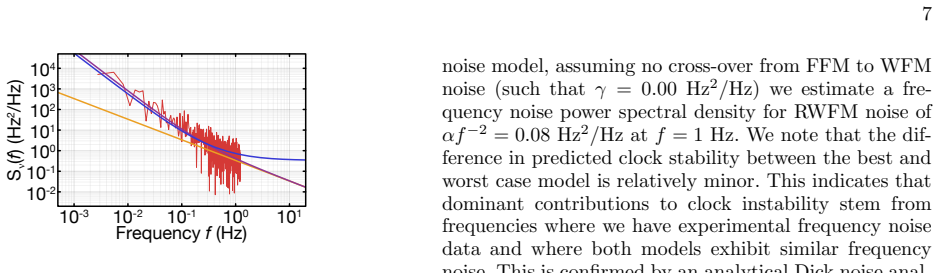
- [Appendix A3, Fig. 5, Sec. V] The predicted single-clock stability and the interpretation of σ∞ in Sec. V as a laser-noise floor rest on the PSD model Sν(f)=αf⁻²+βf⁻¹+γf⁰ of Appendix A3. The coefficient γ is not directly measured—the beat-note spectrum is not a direct measurement of the white-noise floor at high frequencies—and is only bracketed between 0 and 0.34 Hz²/Hz. The statement that the best/worst-case difference is 'relatively minor' is not backed by a quantitative sensitivity analysis; at the upper bound, white frequency noise contributes about 1.2 Hz rms per 110-ms interrogation, i.e. roughly 3×10⁻¹⁵ fractional, which is comparable to the claimed total stability. Please provide predicted Allan deviations and predicted σ∞ as functions of γ (and α), and show explicitly how the best/worst-case models bracket the measured σ∞ in Fig. 4b. Without this mapping, the agreement between the MC model and the atom-number-scaling cross-check is not closed.
- [Sec. V, Fig. 4, Appendix B8] The headline numbers in Sec. V—2.5×10⁻¹⁵/√τ and σ∞=2.3×10⁻¹⁵/√τ—are quoted without statistical uncertainties. The fit procedure in Appendix B8 uses τ=10–100 s and an assumed equal spacing Δt≈835 ms, but no confidence interval is reported for the fitted amplitude A nor for σ∞ from the σ²=σ∞²+σ_NA² fit in Fig. 4b. Given that the paper's central claim is quantitative agreement between data and simulation, the absence of error bars makes the agreement impossible to assess quantitatively. Please report uncertainties from a bootstrap or equivalent procedure on these values and on the MC shaded band.
minor comments (3)
- [Abstract, Sec. I, Appendix A3] The word 'ab initio' in the abstract and Sec. I is stronger than the simulation supports: the noise PSD coefficients in Appendix A3 are estimated from thermal-noise calculations and beat-note fits, and the light-shift model in Appendix E includes one fitted global offset. Please qualify the term or explicitly list which input parameters are independently measured versus fitted.
- [Fig. 5, Appendix A3] The measured PSD appears to be limited by the reference laser at high frequencies; adding a caption note that the white-noise floor is not directly resolved would prevent readers from overinterpreting the data.
- [Appendix B8] The approximation that feedbacks are equally spaced with Δt≈835 ms, introducing an error of about 100 ms at all τ, is acceptable for the long-time fit, but it should be stated in the main text next to the headline Allan-deviation result.
Circularity Check
No significant circularity: the instability measurement is direct and the MC predictions come from a forward model with independently characterized inputs.
full rationale
The claimed derivation chain is not circular. The short-term instability of 2.5e-15/sqrt(tau) is a direct experimental result from an interleaved self-comparison of two feedback loops, not an output of a fitted model. The Monte Carlo simulation is a forward model: its noise inputs are independently characterized (beat-note PSD against a reference laser, cavity thermal-noise estimate, measured nbar ~ 0.66, measured detection fidelities, and the experimental dead time and gain), and the paper does not fit the simulation to the clock's Allan deviation. The predicted single-clock stability of (1.9-2.2)e-15/sqrt(tau) is a conditional extrapolation of that forward model; the bracketing of the unmeasured white-noise coefficient gamma is an uncertainty band rather than a calibration to the target, so any concern about that bracket is a correctness or sensitivity issue, not circularity. The light-shift analysis in Appendix E uses published atomic constants from external work and fits only a single global frequency offset, so the operational magic condition is a genuine model prediction constrained by the data. Self-citations (Refs. [25,41]) provide prior experimental techniques and are not load-bearing for the central stability claim; no uniqueness theorem or ansatz is imported from the authors' own prior work. I therefore find no step in which an output reduces to its own input by construction.
Assumptions & free parameters
free parameters (4)
- Clock laser noise PSD coefficients (α, β, γ) =
Worst-case: α=0.05, β=0.34, γ=0.34 Hz^2/Hz at 1 Hz; best-case: α=0.08, β=0.34, γ=0.00 Hz^2/Hz
- Feedback gain κ =
3 Hz
- Light-shift model global frequency offset =
Not quoted in paper
- Interrogation offsets δo =
±3.8 Hz
assumptions (5)
- domain assumption The clock laser frequency noise is described by Sν(f) = α f^-2 + β f^-1 + γ f^0 with best/worst-case parameters (Appendix A 3).
- domain assumption Raman scattering from the trap and differential trapping due to hyperpolarizability or AOD trap-wavelength shifts are negligible at the demonstrated stability level (Appendix A 1).
- domain assumption Clock interrogation is a two-level Rabi process with Lamb-Dicke-modified Rabi frequencies (Appendix A 1).
- domain assumption The tweezer differential light shift is captured by Eq. E1 using literature polarizability values (Table I), with one fitted global offset.
- standard math Standard probability theory for the convolution of binomial distributions (Eq. C2).
Cite this review
Pith. "Pith review of An atomic array optical clock with single-atom readout." pith.science (2026). https://pith.science/paper/IR7U6SCQ
@misc{pith2026190805619,
  author       = {Pith},
  title        = {Pith review of: An atomic array optical clock with single-atom readout},
  year         = {2026},
  howpublished = {\url{https://pith.science/paper/IR7U6SCQ}},
  note         = {Machine review of arXiv:1908.05619}
}
read the original abstract
Currently, the most accurate and stable clocks use optical interrogation of either a single ion or an ensemble of neutral atoms confined in an optical lattice. Here, we demonstrate a new optical clock system based on an array of individually trapped neutral atoms with single-atom readout, merging many of the benefits of ion and lattice clocks as well as creating a bridge to recently developed techniques in quantum simulation and computing with neutral atoms. We evaluate single-site resolved frequency shifts and short-term stability via self-comparison. Atom-by-atom feedback control enables direct experimental estimation of laser noise contributions. Results agree well with an ab initio Monte Carlo simulation that incorporates finite temperature, projective read-out, laser noise, and feedback dynamics. Our approach, based on a tweezer array, also suppresses interaction shifts while retaining a short dead time, all in a comparatively simple experimental setup suited for transportable operation. These results establish the foundations for a third optical clock platform and provide a novel starting point for entanglement-enhanced metrology, quantum clock networks, and applications in quantum computing and communication with individual neutral atoms that require optical clock state control.
Figures


Figures from the paper (4 more)


Forward citations
Cited by 1 Pith paper
-
Variational spin-squeezing algorithms on programmable quantum sensors
A variational feedback algorithm using only global pulses and finite-range Rydberg interactions can prepare spin-squeezed states that outperform standard one-axis and two-axis twisting protocols in numerical simulations.
Reference graph
Works this paper leans on
-
[1]
Operation We compare the performance of our clock to Monte Carlo (MC) simulations. The simulations include the ef- fects of laser frequency noise, dead time during loading and between interrogations, quantum projection noise, finite temperature, stochastic filling of tweezers, and experimental imperfections such as state-detection infi- delity and atom loss....
-
[2]
in Fig. 4a, where ν0 is the clock transition frequency and the √ 2 factor is introduced to take into account the addition of noise from two iden- tical sources. The results show a 1 /√τ behavior after a lock onset time, where τ is the averaging time in sec- onds. Fitting this behavior yields σy = 2.5× 10⁻¹⁵/√τ, in excellent agreement with MC simulations (...
-
[3]
Generating frequency noise traces Using a model of the power spectral density of our clock laser’s frequency noise (Sec A 3), we generate random fre- 7 Sν(f) (Hz2/Hz) Frequency f (Hz) 104 103 102 101 100 10-1 10-2 10-3 10-2 10-1 100 101 FIG. 5. Frequency noise spectrum of the clock laser. Power spectral density of the frequency noise of our clock laser me...
-
[4]
Frequency noise model The power spectral density of the frequency noise of our clock laser is modeled by the sum of contributions from random walk frequency modulation (RWFM) noise (f−2), flicker frequency modulation (FFM) noise ( f−1), and white frequency modulation (WFM) noise (f0), such that Sν(f) = αf−2 +βf−1 +γf 0. We obtain these pa- rameters through...
-
[5]
Experimental system Our strontium apparatus is described in detail in Refs. [25, 41]. Strontium-88 atoms from an atomic beam oven are slowed and cooled to a few microkelvin temper- ature by a 3d magneto-optical trap operating first on the broad dipole-allowed 1S0↔ 1P1 transition at 461 nm and then on the narrow spin-forbidden 1S0↔ 3P1 transition at 689 nm....
-
[6]
Clock laser system Our clock laser is based on a modified portable clock laser system (Stable Laser Systems) composed of an ex- ternal cavity diode laser (Moglabs) stabilized to an iso- lated, high-finesse optical cavity using the Pound-Drever- Hall scheme and electronic feedback to the laser diode current and piezoelectric transducer. The optical cavity is...
-
[7]
Bosonic clock transition Optical excitation of the 1S0 ↔ 3P0 clock transmis- sion in a bosonic alkaline-earth-like atom is facilitated by applying a bias magnetic field B [26]. This field cre- ates a small admixture of 3P1 into 3P0, and results in a Rabi frequency of Ω R/2π = α √ I|B|, where I is the intensity of the clock probe beam and α is the coupling c...
-
[8]
This imaging procedure initializes the atoms in the 1S0 elec- tronic ground state |g⟩
Interrogation sequence We confirm the presence of atoms in each tweezer us- ing fluorescence imaging for 30 ms on the 461 nm tran- sition while cooling on the 689 nm transition and re- pumping atoms out of the metastable 3P0,2 states. This imaging procedure initializes the atoms in the 1S0 elec- tronic ground state |g⟩. We then further cool the atoms for 10...
Show all 74 references
-
[9]
[25], we analyze the fidelity of detecting atoms in the 1S0 (|g⟩) and 3P0 (|e⟩) states under these imaging conditions
Clock state detection fidelity Based on the approach demonstrated in Ref. [25], we analyze the fidelity of detecting atoms in the 1S0 (|g⟩) and 3P0 (|e⟩) states under these imaging conditions. We diagnose our state-detection fidelity with two consecu- tive images. In the first ima...
-
[10]
Stabilization to the atomic signal The clock laser is actively stabilized to the atomic sig- nal using a digital control system. The frequency devia- tion of the clock laser from the atomic transition is esti- mated from a two-point measurement of the Rabi spec- troscopy signa...
-
[11]
7) using the same beam used to interrogate the atoms for clock operation
Sideband thermometry on the clock transition We perform sideband thermometry on the clock transi- tion (Fig. 7) using the same beam used to interrogate the atoms for clock operation. Using a standard technique of taking the ratio of the integrated area under the first red and b...
-
[12]
To account for this variation, we approximate that all feedbacks are equally spaced in time with ∆t≈ 835 ms
Evaluating Allan deviations Repeated interrogation introduces a bimodal distribu- tion in the time between feedback events due to the pe- riodic refilling of the array. To account for this variation, we approximate that all feedbacks are equally spaced in time with ∆t≈ 835 ms. ...
-
[13]
Probability distribution function In the absence of additional noise and givenNA atoms, the probability of finding Ng atoms in the ground state after a single clock interrogation block is given by the bi- nomial distribution PB(Ng;NA,p ), where p is the prob- ability of detecti...
-
[14]
Additional noise In the presence of noise, such as laser noise or finite temperature, the excitation probability pA and pB fluc- tuates from repetition to repetition. These fluctuations can be accounted for by introducing a joint probability 10 density function π(pA,pB), so that ...
-
[15]
Experimental data We can directly extract the correlation function C through the results of images (2) and (4) for valid tweez- ers (Fig. 1e). We explicitly confirm that C is indepen- dent of the number of atoms used per AB interrogation cycle and extract C =−0.025. The anti-co...
-
[16]
Atom number dependent stability To study the performance of our clock as a function of atom number, we can choose to use only part of our full array for clock operation (Fig. 4b). We preferentially choose atoms near the center of the array to minimize errors due to gradients i...
-
[17]
Clock comparison between two halves of the array We use the ability to lock to a subset of occupied traps to perform stability analysis that is sensitive to slow drifts of gradients across the array (such as from external fields or spatial variations in trap homogeneity). In th...
-
[18]
As an example, the AOD introduces a spatial gra- dient in trap frequencies across the array, leading to a spatial variation in zero-crossings of the error signal (as shown in Fig
In situ error correction Single-site resolution offers the opportunity both to an- alyze single-atom signals, as discussed in the main text, and to modify such signals before using them for feed- back. As an example, the AOD introduces a spatial gra- dient in trap frequencies a...
-
[19]
Optical atomic clocks,
Andrew D. Ludlow, Martin M. Boyd, Jun Ye, E. Peik, and P. O. Schmidt, “Optical atomic clocks,” Rev. Mod. Phys. 87, 637–701 (2015)
2015
-
[20]
Atomic clock performance enabling geodesy below the centimetre level,
W. F. McGrew, X. Zhang, R. J. Fasano, S. A. Sch¨ affer, K. Beloy, D. Nicolodi, R. C. Brown, N. Hinkley, G. Mi- lani, M. Schioppo, T. H. Yoon, and A. D. Ludlow, “Atomic clock performance enabling geodesy below the centimetre level,” Nature 564, 87–90 (2018)
2018
-
[21]
27Al+ Quantum-Logic Clock with a System- atic Uncertainty below 10 −18,
S. M. Brewer, J.-S. Chen, A. M. Hankin, E. R. Clements, C. W. Chou, D. J. Wineland, D. B. Hume, and D. R. Leibrandt, “27Al+ Quantum-Logic Clock with a System- atic Uncertainty below 10 −18,” Phys. Rev. Lett. 123, 033201 (2019)
2019
-
[22]
Demonstration of 4.8× 10⁻¹⁷ stability at 1 s for two independent optical clocks,
E. Oelker, R. B. Hutson, C. J. Kennedy, L. Sonder- house, T. Bothwell, A. Goban, D. Kedar, C. Sanner, J. M. Robinson, G. E. Marti, D. G. Matei, T. Leg- ero, M. Giunta, R. Holzwarth, F. Riehle, U. Sterr, and J. Ye, “Demonstration of 4.8× 10⁻¹⁷ stability at 1 s for two independe...
2019 doi
-
[23]
Geodesy and metrol- ogy with a transportable optical clock,
Jacopo Grotti, Silvio Koller, Stefan Vogt, Sebastian H¨ afner, Uwe Sterr, Christian Lisdat, Heiner Denker, Christian Voigt, Ludger Timmen, Antoine Rolland, Fred N. Baynes, Helen S. Margolis, Michel Zampaolo, Pierre Thoumany, Marco Pizzocaro, Benjamin Rauf, Fil- ippo Bregolin, ...
2018
-
[24]
New Limits on Coupling of Fundamental Constants to Gravity Us- ing 87Sr Optical Lattice Clocks,
S. Blatt, A. D. Ludlow, G. K. Campbell, J. W. Thomsen, T. Zelevinsky, M. M. Boyd, J. Ye, X. Baillard, M. Fouch´ e, R. Le Targat, A. Brusch, P. Lemonde, M. Takamoto, F.- L. Hong, H. Katori, and V. V. Flambaum, “New Limits on Coupling of Fundamental Constants to Gravity Us- ing ...
2008
-
[25]
Michelson-Morley analogue for electrons using trapped ions to test Lorentz symmetry,
T. Pruttivarasin, M. Ramm, S. G. Porsev, I. I. Tupit- syn, M. S. Safronova, M. A. Hohensee, and H. H¨ affner, “Michelson-Morley analogue for electrons using trapped ions to test Lorentz symmetry,” Nature 517, 592–595 (2015)
2015
-
[26]
Observation of two- orbital spin-exchange interactions with ultracold SU(N)- symmetric fermions,
F. Scazza, C. Hofrichter, M. H¨ ofer, P. C. De Groot, I. Bloch, and S. F¨ olling, “Observation of two- orbital spin-exchange interactions with ultracold SU(N)- symmetric fermions,” Nat. Phys. 10, 779–784 (2014)
2014
-
[27]
Towards the optical second: verifying optical clocks at the SI limit,
W. F. McGrew, X. Zhang, H. Leopardi, R. J. Fasano, D. Nicolodi, K. Beloy, J. Yao, J. A. Sherman, S. A. Sch¨ affer, J. Savory, R. C. Brown, S. R¨ omisch, C. W. Oates, T. E. Parker, T. M. Fortier, and A. D. Ludlow, “Towards the optical second: verifying optical clocks at the SI l...
2019
-
[28]
Quantum simulation of frustrated Ising spins with trapped ions,
K. Kim, M.-S. Chang, S. Korenblit, R. Islam, E. E. Ed- wards, J. K. Freericks, G.-D. Lin, L.-M. Duan, and C. Monroe, “Quantum simulation of frustrated Ising spins with trapped ions,” Nature 465, 590–593 (2010)
2010
-
[29]
Quantum simu- lations with ultracold atoms in optical lattices,
Christian Gross and Immanuel Bloch, “Quantum simu- lations with ultracold atoms in optical lattices,” Science 357, 995–1001 (2017)
2017
-
[30]
Probing many-body dynamics on a 51-atom quantum simulator,
Hannes Bernien, Sylvain Schwartz, Alexander Keesling, Harry Levine, Ahmed Omran, Hannes Pichler, Soon- won Choi, Alexander S. Zibrov, Manuel Endres, Markus Greiner, Vladan Vuleti´ c, and Mikhail D. Lukin, “Probing many-body dynamics on a 51-atom quantum simulator,” Nature 551,...
2017
-
[31]
Observ- ing the Space- and Time-Dependent Growth of Correla- tions in Dynamically Tuned Synthetic Ising Models with Antiferromagnetic Interactions,
Vincent Lienhard, Sylvain de L´ es´ eleuc, Daniel Barredo, Thierry Lahaye, Antoine Browaeys, Michael Schuler, Louis-Paul Henry, and Andreas M. L¨ auchli, “Observ- ing the Space- and Time-Dependent Growth of Correla- tions in Dynamically Tuned Synthetic Ising Models with Antife...
2018
-
[32]
Rydberg Spectroscopy in an Optical Lattice: Blackbody Thermometry for Atomic Clocks,
Vitali D. Ovsiannikov, Andrei Derevianko, and Kurt Gibble, “Rydberg Spectroscopy in an Optical Lattice: Blackbody Thermometry for Atomic Clocks,” Phys. Rev. Lett. 107, 093003 (2011)
2011
-
[33]
Spin Squeezing in a Rydberg Lat- tice Clock,
L. I. R. Gil, R. Mukherjee, E. M. Bridge, M. P. A. Jones, and T. Pohl, “Spin Squeezing in a Rydberg Lat- tice Clock,” Phys. Rev. Lett. 112, 103601 (2014)
2014
-
[34]
Near- Unitary Spin Squeezing in 171Yb,
Boris Braverman, Akio Kawasaki, Edwin Pedrozo- Pe˜ nafiel, Simone Colombo, Chi Shu, Zeyang Li, En- rique Mendez, Megan Yamoah, Leonardo Salvi, Daisuke Akamatsu, Yanhong Xiao, and Vladan Vuleti´ c, “Near- Unitary Spin Squeezing in 171Yb,” Phys. Rev. Lett. 122, 223203 (2019)
2019
-
[35]
Variational spin- squeezing algorithms on programmable quantum sen- sors,
Raphael Kaubruegger, Pietro Silvi, Christian Kokail, Rick van Bijnen, Ana Maria Rey, Jun Ye, Adam M. Kaufman, and Peter Zoller, “Variational spin- squeezing algorithms on programmable quantum sen- sors,” arXiv:1908.08343 (2019)
2019 arXiv
-
[36]
Variational-State Quantum Metrology,
B´ alint Koczor, Suguru Endo, Tyson Jones, Yuichiro Matsuzaki, and Simon C. Benjamin, “Variational-State Quantum Metrology,” arXiv:1908.08904 (2019)
2019 arXiv
-
[37]
A quantum network of clocks,
P. K´ om´ ar, E. M. Kessler, M. Bishof, L. Jiang, A. S. Sørensen, J. Ye, and M. D. Lukin, “A quantum network of clocks,” Nat. Phys. 10, 582–587 (2014)
2014
-
[38]
Quantum Computing with Alkaline-Earth-Metal Atoms,
Andrew J. Daley, Martin M. Boyd, Jun Ye, and Peter Zoller, “Quantum Computing with Alkaline-Earth-Metal Atoms,” Phys. Rev. Lett. 101, 170504 (2008)
2008
-
[39]
Fast and Scalable Quantum Information Processing with Two-Electron Atoms in Optical Tweezer Arrays,
Guido Pagano, Francesco Scazza, and Michael Foss-Feig, “Fast and Scalable Quantum Information Processing with Two-Electron Atoms in Optical Tweezer Arrays,” Advanced Quantum Technologies 2, 1800067 (2019)
2019
-
[40]
Telecom- Band Quantum Optics with Ytterbium Atoms and Sil- icon Nanophotonics,
Jacob P. Covey, Alp Sipahigil, Szilard Szoke, Neil Sin- clair, Manuel Endres, and Oskar Painter, “Telecom- Band Quantum Optics with Ytterbium Atoms and Sil- icon Nanophotonics,” Phys. Rev. Applied 11, 034044 (2019)
2019
-
[41]
High-Accuracy Optical Clock Based on the Octupole Transition in171Yb+,
N. Huntemann, M. Okhapkin, B. Lipphardt, S. Weyers, Chr. Tamm, and E. Peik, “High-Accuracy Optical Clock Based on the Octupole Transition in171Yb+,” Phys. Rev. Lett. 108, 090801 (2012)
2012
-
[42]
Suppressing Inhomogeneous Broadening in a Lutetium Multi-ion Optical Clock,
T. R. Tan, R. Kaewuam, K. J. Arnold, S. R. Chanu, Zhiqiang Zhang, M. S. Safronova, and M. D. Barrett, “Suppressing Inhomogeneous Broadening in a Lutetium Multi-ion Optical Clock,” Phys. Rev. Lett. 123, 063201 (2019)
2019
-
[43]
2000-Times Repeated Imaging of Strontium Atoms in Clock-Magic Tweezer Arrays,
Jacob P. Covey, Ivaylo S. Madjarov, Alexandre Cooper, and Manuel Endres, “2000-Times Repeated Imaging of Strontium Atoms in Clock-Magic Tweezer Arrays,” Phys. Rev. Lett. 122, 173201 (2019)
2019
-
[44]
Magnetic Field-Induced Spec- troscopy of Forbidden Optical Transitions with Appli- cation to Lattice-Based Optical Atomic Clocks,
A. Taichenachev, V. Yudin, C. Oates, C. Hoyt, Z. Bar- 14 ber, and L. Hollberg, “Magnetic Field-Induced Spec- troscopy of Forbidden Optical Transitions with Appli- cation to Lattice-Based Optical Atomic Clocks,” Phys. Rev. Lett. 96, 083001 (2006)
2006
-
[45]
Three-dimensional optical lattice clock with bosonic 88Sr atoms,
Tomoya Akatsuka, Masao Takamoto, and Hidetoshi Katori, “Three-dimensional optical lattice clock with bosonic 88Sr atoms,” Phys. Rev. A 81, 023402 (2010)
2010
-
[46]
Sys- tematic evaluation of an atomic clock at 2 10-18 total uncertainty,
T.L. Nicholson, S.L. Campbell, R.B. Hutson, G.E. Marti, B.J. Bloom, R.L. McNally, W. Zhang, M.D. Barrett, M.S. Safronova, G.F. Strouse, W.L. Tew, and J. Ye, “Sys- tematic evaluation of an atomic clock at 2 10-18 total uncertainty,” Nat. Commun. 6, 6896 (2015)
2015
-
[47]
Noise and instability of an optical lattice clock,
Ali Al-Masoudi, S¨ oren D¨ orscher, Sebastian H¨ afner, Uwe Sterr, and Christian Lisdat, “Noise and instability of an optical lattice clock,” Phys. Rev. A 92, 063814 (2015)
2015
-
[48]
Hyperpolarizability and Operational Magic Wavelength in an Optical Lattice Clock,
R. C. Brown, N. B. Phillips, K. Beloy, W. F. McGrew, M. Schioppo, R. J. Fasano, G. Milani, X. Zhang, N. Hink- ley, H. Leopardi, T. H. Yoon, D. Nicolodi, T. M. Fortier, and A. D. Ludlow, “Hyperpolarizability and Operational Magic Wavelength in an Optical Lattice Clock,” Phys. R...
2017
-
[49]
Towards an op- tical clock for space: Compact, high-performance optical lattice clock based on bosonic atoms,
S. Origlia, M. S. Pramod, S. Schiller, Y. Singh, K. Bongs, R. Schwarz, A. Al-Masoudi, S. D¨ orscher, S. Herbers, S. H¨ afner, U. Sterr, and Ch. Lisdat, “Towards an op- tical clock for space: Compact, high-performance optical lattice clock based on bosonic atoms,” Phys. Rev. A ...
2018
-
[50]
Mod- eling light shifts in optical lattice clocks,
Nils Nemitz, Asbjørn Arvad Jørgensen, Ryotatsu Yanag- imoto, Filippo Bregolin, and Hidetoshi Katori, “Mod- eling light shifts in optical lattice clocks,” Phys. Rev. A 99, 033424 (2019)
2019
-
[51]
Trans- portable Optical Lattice Clock with 7 × 10⁻¹⁷ Uncer- tainty,
S. B. Koller, J. Grotti, St. Vogt, A. Al-Masoudi, S. D¨ orscher, S. H¨ afner, U. Sterr, and Ch. Lisdat, “Trans- portable Optical Lattice Clock with 7 × 10⁻¹⁷ Uncer- tainty,” Phys. Rev. Lett. 118, 073601 (2017)
2017
-
[52]
Seconds- scale coherence on an optical clock transition in a tweezer array,
Matthew A. Norcia, Aaron W. Young, William J. Eckner, Eric Oelker, Jun Ye, and Adam M. Kaufman, “Seconds- scale coherence on an optical clock transition in a tweezer array,” Science 366, 93–97 (2019)
2019
-
[53]
Local Oscillator Induced Instabilities in Trapped Ion Frequency Standards,
G. John Dick, “Local Oscillator Induced Instabilities in Trapped Ion Frequency Standards,” Proceedings of the 19th Annual Precise Time and Time Interval Systems and Applications , 133 – 147 (1987)
1987
-
[54]
A Fermi-degenerate three-dimensional optical lattice clock,
S. L. Campbell, R. B. Hutson, G. E. Marti, A. Goban, N. Darkwah Oppong, R. L. McNally, L. Sonderhouse, J. M. Robinson, W. Zhang, B. J. Bloom, and J. Ye, “A Fermi-degenerate three-dimensional optical lattice clock,” Science 358, 90–94 (2017)
2017
-
[55]
Ultrastable optical clock with two cold- atom ensembles,
M. Schioppo, R. C. Brown, W. F. McGrew, N. Hinkley, R. J. Fasano, K. Beloy, T. H. Yoon, G. Milani, D. Ni- colodi, J. A. Sherman, N. B. Phillips, C. W. Oates, and A. D. Ludlow, “Ultrastable optical clock with two cold- atom ensembles,” Nat. Photonics 11, 48–52 (2017)
2017
-
[56]
Suppression of Collisional Shifts in a Strongly Interacting Lattice Clock,
M. D. Swallows, M. Bishof, Y. Lin, S. Blatt, M. J. Martin, A. M. Rey, and J. Ye, “Suppression of Collisional Shifts in a Strongly Interacting Lattice Clock,” Science 331, 1043–1046 (2011)
2011
-
[57]
Controlling dipole-dipole frequency shifts in a lattice-based optical atomic clock,
D. E. Chang, Jun Ye, and M. D. Lukin, “Controlling dipole-dipole frequency shifts in a lattice-based optical atomic clock,” Phys. Rev. A 69, 023810 (2004)
2004
-
[58]
Engi- neering Quantum States of Matter for Atomic Clocks in Shallow Optical Lattices,
Ross B. Hutson, Akihisa Goban, G. Edward Marti, Lind- say Sonderhouse, Christian Sanner, and Jun Ye, “Engi- neering Quantum States of Matter for Atomic Clocks in Shallow Optical Lattices,” arXiv:1903.02498 (2019)
2019 arXiv
-
[59]
Alkaline-Earth Atoms in Optical Tweezers,
Alexandre Cooper, Jacob P. Covey, Ivaylo S. Madjarov, Sergey G. Porsev, Marianna S. Safronova, and Manuel Endres, “Alkaline-Earth Atoms in Optical Tweezers,” Phys. Rev. X 8, 041055 (2018)
2018
-
[60]
Single-Atom Trapping in Holographic 2D Arrays of Mi- crotraps with Arbitrary Geometries,
F. Nogrette, H. Labuhn, S. Ravets, D. Barredo, L. B´ eguin, A. Vernier, T. Lahaye, and A. Browaeys, “Single-Atom Trapping in Holographic 2D Arrays of Mi- crotraps with Arbitrary Geometries,” Phys. Rev. X 4, 021034 (2014)
2014
-
[61]
Fritz Riehle, Frequency Standards (Wiley, 2003)
2003
-
[62]
Mi- croscopic Control and Detection of Ultracold Strontium in Optical-Tweezer Arrays,
M. A. Norcia, A. W. Young, and A. M. Kaufman, “Mi- croscopic Control and Detection of Ultracold Strontium in Optical-Tweezer Arrays,” Phys. Rev. X 8, 041054 (2018)
2018
-
[63]
Coupling atoms to cavities with narrow linewidth optical transitions: Applications to fre- quency metrology,
Matthew A. Norcia, “Coupling atoms to cavities with narrow linewidth optical transitions: Applications to fre- quency metrology,” arXiv:1908.11442 (2019)
2019 arXiv
-
[64]
Laser cooling of atoms,
D. J. Wineland and Wayne M. Itano, “Laser cooling of atoms,” Phys. Rev. A 20, 1521–1540 (1979)
1979
-
[65]
Analysis of imperfections in the coherent optical excitation of sin- gle atoms to Rydberg states,
Sylvain de L´ es´ eleuc, Daniel Barredo, Vincent Lienhard, Antoine Browaeys, and Thierry Lahaye, “Analysis of imperfections in the coherent optical excitation of sin- gle atoms to Rydberg states,” Phys. Rev. A 97, 053803 (2018)
2018
-
[66]
Thermal-Noise Limit in the Frequency Stabilization of Lasers with Rigid Cavities,
Kenji Numata, Amy Kemery, and Jordan Camp, “Thermal-Noise Limit in the Frequency Stabilization of Lasers with Rigid Cavities,” Phys. Rev. Lett. 93, 250602 (2004)
2004
-
[67]
Making optical atomic clocks more stable with 10 −16-level laser stabilization,
Y. Y. Jiang, A. D. Ludlow, N. D. Lemke, R. W. Fox, J. A. Sherman, L.-S. Ma, and C. W. Oates, “Making optical atomic clocks more stable with 10 −16-level laser stabilization,” Nat. Photonics 5, 158–161 (2011)
2011
-
[68]
Force-insensitive op- tical cavity,
Stephen Webster and Patrick Gill, “Force-insensitive op- tical cavity,” Opt. Lett. 36, 3572 (2011)
2011
-
[69]
Direct Excita- tion of the Forbidden Clock Transition in Neutral 174Yb Atoms Confined to an Optical Lattice,
Z. Barber, C. Hoyt, C. Oates, L. Hollberg, A. Taichenachev, and V. Yudin, “Direct Excita- tion of the Forbidden Clock Transition in Neutral 174Yb Atoms Confined to an Optical Lattice,” Phys. Rev. Lett. 96, 083002 (2006)
2006
-
[70]
Carrier thermometry of cold ytterbium atoms in an op- tical lattice clock,
Chengyin Han, Min Zhou, Xiaohang Zhang, Qi Gao, Yilin Xu, Shangyan Li, Shuang Zhang, and Xinye Xu, “Carrier thermometry of cold ytterbium atoms in an op- tical lattice clock,” Scientific Reports 8, 7927 (2018)
2018
-
[71]
Strategies for reducing the light shift in atomic clocks,
Hidetoshi Katori, V. D. Ovsiannikov, S. I. Marmo, and V. G. Palchikov, “Strategies for reducing the light shift in atomic clocks,” Phys. Rev. A 91, 052503 (2015)
2015
-
[72]
Experimental realization of an optical second with strontium lattice clocks,
R. Le Targat, L. Lorini, Y. Le Coq, M. Zawada, J. Gu´ ena, M. Abgrall, M. Gurov, P. Rosenbusch, D. G. Rovera, B. Nag´ orny, R. Gartman, P. G. Westergaard, M. E. To- bar, M. Lours, G. Santarelli, A. Clairon, S. Bize, P. Lau- rent, P. Lemonde, and J. Lodewyck, “Experimental real...
2013
-
[73]
High Accuracy Correction of Blackbody Radiation Shift in an Optical Lattice Clock,
Thomas Middelmann, Stephan Falke, Christian Lisdat, and Uwe Sterr, “High Accuracy Correction of Blackbody Radiation Shift in an Optical Lattice Clock,” Phys. Rev. Lett. 109, 263004 (2012)
2012
-
[74]
Lattice-Induced Frequency Shifts in Sr Optical Lattice Clocks at the 10−17 Level,
P. G. Westergaard, J. Lodewyck, L. Lorini, A. Lecal- lier, E. A. Burt, M. Zawada, J. Millo, and P. Lemonde, “Lattice-Induced Frequency Shifts in Sr Optical Lattice Clocks at the 10−17 Level,” Phys. Rev. Lett. 106, 210801 (2011)
2011
Reviewed August 14, 2026 · model on record in the stance chip above.
Discussion (0). Continue with ORCID to comment.