REVIEW 4 major objections 4 minor 111 references
FlexiD-Fuse: Flexible number of inputs multi-modal medical image fusion based on diffusion model
T0 review · 4 major / 4 minor · reviewed 2026-08-04 · deepseek-v4-flash
Pith's one-line read FlexiD-Fuse claims that a single diffusion model fuses two or three medical image modalities under one set of weights, by turning fusion into a maximum-likelihood problem with an EM correction inside each denoising step.
desk verdict A legitimate two-modal DDFM extension with a fast Mamba backbone and extensive experiments, but the tri-modal and 'flexible number' claims rest on an ad hoc add-the-third-image construction. read the letter →
The pith
A machine-rendered reading of the paper's core claim, the machinery that carries it, and where it could break.
The reading
What carries the argument
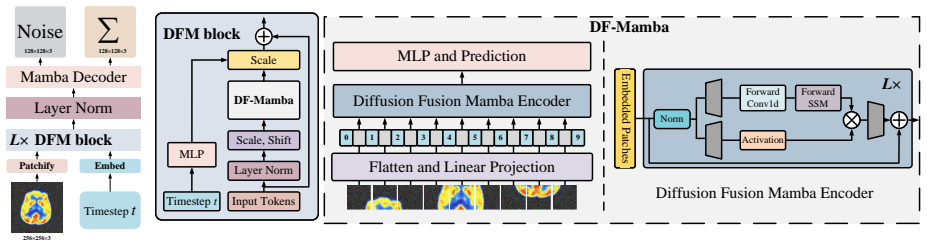
The load-bearing device is the additive fusion identity f = x + img2 + img3 (Eq. 31), paired with the substitution y = img1 - img2 (Eq. 20). It rewrites the switching loss, min_f (||f - img1 - img3||_1 + phi||f - img2 - img3||_1), into a one-variable maximum-likelihood problem, min_x (||y - x||_1 + phi||x||_1); the number of inputs enters only through the term added back at the end. Inference is carried by an EM module interleaved with the diffusion sampler: the E-step computes per-pixel confidence weights from the current prediction, and the M-step solves half-quadratic-splitting subproblems via closed-form FFT updates, then adds img2 + img3 back. The Diffusion Fusion Mamba (DFM), an ultra-
What would settle it
Fuse one fixed triple of source images six times, once for each permutation of the roles img1, img2, img3. If the fused outputs differ materially, the result depends on input ordering, not on the set of modalities, and the additive fusion model (Eq. 31) fails as a general prior. A lighter check: the paper's equations imply that tri-modal fusion with an all-zero img3 must exactly reproduce two-modal fusion; any deviation would reveal hidden input-count dependence.
Extended reading notes
Core claim
A fusion network need not know its input count in advance: FlexiD-Fuse fuses two- or three-modal medical images end-to-end with one set of weights, by re-casting diffusion fusion as maximum-likelihood estimation and running an EM correction inside every reverse-sampling step. The correction uses the additive identity f = x + img2 + img3 (img3 = 0 for two inputs), where x solves an L1-plus-total-variation problem with closed-form FFT updates. The paper reports best scores on most of nine metrics for both settings on the Harvard dataset, and the same weights transfer to infrared-visible, multi-exposure, and multi-focus fusion. The abstract claims independence from input number; the paper's own
Load-bearing premise
The tri-modal capability rests on the additive equation f = x + img2 + img3: for three inputs the loss simultaneously wants f approximately img1 + img3 and f approximately img2 + img3, so the method succeeds only to the extent both additive targets are valid descriptions of the same fusion, and the output can vary with which input is labeled img3.
Editorial extensions
If this is right
- One pretrained denoiser serves both two-modal and tri-modal fusion under identical weights, eliminating per-count retraining and the information-losing two-stage cascade used to extend two-modal models to three inputs.
- The flexibility is nearly free: the EM correction uses closed-form FFT updates, so handling a variable number of inputs adds no learned parameters to the network.
- The same weights transfer across tasks: the paper demonstrates infrared-visible, multi-exposure, and multi-focus (including three-source) fusion without retraining, supporting the claim that the mechanism is modality-agnostic.
- Because the correction re-derives the fusion target from the sources at every diffusion step, the fused image is generated without any ground-truth fusion image, removing a standard obstacle for diffusion-based fusion.
Reading between the lines
- The additive identity is order-sensitive: permuting which input plays img1, img2, or img3 changes y = img1 - img2 and hence changes the fused output. A true any-number fusion should be permutation-invariant, so fusing the same triple in all six orderings is a direct, untested implication.
- The math does not obviously stop at three inputs: the same E- and M-steps would work for four or more modalities with f = x + (sum of all but one input). The paper's stated limitation to two- and three-modal switching looks like an implementation choice rather than a formal ceiling, and would be easy to test.
- The L1 intensity losses tacitly assume the source modalities share a comparable intensity scale; the paper normalizes images to [-1, 1] before fusion, so that normalization is likely load-bearing for the additive correction even though the paper does not discuss it.
Editorial analysis
A structured set of objections, weighed in public.
Referee Report
Summary. FlexiD-Fuse proposes a diffusion-based framework for two-modal and tri-modal medical image fusion with a single pretrained denoising model. At inference, the method interleaves standard DDPM sampling with an EM module that corrects the denoised estimate using the source images. The central claim is that this corrector is independent of the number of input modalities, so the same weights can fuse two or three images. The paper reports SOTA metrics on Harvard two- and tri-modal medical fusion and on extended infrared-visible, multi-exposure, and multi-focus experiments, and it releases code.
Significance. If the flexible-input claim were correct, the paper would be a meaningful advance: most existing fusion methods are fixed-input, and a single diffusion prior plus a likelihood corrector that accepts variable numbers of modalities would be practically valuable. The manuscript also has real strengths: a broad experimental campaign across six datasets, comparisons with many recent methods, a lightweight Mamba-based diffusion backbone (DFM), and a public code release. However, the core derivation of the tri-modal case is, by the paper's own substitution, two-modal EM followed by an additive third image. The headline claim therefore rests on a step that is neither justified nor permutation-invariant, and the reported tri-modal gains are consistent with a trivial additive baseline. The significance of the flexible-input contribution is consequently not established.
major comments (4)
- [§3.4, Eq. (18)–(20), (31); Algorithm 1 lines 11–18] The central construction is, by the paper's own substitution, two-modal EM plus an additive third image. Setting x=f−img2−img3 and y=img1−img2 turns Eq. (18) into Eq. (20), whose solution depends only on img1 and img2; Eq. (31) then returns x+img2+img3. In Algorithm 1 the E-step (line 12) also uses only y=img1−img2. Thus the tri-modal case does not perform a three-way likelihood correction; it is DDFM-style two-modal EM followed by an unchanged addition of img3. The abstract's claim that the method fuses inputs 'independently of the number of input images' is therefore not supported by the derivation.
- [§3.4, Eq. (18)] Eq. (18) is introduced without derivation and is not a natural symmetric extension of the two-modal loss. For three modalities a symmetric objective would depend on all pairwise differences or treat all images equally; Eq. (18) only couples img1 and img2 through their difference and forces f to approximate img1+img3 and img2+img3. Because these two targets conflict whenever img1≠img2, the minimizer is an arbitrary weighted compromise, and the result is permutation-dependent: swapping img1 and img2 changes x and hence changes f. No permutation-invariance test or theoretical justification is provided. This is load-bearing because the 'flexible number of inputs' claim requires the output to be independent of input ordering, at least up to the fusion semantics.
- [Conclusion (last paragraph) and abstract] The abstract states the method handles 'flexible quantities' of inputs and works 'independently of the number of input images,' but the Conclusion explicitly limits the method to two- and three-modal fusion: 'it is not yet capable of handling fusion tasks involving more than three modalities.' The extended experiments also only use two or three sources. The paper should at minimum restrict all claims to n=2,3. This is not a minor wording issue because the 'arbitrary number' claim is part of the advertised contribution.
- [Table 7 and §4.6] The ablation does not test the key assumption. Since Eq. (31) defines the tri-modal output as x+img2+img3, the proposed tri-modal method is exactly the trivial baseline 'run the two-modal algorithm on (img1,img2) and add img3'. Table 7 compares against a two-stage fusion (Config 2) but not against this baseline, nor against f=EM(img1,img3)+img2 or f=EM(img2,img3)+img1. Without these controls, the reported tri-modal gains cannot be attributed to a principled three-way fusion; they are consistent with the additive construction. The authors should add these baselines and a permutation analysis.
minor comments (4)
- [§3.2, Eq. (6)] The expectation notation in Eq. (6) is garbled: 'EtEx0 Ext|x0' is not readable as a standard expectation over (t, x0, xt), and the integrand mixes ∇_x_t with ∇_f. Please rewrite in standard notation.
- [§3.4.2, Eq. (30)] The x-update is written as x = (2m^2⊙y+ηk)⊘(2m^2+2n^2+η)^{-1}; as written this multiplies by the inverse, which is wrong. It should be division by (2m^2+2n^2+η). The code presumably uses the correct form, but the printed formula is a mathematical error in a core update.
- [§4.1.1 and §4.3] The text says 'nine metrics' but only eight are listed (SSIM, MI, PSNR, VIF, QS, QCV, FSIM, QNCIE). Similarly, §4.3 says '9 SOTA methods' but Table 2 lists eleven two-modal methods. Please correct these inconsistencies.
- [§4.4, Table 3] For the proposed method, Time-3M equals Time-2M (9.850 s in both cases). This is consistent with Eq. (31) but should be explained; otherwise it reinforces the impression that the third modality is not processed through the EM likelihood at all.
Circularity Check
Tri-modal fusion is by construction two-modal EM plus img3: Eq. 18's loss is rearranged via x=f−img2−img3 into the two-modal problem, and Eq. 31 adds img2+img3 back, so the third modality is only added, not fused.
-
self definitional
[Section 3.4, Eqs. 18-20 and 31; Algorithm 1 lines 11-18]
"min f {∥f−img1−img3∥1 + φ∥f−img2−img3∥1} ... by performing a simple variable substitution x=f−img2−img3 and y=img1−img2, we derive the optimization formula: min x (∥y−x∥1 + φ∥x∥1) ... The final estimation of f is: f̂=x+img2+img3 (31). If 2-mode fusion, img3=0 (32)."
The tri-modal loss (Eq. 18) is itself the assumption that the fused image equals img1+img3 and img2+img3. The substitution x=f−img2−img3, y=img1−img2 turns this into the two-modal problem min_x ||y−x||+φ||x||, which does not involve img3 at all. The final reconstruction f̂=x+img2+img3 then guarantees that the three-modal output is exactly the two-modal EM solution on (img1,img2) plus the raw third image img3. So the paper's central claim of processing two- and three-modal inputs 'independently of the number of input images' is true only by construction: n=3 is defined as n=2 plus an additive image. The derivation does not fuse img3 through the likelihood; it appends it. The output also depends on which modality is labelled img3, since no permutation symmetry is imposed. This is a self-defi
full rationale
The two-modal subcase (img3=0) is an independent DDFM-style EM formulation and is evaluated against external baselines; that part is not circular. However, the paper's headline contribution—flexible two/tri-modal fusion under the same weight—is obtained by defining the tri-modal output as x+img2+img3. The loss in Eq. 18 is chosen so that the variable substitution x=f−img2−img3 reduces to the same two-modal likelihood term, and Eq. 31 simply adds img2+img3 back. Therefore the tri-modal 'prediction' is an algebraic identity of the input loss, not a derived property. The paper acknowledges it only handles up to three modalities, which is consistent with this additive construction. Because the central flexible-number claim reduces by construction while the two-modal core retains independent content, the appropriate circularity score is 6.
Assumptions & free parameters
free parameters (4)
- eta (penalty weight in Eq. 28) =
0.1
- phi (weight on the second L1 term, written as psi in Eq. 21) =
0.5
- initial gamma and rho (latent variance hyperparameters) =
unspecified
- T (number of diffusion steps) =
100
assumptions (4)
- domain assumption The conditional score decomposes as an unconditional score plus a likelihood term via Bayes, as in Eq. 10 and validated in DPS.
- ad hoc to paper The fusion objective is the ad hoc L1 loss in Eq. 18, min_f ||f-img1-img3||_1 + phi||f-img2-img3||_1.
- ad hoc to paper The fused image is parametrized as f = x + img2 + img3 (Eq. 31), i.e., the third modality is added unchanged to the EM-corrected two-modal result.
- domain assumption x follows a Laplace distribution and the log-likelihood has the Gaussian latent-variable form in Eq. 21, with m and n as latent variances.
Cite this review
Pith. "Pith review of FlexiD-Fuse: Flexible number of inputs multi-modal medical image fusion based on diffusion model." pith.science (2026). https://pith.science/paper/ISFHAX2J
@misc{pith2026250909456,
  author       = {Pith},
  title        = {Pith review of: FlexiD-Fuse: Flexible number of inputs multi-modal medical image fusion based on diffusion model},
  year         = {2026},
  howpublished = {\url{https://pith.science/paper/ISFHAX2J}},
  note         = {Machine review of arXiv:2509.09456}
}
read the original abstract
Different modalities of medical images provide unique physiological and anatomical information for diseases. Multi-modal medical image fusion integrates useful information from different complementary medical images with different modalities, producing a fused image that comprehensively and objectively reflects lesion characteristics to assist doctors in clinical diagnosis. However, existing fusion methods can only handle a fixed number of modality inputs, such as accepting only two-modal or tri-modal inputs, and cannot directly process varying input quantities, which hinders their application in clinical settings. To tackle this issue, we introduce FlexiD-Fuse, a diffusion-based image fusion network designed to accommodate flexible quantities of input modalities. It can end-to-end process two-modal and tri-modal medical image fusion under the same weight. FlexiD-Fuse transforms the diffusion fusion problem, which supports only fixed-condition inputs, into a maximum likelihood estimation problem based on the diffusion process and hierarchical Bayesian modeling. By incorporating the Expectation-Maximization algorithm into the diffusion sampling iteration process, FlexiD-Fuse can generate high-quality fused images with cross-modal information from source images, independently of the number of input images. We compared the latest two and tri-modal medical image fusion methods, tested them on Harvard datasets, and evaluated them using nine popular metrics. The experimental results show that our method achieves the best performance in medical image fusion with varying inputs. Meanwhile, we conducted extensive extension experiments on infrared-visible, multi-exposure, and multi-focus image fusion tasks with arbitrary numbers, and compared them with the perspective SOTA methods. The results of the extension experiments consistently demonstrate the effectiveness and superiority of our method.
Figures


Figures from the paper (7 more)


Reference graph
Works this paper leans on
-
[1]
C. Qu, T. Zhang, H. Qiao, Y . Tang, A. L. Yuille, Z. Zhou, et al., Abdomenatlas-8k: Annotating 8,000 ct volumes for multi-organ segmentation in three weeks, Advances in Neural Information Processing Systems 36 (2024)
2024
-
[2]
Y . Jie, X. Li, F. Zhou, H. Tan, et al., Medical image fusion based on extended difference-of- gaussians and edge-preserving, Expert Systems with Applications 227 (2023) 120301
2023
-
[3]
Salim, Y
M. Salim, Y . Liu, M. Sorkhei, D. Ntoula, T. Foukakis, I. Fredriksson, Y . Wang, M. Ek- lund, H. Azizpour, K. Smith, et al., Ai- based selection of individuals for supplemental mri in population-based breast cancer screen- ing: the randomized screentrustmri trial, Nature Medicine 30 (9) (2024) 2623–2630
2024
-
[4]
Huang, W
Z. Huang, W. Li, Y . Wu, L. Yang, Y . Dong, Y . Yang, H. Zheng, D. Liang, M. Wang, Z. Hu, Accurate whole-brain image enhancement for low-dose integrated pet/mr imaging through spatial brain transformation, IEEE Journal of Biomedical and Health Informatics (2024)
2024
-
[5]
Jin, L.-J
Y . Jin, L.-J. Meng, Exploration of coincidence detection of cascade photons to enhance pre- clinical multi-radionuclide spect imaging, IEEE transactions on medical imaging (2024)
2024
-
[6]
Diwakar, P
M. Diwakar, P. Singh, A. Shankar, Multi- modal medical image fusion framework using co-occurrence filter and local extrema in nsst do- main, Biomedical Signal Processing and Control 68 (2021) 102788
2021
-
[7]
Y . Li, M. E. H. Daho, P.-H. Conze, R. Zegh- lache, H. Le Boité, R. Tadayoni, B. Coch- ener, M. Lamard, G. Quellec, A review of deep learning-based information fusion techniques for multimodal medical image classification, Com- puters in Biology and Medicine (2024) 108635
2024
-
[9]
R. Qin, Z. Wang, L. Jiang, K. Qiao, J. Hai, J. Chen, J. Xu, D. Shi, B. Yan, Fine-grained lung cancer classification from pet and ct images based on multidimensional attention mechanism, Complexity 2020 (1) (2020) 6153657. 19
2020
Show all 111 references
-
[10]
P. Wu, Z. Wang, B. Zheng, H. Li, F. E. Alsaadi, N. Zeng, Aggn: Attention-based glioma grad- ing network with multi-scale feature extraction and multi-modal information fusion, Computers in biology and medicine 152 (2023) 106457
2023
-
[11]
Dhaundiyal, A
R. Dhaundiyal, A. Tripathi, K. Joshi, M. Di- wakar, P. Singh, Clustering based multi-modality medical image fusion, in: Journal of Physics: Conference Series, V ol. 1478, IOP Publishing, 2020, p. 012024
2020
-
[12]
Diwakar, P
M. Diwakar, P. Singh, A. Shankar, S. R. Nayak, J. Nayak, S. Vimal, R. Singh, D. Sisodia, Di- rective clustering contrast-based multi-modality medical image fusion for smart healthcare sys- tem, Network Modeling Analysis in Health In- formatics and Bioinformatics 11 (1) (2022) 15
2022
-
[13]
Y . Jie, F. Zhou, H. Tan, G. Wang, X. Cheng, X. Li, Tri-modal medical image fusion based on adaptive energy choosing scheme and sparse rep- resentation, Measurement 204 (2022) 112038
2022
-
[14]
Y . Liu, X. Chen, A. Liu, R. K. Ward, Z. J. Wang, Recent advances in sparse representation based medical image fusion, IEEE Instrumentation & Measurement Magazine 24 (2) (2021) 45–53
2021
-
[15]
Zhang, A
X. Zhang, A. Liu, G. Yang, Y . Liu, X. Chen, Simfusion: A semantic information-guided modality-specific fusion network for mr images, Information Fusion 112 (2024) 102560
2024
-
[16]
Y . Jie, X. Li, T. Tan, L. Yang, M. Wang, Multi- modality image fusion using fuzzy set theory and compensation dictionary learning, Optics & Laser Technology 181 (2025) 112001
2025
-
[17]
X. Li, W. Wan, F. Zhou, X. Cheng, Y . Jie, H. Tan, Medical image fusion based on sparse represen- tation and neighbor energy activity, Biomedical Signal Processing and Control 80 (2023) 104353
2023
-
[18]
X. Li, F. Zhou, H. Tan, W. Zhang, C. Zhao, Mul- timodal medical image fusion based on joint bi- lateral filter and local gradient energy, Informa- tion Sciences 569 (2021) 302–325
2021
-
[19]
Kalage, P
D. Kalage, P. Gupta, A. Gulati, K. P. Reddy, K. Sharma, A. Thakur, T. D. Yadav, V . Gupta, L. Kaman, R. Nada, et al., Contrast enhanced ct versus mri for accurate diagnosis of wall- thickening type gallbladder cancer, Journal of Clinical and Experimental Hepatology 14 (5) (202...
2024
-
[20]
X. Li, S. Ma, J. Xu, J. Tang, S. He, F. Guo, Tran- siam: Aggregating multi-modal visual features with locality for medical image segmentation, Expert Systems with Applications 237 (2024) 121574
2024
-
[21]
Z. Guo, X. Li, H. Huang, N. Guo, Q. Li, Deep learning-based image segmentation on multi- modal medical imaging, IEEE Transactions on Radiation and Plasma Medical Sciences 3 (2) (2019) 162–169
2019
-
[22]
Karthik, H
A. Karthik, H. S. Hamatta, S. Patthi, C. Krubakaran, A. K. Pradhan, V . Racha- pudi, M. Shuaib, A. Rajaram, Ensemble-based multimodal medical imaging fusion for tumor segmentation, Biomedical Signal Processing and Control 96 (2024) 106550
2024
-
[23]
Li, X.-J
H. Li, X.-J. Wu, Densefuse: A fusion approach to infrared and visible images, IEEE Transactions on Image Processing 28 (5) (2018) 2614–2623
2018
-
[24]
Y . Jie, Y . Xu, X. Li, H. Tan, Tsjnet: A multi- modality target and semantic awareness joint- driven image fusion network, arXiv preprint arXiv:2402.01212 (2024)
2024
-
[25]
J. Liu, G. Wu, Z. Liu, D. Wang, Z. Jiang, L. Ma, W. Zhong, X. Fan, Infrared and visible image fu- sion: From data compatibility to task adaption, IEEE Transactions on Pattern Analysis and Ma- chine Intelligence (2024)
2024
-
[26]
H. Li, Y . Cen, Y . Liu, X. Chen, Z. Yu, Differ- ent input resolutions and arbitrary output resolu- tion: A meta learning-based deep framework for infrared and visible image fusion, IEEE Transac- tions on Image Processing 30 (2021) 4070–4083
2021
-
[27]
H. Li, Z. Yang, Y . Zhang, W. Jia, Z. Yu, Y . Liu, Mulfs-cap: Multimodal fusion-supervised cross- modality alignment perception for unregistered infrared-visible image fusion, IEEE Transactions on Pattern Analysis and Machine Intelligence (2025)
2025
-
[28]
Z. Zhao, H. Bai, J. Zhang, Y . Zhang, K. Zhang, S. Xu, D. Chen, R. Timofte, L. Van Gool, Equiv- ariant multi-modality image fusion, in: Pro- ceedings of the IEEE/CVF Conference on Com- puter Vision and Pattern Recognition, 2024, pp. 25912–25921. 20
2024
-
[29]
H. Xu, J. Yuan, J. Ma, Murf: Mutually reinforc- ing multi-modal image registration and fusion, IEEE transactions on pattern analysis and ma- chine intelligence 45 (10) (2023) 12148–12166
2023
-
[30]
H. Li, J. Zhao, J. Li, Z. Yu, G. Lu, Feature dynamic alignment and refinement for infrared– visible image fusion: Translation robust fusion, Information Fusion 95 (2023) 26–41
2023
-
[32]
J. Ma, L. Tang, F. Fan, J. Huang, X. Mei, Y . Ma, Swinfusion: Cross-domain long-range learning for general image fusion via swin transformer, IEEE/CAA Journal of Automatica Sinica 9 (7) (2022) 1200–1217
2022
-
[33]
W. Tang, F. He, Y . Liu, Ydtr: Infrared and vis- ible image fusion via y-shape dynamic trans- former, IEEE Transactions on Multimedia 25 (2022) 5413–5428
2022
-
[34]
J. Li, Y . Wang, X. Ning, W. He, W. Cai, Fefdm-transformer: Dual-channel multi-stage transformer-based encoding and fusion mode for infrared-visible images, Expert Systems with Applications (2025) 127229
2025
-
[35]
H. Li, J. Liu, Y . Zhang, Y . Liu, A deep learning framework for infrared and visible image fusion without strict registration, International Journal of Computer Vision 132 (5) (2024) 1625–1644
2024
-
[36]
A. Dong, L. Wang, J. Liu, G. Lv, G. Zhao, J. Cheng, Mfifusion: An infrared and visible im- age enhanced fusion network based on multi- level feature injection, Pattern Recognition 152 (2024) 110445
2024
-
[37]
J. Ma, W. Yu, P. Liang, C. Li, J. Jiang, Fusion- gan: A generative adversarial network for in- frared and visible image fusion, Information fu- sion 48 (2019) 11–26
2019
-
[38]
J. Ma, H. Xu, J. Jiang, X. Mei, X.-P. Zhang, Dd- cgan: A dual-discriminator conditional genera- tive adversarial network for multi-resolution im- age fusion, IEEE Transactions on Image Process- ing 29 (2020) 4980–4995
2020
-
[39]
M. Das, D. Gupta, A. Bakde, An end-to- end content-aware generative adversarial net- work based method for multimodal medical im- age fusion, in: Data Analytics for Intelligent Sys- tems: Techniques and Solutions, IOP Publishing Bristol, UK, 2024, pp. 7–1
2024
-
[40]
W. Zhao, S. Xie, F. Zhao, Y . He, H. Lu, Meta- fusion: Infrared and visible image fusion via meta-feature embedding from object detection, in: Proceedings of the IEEE/CVF Conference on Computer Vision and Pattern Recognition, 2023, pp. 13955–13965
2023
-
[41]
J. Yue, L. Fang, S. Xia, Y . Deng, J. Ma, Dif- fusion: Towards high color fidelity in infrared and visible image fusion with diffusion models, IEEE Transactions on Image Processing (2023)
2023
-
[42]
Y . Xu, X. Li, Y . Jie, H. Tan, Simultaneous tri- modal medical image fusion and super-resolution using conditional diffusion model, in: Interna- tional Conference on Medical Image Computing and Computer-Assisted Intervention, Springer, 2024, pp. 635–645
2024
-
[43]
X. Yi, L. Tang, H. Zhang, H. Xu, J. Ma, Diff-if: Multi-modality image fusion via diffusion model with fusion knowledge prior, Information Fusion 110 (2024) 102450
2024
-
[44]
Y . Jie, X. Li, F. Zhou, T. Ye, Tri-modal medi- cal image fusion and denoising based on bitonicx filtering, IEEE Transactions on Instrumentation and Measurement 72 (2023) 1–15
2023
-
[45]
Huang, X
J. Huang, X. Li, H. Tan, X. Cheng, Genera- tive adversarial network for trimodal medical im- age fusion using primitive relationship reasoning, IEEE Journal of Biomedical and Health Infor- matics (2024)
2024
-
[46]
J. Ho, A. Jain, P. Abbeel, Denoising diffu- sion probabilistic models, Advances in neural in- formation processing systems 33 (2020) 6840– 6851
2020
-
[47]
Zhang, A
L. Zhang, A. Rao, M. Agrawala, Adding con- ditional control to text-to-image diffusion mod- els, in: Proceedings of the IEEE/CVF Interna- tional Conference on Computer Vision, 2023, pp. 3836–3847
2023
-
[48]
Zhang, L
H. Zhang, L. Cao, J. Ma, Text-difuse: An in- teractive multi-modal image fusion framework 21 based on text-modulated diffusion model, arXiv preprint arXiv:2410.23905 (2024)
2024 arXiv
-
[49]
B. Yang, Z. Jiang, D. Pan, H. Yu, G. Gui, W. Gui, Lfdt-fusion: a latent feature-guided dif- fusion transformer model for general image fu- sion, Information Fusion 113 (2025) 102639
2025
-
[50]
Z. Zhao, H. Bai, Y . Zhu, J. Zhang, S. Xu, Y . Zhang, K. Zhang, D. Meng, R. Timofte, L. Van Gool, Ddfm: denoising diffusion model for multi-modality image fusion, in: Proceed- ings of the IEEE/CVF International Conference on Computer Vision, 2023, pp. 8082–8093
2023
-
[51]
Y . Shi, Y . Liu, J. Cheng, Z. J. Wang, X. Chen, Vdmufusion: A versatile diffusion model-based unsupervised framework for image fusion, IEEE Transactions on Image Processing (2024)
2024
-
[52]
Peebles, S
W. Peebles, S. Xie, Scalable diffusion mod- els with transformers, in: Proceedings of the IEEE/CVF International Conference on Com- puter Vision, 2023, pp. 4195–4205
2023
-
[53]
V . T. Hu, S. A. Baumann, M. Gui, O. Grebenkova, P. Ma, J. Schusterbauer, B. Ommer, Zigma: A dit-style zigzag mamba diffusion model, in: ECCV , 2024
2024
-
[54]
X. Li, X. Li, T. Ye, X. Cheng, W. Liu, H. Tan, Bridging the gap between multi-focus and multi- modal: a focused integration framework for multi-modal image fusion, in: Proceedings of the IEEE/CVF winter conference on applications of computer vision, 2024, pp. 1628–1637
2024
-
[55]
J. Li, X. Li, X. Li, D. Han, H. Tan, Z. Hou, P. Yi, Multi-focus image fusion based on mul- tiscale fuzzy quality assessment, Digital Signal Processing 153 (2024) 104592
2024
-
[56]
J. Liu, X. Fan, J. Jiang, R. Liu, Z. Luo, Learn- ing a deep multi-scale feature ensemble and an edge-attention guidance for image fusion, IEEE Transactions on Circuits and Systems for Video Technology 32 (1) (2021) 105–119
2021
-
[57]
X. Li, H. Tan, F. Zhou, G. Wang, X. Li, Infrared and visible image fusion based on domain trans- form filtering and sparse representation, Infrared Physics & Technology 131 (2023) 104701
2023
-
[58]
X. Li, F. Zhou, H. Tan, Joint image fusion and de- noising via three-layer decomposition and sparse representation, Knowledge-Based Systems 224 (2021) 107087
2021
-
[59]
Z. Zhu, H. Yin, Y . Chai, Y . Li, G. Qi, A novel multi-modality image fusion method based on image decomposition and sparse representation, Information Sciences 432 (2018) 516–529
2018
-
[60]
X. Luo, G. Fu, J. Yang, Y . Cao, Y . Cao, Multi- modal image fusion via deep laplacian pyra- mid hybrid network, IEEE Transactions on Cir- cuits and Systems for Video Technology 33 (12) (2023) 7354–7369
2023
-
[61]
J. Chen, X. Li, L. Luo, X. Mei, J. Ma, In- frared and visible image fusion based on target- enhanced multiscale transform decomposition, Information Sciences 508 (2020) 64–78
2020
-
[62]
Pajares, J
G. Pajares, J. M. De La Cruz, A wavelet-based image fusion tutorial, Pattern recognition 37 (9) (2004) 1855–1872
2004
-
[63]
Z. Zhao, H. Bai, J. Zhang, Y . Zhang, S. Xu, Z. Lin, R. Timofte, L. Van Gool, Cddfuse: Correlation-driven dual-branch feature decompo- sition for multi-modality image fusion, in: Pro- ceedings of the IEEE/CVF conference on com- puter vision and pattern recognition, 2023, pp. 5906–5916
2023
-
[64]
H. Xu, J. Ma, J. Jiang, X. Guo, H. Ling, U2fusion: A unified unsupervised image fusion network, IEEE Transactions on Pattern Analysis and Machine Intelligence 44 (1) (2020) 502–518
2020
-
[65]
M. Chen, Z. Chen, Y . Xi, X. Qiao, X. Chen, Q. Huang, Multimodal fusion network for detect- ing hyperplastic parathyroid glands in spect/ct images, IEEE Journal of Biomedical and Health Informatics 27 (3) (2022) 1524–1534
2022
-
[66]
H. Li, D. Wang, Y . Huang, Y . Zhang, Z. Yu, Gen- eration and recombination for multifocus image fusion with free number of inputs, IEEE Trans- actions on Circuits and Systems for Video Tech- nology (2023)
2023
-
[67]
Y . Song, J. Sohl-Dickstein, D. P. Kingma, A. Ku- mar, S. Ermon, B. Poole, Score-based generative modeling through stochastic differential equa- tions, arXiv preprint arXiv:2011.13456 (2020)
2011 arXiv
-
[68]
B. D. Anderson, Reverse-time diffusion equation models, Stochastic Processes and their Applica- tions 12 (3) (1982) 313–326. 22
1982
-
[69]
Chung, J
H. Chung, J. Kim, M. T. Mccann, M. L. Klasky, J. C. Ye, Diffusion posterior sampling for general noisy inverse problems, arXiv preprint arXiv:2209.14687 (2022)
2022 arXiv
-
[70]
OpenAI, Sora: Creating video from text (2024)
2024
-
[71]
A. Gu, T. Dao, Mamba: Linear-time sequence modeling with selective state spaces, arXiv preprint arXiv:2312.00752 (2023)
2023 arXiv
-
[72]
L. Zhu, B. Liao, Q. Zhang, X. Wang, W. Liu, X. Wang, Vision mamba: Efficient visual repre- sentation learning with bidirectional state space model, arXiv preprint arXiv:2401.09417 (2024)
2024 arXiv
-
[73]
Dosovitskiy, An image is worth 16x16 words: Transformers for image recognition at scale, arXiv preprint arXiv:2010.11929 (2020)
A. Dosovitskiy, An image is worth 16x16 words: Transformers for image recognition at scale, arXiv preprint arXiv:2010.11929 (2020)
2010 arXiv
-
[74]
Gu, Modeling Sequences with Structured State Spaces, Stanford University, 2023
A. Gu, Modeling Sequences with Structured State Spaces, Stanford University, 2023
2023
-
[75]
A. Gu, I. Johnson, A. Timalsina, A. Rudra, C. Ré, How to train your hippo: State space models with generalized orthogonal basis projections, arXiv preprint arXiv:2206.12037 (2022)
2022 arXiv
-
[76]
A. Gu, K. Goel, A. Gupta, C. Ré, On the pa- rameterization and initialization of diagonal state space models, Advances in Neural Information Processing Systems 35 (2022) 35971–35983
2022
-
[77]
J. Wang, W. Zhu, P. Wang, X. Yu, L. Liu, M. Omar, R. Hamid, Selective structured state- spaces for long-form video understanding, in: Proceedings of the IEEE/CVF Conference on Computer Vision and Pattern Recognition, 2023, pp. 6387–6397
2023
-
[78]
Z. Zhao, S. Xu, C. Zhang, J. Liu, J. Zhang, Bayesian fusion for infrared and visible images, Signal Processing 177 (2020) 107734
2020
-
[79]
J. Ma, C. Chen, C. Li, J. Huang, Infrared and vis- ible image fusion via gradient transfer and total variation minimization, Information Fusion 31 (2016) 100–109
2016
-
[80]
L. Tang, J. Yuan, J. Ma, Image fusion in the loop of high-level vision tasks: A semantic-aware real-time infrared and visible image fusion net- work, Information Fusion 82 (2022) 28–42
2022
-
[81]
Summers, Harvard whole brain atlas: www
D. Summers, Harvard whole brain atlas: www. med. harvard. edu/aanlib/home. html, Journal of Neurology, Neurosurgery & Psychiatry 74 (3) (2003) 288–288
2003
-
[82]
Piella, H
G. Piella, H. Heijmans, A new quality metric for image fusion, in: Proceedings 2003 interna- tional conference on image processing (Cat. No. 03CH37429), V ol. 3, IEEE, 2003, pp. III–173
2003
-
[83]
H. Chen, P. K. Varshney, A human perception inspired quality metric for image fusion based on regional information, Information fusion 8 (2) (2007) 193–207
2007
-
[84]
Zhang, L
L. Zhang, L. Zhang, X. Mou, D. Zhang, Fsim: A feature similarity index for image quality as- sessment, IEEE transactions on Image Process- ing 20 (8) (2011) 2378–2386
2011
-
[85]
Q. Wang, Y . Shen, J. Jin, Performance evaluation of image fusion techniques, Image fusion: algo- rithms and applications 19 (2008) 469–492
2008
-
[86]
Zheng, M
N. Zheng, M. Zhou, J. Huang, J. Hou, H. Li, Y . Xu, F. Zhao, Probing synergistic high-order interaction in infrared and visible image fusion, in: Proceedings of the IEEE/CVF Conference on Computer Vision and Pattern Recognition, 2024, pp. 26384–26395
2024
-
[87]
P. Mu, G. Wu, J. Liu, Y . Zhang, X. Fan, R. Liu, Learning to search a lightweight generalized net- work for medical image fusion, IEEE Transac- tions on Circuits and Systems for Video Technol- ogy (2023)
2023
-
[88]
J. Li, J. Liu, S. Zhou, Q. Zhang, N. K. Kasabov, Gesenet: A general semantic-guided network with couple mask ensemble for medical image fusion, IEEE Transactions on Neural Networks and Learning Systems (2023)
2023
-
[89]
J. Liu, R. Lin, G. Wu, R. Liu, Z. Luo, X. Fan, Coconet: Coupled contrastive learning network with multi-level feature ensemble for multi- modality image fusion, International Journal of Computer Vision 132 (5) (2024) 1748–1775
2024
-
[90]
Huang, X
J. Huang, X. Li, H. Tan, L. Yang, G. Wang, P. Yi, Dednet: Infrared and visible image fusion with noise removal by decomposition-driven network, Measurement (2024) 115092. 23
2024
-
[91]
Z. Ruan, J. Wan, G. Xiao, Z. Tang, J. Ma, Seman- tic attention-based heterogeneous feature aggre- gation network for image fusion, Pattern Recog- nition 155 (2024) 110728
2024
-
[92]
Huang, X
J. Huang, X. Li, T. Tan, X. Li, T. Ye, Mma-unet: A multi-modal asymmetric unet architecture for infrared and visible image fusion, arXiv preprint arXiv:2404.17747 (2024)
2024 arXiv
-
[93]
X. Yi, H. Xu, H. Zhang, L. Tang, J. Ma, Text-if: Leveraging semantic text guidance for degradation-aware and interactive image fusion, in: Proceedings of the IEEE/CVF Conference on Computer Vision and Pattern Recognition, 2024, pp. 27026–27035
2024
-
[94]
L. Tang, J. Yuan, H. Zhang, X. Jiang, J. Ma, Pia- fusion: A progressive infrared and visible image fusion network based on illumination aware, In- formation Fusion 83 (2022) 79–92
2022
-
[95]
X. Jia, C. Zhu, M. Li, W. Tang, W. Zhou, Llvip: A visible-infrared paired dataset for low-light vi- sion, in: Proceedings of the IEEE/CVF interna- tional conference on computer vision, 2021, pp. 3496–3504
2021
-
[96]
J. Liu, X. Fan, Z. Huang, G. Wu, R. Liu, W. Zhong, Z. Luo, Target-aware dual adversar- ial learning and a multi-scenario multi-modality benchmark to fuse infrared and visible for ob- ject detection, in: Proceedings of the IEEE/CVF Conference on Computer Vision and Pattern Reco...
2022
-
[97]
H. Li, Z. Yang, Y . Zhang, D. Tao, Z. Yu, Single- image hdr reconstruction assisted ghost suppres- sion and detail preservation network for multi- exposure hdr imaging, IEEE Transactions on Computational Imaging (2024)
2024
-
[98]
Jiang, B
Z. Jiang, B. Yang, D. Pan, H. Yu, W. Gui, Irw-mef: Informative random walk for multi- exposure image fusion, Expert Systems with Ap- plications (2025) 127147
2025
-
[99]
P. Mu, Z. Du, J. Liu, C. Bai, Little strokes fell great oaks: Boosting the hierarchical features for multi-exposure image fusion, in: Proceedings of the 31st ACM International Conference on Mul- timedia, 2023, pp. 2985–2993
2023
-
[100]
J. Liu, G. Wu, J. Luan, Z. Jiang, R. Liu, X. Fan, Holoco: Holistic and local contrastive learning network for multi-exposure image fusion, Infor- mation Fusion 95 (2023) 237–249
2023
-
[101]
G. Wu, H. Fu, J. Liu, L. Ma, X. Fan, R. Liu, Hybrid-supervised dual-search: Leveraging au- tomatic learning for loss-free multi-exposure im- age fusion, in: Proceedings of the AAAI Confer- ence on Artificial Intelligence, V ol. 38, 2024, pp. 5985–5993
2024
-
[102]
Reiser, R
C. Reiser, R. Szeliski, D. Verbin, P. Srinivasan, B. Mildenhall, A. Geiger, J. Barron, P. Hedman, Merf: Memory-efficient radiance fields for real- time view synthesis in unbounded scenes, ACM Transactions on Graphics (TOG) 42 (4) (2023) 1–12
2023
-
[103]
X. Li, X. Li, H. Tan, J. Li, Samf: small-area- aware multi-focus image fusion for object de- tection, in: ICASSP 2024-2024 IEEE Interna- tional Conference on Acoustics, Speech and Sig- nal Processing (ICASSP), IEEE, 2024, pp. 3845– 3849
2024
-
[104]
X. Li, F. Zhou, H. Tan, Y . Chen, W. Zuo, Multi- focus image fusion based on nonsubsampled con- tourlet transform and residual removal, Signal Processing 184 (2021) 108062
2021
-
[105]
H. Li, M. Yuan, J. Li, Y . Liu, G. Lu, Y . Xu, Z. Yu, D. Zhang, Focus affinity perception and super- resolution embedding for multifocus image fu- sion, IEEE Transactions on Neural Networks and Learning Systems (2024)
2024
-
[106]
Jiang, S
S. Jiang, S. Yu, Refined multi-focus image fu- sion using multi-scale neural network with sp- swin autoencoder-based matting, Expert Systems with Applications (2025) 126980
2025
-
[107]
X. Wang, L. Fang, J. Zhao, Z. Pan, H. Li, Y . Li, Mmae: A universal image fusion method via mask attention mechanism, Pattern Recognition 158 (2025) 111041
2025
-
[108]
Zhang, Z
H. Zhang, Z. Le, Z. Shao, H. Xu, J. Ma, Mff-gan: An unsupervised generative adversarial network with adaptive and gradient joint constraints for multi-focus image fusion, Information Fusion 66 (2021) 40–53
2021
-
[109]
Nejati, S
M. Nejati, S. Samavi, S. Shirani, Multi-focus im- age fusion using dictionary-based sparse repre- sentation, Information Fusion 25 (2015) 72–84. 24
2015
-
[110]
Cheng, T
C. Cheng, T. Xu, X.-J. Wu, Mufusion: A gen- eral unsupervised image fusion network based on memory unit, Information Fusion 92 (2023) 80– 92
2023
-
[111]
M. Li, R. Pei, T. Zheng, Y . Zhang, W. Fu, Fu- siondiff: Multi-focus image fusion using denois- ing diffusion probabilistic models, Expert Sys- tems with Applications 238 (2024) 121664
2024
-
[112]
B. Cao, Y . Sun, P. Zhu, Q. Hu, Multi-modal gated mixture of local-to-global experts for dynamic image fusion, in: Proceedings of the IEEE/CVF International Conference on Computer Vision, 2023, pp. 23555–23564
2023
-
[113]
H. Zhai, Y . Ouyang, N. Luo, L. Chen, Z. Zeng, Msi-dtrans: A multi-focus image fusion us- ing multilayer semantic interaction and dynamic transformer, Displays 85 (2024) 102837. 25
2024
Reviewed August 4, 2026 · model on record in the stance chip above.
Discussion (0). Sign in to comment.