REVIEW 3 major objections 5 minor 23 references
Investigating Decision Boundaries of Trained Neural Networks
T0 review · 3 major / 5 minor · reviewed 2026-08-14 · deepseek-v4-flash
Pith's one-line read For a trained neural network with nonlinear activations, exact points on decision boundaries can be computed by solving a nonconvex optimization problem, and these flip points show that Taylor-based distances and loss-based adversarial…
desk verdict Useful empirical check on boundary-distance approximations, but the 'exact/closest' claims outrun what the nonconvex numerics can certify. read the letter →
The pith
A machine-rendered reading of the paper's core claim, the machinery that carries it, and where it could break.
The reading
What carries the argument
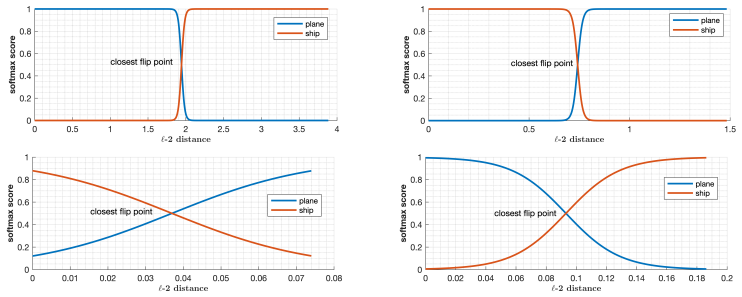
The central object is the flip point: a point on the decision boundary where the model's top-two softmax outputs are equal. The carrying machinery is the optimization problem $\min_z \|z-x\|_2$ subject to $f_i(z)=f_j(z)$ and $f_i(z)\ge f_k(z)$ for all other classes, where $f$ is the softmax output vector and $x$ is the original input. A good starting point for the optimization is the data point itself, and the authors cross-check solutions with several nonlinear optimization algorithms. A second piece of machinery is Lipschitz continuity of the network output, which tells them how finely to discretize straight paths between images so that boundary crossings and the shape of decision regions can be observed reliably.
What would settle it
Take a small trained network whose decision boundary can be computed analytically, or enumerate all boundary points on a fine grid in a low-dimensional input space, then run the paper's optimization routine and check whether it returns the true closest boundary point. If it returns a flip point that is farther than a grid-found boundary point, then the reported distances, directions, and vulnerability claims are not guaranteed for that case.
Extended reading notes
Core claim
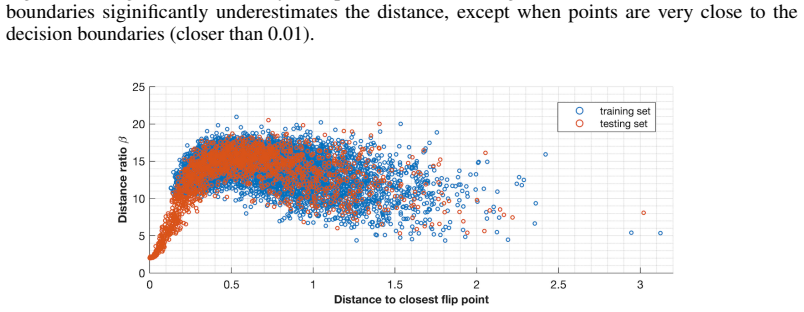
The paper's central claim is that for a trained network with nonlinear activations, one can compute exact points on its decision boundaries by minimizing the distance from a given input to a boundary point subject to the conditions that the softmax outputs of the two competing classes are equal and no other class has a higher output. Applied to a 12-layer feedforward network using erf activations and 200 wavelet coefficients, the resulting flip points yield actual boundary distances and directions. These exact quantities reveal that first-order Taylor distance estimates systematically underestimate the true distance, sometimes by a factor of 20 or more, and that the Taylor direction can point far from the closest boundary point. The closest flip point also provides a more direct measure of adversarial vulnerability than minimizing an adversarial loss under a fixed distance constraint, which may find a point much farther away or have no feasible solution. The authors explicitly note in Section 2 that their optimization problem is nonconvex and that they cannot guarantee finding the global minimizer, although consistency across several solvers and the fact that their points are closer than Taylor estimates support the computed results.
Load-bearing premise
The whole study rests on the assumption that the optimization solver truly finds the closest flip point, and the authors state in Section 2 that they cannot prove this because the problem is nonconvex.
Editorial extensions
If this is right
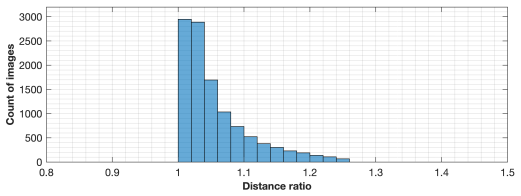
- Distance-to-boundary estimates based on first-order Taylor expansions can be checked against flip points; in the authors' tests they understate the true distance by factors from about 2 to more than 20.
- Adversarial-example searches that minimize loss under a distance constraint can be replaced or supplemented by searching for the closest flip point, which yields a closer adversarial change and reveals the weakest vulnerability.
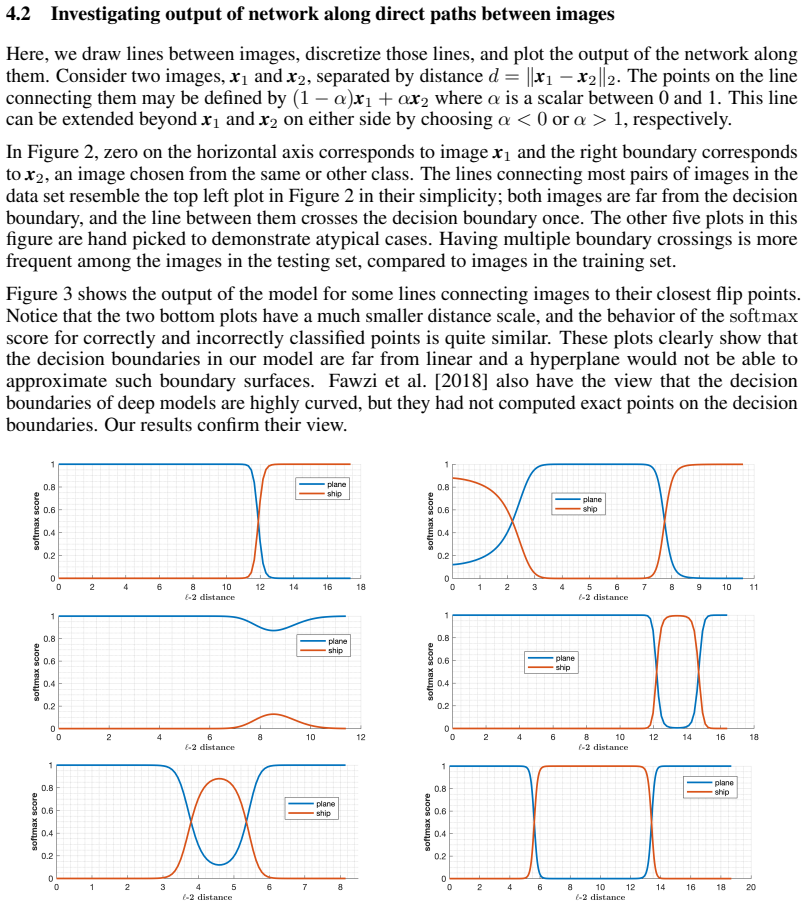
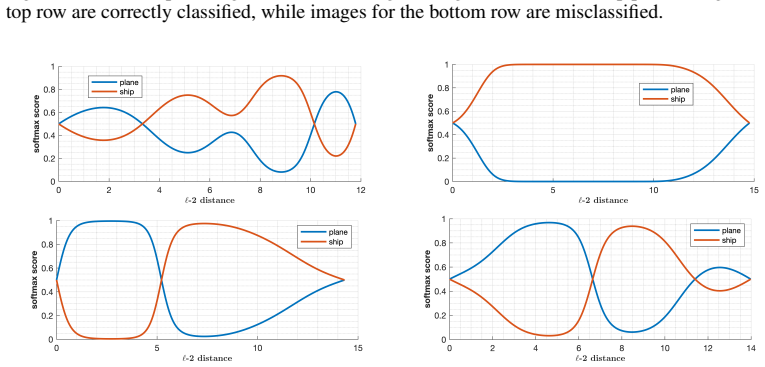
- The decision region for a class can be studied directly: in their model the ship region is connected and star-shaped, so hyperplane or locally linear approximations to the boundary are inadequate.
- Computing flip points costs about the same as common adversarial-attack methods, making direct boundary investigation a practical tool rather than a theoretical one.
- A single distance constraint tuned for one image does not transfer across a dataset, because distances to the closest flip point vary widely between images.
Reading between the lines
- If the global-minimizer assumption holds, true flip-point distances could replace Taylor-based margin estimates in generalization-gap prediction, potentially yielding tighter and more reliable margin distributions than current approximations.
- The same optimization could be turned into a training procedure: the authors note that adding flip points as training data improves accuracy, but they do not design or test a systematic boundary-moving training algorithm.
- The observed near-linear growth of the angle between the Taylor direction and the closest flip point as distance increases suggests a predictable degradation of local linearity; testing this relationship on other architectures would show whether it is a general geometric law or an artifact of this model.
- Because the paper says its method has been implemented for multiple classes and discrete features, a natural extension is to check whether the distance, direction, and vulnerability conclusions persist beyond the binary continuous-input setting studied here.
Signed reviews
Editorial analysis
A structured set of objections, weighed in public.
Referee Report
Summary. The paper proposes computing 'flip points'—points on the decision boundaries of trained neural networks—by solving a nonconvex optimization problem that minimizes the distance from a given input to a point where the softmax outputs of two classes are equal. The authors use these flip points to compare against first-order Taylor approximations of boundary distance (Section 5), to study the geometry and connectivity of decision regions along straight lines (Sections 4 and 6), and to produce adversarial examples that they argue reveal the 'weakest vulnerability' of a model (Section 7). All experiments use a 12-layer fully connected network with erf activations trained on 200 Daubechies-1 wavelet coefficients of ship/plane images from CIFAR-10, achieving 84.05% test accuracy.
Significance. If the computed flip points are indeed the closest points on decision boundaries, the paper offers a practical tool for interpreting trained networks, auditing approximation methods, and generating minimal adversarial perturbations. The empirical comparisons with Taylor-series distance estimates (Figures 5–8) and with loss-minimization adversarial attacks (Figures 9–12) are valuable and clearly demonstrate that common approximations can be misleading. The paper is also honest in stating the nonconvexity of its optimization problem. However, the central quantitative claims depend on unverified global optimality, the star-shapedness conclusion is not supported by the presented evidence, and the asserted generalization to pixel-based networks is without experimental support. These issues currently limit the contribution to a useful methodology demonstration rather than a fully established set of geometric and robustness conclusions.
major comments (3)
- [Section 2] The paper's central claim is that it computes 'exact points' on decision boundaries and 'closest' flip points, but the optimization problem is nonconvex and the authors explicitly state that they 'cannot be sure that optimization algorithms will find the global minimizer.' They also report that in fewer than 5% of images, interior-point algorithms found closer flip points than their preferred solution. This means the reported distances are only upper bounds on the true distance in general, and all downstream quantitative results—the underestimation factors in Figures 5–6, the angle distributions in Figure 8, and the 'weakest vulnerability' comparisons in Figures 9–12—are computed relative to possibly suboptimal flip points. The text should either provide optimality certificates (e.g., interval bounds, branch-and-bound, or verified local optimality with a gap estimate) or systematically qualify 'closest' as 'locally closest among computed solutions' and discuss how the <5% gap affects the conclusions.
- [Section 6] The claim that the 'ship' region is star-shaped does not follow from the evidence presented. The authors show that for 89% of pairs of correctly classified ships, the straight line segment between them stays in the ship class, and that there exist paths (using multiple lines) connecting every pair. Star-shapedness requires the existence of a single center point that sees every other point in the region via a straight line; pairwise line connectivity is a weaker property that implies path-connectedness but not star-shapedness. The statement 'This indicates that the ship region is star-shaped' should be revised to a claim supported by the data, such as 'the region is path-connected' or 'most pairs are line-connected,' or new evidence for a common center should be provided.
- [Section 7] The sentence 'These observations would still hold for networks trained on the pixels rather than wavelet coefficients' is an unsupported generalization. All experiments in the paper use a 200-dimensional wavelet-coefficient feature space, and the geometry of decision boundaries in that space may differ from the geometry in the original pixel space. Since the adversarial-robustness conclusions in this section are intended to apply broadly, the authors should either provide comparable experiments on pixel-based networks or remove this claim and restrict the conclusions to the feature representation actually tested.
minor comments (5)
- [Abstract and Section 1] The terms 'exact points' and 'closest flip point' are used throughout the abstract and introduction without qualification, despite the nonconvexity caveat in Section 2. Consider consistently using 'computed flip point' or 'locally closest flip point' so that the presentation matches the technical caveats.
- [Section 3] The statement that using a smaller number of wavelet coefficients 'makes us more likely to find the global solution of our non-convex optimization problem' is presented without supporting evidence. It would be helpful to frame this as a heuristic rationale or provide diagnostic results on smaller problems.
- [Section 5, Figure 6] There is a typo in the caption: 'siginificantly' should be 'significantly.'
- [Section 7] The discussion of the distance-constrained loss-minimization problem is imprecise: the problem with a distance constraint of 0.5 is always feasible (the original image is feasible), but it may have no solution that changes the label. The text should clarify that the issue is the absence of an adversarial example within the ball, not infeasibility of the optimization problem itself.
- [Section 4.2] The sentence 'This means that we choose the distance between the discretization points small enough such that the output of network can be considered to change linearly between any consecutive points' is a heuristic interpretation of Lipschitz continuity; a Lipschitz bound controls the magnitude of change, not the linearity of the function between points. Consider rewording to avoid overstating what the bound provides.
Circularity Check
No significant circularity: flip points are computed numerical solutions; the conceded nonconvexity is a correctness caveat, not a circular reduction.
full rationale
The paper's core objects are flip points, defined in Section 2 as minimizers of distance subject to softmax-equality constraints. All subsequent measurements—distances, ratios to Taylor estimates, angles, connectedness, and adversarial examples—are read off from these computed points. No target quantity appears in the objective or constraints, and no parameter is fitted to a subset of the data and then renamed a prediction. The only self-citation is [Yousefzadeh and O'Leary, 2019] for the flip-point optimization formulation; that is provenance for a method restated in the present paper, and the numerical results here are independent checks on those computed points, so the citation is not load-bearing. Flagged limitation: Section 2 explicitly concedes 'our optimization problem is nonconvex, so we cannot be sure that optimization algorithms will find the global minimizer' and notes that in fewer than 5% of images the interior point algorithms find closer flip points. This weakens the word 'exact' and means reported distances may be upper bounds on the true distances, but it is a verification/correctness gap, not an equivalence of conclusions to inputs. No uniqueness theorem is imported, no ansatz is hidden in a citation, and no known empirical result is merely renamed.
Assumptions & free parameters
assumptions (3)
- domain assumption The nonconvex optimization problem is solved to global optimality (or near-global in practice), so computed flip points are the closest boundary points.
- domain assumption The 200 wavelet coefficients chosen by pivoted QR preserve the decision-relevant structure of images.
- standard math The network output is Lipschitz continuous and its constants can be bounded using layer matrices and activation scales.
Cite this review
Pith. "Pith review of Investigating Decision Boundaries of Trained Neural Networks." pith.science (2026). https://pith.science/paper/ISLKM426
@misc{pith2026190802802,
  author       = {Pith},
  title        = {Pith review of: Investigating Decision Boundaries of Trained Neural Networks},
  year         = {2026},
  howpublished = {\url{https://pith.science/paper/ISLKM426}},
  note         = {Machine review of arXiv:1908.02802}
}
read the original abstract
Deep learning models have been the subject of study from various perspectives, for example, their training process, interpretation, generalization error, robustness to adversarial attacks, etc. A trained model is defined by its decision boundaries, and therefore, many of the studies about deep learning models speculate about the decision boundaries, and sometimes make simplifying assumptions about them. So far, finding exact points on the decision boundaries of trained deep models has been considered an intractable problem. Here, we compute exact points on the decision boundaries of these models and provide mathematical tools to investigate the surfaces that define the decision boundaries. Through numerical results, we confirm that some of the speculations about the decision boundaries are accurate, some of the computational methods can be improved, and some of the simplifying assumptions may be unreliable, for models with nonlinear activation functions. We advocate for verification of simplifying assumptions and approximation methods, wherever they are used. Finally, we demonstrate that the computational practices used for finding adversarial examples can be improved and computing the closest point on the decision boundary reveals the weakest vulnerability of a model against adversarial attack.
Figures

Figures from the paper (9 more)



Reference graph
Works this paper leans on
-
[1]
Large margin deep networks for classification
Gamaleldin Elsayed, Dilip Krishnan, Hossein Mobahi, Kevin Regan, and Samy Bengio. Large margin deep networks for classification. In Advances in Neural Information Processing Systems (NeurIPS 2018), pages 842--852, 2018
work page 2018
-
[2]
The robustness of deep networks: A geometrical perspective
Alhussein Fawzi, Seyed-Mohsen Moosavi-Dezfooli, and Pascal Frossard. The robustness of deep networks: A geometrical perspective. IEEE Signal Processing Magazine, 34 0 (6): 0 50--62, 2017
work page 2017
-
[3]
Empirical study of the topology and geometry of deep networks
Alhussein Fawzi, Seyed-Mohsen Moosavi-Dezfooli, Pascal Frossard, and Stefano Soatto. Empirical study of the topology and geometry of deep networks. In Proceedings of the IEEE Conference on Computer Vision and Pattern Recognition, pages 3762--3770, 2018
work page 2018
-
[4]
Gene H Golub and Charles F Van Loan. Matrix Computations. JHU Press, Baltimore, 4th edition, 2012
work page 2012
-
[5]
Explaining and harnessing adversarial examples
Ian J Goodfellow, Jonathon Shlens, and Christian Szegedy. Explaining and harnessing adversarial examples. arXiv preprint arXiv:1412.6572, 2014
arXiv 2014
-
[6]
Formal guarantees on the robustness of a classifier against adversarial manipulation
Matthias Hein and Maksym Andriushchenko. Formal guarantees on the robustness of a classifier against adversarial manipulation. In Advances in Neural Information Processing Systems (NeurIPS 2017), pages 2266--2276, 2017
work page 2017
-
[7]
Adversarial examples are not bugs, they are features
Andrew Ilyas, Shibani Santurkar, Dimitris Tsipras, Logan Engstrom, Brandon Tran, and Aleksander Madry. Adversarial examples are not bugs, they are features. arXiv preprint arXiv:1905.02175, 2019
arXiv 1905
-
[8]
Saumya Jetley, Nicholas Lord, and Philip Torr. With friends like these, who needs adversaries? In Advances in Neural Information Processing Systems (NeurIPS 2018), pages 10749--10759, 2018
work page 2018
Show all 23 references
-
[9]
Predicting the generalization gap in deep networks with margin distributions
Yiding Jiang, Dilip Krishnan, Hossein Mobahi, and Samy Bengio. Predicting the generalization gap in deep networks with margin distributions. In International Conference on Learning Representations (ICLR 2019), 2019
2019
-
[10]
Steven G. Johnson. The NLopt nonlinear-optimization package, http://ab-initio.mit.edu/nlopt, 2014
2014
-
[11]
An introduction to computing with neural nets
Richard P Lippmann. An introduction to computing with neural nets. Artificial Neural Networks: Theoretical Concepts, 4 0 (2): 0 4--22, 1987
1987
-
[12]
Margin maximization for robust classification using deep learning
Alexander Matyasko and Lap-Pui Chau. Margin maximization for robust classification using deep learning. In International Joint Conference on Neural Networks, pages 300--307. IEEE, 2017
2017
-
[13]
Deepfool: a simple and accurate method to fool deep neural networks
Seyed-Mohsen Moosavi-Dezfooli, Alhussein Fawzi, and Pascal Frossard. Deepfool: a simple and accurate method to fool deep neural networks. In Proceedings of the IEEE conference on computer vision and pattern recognition, pages 2574--2582, 2016
2016
-
[14]
Exploring generalization in deep learning
Behnam Neyshabur, Srinadh Bhojanapalli, David McAllester, and Nati Srebro. Exploring generalization in deep learning. In Advances in Neural Information Processing Systems (NeurIPS 2017), pages 5947--5956, 2017
2017
-
[15]
Why should I trust you?: Explaining the predictions of any classifier
Marco Tulio Ribeiro, Sameer Singh, and Carlos Guestrin. Why should I trust you?: Explaining the predictions of any classifier. In International Conference on Knowledge Discovery and Data Mining, pages 1135--1144. ACM, 2016
2016
-
[16]
A simple explanation for the existence of adversarial examples with small Hamming distance
Adi Shamir, Itay Safran, Eyal Ronen, and Orr Dunkelman. A simple explanation for the existence of adversarial examples with small Hamming distance. arXiv preprint arXiv:1901.10861, 2019
1901 arXiv
-
[17]
Actionable recourse in linear classification
Alexander Spangher, Berk Ustun, and Yang Liu. Actionable recourse in linear classification. In Proceedings of the 5th Workshop on Fairness, Accountability and Transparency in Machine Learning, 2018
2018
-
[18]
A boundary tilting persepective on the phenomenon of adversarial examples
Thomas Tanay and Lewis Griffin. A boundary tilting persepective on the phenomenon of adversarial examples. arXiv preprint arXiv:1608.07690, 2016
2016 arXiv
-
[19]
Robustness may be at odds with accuracy
Dimitris Tsipras, Shibani Santurkar, Logan Engstrom, Alexander Turner, and Aleksander Madry. Robustness may be at odds with accuracy. In International Conference on Learning Representations (ICLR 2019), 2019
2019
-
[20]
A tutorial on spectral clustering
Ulrike Von Luxburg. A tutorial on spectral clustering. Statistics and Computing, 17 0 (4): 0 395--416, 2007
2007
-
[21]
On the implementation of an interior-point filter line-search algorithm for large-scale nonlinear programming
Andreas W \"a chter and Lorenz T Biegler. On the implementation of an interior-point filter line-search algorithm for large-scale nonlinear programming. Mathematical Programming, 106 0 (1): 0 25--57, 2006
2006
-
[22]
Counterfactual explanations without opening the black box: Automated decisions and the GDPR
Sandra Wachter, Brent Mittelstadt, and Chris Russell. Counterfactual explanations without opening the black box: Automated decisions and the GDPR . Harvard Journal of Law & Technology, 31 0 (2), 2018
2018
-
[23]
Interpreting neural networks using flip points
Roozbeh Yousefzadeh and Dianne P O'Leary. Interpreting neural networks using flip points. arXiv preprint arXiv:1903.08789, 2019
1903 arXiv
Reviewed August 14, 2026 · model on record in the stance chip above.
Discussion (0). Continue with ORCID to comment.