REVIEW 4 major objections 4 minor 69 references
Cosmological insights from an exponential $Om(z)$ function in $f(T,T_{G})$ gravity framework
T0 review · 4 major / 4 minor · reviewed 2026-08-07 · deepseek-v4-flash
Pith's one-line read An exponential Om(z) diagnostic in modified teleparallel gravity fits the combined CC, BAO, and Pantheon+ datasets and yields a Hubble constant in line with local distance-ladder measurements.
desk verdict New exponential Om(z) parameterization fit to standard datasets, but the best-fit parameters make H(z)^2 negative at z≳11, contradicting the paper's central 'well-behaved at all redshifts' claim. read the letter →
The pith
A machine-rendered reading of the paper's core claim, the machinery that carries it, and where it could break.
The reading
What carries the argument
The central object is the exponential $Om(z)$ diagnostic, $Om(z)=\alpha e^{z/(1+z)}+\beta$, whose inversion through the definition $Om(z)=((H/H_0)^2-1)/((1+z)^3-1)$ produces the model Hubble function $H(z)=H_0\sqrt{(\alpha e^{z/(1+z)}+\beta)[(1+z)^3-1]+1}$. This Hubble function is fed into the modified Friedmann equations of $f(T,T_G)=T+\gamma\sqrt{T_G}+\delta\sqrt{T}$ (with $\gamma=0.05$ used for the derived plots), which turn it into predictions for the deceleration parameter, energy density and pressure, equation of state, energy conditions, statefinder pair, and cosmic age. The diagnostic carries the argument by converting a model-independent ratio of Hubble rates into a parameterized expansion history that can be fit directly to CC, BAO, and Pantheon+ data.
What would settle it
A reliable measurement of $H(z)$ at a redshift above about 10.6 would falsify the all-redshift claim, because the best-fit model makes $H(z)^2$ negative there. Even without new data, evaluating the reconstructed $H(z)$ at $z=10.6$ with $\alpha=-0.148$ and $\beta=0.369$ gives a negative square, contradicting the paper's statement that the model is well-behaved at all redshifts.
Extended reading notes
Core claim
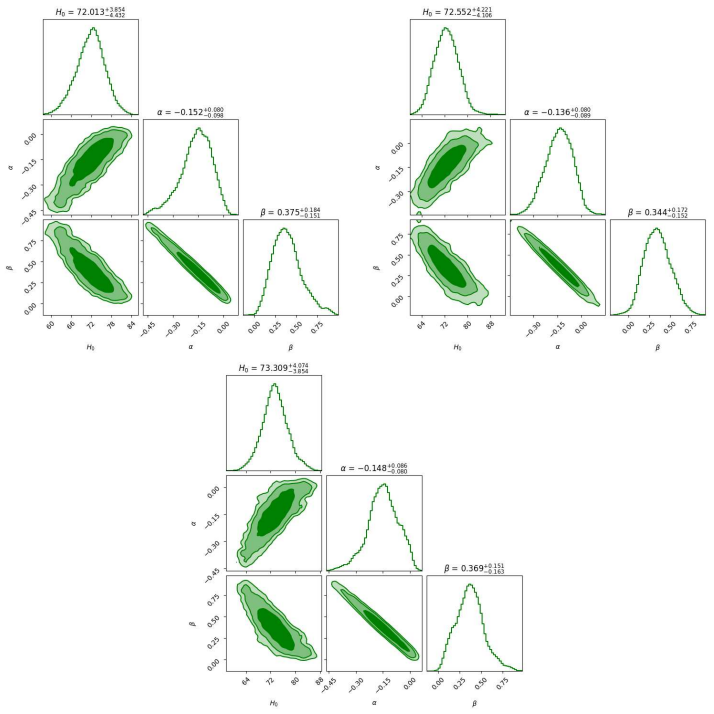
The paper's central claim is that the exponential diagnostic $Om(z)=\alpha e^{z/(1+z)}+\beta$, combined with the modified teleparallel gravity model $f(T,T_G)=T+\gamma\sqrt{T_G}+\delta\sqrt{T}$, accounts for the observed late-time expansion history. With the combined CC+BAO+Pantheon+ dataset the best-fit parameters $\alpha=-0.148$, $\beta=0.369$ yield $H_0\approx73.3$ km/s/Mpc with a 1$\sigma$ range of about 68.5–77.4, a deceleration-to-acceleration transition at $z_{tr}\approx0.48$–$0.54$, present $q_0\approx-0.32$ to $-0.34$ and $\omega_0\approx-0.33$, and a cosmic age of about 13.3–13.9 Gyr. The model satisfies the null and dominant energy conditions, violates the strong energy condition at late times, and its statefinder trajectory passes through the $\Lambda$CDM point $(r,s)=(1,0)$. The authors take these results to show that the exponential $Om(z)$ form is a viable, data-consistent description of dark energy evolution within this modified gravity framework.
Load-bearing premise
The load-bearing premise is that the exponential expansion formula used for $Om(z)$ is valid at every redshift, so the reconstructed expansion rate squared stays positive; at the paper's best-fit parameters the factor $\alpha e^{z/(1+z)}+\beta$ crosses zero near $z\approx10.6$, which would make the expansion rate imaginary there.
Editorial extensions
If this is right
- The combined CC, BAO, and Pantheon+ data can be described by a two-parameter exponential $Om(z)$ diagnostic, so the present data do not require a cosmological constant if modified teleparallel gravity is allowed.
- The best-fit $H_0$ of about 73.3 km/s/Mpc sits closer to local distance-ladder values than to the early-universe Planck value, giving a concrete path toward easing the Hubble tension.
- The predicted transition redshift $z_{tr}\approx0.48$–$0.54$ and present deceleration $q_0\approx-0.32$ place the onset of acceleration at roughly the epoch inferred in $\Lambda$CDM.
- The model's statefinder trajectory passes through the $\Lambda$CDM point $(r,s)=(1,0)$, so the modified-gravity model is observationally close to $\Lambda$CDM while allowing evolving dark energy.
- The age estimate of 13.3–13.9 Gyr is consistent with globular-cluster and Planck age bounds, so the model does not require a revision of cosmic chronology.
Reading between the lines
- Read as a full-history model, the best-fit form fails at high redshift: $\alpha e^{z/(1+z)}+\beta$ changes sign near $z\approx10.6$, making the reconstructed expansion rate imaginary. That suggests the exponential diagnostic should be treated as a late-time parameterization rather than a complete description of the early universe.
- Because $\gamma$ is set to 0.05 by hand for the energy-condition and equation-of-state plots, those conclusions are conditional on that choice; a joint fit of $\gamma$ with $\alpha$ and $\beta$ would test whether the NEC and DEC results survive.
- Since the paper compares against $\Lambda$CDM but not against other two-parameter dark-energy forms, a model comparison on the same data would show whether the exponential shape itself is preferred or merely adequate.
- The negative $\alpha$ produces an $Om(z)$ that grows with redshift, which the paper links to phantom-like dark energy; a derived check of whether this growth leads to a future singularity would extend the model's predictions beyond the current epoch.
Editorial analysis
A structured set of objections, weighed in public.
Referee Report
Summary. The paper proposes an exponential parameterization of the Om(z) diagnostic, Om(z) = α e^{z/(1+z)} + β, within the f(T,T_G) = T + γ√T_G + δ√T gravity model. The authors invert the standard Om diagnostic to reconstruct H(z), fit α, β, and H0 to 31 cosmic chronometer, 26 BAO, and 1701 Pantheon+ data points using MCMC, and then derive q(z), the effective equation of state, energy conditions, statefinder parameters, and the cosmic age. The reported best-fit results include H0 ≈ 73.3 km/s/Mpc, z_tr ≈ 0.48–0.54, q0 ≈ −0.34, ω0 ≈ −0.33, and an age of 13.28–13.87 Gyr, leading the authors to claim the model is observationally supported and well-behaved at all redshifts.
Significance. If the reconstructed expansion history and the derived cosmological parameters were reliable, the paper would add a useful example to the literature on Om(z) parameterizations in modified gravity. The use of 31 CC + 26 BAO + 1701 Pantheon+ points is a reasonable dataset combination, and the paper presents the field-equation algebra explicitly, which aids reproducibility of the derivation. However, the central claims are undermined by an internal inconsistency in the high-redshift regime, an error in the interpretation of the fitted parameters, and an ad hoc treatment of the modified-gravity parameters. The presently stated conclusions therefore do not provide a dependable test of the f(T,T_G) framework.
major comments (4)
- [§4, Eqs. (21), (25)] The claim that the exponential Om(z) form 'remains well-behaved at all redshifts from z=0 to high redshift z→∞' is contradicted by the paper's own best-fit values. With α = −0.148 and β = 0.369 (the CC+BAO+Pantheon+ case), Om(z) = α e^{z/(1+z)} + β vanishes at z ≈ 10.6 and becomes negative for larger z. Since H(z)^2/H0^2 = Om(z)[(1+z)^3 − 1] + 1, H(z)^2 becomes negative for z ≳ 11, so H(z) is imaginary in the early universe. Every quantity derived from H(z), including q(z) in Eq. (39), ρ and p in Eqs. (40)–(41), the energy conditions in Eqs. (43)–(45), the statefinder parameters, and the age integral in Eq. (49), is therefore not defined on the full redshift range used to support the claimed 'stable and physically realistic behavior across all epochs'.
- [§4, Eq. (21)] The phantom-like interpretation of the best fit is based on an incorrect derivative. The text states that a negative α produces an increasing Om(z), but dOm/dz = α e^{z/(1+z)}/(1+z)^2, which is negative for α < 0. Hence the best-fit parameter set gives a decreasing Om(z), not an increasing one. The claimed phantom behavior and the related discussion in Sections 5.2 and 6.4 need to be revised accordingly.
- [§2–3, 5] The observational analysis does not actually constrain the f(T,T_G) model. The reconstructed H(z) comes entirely from the Om(z) ansatz (Eqs. 21 and 25), and the MCMC fit in Section 5 involves only H0, α, and β; the gravity parameters γ and δ do not enter the likelihood. The field equations of f(T,T_G) are used only after the fit, with γ fixed to 0.05, to compute ρ, p, the EoS, and the energy conditions. Consequently, the claimed agreement with CC+BAO+Pantheon+ data is a statement about the kinematic Om(z) parameterization, not about f(T,T_G) gravity; the modified-gravity part of the model is not tested by the data.
- [§6.2–6.3, §7, Eqs. (40)–(45)] The energy-density, pressure, EoS, and energy-condition results are presented for γ = 0.05 with no explanation of how this value was chosen and no propagation of the MCMC uncertainties. Since γ is a free parameter in the action, the statement that the model 'satisfies NEC and DEC' is not a result of the observational fit; it is conditional on an arbitrary choice of γ. A joint fit over γ (or a demonstration of insensitivity to γ) is needed before these claims can be regarded as a test of the model.
minor comments (4)
- [§5.1.1, Eq. (34)] The BAO chi-square uses the notation σYi; this should read σ(Y_i) or σ_i. In addition, the manuscript does not itemize the 26 BAO data points or the exact covariance information, making the analysis difficult to reproduce.
- [Fig. 3 caption] The caption contains a typo: 'CC+ABO' should be 'CC+BAO'. The caption also refers to 'Pantheon+SHOES' while the text and abstract refer to the Pantheon+ dataset; the nomenclature should be unified.
- [§6.4 and Fig. 6] The text states that Om(z) 'starts near 0.05 at higher redshifts and approaches approximately 0.36 as z → −1', while the figure axis extends to z = −1, where the combination z/(1+z) is singular. The redshift range of the plot and the interpretation of the limiting behavior should be clarified.
- [§3 and §6.2, Eqs. (20), (40)–(41)] The parameter δ in f(T,T_G) = T + γ√T_G + δ√T does not appear in the reconstructed ρ and p or in any of the derived observables. If δ cancels in the FLRW background, this should be stated explicitly; if it does not, the expressions in Eqs. (40)–(41) are incomplete. As written, the paper advertises a two-parameter modification but effectively analyzes only the γ√T_G term.
Circularity Check
Fitted exponential Om(z) ansatz drives all derived 'predictions'; the MCMC fit itself is legitimate, and the main circularity is presenting algebraic consequences of the fit as model confirmations.
-
fitted input called prediction
[Abstract; Section 6.1, especially Eq. (39); Section 6.3]
"Our model predicts a transition redshift z_tr ≈ (0.48−0.54), present q_0≈−0.34, and ω_0≈−0.33. ... By substituting the best-fit values of α and β from our observational analysis into the reconstructed Hubble parameter H(z), we examine the evolution of q(z)."
The advertised 'predictions' are obtained by inserting the fitted α and β into expressions that are algebraic consequences of the assumed ansatz itself. Equation (25) is just the definition of Om(z) in Eq. (24), inverted after substituting Eq. (21). Every derived quantity is therefore a deterministic function of the fitted parameters. In particular, setting z=0 in Eq. (39) gives q_0 = −1 + 3(α+β), so the reported q_0 ≈ −0.34 is a re-labeling of the fitted combination α+β ≈ 0.22; z_tr, ω_0, the statefinder values, and the dimensionless age integral are likewise fixed by the same fitted α, β, and H_0. Presenting these algebraic outputs as 'predictions' and using them to claim validation adds no independent information beyond the fit itself.
full rationale
The parameter estimation against CC, BAO, and Pantheon+ is not circular: H_0, α, and β are genuinely fitted to external data through Eq. (25). The circularity is limited to the presentation of derived quantities. q_0, z_tr, ω_0, r_0, s_0, and the cosmic age are not independent outputs of the f(T,T_G) theory; they are obtained by substituting the best-fit parameters into formulas that follow immediately from the exponential Om(z) ansatz and the definition of Om(z). In particular, q_0 = −1 + 3(α+β) makes the abstract's 'our model predicts ... q_0≈−0.34' a restatement of the fitted combination α+β, not a test. The energy-condition results also depend on a hand-set γ=0.05 rather than a fitted or marginalized value, so they are limitations rather than additional validations. A separate, non-circular correctness problem is that the best-fit parameters make H²(z) negative for z ≳ 11, contradicting the paper's claim that the model is 'well-behaved at all redshifts'; this affects the high-redshift derived quantities and the age integral but is not a circularity. On balance, the fit has independent content, but the central claim's supporting 'predictions' reduce by construction to the fitted ansatz, warranting a partial circularity score of 5.
Assumptions & free parameters
free parameters (5)
- alpha =
-0.148 (CC+BAO+Pantheon+); range [-0.232, -0.068]
- beta =
0.369 (CC+BAO+Pantheon+); range [0.218, 0.560]
- H0 =
73.309 km/s/Mpc (CC+BAO+Pantheon+)
- gamma =
0.05 (chosen, not fitted)
- delta =
unspecified
assumptions (6)
- domain assumption Spatially flat FLRW background with Weitzenbock gauge tetrad
- domain assumption Modified Friedmann equations (18)-(19) for f(T,T_G) gravity, adopted from the literature
- ad hoc to paper Specific model f(T,T_G)=T+gamma*sqrt(T_G)+delta*sqrt(T) is assumed ad hoc
- ad hoc to paper Exponential Om(z)=alpha*exp(z/(1+z))+beta is assumed ad hoc
- standard math Natural units kappa^2=1
- domain assumption Data likelihoods (CC, BAO, Pantheon+) are correctly implemented
Cite this review
Pith. "Pith review of Cosmological insights from an exponential $Om(z)$ function in $f(T,T_{G})$ gravity framework." pith.science (2026). https://pith.science/paper/ISU3QFV7
@misc{pith2026250606399,
  author       = {Pith},
  title        = {Pith review of: Cosmological insights from an exponential $Om(z)$ function in $f(T,T_G)$ gravity framework},
  year         = {2026},
  howpublished = {\url{https://pith.science/paper/ISU3QFV7}},
  note         = {Machine review of arXiv:2506.06399}
}
abstract
We examine a modified teleparallel gravity model defined by $f(T,T_{G})=T+\gamma\sqrt{T_{G}}+\delta\sqrt{T}$ by introducing an exponential $Om(z)$ diagnostic of the form $Om(z)=\alpha e^{\frac{z}{1+z}}+\beta$. This novel form captures smooth redshift evolution and allows for a flexible, model-independent probe of dark energy dynamics. We derive a Hubble function from this expression and use MCMC analysis with $31$ CC, $26$ BAO and $1701$ Pantheon+ data points to constrain the model parameters. The best-fit results yield $H_{0} \in [68.46, 77.38]$km/s/Mpc for $\alpha \in [-0.232, -0.068]$ and $\beta \in [0.218, 0.560]$ which is consistent with local $H_{0}$ values. Our model predicts a transition redshift $z_{tr} \approx (0.48-0.54)$, present $q_{0}\approx -0.34$, and $\omega_{0}\approx-0.33$. It satisfies NEC and DEC, closely tracks $\Lambda$CDM in the statefinder plane and estimates a cosmic age of $(13.28-13.87)$ Gyr which confirms its strength in explaining late-time acceleration. Our findings demonstrate that the exponential $Om(z)$ parameterization provides a robust and insightful approach to trace dark energy evolution within modified gravity frameworks.
Figures


Figures from the paper (6 more)


Reference graph
Works this paper leans on
-
[1]
Riess, et al., Astron.J
Adam G. Riess, et al., Astron.J. 116:1009-1038, 1998
1998
-
[2]
Perlmutter et al., The Astrophys
S. Perlmutter et al., The Astrophys. Journ. 517, 565 (1999)
1999
-
[3]
WMAP Collaboration, Astrophys. J. Suppl. 208, 19 (2013)
2013
-
[4]
Eisenstein et al ApJ 633, 560 (2005)
Daniel J. Eisenstein et al ApJ 633, 560 (2005). 15
work page 2005
-
[5]
Tegmark et al., Phys.Rev.D, 69 :103501, (2004)
M. Tegmark et al., Phys.Rev.D, 69 :103501, (2004)
work page 2004
-
[6]
Steven Weinberg, Rev. Mod. Phys. 61, 1, 1989
1989
- [7]
-
[8]
Nojiri and S
S. Nojiri and S. D. Odintsov, Phys. Rept. 505, 59, 144 (2011)
2011
Show all 69 references
-
[9]
De Felice and S
A. De Felice and S. Tsujikawa, Living Rev. Relativity 13, 3 (2010)
2010
-
[11]
Bamba, S
K. Bamba, S. Nojiri, and S. D. Odintsov, Phys. Lett. B 698, 451 (2011)
2011
-
[12]
T. P. Sotiriou and V. Faraoni, Rev. Mod. Phys. 82, 451 (2010)
2010
-
[13]
Hayashi and T
K. Hayashi and T. Shirafuji, Phys. Rev. D 19, 3524–3553 (1979)
1979
-
[14]
J. W. Maluf, J. Math. Phys. 35, (1994) 335
1994
-
[15]
Aldrovandi and J
R. Aldrovandi and J. G. Pereira, Teleparallel Gravity: An Intro duction, Springer, Dordrecht (2013)
2013
-
[16]
J. W. Maluf, Annalen Phys. 525, 339 (2013)
2013
-
[17]
Ferraro and F
R. Ferraro and F. Fiorini, Phys. Rev. D 75, 084031 (2007)
2007
-
[18]
Ferraro, F
R. Ferraro, F. Fiorini, Phys. Rev. D 78, 124019 (2008)
2008
-
[19]
G. R. Bengochea and R. Ferraro, Phys. Rev. D 79, 124019 (2009)
2009
-
[20]
Boulware and S
D. Boulware and S. Deser, Phys. Rev. Lett. 55, 2656 (1985)
1985
-
[21]
J. T. Wheeler, Nucl. Phys. B 268, 737 (1986)
1986
-
[22]
Antoniadis, J
I. Antoniadis, J. Rizos and K. Tamvakis, Nucl. Phys. B 415, 497 (1994)
1994
-
[23]
Kanti, J
P. Kanti, J. Rizos and K. Tamvakis, Phys. Rev. D 59, 083512 (1999)
1999
-
[24]
Nojiri and S
S. Nojiri and S. D. Odintsov, Phys. Lett. B 631, 1 (2005)
2005
-
[25]
Kadam, S
S. Kadam, S. V. Lokhare, B. Mishra, Annals of Physics, 460, 16 9563 (2023)
2023
-
[26]
Sharif, Kanwal Nazir, International Journal of Modern Ph ysics D, Vol
M. Sharif, Kanwal Nazir, International Journal of Modern Ph ysics D, Vol. 27 (2018) 1850001
2018
-
[27]
Sahni, A
V. Sahni, A. Shafieloo, A. A. Starobinsky, Physical Review D, 78 (10), 103502 (2008)
2008
-
[28]
Shafieloo, V
A. Shafieloo, V. Sahni, A. A. Starobinsky, Physical Review D, 86 (10), 103527 (2012)
2012
-
[29]
Zunckel, C
C. Zunckel, C. Clarkson, Physical Review Letters, 101 (18), 181301 (2008)
2008
-
[30]
Sahni, A
V. Sahni, A. Shafieloo, A. A. Starobinsky, Astrophys. J. Lett . 793, L40 (2014)
2014
-
[31]
Ding, et al., Astrophys
X. Ding, et al., Astrophys. J. Lett. 803, L22 (2015)
2015
-
[32]
Zheng, et al., Astrophys
X. Zheng, et al., Astrophys. J. 825, 17 (2016)
2016
-
[33]
Qi, et al., Res
J.Z. Qi, et al., Res. Astron. Astrophys. 18, 066 (2018)
2018
-
[34]
Myrzakulov, M
N. Myrzakulov, M. Koussour, D.J. Gogoi, D.J., Eur. Phys. J. C 83, 594 (2023)
2023
-
[35]
Myrzakulov, Alnadhief H.A
Y. Myrzakulov, Alnadhief H.A. Alfedeel, M. Koussour, E.I. Hassa n, S. Muminov, Journal of High Energy Astrophysics 47 (2025) 100386
2025
-
[36]
Bahamonde et al., Rep
S. Bahamonde et al., Rep. Prog. Phys. 86, 207pp (2023), arXiv:2106.13793 [gr-qc]
2023 arXiv
-
[37]
Y.-F. Cai, S. Capozziello, M. De Laurentis, and E. N. Saridakis, Re pt. Prog. Phys. 79, no. 10, 106901 (2016). 16
2016
-
[38]
Weitzenb¨ock, Noordhoff, Gronningen, 1923
R. Weitzenb¨ock, Noordhoff, Gronningen, 1923
1923
-
[39]
Clifton, P
T. Clifton, P. G. Ferreira, A. Padilla, and C. Skordis, Phys. Rept . 513, 1–189 (2012)
2012
-
[40]
Krssak, R
M. Krssak, R. J. van den Hoogen, J. G. Pereira, C. G. Bohmer, and A. A. Coley, Class. Quant. Grav. 36, no. 18, 183001 (2019)
2019
-
[41]
Bahamonde, C
S. Bahamonde, C. G. Bohmer, and M. Wright, Phys. Rev. D 92, no. 10, 104042 (2015)
2015
-
[42]
Surendra Singh, Eur
Amit Samaddar, S. Surendra Singh, Eur. Phys. J. C, 83, 283 (2023)
2023
-
[43]
Kofinas and E
G. Kofinas and E. N. Saridakis, Phys. Rev. D 90, 084044 (2014)
2014
-
[44]
Capozziello, M
S. Capozziello, M. De Laurentis, and K. F. Dialektopoulos, Eur. P hys. J. C 76, no. 11, 629 (2016)
2016
-
[45]
Hohmann, L
M. Hohmann, L. Jarv, and U. Ualikhanova, Phys. Rev. D 96, 043508 (2017)
2017
-
[46]
Kofinas and E
G. Kofinas and E. N. Saridakis, Phys. Rev. D 90, 084045 (2014)
2014
-
[47]
L. K. Duchaniya, S. A. Kadam, J. L. Said, and B. Mishra, Eur. Ph ys. J. C 83, no. 1, 27 (2023)
2023
-
[48]
Paliathanasis and G
A. Paliathanasis and G. Leon, Eur. Phys. J. P. 136, 1–14 (2021)
2021
-
[49]
L. K. Duchaniya, S. V. Lohakare, and B. Mishra, Phys. Dark Un iv. 43, 101402 (2024)
2024
-
[50]
Y. Xu, G. Li, T. Harko, et al. Eur. Phys. J. C 79, 708 (2019)
2019
-
[51]
Samaddar, S
A. Samaddar, S. Surendra Singh & M. K. Alam, Gravit. Cosmol. 30, 462–480 (2024)
2024
-
[52]
Moresco, J
M. Moresco, J. Cosmol. Astropart. Phys. 05, 014 (2016)
2016
-
[53]
Samaddar, S
A. Samaddar, S. Surendra Singh, Physics of the Dark Universe , 47, 101792 (2025)
2025
-
[54]
Myrzakulov, M
N. Myrzakulov, M. Koussour, D.J. Gogoi, Eur. Phys. J. C 83, 594 (2023)
2023
-
[55]
DESI collaboration, arXiv:2404.03000, 2024
2024 arXiv
-
[56]
Adame, et al., J
A.G. Adame, et al., J. Cosmol. Astropart. Phys. 01, 124 (2025)
2025
-
[57]
Adame, et al., J
A.G. Adame, et al., J. Cosmol. Astropart. Phys. 02, 021 (2025)
2025
-
[58]
Eisenstein, et al., Astrophys
D.J. Eisenstein, et al., Astrophys. J. 633, 560 (2005)
2005
-
[59]
Kowalski, et al., Astrophys
M. Kowalski, et al., Astrophys. J. 686, (2), 749 (2008)
2008
-
[60]
Amanullah, et al., Astrophys
R. Amanullah, et al., Astrophys. J. 716, (1), 712 (2010)
2010
-
[61]
Suzuki, et al., Astrophys
N. Suzuki, et al., Astrophys. J. 746, (1), 85 (2012)
2012
-
[62]
Scolnic, et al., Astrophys
D.M. Scolnic, et al., Astrophys. J. 859, (2), 101 (2018)
2018
-
[63]
Riess et al 2021 ApJL 908, L6
Adam G. Riess et al 2021 ApJL 908, L6
2021
-
[64]
Scr., 99, 035219
Amit Samaddar and Surendra Sanasam, 2024, Phys. Scr., 99, 035219
2024
-
[65]
Surendra Singh et al., Canadian Journal of Physics 102 (1):61-68 (2023)
S. Surendra Singh et al., Canadian Journal of Physics 102 (1):61-68 (2023)
2023
-
[66]
Samaddar, S
A. Samaddar, S. S. Singh, Fortschritte der Physik, 72 (6), 2400006 (2024)
2024
-
[67]
Sahni, Varun, et al., Journal of Experimental and Theoretical Physics Letters 77.5 (2003): 201
2003
-
[68]
Surendra Singh, Md Khurshid Alam, Int
Amit Samaddar, S. Surendra Singh, Md Khurshid Alam, Int. J. Mo d. Phys. D, Vol. 32, No. 09, 2350062 (2023)
2023
-
[69]
M. Cruz, S. Lepe, Nuclear Physics B, 956, 115017 (2020)
2020
-
[70]
Brevik, A
I. Brevik, A. V. Timoshkin, International Journal of Geometr ic Methods in Modern Physics, 17, 06, 2050087 (2020). 17
2020
Reviewed August 7, 2026 · model on record in the stance chip above.
Discussion (0). Sign in to comment.