REVIEW 2 major objections 2 minor 40 references
Geometry-Aware Style Transfer in 3D Gaussian Splatting
T0 review · 2 major / 2 minor · reviewed 2026-06-26 · grok-4.3
Pith's one-line read A decoupled optimization scheme alternately updates color and geometry to transfer both appearance and structure in 3D Gaussian splatting.
desk verdict The paper adds alternating color-then-geometry optimization plus a contrastive loss that pulls in depth and edges, which is a reasonable incremental step for 3DGS stylization but rests on unshown experiments. read the letter →
The pith
A machine-rendered reading of the paper's core claim, the machinery that carries it, and where it could break.
The reading
What carries the argument
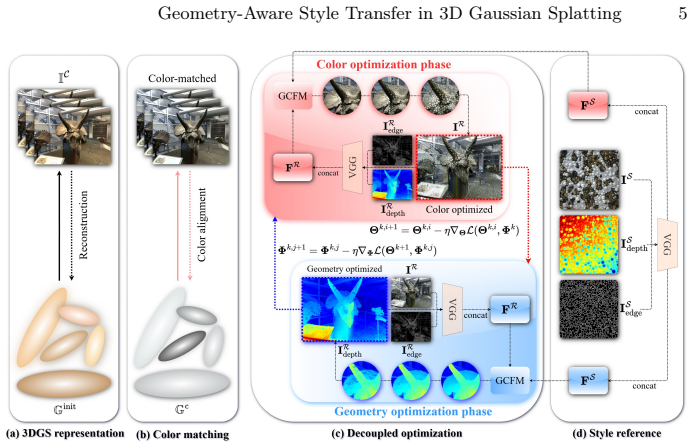
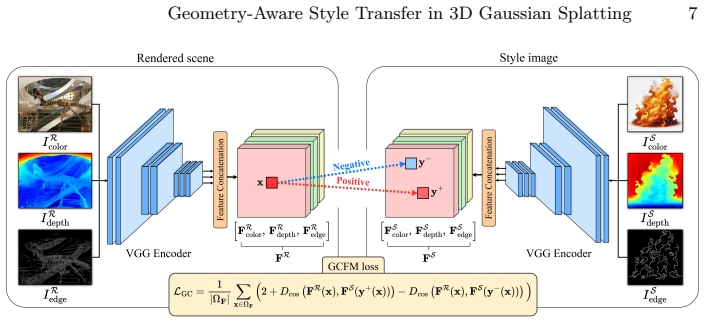
Decoupled optimization scheme that alternately updates color and geometry parameters, enabled by geometry-aware contrastive feature matching (GCFM) that integrates RGB, depth, and edge cues into a contrastive objective.
What would settle it
A test scene where the style image has substantially different depth and edge structures produces visible geometric artifacts or inconsistencies after optimization.
Extended reading notes
Core claim
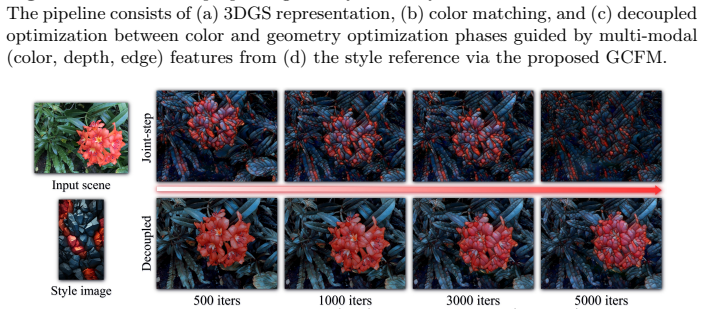
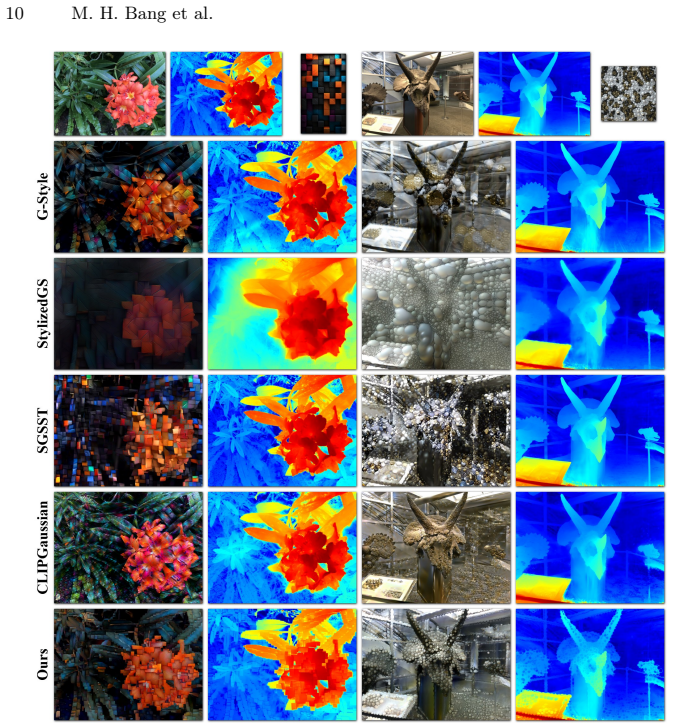
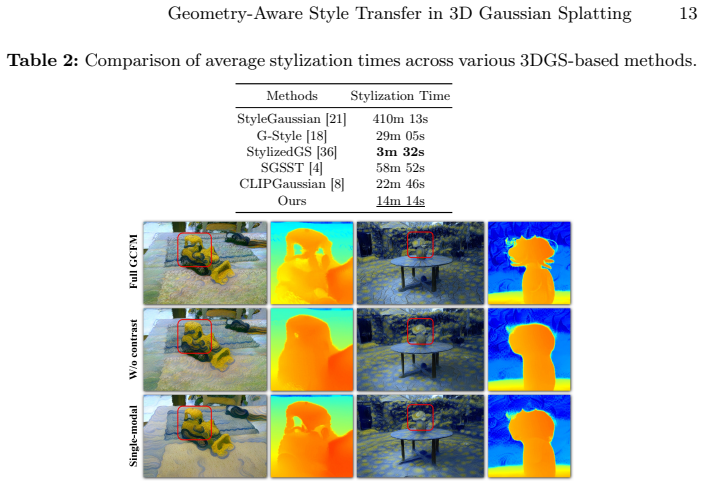
Our method explicitly incorporates geometry adaptation through a decoupled optimization scheme that alternately updates color and geometry parameters. This strategy alleviates potential interference between color and geometry updates, leading to stable and consistent scene-level geometry transformation. The decoupled optimization is enabled by the proposed geometry-aware contrastive feature matching (GCFM). GCFM integrates RGB, depth, and edge cues into a contrastive objective and is employed in both optimization phases to effectively transfer structural characteristics from style images to Gaussian primitives.
Load-bearing premise
The geometry-aware contrastive feature matching successfully transfers structural characteristics from style images to Gaussian primitives without introducing inconsistencies or artifacts.
Editorial extensions
If this is right
- Stable and consistent scene-level geometry transformation occurs without interference between color and geometry updates.
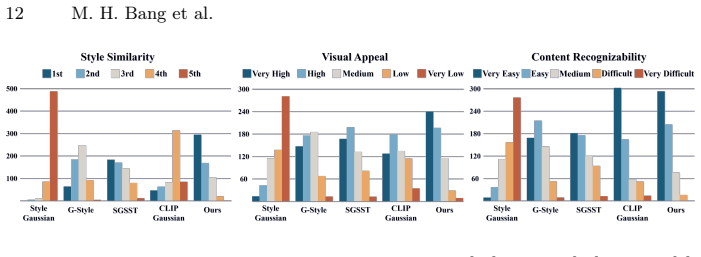
- Superior performance is achieved in both qualitative fidelity and quantitative metrics compared to prior methods.
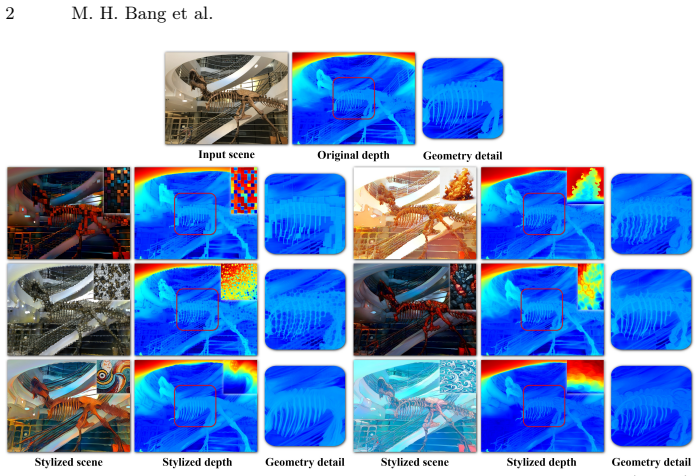
- Simultaneous transfer of appearance attributes and geometric structures becomes possible in 3DGS scenes.
- Existing 3DGS-based stylization methods are significantly outperformed on structural adaptation tasks.
Reading between the lines
- The method could extend to dynamic or video-based 3D scenes if temporal consistency is added to the decoupled updates.
- Structural style transfer might improve applications like virtual object redesign where shape changes matter more than recoloring.
- Similar contrastive matching on multiple cues could apply to other 3D representations if the Gaussian primitive assumption is relaxed.
Signed reviews
Editorial analysis
A structured set of objections, weighed in public.
Referee Report
Summary. The paper presents a geometry-aware style transfer framework for 3D Gaussian Splatting that transfers both appearance and geometric structure from style images. It introduces a decoupled alternating optimization scheme for color and geometry parameters, enabled by a geometry-aware contrastive feature matching (GCFM) objective that integrates RGB, depth, and edge cues to guide updates on Gaussian primitives. The method is claimed to reduce interference between color and geometry, yielding stable scene-level transformations, with experiments asserting superior qualitative and quantitative results over prior 3DGS stylization approaches. Code is released at the provided GitHub link.
Significance. If the empirical claims hold, the work addresses an under-explored aspect of 3D stylization by explicitly handling geometry adaptation rather than color-only transfer. The decoupled optimization and multi-cue contrastive matching represent a practical algorithmic pattern that could generalize to other 3D representation tasks. The public code release supports reproducibility and further investigation.
major comments (2)
- [Experiments] Experiments section: the central claim of superior performance requires explicit reporting of quantitative metrics (e.g., PSNR, LPIPS, or geometry-specific measures), baselines, and ablation tables; without these details the assertion that the decoupled scheme and GCFM produce measurable gains cannot be evaluated.
- [Method] §3.2 (GCFM formulation): the contrastive objective combining RGB, depth, and edge cues is described at a high level but lacks the precise loss equation or weighting scheme; this is load-bearing for verifying that the matching transfers structure without introducing inconsistencies.
minor comments (2)
- [Abstract] The abstract and introduction could more clearly distinguish the proposed GCFM from standard contrastive losses used in prior style transfer works.
- [Figures] Figure captions should explicitly state which scenes and style images are shown to allow direct comparison with the quantitative claims.
Simulated Author's Rebuttal
We thank the referee for the constructive comments. We address each major point below and will revise the manuscript accordingly to improve clarity and completeness.
read point-by-point responses
-
Referee: [Experiments] Experiments section: the central claim of superior performance requires explicit reporting of quantitative metrics (e.g., PSNR, LPIPS, or geometry-specific measures), baselines, and ablation tables; without these details the assertion that the decoupled scheme and GCFM produce measurable gains cannot be evaluated.
Authors: We agree that explicit quantitative reporting is necessary to substantiate the claims. The current manuscript mentions quantitative metrics in the abstract and experiments but does not present them in dedicated tables with all baselines and ablations. In the revision we will add comprehensive tables reporting PSNR, LPIPS, depth error, and other geometry measures, full baseline comparisons, and ablation studies isolating the decoupled optimization and GCFM contributions. revision: yes
-
Referee: [Method] §3.2 (GCFM formulation): the contrastive objective combining RGB, depth, and edge cues is described at a high level but lacks the precise loss equation or weighting scheme; this is load-bearing for verifying that the matching transfers structure without introducing inconsistencies.
Authors: We acknowledge the need for the exact formulation. Section 3.2 currently describes GCFM at a high level. We will insert the full mathematical definition of the contrastive loss, the precise combination of RGB, depth, and edge terms, and the weighting coefficients used in the revised manuscript. revision: yes
Circularity Check
No significant circularity
full rationale
The paper describes an algorithmic framework consisting of a decoupled alternating optimization scheme (color then geometry parameters) enabled by a geometry-aware contrastive feature matching loss (GCFM) that fuses RGB, depth, and edge cues. No equations, derivations, or predictions are shown that reduce any claimed output to a fitted input or self-referential definition by construction. The central claim is presented as an independent engineering contribution whose validity rests on external empirical results rather than internal reduction; no self-citation chains or ansatzes imported from prior author work are invoked as load-bearing steps in the provided text.
Assumptions & free parameters
assumptions (1)
- domain assumption Style images contain transferable geometric structure that can be captured by RGB, depth, and edge cues and matched to Gaussian primitives via contrastive loss.
invented entities (1)
-
Geometry-aware contrastive feature matching (GCFM)
Cite this review
Pith. "Pith review of Geometry-Aware Style Transfer in 3D Gaussian Splatting." pith.science (2026). https://pith.science/paper/ITB7XLP2
@misc{pith2026260624144,
  author       = {Pith},
  title        = {Pith review of: Geometry-Aware Style Transfer in 3D Gaussian Splatting},
  year         = {2026},
  howpublished = {\url{https://pith.science/paper/ITB7XLP2}},
  note         = {Machine review of arXiv:2606.24144}
}
read the original abstract
In this paper, we present a novel geometry-aware style transfer framework for 3D Gaussian splatting (3DGS) that simultaneously transfers appearance attributes and geometric structures. Unlike prior works that primarily focus on color-based stylization and often overlook structural adaptation, our method explicitly incorporates geometry adaptation through a decoupled optimization scheme that alternately updates color and geometry parameters. This strategy alleviates potential interference between color and geometry updates, leading to stable and consistent scene-level geometry transformation. The decoupled optimization is enabled by the proposed geometry-aware contrastive feature matching (GCFM). GCFM integrates RGB, depth, and edge cues into a contrastive objective and is employed in both optimization phases to effectively transfer structural characteristics from style images to Gaussian primitives. Extensive experiments show that our approach achieves superior performance in both qualitative fidelity and quantitative metrics, significantly outperforming existing 3DGS-based stylization methods. Our code is available at \href{https://github.com/oweixx/gast}{https://github.com/oweixx/gast}.
Figures
Figures from the paper (4 more)
Reference graph
Works this paper leans on
-
[1]
In: CVPR
Barron, J.T., Mildenhall, B., Verbin, D., Srinivasan, P.P., Hedman, P.: Mip-NeRF 360: Unbounded anti-aliased neural radiance fields. In: CVPR. pp. 5470–5479 (2022)
2022
-
[2]
IEEE TPAMIP AMI- 8(6), 679–698 (1986)
Canny, J.: A computational approach to edge detection. IEEE TPAMIP AMI- 8(6), 679–698 (1986)
1986
-
[3]
com / premium - vector / seamless - pattern - with - water - waves - splashes _ 9413868.htm
Freepik: Seamless pattern with water waves and splashes.https://www.freepik. com / premium - vector / seamless - pattern - with - water - waves - splashes _ 9413868.htm
-
[4]
In: CVPR
Galerne, B., Wang, J., Raad, L., Morel, J.M.: SGSST: Scaling Gaussian splatting style transfer. In: CVPR. pp. 26535–26544 (June 2025)
2025
-
[5]
In: CVPR
Gatys, L.A., Ecker, A.S., Bethge, M.: Image style transfer using convolutional neural networks. In: CVPR. pp. 2414–2423 (2016)
2016
-
[6]
In: Guyon, I., Luxburg, U.V., Bengio, S., Wallach, H., Fergus, R., Vishwanathan, S., Garnett, R
Heusel,M.,Ramsauer,H.,Unterthiner,T.,Nessler,B.,Hochreiter,S.:Ganstrained by a two time-scale update rule converge to a local nash equilibrium. In: Guyon, I., Luxburg, U.V., Bengio, S., Wallach, H., Fergus, R., Vishwanathan, S., Garnett, R. (eds.) NeurIPS. vol. 30. Curran Associates, Inc. (2017)
2017
-
[7]
In: CVPR
Höllein, L., Johnson, J., Nießner, M.: StyleMesh: Style transfer for indoor 3D scene reconstructions. In: CVPR. pp. 6198–6208 (2022)
2022
-
[8]
In: NeurIPS (2025)
Howil,K.,Waczyńska,J.,Borycki,P.,Dziarmaga,T.,Mazur,M.,Spurek,P.:CLIP- Gaussian: Universal and multimodal style transfer based on Gaussian splatting. In: NeurIPS (2025)
2025
Show all 40 references
-
[9]
In: ICCV
Huang, H.P., Tseng, H.Y., Saini, S., Singh, M., Yang, M.H.: Learning to stylize novel views. In: ICCV. pp. 13869–13878 (October 2021)
2021
-
[10]
In: ICCV
Huang, X., Belongie, S.: Arbitrary style transfer in real-time with adaptive instance normalization. In: ICCV. pp. 1501–1510 (2017)
2017
-
[11]
In: ECCV
Huang, X., Liu, M.Y., Belongie, S., Kautz, J.: Multimodal unsupervised image-to- image translation. In: ECCV. pp. 172–189 (2018)
2018
-
[12]
In: CVPR
Huang, Y.H., He, Y., Yuan, Y.J., Lai, Y.K., Gao, L.: StylizedNeRF: Consistent 3D scene stylization as stylized NeRF via 2D-3D mutual learning. In: CVPR. pp. 18342–18352 (June 2022)
2022
-
[13]
In: ECCV
Johnson, J., Alahi, A., Fei-Fei, L.: Perceptual losses for real-time style transfer and super-resolution. In: ECCV. pp. 694–711 (2016)
2016
-
[14]
In: CVPR
Jung, H., Nam, S., Sarafianos, N., Yoo, S., Sorkine-Hornung, A., Ranjan, R.: Ge- ometry transfer for stylizing radiance fields. In: CVPR. pp. 8565–8575 (June 2024)
2024
-
[15]
ACM Transactions on Graphics42(4) (July 2023)
Kerbl, B., Kopanas, G., Leimkühler, T., Drettakis, G.: 3D Gaussian splatting for real-time radiance field rendering. ACM Transactions on Graphics42(4) (July 2023)
2023
-
[16]
In: Interna- tional Conference on Learning Representations (ICLR) (2015)
Kingma, D.P., Ba, J.: Adam: A method for stochastic optimization. In: Interna- tional Conference on Learning Representations (ICLR) (2015)
2015
-
[17]
ACM TOG36(4), 1–13 (2017) 16 M
Knapitsch, A., Park, J., Zhou, Q.Y., Koltun, V.: Tanks and temples: Benchmarking large-scale scene reconstruction. ACM TOG36(4), 1–13 (2017) 16 M. H. Bang et al
2017
-
[18]
In: Computer Graphics Forum
Kovács, Á.S., Hermosilla, P., Raidou, R.G.: G-Style: Stylized Gaussian splatting. In: Computer Graphics Forum. vol. 43, p. e15259. Wiley Online Library (2024)
2024
-
[19]
In: ECCV
Lee, H.Y., Tseng, H.Y., Huang, J.B., Singh, M., Yang, M.H.: Diverse image-to- image translation via disentangled representations. In: ECCV. pp. 35–51 (2018)
2018
-
[20]
In: CVPR
Liu, K., Zhan, F., Chen, Y., Zhang, J., Yu, Y., El Saddik, A., Lu, S., Xing, E.P.: StyleRF: Zero-shot 3D style transfer of neural radiance fields. In: CVPR. pp. 8338– 8348 (June 2023)
2023
-
[21]
In: SIGGRAPH Asia (2024)
Liu, K., Zhan, F., Xu, M., Theobalt, C., Shao, L., Lu, S.: StyleGaussian: Instant 3D style transfer with Gaussian splatting. In: SIGGRAPH Asia (2024)
2024
-
[22]
In: ICME (2025)
Liu, W., Liu, Z., Yang, X., Sha, M., Li, Y.: ABC-GS: Alignment-based controllable style transfer for 3D Gaussian splatting. In: ICME (2025)
2025
-
[23]
ACM TOG38(4) (2019)
Mildenhall, B., Srinivasan, P.P., Ortiz-Cayon, R., Kalantari, N.K., Ramamoorthi, R., Ng, R., Kar, A.: Local light field fusion: Practical view synthesis with prescrip- tive sampling guidelines. ACM TOG38(4) (2019)
2019
-
[24]
In: Vedaldi, A., Bischof, H., Brox, T., Frahm, J.M
Mildenhall, B., Srinivasan, P.P., Tancik, M., Barron, J.T., Ramamoorthi, R., Ng, R.: NeRF: Representing scenes as neural radiance fields for view synthesis. In: Vedaldi, A., Bischof, H., Brox, T., Frahm, J.M. (eds.) ECCV. pp. 405–421 (2020)
2020
-
[25]
ACM Trans
Nguyen-Phuoc, T., Liu, F., Xiao, L.: SNeRF: Stylized neural implicit representa- tions for 3D scenes. ACM Trans. Graph.41(4) (Jul 2022)
2022
-
[26]
In: CVPR
Niklaus, S., Liu, F.: Softmax splatting for video frame interpolation. In: CVPR. pp. 5437–5446 (June 2020)
2020
-
[27]
In: NeurIPS (2019)
Paszke, A., Gross, S., Massa, F., Lerer, A., Bradbury, J., Chanan, G., Killeen, T., Lin, Z., Gimelshein, N., Antiga, L., et al.: PyTorch: An imperative style, high- performance deep learning library. In: NeurIPS (2019)
2019
-
[28]
In: ICCV
Shaham, T.R., Dekel, T., Michaeli, T.: SinGAN: Learning a generative model from a single natural image. In: ICCV. pp. 4570–4580 (October 2019)
2019
-
[29]
In: ICLR (2015)
Simonyan, K., Zisserman, A.: Very deep convolutional networks for large-scale image recognition. In: ICLR (2015)
2015
-
[30]
IEEE TIP28(1), 394–409 (2019),https: //doi.org/10.1109/TIP.2018.2866698
Tan, W.R., Chan, C.S., Aguirre, H., Tanaka, K.: Improved ArtGAN for conditional synthesis of natural image and artwork. IEEE TIP28(1), 394–409 (2019),https: //doi.org/10.1109/TIP.2018.2866698
2019 doi
-
[31]
In: ECCV
Teed, Z., Deng, J.: RAFT: Recurrent all-pairs field transforms for optical flow. In: ECCV. p. 402–419 (2020)
2020
-
[32]
CoRRabs/1607.08022(2016)
Ulyanov, D., Vedaldi, A., Lempitsky, V.S.: Instance normalization: The missing ingredient for fast stylization. CoRRabs/1607.08022(2016)
2016 arXiv
-
[33]
In: ICCV
Wang, Z., Zhao, L., Xing, W.: StyleDiffusion: Controllable disentangled style trans- fer via diffusion models. In: ICCV. pp. 7677–7689 (October 2023)
2023
-
[34]
CoRRabs/2406.09414(2024)
Yang, L., Kang, B., Huang, Z., Zhao, Z., Xu, X., Feng, J., Zhao, H.: Depth anything V2. CoRRabs/2406.09414(2024)
2024 arXiv
-
[35]
In: 2024 International Conference on 3D Vision (3DV)
Zhang, D., Fernandez-Labrador, C., Schroers, C.: CoARF: Controllable 3D artistic style transfer for radiance fields. In: 2024 International Conference on 3D Vision (3DV). pp. 612–622 (2024)
2024
-
[36]
IEEE TPAMI pp
Zhang, D., Yuan, Y.J., Chen, Z., Zhang, F.L., He, Z., Shan, S., Gao, L.: StylizedGS: Controllable stylization for 3D Gaussian splatting. IEEE TPAMI pp. 1–13 (2025)
2025
-
[37]
In: ECCV
Zhang, K., Kolkin, N., Bi, S., Luan, F., Xu, Z., Shechtman, E., Snavely, N.: ARF: Artistic radiance fields. In: ECCV. pp. 717–733 (2022)
2022
-
[38]
In: CVPR
Zhang, R., Isola, P., Efros, A.A., Shechtman, E., Wang, O.: The unreasonable effectiveness of deep features as a perceptual metric. In: CVPR. pp. 586–595 (2018)
2018
-
[39]
Zhang, Y., He, Z., Xing, J., Yao, X., Jia, J.: Ref-NPR: Reference-based non- photorealisticradiancefieldsforcontrollablescenestylization.In:CVPR.pp.4242– 4251 (June 2023) Geometry-Aware Style Transfer in 3D Gaussian Splatting 17
2023
-
[40]
Please rank the following results according to their similarity to the reference style (1=Most Similar, 5=Least Similar)
Zhu, J.Y., Park, T., Isola, P., Efros, A.A.: Unpaired image-to-image translation using cycle-consistent adversarial networks. In: ICCV. pp. 2242–2251 (2017) Geometry-Aware Style Transfer in 3D Gaussian Splatting 1 Geometry-Aware Style Transfer in 3D Gaussian Splatting – Supple...
2017
Reviewed June 26, 2026 · model on record in the stance chip above.
Discussion (0). Continue with ORCID to comment.