REVIEW 41 references
Cascaded Context Pyramid for Full-Resolution 3D Semantic Scene Completion
T0 review · reviewed 2026-08-14 · deepseek-v4-flash
Pith's one-line read A cascaded context pyramid network with guided residual refinement achieves state-of-the-art full-resolution 3D semantic scene completion from a single depth map on SUNCG and NYU datasets.
The pith
A machine-rendered reading of the paper's core claim, the machinery that carries it, and where it could break.
The reading
Extended reading notes
Core claim
Our proposed framework can generate high-quality SSC results, and outperforms state-of-the-art approaches on both the synthetic SUNCG and real NYU datasets. More specifically, Table 1 reports SC IoU 91.4% and SSC IoU 74.2% on SUNCG, exceeding all compared methods. If the paper is correct, CCPNet is the current state of the art for single-depth-image semantic scene completion.
Load-bearing premise
The evaluation protocol assumes that picking the best test checkpoint is a legitimate way to report final performance. The paper states: "we test the models at every 2K iterations and pick the best one as the final result" for NYU (Section 4.1). If the baseline methods did not use the same test-set selection, the reported improvements may be partly due to this advantage, so the central claim of superiority is not fully supported without a shared, unbiased protocol.
Signed reviews
Editorial analysis
A structured set of objections, weighed in public.
Assumptions & free parameters
free parameters (2)
- dilation rates for context pyramid =
30, 24, 18, 12, 6, 1
- number of subvolumes in separated dilated convolution =
4 in ablation; varies with depth in main model
assumptions (4)
- domain assumption Manhattan world assumption for alignment
- domain assumption fTSDF voxelization with 0.02 m grid and 0.24 m truncation
- domain assumption Ground truth volumes used for supervision are correct
- standard math Voxel-wise softmax loss with 2:1 empty-occupied sampling is a sound objective
Cite this review
Pith. "Pith review of Cascaded Context Pyramid for Full-Resolution 3D Semantic Scene Completion." pith.science (2026). https://pith.science/paper/ITK6Y2ME
@misc{pith2026190800382,
  author       = {Pith},
  title        = {Pith review of: Cascaded Context Pyramid for Full-Resolution 3D Semantic Scene Completion},
  year         = {2026},
  howpublished = {\url{https://pith.science/paper/ITK6Y2ME}},
  note         = {Machine review of arXiv:1908.00382}
}
read the original abstract
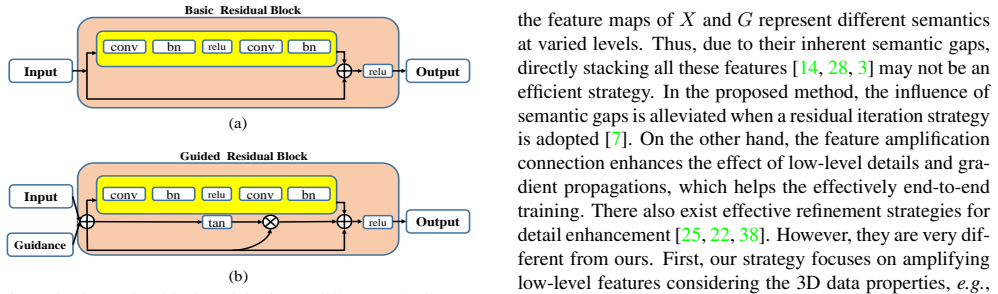
Semantic Scene Completion (SSC) aims to simultaneously predict the volumetric occupancy and semantic category of a 3D scene. It helps intelligent devices to understand and interact with the surrounding scenes. Due to the high-memory requirement, current methods only produce low-resolution completion predictions, and generally lose the object details. Furthermore, they also ignore the multi-scale spatial contexts, which play a vital role for the 3D inference. To address these issues, in this work we propose a novel deep learning framework, named Cascaded Context Pyramid Network (CCPNet), to jointly infer the occupancy and semantic labels of a volumetric 3D scene from a single depth image. The proposed CCPNet improves the labeling coherence with a cascaded context pyramid. Meanwhile, based on the low-level features, it progressively restores the fine-structures of objects with Guided Residual Refinement (GRR) modules. Our proposed framework has three outstanding advantages: (1) it explicitly models the 3D spatial context for performance improvement; (2) full-resolution 3D volumes are produced with structure-preserving details; (3) light-weight models with low-memory requirements are captured with a good extensibility. Extensive experiments demonstrate that in spite of taking a single-view depth map, our proposed framework can generate high-quality SSC results, and outperforms state-of-the-art approaches on both the synthetic SUNCG and real NYU datasets.
Figures


Figures from the paper (3 more)


Reference graph
Works this paper leans on
-
[1]
A. Atapour-Abarghouei and T. P. Breckon. Depthcomp: real- time depth image completion based on prior semantic scene segmentation. In BMVC, pages 1–13, 2017. 2
work page 2017
-
[2]
L.-C. Chen, G. Papandreou, I. Kokkinos, K. Murphy, and A. L. Yuille. Deeplab: Semantic image segmentation with deep convolutional nets, atrous convolution, and fully con- nected crfs. TPAMI, 40(4):834–848, 2018. 2, 3, 4, 8
work page 2018
-
[3]
¨O. C ¸ ic ¸ek, A. Abdulkadir, S. S. Lienkamp, T. Brox, and O. Ronneberger. 3d u-net: learning dense volumetric seg- mentation from sparse annotation. In MICCAI, pages 424– 432, 2016. 5
work page 2016
- [4]
-
[5]
M. Garbade, J. Sawatzky, A. Richard, and J. Gall. Two stream 3d semantic scene completion. arXiv:1804.03550,
-
[6]
A. Geiger and C. Wang. Joint 3d object and layout inference from a single rgb-d image. In GCPR, pages 183–195, 2015. 2, 7
work page 2015
- [7]
-
[8]
A. B. S. Guedes, T. E. de Campos, and A. Hilton. Semantic scene completion combining colour and depth: preliminary experiments. In ICCV Workshop, pages –, 2017. 1, 7
work page 2017
Show all 41 references
-
[9]
R. Guo, C. Zou, and D. Hoiem. Predicting complete 3d mod- els of indoor scenes. arXiv:1504.02437, 2015. 6
2015 arXiv
-
[10]
Guo and X
Y .-X. Guo and X. Tong. View-volume network for seman- tic scene completion from a single depth image. In IJCAI, pages –, 2018. 1, 2, 3, 5, 6, 7, 8
2018
-
[11]
Gupta, P
S. Gupta, P. Arbel ´aez, R. Girshick, and J. Malik. Indoor scene understanding with rgb-d images: Bottom-up segmen- tation, object detection and semantic segmentation. IJCV, 112(2):133–149, 2015. 2
2015
-
[12]
Gupta, P
S. Gupta, P. Arbelaez, and J. Malik. Perceptual organiza- tion and recognition of indoor scenes from rgb-d images. In CVPR, pages 564–571, 2013. 2
2013
-
[13]
Gupta, R
S. Gupta, R. Girshick, P. Arbel ´aez, and J. Malik. Learning rich features from rgb-d images for object detection and seg- mentation. In ECCV, pages 345–360, 2014. 2
2014
-
[14]
Hariharan, P
B. Hariharan, P. Arbel ´aez, R. Girshick, and J. Malik. Hyper- columns for object segmentation and fine-grained localiza- tion. In CVPR, pages 447–456, 2015. 5
2015
-
[15]
K. He, X. Zhang, S. Ren, and J. Sun. Delving deep into rectifiers: surpassing human-level performance on imagenet classification. arxiv e-prints 2015. In ICCV, pages 1026– 1034, 2015. 6
2015
-
[16]
K. He, X. Zhang, S. Ren, and J. Sun. Deep residual learning for image recognition. In CVPR, pages 770–778, 2016. 4, 5
2016
-
[17]
Ioannidou, E
A. Ioannidou, E. Chatzilari, S. Nikolopoulos, and I. Kompat- siaris. Deep learning advances in computer vision with 3d data: A survey. ACM Computing Surveys (CSUR), 50(2):20,
-
[18]
S. Ji, W. Xu, M. Yang, and K. Yu. 3d convolutional neural networks for human action recognition. TPAMI, 35(1):221– 231, 2013. 4
2013
-
[19]
Y . Jia, E. Shelhamer, J. Donahue, S. Karayev, J. Long, R. Gir- shick, S. Guadarrama, and T. Darrell. Caffe: Convolutional architecture for fast feature embedding. InACM Multimedia, pages 675–678, 2014. 6
2014
-
[20]
J. Li, Y . Liu, D. Gong, Q. Shi, X. Yuan, C. Zhao, and I. Reid. Rgbd based dimensional decomposition residual network for 3d semantic scene completion. In CVPR, pages –, 2019. 1, 2, 7, 8
2019
-
[21]
D. Lin, S. Fidler, and R. Urtasun. Holistic scene understand- ing for 3d object detection with rgbd cameras. In ICCV, pages 1417–1424, 2013. 7
2013
-
[22]
G. Lin, A. Milan, C. Shen, and I. Reid. Refinenet: Multi-path refinement networks for high-resolution semantic segmenta- tion. In CVPR, pages 1925–1934, 2017. 5
1925
-
[23]
S. Liu, Y . Hu, Y . Zeng, Q. Tang, B. Jin, Y . Han, and X. Li. See and think: Disentangling semantic scene completion. In NIPS, pages 261–272, 2018. 1, 2, 6, 7, 8
2018
-
[24]
Y . Liu, B. Fan, L. Wang, J. Bai, S. Xiang, and C. Pan. Semantic labeling in very high resolution images via a self-cascaded convolutional neural network. ISPRS JPRS , 145:78–95, 2018. 2, 4
2018
-
[25]
P. O. Pinheiro, T.-Y . Lin, R. Collobert, and P. Doll´ar. Learn- ing to refine object segments. In ECCV, pages 75–91, 2016. 5
2016
-
[26]
X. Ren, L. Bo, and D. Fox. Rgb-(d) scene labeling: Features and algorithms. In CVPR, pages 2759–2766, 2012. 2
2012
-
[27]
Ren and E
Z. Ren and E. B. Sudderth. Three-dimensional object detec- tion and layout prediction using clouds of oriented gradients. In CVPR, pages 1525–1533, 2016. 2
2016
-
[28]
Ronneberger, P
O. Ronneberger, P. Fischer, and T. Brox. U-net: Convolu- tional networks for biomedical image segmentation. InMIC- CAI, pages 234–241, 2015. 5
2015
-
[29]
Silberman, D
N. Silberman, D. Hoiem, P. Kohli, and R. Fergus. Indoor segmentation and support inference from rgbd images. In ECCV, pages 746–760, 2012. 6
2012
-
[30]
Song and J
S. Song and J. Xiao. Sliding shapes for 3d object detection in depth images. In ECCV, pages 634–651, 2014. 2
2014
-
[31]
Song and J
S. Song and J. Xiao. Deep sliding shapes for amodal 3d object detection in rgb-d images. In CVPR, pages 808–816,
-
[32]
S. Song, F. Yu, A. Zeng, A. X. Chang, M. Savva, and T. Funkhouser. Semantic scene completion from a single depth image. In CVPR, pages 1746–1754, 2017. 1, 2, 3, 4, 5, 6, 7, 8
2017
-
[33]
Wang and U
W. Wang and U. Neumann. Depth-aware cnn for rgb-d seg- mentation. In ECCV, pages 135–150, 2018. 2
2018
-
[34]
Yu and V
F. Yu and V . Koltun. Multi-scale context aggregation by di- lated convolutions. ICLR, 2016. 1, 3
2016
-
[35]
Zhang, H
J. Zhang, H. Zhao, A. Yao, Y . Chen, L. Zhang, and H. Liao. Efficient semantic scene completion network with spatial group convolution. In ECCV, pages 733–749, 2018. 6, 7, 8
2018
-
[36]
Zhang, L
L. Zhang, L. Wang, X. Zhang, P. Shen, M. Bennamoun, G. Zhu, S. A. A. Shah, and J. Song. Semantic scene com- pletion with dense crf from a single depth image. Neuro- computing, 318:182–195, 2018. 1, 6, 7
2018
-
[37]
Zhang, W
P. Zhang, W. Liu, H. Wang, Y . Lei, and H. Lu. Deep gated attention networks for large-scale street-level scene segmen- tation. PR, 88:702–714, 2019. 3
2019
-
[38]
Zhang, D
P. Zhang, D. Wang, H. Lu, H. Wang, and X. Ruan. Amulet: Aggregating multi-level convolutional features for salient object detection. In ICCV, pages 202–211, 2017. 5
2017
-
[39]
Zhang, L
P. Zhang, L. Wang, D. Wang, H. Lu, and C. Shen. Agile amulet: Real-time salient object detection with contextual attention. arXiv:1802.06960, 2018. 3
2018 arXiv
-
[40]
H. Zhao, J. Shi, X. Qi, X. Wang, and J. Jia. Pyramid scene parsing network. In CVPR, pages 2881–2890, 2017. 3, 4, 8
2017
-
[41]
Zheng, Y
B. Zheng, Y . Zhao, J. C. Yu, K. Ikeuchi, and S.-C. Zhu. Be- yond point clouds: Scene understanding by reasoning geom- etry and physics. In CVPR, pages 3127–3134, 2013. 2, 7
2013
Reviewed August 14, 2026 · model on record in the stance chip above.
Discussion (0). Continue with ORCID to comment.