Confidence-Aware Automated Assessment of Student-Drawn Scientific Models
Pith reviewed 2026-06-26 17:12 UTC · model grok-4.3
The pith
Adapting a Vision Transformer to extract confidence from test-time predictions enables selective automation of student-drawn science model scoring while raising reliability.
A machine-rendered reading of the paper's core claim, the machinery that carries it, and where it could break.
Core claim
The authors claim that parameter-efficient adaptation of a Vision Transformer, paired with a confidence-aware framework that derives response-level confidence from test-time predictive distributions, supports selective scoring: high-confidence student drawings receive automated scores and uncertain ones are deferred to human review. On six NGSS-aligned middle school assessment items this produces improved scoring reliability together with a workable trade-off between automated coverage and scoring risk.
What carries the argument
Response-level confidence signal extracted from test-time predictive distributions of the adapted Vision Transformer, used to route high-confidence cases to automation and low-confidence cases to human review.
If this is right
- Scoring reliability rises on the six NGSS-aligned middle school items.
- Users can adjust the share of responses handled automatically against the resulting risk.
- Confidence-aware routing adds value for trustworthy large-scale educational assessment.
- Selective automation reduces full human review load while keeping overall error manageable.
Where Pith is reading between the lines
- The same deferral logic could apply to other student visual work such as diagrams in mathematics.
- Lower per-assessment costs might encourage schools to use drawing tasks more frequently.
- Combining the signal with additional uncertainty methods could tighten the coverage-risk curve further.
Load-bearing premise
The predictive distributions produced by the adapted model at test time give a trustworthy signal of when automation would not add unacceptable error.
What would settle it
An evaluation in which error rates on the high-confidence automated subset exceed those on the full set or human agreement levels would show the confidence signal fails to support safe selective automation.
Figures
read the original abstract
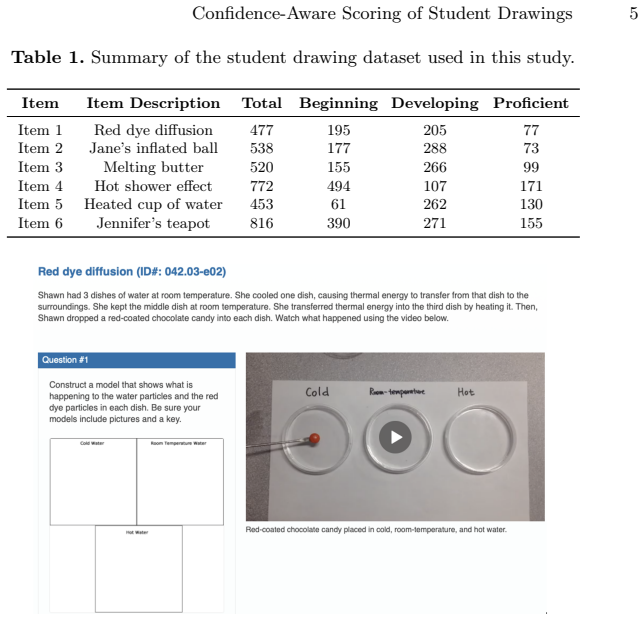
Student-generated drawings are widely used in science education to assess learners' conceptual understanding in modeling-based tasks aligned with the Next Generation Science Standards (NGSS). However, scoring such drawings requires expert human judgment to interpret complex visual representations, making large-scale assessment costly to implement and sustain in classroom settings. In this work, we study automated scoring of student-generated scientific drawings using a vision-based model. We evaluate a Vision Transformer (ViT) with parameter-efficient adaptation and propose a confidence-aware scoring framework that derives response-level confidence from test-time predictive distributions. This confidence signal enables selective automation by scoring high-confidence responses automatically while deferring uncertain cases for human review. Experiments on six NGSS-aligned middle school assessment items show that the proposed approach improves scoring reliability while supporting a practical trade-off between automated coverage and scoring risk, highlighting the value of confidence-aware methods for trustworthy educational assessment.
Editorial analysis
A structured set of objections, weighed in public.
Referee Report
Summary. The paper introduces a confidence-aware framework for automated scoring of student-drawn scientific models using a parameter-efficiently adapted Vision Transformer (ViT). It derives response-level confidence from test-time predictive distributions to selectively automate high-confidence scores while deferring uncertain ones to human review. Experiments on six NGSS-aligned middle school assessment items demonstrate that this approach improves scoring reliability and allows a practical trade-off between automated coverage and scoring risk.
Significance. If the results hold, this work offers a method to make large-scale assessment of NGSS modeling tasks more feasible and trustworthy by integrating AI with human oversight. The use of standard ViT techniques and focus on real classroom assessment items strengthens its applicability to educational technology.
minor comments (1)
- [Abstract] Abstract: the claim of improved reliability is stated without any quantitative results, error bars, baseline comparisons, or details on how confidence correlates with accuracy; a brief summary of key metrics should be added to support the central claim at first reading.
Simulated Author's Rebuttal
We thank the referee for the positive summary, significance assessment, and recommendation for minor revision. No major comments appear in the provided report, so there are no specific points requiring point-by-point response or manuscript changes at this stage.
Circularity Check
No significant circularity in derivation chain
full rationale
The paper describes an empirical ML framework adapting a standard Vision Transformer for scoring student drawings, deriving confidence from test-time predictive distributions, and evaluating selective automation on six NGSS items. No equations, derivations, or load-bearing steps reduce the reported reliability improvements or coverage-risk trade-off to a fitted quantity defined by the same data, a self-citation chain, or an ansatz smuggled via prior work. The central claims rest on experimental results that remain independent of the inputs by construction.
Axiom & Free-Parameter Ledger
axioms (2)
- domain assumption Vision Transformer with parameter-efficient adaptation can extract features relevant to scoring scientific drawings
- domain assumption Test-time predictive distributions yield a usable confidence signal for deferral decisions
Reference graph
Works this paper leans on
-
[1]
arXiv preprint arXiv:2006.16705 (2020)
Bahat, Y., Shakhnarovich, G.: Classification confidence estimation with test-time data-augmentation. arXiv preprint arXiv:2006.16705 (2020)
-
[2]
principles, policy & practice, 5 (1), 7–74 (1998)
Black, P., Wiliam, D.: Assessment and classroom learning assessment in education. principles, policy & practice, 5 (1), 7–74 (1998)
1998
-
[3]
In: Proceedings of the AAAI Conference on Artificial Intelligence
Fang, L., Wang, T., Ma, P., Zhai, X.: Generalizable and efficient automated scoring with a knowledge-distilled multi-task mixture-of-experts. In: Proceedings of the AAAI Conference on Artificial Intelligence. vol. 40, pp. 40831–40839 (2026)
2026
-
[4]
Fu, Y., Wang, X., Tian, Y., Zhao, J.: Deep think with confidence. arXiv preprint arXiv:2508.15260 (2025)
work page internal anchor Pith review Pith/arXiv arXiv 2025
-
[5]
arXiv preprint arXiv:2507.23470 (2025)
Gürtl, S., Schimetta, G., Kerschbaumer, D., Liut, M., Steinmaurer, A.: Automated feedback on student-generated uml and er diagrams using large language models. arXiv preprint arXiv:2507.23470 (2025)
-
[6]
IEEE transactions on pattern analysis and machine intelligence45(1), 87–110 (2022)
Han, K., Wang, Y., Chen, H., Chen, X., Guo, J., Liu, Z., Tang, Y., Xiao, A., Xu, C., Xu, Y., et al.: A survey on vision transformer. IEEE transactions on pattern analysis and machine intelligence45(1), 87–110 (2022)
2022
-
[7]
Parameter-Efficient Fine-Tuning for Large Models: A Comprehensive Survey
Han, Z., Gao, C., Liu, J., Zhang, J., Zhang, S.: Parameter-efficient fine-tuning for large models: A comprehensive survey. arXiv preprint arXiv:2403.14608 (2024)
work page internal anchor Pith review Pith/arXiv arXiv 2024
-
[8]
NSTA Press, National Science Teaching Association (2024)
Harris, C.J., Krajcik, J.S., Pellegrino, J.W.: Creating and using instructionally sup- portive assessments in NGSS classrooms. NSTA Press, National Science Teaching Association (2024)
2024
-
[9]
In: International Conference on Learning Representations (ICLR) (2022)
Hu, E.J., Shen, Y., Wallis, P., Allen-Zhu, Z., Li, Y., Wang, S., Wang, L., Chen, W.: Lora: Low-rank adaptation of large language models. In: International Conference on Learning Representations (ICLR) (2022)
2022
-
[10]
In: International conference on artificial intelligence in education
Latif, E., Fang, L., Ma, P., Zhai, X.: Knowledge distillation of llms for automatic scoring of science assessments. In: International conference on artificial intelligence in education. pp. 166–174. Springer (2024)
2024
-
[11]
Journal of Science Education and Technology pp
Lee, G., Zhai, X.: Nerif: Gpt-4v for automatic scoring of drawn models. Journal of Science Education and Technology pp. 1–18 (2025)
2025
-
[12]
Journal of Science Ed- ucation and Technology32(4), 549–566 (2023)
Lee, J., Lee, G.G., Hong, H.G.: Automated assessment of student hand drawings in free-response items on the particulate nature of matter. Journal of Science Ed- ucation and Technology32(4), 549–566 (2023)
2023
-
[13]
In: Proceedings of the Fifth Annual ACM Conference on Learning at Scale
Leong, C.W., Liu, L., Ubale, R., Chen, L.: Toward large-scale automated scoring of scientific visual models. In: Proceedings of the Fifth Annual ACM Conference on Learning at Scale. pp. 1–4 (2018)
2018
-
[14]
Journal of Science Education and Technology pp
Li, T., Haudek, K., Krajcik, J.: Utilizing deep learning ai to analyze scientific models: Overcoming challenges. Journal of Science Education and Technology pp. 1–22 (2025)
2025
-
[15]
British Journal of Edu- cational Technology50(6), 3391–3404 (2019)
Pei, B., Xing, W., Lee, H.S.: Using automatic image processing to analyze visual artifacts created by students in scientific argumentation. British Journal of Edu- cational Technology50(6), 3391–3404 (2019)
2019
-
[16]
In: 2024 International Conference on Innovations in Science, Engineering and Technology (ICISET)
Rahaman, M.A., Rahman, T., Hossain, M.M.: Automated grading and classifica- tion of hand-drawn sketches using deep learning. In: 2024 International Conference on Innovations in Science, Engineering and Technology (ICISET). pp. 1–6. IEEE (2024)
2024
-
[17]
Neurocomputing338, 34–45 (2019)
Wang, G., Li, W., Aertsen, M., Deprest, J., Ourselin, S., Vercauteren, T.: Aleatoric uncertainty estimation with test-time augmentation for medical image segmenta- tion with convolutional neural networks. Neurocomputing338, 34–45 (2019)
2019
discussion (0)
Sign in with ORCID, Apple, or X to comment. Anyone can read and Pith papers without signing in.