REVIEW 3 major objections 38 references
A kinematic normalizing flow plus a low-level imitation filter lets a quadruped with an arm exploit whole-body redundancy for precise loco-manipulation.
Reviewed by Pith at T0; open to challenge. T0 means a machine referee read the full paper against a public rubric. the ladder, T0–T4 →
A hierarchical controller using a kinematic normalizing flow for partial inverse-kinematics redundancy plus low-level imitation yields 4.5 cm / 0.14 rad end-effector tracking while walking on a real quadruped-arm platform.
T0 review reviewed 2026-07-14 challenge →
load-bearing objection Clean hierarchical loco-manipulation controller that turns partial kinematic redundancy into real tracking gains on an 18-DoF platform; soft spot is the usual kinematic-to-dynamics hand-off, not a structural flaw. the 3 major comments →
PAKE: Learning Whole-Body Loco-Manipulation with Partial Kinematic Embeddings
The pith
A machine-rendered reading of the paper's core claim, the machinery that carries it, and where it could break.
The reading
Core claim
Decomposing whole-body loco-manipulation into partial kinematic reference generation (via a Kinematic Normalizing Flow that encodes redundant inverse-kinematic solutions) and low-level imitation control lets a high-level policy exploit system redundancy while a low-level policy enforces dynamic feasibility, yielding substantially higher end-effector and base-velocity tracking accuracy and larger feasible workspace than prior end-to-end or decoupled baselines on a quadrupedal mobile manipulator.
What carries the argument
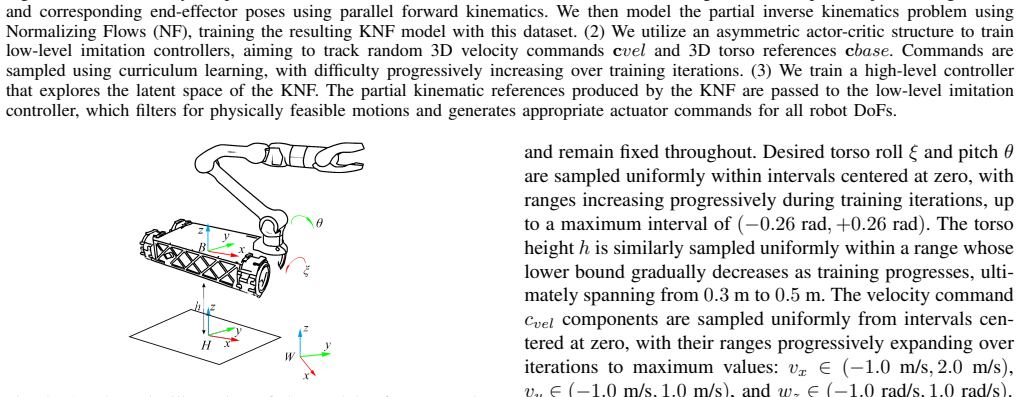
Kinematic Normalizing Flow (KNF): a conditional normalizing flow trained on 170 million partial joint-pose pairs that maps a desired end-effector pose to a distribution of feasible partial references (torso height/roll/pitch + 6 arm DoFs); the high-level controller acts in its latent space and the low-level controller filters and executes the decoded references.
Load-bearing premise
That a purely kinematic model of partial joint configurations, filtered only by a low-level imitation policy, is enough to recover dynamically stable full-body motions for whatever latent code the high-level policy chooses.
What would settle it
On the same hardware, measure whether end-effector and base-velocity errors remain under the reported thresholds when the high-level policy is forced to sample latent codes far from the training distribution of the KNF (or when contact-rich tasks require leg configurations the partial kinematic dataset never saw).
Editorial analysis
A structured set of objections, weighed in public.
Referee Report
Summary. The paper presents PAKE, a hierarchical whole-body loco-manipulation framework for a quadruped with a six-DoF arm. A Kinematic Normalizing Flow (KNF) is trained on ~170M partial forward-kinematics samples (torso height/roll/pitch + arm joints) to embed a distribution of inverse-kinematic solutions conditioned on end-effector pose. A high-level RL policy navigates the KNF latent space to select partial references that exploit redundancy; a low-level imitation RL policy tracks those partial references plus base velocity commands and produces full-DoF actuator targets via PD control. Simulation comparisons against VBC and Umi-on-Legs (plus an HLC ablation) report lower pose and velocity tracking errors and larger feasible workspace volumes. Hardware evaluation over 24 episodes of 8 tasks reports mean end-effector errors of ~4.5 cm / 0.14 rad and base velocity errors of ~0.1 m/s / 0.01 rad/s.
Significance. If the reported accuracy and workspace gains hold under broader conditions, PAKE is a useful practical contribution: it makes kinematic redundancy an explicit, navigable action space rather than leaving RL to discover a single feasible solution in a high-DoF joint space. Strengths include a large, independently generated kinematic dataset; a clean hierarchy that separates redundancy-aware planning from dynamic execution; quantitative sim ablations (Table II, (-)HLC); workspace volume metrics (Table III); and multi-task hardware numbers with motion capture (Table IV). The approach is incremental relative to prior hierarchical loco-manipulation RL, but the KNF formulation and the demonstrated combination of mobile base tracking with 6D end-effector accuracy are of clear interest to the field.
major comments (3)
- Abstract and §IV-D claim hardware performance “outperforming competitive baselines,” yet Table IV and the hardware section report only PAKE metrics (24 episodes / 8 tasks). No hardware numbers for VBC, Umi-on-Legs, or other cited methods appear. Either add matched hardware baselines on the same task set or restrict the outperformance claim to the simulation suite (Tables II–III), where baselines are actually evaluated.
- §III-A and §III-C state that KNF references “may violate physical constraints” and that the LLC “filters infeasible references,” which is load-bearing for the claim that latent navigation plus imitation substitutes for explicit dynamics/contact planning. The manuscript provides no quantitative support (e.g., fraction of HLC-selected latents that produce large tracking residuals, joint-limit or tip-over events, or recovery behavior). A short analysis or failure-case characterization would make the kinematic-to-dynamics assumption falsifiable rather than asserted.
- Table II / §IV-B: Umi-on-Legs is evaluated without chassis velocity tracking (marked “%” for planar and angular velocity), while PAKE and VBC are scored on simultaneous loco-manipulation. The comparison is informative for end-effector pose but is not fully fair for the paper’s central claim of coordinated locomotion + manipulation. Clarify task alignment or add a velocity-capable concurrent baseline among those already cited (e.g., Portela et al., Jung et al.).
Circularity Check
No circularity: empirical hierarchical control with KNF trained on independent FK samples and tracking evaluated against external commands/mocap.
full rationale
The paper's derivation chain is self-contained and non-circular. The KNF is fit solely to a large kinematic dataset of 170 million forward-kinematics pairs (uniform joint samples of 9 DoFs mapped to end-effector poses in the heading frame; Sec. III-B.1–2), producing a latent embedding of partial inverse-kinematic solutions. The high-level policy then navigates that latent space via RL, while the low-level imitation policy is pretrained and fine-tuned to track the resulting partial references plus velocity commands under physical simulation (Sec. III-C–D). Final claims of tracking accuracy (Tables II–IV, Figs. 4–6) and workspace volume are measured against independently sampled target trajectories and real motion-capture data, not against quantities that were fitted into the model. No equation equates a claimed prediction to a fitted constant by construction; no uniqueness theorem or ansatz is imported from overlapping-author prior work as a load-bearing premise; and the acknowledged kinematic-to-dynamics gap (KNF references may violate joint/leg/stability constraints, filtered by the LLC) is an ordinary hierarchical limitation rather than an internal reduction. The method is therefore an ordinary empirical robotics result with independent training data and external evaluation.
Axiom & Free-Parameter Ledger
free parameters (4)
- lambda_latent_scale =
0.7
- KNF architecture (12 Glow layers, width 12, 1024-hidden coefficient nets) =
12 layers / 1024
- PD gains (kp=100, kd=1) and actor/critic sizes =
kp=100, kd=1; [256x128]/[512x256x128]
- reward curriculum scales and airtime/clearance coefficients
axioms (4)
- domain assumption A normalizing flow trained solely on forward-kinematics samples of 9 DoFs can represent a useful distribution over inverse-kinematic solutions for the partial system.
- domain assumption A low-level RL policy trained to track random torso references and velocities can filter kinematically generated but dynamically infeasible references into stable whole-body motions.
- domain assumption Standard PPO with asymmetric actor-critic and domain randomization transfers zero-shot from RaiSim to the real robot.
- ad hoc to paper Uniform sampling of joint limits followed by parallel FK yields a representative kinematic dataset of 170 M pairs.
invented entities (2)
-
Kinematic Normalizing Flow (KNF)
no independent evidence
-
Partial Kinematic Embeddings (PAKE) hierarchy
no independent evidence
Cite this review
Pith. "Pith review of PAKE: Learning Whole-Body Loco-Manipulation with Partial Kinematic Embeddings." pith.science (2026). https://pith.science/paper/IU5VXHEP
@misc{pith2026260711041,
  author       = {Pith},
  title        = {Pith review of: PAKE: Learning Whole-Body Loco-Manipulation with Partial Kinematic Embeddings},
  year         = {2026},
  howpublished = {\url{https://pith.science/paper/IU5VXHEP}},
  note         = {Machine review of arXiv:2607.11041}
}
read the original abstract
Loco-manipulation has recently shown promising capabilities; however, achieving high-precision control, managing the high-dimensional action space induced by many degrees of freedom (DoFs), and fully exploiting the inherent redundancy of whole-body systems remain challenging. In this paper, we propose a novel whole-body control framework that effectively addresses these challenges by decomposing the complex loco-manipulation problem into partial reference motion generation and low-level imitation control. We introduce a new Kinematic Normalizing Flow (KNF) model, trained on a large-scale kinematic dataset, that generates diverse yet feasible partial reference motions. A high-level controller is then trained to navigate the KNF's latent space to exploit redundant solutions, while a low-level controller ensures physically feasible and accurate motion execution. We validate our approach on the quadrupedal robot equipped with a six-DoF robotic arm. In simulation, experimental results show that our approach significantly outperforms state-of-the-art methods in terms of tracking accuracy and feasible workspace coverage. For hardware deployment, we evaluate the system over 24 episodes across 8 different mobile loco-manipulation tasks. The system achieves end-effector pose-tracking errors of 4.5 cm and 0.14 rad, while maintaining accurate locomotion tracking with linear and angular velocity errors of 0.1 m/s and 0.01 rad/s, respectively, outperforming competitive baselines. Our method represents a practical and powerful solution for accurate and generalized whole-body loco-manipulation in high-DoF robotic systems, with promising potential for diverse downstream robotic tasks.
Figures




Reference graph
Works this paper leans on
-
[1]
Learning agile and dynamic motor skills for legged robots,
J. Hwangbo, J. Lee, A. Dosovitskiy, D. Bellicoso, V . Tsounis, V . Koltun, and M. Hutter, “Learning agile and dynamic motor skills for legged robots,”Science Robotics, vol. 4, no. 26, p. eaau5872, 2019
2019
-
[2]
Learning quadrupedal locomotion on deformable terrain,
S. Choi, G. Ji, J. Park, H. Kim, J. Mun, J. H. Lee, and J. Hwangbo, “Learning quadrupedal locomotion on deformable terrain,”Science Robotics, vol. 8, no. 74, p. eade2256, 2023
2023
-
[3]
RobustDex- Grasp: Robust dexterous grasping of general objects from single-view perception,
H. Zhang, Z. Wu, L. Huang, S. Christen, and J. Song, “RobustDex- Grasp: Robust dexterous grasping of general objects from single-view perception,”arXiv preprint arXiv:2504.05287, 2025
Pith/arXiv arXiv 2025
-
[4]
FunGrasp: Functional grasping for diverse dexterous hands,
L. Huang, H. Zhang, Z. Wu, S. Christen, and J. Song, “FunGrasp: Functional grasping for diverse dexterous hands,” 2025
2025
-
[5]
Whole- body end-effector pose tracking,
T. Portela, A. Cramariuc, M. Mittal, and M. Hutter, “Whole- body end-effector pose tracking,” 2024. [Online]. Available: https: //arxiv.org/abs/2409.16048
Pith/arXiv arXiv 2024
-
[6]
Deep whole-body control: Learning a unified policy for manipulation and locomotion,
Z. Fu, X. Cheng, and D. Pathak, “Deep whole-body control: Learning a unified policy for manipulation and locomotion,” inConference on Robot Learning (CoRL), 2022
2022
-
[7]
Visual whole-body control for legged loco-manipulation,
M. Liu, Z. Chen, X. Cheng, Y . Ji, R. Qiu, R. Yang, and X. Wang, “Visual whole-body control for legged loco-manipulation,”The 8th Conference on Robot Learning, 2024
2024
-
[8]
Learning force con- trol for legged manipulation,
T. Portela, G. B. Margolis, Y . Ji, and P. Agrawal, “Learning force con- trol for legged manipulation,” in2024 IEEE International Conference on Robotics and Automation (ICRA), 2024, pp. 15 366–15 372
2024
-
[9]
Learning visual quadrupedal loco-manipulation from demonstrations,
Z. He, K. Lei, Y . Ze, K. Sreenath, Z. Li, and H. Xu, “Learning visual quadrupedal loco-manipulation from demonstrations,” in2024 IEEE/RSJ International Conference on Intelligent Robots and Systems (IROS), 2024, pp. 9102–9109
2024
-
[10]
Pedipulate: Enabling manipulation skills using a quadruped robot’s leg,
P. Arm, M. Mittal, H. Kolvenbach, and M. Hutter, “Pedipulate: Enabling manipulation skills using a quadruped robot’s leg,” in2024 IEEE International Conference on Robotics and Automation (ICRA), 2024, pp. 5717–5723
2024
-
[11]
Roboduet: Learning a cooperative policy for whole-body legged loco-manipulation,
G. Pan, Q. Ben, Z. Yuan, G. Jiang, Y . Ji, S. Li, J. Pang, H. Liu, and H. Xu, “Roboduet: Learning a cooperative policy for whole-body legged loco-manipulation,”IEEE Robotics and Automation Letters, vol. 10, no. 5, pp. 4564–4571, 2025
2025
-
[12]
Learning whole-body loco-manipulation for omni-directional task space pose tracking with a wheeled-quadrupedal-manipulator,
K. Jiang, Z. Fu, J. Guo, W. Zhang, and H. Chen, “Learning whole-body loco-manipulation for omni-directional task space pose tracking with a wheeled-quadrupedal-manipulator,”IEEE Robotics and Automation Letters, vol. 10, no. 2, pp. 1481–1488, 2025
2025
-
[13]
Perception-less terrain adaptation through whole body control and hierarchical optimization,
C. Dario Bellicoso, C. Gehring, J. Hwangbo, P. Fankhauser, and M. Hutter, “Perception-less terrain adaptation through whole body control and hierarchical optimization,” in2016 IEEE-RAS 16th In- ternational Conference on Humanoid Robots (Humanoids), 2016, pp. 558–564
2016
-
[14]
Dynamic locomotion in the mit cheetah 3 through convex model-predictive control,
J. Di Carlo, P. M. Wensing, B. Katz, G. Bledt, and S. Kim, “Dynamic locomotion in the mit cheetah 3 through convex model-predictive control,” in2018 IEEE/RSJ International Conference on Intelligent Robots and Systems (IROS), 2018, pp. 1–9
2018
-
[15]
Highly dynamic quadruped locomotion via whole-body impulse control and model predictive control,
D. Kim, J. Di Carlo, B. Katz, G. Bledt, and S. Kim, “Highly dynamic quadruped locomotion via whole-body impulse control and model predictive control,”arXiv preprint arXiv:1909.06586, 2019
Pith/arXiv arXiv 1909
-
[16]
Perceptive locomotion through nonlinear model-predictive control,
R. Grandia, F. Jenelten, S. Yang, F. Farshidian, and M. Hutter, “Perceptive locomotion through nonlinear model-predictive control,” IEEE Transactions on Robotics, vol. 39, no. 5, pp. 3402–3421, 2023
2023
-
[17]
Per-contact iteration method for solving contact dynamics,
J. Hwangbo, J. Lee, and M. Hutter, “Per-contact iteration method for solving contact dynamics,”IEEE Robotics and Automation Letters, vol. 3, no. 2, pp. 895–902, 2018. [Online]. Available: www.raisim.com
2018
-
[18]
Isaac gym: High performance GPU based physics simulation for robot learning,
V . Makoviychuk, L. Wawrzyniak, Y . Guo, M. Lu, K. Storey, M. Mack- lin, D. Hoeller, N. Rudin, A. Allshire, A. Handa, and G. State, “Isaac gym: High performance GPU based physics simulation for robot learning,” inThirty-fifth Conference on Neural Information Processing Systems Datasets and Benchmarks Track (Round 2), 2021
2021
-
[19]
Learning arm-assisted fall damage reduction and recovery for legged mobile manipulators,
Y . Ma, F. Farshidian, and M. Hutter, “Learning arm-assisted fall damage reduction and recovery for legged mobile manipulators,” in 2023 IEEE International Conference on Robotics and Automation (ICRA), 2023, pp. 12 149–12 155
2023
-
[20]
Multi- expert learning of adaptive legged locomotion,
C. Yang, K. Yuan, Q. Zhu, W. Yu, and Z. Li, “Multi- expert learning of adaptive legged locomotion,”Science Robotics, vol. 5, no. 49, p. eabb2174, 2020. [Online]. Available: https: //www.science.org/doi/abs/10.1126/scirobotics.abb2174
-
[21]
Walk these ways: Tuning robot control for generalization with multiplicity of behavior,
G. B. Margolis and P. Agrawal, “Walk these ways: Tuning robot control for generalization with multiplicity of behavior,” in6th Annual Conference on Robot Learning, 2022. [Online]. Available: https://openreview.net/forum?id=52c5e73SlS2
2022
-
[22]
Anymal parkour: Learning agile navigation for quadrupedal robots,
D. Hoeller, N. Rudin, D. Sako, and M. Hutter, “Anymal parkour: Learning agile navigation for quadrupedal robots,”Science Robotics, vol. 9, no. 88, p. eadi7566, 2024. [Online]. Available: https://www.science.org/doi/abs/10.1126/scirobotics.adi7566
-
[23]
Extreme parkour with legged robots,
X. Cheng, K. Shi, A. Agarwal, and D. Pathak, “Extreme parkour with legged robots,” inTowards Generalist Robots: Learning Paradigms for Scalable Skill Acquisition @ CoRL2023, 2023
2023
-
[24]
Robot parkour learning,
Z. Zhuang, Z. Fu, J. Wang, C. Atkeson, S. Schwertfeger, C. Finn, and H. Zhao, “Robot parkour learning,” inConference on Robot Learning (CoRL), 2023
2023
-
[25]
A unified mpc framework for whole-body dynamic locomotion and manipula- tion,
J.-P. Sleiman, F. Farshidian, M. V . Minniti, and M. Hutter, “A unified mpc framework for whole-body dynamic locomotion and manipula- tion,”IEEE Robotics and Automation Letters, vol. 6, no. 3, pp. 4688– 4695, 2021
2021
-
[26]
Alma - articulated locomotion and manipulation for a torque-controllable robot,
C. D. Bellicoso, K. Krämer, M. Stäuble, D. Sako, F. Jenelten, M. Bjelonic, and M. Hutter, “Alma - articulated locomotion and manipulation for a torque-controllable robot,” in2019 International Conference on Robotics and Automation (ICRA), 2019, pp. 8477– 8483
2019
-
[27]
Roloma: Robust loco-manipulation for quadruped robots with arms,
H. Ferrolho, V . Ivan, W. Merkt, I. Havoutis, and S. Vijayakumar, “Roloma: Robust loco-manipulation for quadruped robots with arms,” Autonomous Robots, vol. 47, no. 8, pp. 1463–1481, 2023
2023
-
[28]
Learning quadrupedal locomotion over challenging terrain,
J. Lee, J. Hwangbo, L. Wellhausen, V . Koltun, and M. Hutter, “Learning quadrupedal locomotion over challenging terrain,”Science robotics, vol. 5, no. 47, p. eabc5986, 2020
2020
-
[29]
Combining learning-based locomotion policy with model-based manipulation for legged mobile manipulators,
Y . Ma, F. Farshidian, T. Miki, J. Lee, and M. Hutter, “Combining learning-based locomotion policy with model-based manipulation for legged mobile manipulators,”IEEE Robotics and Automation Letters, vol. 7, no. 2, pp. 2377–2384, 2022
2022
-
[30]
UMI-on-legs: Making manipulation policies mobile with manipulation-centric whole-body controllers,
H. Ha, Y . Gao, Z. Fu, J. Tan, and S. Song, “UMI-on-legs: Making manipulation policies mobile with manipulation-centric whole-body controllers,” in8th Annual Conference on Robot Learning, 2024. [Online]. Available: https://openreview.net/forum?id=3i7j8ZPnbm
2024
-
[31]
Learning dynamic pick-and-place for a legged manipulator,
M. Jung, J. Lee, Z. He, D. Youm, J. Mun, H. Kim, H. Oh, D. Choi, J. Hur, J. Song, and J. Hwangbo, “Learning dynamic pick-and-place for a legged manipulator,”IEEE Robotics and Automation Letters, vol. 11, no. 6, pp. 7652–7659, 2026
2026
-
[32]
Ikflow: Generating diverse inverse kinematics solutions,
B. Ames, J. Morgan, and G. Konidaris, “Ikflow: Generating diverse inverse kinematics solutions,”IEEE Robotics and Automation Letters, vol. 7, no. 3, pp. 7177–7184, 2022
2022
-
[33]
Softflow: Probabilistic framework for normalizing flow on manifolds,
H. Kim, H. Lee, W. H. Kang, J. Y . Lee, and N. S. Kim, “Softflow: Probabilistic framework for normalizing flow on manifolds,” inAdvances in Neural Information Processing Systems, H. Larochelle, M. Ranzato, R. Hadsell, M. Balcan, and H. Lin, Eds., vol. 33. Curran Associates, Inc., 2020, pp. 16 388–16 397. [Online]. Available: https://proceedings.neurips.cc...
2020
-
[34]
Glow: Generative flow with invertible 1x1 convolutions,
D. P. Kingma and P. Dhariwal, “Glow: Generative flow with invertible 1x1 convolutions,” inAdvances in Neural Information Processing Systems, S. Bengio, H. Wallach, H. Larochelle, K. Grauman, N. Cesa-Bianchi, and R. Garnett, Eds., vol. 31. Curran Associates, Inc., 2018. [Online]. Available: https://proceedings.neurips.cc/paper_ files/paper/2018/file/d139db...
2018
-
[35]
Learning coordinated terrain-adaptive locomotion by imitating a cen- troidal dynamics planner,
P. Brakel, S. Bohez, L. Hasenclever, N. Heess, and K. Bousmalis, “Learning coordinated terrain-adaptive locomotion by imitating a cen- troidal dynamics planner,” in2022 IEEE/RSJ International Conference on Intelligent Robots and Systems (IROS), 2022, pp. 10 335–10 342
2022
-
[36]
Concurrent training of a control policy and a state estimator for dynamic and robust legged locomotion,
G. Ji, J. Mun, H. Kim, and J. Hwangbo, “Concurrent training of a control policy and a state estimator for dynamic and robust legged locomotion,”IEEE Robotics and Automation Letters, vol. 7, no. 2, pp. 4630–4637, 2022
2022
-
[37]
Hierarchical reinforcement learning for precise soccer shooting skills using a quadrupedal robot,
Y . Ji, Z. Li, Y . Sun, X. B. Peng, S. Levine, G. Berseth, and K. Sreenath, “Hierarchical reinforcement learning for precise soccer shooting skills using a quadrupedal robot,” in2022 IEEE/RSJ International Confer- ence on Intelligent Robots and Systems (IROS), 2022, pp. 1479–1486
2022
-
[38]
Pytorch: An imperative style, high-performance deep learning library,
A. Paszke, S. Gross, F. Massa, A. Lerer, J. Bradbury, G. Chanan, T. Killeen, Z. Lin, N. Gimelshein, L. Antiga, A. Desmaison, A. Kopf, E. Yang, Z. DeVito, M. Raison, A. Tejani, S. Chilamkurthy, B. Steiner, L. Fang, J. Bai, and S. Chintala, “Pytorch: An imperative style, high-performance deep learning library,” in Advances in Neural Information Processing S...
2019
This paper was first reviewed by grok-4.5 on July 14, 2026.
discussion (0)
Sign in with ORCID, Apple, or X to comment. Anyone can read and Pith papers without signing in.